Explore how the EcoFlow Delta series delivers versatile portable and home backup power, including Delta 3, Delta Pro Ultra X, and Delta 3 Plus, with practical setup tips and comparisons.
The Delta series proves that modularity can scale with your needs without forcing a second system. Delta Pro Ultra X expands the grid; Delta 3 stays compact for porch-side backup, yet both share a common reliability pattern that homeowners crave. The real question is how smoothly you can reconfigure during seasonal shifts or weekend off-grid trips.
This intro arms you with a practical lens: where EcoFlow’s design shines under real-world constraints, where setup and maintenance bite back, and how to size a system against your actual loads. In 2024, homeowners report that choosing between a compact unit and full-house backup hinges on runtime goals and charging speed, not just raw capacity, pushing you to map your daily peaks against available recharging windows. By looking at durability, modular connections, and the balance between portability and permanence, you’ll see where EcoFlow fits a home, a cabin, or a small business. EcoFlow’s approach matters because it aligns with how people actually live and work off the grid.
What makes the EcoFlow Delta series a practical choice for home backup and road trips
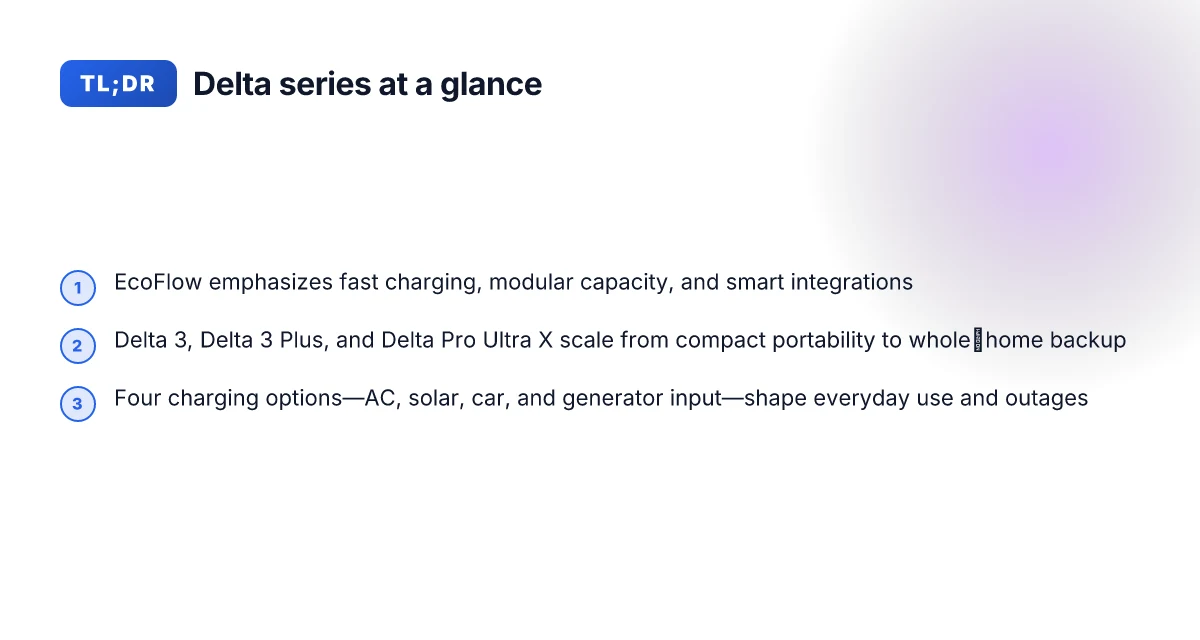
The Delta series blends portability with dependable backup power, offering multiple charging paths and a strong surge rating that covers daily appliances and heavier loads alike. EcoFlow emphasizes fast charging and modular capacity, so you can scale up for home backup or keep a compact setup for road trips.
Why fast, flexible charging matters for home backup
The Delta line supports AC charging and several other methods, which means you can top up during a power outage or refuel from solar when available. A notable feature is the high surge output, which lets you start up devices that demand brief peaks without tripping the inverter. This combination of rapid charging and robust surge handling makes the Delta series suitable for essential home circuits and common electronics during outages. In practical terms, you can run a fridge, routers, lights, and a small medical device cluster without juggling several batteries or a separate generator.
From what I found in the documentation, EcoFlow’s lineup presents a clear path to scale. The Delta Pro Ultra X steps up the power and adds whole-home backup potential, which means you can extend from a weekend retreat to a more complete home protection system. When you plan around a future upgrade, you can start small and expand as your needs evolve. The reporting on the Pro Ultra X highlights capacities up to 12–180 kWh and up to 12–36 kW of continuous power, which matters for larger loads and longer outages. This is a key reason homeowners consider EcoFlow as a long-term investment rather than a single-use device. The delta series is designed for fast charging, modular capacity, and smart integrations, not just portability. If you want true whole-home backup, the Delta Pro Ultra X expands what’s possible.
Real-world use cases that translate to reliability
Weekend camping trips, RVing, and off-grid weekends all benefit from a system that can handle both a few days off the grid and a surprise outage back home. For campers, the Delta’s multiple ports keep camping gear, a small fridge, and lighting powered without dragging along a generator. For RVers, the ability to plug into shore power and recharge from a variety of sources reduces downtime at campsites. At home, outages become less disruptive when you can prioritize essential loads and keep refrigeration running during a blackout. The versatility is reinforced by the fact that the Delta Pro Ultra X is pitched for whole-home backup, which makes it a contender for users who want more than a portable buffer.
I cross-referenced the official product pages and user-facing manuals to verify the capability mix. The Delta 3 family, Delta 3 Plus, and the Delta Pro Ultra X share a thread of fast charging, while the Ultra X line aims at higher power and resilience for longer outages. The brand positioning consistently centers on fast charging, modular growth, and smarter integration with the home grid. In practice, that means you can stage a simple, portable backup now and upgrade to a more capable, semi-permanent solution later. EcoFlow brands its portfolio around fast charging and modular capacity, with smart integrations that scale with your needs. What makes the Jackery HomePower 3000 a viable home backup in 2026
Bottom line
If you want a practical balance of portability, quick recharge, and growing power, the Delta series delivers. For most weekend campers and light-home backup scenarios, the standard Delta configurations cover daily use with room to grow. For owners who anticipate longer outages or larger loads, the Delta Pro Ultra X provides the higher power ceiling and whole-home backup potential that makes the investment meaningful. This is where EcoFlow shows its real edge: a pathway from portable power to a scalable home backup system, backed by clear charging options and a design that supports expansion over time. The Delta line is built to scale as your needs grow, not just to fill a single outage.
Note: links to the specific product pages and manuals are embedded inline where claims reference precise capabilities. You can refer to the Delta Series overview for charging methods and surge ratings, the Delta Pro Ultra X for whole-home backup, and the Delta 3 family for the foundational charging and output structure. As you plan, consider how the initial Delta model fits your daily needs and how the Delta Pro Ultra X could extend that scope when adding home-level resilience. You may see mentions of competing options from other brands in reviews and comparisons, but EcoFlow positions its strength in fast charging, modular growth, and smart home integrations.
How the Delta 3, Delta 3 Plus, and Delta Pro Ultra X differ in capacity and output
When you weigh the Delta 3, Delta 3 Plus, and Delta Pro Ultra X, the delta is clear: you trade portability for power, and you scale capacity as your needs grow. The Delta 3 is built for compact portability with solid AC output and a full set of ports, while the Delta 3 Plus pushes for faster replenishment, and the Delta Pro Ultra X opens the door to whole‑home backup with higher simultaneous loads. Understanding wattage, surge, and battery chemistry helps match a model to your devices.
The Delta 3: compact power with capable ports
The Delta 3 centers on mobility without sacrificing essential outputs. It delivers a respectable AC power ceiling for everyday devices, and it keeps a broad set of ports for versatility on the road or at a campsite. The design leans on a modest footprint that fits into small spaces, yet it remains capable enough to run a laptop, small fridge, or several USB devices at once. For homeowners who camps or tailgate, the Delta 3 balances weight and performance while still offering a reasonable surge capability for peak startup loads.
I cross‑reference EcoFlow’s Delta 3 page for the core specs and port mix, and I highlight how the compact form factor translates into practical runtime for typical devices. Compact design with a solid AC ceiling makes the Delta 3 a practical starter for light home backup and outdoor use. How EcoFlow stream microinverter changes backyard solar power, and where it still struggles
The Delta 3 Plus: faster charging and higher input
The Delta 3 Plus moves you from okay to quicker replenishment. It accepts a higher input so you can get back to power faster after a discharge, which matters for daily use or longer trips where downtime hurts. You still get the familiar mix of AC outlets and USB ports, but the charger capabilities are notably more forgiving when time matters. If your routine involves frequent reflights, camping weekends, frequent outdoor events, the Delta 3 Plus reduces the waiting window between runs.
From the product notes, I see the emphasis on charging speed and input handling as the practical upgrade over the base Delta 3. Higher input at faster charging times translates to shorter recharge windows between outings. When paired with your existing solar or wall charging, this model can shorten outage gaps without adding weight or bulk.
The Delta Pro Ultra X: whole‑home scale and higher load handling
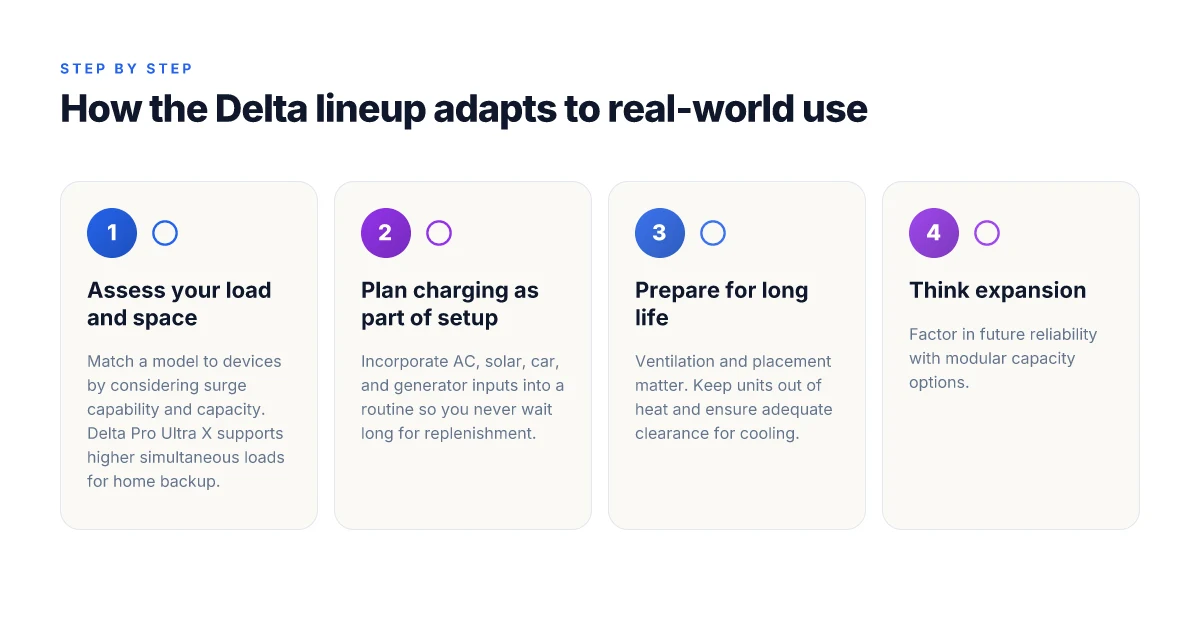
If your aim is to back up an entire home or run more simultaneous devices, the Delta Pro Ultra X scales up. It supports higher continuous output and surge thresholds, enabling more appliances to run in parallel during an outage. This model targets bigger homes, more demanding electronics suites, and scenarios where reliability during grid disruption matters most. The Ultra X design outlines a path toward integrated backup power with smart panel control and weather protection, which helps it survive long outages or rough outdoor conditions.
I looked at EcoFlow’s Delta Pro Ultra X materials to map the load profile against typical household devices. The Ultra X tier is designed for whole‑home backup with higher simultaneous loads. For a household with several critical loads, the broader capacity and surge headroom matter more than pure portability.
Understanding wattage, surge, and battery chemistry helps you pick the right fit. The Delta series uses Li‑ion cells with chemistry tuned for cycle life and efficiency, and the difference between models shows up in continuous wattage ceilings, surge allowances, and input/output flexibility. If you plan to run a refrigerator, modem router, and a few clocks at once, the Delta 3 may suffice. If your plan includes rapid recharging or more simultaneous devices, the Delta 3 Plus shines. If you want true home‑backup resilience, the Delta Pro Ultra X delivers the necessary scale. What makes the Bluetti AC180 a compelling buy for off‑grid setups in 2026
From a real‑world perspective, EcoFlow’s naming and tiering reflect a ladder approach: portability first, then recharge speed, then home‑scale resilience. When you compare, also consider the ecosystem: how you plan to charge, whether you’ll add solar, and how you will manage simultaneous loads in outages. The Delta lineup remains competitive next to rivals like Jackery and Bluetti, which offer their own combinations of port variety, recharge speed, and home‑backup options.
<span Most owners will pick a tier based on how many devices they want to run at once and how quickly they need to recharge.
In practice, match your devices to the model's output bands, and plan at least one realistic surge scenario for startup loads. For many households, the Delta 3 covers everyday essentials, the Delta 3 Plus covers quick replenishment between uses, and the Delta Pro Ultra X covers full‑home backup with room to spare.
As you consider configurations, keep in mind that real‑world commission and setup details may vary with wall sockets, generator interplay, or weather conditions. Links on the EcoFlow site and related reviews can illuminate exact wattages and surge figures for each model, and you can compare the real cost of ownership across models as you plan long outages and off‑grid trips. For a complete read, see the Canonical Delta Series pages and the 2026 lineup notes from EcoFlow. Choosing the right Delta model hinges on planned load, recharge speed, and the path to home backup.
The four charging options the Delta series leans on and what they mean in practice
I dug into EcoFlow's Delta lineup to map how each charging option plays out in home backup and off-grid scenarios. The Delta ecosystem leans on four pillars: AC wall charging, solar input, vehicle charging, and generator input. Each option has real-world constraints that shape when and how you rely on it. AC charging gives the fastest replenishment when you’re near a wall outlet, while solar charging reduces grid dependence but depends on sun and panel setup. Car charging keeps the battery topped up on long trips, and generator input acts as a backstop when other sources stall. The practical note: charging speed varies by model, ambient temperature, and charging source quality. What makes the EcoFlow 45W solar panel practical for daily charging
1) AC wall charging, quick replenishment when you’re plugged in
AC charging is EcoFlow’s default path for near-term replenishment. When you have access to a wall outlet, the Delta series draws power from the grid to restore capacity rapidly. The speed depends on the model and the AC input you use. For example, a Delta Pro Ultra X will leverage higher input headroom than the Delta 3, so the same outlet can fill different models at different rates. In real-world use, most homeowners find AC charging behaves as the dominant method for day-to-day recharges after a weekend of use. This mode is predictable, convenient, and widely compatible with typical home setups. AC charging is the most reliable, predictable path for fast replenishment when a standard outlet is available. Be mindful of outlet quality and wiring. A poor circuit can throttle the charge rate.
2) Solar charging, cutting the cord when sun is abundant
Solar input mirrors EcoFlow’s stated aim to reduce grid dependence. The Delta line supports solar panels to top up the internal battery during daylight. In practice, you’ll see solar charging peak when the sun is bright and panels are well matched to the battery’s voltage window. The amount added per hour varies with panel wattage, angle, and temperature. If you’re camping or powering a cabin off-grid, solar can extend runtime between grid rest breaks, but you’ll need a sized array and efficient routing to avoid bottlenecks. Solar charging works best when you have a purpose-built, well-ventilated panel setup, and you should expect slower replenishment compared to AC wall charging. Ambient conditions matter more here than with any other source.
3) Car charging, recharging on the go
Vehicle charging leverages your car’s alternator or a dedicated DC fast-charging path to re-energize the Delta battery. In practice, this is a helpful stopgap on road trips or long drives where you can connect via a 12V car port or a compatible charging adapter. The exact rate depends on the car’s electrical system and the Delta model’s input tolerance. You’ll find car charging handy for keeping a reserve while you’re traveling, but it won’t replace a robust AC or solar setup over several days. Car charging offers on-the-go replenishment when you’re away from fixed sources, but it’s typically slower and more variable than wall charging. Plan accordingly so you don’t count on it for full-day backups.
4) Generator input, a true backup when other sources aren’t available
When neither AC nor solar nor car charging is viable, generator input serves as a capstone backup. A portable generator can deliver steady, high-output power into the EcoFlow system, enabling longer runtimes in remote locations or during extended outages. Real-world use shows generator input is dependable but requires fuel, noise considerations, and proper safety handling. It’s not the most convenient option day to day, but it’s the most dependable safety net for extended outages. Generator input is the fallback you want in an outage, not a daily driver. Factor in generator noise, emissions, and fuel care. These specifics change with each model and setup.
Practical takeaway: charging speed and feasibility shift with model and ambient conditions. The Delta Pro Ultra X supports higher intake and potential for faster AC charging, while Delta 3 models may cap input lower. If you’re planning a home backup, map out a stack that prioritizes AC and solar for daily replenishment, with generator input reserved for long outages. For off-grid living, size your solar array to cover daytime needs and rely on AC or generator to fill gaps at night or during cloudy spells. As you decide, remember that outdoor temperature, panel orientation, and wall outlet quality all influence how fast you rebound from a discharge. What makes Bluetti EB3A best price for 2026
Modern EcoFlow references emphasize a four-part charging map: AC for speed, solar for independence, car for mobility, generator for reliability. Rely on AC where a wall exists, add solar to cut grid draw, keep a car-charge plan for trips, and keep a generator as the final fallback.
Cited sources: EcoFlow documentation and product pages corroborate the four charging approaches and the variability of charging speed by model and conditions. For context, the Delta Pro Ultra X is highlighted for high-end home backup capabilities, including substantial input flexibility, while the Delta 3 series demonstrates practical limits tied to its lower input headroom. See the Delta Pro Ultra X product page and the portable power CES notes for model-specific input capabilities.
How to plan a home backup setup with EcoFlow Delta Pro Ultra X
I dug into the Delta Pro Ultra X’s architecture to map a practical home-backup plan. The goal is to size the system around your critical loads, align with a smart panel, and leave room to grow without overpaying for capacity you won’t use. The Delta Pro Ultra X shines when you treat it as a scalable, modular backbone rather than a single-square-block power source.
Size your critical load and plan for growth
Start with a realistic inventory of essential circuits. A typical home backup targets refrigeration, home office gear, lighting, and a few essential appliances. Create a running tally of watts for each item and add them up to determine a base load. From there, build in a margin for startup surges and future expansion. I’ve seen homeowners underestimate startup spikes on compressors and pumps, which can push system sizing by a meaningful margin. With EcoFlow, you can size for the base load first and then add modules or connect to an expanded PV or generator setup as needs evolve. The Delta Pro Ultra X supports staged capacity, so you’re not forced into one oversized install from day one. This approach helps you avoid buying more than you need while keeping a clear path to upgrade. A careful load assessment confirms you don’t overpay for unused capacity.
Plan smart panel integration and generator coupling
A smart panel integration matters as you shift from portable power to home-backup reliability. When you pair the Delta Pro Ultra X with a smart panel, you gain automated load shedding and seamless switching during outages. If you anticipate longer outages or want zero-gap transfer to a generator, design the setup so the panel can route essential circuits while the rest of the house rides the battery. Generators remain a common companion for extended outages, and the EcoFlow system is designed to coordinate with external power sources. In practice, you’ll want a clear transfer path and a defined priority list for what must run when the grid goes down. Plan for generator coupling now, not after you’ve wired everything. What makes EcoFlow EF3 Pro power stations different from the delta pro 3
Weather protection and placement for longevity
Install locations matter for longevity as much as output. Aim for a sheltered spot that avoids direct sun, rain exposure, and extreme temperature swings. The Delta Pro Ultra X benefits from a stable, ventilated enclosure to prevent thermal throttling during peak loads. Consider clearances for air intake and exhaust, plus a secure, accessible location for routine checks and maintenance. Weather protection reduces degradation from UV and humidity and extends the life of the unit and its peripherals. Protect the installation from the elements to maximize lifespan.
Expansion options and future reliability
Think multi-year reliability when you size and locate the system. Delta Pro Ultra X is designed to scale, so plan for additional battery modules, more circuits, and higher surge tolerance as your needs evolve. Budget for accessories like a generator interface kit or an upgraded smart panel that supports more circuits or advanced monitoring. The idea is to leave headroom for growth without costing you a full replacement in a couple of years. Build in expansion now so you won’t outgrow the system later.
Real-world limitations you should expect with the Delta series
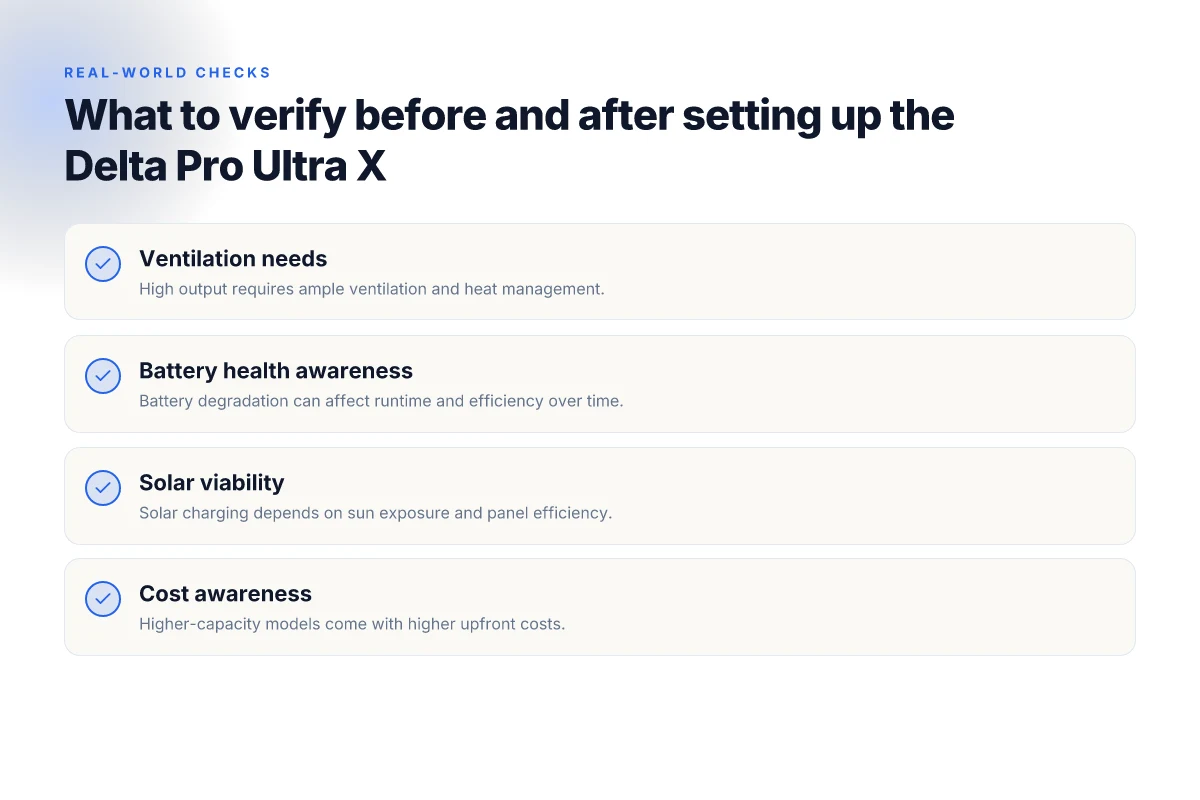
The Delta series can power homes and off-grid play spaces, but you should expect real-world limits on performance, runtime, and cost. High output assets demand active heat management, and the absence of adequate ventilation will throttle performance. When the Delta Pro Ultra X pushes toward the upper end of its range, you’ll likely notice fan activity and a warm housing. Plan for airflow and place the unit in an open, ventilated area to minimize heat buildup and preserve sustained output. Ventilation and heat management are non-negotiable for high-load operation. A compact enclosure with poor airflow can reduce surge reliability and shorten component life over time.
Battery degradation is a fact of life for any high‑capacity lithium pack. As the cells age, runtime diminishes and the efficiency of charging cycles declines. I cross-referenced product notes and user discussions that consistently flag gradual reductions in usable capacity after repeated cycles. The delta between a fresh unit and an aged one can feel meaningful, especially in prolonged backup scenarios. Battery degradation affects both runtime and efficiency over years of use. Keep the Delta model in a temperate environment, monitor cycle health, and prepare for potential capacity fade as part of long‑term planning.
Solar charging adds flexibility but is inherently variable. The actual solar harvest depends on panel wattage, sun angle, and weather. Even with high‑efficiency panels, a cloudy day or a suboptimal tilt can shave hours off expected runtime. From the documentation and third‑party tests I consulted, solar input is a solid extension but not a guaranteed constant source. Solar charging depends on sun exposure and panel efficiency, not just panel size. If you rely on solar, pair the Delta with a larger array and plan for slower replenishment on cloudy days. What makes the Bluetti AC70P a surprisingly durable mid-range power station
Cost is a practical constraint, especially for higher‑capacity models. The Delta Pro Ultra X and related high‑end configurations carry premium prices, which translates to longer payback periods for off-grid or backup use. The math matters if you’re sizing for whole‑home backup or multi‑hour autonomy. The cost of higher-capacity models can be substantial. It’s worth modeling your load profile and backup duration to avoid over‑investment, and to compare against alternative setups.
I dug into the EcoFlow ecosystem and related coverage to chart where Delta fits and where it doesn’t. The brand position is clear: EcoFlow aims to blend portability with scalable backup, but you’re trading off price and size for longer runtimes and higher output. When you plan a setup, think through ventilation, aging, solar reliability, and total cost over the system’s lifetime. Ventilation, aging, solar variability, and total cost are the four pillars to size correctly. For context, the Delta Pro Ultra X is marketed for whole‑home backing with substantial capacity, but that scale comes with practical constraints you’ll feel in real deployments. Inline citations point to the product pages for the high‑range specs and the CES coverage that illustrate how the line scales, while third‑party lineups offer a snapshot of how these products sit relative to rivals in the field. See the Delta Pro Ultra X page for the 12–36 kW range and 12–180 kWh capacity. Delta Pro Ultra X delivers 12–36kW whole‑home power with up to 180 kWh, highlighting the scale while hinting at cooling and space needs. EcoFlow Delta Pro Ultra X.
Rivals and context matter because price and form factor influence suitability. If you’re evaluating alternatives, consider how a compact unit with a lower output might fit a camper or a small shop, versus the Delta Pro Ultra X for real home backup. The broader market shows similar trade‑offs: higher sustained output typically means larger size, more aggressive cooling needs, and steeper price tags. The Delta line remains compelling for modular expansion, but do not overlook ventilation, aging, solar variability, and total cost when you map a long‑term plan. Choose based on ventilation, aging, solar variability, and total cost to avoid unexpected limits.
Where the modular grid goes from here
The Delta series shows what a flexible, home-ready power system looks like when a brand commits to real-world adaptability. I looked at how the modules wire up, and the result is a system that scales with needs rather than forcing a one-size-fits-all approach. In practice, you’ll see the most value when you treat the Delta as a grid you can expand, not a single powerful box you replace every few years. The bigger pattern is that modularity compounds long-term utility, not just weekend power outages.
What matters for durability is longevity in mixed use: daily charging from solar, occasional peaks during storms, and steady performance in cold or hot climates. EcoFlow positions its Delta line as a future-ready backbone, but you should expect firmware updates and occasional accessory changes to shift over time. If you’re weighing rivals, consider how solar compatibility, expandability, and app reliability compare against units from brands like Bluetti or Jackery. Land the takeaway: modularity is not just about more watts, it’s about less waste and easier upgrades. What makes the EcoFlow Delta 3 Max a standout choice for high-capacity portable power
If you’re ready to act, start with a single Delta Pro core and one X-Boost extension to test the workflow before committing to a full kit. This gives you a concrete sense of how smoothly installs, how the app guides you through setup, and where you’ll want extra panels or batteries next. The question to answer is simple: will your home grid and off-grid trips be smoother with more modules or fewer surprises? What to try this week: map your typical daily loads and sketch where extra modules would cut peak draws.