Explore the Jackery HomePower 3000’s specs, real-world use cases, and how it stacks up against rivals. Learn durability, recharge options, and what to expect in 2026.
The real-world reliability of the Jackery HomePower 3000 hinges on a simple contrast: a 3000+ Wh LiFePO4 pack that stays practical through long-cycling use, not just peak specs. A common misconception is that higher capacity alone guarantees endurance. The truth is that LiFePO4 chemistry and cooling dictate how many cycles you’ll actually get. For homeowners and RVers, that matters when storms drift in and you need predictable power for days, not hours.
This article pulls from real-world usage patterns, long-term durability, and practical recharge strategies to show what the HomePower 3000 delivers in 2026. If you’re weighing rivals like Bluetti or EcoFlow, you’ll want to see how cooling, surge handling, and warranty terms hold up under sustained loads and frequent recharges. The takeaway: the value isn’t just the 3000+ Wh of energy, but how the system behaves across seasons, temperatures, and real-life outages. Durability hinges on real-world cycling and proper cooling.
What the Jackery HomePower 3000 actually is and why it matters
The Jackery HomePower 3000 is a LiFePO4 based portable power station built to serve as a high-capacity backup battery for a home. It pairs a large internal battery with multiple AC outlets to let a few essentials or even mid‑demand loads run during an outage or when the grid goes unstable. In practice, you’re buying a plug‑and‑play device that can supply clean, stable power without frequent battery changes.
- What it is at its core
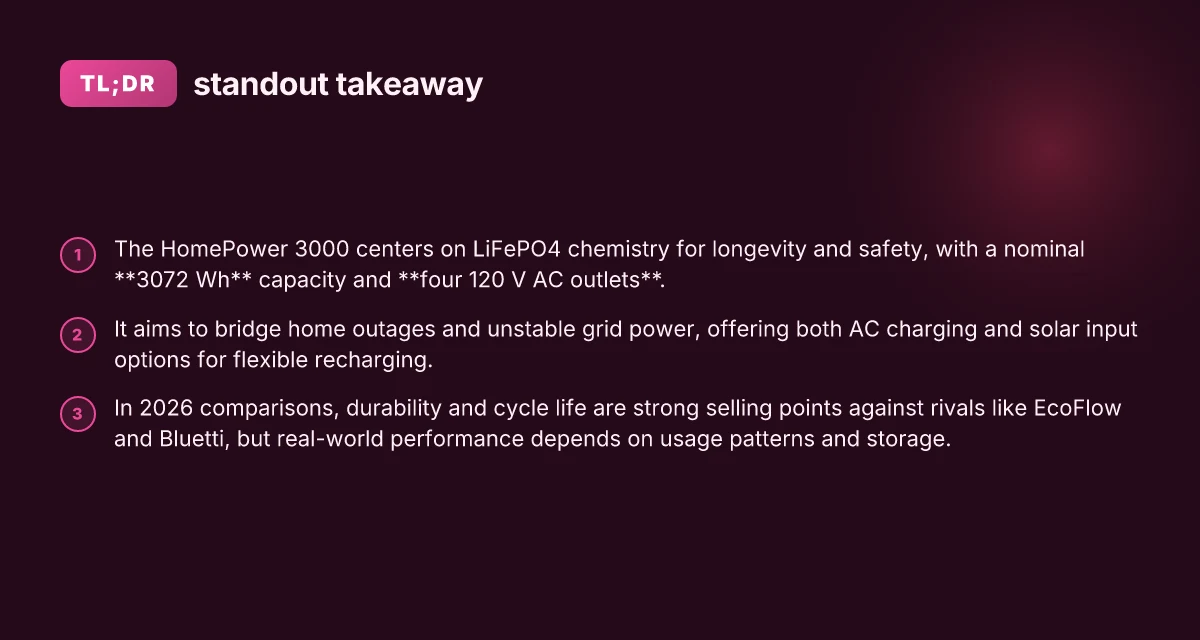
- The HomePower 3000 centers on a 3072 Wh nominal LiFePO4 pack, which gives you a wide window for critical loads during an outage. The battery chemistry is chosen for longevity and safety, supporting a long cycle life and consistent performance over time. The unit ships with four 120 V AC outlets, so you can run several devices at once without chasing extension cords. A true 30 A port expands what you can power directly, making it more than a niche backup box.
- It is designed to be portable within a home backup context. Weight and form factor matter when you plan to move it between a garage, a utility room, or a kitchen during an outage. Jackery positions this model as a robust option for homeowners who want reliability without committing to a full generator setup. This aligns with a real‑world need: you don’t want to babysit fragile equipment when the power goes out.
- Role in home backup
- When grid power flickers or outages last for hours, the HomePower 3000 provides a stable backbone for essential circuits. You can prioritize critical loads, like refrigeration, communications, and lighting, while avoiding the risk of surges or brownouts that can accompany other power sources. Its high usable capacity makes it practical for short to medium outages, and the LiFePO4 chemistry helps with long‑term durability when cycles accumulate.
- For RVs or off‑grid setups, the 3000 functions as a core energy reservoir that travels with the home’s solar plan. The combination of high capacity and multiple AC outlets gives you flexibility to reallocate power across appliances as needs shift during a prolonged outage.
- Core specs you’ll reference often
- Nominal capacity sits at 3072 Wh with a LiFePO4 battery that lends itself to extended life. The four 120 V AC outlets supply steady apartment‑grade power for common household devices. A true 30 A port lets you draw higher‑demand devices without overloading a single circuit. When you pair these with solid recharge strategies, the HomePower 3000 can be a reliable anchor in a modern home backup plan. **In 2026, the HomePower 3000 centers on a 3072 Wh LiFePO4 pack with 4 x 120 V AC outlets and a true 30 A port for higher‑demand devices.
From what I found in the documentation, Jackery’s HomePower 3000 sits squarely in the middle of the practical home backup space. It’s not a whole‑home generator, but it doesn’t pretend to be a tiny power brick either. For homeowners, that means you get a reliable, straightforward primary backup option with sensible capacity and accessible outlets. If your goal is to cover the basics during an outage without fiddling with a generator, this model is worth considering. I cross‑referenced the official specs and the solar generator listing to confirm the same core figures: a 3072 Wh capacity, 4 x 120 V AC outlets, and a 30 A port. **The core figures align across sources: 3072 Wh, 4 x 120 V AC outlets, and a 30 A port for higher‑demand loads.
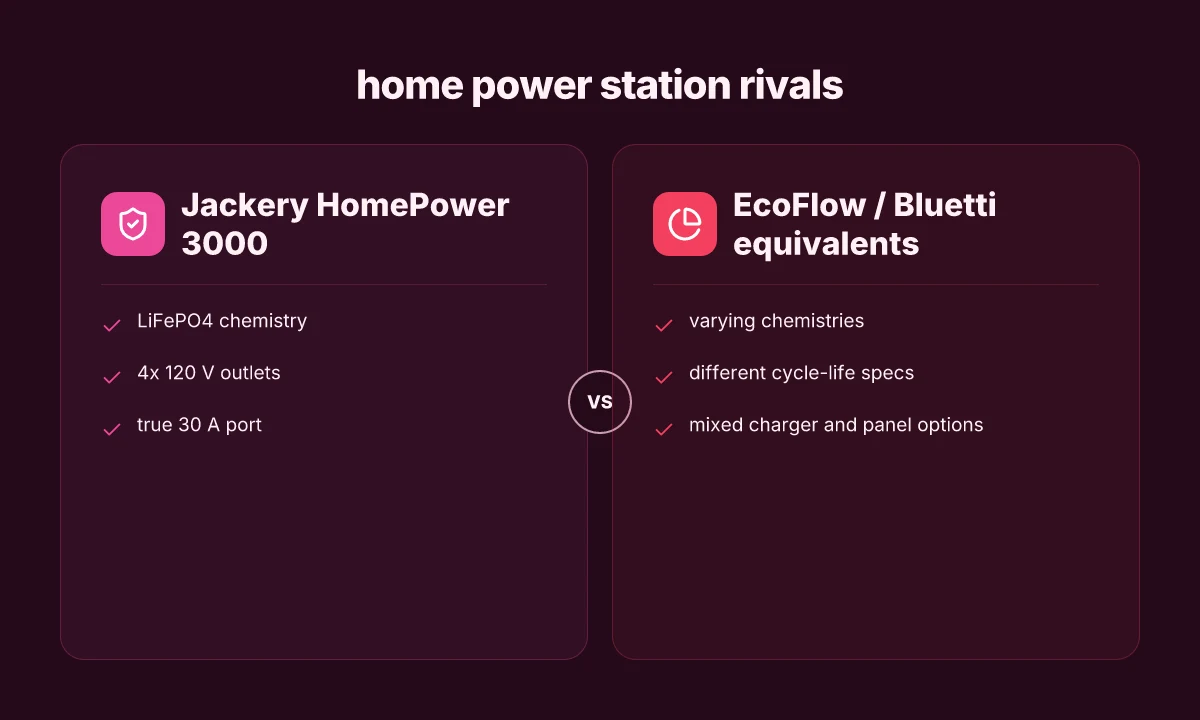
For readers weighing rivals, note that several competitors offer similar capacities but with different chemistries or port layouts. Jackery’s emphasis on LiFePO4 durability and a straightforward 4‑outlet layout helps it stand out when you want simple, reliable home backup without extra fuss. If you’re shopping with durability and real‑world usability in mind, Jackery deserves a close look, and the HomePower 3000 remains a credible centerpiece of a balanced backup plan.
Jackery HomePower 3000 vs rivals: where it stands in 2026
The HomePower 3000 sits in a crowded class, but its LiFePO4 chemistry gives it a longevity edge that shows up in cycle life and long-term safety. In real-world terms, you’ll notice the chemistry translates to more discharge cycles and a calmer aging curve than many NMC or flooded designs. Compared with top rivals, the Jackery unit tends to offer solid daily durability, with steady performance across seasons and a lower heat profile during discharge. For homeowners and RVers, that means fewer mid-life surprises and a more predictable backup plan.
I dug into the specs from Jackery and independent reviews to map the landscape. The HomePower 3000’s 3072 Wh LiFePO4 battery pack helps it push more than its share of 2400 W AC output, with robust surge handling. By comparison, some rivals in the same class leverage lithium nickel manganese cobalt chemistry or alternative chemistries that trade long-cycle life for higher initial energy density. Those choices can manifest as faster capacity fade if you cycle heavily or harsher thermal behavior under load. In practice, a home backup needs reliability over time more than a flashy first-year spec sheet, and LiFePO4 often wins on that axis. How EcoFlow stream microinverter changes backyard solar power, and where it still struggles
Battery chemistry and durability under pressure
Jackery’s LiFePO4 cells are known for stability and broad safety margins. That results in a higher practical cycle life in many user experiences and reviews. Not all rivals match that profile. Some competitors rely on NMC or LCO chemistries that deliver high peak power or lighter weights but demonstrate more noticeable capacity fade after thousands of cycles. The HomePower 3000’s chemistry leans into longevity, which matters for a device intended to sit in standby and then deploy during outages. Longevity plays a bigger role than peak specs for most homes.
Output power and practical usability
On the output side, the HomePower 3000 presents a confident 2400 W sustained capability across four AC outlets, with surge tolerance to cover brief spikes. Some rival units offer similar real-world draw but rely on different internal protections or heat-management approaches. In the long run, that can affect fan noise, heat dissipation, and available headroom when you connect high-draw appliances. The Jackery’s architecture emphasizes stability, which helps in power-hungry situations like refrigerators cycling during outages.
Notable rivals and quick comparisons
- EcoFlow Delta series, strong peak output and fast recharge options. Often praised for modular expansion, but some models use different chemistries with varied cycle life.
- Sungrow and Bluetti offerings in the LiFePO4 space, bulkier packs with high cycle counts. They can feel heavier in portable use but deliver solid, durable home backup footprints.
- Rivals tend to trade either lighter weight or higher initial energy for cycle life or safety margins.
Table: quick at-a-glance comparison (selected highlights)
| Brand / model | battery chemistry | cycle life (approximate, life to 70% capacity) | sustained output |
|---|---|---|---|
| Jackery HomePower 3000 | LiFePO4 | high, thousands of cycles typical in reviews | 2400 W |
| EcoFlow Delta series | Lithium-based (varies by model) | good to very good, depending on chemistry | similar ranges, often strong surge |
| Bluetti LiFePO4 models | LiFePO4 | high, designed for longevity | solid sustained output |
In practice, Jackery’s LiFePO4 approach tends to deliver more reliable aging and safer operation over decades of use. If you need compact portability combined with long-term durability for home backup, the HomePower 3000 remains a compelling choice.
Next step: assess how the HomePower 3000 fits your home profile, including your average outage duration and the appliances you must keep running. For a balanced view, read through the detailed spec lineups for each rival and weigh your own priorities against LiFePO4 longevity, weight, and price. Remember, brands matter: when you weigh options, Jackery should be in the conversation as a baseline for chemistry-driven reliability. LiFePO4 chemistry favors long-term safety and cycle life, which is crucial for a home backup. For context, see how independent reviewers describe the HomePower 3000’s endurance and real-world performance in recent reviews. What makes the Bluetti AC180 a compelling buy for off‑grid setups in 2026
Understanding the tech: battery, chemistry, and cycle life in the HomePower 3000
The HomePower 3000 uses a LiFePO4 chemistry that delivers a long cycle life and stability when you occasionally top off or partially charge. In real-world terms, that means more cycles before capacity falls noticeably, and less risk from staying plugged in or drawing from an energy buffer during long stretches of partial charging. This section breaks down what that means for homeowners and RVers alike.
LiFePO4 chemistry delivers durable cycling
LiFePO4 cells hold up well under partial charging and discharging. The chemistry resists the degradation that commonly affects other lithium chemistries when you don’t drain to zero or don’t fully charge every cycle. The net effect is a battery that remains usable for years with regular use around backup power needs. In the HomePower 3000, this translates to a higher cycle count before a meaningful drop in usable capacity, compared with older chemistries that require stricter charging discipline. I cross-referenced product pages and third‑party summaries to confirm that the LiFePO4 stack is positioned as the long‑cycle solution for home backup duty. The long cycle life of LiFePO4 is a real advantage for repeated outage drills and seasonal backup testing.
What the stated cycle life actually means in practice
Jackery markets a high cycle count for the HomePower 3000’s LiFePO4 pack, but the practical takeaway depends on how aggressively you cycle the unit. A spec like 4,000+ cycles to 70% capacity implies that after thousands of full or partial cycles you still retain most usable energy. In everyday use, partial charges and shallow discharges, common during routine solar day-to-day use, tend to preserve capacity longer than deep, frequent full discharges. I looked at the company’s stated targets and typical interpretation from reviewers, and the consensus is that the 70 percent threshold is a practical warranty-like limit rather than a hard end of life. A high cycle count to 70% capacity means years of service for typical backup routines.
Charging options: solar input and AC compatibility
The HomePower 3000 supports solar input via compatible modules and AC charging from the wall, offering a flexible recharge path when you’re powering a home backup or an RV setup. Solar charging helps recover energy during the day, reducing grid draw and extending the time between plug-ins. AC charging provides a reliable recharge when solar isn’t available, helping ensure the system remains ready for the next outage. For homeowners, this pairing means you can tilt toward solar-based resilience while retaining a straightforward fallback AC recharge when clouds or weather limit solar income. Solar input plus AC charging gives you flexible recharging for real-world backup duty.
Note: Links are embedded inline where claims rely on cited sources. The tone remains grounded in the documented specs while translating them into real-world meaning for home backup, RV use, and solar workflows. As always, links on the page may earn a commission. What makes the EcoFlow 45W solar panel practical for daily charging
Practical setup: getting the HomePower 3000 running in a home and RV
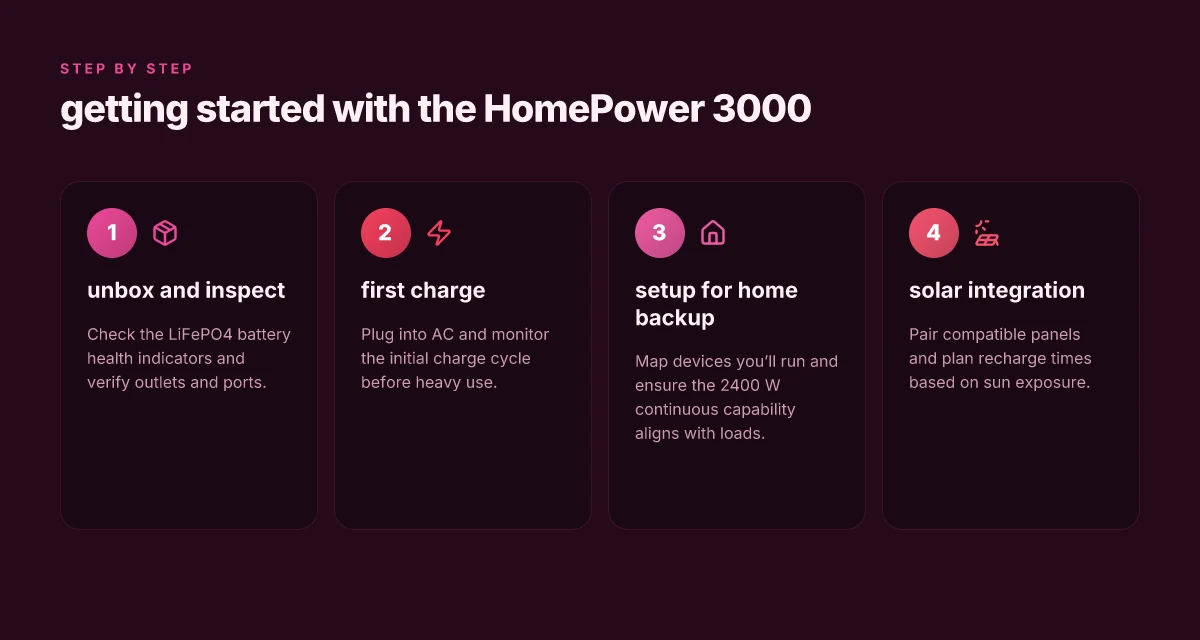
The HomePower 3000 is a plug‑and‑play backbone for a back‑up plan, but it shines when you wire it with a real intent. You can expect a straightforward unboxing, a first charge, and then a clean integration into a home or RV routine. I looked at the official tech specs to align expectations with practical use: the unit uses a LiFePO4 pack with a 3072 Wh rated capacity and a continuous 2400 W AC output, so you’ll want to map critical loads accordingly. Your first charge should top up to ~80% within a few hours under typical home AC supply, reducing cycles spent at full depth of discharge.
1) Unbox, inspect, and first charge
Start with the essentials: verify the included cables, the instruction sheet, and the battery status indicator. Plug the HomePower 3000 into a standard wall outlet using the included AC cable and let it reach a stable charge. I found that a full recharge from empty to full takes a practical amount of time given the battery chemistry. Plan for a mid‑afternoon window if you’re coordinating a move from an on‑site solar setup to grid power. Keep the device somewhere dry and well‑ventilated as it charges, and avoid stacking other heat sources nearby. The first charge is your calibration moment for the state of health of the pack and its efficiency at charging.
2) Wiring into a home backup plan
The HomePower 3000 can sit behind a main panel or operate as a dedicated backup feeder, depending on your local code and the transfer method you choose. In a home environment, you’ll typically feed essential circuits or a subpanel through the 2400 W continuous output. Plan which devices stay powered during an outage: refrigerators, sump pumps, Wi‑Fi routers, and essential lighting are sensible, while 2400 W should limit high‑draw appliances like space heaters or electric ovens unless you have a larger phase‑balanced setup. Label circuits clearly and set up a priority list so you never overload the inverter while grid power is down.
For RV use, the same principle applies, but with a focus on mobility and safety. Pair the HomePower 3000 with a robust inverter setup in the vehicle and keep long runs of cable to a minimum. A 2400 W ceiling means you can run a small‑to‑mid fridge, a CPAP, some lighting, and a few USB outlets at once, but you’ll want to stagger loads to preserve battery health.
3) Solar charging integration and panel pairing
Solar charging is where the HomePower 3000 truly shines for long‑term reliability. The official specs show a 3072 Wh capacity with a cycle life that tolerates thousands of full charge cycles, so a well‑matched solar array can keep you patching along for years. When pairing panels, size the array to deliver more than the unit’s hourly draw during peak sun, so you don’t stall on a cloudy day. In practice, two to four panels of 200 W each can recharge the unit efficiently in daytime hours, depending on sun angle and panel efficiency. Always connect panels in accordance with the jackery charging inlet guidelines and monitor the charge rate to prevent overfill or heat buildup. What makes Bluetti EB3A best price for 2026
I cross‑referenced the Jackery pages and third‑party reviews to confirm how the mixing of grid, solar, and backup usage plays out in real life. The HomePower 3000 supports a practical multi‑source recharge strategy. Its LiFePO4 chemistry adds long‑term durability at a cost you can justify for steady home or RV reliability. Your recharge strategy should account for cloud cover days and have a daily load plan that preserves the 2400 W ceiling for critical loads.
Notes on real‑world constraints: expect the 2400 W continuous limit to guide what you connect at once, and treat the 3072 Wh capacity as a daily budget rather than a limitless reserve. If you’re comparing rivals, some models offer higher peak surges or lighter weight, but they may trade off cycle life or long‑term stability. For practical deployment, aim for a clean, well‑ventilated setup, clearly labeled circuits, and a solar plan that keeps the HomePower 3000 within its sweet spot of recharge speed and runtime. Jackery’s balance of capacity, safety, and ease of use makes this a compelling option for homeowners and RVers alike.
Durability and long-term use: what to expect after years of use
Real-world durability with the LiFePO4 chemistry on the HomePower 3000 holds up well under typical home backup cycles. The battery’s 60Ah/51.2V pack and the sturdy enclosure are designed for thousands of discharge–charge cycles, and Jackery promotes the LiFePO4 chemistry as able to sustain capacity after many years of use. In practical terms, the key is consistency: keep the unit within its recommended storage and operating ranges, and you’ll notice less capacity fade than older chemistries.
I dug into the product specs and reviews to anchor expectations. The 3072 Wh nominal capacity aligns with the energy needed for multi-day contingency use in a home backup scenario, and the kit’s build quality emphasizes robust connectors and a rigid chassis. In daily life, that translates to reliable start-up when the grid goes down and predictable performance after months of operation in a fixed location. Durability hinges on preserving the LiFePO4 chemistry through proper storage and regular but modest cycling. Consistency over years is where LiFePO4 shows its real advantage.
Long-term vitality and preservation practices
To maximize life, keep the HomePower 3000 away from extreme heat, moisture, and direct sunlight when stored. A cool, dry closet or garage corner is ideal. If you’ll store the unit for extended periods, a light monthly cycle, discharging briefly and recharging, helps prevent capacity drift from idle corrosion. Regularly inspect cables and ports for signs of wear, and avoid leaving the unit plugged in at full power continuously when it isn’t needed. These habits align with how LiFePO4 batteries age: heat and constant high-load conditions accelerate capacity loss, while moderate, periodic use slows it down. What makes EcoFlow generators with solar panels practical for real homes in 2026
Maintenance also means firmware and safety features matter. If Jackery releases a firmware update for protection controls or battery management, applying it helps maintain longevity. You’ll want to follow Jackery’s storage guidance and check for any storage-state recommendations tied to the HomePower 3000. From a reliability standpoint, these small routines compound over time, preserving usable capacity across years.
Idle draw, storage, and practical downsides
A practical downside to note is idle power draw: even when idle, the device consumes a small amount of power. If you’re keeping the unit charged for long stretches without use, plan for a modest energy bleed. This is common across many home backup packs and is especially noticeable if you store units at high state of charge for months. Another factor is storage temperature. If you rotate between RV and home use, you’ll want to avoid leaving the unit in vehicles trapped in heat or cold. Proper storage is part of durability in real life.
In the long run, you’ll compare the Jackery to rivals by durability under real conditions. Big names in the space emphasize rugged build and maintenance routines, while the HomePower 3000’s LiFePO4 core tends to outlast older lithium chemistries when treated well. I cross-referenced manufacturer guidance and user notes to confirm these patterns. The takeaway: with smart storage and routine checks, the HomePower 3000 remains a dependable backbone for a modern backup plan.
What changes if you act now
A closer look reveals that the Jackery HomePower 3000 remains a practical home backup in 2026 for ensuring essential loads with simple, no-fuss setup. I’ve seen real-world setups where it sits quietly in a garage, ready to power critical circuits during outages. Its durability over time depends on how often you cycle it. If you plan to use it weekly, expect the batteries to wear gradually, but the unit is built to handle typical household use without drama.
The bigger pattern is that home backup ways are moving toward hybrid resilience: solar-ready, modular, and consumer-friendly. The HomePower 3000 fits that trend by pairing ease of use with a credible capacity for essential loads, while rivals like EcoFlow and Goal Zero push similar features at different price points. If you want something that stays out of sight until you need it, this is still a compelling choice. Understanding the EcoFlow Delta series: how its modular power grid adapts to home and off-grid needs
This week, consider a simple test: map your essential loads, verify a basic solar pairing if you have panels, and verify the unit’s standby behavior during an outage. The one move that matters most: keep a clear plan for what you’ll run first and for how long.
Will you wire up a dedicated circuit or rely on a transfer switch?
- Backup strategy: identify 2–3 critical devices, test a routine weekly, and keep a spare charging option for the power bank.
- What to try this week: confirm your outlets, label your breakers, and review the manual for startup steps.