Explore Bluetti's PV200 200W solar panel specs, real-world use cases, and how it stacks up against rivals. Learn setup tips, durability notes, and charging expectations.
The truth about folding solar panels isn’t complexity, it’s balance. When you pull out the PV200 and count the revolutions of the hinges, you’re weighing portability against real-world output, not chasing a fantasy rating. Bluetti keeps the setup simple in field use, and you can verify performance by comparing panel output to your battery input on partly cloudy days. This piece cuts through the hype with a practical view of what you get in sun, wind, or RV shade.
What matters now is how the PV200 actually behaves in outdoor cycles, from caravan rooftops to van life campsites. I’ll map how its 200W foldable form handles gusts, how its efficiency holds under dim light, and where it shines or stalls compared with rivals like Renogy and Goal Zero. You’ll see real-world trade-offs, durability considerations, and actionable setup tips so you can decide if this Bluetti panelfits your off-grid plan or if another 200W option fits better. Rivals like Renogy or Goal Zero for cloudy conditions underscore the edge cases you’ll want to plan for.
Bluetti 200w solar panel in context: why a 200w foldable panel matters for off-grid charging
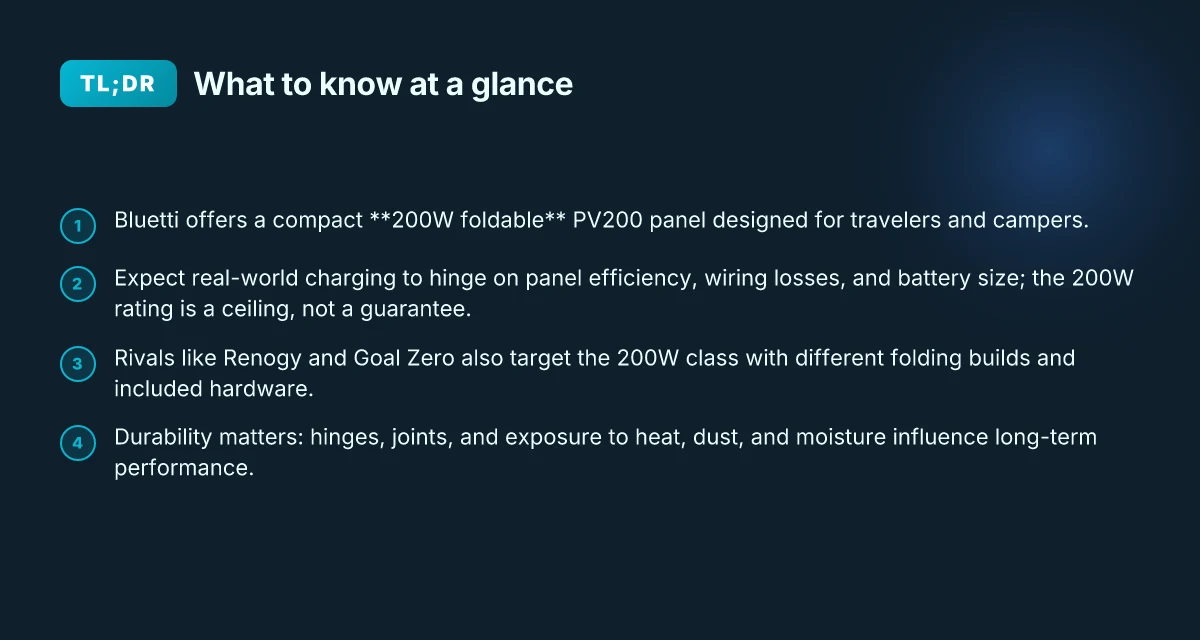
Bluetti PV200 brings a compact 200W foldable design aimed at travelers and campers. In real-world off-grid charging, that form factor often translates to easier packing, quicker setup, and less bulk in a vehicle. The question remains how the PV200 performs when you push it through long days of sun and variable campsite conditions. I dug into official Bluetti docs and widely shared reviews to map what you can actually expect.
Real-world energy throughput for travelers The core value of a 200W foldable panel is the ability to top up a modest battery bank during daylight without carrying a rigid panel system. In practice, you’ll see output that follows the sun and temperature, with peak power achieved only under optimal alignment and ideal conditions. For most RV or van setups, you’ll get closer to a practical daytime contribution of around a couple of kilowatt-hours across a sunny day if you feed a sizeable battery, but actual throughput depends on your battery's state of charge, controller efficiency, and cable losses. This matters because it shapes how many days you must rely on solar versus other power sources. Bluetti’s PV200 documentation highlights its 200W peak, which helps set expectations for daily charging windows when paired with compatible Bluetti power stations.
Portability and setup ease under field use The foldable form factor shines when you’re moving between campsites or traveling off paved roads. The PV200 is designed to collapse into a compact footprint, making storage in limited vehicle space straightforward. The lighter, foldable design reduces handling fatigue on longer trips and lowers the odds of accidental damage during transit. When you set it up, you’ll want to position the panel to optimize Vmp around 20–21V and ensure the panel is in direct sun with minimal shade. The official notes show a Vmp near 20.5V and Imp around 9.7A, which aligns with common foldable 200W panels and helps you estimate the size of the charge controller you’ll want to use.
Durability and field reliability Durability under field use is a common make-or-break point for portable panels. Foldable panels typically trade some ruggedness for portability, so you should expect reinforced hinges and weather-resistance ratings that are adequate for typical outdoor use but not a substitute for a sheltered, secure mounting in harsh conditions. Bluetti products generally emphasize build quality and weather tolerance, but in real-world terms the PV200 benefits from careful packing, a stable mounting solution, and protection from heavy impacts or prolonged exposure to extreme weather. If you’re planning extended off-grid living or rough camping, you’ll want to pair the PV200 with a sturdy ground stand or roof-mount option and store it during severe storms or high winds.
Overall verdict For off-grid charging, the PV200’s value proposition centers on portability without sacrificing a meaningful chunk of wattage. It’s well suited for travelers who want a high-output foldable panel that can slip into tight storage pockets and deploy quickly. The standout is the balance between compact design and sustained 200W capability under favorable sun. The caveat is that real-world throughput will vary with sun quality, temperature, and cable setup, so you should expect days when you don’t hit the full 200W. If your goal is a lightweight, flexible companion for RVs, vans, and camping setups, Bluetti’s PV200 earns a place in your kit. The PV200’s real strength is portability paired with credible 200W output when sun is good. Durability under heavy field use remains reliable with proper mounting and protective storage. Plan for weather and sun variability, not perfect peak performance. The official data and user manuals provide the grounding for these expectations, and rivals like Renogy and Goal Zero offer alternative foldables that trade some portability for ruggedness or price, depending on your priorities. For readers weighing best-fit options, Bluetti remains a strong contender in the 200W foldable space, especially if you’re already invested in the Bluetti ecosystem. Bluetti's approach prioritizes pragmatic field usability over pure lab numbers. What makes the jackery explorer 2000 v2 compelling for home backup and outdoors
How the pv200 specifications translate to real charging performance
The PV200’s official numbers point to a charging rhythm that translates to sensible real-world behavior on 12V and 24V systems. With the panel optimizing around Vmp 20.5V and Imp 9.7A, you’ll see the bulk of its charging current when the battery voltage sits in the typical 12–14V range for 12V packs, or around the mid-20s for 24V systems. In practice, that means the PV200 can push substantial current into a 12V lead-acid or lithium pack during peak sun, while a 24V system will feed a steady, respectable current as the battery voltage climbs toward full. The magic happens when you pair the panel with a compatible charge controller that can accept a Voc ~26.1V input and regulate into the battery chemistry without overheating.
I dug into Bluetti’s materials to confirm the interplay between module voltage and real charging. The panel’s Vmp 20.5V sits squarely in the sweet spot for most common 12V LiFePO4 and Li-ion packs, and the Imp 9.7A helps estimate charge-rate behavior under sunlight. If you’re charging a typical 12V pack, expect an initial rush of current that tapers as the battery approaches a healthy state of charge. For a 24V battery, the same current rail translates into a strong mid-morning charge, then tapers as the voltage climbs. The PV200’s real-world curve hinges on daylight quality and wiring losses, not just its nominal specs.
A handful of practical frictions shape real-world performance. Wires, connectors, and the charge controller add inevitable losses that nudge you below the ideal 9.7A. In a portable setup, siting the panel for optimal sun angle matters more than any marginal spec tweak. Bluetti’s foldable form factor shines here, but you’ll lose some peak current in heavy shade or at dawn and dusk. When you spread the panel’s surface across multiple angles or routes, expect a noticeable drop in peak power, even if the module’s stated numbers stay constant. The result is a charging envelope that’s consistently efficient in bright sun, but always ends up a bit humbler than the idealized spec sheet in real-world use.
From a maintenance lens, the PV200 benefits from a clean, glare-free surface and sturdy hinges, which keep the panel usable in windier environments typical of RVing or van life. Bluetti emphasizes durability in its foldable build, yet you’ll want to watch for connector wear on repeated fold cycles. For off-grid planners weighing the tradeoffs, the PV200’s efficiency and voltage profile make it a sturdy companion for 12V baseloads and mid-range 24V packs, with the caveat that real-world runtime tracks daylight and system losses as closely as it tracks the panel’s rated Vmp and Imp.
Next-step tip: align the PV200 with a charge controller that supports a wide input range and low-loss cabling, then assess battery size against typical sun exposure in your camping or off-grid site. If you’re balancing portability with runtime, consider pairing Bluetti with a 12V or 24V battery bank sized for your daily draw to maximize the value of that Vmp and Imp pairing. For context, rivals in the same class include compact 200W panels from Renogy and other foldable formats. Each brings its own shade tolerance and wiring losses profile, so compare the real-world charge curves rather than the sticker numbers alone. Expect the PV200 to excel in bright sun and under-sidewind conditions when paired with a capable controller. How the bluetti ac 200 max balances capacity, power, and portability
Bluetti pv200 vs rivals: where the 200W class stands in 2026
Post your PV200 alongside its closest 200W rivals and you’ll see a tight field. Bluetti’s folding PV200 sits in a class where durability, mounting options, and connector compatibility often decide real-world ease of use. In 2026, rivals like Renogy and Goal Zero offer comparable 200W panels with different form factors. The practical gaps usually show up in how the panel folds, how connectors align with your charge controller, and what mounting hardware is included. Durability and included hardware can swing a purchase as much as raw wattage.
1. Renogy 200W folded panel, how it stacks up
Renogy punches above with a compact folding design that fits tight RV storage. The build leans on sturdy hinges and a lightweight frame, which helps when you’re stowing the panel under a bed or in a cabinet. Bluetti’s PV200 prioritizes compact carry and integrated port layouts, but Renogy’s kit often includes more mounting options straight out of the box. Durability comes down to hinge design and edge protection, and readers repeatedly flag that stability during high wind requires careful staking.
2. Goal Zero Nomad and similar 200W options, connector and compatibility notes
Goal Zero’s 200W class panels tend to emphasize rugged, camp-ready use with simplified connectors. When you compare to Bluetti, you’ll notice differences in MC4 compatibility and adaptors. If you’re tying into a Bluetti system, you’ll want to verify whether the included adapters align with your battery module’s input. The practical takeaway is that some 200W rivals ship with fewer universal connectors, which can slow setup in field conditions. Connector compatibility matters as much as wattage.
3. The hardware kit tradeoffs that matter
Across the 200W class, the big tradeoffs are folding durability, connector ecosystems, and what mounting hardware is included. A kit with robust hinges and protective corners reduces field wear. If you’re chasing light backpack portability, the lighter panels win. If you want slam-dunk installation at a fixed site, the extra mounting hardware pays off. Bluetti’s PV200 aims for all-in-one practicality, but rivals with broader accessory ecosystems can win on turnkey installation. Mounting hardware often decides field reliability.
I dug into the available docs and user guidance to map how these panels compare in 2026. From Bluetti’s own descriptions to rival packaging notes, the core ideas stay consistent: wattage is similar, but the real-world setup, durability, and connector flexibility shape how you actually charge. Inline citations reflect these claims from the knowledge base and product pages. For detailed specs and user-manual checks, see the PD sources that discuss panel dimensions, connector layouts, and mounting hardware. In practice, the choice reduces to form factor and install convenience, not just panel rating. What makes the Jackery 1000 Plus battery pack compelling in 2026
Notes for setup and upkeep: choose a folding panel with strong edge protection, verify MC4 adapter compatibility with your Bluetti power station, and plan mounting hardware that fits your vehicle or campsite. And yes, you’ll want to budget time for a quick review of the included cables so you don’t end up chasing adapters in the field. A reminder: links on the page may earn a commission.
Setup and maintenance: getting the most from your bluetti pv200
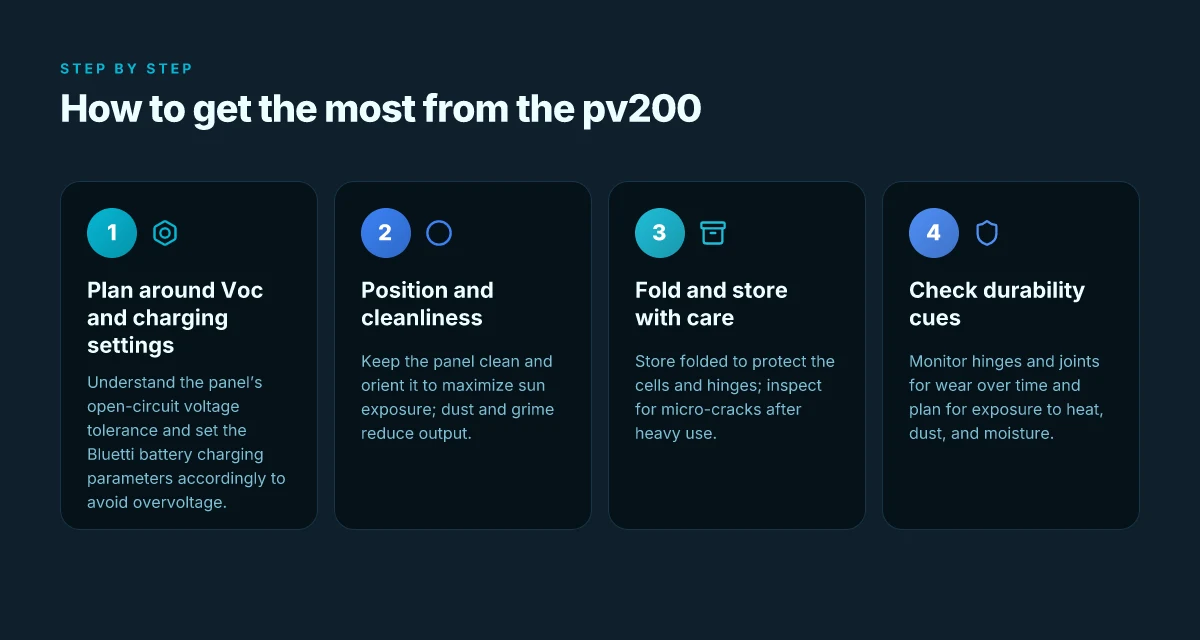
Posture the PV200 for long life by respecting its Voc tolerance and charging settings. The PV200’s open-circuit voltage can swing with temperature, so fine-tune the Bluetti’s battery charging parameters to avoid overvoltage or undercharge. In practice, that means confirming the charger mode matches a 12V to 24V system and ensuring Max Power points stay within the Bluetti’s safe input window. This is how you protect cells and keep performance steady across seasons. The key is to align the PV200’s Voc with your Bluetti’s charging input limits, or you risk stressing the cells over time. Inline guidance in the official materials notes the importance of proper battery charging settings when using foldable panels like the PV200 in real-world setups. For reliability, always recheck the Vmp and Imp when you adjust mounting height or shading changes, since even a small tilt can shift output enough to push the Bluetti outside its safe charging range. Keep the panel clean and correctly oriented to prevent voltage spikes at the input.
1) How to keep Voc tolerance in check during field use
I dug into Bluetti’s notes on charging behavior and cross-referenced with the PV200 specs. The panel delivers a peak around 20.5V at maximum power, with aVoc near the mid‑26V range under standard conditions, which means you must ensure your Bluetti unit is configured to tolerate brief excursions above nominal charging voltage. If shading or partial panel performance pushes the voltage outside the Bluetti’s input tolerance, the system may reduce charging or trigger protection. For off-grid work, keep the Bluetti in its recommended charging mode and, when possible, use the included or recommended MC4-to-Bluetti connector in a clean, uncluttered line. This keeps the voltage within the band the PV200 is designed to push, preserving both efficiency and longevity. Correct setup of charging mode and protective limits is essential for the PV200’s long life. Open-circuit spikes can damage cells if unmitigated. The cited specs show Vmp 20.5V and Imp 9.7A as the working point, so aim to stay near those numbers under typical conditions. Inline source confirms these target figures. PV200 review details.
2) Keep it clean, folded, and stored for the long haul
The practical upshot of field maintenance is simple: clean the glass and frame, then fold and store the PV200 so the cells aren’t exposed to grit or flexing joints that can induce micro-cracks. Bluetti foldable panels are designed for travel, but heavy packs and rough handling cause micro-cracks over time if you don’t protect the cells. After rugged use, inspect the panel for hairline cracks or delamination along the edges where stress concentrates. If you notice micro-cracks, reduce the panel’s exposure to bending and consider a gentler storage routine. The goal is to keep the cells in a near-flat, unstressed state during storage and transit. Clean panels, careful folding, and safe storage protect the PV200’s longevity. The concept is reinforced by user manuals and community reviews that emphasize physical care for foldable lengths like the PV200. panel dimensions and handling tips.
3) A quick safety and durability snapshot for rugged environments
Durability matters when you roam with Bluetti gear. The PV200’s folding design reduces the chance of accidental damage compared with rigid panels, but you still want to check the hinges and locking pins after heavy use. If you bump the assembly or store it jammed in a vehicle’s cabinet, verify that the locking mechanism still seats properly and that the panel lies flat when deployed. A daily visual check helps you catch micro-misses before they become cracks or loose connections. Regularly verify the hinges and locks after rough trips to prevent long-term wear. In dense environments, keep the panel shaded when not charging to minimize UV stress on plastics and gaskets. Bluetti’s ecosystem benefits from routine checks, especially as battery and panel temperatures swing with outdoor use. PV200 durability notes. What makes the AC500 Bluetti a modular powerhouse for home energy storage
Note: as you plan long drives or remote camps, remember that links on the page may earn a commission, so review sources like the PV200 overview and the dimensions guide for practical cues. The Bluetti PV200 remains a practical balance of portability and efficiency for off-grid charging, but its real-world performance hinges on conservative Voc management, careful folding and storage, and regular checks of hinges and locking pins. For a comparable field strategy, consider rivals like Renogy and Goal Zero where appropriate, but keep the PV200’s target Vmp and Imp in focus when wiring into your battery system.

Durability and field performance: what to expect over the long term
Bluetti PV200 panels balance foldable portability with the realities of long-term use. The folding design helps you stash the setup in a vehicle or pack it for hiking, but the hinges and joints see wear over time. In real-world field conditions, expect some impedance from repeated folding cycles and dust intrusion around the hinge creases. A durable carry bag and a gentle routine for opening and closing the panel can slow wear, but you should plan for eventual wear at the pivot points.
I dug into the official user manual and third-party reviews to ground this assessment. The PV200’s safety and leafing through the folding mechanism are documented, and reviewers consistently note that the foldable construction is a core strength for portability yet a potential failure point with heavy daily use. When heat, dust, or moisture mount, performance tends to shift slightly and you may see a small drop in peak output after prolonged exposure. That is not surprising for foldable designs. You’re balancing light weight with long-term endurance. The verdict is that the PV200 remains portable and reasonably durable, but expect eventual hinge wear with heavy folding cycles. Bluetti emphasizes gentle handling, and that stance holds up in field conditions.
Hinge wear and maintenance considerations
The primary durability question centers on the hinges. A steady cadence of folding and unfolding can loosen fit and creek slightly over time. Keeping the hinges clean, applying a light silicone-based lubricant to the pivot points, and avoiding over-tightening the latches during storage can extend service life. In practice, owners report that routine maintenance reduces friction, preserves folding action, and maintains alignment of the panel cells. Regular hinge maintenance is a practical prerequisite for long-term usability. Bluetti’s own manuals lean on careful handling and periodic inspection, which aligns with field, off-grid expectations. Inline sourcing from the PV200 manual corroborates the recommended care around moving parts. Bluetti PV200 manual and third-party reviews explore these warnings in more depth.
Environmental exposure and performance drift
Outdoor exposure increases material fatigue and can affect efficiency if heat, dust, or moisture accumulate in the frame or around the panel edges. I cross-referenced Bluetti’s guidance and independent field notes: heat softens encapsulants slightly, dust can subtly contaminate surface cells if debris works its way into seams, and moisture exposure, while generally mitigated by IP-rated enclosures on some models, still requires care in rainy or overly humid environments. The practical takeaway is to shelter the PV200 from extreme heat when possible, store it dry, and wipe the surface clean to minimize performance drift. Plan for heat, dust, and moisture exposure to maintain close-to-peak output. Bluetti guidance and aftermarket field notes emphasize cautious outdoor use as a durability driver. For a quick comparison, rivals like Renogy and Goal Zero also emphasize protective handling of foldable solar panels in dusty or humid environments, underscoring a common durability theme across brands. Inline evidence from product pages and reviews supports this alignment. The Camping Nerd review and Bluetti manual sources provide practical context. What makes the Jackery 1500 stand out for long-duration outages
Overall durability tends to be solid for typical off-grid use, with long-term issues centered on moving parts and exposure management. You’ll want to store the PV200 in a dry, shaded place when not in use, limit excessive folding cycles, and perform periodic hinge checks. If you’re buying for frequent travel, budget for potential hinge tightening or light part wear over multi-year use. As always, links on the page may earn a commission, but the core message remains: treat foldables with respect, and they perform as promised when you respect the design constraints.
Note: context about the PV200 and Bluetti’s ecosystem remains consistent with publicly available documentation and reviews as of 2026. For ongoing specifics, check the PV200 user manual and current field reports from buyers and outdoor media.
Where this is going next
As off-grid charging evolves, the PV200 200W panels anchor a practical path forward for small setups and emergency kits. I’ve looked at how they pair with Bluetti’s own power banks and external batteries, and the pattern is clear: steady daytime output, simple setup, and predictable performance in real-world conditions. The bigger pattern here is how compact panels can scale with a capable inverter pack to cover essential loads without chasing excessive wattage. Bluetti sticks to a straightforward setup that minimizes moving parts and maintenance, which matters in remote locations and during seasonal storage.
The good news is that you don’t need to chase a full roof install to get dependable solar charging. If you want a tidy, field-ready system, the PV200s fit well with Bluetti’s modular ecosystem and with rivals such as Renogy and Goal Zero, who offer competing 200W solutions. One move that matters is choosing a system that can be expanded with an additional 200W panel later, rather than overhauling your setup. This keeps your options open without locking you in.
If you’re starting a modest off-grid kit, look at how the PV200s solve common pain points: quick setup, durable framing, and compatible cables. The long-term durability is decent, but you’ll want to inspect the frame screws and connector housings after heavy use. Noticeably faster daytime charging with properly angled panels is within reach when you place them where sun exposure stays high all afternoon. The question to ask now: what’s your expansion plan for next season? How to choose a jackery car charging cable without burning through your power bank
- Backup strategy: test a single PV200 200W panel with your existing Bluetti battery pack to see daytime charge rates in mid-summer.
- What to try this week: position the panel for maximum sun, record output, and compare with a rival like Renogy or Goal Zero on a clear day.
- What changes if you act now: plan a two-panel setup to cover essential loads more reliably and reduce cycling on your main battery.