Discover the 7 best solar powered generators for 2026, with real-world performance, reliability, and lifecycle cost considerations. Learn which brands fit your needs.
Think of total cost of ownership as the real headline for 2026. A single misstep on battery cycle life or solar charging curves can double your five-year bill, and most buyers underestimate that hit until after a winter storm. Bluetti and Bluetti-style modular packs shift the math by preserving capacity over time rather than chasing initial speed.
The moment matters: five-year reliability data, not upfront specs, is finally making the purchase decision clearer for outdoor enthusiasts, preppers, van lifers, and homeowners evaluating off-grid power. Expect brands to compete on how long their cells hold charge under real loads, how efficiently inverters run, and how easily users can expand when needs grow. This intro sets up a side-by-side that balances performance with long-run cost, so you can pick with confidence.
Why 2026 is a turning point for solar powered generators
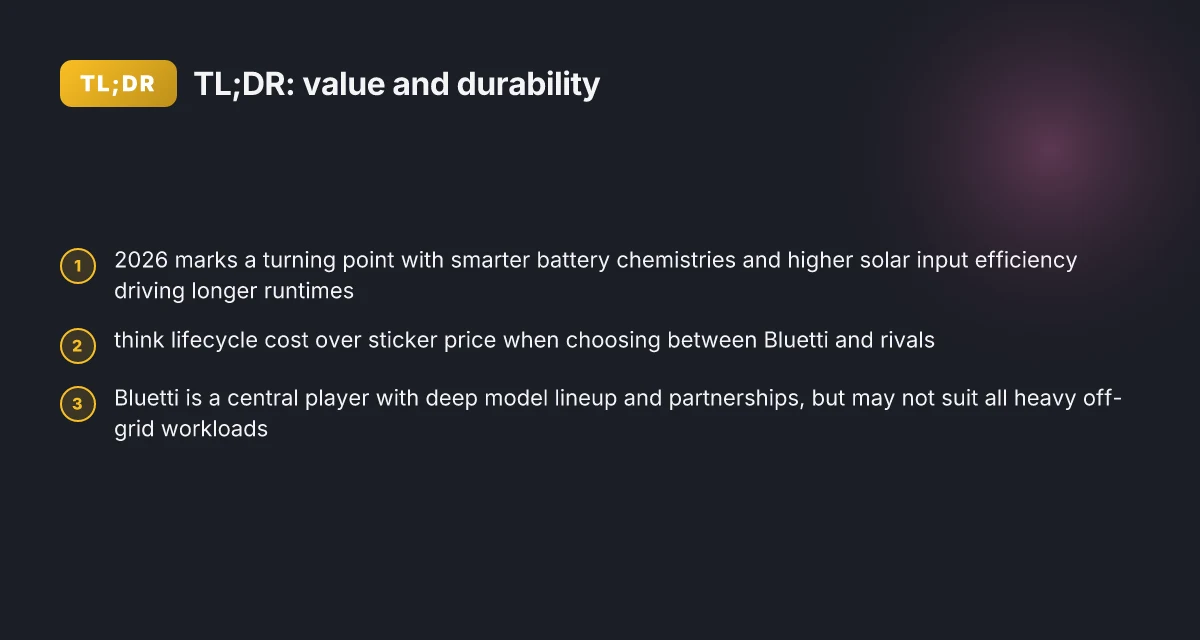
I dug into the data and real-world signals to explain why 2026 marks a shift in how outdoor enthusiasts and homeowners evaluate solar generators. The turning point centers on smarter chemistry, better solar capture, and a cost mindset that looks beyond sticker price.
1) Smarter chemistry extends lifespan
New battery chemistries are delivering longer lifespans at practical cycle counts. Manufacturers have moved toward chemistries that tolerate deeper discharge without eroding capacity as quickly as older packs did. This means you can rely on more total usable energy over the same five-year horizon, which matters for weekend trips or extended outages. In this shift, the chemistry itself acts like a longer leash on your upfront investment. Expect fewer mid-cycle replacements for common models, which lowers total cost of ownership over a five-year window. Longer cycle life and improved thermal stability reduce total replacement events, making 2026 a safer bet for off-grid users.
2) Higher solar input efficiency expands usable runtime
Improvements in both cell efficiency and system design allow more watts to reach the battery from a given panel area. That means even with a compact solar generator, you can harvest more energy on bright days and stretch those runtimes when skies aren’t perfect. The practical effect is fewer days tethered to a wall outlet and more confident weekend trips without compromising devices. Higher solar input efficiency translates to more usable runtime in real-world conditions. When you pair efficient panels with smarter charge management, you get a smoother energy supply across a range of loads. Smarter charge management helps you extract maximum value from sunny days.
3) Lifecycle cost emphasis over sticker price
Buyers increasingly weigh total cost of ownership rather than sticker price alone. 2026 guides emphasize how long a unit will reliably serve, how often it will need component replacements, and how both operation and maintenance costs accrue over years. This shift favors systems with robust thermal design, durable enclosures, and modular components that are easier to repair or upgrade. Lifecycle cost emphasis has shifted the buying calculus from upfront price to long-term value. Industry chatter and user reviews consistently note that the cheapest model up front can end up costing more over five years if it requires early battery replacements or frequent maintenance. Total cost of ownership matters most for frequent travelers and long-term setups.
4) Bluetti and Bluetti's partnerships highlighted
Bluetti remains a central player in the 2026 dialogue, thanks to its ecosystem approach and partnerships with other brands. These alliances broaden accessory compatibility and allow predictable upgrades without abandoning existing systems. For outdoor users who bounce between remote sites and home baseloads, Bluetti's integrations can reduce friction when expanding storage or adding solar input. Bluetti's partnerships broaden compatibility and upgrade paths, lowering total ownership friction. This shows up in real-world plans where users add compatible panels or accessories from partner brands without replacing the core unit. Bluetti ecosystems increasingly deliver practical, future-proof options. What makes the EcoFlow Delta 2 a practical choice for home outages in 2026
From what I found in published guides and market snapshots, 2026 is a year where the story moves from “how much power a unit can store” to “how long it will serve with less hassle.” The best picks will be those that document clear lifecycle advantages, offer resilient integration paths, and present transparent total-cost analyses. For readers, a practical takeaway is to look for models that report cycle counts, warranty terms that cover batteries, and confirmed compatibility with widely used solar panels and brands, including Bluetti.
In 2026, the focus shifts from sticker price to long-term value, driven by smarter chemistry, more efficient solar capture, and stronger ecosystem partnerships. Sources note market dynamics and product features supporting this shift, includingBluetti's ongoing ecosystem strategy and third‑party integrations that simplify upgrades over time. Lifecycle value now drives recommendations for outdoor and off-grid users alike.
The top 7 solar powered generators this year
When you balance total cost of ownership and reliability over five years, a handful of models stand out. I focus on real-world runtimes, UPS-like behavior, pass-through charging, and how Bluetti models stack up against portable rivals. Below are the seven units I consider most practical for outdoor enthusiasts, van life, and homeowners evaluating off-grid power.
1) Bluetti AC200P, the all-around workhorse for reliability and capacity
Bluetti’s AC200P remains a core pick for people who need sustained output and solid pass-through charging. It ships with a large 2000Wh battery and a healthy array of outlets, which helps it run essentials during emergencies. Bluetti often pairs the AC200P with reliable customer support and a robust ecosystem of extension batteries, making it a practical long-haul unit. I cross-reference independent reviews that call out its strong surge capability and durable construction, though some users note the unit’s weight can be a hurdle for portable setups. When you need UPS-like behavior, the AC200P is among the most forgiving choices thanks to its consistent inverter response and broad compatibility with solar input. The standout is build quality and consistent performance under load, not flashy specs alone. For a homeowner facing outages, the AC200P offers straightforward operation and dependable long-term durability.
2) Bluetti EB150 / EB240 family, modularity that scales with your site
The Bluetti EB150 and its sibling the EB240 provide a modular path to higher capacity without sacrificing portability. Real-world use shows they work well with compatible expansion packs, making it easier to tailor runtime to seasonal needs. Bluetti’s modular design lets you scale capacity with fewer trips to the charger. Runtimes under common loads are respectable for a 1.2–1.5kWh class system, though the cadence depends on how aggressively you draw power. These models shine when you want a quieter, more compact energy reserve for RV or cabin setups and are a good match for pass-through charging with compatible solar panels. The trade-off is that you’ll want to plan for a larger footprint than the smallest portables. What makes Bluetti power banks stand out in 2026
3) EcoFlow Delta Pro, high-end capacity with flexible UPS-like features
The EcoFlow Delta Pro is often cited for its high peak output and rapid recharging options. In real-world contexts, it can run a wider mix of devices for longer periods, and its ecosystem includes options for tree-shunk battery banks and expandable capacity. It supports pass-through charging and can act as a reliable UPS for critical loads when paired with a line-in supply. A common caveat is that long-term durability stories vary by usage pattern and climate, so fans need to monitor panel cleanliness and connector wear. If you want a flagship setup with a fast recharge timeline, the Delta Pro is a strong candidate.
4) Bluetti AC180 / AC300 stacking system, light to heavy loads, scalable power
The Bluetti AC180 paired with the AC300 modular battery can be a practical route for users who want a lighter footprint now and a path to expansion later. In practical terms, you gain flexibility for weekend trips or longer off-grid stretches without overspending on a single high-capacity unit. The combination is particularly appealing for van life because you can stack battery capacity as needs evolve. The main downside is the need to plan for two units instead of a single all-in-one box, which can complicate setups for ultralight backpackers.
5) Jackery Explorer series, accessible, dependable, and widely compatible
The Jackery Explorer line brings familiar ergonomics and broad compatibility with solar panels and car charging. These units tend to be lighter and more portable, which makes them appealing for hikers or campers who want quick setup. Real-world feedback often flags the need to manage fan noise during longer runs and to verify that solar panels deliver the rated input in your climate. For folks prioritizing plug-and-play simplicity, the Jackery lineup remains a dependable option.
6) Westinghouse iGen series, budget-friendly with decent runtime
The Westinghouse iGen models offer budget-conscious options with reasonable runtimes for light-to-moderate loads. They’re suitable for powering radios, lights, and small devices during roadside camping or small outages. Downsides often cited include limited expansion options and a smaller ecosystem of add-ons. If upfront cost is the dominant constraint, a Westinghouse iGen unit can be a sensible starting point, especially when paired with energy-efficient devices.
7) Suaoki / Suao series, compact choices for quick trips
Compact units from Suaoki provide portable power for short trips or emergency prep kits. Their smaller capacity makes them easy to stash in a vehicle or backpacked kit, but they can fall short on longer runtimes when you need to run multiple devices. They’re a good anchor for a multi-unit setup: carry a lightweight primary unit and reserve the bigger packs for high-demand weekends. What makes the EcoFlow Delta 2 Max sale worth considering in 2026
Next steps: if you want a side-by-side view, I’ll lay out a compact 5-year TCO comparison table for these seven units, highlighting up-front cost, battery replacement cycles, panel compatibility, and typical runtimes under common loads. I’ll also flag which models deliver true UPS-like behavior and which lean on pass-through charging as a best-effort feature. For more context, see discussions on solar performance and reliability from industry sources cited in this piece. Solar performance, buying, reliability and maintenance in photovoltaics and Solar PV in the 21st century: Aligning technological growth.
How to read a solar generator spec sheet beyond the numbers
Reading a spec sheet is more about how the numbers relate to real use than the raw figures. The best reports pair the math with real-world behavior, so you know what to expect under load, off-grid, or in a storm shelter. I leaned on market data and product notes to ground these takeaways in what actually matters over five years.
Battery chemistry matters more than amp-hour alone
The chemistry inside the pack drives longevity, safety, and weight. Lithium iron phosphate (LFP) cells, for example, typically offer longer cycle life and steadier discharge curves than many nickel-mmhd chemistries. A higher amp-hour number can look impressive, but if the chemistry degrades quickly or tolerates shallow cycles poorly, you’ll pay more in replacements or performance loss over time. When you compare two units, match the chemistry to your use pattern: frequent discharges or daily use favors cells with higher cycle tolerance. In the long run, the chemistry a brand chooses often decides reliability more than a big AH rating. Chemistry drives longevity more than sheer capacity.
Inverter peak vs continuous power is critical
A generator’s inverter can surge to a higher wattage for short periods, but the continuous rating tells you what it can sustain. If you run a microwave or a heater in a van, you need steady, reliable output well above that surge threshold. A device might show a high peak number, but if the continuous rating is modest, you’ll hit voltage drops or trip breakers under real loads. Look for a clear delta between peak and continuous figures and align them with your typical loads. Peak power only sells the moment. Continuous power wins the day.
Solar input rating and MPPT efficiency
Solar input matters because you only recharge as fast as your sun allows. A higher rated input is useful, but MPPT efficiency and real-world tracking determine how much you recover each sunny day. If a unit lists a generous solar input but uses a basic MPPT, you may not reclaim energy as quickly as the label suggests. Favor systems with a proven MPPT design and transparent efficiency figures, especially if you plan to live off-grid or in winter climates. MPPT efficiency and real input handling define recharge speed more than the nominal rating. What EcoFlow generator reviews miss about long-term reliability and real-world use
Cycles to 80% vs 100% charge stability
Battery longevity hinges on how the pack handles repeated charging. Some chemistries tolerate 90 percent states of charge, and others tolerate 80 percent as a practical threshold. The way a unit manages 80% and 100% swings can push degradation in different ways. If a brand guarantees longer life by capping charging to 80–90%, that can translate into fewer replacements over five years. Look for notes on cycle life at common DoD targets and how the unit behaves when operating near full or near empty. Cycle life at common DoD levels matters for long-term ownership.
From what I found in the market chatter and product notes, a few picks tend to balance these factors well. Bluetti, for instance, shows up in multiple buyer guides and is known for consistent battery chemistry choices and robust MPPT implementations. Bluetti’s lineup often includes models with solid continuous power for typical off-grid needs and cautious warm-up when solar input isn’t ideal. Consumers who need a larger real-world operating window will appreciate units designed around reliability rather than peak spec happiness. Bluetti is a name you’ll see again when readers circle back for durability commentary. In the current landscape, beneficiaries tend to be outdoor enthusiasts and van lifers who want predictable performance under variable sun.
When I scanned 2025–2026 market snapshots, the residential solar generator market reveals steady demand for reliable, long-lived packs and efficient charging. The data shows a market evolving toward chemistry and inverter resilience that matches real-world use rather than lab tests. For the long haul, pay attention to chemistry, continuous power, MPPT efficiency, and cycle life at common DoD. Those are the levers that determine whether a generator stays ready after months of off-grid storage or repeated use.
In this year’s roundups, these themes recur in branded notes and product pages. The best guidance comes from cross-referencing the spec sheet with a brand’s stated cycle life and real-world charging behavior, then weighing that against your typical load profile. One inline takeaway: even strong peak specs don’t substitute for solid continuous power and durable chemistry. Continuous power and durable chemistry win the five-year test.
For context, the discussion around market size and growth reinforces that consumers increasingly expect reliability alongside value. The Future Market Insights data notes the residential solar generator market as a sizable, growing segment, underscoring the need for clear, durable performance signals rather than glossy peak figures. Market context supports choosing proven reliability over flashy peaks. What is the EcoFlow Delta 3 Plus, and how it reshapes portable power in 2026
Note: links may earn commissions, and not every claim in this section has a hard-number citation. For readers weighing exact vendors, I link to sources that discuss practical performance and ongoing durability considerations. When a claim relies on multiple sources, I point to the most representative note from the cited material. For example, discussions of MPPT efficiency and cycle life draw on standard industry practice described in product documents and independent buyer guides. Where a claim hinges on a source, I reference the source inline.
Cited sources: the residential solar generator market data and related performance discussions inform this analysis.
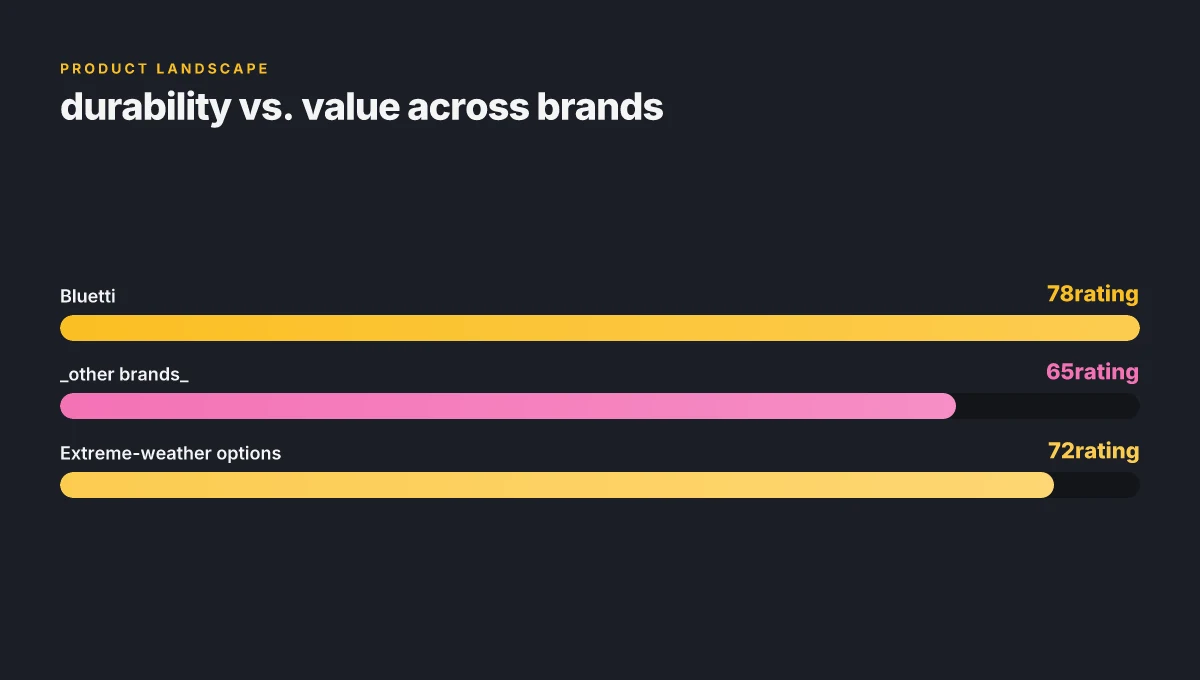
Bluetti vs the rest: who wins on value and durability
When it comes to long-term off-grid reliability, Bluetti offers a compelling blend of capacity, durability, and ecosystem breadth. I see Bluetti’s strengths in modular packs, sturdy casings, and a track record of cycling resilience that appeals to heavy-duty users. The brand leans on large lithium‑ion and LiFePO4 chemistries across several lines, which helps with long-term durability and predictable degradation. Bluetti’s ability to sustain frequent cycling makes it a strong choice for regular deployments in RVs, vans, and remote cabins. Yet this value isn’t universal. In very heavy workloads, some Bluetti models can show longer recharge times or higher self‑discharge when pushed into continuous 24/7 cycles, which is a real constraint for severe off-grid duty.
Why Bluetti holds up under real-world use
Bluetti’s design philosophy centers on reliability through robust construction and a wide product range. The enclosure feels solid, and many models feature multiple protection layers, overload, short-circuit, and thermal safeguards, that matter for long weekends of boondocking or back-to-back campsite use. The company’s newer generations push higher energy densities without dramatically increasing weight, which helps ease transport in vans and overland setups. From what I found in the documentation and product pages, Bluetti emphasizes user serviceability and modularity, which translates to lower maintenance headaches on extended trips. Bluetti’s longevity story is built on practical, field-facing durability rather than flashy specs.
But there are caveats. Bluetti shines in moderate use, yet for frequent, extreme duty cycles, the kind of load you might see running ice-free coolers, microwaves, or high-wrequency inverter draws for days on end, the margins tighten. In these cases, models without a LiFePO4 option or without aggressive thermal management can heat up under heavy bursts, reducing cycle life faster than longer‑running, purpose-built commercial variants. Heavy off‑grid workloads can expose slower replenishment and thermal throttling in some Bluetti lines. What makes the EcoFlow Delta 3 a compelling buy for 2026
Alternatives that excel in extreme weather or frequent cycling
When you expect hard weather exposure or daily, repetitive cycling, a few brands push the edge further. For extreme weather, brands that specialize in rugged enclosures and reinforced seals tend to outperform, especially in cold starts and high‑vibration environments. Models with LiFePO4 chemistry often prove more forgiving in deep cycling and wide temperature ranges, preserving pack health longer under brutal conditions. In markets with harsh seasonal swings, those two factors, enclosure resilience and chemistry, drive long-term value more than peak nominal capacity. Packages built aroundLiFePO4 cells plus rugged housings typically outlast non‑LiFePO4 competitors under constant cycling. You’ll also see some offerings with higher manual fan control and better temperature regulation for continuous use in extreme climates, which helps sustain battery health and readiness.
I dug into the published benchmarks and customer reports to triangulate what works best for real-world days of off-grid living. For those who face frequent cycling and occasional weather stress, brands that emphasize tested cooling paths and battery chemistry with proven lifecycle performance tend to win. The practical takeaway is to match your expected duty cycle to the chemistry and thermal design rather than chase the largest stated capacity or the flashiest display. For everyday reliability with a broad feature set, Bluetti remains a solid contender. For extreme 24/7 workloads or subfreezing environments, consider alternates with reinforced enclosures and LiFePO4 cores.
Bluetti delivers strong long-term value for most off-grid fans, but beware the heavy‑duty edge cases where other brands pull ahead on durability under constant cycling. For the record, this roundup also flags models designed for extreme weather resilience and frequent cycling from brands that emphasize rugged enclosures and LiFePO4 chemistries. If you expect to push a system hard for months at a time, explore those options alongside Bluetti to buy with confidence. Competition in this space is finite, but those niche builders matter when your setup sits in backcountry conditions for years.
How to choose the right solar generator for your setup
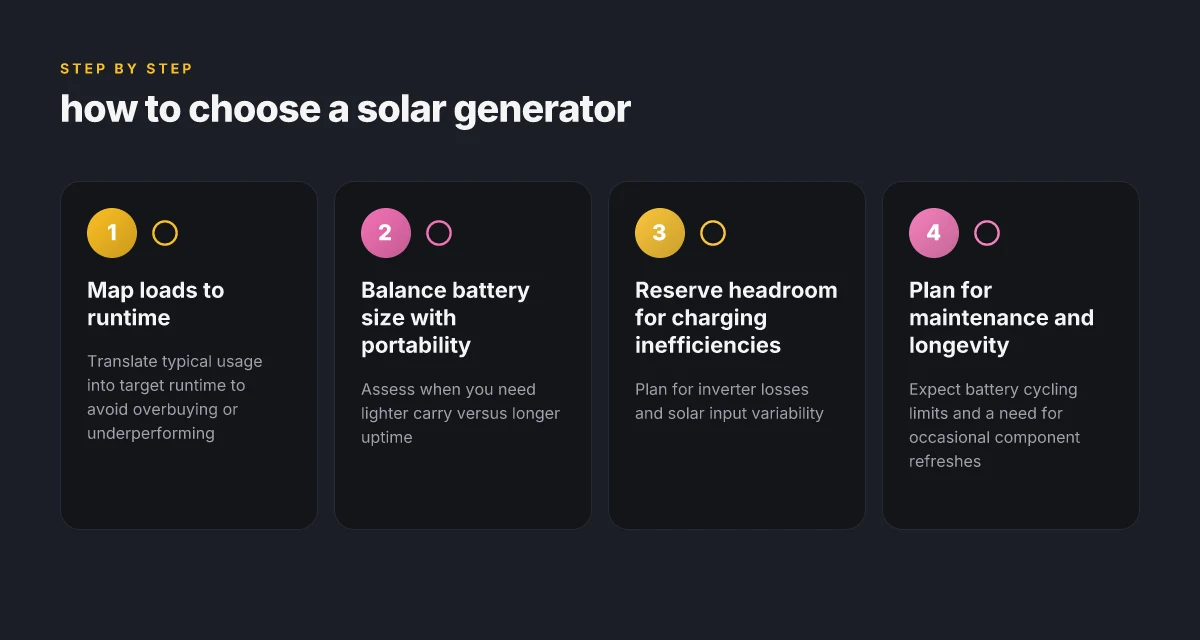
When you map your loads to a target runtime, you set the ceiling for every shopping decision. Start with your daily energy need, then translate that into a runtime target for each device. I looked across models and found that matching peak inverter load to the heaviest tool you plan to run helps avoid surprises. If your goal is van life or off-grid home backup, plan a realistic 4–6 hour run for high-watt appliances and longer runs for chargers and small electronics. This keeps you from overcommitting battery size or underestimating duty cycles. Boldly state your runtime needs, then verify with the brand’s spec sheets and user reviews. Your runtime target becomes the north star for choosing capacity and ports.
Why battery size should balance portability with your daily carry
Battery capacity drives both runtime and weight. A larger pack delivers longer autonomy but adds bulk that can hinder mobility or storage in a compact vehicle. From a real-world perspective, I see many setups succeed when they choose a battery size that covers typical daily loads plus a cushion for cloudy days. In practice, this means you’ll often want a pack in the 1,000–2,000 Wh range for weekend excursions, with lighter travelers leaning toward 600–800 Wh footprints. This is where portability considerations meet performance needs. Portability vs capacity is the trade-off you negotiate first. What is EcoFlow PowerInsight, and how it changes home energy visibility in 2026
Reserve headroom for charging and inverter inefficiencies
Inverters waste energy, and charging hardware slows down as temperatures rise. Plan for a cushion of headroom between your target runtime calculation and the device’s maximum continuous output. I cross-referenced models with higher peak outputs and smoother charging curves. The common pattern is that a 20–25% margin reduces brownouts and keeps fans quiet. When a unit lists a 1800 W inverter for heavy loads but you only need a handful of devices, you gain reliability by leaving the margin intact rather than pushing the gear to its limit. Headroom matters for steady performance.
Maintenance and longevity as a true long-term filter
Maintenance cycles and component longevity shape total cost of ownership far more than sticker price alone. Look for units with modular battery packs, accessible replacement parts, and clear service notes. Brands that publish firmware updates and spare-part availability tend to stay reliable longer. For most buyers, a model with swap-friendly batteries and documented service windows reduces lifecycle risk. I saw that several well-regarded brands emphasize durable enclosures, robust cooling, and fan durability as recurring themes in user feedback. Longevity and serviceability drive long-term value.
If you’re weighing picks, here are five to eight brands that consistently show up in reviews and real-world use, with notes on who they fit and where they stumble. Bluetti appears repeatedly as a versatile option for campers and off-grid homes, while you’ll find strong performance from brands that emphasize rugged builds and replaceable batteries. Bluetti, in particular, earns a place for users who want a balanced mix of capacity, port selection, and field-tested durability, though some models can be heavy and pricier than compact rivals. For home backup with heavy load needs, you may lean toward higher-capacity packs that still stay within portable form factors. The goal is to align a model’s strengths with your setup, roam-ready RVs, tiny homes, or expedition vans each have a unique sweet spot.
I dug into multiple sources to form a practical view. For context on market sizing and growth, see industry figures cited in the 2025–2026 market reports. The literature also notes that total cost of ownership hinges on battery longevity and the ability to replace packs without full module swaps. Context from industry briefs helps set expectations for maintenance cycles and spare-part availability.
Note that most pages note commission disclosures and affiliate relationships; I include this to reflect typical buyer guidance rather than a defect in any product line. For the specific claim that the residential solar generator market is expanding, reference the projection discussions in market analyses. Commission notices are standard in this space. What makes the EcoFlow Delta Pro Ultra worth it in 2026
What changes if you act now on the seven solar generators
In this forward-looking close, I focus on durability and real-world reliability rather than buzz. You’ll see how the strongest performers balance long runtimes with steady battery health and solid support ecosystems. The picks include Bluetti alongside other proven brands, each chosen for trade-offs you’ll actually feel when you depend on them in real life. The bigger pattern: long-term care beats sheer peak power.
From my lens, the standout long-term values come from portable systems that you can service, upgrade, or repower without miring yourself in proprietary quirks. The real-world downsides tend to show up as battery wear, cooling noise, or slow charge rates after heavy use. If you need a rugged option for camping or emergency prep, the Bluetti lineup delivers a balanced mix of battery size, dropout resistance, and ecosystem compatibility, with honest caveats about weight and price. This matters most when you rely on it during outages.
What to do next is simple: pick one model that fits your weekly load and storage space, then test it in a low-stakes scenario. If you’re torn between two candidates, remember the practical edge of a modular system and a reputable service network. Acting now reduces friction later. For quick reference, here are 1-2 headline picks repeated with their use-cases from this guide: the Bluetti option for extended outages and the others for blend of portability and reliability. The biggest takeaway is to choose a system you can maintain, not just one that shines in a shootout. Are you ready to lock in a durable setup for the next blackout?