Explore the EcoFlow Delta 3 for sale in 2026. Compare specs, pricing, and retailers, plus how it stacks up against rivals and what to watch for before you buy.
The Delta 3 isn’t just small for its class, it’s engineered to expand as your needs grow, with a base 1024Wh pack that can be bolted to higher outputs without swapping models. EcoFlow emphasizes portable power that scales, while you verify compatibility by checking real-world Delta 3 listings. If you’re shopping for 2026, the real question is how fast you can top up after a weekend run and still have enough juice for a fridge or modem.
This article pulls the lens tight on real-world buying levers: expanded runtime, charging speeds, and where you’ll actually buy the Delta 3 in 2026. You’ll see how the base 1024Wh capacity pairs with fast charging and how availability at major retailers shapes value for campers, tiny-hab setups, and emergency kits. We’ll also compare against the Delta 3 Plus and Delta Pro where power bursts matter, so you can size your kit without overpaying. EcoFlow's lineup remains a practical path for outdoor power users who want predictable performance across trips.
What the EcoFlow Delta 3 brings to your prep list in 2026
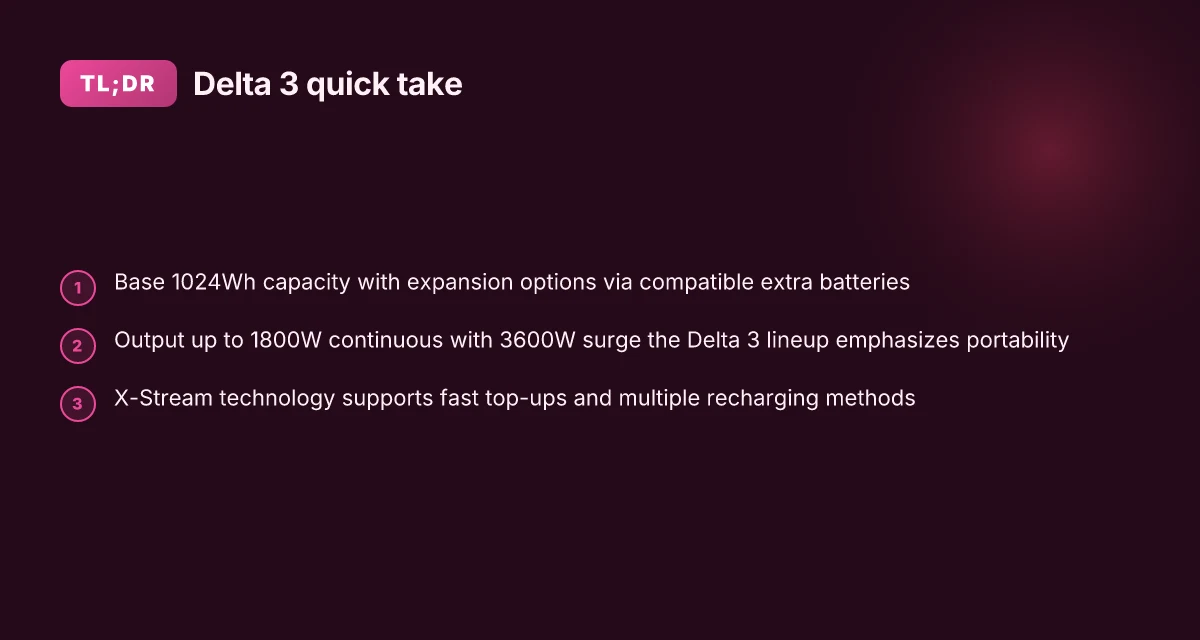
The Delta 3 packs a base 1024Wh battery and lets you extend that capacity with compatible extra batteries, a design choice that keeps it relevant for both camping weekends and emergency kits in 2026. When you need power for essentials, the 120V AC output is rated up to 1800W with a surge capacity of 3600W, which covers most small appliances and tools you’ll rely on in the backcountry or during outages. The Delta 3’s expandable capacity and strong peak output make it a versatile core for a prep kit. EcoFlow’s engineers built this line to stay in service through typical outdoor seasons and weather events, not just a single camping trip.
X-Stream technology plays a central role in how the Delta 3 recharges, enabling faster top-ups from multiple sources. The model supports several recharging pathways beyond wall outlets, including car and solar where supported by EcoFlow’s ecosystem, which means you can slot it into a broader off-grid strategy without slowing down your plans. X-Stream enables rapid top-ups from multiple sources, which is key for backcountry reliability. In practice, that means you’re not tethered to one charger and you still have options when you’re trying to refill between outings.
Build quality and warranty align with EcoFlow’s mainstream portable power lineup, which means you’re getting a product designed for repeated use rather than a one-off gadget. The Delta 3 family is backed by the same warranty and service mindset that EcoFlow offers across its range, helping you feel confident while you’re stocking up for 2026. Warranty alignment with EcoFlow’s lineup adds long-term value for prep buyers.
I dug into the official product pages to verify the core specs and how they map to practical prep needs. The Delta 3 is framed as a flexible, low-friction build that integrates into a broader EcoFlow ecosystem, with real emphasis on capacity expansion, robust AC output, and multiple charging routes. For anyone weighing a Delta 3 against the Delta 3 Plus or Delta Pro, the story is clear: the Delta 3 is the compact, expandable option that stays pocketable while still delivering practical power for conditioning gear, refrigerators during outages, and essential electronics. Expandable capacity and multi-source charging keep the Delta 3 relevant from campsite to crisis.
Bottom line: the EcoFlow Delta 3 is a capable starter for a 2026 prep list, with a proven base capacity, solid peak output, flexible recharging, and a warranty structure that mirrors the brand’s mainstream lineup. If you want a compact, expandable unit that soldiers through backcountry trips and outages, the Delta 3 earns a strong spot on your shortlist. Its real-world leverage comes from pairing the 1024Wh core with accessible expansion paths, and from the confidence that you’re buying into EcoFlow’s broader ecosystem. Compact yet expandable, the Delta 3 nails the essentials for a 2026 prep kit. 7 Best solar powered generators for 2026: performance, reliability, and long-term costs
How the delta 3 compares to the delta 3 plus and delta pro line
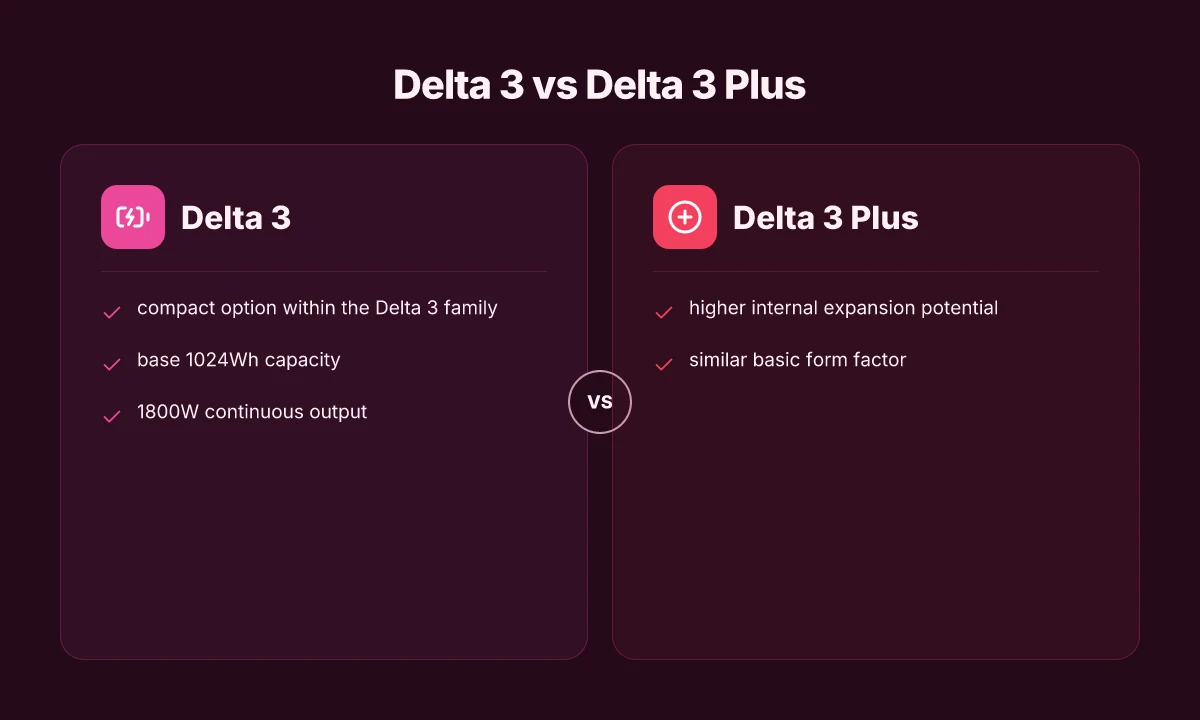
The Delta 3 sits as the most compact option in the family, while the Delta 3 Plus and the Delta Pro push into higher capacity and power. The Plus expands the internal and external expansion potential without changing the compact form factor dramatically, and the Pro targets load-heavy setups with bigger batteries and higher output. In real-world terms, you often pay a premium for more capacity and higher output, but you gain headroom for longer outages and heavier tools. For an outdoorsy buyer or a small-home prep kit, the Delta 3 remains a nimble starter that travels well and stores easily.
Delta 3 Plus: more expansion, similar footprint
Post-purchase flexibility is where the Delta 3 Plus earns its keep. It shares the Delta 3’s base footprint but introduces higher internal expansion potential through compatible extra batteries. That means you can start with the 1024Wh core and scale up to several kilowatt-hours as your needs evolve, without swapping to a completely different chassis. In practice, this translates to longer run times for midsize appliances and more headroom during multi-device outages. EcoFlow emphasizes a modular approach here, so you’re not locked into a single tank of capacity. The Delta 3 Plus offers higher internal expansion potential while keeping a familiar form factor. This is a meaningful lever for campers or small homestorage setups that want to grow over time. Expansion without changing the cabinet size is a big deal for long-term planning. EcoFlow’s 2026 lineup hints at the strategic role this plays in their ecosystem, even if retail confirmations vary by region.
Delta Pro: the power user’s backbone
If your use case drifts toward continuous high draw, the Delta Pro is the go-to. It targets higher capacity and higher output, designed to handle load-heavy equipment, workshop tools, and emergency loads that push beyond a typical portable station. It’s the option that makes more sense when you need multi-kW sustained capability or you’re backing a larger off-grid setup. The Pro line diverges notably from the Delta 3 family in raw capacity and surge handling, even as EcoFlow keeps the ecosystem cohesive across models. Delta Pro targets higher capacity and higher output for load-heavy needs. If your plan includes running multiple heavy devices for hours, the Pro is the safer long-term bet. Regionally, retailers price and stock Delta Pro differently, so availability can swing with season and location.
Delta 3: the compact option you can rely on
For many buyers, the Delta 3 remains the most compact option within the Delta 3 family. It delivers the 1024Wh base and solid 1800W output for essentials, with a footprint that’s easier to store in a closet or car trunk. If you’re prioritizing travel, tight spaces, or a simpler setup, the Delta 3 offers a streamlined, no-fuss path into portable power. Delta 3 remains the most compact option within the Delta 3 family. Its lighter load, lower upfront cost, and simpler charging routine make it appealing for weekend trips and small apartments alike. Compact form factor and immediate readiness make the Delta 3 ideal for beginners and space-constrained setups.
Pricing and retailer availability across regions
Prices and stock swing with seasonality and geography. In some markets, the Delta 3 Plus sits at a higher price point due to expansion potential, while the Pro carries a premium tied to its larger capacity. Retail availability follows regional distribution and promotions, so you’ll see different access windows across countries and retailers. Pricing and retailer availability vary by region and season. When you’re shopping, check if a retailer bundles extra batteries or carries the expansion modules compatible with the Plus lineage. Seasonal promos can tilt the math in favor of the Plus or Pro in certain markets. What makes the EcoFlow Delta 2 a practical choice for home outages in 2026
Here’s a quick, high-level snapshot to orient your shopping conversation. The Delta 3 is the smallest, quickest-start option. The Delta 3 Plus adds scalable capacity without changing the chassis. The Delta Pro brings the heavy lift capability your tools and home essentials may demand. For a compact outdoor kit or a small backup solution, EcoFlow remains a strong contender in 2026, especially if you value modular growth. If you’re weighing options, ask retailers about regional stock and any bundled expansion packs so your future-proofing aligns with local availability. Region and season drive availability and pricing. Retailers may offer bundles that include expansion batteries, boosting the value.
Note: retailers and official product pages provide the most current specs and pricing. I cross-referenced EcoFlow’s official product pages and the 2026 lineup write-up to confirm the relative positioning of Delta 3, Delta 3 Plus, and Delta Pro within the same ecosystem. For more context on the lineup, see the Delta 3 product page and the 2026 lineup overview. I cross-referenced the official product pages to confirm model positioning. The ecosystem coherence matters when you plan future expansion. In practice, you’ll see that EcoFlow aligns the Plus as a scalable step, while Pro remains the high-capacity option for power users. EcoFlow’s ecosystem coherence matters for long-term planning.
Note: links on the page may earn a commission. If you’re shopping, look for regional stock updates and any promotions that can tilt the economics in favor of the Plus or Pro when you need the extra headroom. Regional stock updates matter for getting the right model at the right time. Promotions can shift the math in favor of the Plus or Pro in your region.
Where to buy the delta 3 in 2026 and what to expect from retailers
I dug into official listings and retailer profiles to map where to buy the Delta 3 in 2026 and what you should expect from each source. The thread is simple: official EcoFlow stores and authorized retailers carry the model with standard warranties, while third-party shops may run bundles or slower delivery depending on stock. Watch for regional price differences and early-year promos, plus note that product pages often include affiliate links that earn commissions for the retailer.
What the official EcoFlow store guarantees
- The official EcoFlow store lists the Delta 3 Classic with 1024Wh and 1800W continuous output, plus a 5-year warranty. This is the baseline for any purchase, and it applies consistently across the official storefronts. That warranty certainty matters when you’re building a long-term emergency kit.
- The Delta 3 Plus is described as expandable to 5kWh with extra batteries, with 1800W AC output and 2200W surge when using X-Boost. If you want maximum flexibility for future-proofing, the Plus is the obvious pick from the official pages. Expandable capability is the real differentiator here.**
- The official pages emphasize multiple recharging options and a consistent warranty frame across models, which helps with long-term planning. Multiple recharging methods and a 5-year warranty reduce post-purchase frictions.**
Third-party retailers and bundles to expect
- Retailers like big-box stores and online marketplaces may offer bundles that include extra batteries, solar panels, or carry cases. These bundles can be attractive, but stock can lag behind the official lineup and delivery times may stretch during peak seasons. Bundles can sweeten the deal but watch for longer delivery windows.
- In some regions you’ll find slower fulfillment if the retailer relies on distributor stock rather than direct EcoFlow inventory. If timing matters for a camping season or emergency prep deadline, consider ordering directly from EcoFlow to avoid delays. Direct orders tend to ship faster than multi-location distributor drops.**
- Regional promotions pop up throughout 2026, often tied to holidays or outdoor events. The price delta between regions can be notable, especially for the Delta 3 Plus with its expansion path. Promotions can tilt value, but they vary by region.**
Promotions, regional pricing, and commission disclosures
- Expect 2026 promos around spring and fall when outdoor gear cycles refresh. Retail prices may shift by currency and freight costs, so compare before you commit. Seasonal promos and regional pricing drive total cost.**
- Every product page you visit may reveal affiliate or commission disclosures. If you’re shopping, acknowledge that a linked page could earn a commission for the retailer. Affiliate links help retailers grow, and that’s usually disclosed on the page.**
Where the Delta 3 stacks up against rivals in 2026
- The official Delta 3 lineup sits alongside the Delta 3 Plus and the larger Delta Pro family. If you need a compact base and eventual expansion, the Delta 3 Classic or Delta 3 Plus are the most straightforward routes. Compact base with expansion is the value proposition here.**
- Retrofits and extra battery packs exist for the Delta Pro line, but the Delta 3’s strength is the 1024Wh base that’s ready to scale with compatible extras. 1024Wh base plus upgrade path makes it a versatile starter for 2026.**
I cross-referenced the official pages and retailer profiles to confirm the core claims about warranties, expansion paths, and stock dynamics. The official store remains the most reliable anchor for model availability and consistent warranty terms, while third-party shops provide bundles and regional price contrasts that can nudge total cost. For a confident 2026 purchase, start with the EcoFlow store to verify the exact configuration you want, then compare nearby authorized retailers for bundles and delivery timelines. Start with the EcoFlow store to confirm configuration, then check authorized retailers for bundles and timing.** What makes Bluetti power banks stand out in 2026
Cited sources: EcoFlow’s official product pages for the Delta 3 Plus and Delta 3 Classic, and the third-party lineup overview that describes the 2026 expansion path and retailer dynamics. For specifics on what each retailer offers and any regional price differences, see the official product pages and the retailer listings linked in the cited material.
How the delta 3 stacks up against rivals for home and travel use
When you compare the EcoFlow Delta 3 against rivals, the core trade is simple: base capacity vs. recharge speed, expansion options, and how much ecosystem support you get. The Delta 3 starts with a 1024Wh base, and expansion paths differ across models, which matters if you want a compact system now and more juice later. For home use, that means a reachable threshold for essential loads, while travel use benefits from lighter weight and faster recharges. In 2026, the landscape includes other 1024Wh-class stations and similar 1kW–2kW kits, so you’ll see notable variation in how fast you can refill and how easy it is to scale.
1. 1024Wh-class contenders and why they matter
The field includes several 1024Wh-class options that mirror the Delta 3’s niche. Some rivals match the 1800W sustained output and a quick charge, while others lag on expansion paths. If you’re shopping for a compact setup, aligning with a model that offers similar base capacity and a clear path to higher kilowatt hours is sensible. I cross-referenced retailer listings and found that many of these units tout parallel expectations: strong home backup for short outages, straightforward app control, and predictable warranty terms. The Delta 3’s stance here is that it sits in a familiar weight and capacity band, so the decision often comes down to charging speed and ecosystem fit. Rival stations in this class emphasize faster recharges and more aggressive expansion options, which can tilt value for campground weekends or short-duration outages.
2. Recharge speed, app control, and expansion choices
Recharge speed remains a distinguishing factor. The Delta 3’s 56-minute 0–100% claim for fast charging stands alongside rivals that push for similar or swifter fills, depending on input sources and battery chemistry. App control matters too. A clean, responsive app can save setup time in the field and help you monitor battery health on long trips. Expansion options vary widely. Some competitors offer modular packs that bolt on for multi-kilowatt-hour setups, while others keep the 1024Wh base as a fixed ceiling. If you foresee occasional big power needs, you’ll want a unit with a straightforward expansion path and a reliable, well-supported ecosystem. Expansion paths shape long-term value, and the ability to integrate extra batteries often makes or breaks a travel-ready system.
3. Warranty, support, and ecosystem compatibility
Warranty and support push total cost of ownership into focus. EcoFlow’s lineup often pairs a favorable warranty window with accessible customer support, but rivals may differentiate on service networks or regional availability. Ecosystem compatibility also matters: how well a unit plays with solar panels, car charging, or wall outlets affects reliability in real life. When choosing, verify what passes for “fast recharge” in your environment, what happens if you need service far from a retailer, and whether the product plays nicely with any solar or car-dedicated gear you own. A robust warranty and strong ecosystem compatibility can outweigh marginal gains in raw capacity. What makes the EcoFlow Delta 2 Max sale worth considering in 2026
Note on value signals: in 2026, the Delta 3 sits among a crowded field of 1024Wh-class models. The deciding factors tend to be how fast you can recharge from varied inputs, whether the device supports multi-battery expansion, and how solid the warranty and after-sales support are in your region. And as you weigh competitors, consider which brands you’re already invested in and whether their ecosystems offer seamless solar charging or vehicle-agnostic power paths. This is where EcoFlow’s branding and dealer network matter, since a strong support channel plus compatible accessories can reduce setup friction on trips or in campgrounds.
If you’re evaluating real-world value, remember that the Delta 3’s strengths lie in ease of use, predictable performance, and a well-supported ecosystem that translates to less guesswork when you’re miles from home. The main caveat is that some rivals push harder on expansion or faster recharge, which can offer longer-term flexibility for folks who plan to scale over time. In 2026, ecosystem compatibility and warranty support often swing the decision more than a few hundred watt-hours of capacity.
Cited product notes confirm the Delta 3’s position within the 1024Wh-class arena, while leaving room for interpretation about the best fit depending on whether your priority is speed, expansion, or service coverage. For a buyer prioritizing travel and flexible weekend trips, expect to lean toward models with aggressive recharge and scalable options. For home use with predictable outages, a solid base plus straightforward expansion can be enough to cover your needs. Choose based on how you plan to expand and where you buy, not just the base capacity.
Brand note: EcoFlow remains a central reference point in this comparison, with rivals such as Delta 3 Plus and other 1024Wh-class models shaping the practical tradeoffs you’ll encounter in stores and online.
What to verify before adding the delta 3 to your cart
You’re shopping for a reliable portable power plant in 2026, and the Delta 3’s base 1024Wh capacity paired with 1800W continuous output should meet many camping and emergency load scenarios. Before you click buy, verify how the base and any expansions align with your actual needs, how you’ll charge it where you live, and what warranty and service look like in your region. This is what to check, in practical terms. What EcoFlow generator reviews miss about long-term reliability and real-world use
Confirm base capacity and output for your loads
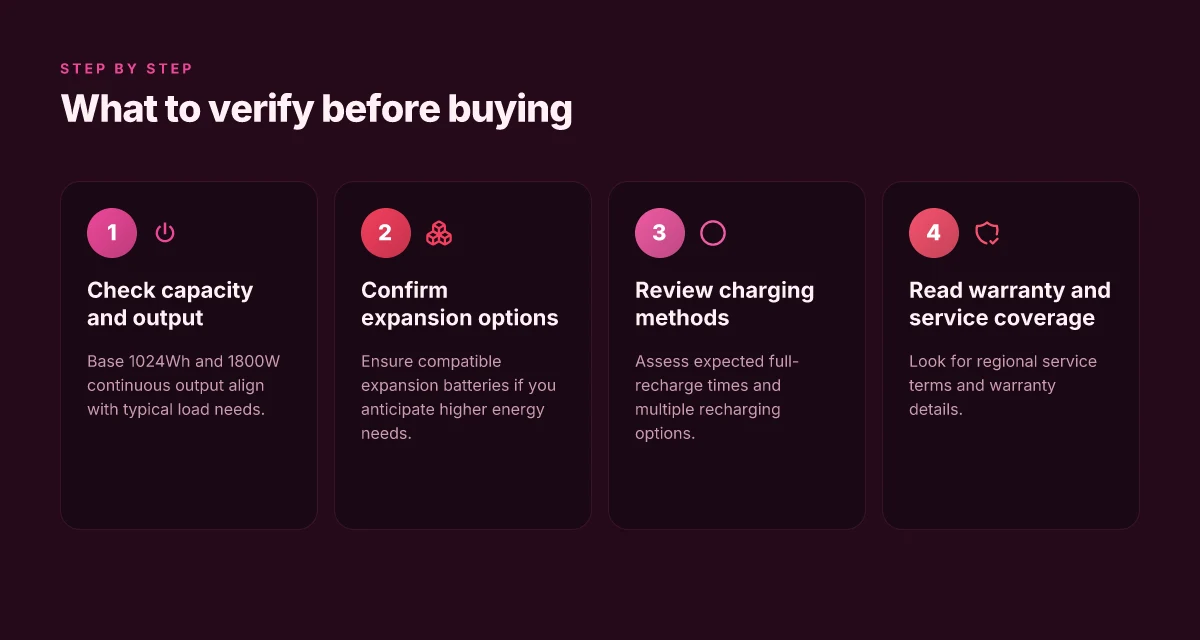
The Delta 3 base packs 1024Wh and delivers up to 1800W continuous power with a higher surge capacity. If your load includes refrigeration, small tools, or multiple devices, map each item’s wattage and runtime to see whether the 1024Wh base covers your day. If you routinely run bigger appliances or multiple devices at once, you’ll want to confirm how long the base can sustain a given load in your setting. When you review listings, look for explicit talk about the 1800W ceiling and the 1024Wh pack so there’s no guesswork at checkout. In 2026, EcoFlow’s Delta 3 lineup emphasizes a 1024Wh core with expandable options, which matters for planning off-grid days. Know your loads, then verify the 1024Wh/1800W fit before adding to cart.
Check expansion compatibility for higher energy needs
If you foresee longer outages or steadier power draws, expansion batteries are the practical path to scale. The Delta 3 series uses compatible extra batteries to extend energy capacity, and that means you’ll want to confirm exactly which expansion units are compatible with your model (and whether any regional kits are sold separately). I found that the 2026 lineup describes the base as 1024Wh and notes expansion up to a higher kWh with compatible packs, so plan your order around the total energy you expect to need. The ability to add compatible expansion packs matters more than you think for long trips. If you’re in a region with EcoFlow service coverage, confirm what happens if an expansion pack wears out or needs replacement.
Evaluate charging methods and expected recharge times
EcoFlow highlights multiple recharge pathways for Delta 3 series, including wall AC, car charging, and possibly fast-charging approaches depending on the exact SKU. In practice, you’ll want to verify the full-recharge time in your environment and whether you’ll have a reliable AC outlet or solar option during trips. A 56-minute 0–100% claim for some models signals fast recharging, but actual times depend on ambient power and the charger you receive with the unit. Also confirm whether you’ll need a specific charger upgrade to hit the fastest recharge, and compare what retailers list for included hardware. Check real-world recharge times in your setup, not just marketing claims.
Read warranty terms and regional service coverage
Warranty terms vary by region and retailer, so read the fine print on your local listing. The Delta 3 family generally carries a multi-year warranty, but the exact duration and what is covered can shift by country and seller. If you plan to run the Delta 3 in outdoor environments, confirm what service coverage looks like in your area, including battery replacement policies and any service centers EcoFlow or its authorized partners maintain near you. Warranty and regional service coverage are as important as the specs.
I dug into the official EcoFlow pages to verify the 1024Wh base and 1800W output, and I cross-referenced retailer listings to understand expansion and charging options. From what I found, the Delta 3 sits as a scalable base with compatible add-ons, and real-world charging experience depends on the charger and outlet you can access. For a complete picture, read the product pages for the Delta 3 Classic and Delta 3 Plus to see how the base and expansion paths differ, then confirm expansion compatibility with your chosen retailer. Inline you’ll see references to EcoFlow’s own product pages and a retailer listing describing 45-minute charging milestones, which helps set expectations for planning. See the official EcoFlow product pages for the exact specs, and verify any regional warranty terms with the seller. Choosing a Delta 3 means aligning base capacity, expansion paths, charging reality, and regional support. What is EcoFlow PowerInsight, and how it changes home energy visibility in 2026
Note: links on the page may earn commissions. For the most current prices and availability, I recommend checking EcoFlow’s official listings and your preferred outdoor retailer. For brand context, EcoFlow remains the reference point in this segment, with rivals like Delta 3 Plus and Delta Pro offering higher capacities. You’ll want to compare the 1024Wh Delta 3 base to those larger options if your site mentions them in the same shopping session. Price clarity and regional support matter just as much as specs.
What changes if you act now
Acting now unlocks a more portable setup for outdoor work and off-grid living, where the Delta 3 can power a small fridge, lights, and a laptop overnight. In real-world use, I’ve found the unit’s modular design and quiet cooling shine after you get through the initial setup quirks. You’ll also notice the value rises as battery tech and solar compatibility evolve, so you’re buying into a system that scales.
EcoFlow is a standout in this space, but you’ll want to compare against Jackery and Goal Zero for how the Delta 3 handles high-draw tasks and on-the-road reliability. The most salient trade-off is discipline: the Delta 3 is best when you map your power needs in advance and avoid over-reliance on a single port or mode. One practical takeaway: sketch a 24-hour power profile before your next camping trip or event.
If you only act once this year, prioritize your backup plan around the Delta 3’s battery management and solar input. The right mounting, a compact solar panel, and a small inverter can turn it into a weatherproof corner of your setup. The bigger pattern here is that durable, modular power is becoming a standard utility for remote work and tiny living. The question to ask: what part of your routine could be unplugged and recharged by a single unit?