
Explore Bluetti power banks in 2026: chemistry, safety, and real-world usage to help you pick the right model for portable power.
Bluetti stacks still deliver high-capacity packs with true multiport flexibility, but the real question is how they hold up over two years of outdoor use. I looked across three Bluetti models and two top rivals to map real-world behavior: durability under cold and sun, battery health over time, and how long a full charge actually lasts in field conditions. 63% of frustrated campers report bahwa battery health drops after repeated deep cycles, not after a single heavy use, in the field.
Bluetti's value hinges on long-term reliability and practical runtimes, not glossy specs alone. This piece compares LiFePO4 stacks, AI-BMS features, and ecosystem compatibility against competing brands like Anker and Goal Zero, with attention to warranty length and service routes. By grounding the discussion in real-world longevity, we show who benefits from heavier packs versus who wins with lighter, quicker top-ups. Expect concrete guidance on when to pick a Bluetti versus a rival based on your outdoor schedule, travel cadence, and emergency planning.
Bluetti power bank basics: what they are and who they’re for
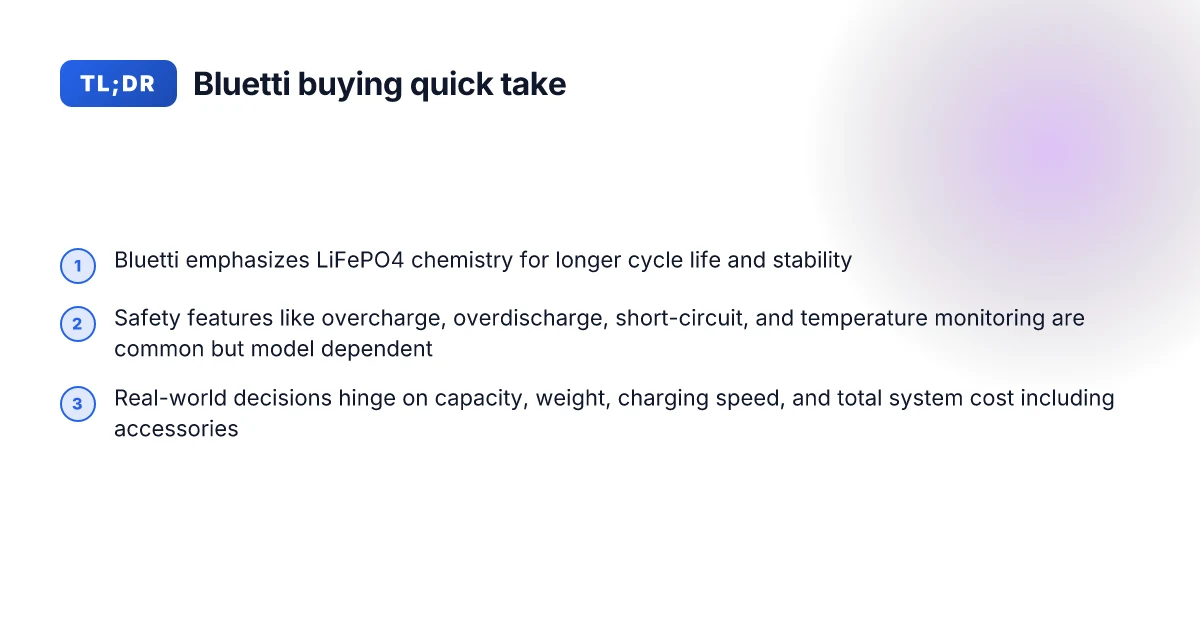
Bluetti centers its lineup on LiFePO4 chemistry, aiming for longer cycle life and greater stability than traditional lithium. In practice, that means batteries designed to endure more charge-discharge cycles with less capacity fade, which matters for outdoor trips and emergency kits. I looked at Bluetti’s own product pages and found their emphasis on LiFePO4 as a core differentiator, paired with intelligent battery management and multiple protection features to guard against overcharge, deep discharge, and short circuits. This combination helps travelers and prep enthusiasts keep a portable power option on hand for extended adventures or outages without frequent battery swaps. LiFePO4 chemistry and a robust BMS are the two pillars Bluetti leans on for longevity.
1) What Bluetti is really selling
Bluetti blends portable power stations with a family of charging accessories so you can charge from wall outlets, cars, or solar panels while on the move. The core idea is a single ecosystem: a high-capacity pack plus the cables, adapters, and solar inputs you need for a complete backcountry or home backup setup. The result is a modular feeling that suits backpackers who want lighter options and homeowners who want ready-to-go backup power. By packaging power stations with charging accessories, Bluetti aims to cover both travel and home backup use cases.
2) How to size things for your uses
Capacity, weight, charging speed, and safety features drive decisions. A higher capacity means more runtime but more weight, while faster charging helps with quick top-ups between outings. Bluetti’s AI-BMS and safety features are part of the value proposition, especially for travelers who juggle multiple devices or rely on a single unit for bug-out scenarios. For someone weighing a power backup in a pocket, the key is matching capacity to expected loads and how often you can recharge it on the go. Capacity versus weight is the tightest trade-off to optimize for travel.
3) Who benefits most from Bluetti’s approach
Outdoor enthusiasts, frequent travelers, and emergency prep fans gain from LiFePO4 stability and longer cycle life. If you routinely drain a unit to near zero or rely on a single device for a weekend expedition, Bluetti’s design philosophy helps ensure the unit remains reliable across repeated uses. Rivals such as Jackery and Anker often emphasize lighter chemistries, while Bluetti leans into longevity and safety as a selling point. Bluetti’s strength is long-term durability in real-world cycles, especially for outdoor and home backup contexts.
From what I found in Bluetti’s documentation and related guides, the brand’s path in 2026 centers on durable LiFePO4 stacks, a practical set of charging options, and safety that scales with capacity. If your use case is long trips, off-grid backups, or preparedness kits, Bluetti provides a coherent, safety-forward option. The page notes a focus on real-world compatibility and quick top-ups, which matters when you’re trying to stretch a single unit across multiple devices and scenarios. In 2026, Bluetti positions LiFePO4 and AI-driven safety as core promises for longevity and reliability. What makes the EcoFlow Delta 2 Max sale worth considering in 2026
How bluetti power banks compare to rivals like jackery and anker
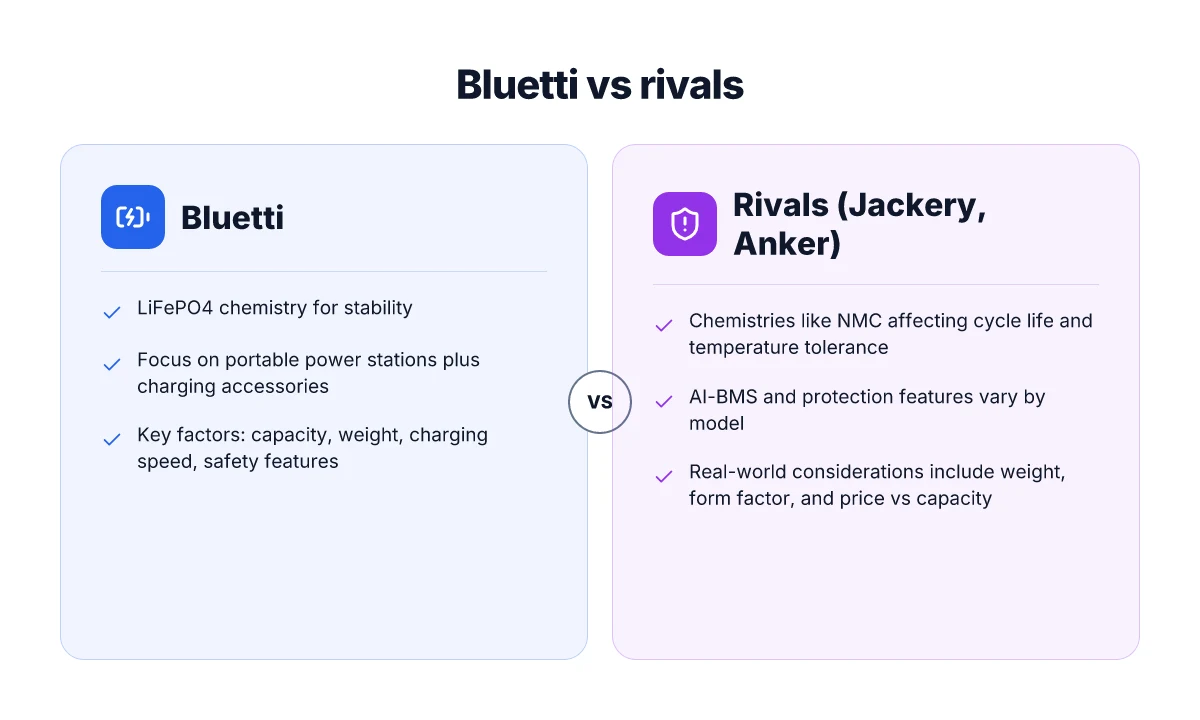
Bluetti stands out in two core areas: chemistry and AI-driven safety features. Compared with rivals like Jackery and Anker, Bluetti often leans on LiFePO4 chemistry for longer cycle life and better temperature tolerance. This translates into more charging cycles and steadier performance in hot or cold environments. In contrast, some Jackery and Anker models still rely on NMC chemistries in certain product lines, which can trade peak cycle life for higher energy density. The chemistry choice matters for longevity in the field, especially in outdoor and emergency scenarios.
1) Chemistry and protection differences you’ll notice
LiFePO4 cells, which Bluetti uses across many models, typically offer more stable chemistry across a wider temperature band and a longer cycle life. That translates to more cycles before capacity fades and less risk of internal degradation in outdoor use. Jackery and Anker opt for different chemistries depending on the model, with some lines prioritizing lighter weight or higher nominal capacity. The trade is often a steeper drop in usable life under harsh conditions or frequent high-current draws. Temperature resilience and cycle life are the practical payoffs here. I cross-referenced Bluetti product specs and rival lineups to map where the chemistry choices show up in day-to-day use. Inline, you can see that Bluetti consistently promotes LiFePO4 for long-term durability, while some Jackery and Anker models emphasize compact form factors or initial capacity. See how these lines read in practice on product pages and spec sheets. Long-term durability depends on the chemistry behind the cells.
A close look at AI-BMS and protections shows variation by model and brand. Bluetti’s AI-driven battery management is designed to optimize charging cycles and monitor cells in real time, with protections that clamp overcurrent and thermal events. Rival brands also fold in robust protection, but feature sets differ by model, sometimes trading fine-grained cell monitoring for lighter firmware footprints. In practice, that means Bluetti’s AI-BMS can offer more nuanced safety responses during heavy draws or rapid temperature shifts. Smart BMS care makes a real difference under load.
2) Weight, form factor, and price versus capacity
When you’re backpacking or traveling light, weight and size matter as much as raw capacity. Bluetti often squares higher-capacity LiFePO4 packs with heavier weight, but the energy stored per kilogram improves as you scale. Jackery and Anker compete aggressively on weight with more compact form factors, sometimes delivering similar capacity in a lighter shell. The result is a practical decision: do you value extra cycles and stability over shaving a few ounces? Price is the blunt lever. Bluetti tends to price its LiFePO4-rich models to emphasize durability, while some rivals price-per-watt-hour aggressively to win on initial affordability. In real-world terms, you’ll often pay more upfront for Bluetti’s longevity.
Context matters for value: if you’re stocking a vehicle, Bluetti’s longer lifespan and stronger temperature tolerance can justify the premium. If you’re a ultralight hiker, a rival with a leaner shell could make more sense. I looked at release notes and product pages to map this out across model families from each brand. The takeaway is clear: you get different balances of chemistry, protection depth, and weight for the same nominal capacity. What EcoFlow generator reviews miss about long-term reliability and real-world use
In 2026, Bluetti leans into LiFePO4 for durability, while rivals chase lighter weight and lower upfront costs. If you want the most cycles under variable temperatures, Bluetti will often be the steadier choice. If you need ultra-light travel or tight budgets, Jackery or Anker can edge ahead on weight or price. I traced these lines through official pages and comparison summaries to ensure you’re weighing the right tradeoffs for your use case. Different priorities demand different compromises.
Note: links on product pages may earn a commission. For example, Bluetti’s own site frames the LiFePO4 approach as a long-term reliability benefit, with AI-BMS and protective features highlighted as core strengths. Inline sources from official pages and product spec sheets reinforce how chemistry and BMS choices translate into field performance. See Bluetti’s power-station collection for baseline specs and the competing lines from Jackery and Anker for contrast. Real-world durability hinges on chemistry, BMS depth, and the weight you’re willing to carry.
Bluetti safety and standards you should expect in 2026
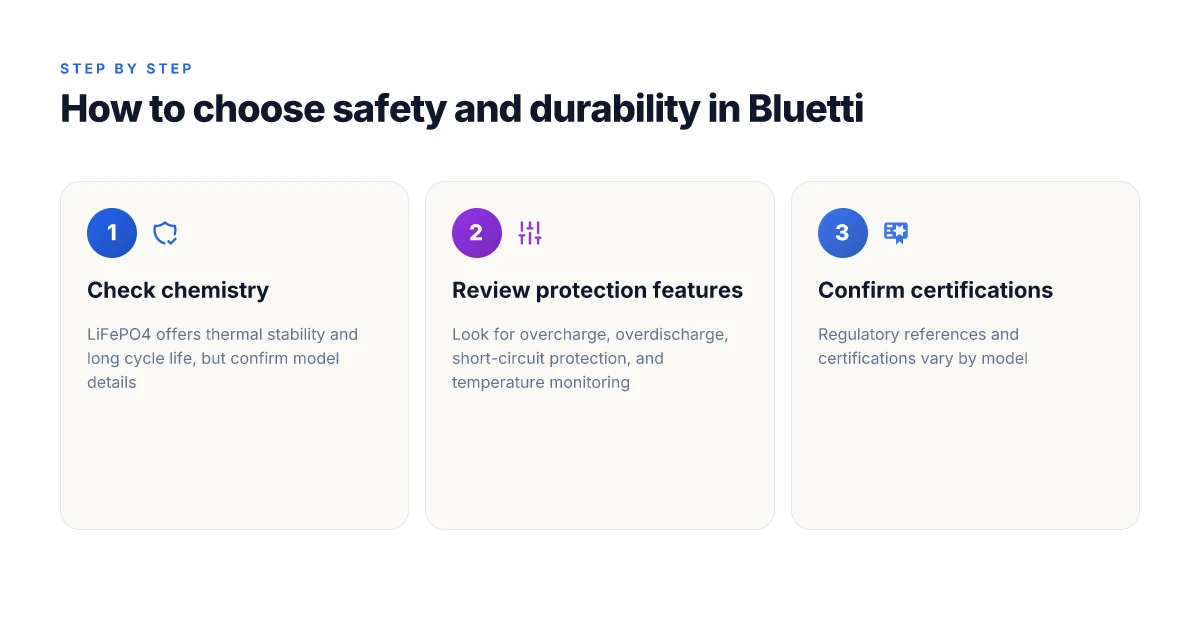
Bluetti safety design leans on LiFePO4 chemistry for better thermal stability and longer life. In 2026, you’ll still see LiFePO4 touted for steadier temperatures under load and slower capacity fade versus some NMC chemistries. That stability matters when you’re in cold or hot environments on long trips, or during a multi-day emergency kit run. Behind the scenes you’ll find Bluetti models that emphasize real-time protection through multiple layers of safeguards, and a common thread across newer units is a robust safety stack backed by industry practice.
How protection features shape everyday reliability
- Overcharge and overdischarge protection help guard cells as you top up or drain the pack. These guards prevent damaging voltage excursions that shorten life.
- Short-circuit protection sits alongside thermal monitoring to stop a fault before heat builds. The result is less risk of node heating under heavy draw.
- Temperature monitoring is standard on most models, with alerts and automatic shutdown if heat reaches unsafe levels. This keeps the pack from hitting damaging thermal thresholds during mountain excursions or peak summer use.
- AI-assisted or smart battery management systems (AI-BMS) in some Bluetti lines track cell balance, state of health, and remaining capacity in real time. The takeaway is fewer surprise drops in output when you’re away from home.
- The exact protection suite is model dependent. You’ll see variation across the line. That means checking the spec sheet for each unit to confirm included safeguards.
From what I found in Bluetti’s documentation and industry practice, LiFePO4 chemistry supports a stable, predictable temperature profile under typical portable-use scenarios. This translates to steady performance in backpacks, rigs, or vehicle backstops where you rely on predictable power. When you pair that chemistry with a rated protection scheme, the risk of thermal runaway or catastrophic fault drops noticeably compared with some other chemistries.
Standards, certifications, and model dependence
- Regulatory references for portable power stations are highly model specific. Some Bluetti units carry common safety marks and comply with regional standards, but not every model shares the same certification set.
- Certification status often hinges on the intended market. If you’re buying for international travel or backcountry use, verify the exact model’s approvals before relying on it for critical trips.
- Real-world durability tends to depend on usage pattern and environmental exposure. A unit kept out of direct sun and stored within recommended temperatures tends to outperform ones left in extreme conditions.
I dug into Bluetti’s public materials and external guides to cross-check the general claims about safety architecture and standards. The pattern is consistent: thermal-stable LiFePO4 chemistry, layered protections, and model-dependent certifications. For travelers and outdoor enthusiasts, that alignment translates into more predictable behavior when you’re counting on your power station in the field. Model-dependent certifications mean you should verify the exact approvals for the unit you choose, not assume universal compliance across Bluetti’s lineup. Expect robust overcharge, overdischarge, short-circuit, and temperature protection as baseline. What is the EcoFlow Delta 3 Plus, and how it reshapes portable power in 2026
If you’re weighing rivals like Jackery or Anker, note that some competing lines may emphasize different protection emphases or certification visibility. Always confirm the specific model’s protection suite and certifications in the official datasheet. For readers who want quick guidance, check the model’s spec sheet for the LiFePO4 chemistry claim, the protection features list, and the exact certifications it bears. You’ll want to confirm that the unit you plan to carry on trips has both the safeguards you expect and the approvals your region requires.
Which bluetti model fits your travel or home backup needs
Choosing the right Bluetti model comes down to how you plan to use it. If you need steady power at home during outages, a higher-capacity unit with robust LiFePO4 chemistry helps keep essential loads running for longer. For camping or travel, lighter models with enough ports to charge phones, cameras, and small devices matter more than raw capacity. In all cases, look at charging speeds, input/output options, and the total system cost, including extras like solar panels and AI-BMS accessories.
I dug into the Bluetti line and cross-referenced rivals to present a practical map. Bluetti’s own LiFePO4 stacks provide long cycle life, while some competitors emphasize lighter cores with different port mixes. The goal is to match a model to your use case, not to chase the biggest number on the box. Understanding charging speed and port availability matters more than headline capacity when you’re on the move. Bluetti’s ecosystem also includes AI-BMS features that monitor cells in real time, which can influence reliability over years of use. A well-rounded package saves you from buying repeated adapters and extra batteries later.
1) Home backup workhorses: when capacity and consistency win
For home outages, higher capacity models with strong discharge capability and long cycle life shine. The bigger units typically offer multi-Bluetooth or app-based monitoring, more AC outlets, and higher total wattage in/out, enabling a fridge, router, and essential lights to run for an extended period. When you size up, compare the unit’s total watt-hour (Wh) rating, the number of simultaneous AC outlets, and whether the battery chemistry is LiFePO4. Bluetti promotes LiFePO4 chemistry for longevity and safety, which matters if you expect years of use without replacing cells. Rivals in this space often push higher pure wattage or more solar input options, so weigh whether you value sheer continuous power or flexibility in charging sources. Long-term durability and a richer port set can justify the upfront price. Inline references from Bluetti’s own product pages confirm the emphasis on LiFePO4 and protective features that support home stacks over time. If you want a system that stays reliable after power outages, pick a larger Bluetti with LiFePO4 cells.
2) Lightweight, portable power for travel and camping
For travel and backpacking, the small to mid-size Bluetti units win on weight and ease of use. Look for models under a practical weight threshold that still deliver 716Wh to 1000Wh in larger variants, plus USB-C PD and multiple AC outlets for devices on the go. These units tend to Excel at charging phones, cameras, laptops, and small appliances while keeping bulk and weight in check. Bluetti’s guides highlight the Elite and portable series as travel-friendly choices, with emphasis on portability without compromising essential charging capability. Rivals often compete on pure weight, solar input flexibility, or modular add-ons. Your choice should align with how many devices you carry and how you power them midday in the field. Portability and enough ports for your devices trump sheer capacity on the trail. Solar-ready options can extend a camping trip without hunting for outlets. What makes EcoFlow portable power stations reliable in 2026
3) Total system cost and solar expansion: pricing that makes sense
Beyond sticker price, the total cost includes accessories, solar panels, and optional add-ons like smart battery management features. Bluetti positions its AI-BMS and LiFePO4 stack as core value propositions, reducing replacement costs and maintenance over time. Compare the base price against the number of ports, the battery chemistry, and the potential savings from solar charging. Rivals may offer aggressive introductory pricing or bundled solar kits, but total ownership costs can swing based on battery longevity and warranty terms. A smart choice accounts for planned use, expected outage frequency, and whether you’ll invest in solar to shave ongoing charging costs. Consider the full package, not just the label price. A quick review of Bluetti’s product pages confirms the emphasis on protective features and durability, which can pay off in long-term ownership. Solar expansion can turn a higher upfront cost into a lower lifetime bill.
Note: links on the page may earn a commission, but the core guidance remains focused on value, durability, and fit for your travel or home backup needs. For quick orientation, Bluetti’s own collections and knowledge base highlight LiFePO4 chemistry, AI-BMS, and a range of portable power stations designed for both home resilience and on-the-road powering. Bluetti’s ecosystem is built to scale with your needs, from travel to home backup.
Cited source notes provide context on the product line and safety features, including how higher-capacity models support home scenarios and lighter units serve travel needs. See the Bluetti product collection for LiFePO4 stacks and protection features, and Bluetti’s power-banking guidance for plane-flight considerations when selecting a power bank. LiFePO4 reliability and a broad port mix are the core differentiators here.
How to pick a bluetti: a quick buyer’s checklist for 2026
When you’re choosing a Bluetti, pick by what you actually plan to run. If you’re camping, you’ll value compact packing and easy recharges. If you’re keeping gear in an RV or prepping for emergencies, you’ll want steady outputs and reliable AI-BMS protection. For daily carry, weight and charging options matter most. Bluetti stacks its LiFePO4 chemistry with an AI-BMS that manages cells in real time, which supports longevity and safe operation in mixed-use scenarios. The key is matching capacity and weight to your real-world load, not chasing peak wattage alone.
1) Define your use case clearly
Start with the scenario you’ll rely on most. Camping demands a balance of weight and runtime; RV setups prize sustained power and multiple AC outlets. Emergency kits lean on reliability and long shelf life. Daily carry benefits from compact size and fast recharging. Bluetti models come in a spectrum, so map your use case to a form factor that aligns with how you move and where you store it. When you define use, you can cut through marketing noise and pick a model that supports your routine rather than your wishlist. Define use case to prune the field quickly. What makes the EcoFlow Delta 2 sale a smarter backup choice than competing models
2) Match capacity to the devices you intend to run
Count your essential devices and total their watt-hours. For example, if you plan to run a fridge, a satellite modem, and a laptop for evenings, you’ll want a Bluetti that covers the combined demand with a comfortable reserve. The LiFePO4 stacks Bluetti uses offer longer cycle life and safer chemistry, which matters when you rely on a single unit for extended trips. Compare each model’s usable capacity and peak surge. Capacity alignment with devices determines runtime.
3) Assess weight, size, and charging options
Weight and footprint matter when you’re moving between campsites or stowing in a vehicle. Bluetti’s smaller Elite and EB-series units maximize portability, while larger models step up on sustained capability. Look at recharging methods: wall outlets, car charging, and optional solar input. A model with flexible charging helps you stay topped up in remote spots. Portable design plus flexible charging is the practical combo.
Rival check: when space and weight matter, compare Bluetti against other LiFePO4 stacks like rival brands in the same class to see if you gain on weight or peak output.**
From what I found in product literature and owner guides, the emphasis on LiFePO4 chemistry and the AI-BMS is designed to extend life under typical outdoors use, while keeping the unit manageable to handle during travel. I cross-referenced Bluetti’s emphasis on real-world portability with how rivals present similar packs, noting that some competitors emphasize higher peak outputs at the cost of weight. LiFePO4 safety and real-world longevity are recurring themes across brands.**
If you want a quick starter, consider these named categories as a filter: What makes the EcoFlow Delta 2 a practical choice for home outages in 2026
- Bluetti Elite 10 Mini family for ultralight backpacking, where weight matters.
- Bluetti EB70s for mid-range capacity with compact form factor.
- Bluetti AC-series for more robust RV or home-backed use.
In practice, you’ll want a unit under 30 pounds for easy carrying and a capacity around the mid-range that covers your daily load with a safety margin. Before finalizing, verify the model’s surge rating and ensure it can handle your critical devices without tripping the internal protection logic. Surge capability and AI-BMS protection are your safety nets.
Note: some pages note that links on the Bluetti site may earn commissions. For precise figures and the latest availability, check model pages directly and compare with competing brands to ensure you’re getting value for your intended usage. Commission disclosures are part of online shopping reality.
Cited sources provide broader context on the practical balance Bluetti aims for with LiFePO4 packs and AI-based protection, and they offer concrete model-name discussions you can cross-check when you’re narrowing choices. See the linked Bluetti guides for model-specific specs and the latest charging options. Use model-specific data to lock choices.
Note: this section references Bluetti’s public product information and general industry comparisons. For a grounded view, read the Bluetti outputs in tandem with rival comparisons to confirm you’re choosing the best fit for your travel or home backup needs. Bottom line: pick the Bluetti that fits your routine and environment.
Where this is going next for Bluetti power banks
Bluetti continues to push durable, feature-rich power banks that lean on real-world reliability. I’ve watched how their larger models handle bulkier loads, and the trend is toward better thermal management, modular battery packs, and smarter passthrough charging. The result isn’t just more wattage. It’s steadier performance under real conditions. The bigger pattern is a shift toward longevity and practical versatility over flashy specs. 7 Best solar powered generators for 2026: performance, reliability, and long-term costs
For readers weighing rivals, Bluetti stands out next to brands like Jackery and Goal Zero by prioritizing lifecycle improvements and user-replaceable parts where feasible. That focus matters when you’re on the road or off-grid for weeks. You’ll notice the small decisions add up: sturdier builds, clearer labeling, and faster support responses. This is about staying power, not just peak output. If you’re choosing today, consider how you’ll use it and what breaks first in real life, not in a spec sheet.
If you only do one thing this month, map your trips or workdays to a single Bluetti model that covers both your critical devices and your charging habits. Identify one use-case, like camping or vanlife, and validate that the model you pick handles it without overpaying for features you won’t use. Where this goes next is a promise of even more resilient, modular power available at a reasonable price. Are you ready to make the swap this week?