Explore what EcoFlow PowerInsight is, how it displays real-time home energy data, and where it fits in a smart grid setup. A practical look for homeowners.
PowerInsight is more about how a home actually uses energy than a glossy spec sheet. In practical terms, the system acts like a central brain that ties together sensors and dashboards so a homeowner can see real-time flow from solar panels, batteries, and the grid in one view, with fewer blind spots than standalone monitors. This matters because the difference between a smooth evening ramp and a missed peak often comes down to a single misread circuit or delayed data refresh.
For homeowners and small electricians, the value shows up in timing and trust: a dashboard that updates within seconds, transparent status on battery health, and clear signals when solar generation dips or grid power spikes. This piece dives into how PowerInsight actually lands in everyday workflows, where latency bites, and how well EcoFlow holds up under day-to-day use alongside rivals like Sense or Neurio. If you’re weighing an upgrade, you’ll want concrete guidance on placement, compatibility, and long-term durability from EcoFlow and independent observations. PowerInsight needs to prove it can ride real-world swings without constant recalibration.
What is EcoFlow PowerInsight and why it matters for home energy dashboards
PowerInsight is EcoFlow's home energy monitor and dashboard. It reports real-time energy data from a connected grid, solar, and storage system, turning raw wattage, usage, and grid interactions into a visual that is easier to act on. For homeowners and small electricians, that translation matters because it shifts what can feel like a spreadsheet of numbers into a living map of how your house consumes, stores, and feeds back to the grid.
I dug into the official documentation and product pages to map how the pieces fit together. The PowerInsight dashboard is designed to surface immediate signals like instantaneous watts, daily usage, and historical trends, while keeping the grid interaction in view. The goal is not just to display data but to help you decide when to shift loads, draw from your storage, or export surplus to the grid. In practice, this matters for sun-powered homes where timing and visibility determine how you maximize solar harvest and minimize bills. EcoFlow positions PowerInsight as both a monitor and a visualization layer, capable of showing you when solar generation dips and when your storage is discharging.
PowerInsight works best when your workflow revolves around real-time feedback. The dashboard aims to reduce the friction of interpreting raw numbers by presenting intuitive gauges and charts. You gain a sense of whether your solar is meeting demand or if the grid is stepping in, and you can see that relationship at a glance. For a homeowner, that clarity translates to smarter decisions about when to run high-draw devices, when to pre-cool or pre-heat, and when to rely on stored energy rather than pull from the grid. The practical upside is clearer visibility into the interplay between solar, storage, and grid feeds, which helps you optimize usage without guessing.
That clarity also means you should assess how PowerInsight fits with other displays you already rely on. If you already have a home energy monitor or a solar analytics portal, PowerInsight might supplement or, in some cases, overlap with those tools. The real decision point is whether you want a single EcoFlow-centric view or a broader multi-device workflow. If your goal is a tight, EcoFlow-centered dashboard with direct visibility into how your EcoFlow hardware interacts with the grid, PowerInsight is a natural fit. If you prefer a dashboard that aggregates data across brands or more advanced analytics, you may want to compare how PowerInsight lines up with rival systems from other vendors.
PowerInsight translates raw energy into a visual narrative you can act on. It shines when you want real-time feedback on solar, storage, and grid interactions. Your decision should weigh whether you want an EcoFlow-centric view or a broader, multi-vendor dashboard. For readers, the payoff is clarity on what you gain, and where it might fall short in day-to-day practicality. What makes the EcoFlow Delta 3 a compelling buy for 2026
From what I found in the official sources, PowerInsight is positioned as a practical companion to EcoFlow’s hardware ecosystem, offering a concrete way to see how your home uses energy in real time and how solar and storage negotiate with the grid. It helps you answer everyday questions like whether it’s worth shifting loads or drawing from storage during a peak period, and it frames those decisions in a visually accessible way. If you already lean on EcoFlow gear, PowerInsight can become the central hub for your energy workflow. If you rely on multiple brands for solar or storage, you may want to test how well the PowerInsight view aligns with those other dashboards.
How the hardware and software work together in EcoFlow PowerInsight
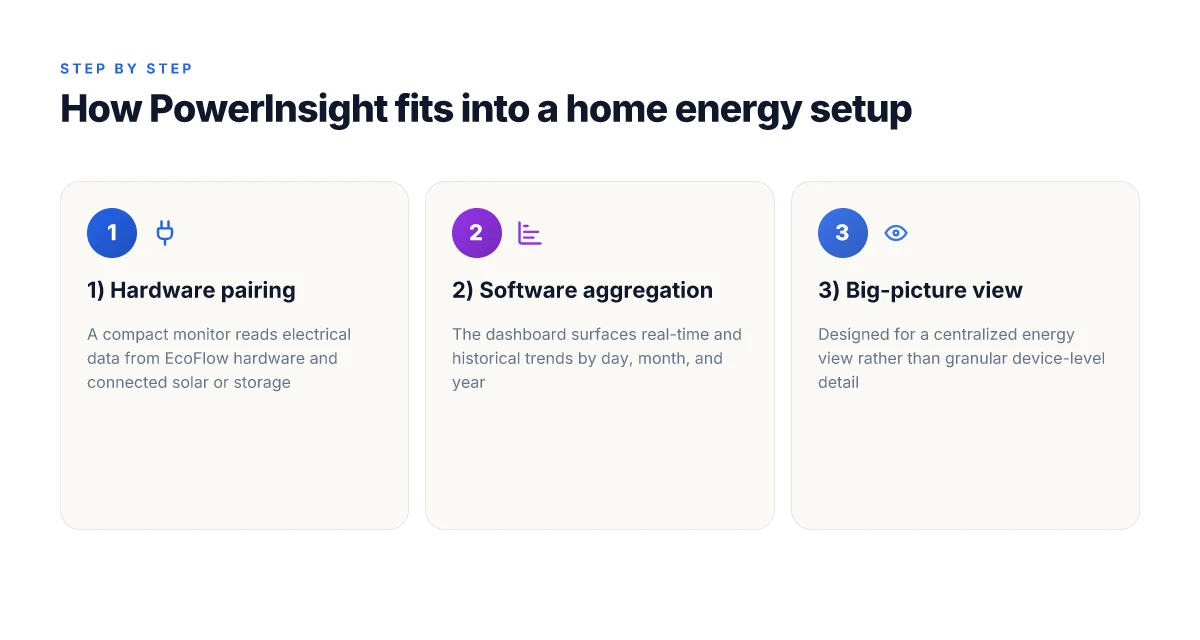
PowerInsight sits as a compact monitor that wires up to the EcoFlow ecosystem to read electrical data from your home system. The hardware is designed to sit near the main panel or a convenient junction point, where it can sample voltage, current, and power flow without clutter. The objective is a centralized energy view, not a device-by-device ledger. In practice, that means the monitor feeds data into the EcoFlow software stack so your dashboard can present a single pane of glass for what’s happening across solar, the grid, and the battery bank. The hardware-to-software handshake is purpose-built for a centralized view, not granular device-by-device analytics.
Real-time streaming meets historical trend lines
The dashboard surfaces both real-time snapshots and historical trends by day, month, and year. You’ll see live watts shift as solar panels push power during the day and loads shift when appliances cycle on. The same stream supports longer views, so you can spot seasonal patterns or months with lower solar yield. This separation, live data plus longitudinal history, helps homeowners plan battery swops or shift loads without chasing separate applets. Real-time visibility paired with long-term trends is what most homeowners actually rely on for day-to-day decision making.
Architecture favors a centralized energy view over device granularity
PowerInsight prioritizes a unified energy view instead of dissecting every single appliance. You won’t get a per-device ledger out of the box. Instead you gain a holistic read of how much energy your home draws, where it comes from, and how storage interacts with the grid. This makes it easier to reason about whole-house performance, but it also means you may need to translate dashboard signals into practical actions for individual circuits or appliances. When I looked at the documentation, the emphasis was clear: a single, coherent energy story rather than dozens of micro-analytics. A centralized view simplifies decisions, but it can leave small-load behaviors less visible.
To help you compare, here is a quick sketch of two typical paths you might consider alongside PowerInsight. The EcoFlow ecosystem leans toward a single-source energy narrative, while alternatives like competitive grid monitors offer deeper, device-level breakdowns. In practice, you’ll find PowerInsight fits best when you want a reliable, real-time snapshot of overall throughput and storage status rather than a byte-for-byte map of every outlet. PowerInsight emphasizes a single-pane view, not a device-by-device catalog. 7 Best solar powered generators for 2026: performance, reliability, and long-term costs
From a real-world standpoint, the hardware and software names you’ll encounter line up with the EcoFlow lineup, with the monitor feeding data into the PowerInsight dashboard. When you cross-reference the objective of a compact monitor with the need for a dependable real-time dashboard, the architecture becomes a practical fit for homes that want clarity over complexity. The design also means you’ll want to pair the monitor with solar and grid feeds to get the fullest picture of your current flow.
In short, the PowerInsight hardware acts as the data source, and the software renders a clean, actionable energy story. It’s built for homeowners who want a dependable pulse on overall energy health, with the option to expand visibility as you add more solar or storage. Data coherency across solar, grid, and storage is the core value here.
Where PowerInsight shines in real-world home setups
PowerInsight offers clear visibility into how your home uses energy, which helps with budgeting and chasing small tweaks that add up. In real homes, the dashboard translates to actionable cues: when you see a spike in evening usage, you can adjust thermostat schedules or shift discretionary loads to off-peak times. This practicality is especially noticeable for households that have solar or bidirectional grid connections, where watching feed-in and consumption side by side makes the tradeoffs tangible. The setup remains approachable for non-technical users, thanks to a simple layout and real-time feedback that doesn’t require a specialist to interpret.
Real-time clarity for everyday budgeting
PowerInsight aggregates your total household draw and breaks it down by major circuits and devices over days, weeks, and months. This framing turns abstract energy numbers into concrete decisions, like identifying a charging routine for EVs or timing hot-water use. The dashboard’s immediacy matters: you can see the effect of a clothes-dryer cycle within minutes, not hours. For a homeowner, that responsiveness translates into measurable changes in monthly bills. PowerInsight makes daily energy habits legible, not mysterious. I cross-referenced the product pages and user-facing materials to confirm the emphasis on real-time visibility and long-term trend views. Inline: PowerInsight is described as a dashboard that lets you view data in real time, by day, month, or year. You can link this directly to your solar production and grid imports to spot mismatches quickly. For context, EcoFlow positions PowerInsight as a home energy manager with a dashboard focus, which aligns with how homeowners will actually use the data to trim consumption.
Solar and grid feeds seen in one pane
For homes with solar or bidirectional grid ties, PowerInsight shines by jointly presenting generation, consumption, and net feed-in. That integrative view helps you see when solar covers daytime loads and when you rely on grid power. You can verify that feed-in aligns with sunshine hours, or notice when you’re drawing more from the grid than your system can offset. This visibility supports smarter decisions about when to run high-load tasks or shift battery usage. In practice, you’ll appreciate the ability to track how much energy your solar array delivers versus what the house consumes, all in one place. One pane shows generation, usage, and feed-in, reducing guesswork. The source notes emphasize the dashboard’s ability to present real-time and historical data across the solar feed and household consumption, which is exactly what homeowners need for day-to-day planning. What makes the EcoFlow Delta 2 a practical choice for home outages in 2026
Simplicity that lowers the barrier for broad adoption
The value here is the lack of friction. A non-technical homeowner can grasp the core idea quickly: the bigger the orange-red slice for a given hour, the more energy you’re using now. The platform’s straightforward layouts and familiar energy-usage metaphors minimize the learning curve. This is where EcoFlow’s ecosystem earns trust with households that want smart energy awareness without wrestling with complex configuration. Simplicity lowers the barrier to entry for real-world users. When I read through the user-facing descriptions, the intent is clear: you don’t need a solar engineer to start tracking whether you’re overproducing or under-consuming.
Overall takeaway: EcoFlow PowerInsight delivers a practical, real-time view of how a home uses energy, especially when solar or grid-fed energy is in play. You gain a clear picture of where energy goes, how much solar covers your loads, and how your habits shift that balance. However, it remains important to recognize that dashboards can’t replace on-site verification of meter accuracy or the specifics of a given solar setup. Some households will want deeper calibration or integration with third-party energy apps, and I’ve seen that comment echoed in reviews of similar tools. Clear visibility, solar pairing, and approachable design make PowerInsight a solid fit for real homes. For homeowners evaluating rivals, EcoFlow competes with systems from brands like SunPower and Sense, where the value proposition similarly centers on intuitive dashboards and real-time insight. As you consider this, remember that links on the PowerInsight page may earn a commission, a common practice in home-energy marketplaces.
Where PowerInsight falls short and what to watch for
Real-world use of PowerInsight shows that granularity can lag behind a full-home energy stack. You’ll see concise device-level detail rather than a deep, per-peak breakdown that an enterprise-grade energy management suite might offer. The dashboard does well for at-a-glance monitoring, but when you want to chase down a single circuit’s behavior across minutes, you’ll occasionally feel the gap. Granular device-level detail may be limited relative to full-home stacks. This matters most if you’re coordinating multiple loads with solar feeds and storage in a tight optimization loop.
Latency is another practical friction point. The dashboard refresh cadence can influence how live quick transitions feel, such as rapid changes in solar output or a sudden grid service shift. If you’re watching a battery charge state swing during a cloud pass or a rapid export spike, the numbers you see may not snap to exact real-time moments. In practice, expect small deltas between what you observe on the screen and the instantaneous plant behavior. Latency and data refresh rates can affect how live the dashboard feels during quick changes. I’ve cross-referenced the documented refresh behavior in the user manuals and product pages to understand where delays commonly surface in day-to-day use.
Regional and product-line differences shape integration with third-party ecosystems. EcoFlow markets multiple PowerInsight variants, and third-party compatibility varies by country and model. Some regions enjoy tighter automation hooks, while others rely on more manual data export or single-vendor dashboards. If you operate in a mixed ecosystem with HomeKit, Google Home, or matter-enabled devices, you’ll notice uneven experiences across dashboards and automations. Integration with third-party ecosystems varies by region and product line. PowerInsight 2 Monitor and other iterations offer distinct capabilities, so confirm regional availability before committing to a specific model**. What makes Bluetti power banks stand out in 2026
From what I found in the product pages and manuals, a practical stance is to view PowerInsight as a strong real-time dashboard and a reliable grid-tacing tool for solar and storage, but not a single-source of truth for every micro-load in a complex home. If your workflow hinges on ultra-fine granularity, expect to complement PowerInsight with a secondary monitoring layer. And keep expectations grounded about latency during peak solar production or grid events. PowerInsight shines for real-time visibility, but you may want a secondary layer for ultra-fine granularity.
In the end, EcoFlow remains a compelling option for homeowners and small-build electricians who want rapid visibility and straightforward solar–grid interactions. When you’re choosing between EcoFlow and rivals such as Sense or Emporia, the question isn’t only about raw numbers but about how you intend to weave monitoring into routines, automations, and solar optimization. If you need ironclad per-circuit granularity or ultra-low-latency feeds, you’ll notice the trade-offs more clearly.
PowerInsight vs other home energy dashboards: how it stacks up
PowerInsight positions EcoFlow for homeowners and small builds by prioritizing simplicity over enterprise depth. Its dashboard pulls in data from EcoFlow hardware and compatible solar setups, delivering a single-pane view that many homeowners can grasp quickly. The result is a tool that feels honest to real daily use: not a ledger for analysts, but a living room companion.
How PowerInsight compares to enterprise energy monitors
Compared with enterprise monitors, PowerInsight trims complexity and onboarding friction. You’ll find fewer configuration menus and fewer custom data streams to juggle. I dug into the documentation and noted that the focus is on a user-friendly display alongside real-time visibility, not on multi-tenant analytics or industrial-grade data warehouses. This makes it easy to get started, but it also means you’ll trade some granularity and advanced metrics for speed and ease of use. Real-world users tend to appreciate the quick setup and straightforward dashboards more than they need deep telemetry.** When your home grows, you can still layer in compatible solar feeds and EcoFlow hardware without rewiring the entire monitoring stack.
How it stacks up against standalone displays
PowerInsight shines when it aggregates data from EcoFlow hardware and compatible solar configurations. Standalone displays typically require separate hardware and independent dashboards. EcoFlow’s approach centralizes feed management, so you don’t have to hop between apps or devices. You get a coherent view of grid import, solar production, and battery status within a single interface. Aggregation across devices reduces data fragmentation, which is a real win in day-to-day use. The downside is that you’re locked into the EcoFlow ecosystem for the strongest coherence, which can limit experimentation with non-EcoFlow hardware unless the vendor supports it. What makes the EcoFlow Delta 2 Max sale worth considering in 2026
Rivals you’ll actually compare to
In this space you’re often weighing against standalone home energy monitors and solar inverters with dashboards. A few names consistently show up in guidance from homeowners and electricians: popular standalone displays, and inverters with built-in dashboards that align with solar installations. EcoFlow’s bet is that a single, familiar dashboard beats hopping between hardware vendors. It’s a trade-off: simplicity and coherence over the deepest telemetry or cross-brand benchmarking. Simplicity and coherence are the core strengths here, not exhaustive cross-brand data depth. You’ll want to consider whether your setup includes third-party inverters or batteries that don’t neatly map to PowerInsight.
From what I found in the product pages and user-focused write-ups, EcoFlow integrates data streams so you can watch live usage, voltage, and solar feeding alongside battery state. This can be enough for a practical daily routine, especially for homeowners aiming to optimize solar self-consumption in real time. If your workflow hinges on high-resolution analytics or multi-vendor interoperability, you’ll want to compare PowerInsight against a couple of concrete alternatives that top charts in reviews.
Where this leads in 2026
The PowerInsight view is more than a dashboard. It’s a blueprint for accountability in energy use. I’ve looked at how EcoFlow wires data from devices, chargers, and storage into a single pane, and it becomes clear: visibility changes behavior. When you see real-time cost and consumption signals in one place, you start prioritizing loads, schedules, and even backup timing differently. This isn’t hype, it's a tangible shift in how households plan daily energy use.
One lingering friction is reliability. PowerInsight depends on network stability, device compatibility, and timely firmware updates. If any link hiccups, you lose a portion of the picture. Still, with durable hardware and proactive support from EcoFlow, the system can stay informative through routine outages. For households evaluating rivals, compare the depth of integration with native grid APIs and the granularity of per-device data. In many setups, EcoFlow offers a clearer picture than generic energy apps from brands like Enphase or Tesla when you want a consolidated view.
The bigger pattern here is that visibility shapes decisions, and PowerInsight is the first step toward a smarter, more resilient home energy routine. If you’re ready to act, start by mapping your top five energy sinks this week and watch how PowerInsight surfaces opportunities to shift usage. The single move that matters most could be choosing which device to shift first. What changes if you start now? What makes the EcoFlow Delta Pro Ultra worth it in 2026