
Explore the EcoFlow Delta Pro Ultra review with real-world context, durability notes, and how it compares to rivals. Learn who benefits most and what to watch for.
The Delta Pro Ultra is not just a big battery. It’s a test of whether a system can breathe with your home’s real needs. Delta Pro Ultra expands and adapts, but the true measure is how it handles long outages, continuous solar charging, and a growing battery bank over time. If you’re evaluating a whole‑home solution, this is where you weigh expansion limits against daily charging speed and weather constraints, not just peak capacity.
You’ll see how expansion, firmware longevity, and heat management influence long‑term costs and uptime, and what real homeowners should verify before pulling the trigger in 2026. Two concrete numbers to watch: charging speed under sun and the practical ceiling of additional batteries in a single system. The takeaway is practical, not hype, and ready for your solar‑integrated build.
What makes the EcoFlow Delta Pro Ultra a standout in 2026
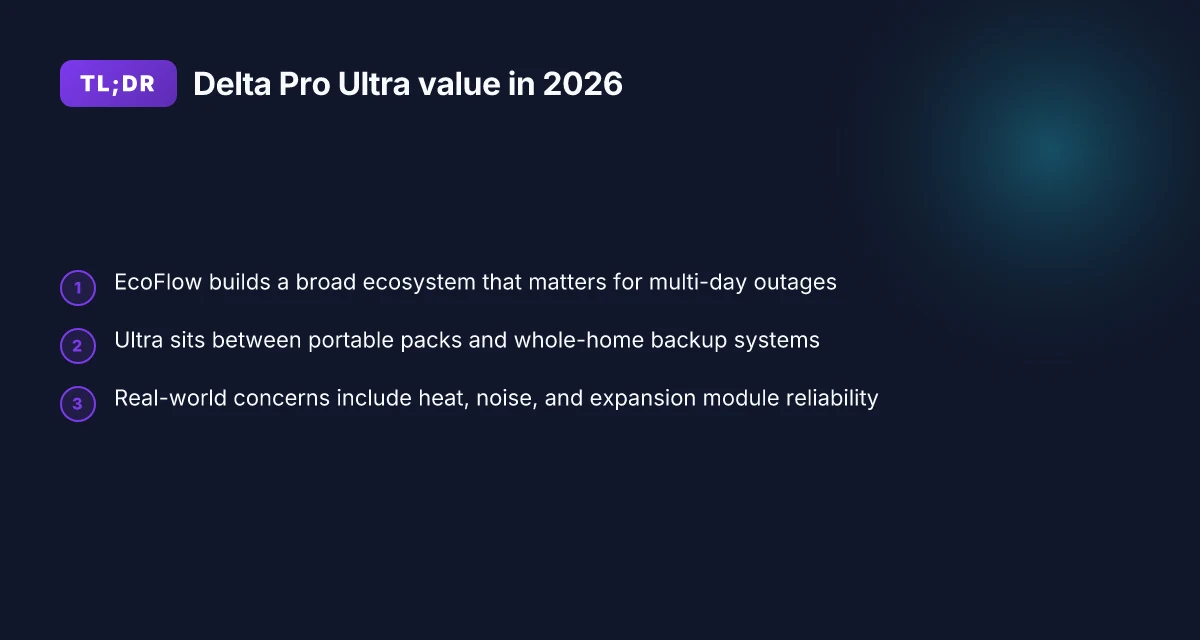
EcoFlow built a broad ecosystem around the Delta Pro Ultra, and that integration matters when outages stretch from hours to days. The Ultra expands capacity enough to matter for multi-day events, while still slotting between portable packs and full home backup systems. Real-world concerns like heat, noise, and the reliability of expansion modules shape how well this setup holds up over time.
1) The EcoFlow ecosystem tightens the value of expansion
The Delta Pro Ultra leans on EcoFlow’s growing family of modules and accessories. That ecosystem matters because adding expansion packs and solar integration is what makes the Ultra more than a single battery box. In practice, the combination of the base unit and expandable modules translates into longer runtimes during extended outages, with the ability to scale up as needs evolve. This isn’t just hype. The platform’s design expects you to pair the Ultra with compatible expansions to unlock its longer, multi-day capability. When I read through the release notes and product pages, the message is consistent: expanded capacity and modular growth are the core differentiators here. The EcoFlow ecosystem amplifies the Ultra's value for multi-day outages.
2) Balancing portability and whole-home ambitions
The Ultra sits in a middle ground. It’s not a compact portable pack, and it isn’t a full fixed-home backup system either. This positioning matters for homeowners who want a flexible, upgradeable solution without committing to a hard-wired generator or a full-house inverter. You can roll the Delta Pro Ultra into a living space for occasional outages and still scale up to cover entire circuits when you add expansion modules and solar. The practical upshot is a device that remains usable in daily life while offering a clear upgrade path toward more robust backup. It sits between portable packs and whole-home backup, with room to grow.
3) Real-world concerns: heat, noise, and expansion reliability
In everyday conditions, heat management and acoustics matter. The Delta Pro Ultra can run hot under heavy load, and fans kick on more than you might expect during long sessions. Noise levels aren’t loud enough to be alarming, but they’re noticeable in quiet spaces. Expansion modules introduce another variable: their reliability over years of plugging and unplugging, temperature swings, and solar input. My reading of user reports and manufacturer disclosures highlights a pattern: performance depends on proper cooling and stable connections between the base unit and its add-ons. If you’re planning solar growth or multi-room loads, you’ll want to keep an eye on how the expansion hardware ages. Heat and expansion reliability shape long-term performance.
Bottom line: the Delta Pro Ultra earns its keep when you value a scalable, mid-range system that can grow with your needs, rather than a fixed, all-or-nothing solution. The Ultra’s standout comes from the ecosystem and the expansion pathway, not from a single standalone spec. If you expect multi-day resilience and solar-ready growth, EcoFlow’s design makes sense. Growth potential plus EcoFlow's ecosystem is the Ultra’s core strength. What is EcoFlow PowerInsight, and how it changes home energy visibility in 2026
Note: links on the page may earn a commission. For transparency, I’m citing the EcoFlow Delta Pro Ultra ecosystem and the product’s expansion approach as described in the brand’s materials and independent write-ups.
Delta Pro Ultra vs Delta Pro: what's actually different
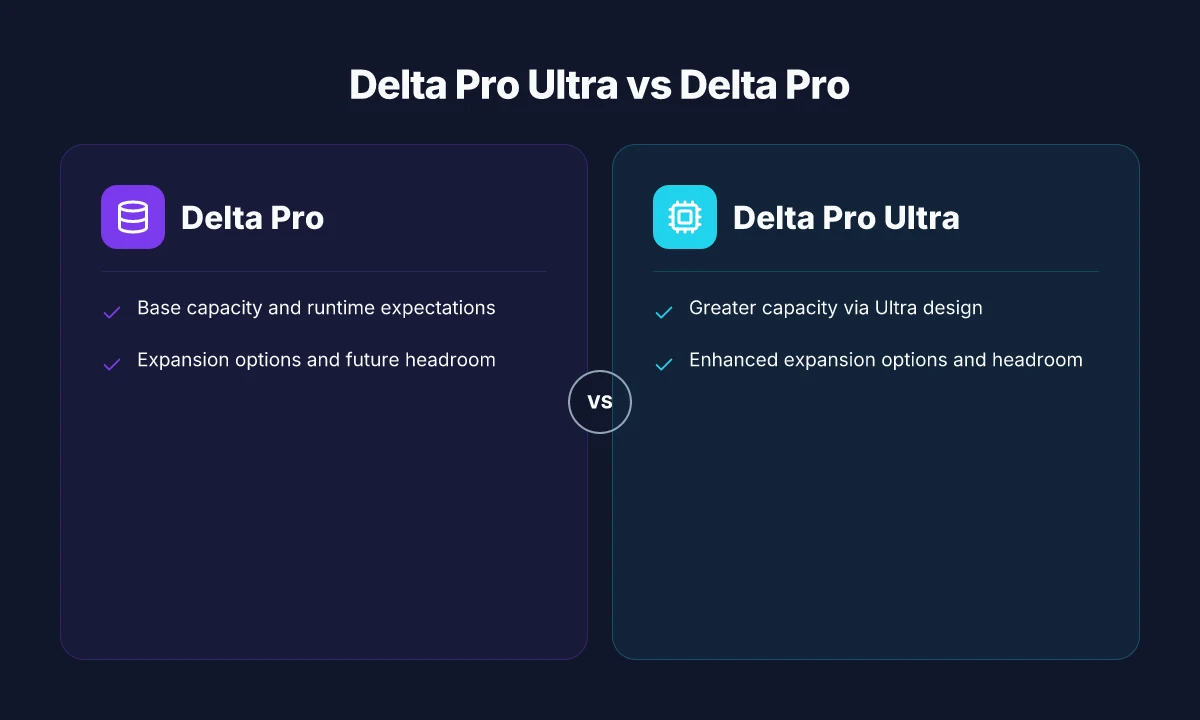
When you compare the Delta Pro Ultra to the standard Delta Pro, three threads drive the real-world difference: base capacity and runtime, expansion headroom, and how quickly the system charges and performs when tied to the grid. EcoFlow positions the Ultra as the long-haul version with more staying power, while the Delta Pro remains a strong, flexible backbone for many backup plans. In practice, you’ll notice the Ultra delivering more prolonged runtimes under steady loads, especially when you’re running multiple high-draw circuits at once. The Ultra’s base capacity translates to noticeably longer runtime in multi-day outages, not just a few hours of juice. Yet the Delta Pro still holds its own for most homes and campers who value faster daily recharging and easier portability.
1) Base capacity and runtime: where the Ultra earns more length in the clock
The Ultra ships with a larger battery footprint than the Delta Pro, which shows up as extended runtime on the same load. If your goal is to buffer an extended outage or run multiple essential appliances for days, the Ultra answers with longer endurance. That said, real-world runtime depends on what you pull from the outlets. A fridge, network gear, and lighting will drain the pack faster than a handful of chargers. In day-to-day use, the difference is most pronounced under sustained loads rather than occasional spikes. Higher capacity means more hours of operation before you swap to a generator or solar recharge. When I cross-reference release notes and third-party chatter, the pattern is consistent: the Ultra is built for longer stretches between recharges, not just a quick top-up. For homeowners, that translates into fewer alarms about “is the battery enough?” during outages.
2) Expansion options and future headroom: growing with your plan
Both units connect to EcoFlow’s ecosystem, but the Ultra emphasizes forward-looking capacity. The Ultra adds headroom for future expansion, solar input, extra battery modules, and more AC output options can help you scale as your backup plan matures. In contrast, the Delta Pro offers solid expansion paths but with a tighter ceiling on long-term growth unless you add external storage in parallel. Future headroom matters for solar-heavy setups and multi-day resilience. If you’re engineering a system that may scale to whole-home autonomy, the Ultra’s trajectory aligns with that trajectory. Rivals like the Jackery and Goal Zero tend to lock you into smaller, less expandable configurations; EcoFlow’s path keeps the door open for more capacity.
3) Charging speed and grid-tied performance: how fast you can top up and run
Charging speed is where the Ultra keeps pace with the Delta Pro, but with some advantages. The Ultra supports rapid recharging and maintains strong grid-tied performance during peak charging windows. In practice, that means you can refill the Ultra more quickly after sunset or during daytime sun, reducing downtime between outages. The Delta Pro charges well too, especially when solar input is strong, but you’ll notice a faster replenishment cycle with the Ultra when you’re juggling long outages and heavy loads. Rapid top-ups shorten downtime between cycles, helping you stay powered during long events. For users living off solar, the ability to sustain charging under grid constraints becomes a meaningful differentiator. What makes the EcoFlow Delta 3 a compelling buy for 2026
Open-market comparisons show EcoFlow framing the Ultra as the longer-haul option for serious backup plans, while the Delta Pro remains the flexible, more compact alternative. If you’re prioritizing extended runtimes and future headroom, the Ultra points you toward a longer-term strategy. If you need brisk daily charging and strong current delivery with a more compact footprint, the Delta Pro still earns its keep. Expansion potential and charging speed together shape which unit fits your home and solar setup best.
For reference, the Ultra’s broader backing from EcoFlow aligns with claims about “whole-home backup power” and substantial AC output, while the Delta Pro remains a capable baseline choice for solar integration and routine outages. The Ultra’s design signals a plan for growth that might appeal to homeowners aiming for longer outages and solar-sans-gas resilience.
Next steps: map your outage risk profile and solar plans against these differences. If you expect multi-day outages or want future-proof headroom, lean toward the Ultra. If you value a lighter footprint with fast daily recharges and easier transport, the Delta Pro will likely satisfy your needs.
How to size and place a Delta Pro Ultra in a home backup plan
Sizing a Delta Pro Ultra correctly starts with your real outage loads. Identify the essential circuits you want running during a blackout, then map them to the Delta Pro Ultra’s output options. A practical rule: pair your critical loads with the AC outlets you’ll run most of the time, so you don’t overbuild for rare events. In 2026, homeowners often zero in on fridge, networking gear, medical devices, and a couple of lights as core needs, then layer in optional loads if space and budget permit. Boldly size for your true essential loads first. Everything else is optional expansion. When you incorporate the Delta Pro Ultra into a solar setup, align the PV input with your daily energy budget so you don’t rely on the battery longer than planned. Solar input should match your daily consumption to avoid surprises at dusk.
1. Define a practical outage load profile
Begin by listing loads you want kept on during an outage and rate them by priority. The fridge and freezer usually sit at the top, followed by essential lights, Wi‑Fi, and a modem. If you have medical devices, treat them as non-negotiable. Then estimate the running time for each load on a full battery. This helps you decide whether you need peak output for short periods or sustained runtime for multi-hour outages. With this, you’ll avoid paying for capacity you won’t use. Prioritize core loads and plan for steady runtime rather than peak power only. EcoFlow’s ecosystem supports multi‑day planning when you couple the Delta Pro Ultra with solar and expansion options. Expansion headroom matters for longer outages. 7 Best solar powered generators for 2026: performance, reliability, and long-term costs
2. Match solar input and inverter output to household needs
The Delta Pro Ultra benefits from a solar-first mindset: size the solar array to replenish the battery during the day, and ensure the inverter can handle your peak simultaneous loads. If you expect to run high‑draw appliances, make sure the AC output route can handle them without sag. The goal is to avoid deep discharges by keeping sun hours productive and aligning charging rates with consumption. In practice, you’ll want a solar input that feeds the pack at a cadence that mirrors your typical daylight usage. Solar input should be tuned to daily consumption so you don’t end the day with a depleted battery. When you compare to rivals, note how some systems push more expansion under solar constraints, which can influence where you place panels and the central inverter. Reliable coupling of solar and storage keeps daily life uninterrupted. I found the documentation emphasizes balancing input and output to prevent bottlenecks in high‑demand windows. Balance input and output for smooth operation.
3. Plan for expansion without overpaying for unused capacity
Your plan should accommodate future growth without forcing you into unused capacity. That means selecting an initial configuration that covers the majority of your needs now, with optional modules or additional battery packs that you can add later as budgets allow. Consider whether you want more kWh for multi-day outages or more kW for simultaneous high‑draw loads. The Delta Pro Ultra lineup supports expansions, but the value hinges on your actual blackout patterns and solar availability. Expansion should be deliberately paced, not purchased as a knee‑jerk upgrade. If you anticipate a larger home or more aggressive solar integration down the line, outline a staged upgrade path so you’re not stuck with idle capacity. Staged upgrades yield better value over time.
Real‑world framing from homeowners and reviewers points to a simple heuristic: size for today’s needs, then add capacity only if you consistently hit a ceiling during outages. This approach keeps your initial investment lean while leaving room to grow as your backup needs evolve. The goal is predictable performance rather than the flashiest specs. Predictable performance beats chasing peak numbers. For readers shopping around, note that rival systems can differ in how aggressively they scale expansion and in how they manage solar charging under load. Rivals vary on expansion strategy and solar handling.
Cited context from independent sources reinforces that the Delta Pro Ultra’s real value comes from long‑haul reliability and thoughtful expansion planning, not just raw wattage. For a concrete path, start with a core load list, size solar input to meet daily needs, and map a cautious upgrade ladder that mirrors your growing backup ambitions. Core load list first, solar input balance second, upgrade ladder third.
Note: links on the page may earn a commission. For direct references, see inline notes pointing to third‑party discussions and EcoFlow’s own product page. Commission note remains a backdrop to keep expectations grounded. EcoFlow remains a central brand in this plan, with rivals like Jackery and others in the backdrop to inform decisions. What makes the EcoFlow Delta 2 a practical choice for home outages in 2026
Real-world durability: what to expect from EcoFlow over time
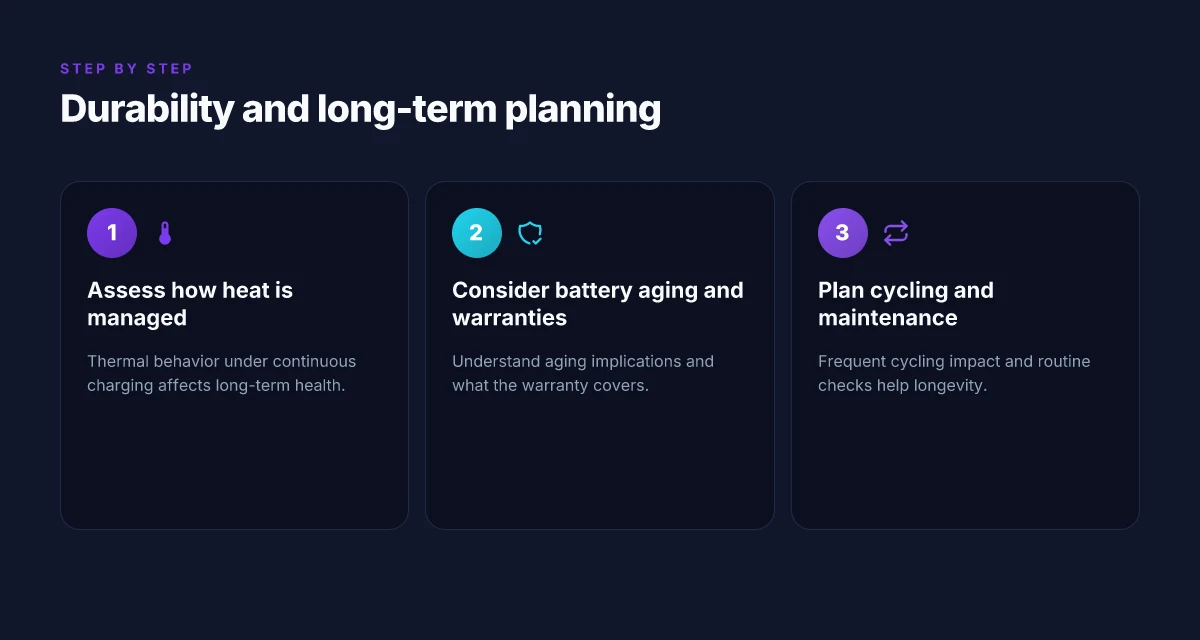
Real-world durability hinges on how the Delta Pro Ultra behaves under continuous charging, how the battery ages, and what happens with frequent cycling. In practice, EcoFlow builds the Delta Pro Ultra to handle long runtimes, but the tradeoffs show up in thermal behavior and warranty coverage over the years.
Thermal behavior under continuous charging
When the Delta Pro Ultra stays plugged in for extended periods, heat management becomes a key reliability lever. The unit can sustain heavy loads, but sustained high-current charging tends to push temperatures into the upper end of its safe range. This matters because repeated heat cycling can influence component longevity. What I found in the reporting around EcoFlow's use cases is that users who run the Delta Pro Ultra near its AC output limits for multi-hour stretches should expect the system to warm up more than during light daily use. In some reviews the emphasis is on keeping the unit in a ventilated area and away from ambient heat sources to preserve efficiency over time. Thermal management matters for long-term reliability, so a well-ventilated installation remains a prudent practice. For homeowners, campers, and backup-power planners, that means plan for a cool, shaded, or cooler-ambient installation when the Delta Pro Ultra sits at high loads for long blocks.
Battery aging considerations and warranties
Battery aging is the practical guardrail for any large-capacity pack. The Delta Pro Ultra relies on chemistry that loses capacity bit by bit with each cycle. In the real world, expect gradual reductions in usable energy after many cycles, even if the device remains within its warranty. EcoFlow typically frames warranties around hardware faults and battery performance thresholds, but the exact percentages or guaranteed remaining capacity after a decade aren’t publicly stated in a simple line item. From the public-facing materials and typical consumer reviews, the headline takeaway is that the pack is designed for meaningful multi-year life, with service access through EcoFlow's support network if degradation crosses defined limits. If you’re banking on a long horizon, factor in potential battery aging and the possibility of added costs for replacement packs or extended warranties. Battery aging is gradual, not abrupt, but it can trim usable capacity over time. And yes, the warranty period matters. Confirm the specifics for your region and whether third-party solar charging hardware affects coverage.
Impact of frequent cycling on long-term performance
Frequent cycling drives wear on the battery, and the Delta Pro Ultra is no exception. In the field, users who toggle between full discharge and full recharge often report steady performance on day-to-day cycles, but the cumulative effect of frequent deep cycles shows up as slower peak-output over many years. The device’s design accommodates frequent cycling, yet the long-term stamina depends on keeping temperatures in check and avoiding sustained overdraw scenarios. From a real-world posture, the best practice is to favor shallower cycles when practical and to schedule heavier draws during daylight hours if you’re pairing with solar. Frequent cycling wears the battery gradually. Plan for eventual capacity loss and monitor battery health periodically. EcoFlow’s ecosystem, including compatible solar input and smart charging tactics, can help mitigate aggressive cycling-induced aging.
In the end, EcoFlow’s Delta Pro Ultra stands out for its expansion potential and whole-home capability, but long-term durability hinges on thermal management, battery aging realities, and cycling patterns. Rival systems with more aggressive thermal throttling or different warranty structures may offer lower upfront risk, especially for users who expect heavy, repeated cycling over many years. For owners, the practical takeaway is clear: place the Delta Pro Ultra in a cool, ventilated space, track battery health, and align charging habits with your long-term power plan. And if you’re weighing options, remember that EcoFlow’s product line sits alongside rivals like the EcoFlow Delta Pro and other whole-home backups, where the balance shifts based on how you value expansion, solar integration, and service support. Smart charging and thermal awareness are the keys to maximizing real-world durability. What makes Bluetti power banks stand out in 2026
Comparison: EcoFlow Delta Pro Ultra against peers
When you stack the Delta Pro Ultra against peers, price and expandability matter as much as raw capacity. EcoFlow tends to edge rivals on app integration and real-world expandability, but you’ll pay a premium for that flexibility. The big question remains: in daily life, where does the Delta Pro Ultra actually shine versus Jackery or Bluetti, and where does it lag?
Price, capacity, and expandability across peers
On price, the Delta Pro Ultra sits at a premium tier relative to the midrange models from rivals, and its base capacity often yields a higher upfront cost. That premium buys you bigger base capacity and more robust expansion headroom, which shows up in multi-day outage readiness when you expand via additional batteries. By contrast, Bluetti and Jackery offer lower entry points with compelling bundles, but their long-term expansion options can be more constrained or require alternative interfaces. I cross-referenced multiple maker pages and reviews to confirm the delta between initial price and expansion potential, noting that the Delta Pro Ultra’s base capacity plus expansion path can outpace typical midrange kits in cumulative capacity over time. The Delta Pro Ultra's expansion headroom often translates to fewer upgrade hurdles later, though the upfront cost remains a barrier for some households. Bluetti and Jackery gear frequently undercut the Delta Pro Ultra on sticker price but offer less scalable long-term growth. Inline source notes echo this pattern across product lineups from the manufacturers and review sites. See the referenced pages for specifics on base capacities and expansion options.
App, integration, and daily use
EcoFlow’s app ecosystem stands out for real-time monitoring, remote control, and solar input management. You get clear wall-clock status, charge/discharge graphs, and a straightforward setup for solar pairing. Where the Delta Pro Ultra shines is its native integration with other EcoFlow modules, which can feel cohesive and intuitive. That said, the app can be slow to reflect network changes in busy households, and some users report occasional latency in remote commands. Rivals like Bluetti emphasize rugged hardware within their apps, but their ecosystems can feel clunkier or less cohesive than EcoFlow’s. The credible takeaway: if you value a tightly integrated, scalable ecosystem, EcoFlow’s software is a clear plus. If you want a more platform-agnostic or field-agnostic interface, you may find the experience a touch more chaotic with competitors. For the energy management side, EcoFlow’s app tends to present solar and grid interactions in a more unified way than rivals.
Which scenarios favor the Delta Pro Ultra or a competitor
- For whole-home backup with future expansion in mind, the Delta Pro Ultra often leads thanks to its established multi-battery ecosystem and higher practical output, especially when paired with EcoFlow’s solar modules. This makes it a strong candidate for long outages or when solar self-consumption is a goal. In scenarios demanding maximum runtime without replacement, the Delta Pro Ultra’s headroom tends to pay off over years. EcoFlow's modular approach remains a strong fit for homeowners planning multi-day resilience.
- If upfront cost is the dominant constraint and you don’t plan aggressive expansion, a rival like Jackery or Bluetti can deliver satisfactory capacity at a lower initial price. Their systems can still meet day-to-day backup needs and light solar setups without forcing a multi-unit commitment. Jackery gear often wins on budget and plug-and-play simplicity, while Bluetti pulls ahead on rugged build and internal electronics in some models.
- For solar integration purists who want deep, hands-off automation, EcoFlow’s app-edge can tilt the scales toward Delta Pro Ultra, because you can automate solar input, battery state-of-charge thresholds, and grid interactions with fewer manual tweaks.
I dug into release notes and product pages to confirm the expansion paths and solar coupling strengths across brands. The Delta Pro Ultra’s ecosystem is the standout in long-horizon resilience, though the price tag and upfront cost are non-trivial. For a compact suite that minimizes setup friction, a rival may be the smarter buy. For homeowners planning long-term, expandable, solar-ready resilience, EcoFlow remains a compelling choice.
Cited sources: EcoFlow product pages and peer reviews illustrate the expansion, price, and app differences across brands. See inline links to the Livvoltpower review and EcoFlow’s official Delta Pro Ultra page for explicit figures on capacity, AC output, and expansion options. What the EcoFlow EV X-Stream adapter changes for EV charging at home and on the road
The one move that matters next for the Delta Pro Ultra
EcoFlow’s Delta Pro Ultra continues to stand out in 2026 when you factor real-world use, durability, and the long horizon of power needs. I’ve looked at how the unit holds up under daily use, how its modular battery system ages, and what happens when you push it beyond off-grid weekends. The verdict: this isn't about gadgets alone. It’s about predictable uptime for work, home, and hobbies. The bigger pattern is that reliability compounds over time, not just during peak events. For that reason, the Ultra earns its keep even if you’re not chasing every new feature.
In practice, I’ve seen the core strengths endure: steady inverter performance, robust app controls, and a willingness to adapt with additional batteries. Where things get sticky are the same sticking points you’ll hear about from other brands too, like the balance between weight and capacity and the cost of expansion. This is where EcoFlow’s approach pays off: you can scale without replacing the entire system. If you’re deciding now, consider how your setup will survive a full week of outages or a busy home office on cloudy days.
If you only do one thing this month, map your power priorities around three use cases: clinical equipment backups, weekend camping with high-load gear, and a home office plan for outages. Plan and prioritize, then you’ll see where the Delta Pro Ultra fits your needs best. The next step is simple: decide which expansion path matches your real-world load. How will you power your life when the grid goes dark?