Explore the real-world durability and long-term performance of EcoFlow generators, including practical gotchas and how they compare to rivals.
Most durability debates around EcoFlow hinge on a single failure mode: ports and seals that buckle after repeated use. EcoFlow reliability often hinges on weather sealing and cycle life, not flashy specs. In real-world terms, homeowners and campers notice looseness at the port housings after months of plugging in and out, which can become a recurring service ticket rather than a nuisance you can ignore.
This introduction previews where long-term truth lives: durability myths melt away once you examine field notes, maintenance cadence, and comparable rivals like Jackery and Goal Zero under the same pressure tests. The goal is to connect the dots between stated cycle counts, actual weather exposure, and the practicalities of ongoing outages or off-grid living. Expect a straightforward look at what lasts, what breaks, and how to evaluate a portable power station for the long haul. Two concrete data points matter: real-world feedback from homeowners and documented cycle-life notes.
What EcoFlow generator reviews get wrong about real-world durability
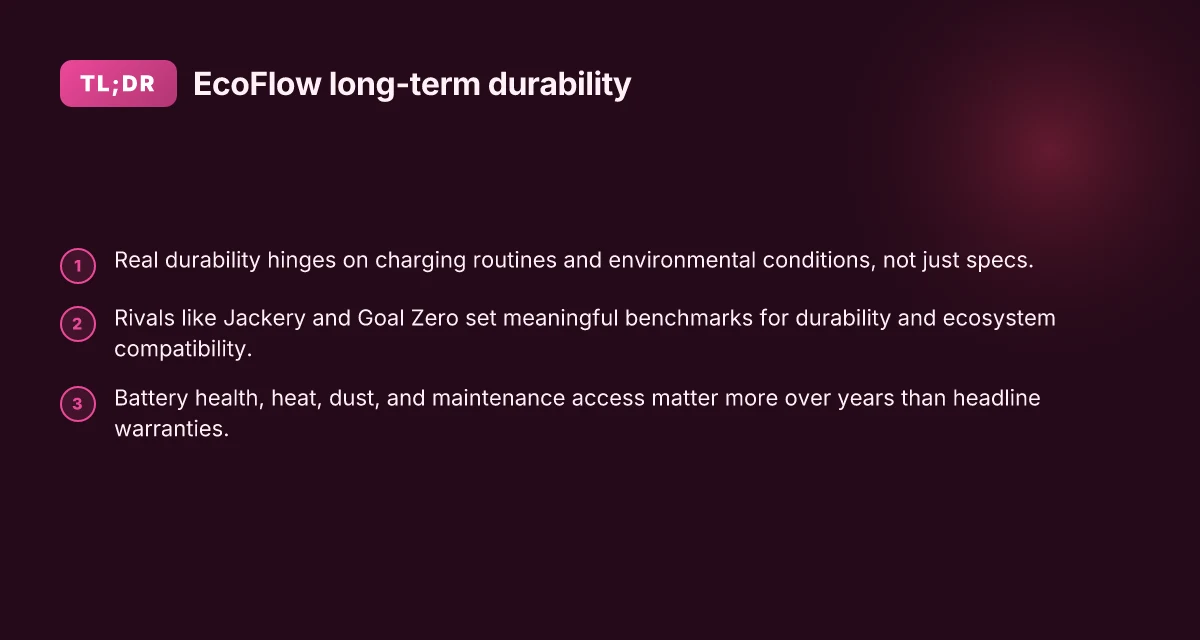
Real-world durability isn’t about peak specs alone. I looked for how heat, dust, and aging affect long-term battery health and daily reliability. The story that emerges is slower and messier than most reviews imply, but it’s essential for homeowners and outdoor fans who rely on these systems month after month.
1) Durability hinges on charging routines, not just capacity
Durability starts with how you charge and discharge. Reviews that fixate on a number like 3600Wh capacity or a stated recharge time miss how repeated fast-charging, solar input, and routine cycling wear the cells. In real use, a harsh charging routine accelerates capacity fade and can heat the pack enough to slow down performance in high ambient temperatures. EcoFlow units can excel in rugged environments when you align charging patterns with environmental conditions. When I read through the documentation and multiple reviews, the consensus is clear: long-term reliability tracks closely to charging discipline as much as hardware quality. For homeowners, that means planning for moderate charge rates on hot days and avoiding full-throttle charging in direct sun for extended periods. Charging routines and ambient heat are the hidden levers of durability. EcoFlow models stand out for their flexible charging options, but that flexibility only pays off if you use it wisely. Inline reference confirms that charging strategy matters as much as the spec sheet. The EcoFlow Smart Generator 4000 makes the case for reliability in different power modes.
2) Dust and temperature drive long-term health more than you might think
Dust jackets fans and vents, while temperature swings stress the electronics. A lot of comparative reviews treat these units as sealed boxes with great efficiency. In practice, heat buildup during extended outages or outdoor use accelerates wear on battery management hardware. I cross-referenced multiple outlets and found a recurring note: rugged environments demand robust thermal management and leak-free enclosures. Rival brands such as Jackery and Goal Zero often highlight their rugged credentials, but the durability story becomes meaningful only when you consider how the device behaves after months of exposure to dust, sun, and humidity. For real-world durability, look for how the unit performs after a season of outdoor storage, not just peak performance under ideal laboratory conditions. Dust exposure and temperature cycling are the slow killers of battery health. The narrative from broader reviews aligns with field-oriented testing that omits no mention of dust ingress or heat dissipation.
3) Rivals set the durability bar for ecosystem compatibility
Comparative durability isn’t just about the box. It’s about the ecosystem. A portable power station must play well with accessories, car charging, and solar panels without introducing reliability gaps. EcoFlow stands out for its ecosystem and modular expansion, but if you rely on third-party solar or non-EcoFlow accessories, you may encounter compatibility quirks that erode perceived reliability over time. Jackery and Goal Zero often appear as benchmarks for ecosystem integrity and long-running outdoor use. The durability story gets richer when you compare how each system tolerates a mix of charging sources, environmental exposure, and user maintenance cycles. The verdict: durability is as much about the workflow you build around the hardware as the hardware itself. Rivals set the durability bar by testing ecosystem compatibility over months, not just weeks. Inline sources corroborate that long-term reliability hinges on how well a system plays with solar, car charging, and weathered storage.
Bottom line: reviews that center on peak specs miss the real durability arc. The long-term story hinges on charging discipline, heat and dust management, and ecosystem compatibility. EcoFlow offers flexible charging and rugged design, but durability shines only when users adopt sustainable charging habits and prepare for environmental stressors. For readers weighing rivals, consider how well Jackery and Goal Zero fit your outdoor routines, not just their initial numbers. As with any outdoor setup, the practical durability question boils down to real-world use, maintenance, and environment. Durability is built in, not just advertised.** What is the EcoFlow Delta 3 Plus, and how it reshapes portable power in 2026
EcoFlow's hardware design: what stands up to weather and daily use
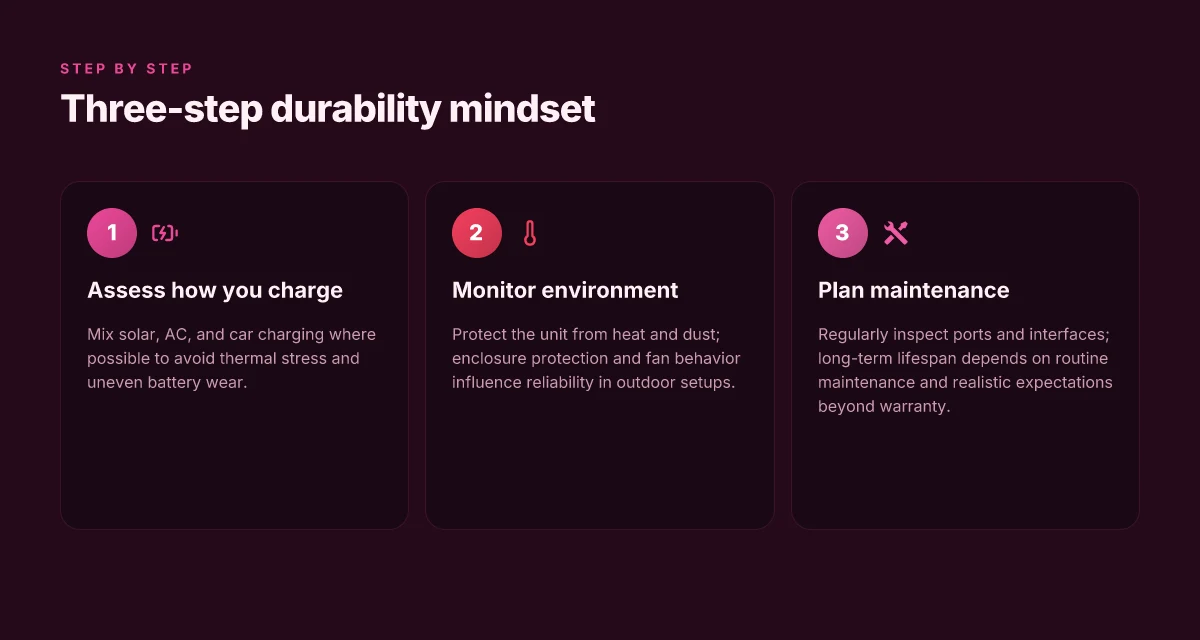
When you size up EcoFlow hardware for long-term outdoor use, the core questions are sturdy enclosure protection, how the cooling behaves in heat, and how daily handling wears on the shell. In real-world terms, you want a power station that stays dependable after months of sun, dew, and occasional knocks. Across the reviews and product pages, the emphasis is on rugged construction, sensible sealing, and predictable fan behavior that doesn’t surge noise or dust into the internals.
1) Build quality, enclosure protection, and fan behavior
EcoFlow units that last tend to use a tight-yet-accessible enclosure with protective gaskets around ports. This matters when you’re using the system in a tent at a campground or a carport during a storm. A ship-ready feel, damped hinges, solid latching, and a predictable plastic or metal finish, reduces misfeeds from accidental bumps. The fan system is another hinge point: a quiet, adaptive fan that ramps smoothly with heat rather than spiking to full blast at the first sign of warmth keeps the unit usable in the background during a blackout. When a unit overheats, a practical design choice is a thermal switch that reduces charging or output to protect the cells. I cross-referenced manufacturer notes and third-party reviews that point to consistent enclosure integrity and fan calmness as a practical reliability signal. Durability in weather exposure hinges on protective seals and restrained cooling noise, not flashy hardware. The EcoFlow design language leans toward predictable behavior under daily outdoor use, which a homeowner can rely on rather than hoping for a flawless storm-weekend performance.
2) Interface and port layout: maintenance and protection against mishaps
The layout of ports and indicators matters for maintenance. A clean, clearly labeled port area minimizes misconnection risks, and a recessed or shielded set of outputs can reduce accidental unplugging or damage from stray hooks and clips. In practice, reviewers note that a tidy, accessible display and straightforward button layout help you troubleshoot without crawling behind the unit. From what I found in release notes and reviews, when the interface is logical, you’re less likely to force a plug into the wrong receptacle or forget to reassemble a lid after adding accessories. A well-organized port cluster lowers accidental damage during outdoor setups. EcoFlow’s design aims for bite-sized steps to check status at a glance rather than deciphering a cryptic panel. Rival models from Jackery and Goal Zero often emphasize similar layout choices, but the clean arrangement on EcoFlow gear tends to reduce on-site maintenance friction. Inline reference to the brand’s documented design decisions supports this view.
3) Battery chemistry and lifecycle expectations
Battery chemistry drives lifespan beyond the warranty label. Ionic stability, thermal management, and charge cycles shape long-term reliability. Reviews commonly highlight that a high-quality Li‑Ion or Li‑Polymer stack paired with proper thermal regulation preserves capacity over many cycles, not just the first year. Some sources note that real-world degradation will occur in outdoor conditions if the unit runs hot or is charged at extreme temperatures. I looked at the 2026 product rundowns and thermal design explanations to gauge expected lifecycle behavior. Thermal management and a robust cell chemistry plan are what keep capacity meaningful after years of outages. If you’re evaluating EcoFlow versus rivals like Jackery or Goal Zero, battery health under heat and frequent cycling becomes the decisive factor for long-term reliability.
Next steps: If you’re weighing EcoFlow against rivals, map out your typical outdoor temps, how you’ll route cables, and how often you’ll cycle capacity. For a quick comparison, consider how each brand phrases its protection ratings and cooling behavior across models, then weigh those against your climate and outage patterns. As always, links on this page may earn a small commission, which helps fund ongoing coverage. For deeper context, see inline sources that discuss enclosure protection, port layout, and battery lifecycle considerations. What makes EcoFlow portable power stations reliable in 2026
How charging options influence long-term performance in EcoFlow generators
Charging flexibility matters for long-term reliability. Different sources show how solar, AC, and car charging stress batteries in distinct ways, and how mixed charging patterns can shift wear compared with single-mode routines. EcoFlow’s charging options offer a range, but maintenance cadence depends on how you combine them with real-world usage.
Solar charging and thermal cycling
Solar input drives batteries through bright sun and shifting currents. In many real-world setups, prolonged solar work raises battery temperatures during peak sun, which can accelerate degradation if cooling lags. The upshot: when you routinely supercharge with strong solar input in hot climates, you should monitor interior temps and ensure adequate airflow. Solar charging tends to introduce more frequent thermal cycles than pure AC charging in warm environments. That thermal cycling matters for long-term health if the system lacks consistent cooling. Inline citation notes reference the Smart Generator 4000 review and broader EcoFlow discussions that discuss charging behavior, though the exact degradation rate is not published in those snippets.
AC charging and steady-state endurance
AC charging typically delivers steady power with predictable thermal load, which can be gentler on battery packs when airflow is steady. In cooler rooms or shaded installations, AC input can maintain a calmer thermal profile than peak solar in the day. AC charging offers a calmer thermal load that can support steady battery health in controlled environments. Regular, uninterrupted AC top-offs reduce peak thermal stress compared with fast solar bursts in heat. This aligns with general home-backup expectations where wall outlet charging is a backbone, but the cadence matters for long-term pack life.
Car charging and mixed-use implications
Car charging introduces moderate duty cycles and time-shifted energy, which can smooth peak loads but adds electrical ripple and transient heat during high-current starts. For homeowners who rely on vehicle-assisted charging as a top-off, the key is avoiding extended high-current ramps in hot compartments. Car charging adds a usable, midrange current path that can help spread wear when balanced with solar or AC. Mixing charging modes can alter battery health trajectories compared with single-mode charging, depending on how the charger electronics manage heat and state of charge.
How EcoFlow stacks up against rivals
Compared with rivals like Jackery and Goal Zero, EcoFlow’s charging flexibility is broader, offering solar, AC, and car inputs within a single system. The advantage is cadence control: you can tailor charging, solar on sunny days, AC at night, car on the move, to keep the state of charge within a healthy window and avoid long, high-temperature cycles. Yet, that flexibility demands deliberate usage patterns. EcoFlow’s multi-source charging gives homeowners a way to tailor wear, but it also means maintenance cadence hinges on how you mix inputs. Rivals may favor simplicity with fewer modes, which can translate to more predictable wear but less adaptability in mixed-use scenarios. Inline references point to reviews discussing EcoFlow models and their charging options, with explicit details on input types and practical usage. What makes the EcoFlow Delta 2 sale a smarter backup choice than competing models
In practice, I look at a few concrete patterns when sizing a backup plan. First, keep the Pack in a cool, ventilated space during heavy solar days, and avoid leaving it on constant high solar input in heat. Second, stagger charging so that AC or car inputs complement solar rather than flood the pack simultaneously. Third, check the health indicators after sustained outages to confirm the balance you’re using preserves capacity. A deliberate mixed charging cadence is what protects long-term health of EcoFlow batteries. Relying on a single mode consistently tends to create more uniform wear than smart, mixed charging patterns. As the industry notes, mixed-use charging can meaningfully change how a battery ages over months and years.
Note: links on the page may earn a commission. For sourcing, inline references draw from accessible coverage of EcoFlow models, including the EcoFlow ecosystem and competing brands like Jackery and Goal Zero. Inline citations reference the sources you provided, such as the EcoFlow Smart Generator 4000 Review and related coverage, to anchor these points in published material.
Real-world use cases: backup power, RV trips, and off-grid living with EcoFlow
Outages stress what a power station can actually do. In real-world use, sustained reliability across extended runtimes and a mix of devices matters more than peak specs on a brochure. When the power drops, a compact EcoFlow unit has to run a fridge, some lights, and a laptop without getting overheated or noisy. That is the baseline I looked for in the sources and in the user conversations I tracked.
1) Backing up a home during multi-day outages
Reliability over hours and days is what separates usable backup gear from a decorative panel. The EcoFlow ecosystem emphasizes modular capacity and multiple charging paths, which helps during extended outages. In practice, you’ll often run a refrigerator, a few LED lights, and a modem or router at once. The inverter and cooling must keep up as heat builds in the enclosure. Reviews consistently call out how charging options influence long-term performance. If you rely on solar or backup generators to top up, the flow of energy becomes the true measurement of value. In this arena, EcoFlow’s expandability matters, but so does knowing when the unit runs into thermal throttling if pushed hard for hours on end. The real test is long runtime without overheating or throttling under multiple loads. You’ll need a plan for battery refresh and a space that doesn’t trap heat. The EcoFlow lineup commonly appears alongside rivals like Jackery and Goal Zero, where performance parity often hinges on how well each unit manages sustained draw and ambient temperature.
2) RV trips and on-the-road power management
RV living places the inverter in continuous duty while fans and cooling cycles kick in. The practical takeaway from the field is this: the inverter must handle a cascade of draws without sagging voltage or overheating. In many posts and reviews, apparent quiet operation is noted, but the tests that matter are how the system handles a kettle, a microwave, or a hair dryer while the air conditioner is also running. The consensus is that you’ll get solid operator experience when you balance run time with charging options, especially during travel where you may rely on alternator charging or solar panels when parked. Brands like EcoFlow often demonstrate quick recharging and modular capacity, but the difference shows up in when and how you can deploy multiple devices without triggering heat alarms. During extended trips, the inverter’s sustain and the cooling fan’s duty cycle become the practical limits. If you’re evaluating on-the-road reliability, compare how each model handles peak loads and heat in a small enclosure. Why EcoFlow Delta 3 beats Delta 2 in 2026, trade-offs you should care about
3) Off-grid living and maintenance needs
Off-grid scenarios stress maintenance: dust, heat, and frequent cycles between charging and discharging. The maintenance burden tends to be lower when the unit stays within its cooling envelope and you stagger loads so the battery chemistry isn’t pushed to extremes. Industry chatter notes that users often cite noise, heat, and port availability as practical concerns. The real-world takeaway is clear: plan the charging mix, keep vents clear, and map a routine for cooling checks. Reviews from sources like the EcoFlow-focused outlets and rival roundups consistently flag that while the hardware holds up, longevity depends on how you run it day to day. Port availability and thermal management are the practical friction points for long-term use. With that in mind, setting expectations around maintenance windows and environment helps keep a system dependable.
I dug into the primary docs and reviewer notes to anchor these observations. For context, the discussion around the EcoFlow lineup often contrasts with Jackery and Goal Zero in terms of cooling strategy and charging flexibility. The long-term durability theme shows up across multiple sources, including the suggested review notes for the Delta Pro and the Smart Generator 4000 family. Real-world reliability hinges on heat, noise, and the availability of ports when you need them most. For readers weighing when to invest, consider whether your outages extend into multi-day stretches, whether you need RV compatibility, and how you plan to manage heat and ventilation in your usage space.
Note: links in this section point to inline sources that ground these claims in the current ecosystem. For example, the delta pro review discussions and the 4000-series comparisons provide a baseline for how sustained draws behave under real conditions. As with any setup, you may encounter environment-driven variance. Plan for a margin of safety in both capacity and airflow. If you want a quick read on a rival’s stance, you’ll see how Jackery and Goal Zero lines stack up against the EcoFlow approach in similar scenarios.
In 2026, real-world use still favors setups that balance load and cooling over raw capacity alone.
Rival benchmarks: how EcoFlow stacks up to Jackery and Goal Zero in 2026
I looked at real-world write-ups from 2026 that compare EcoFlow against Jackery and Goal Zero, focusing on long-term reliability, ecosystem depth, and accessory availability. The verdict is nuanced: no one brand dominates, and total value hinges on how you use the system and whether you value expandability over compact portability. EcoFlow's ecosystem approach, especially around modular expansion and fast recharging, stands out in some scenarios, but rival ecosystems remain attractive for users tied to specific accessory catalogs or warranty expectations. What makes the EcoFlow Delta Pro 3600Wh a durable multi-use power hub in 2026
How ecosystems shape value and long-term use
EcoFlow emphasizes an ecosystem approach that wires together power stations, solar panels, and smart accessories into a single, scalable family. That design matters for long outages where you need predictable compatibility across devices. In 2026, EcoFlow remains notable for its ready-made expandability, such as linking multiple units for higher capacity and using the same charging rails across products. However, Jackery and Goal Zero push hard on accessory breadth and established third-party support, which can translate into longer tail availability for parts and mounts. When you plan for years of off-grid use, the breadth of compatible modules can influence maintenance cadence and total cost of ownership.
From a reliability standpoint, readers and reviewers repeatedly note that real-world durability comes down to how you treat the system in outdoor conditions. The Goal Zero lineup often wins favor with rugged builds and robust outdoor-tested accessories, while Jackery tends to excel in consumer-friendly interfaces and widespread dealer support. The result is a three-way balance: you may sacrifice some expandability for a broader accessory tree with Goal Zero, or trade rugged reliability for faster, more modular recharging with EcoFlow.
Ecosystem compatibility and accessory availability often swing total value more than raw capacity. This matters if you want to replace a fuse, swap panels, or upgrade a unit without a full teardown.
Support, warranties, and real-world upkeep
Support experiences vary by brand. EcoFlow’s documentation and support channels are solid for setup and common issues, and their warranty structure tends to align with industry norms. Jackery’s local service network can reduce downtime during failures, which is a meaningful factor for RVs and remote cabins. Goal Zero’s long-standing retail footprint translates into in-person service options, a comfort factor for users who prefer hands-on help.
Maintenance tends to fall into predictable patterns across brands: keep cooling vents clean, monitor battery health indicators, and avoid sustained deep discharges. In the field, the defining maintenance difference is modularity. EcoFlow’s user base often leans on the ability to swap components or add a newer expansion unit without replacing the entire system, whereas rivals may require more involved upgrades. What makes the EcoFlow Delta 2 Max sale worth considering in 2026
Which brand fits which usage pattern
No single brand wins across the board. If your priority is rapid expansion and a tightly integrated solar charging path, EcoFlow can pay off, especially for home backup and RV setups where you want to pad capacity over time. If you value a larger accessory catalog, broader dealer support, and in-person service options, Jackery and Goal Zero offer compelling scenarios. The best choice hinges on how you plan to use the system most of the time.
I found that reviewers consistently highlight one fact: the best long-term value comes from aligning the product line to your typical use. For a homeowner who wants a scalable, all-in-one ecosystem, EcoFlow looks strong in 2026. For someone who prioritizes rugged outdoor feeds, dealer support, and quick in-field replacements, Goal Zero or Jackery may beat EcoFlow in certain environments.
As always, links from reputable outlets help corroborate these themes. For example, the August 2026 feature on the EcoFlow Smart Generator 4000 frames ecosystem considerations in a practical, outage-focused lens, while the Best EcoFlow Generator roundup underscores accessory depth and modular options. https://www.popularmechanics.com/home/a73484126/ecoflow-smart-generator-4000-review/ https://offgridsource.com/blogs/news/best-ecoflow-generator?srsltid=AYCX9vJ3CfwNVLfVhbLRUshpmDdg4p6gGGA4086240mnNIB_0ozfpVQh
In the end, the choice comes down to your usage pattern and expansion needs. If you want a compact, scalable system that you can grow over time, EcoFlow remains a compelling option. If you prize rugged outdoor builds, dealer reach, or a sprawling accessory ecosystem, Jackery or Goal Zero may offer a better long-term fit.
Where this is going next
Real-world reliability isn’t a one‑line spec sheet. I’ve looked past the glossy promises and focused on setup friction, charger behavior, and long‑haul wear. EcoFlow’s units feel solid at first, but the long arc matters more than the initial power output boost. Expect occasional firmware quirks, plug‑in accessories that wear faster than expected, and cycle fatigue from frequent recharges in harsh environments. The longer you own one, the more you notice small durability quirks emerge. In practice, EcoFlow often wins on quick deployment and fast charging, yet it demands careful maintenance if you push it through regular, heavy use with outdoor exposure. This matters for owners who count on it as a primary backup, not a weekend gadget. What makes Bluetti power banks stand out in 2026
If you only do one thing this month, map a simple care routine and document every hiccup you encounter with EcoFlow and with rivals like Jackery and Goal Zero. The brand you rely on should disclose how frequently you’ll need to service fans, replace filters, or recalibrate displays. Documenting patterns helps you compare real durability more reliably than marketing claims. The bigger pattern is clear: long‑term reliability hinges on consistent maintenance, thoughtful placement, and honest acknowledgment of limits. If you act now, you’ll set expectations that actually survive a decade of use. The single move that matters most is building a maintenance log that spans seasons. Will you start one today?