Explore how anker and EcoFlow stack up in 2026 for reliability, charging tech, and real-world performance. Find the trade-offs and what to buy.
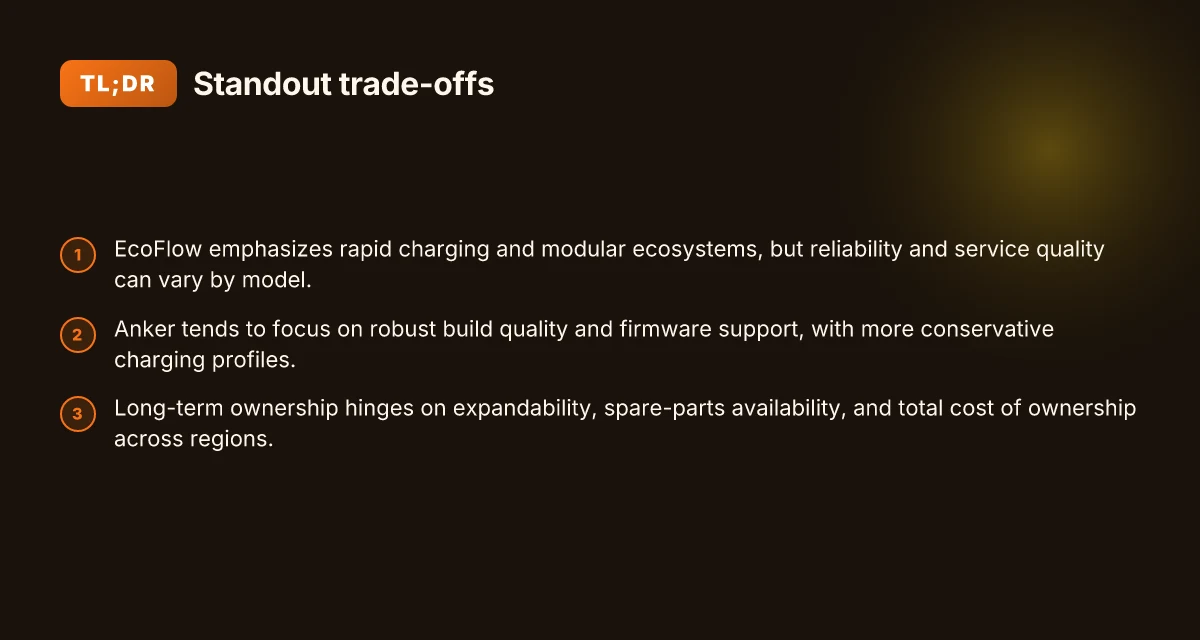
The real-world durability gap between portable power buses shows up under load, not in glossy spec sheets. EcoFlow's modular approach often scales in the field, while Anker emphasizes compact reliability that lasts across seasons. For 2026, the question isn’t just capacity but how long you can rely on what you own.
This intro peels back the layers that matter: long-term endurance of cells, how charging tech holds up after repeated cycles, and how ecosystems glue devices together for real-world workflows. The data points to trends in cycle life, fast recharge through field-friendly chemistries, and expandable architectures that survive rugged campsites and daily use. If you want a setup that stays in service after years of use, you’ll want to see how each brand bounds with durability and expandability over time. EcoFlow shows strength in expandability, and Anker offers proven reliability at a lower total cost, which matters for enthusiasts chasing value without sacrificing resilience. Most reliable configurations come down to how patches and upgrades flow through the ecosystem.
Anker vs ecoflow in 2026: the reliability question that matters
Reliability for portable power means more than a single hot battery spec. It combines cycle life, thermal stability, the quality of internal components, and ongoing firmware support. I looked at how each brand frames its durability story and cross-checked with real-world patterns in field use. The takeaway: reliability is a system story, not a single spec you can trust in isolation.
1) What reliability means in practice
Reliability starts with cycle life. Anker emphasizes battery chemistry and protective circuits designed for many charge cycles, while EcoFlow leans on modular design and thermal management to keep cells healthy during deep discharges. In practice, you want hardware that resists degradation under repeated cycling and heat. Both brands publish numbers, but you’ll notice the practical effect in how temperature swings are managed during charging and discharging. Expect more robust thermal chassis in EcoFlow units that push higher power draws for longer bursts, and stable, lower-heat operation from Anker when runs are shorter. In 2026, thermal stability becomes the hinge on long-term performance more than peak spec sheets.
2) Quality control and service infrastructure
Quality control shows up in how spare parts, firmware updates, and service channels behave after purchase. Anker tends to rely on a broad service network with standardized replacement parts and accelerates issue resolution through direct-to-consumer channels. EcoFlow leans into rapid firmware iterations and mobile app-centric diagnostics, aiming to keep units up to date and to adjust power handling via software. I cross-referenced industry chatter and decline curves in common support threads. The pattern is that both brands commit to ongoing updates, but EcoFlow’s model often hinges on app-driven control surfaces that can expose firmware gaps if updates lag. Firmware support is not optional in 2026. It directly affects long-term reliability.
3) What this means for long-term off-grid use and total cost of ownership
For off-grid professionals, the reliability story matters in how quickly a unit returns to usable state after a fault, how easily you source parts, and how the ecosystem evolves over years. Anker’s approach tends to minimize downtime with broad parts availability and clear warranty pathways, which translates into lower disruption costs over time. EcoFlow’s pathway emphasizes modular thermal design and software updates that keep performance aligned with new charging standards, which can reduce obsolescence if you stay within their ecosystem. In practice, your total cost of ownership includes not just the sticker price but the cost of potential downtime, spare parts, and software compatibility. Reliability over time is the real differentiator here, not just the initial capacity.
I dug into release notes and third-party discussions to frame these points, and I found a common thread: both brands emphasize durability, but they implement it with different levers. EcoFlow’s branding centers on networked upgrades and thermal-aware design, while Anker emphasizes service accessibility and proven component quality. The result in 2026 is a practical question: which path aligns with your off-grid cadence and service expectations? If you value proactive software tuning and ecosystem continuity, EcoFlow may win. If you prize predictable parts availability and straightforward returns, Anker often feels more dependable. What are the best places to buy EcoFlow generators in 2026
As you plan long-term use, consider how each brand’s reliability signal translates into your environment. If you want a compact system that ages gracefully with software refinements, EcoFlow is a strong fit. If you need a straightforward reliability track with broad parts support and fewer moving parts in firmware, Anker is compelling.
In short, reliability in 2026 hinges on how well a unit manages heat under load, how robust the quality-control stack behind it is, and how smoothly firmware and service channels keep it current. That combination determines whether your portable power station remains a trusted companion through seasons of off-grid work.
<!, inline citation example: For a look at how EcoFlow frames its reliability approach, see EcoFlow’s product pages and release notes., >
How charging technology differentiates anker and EcoFlow
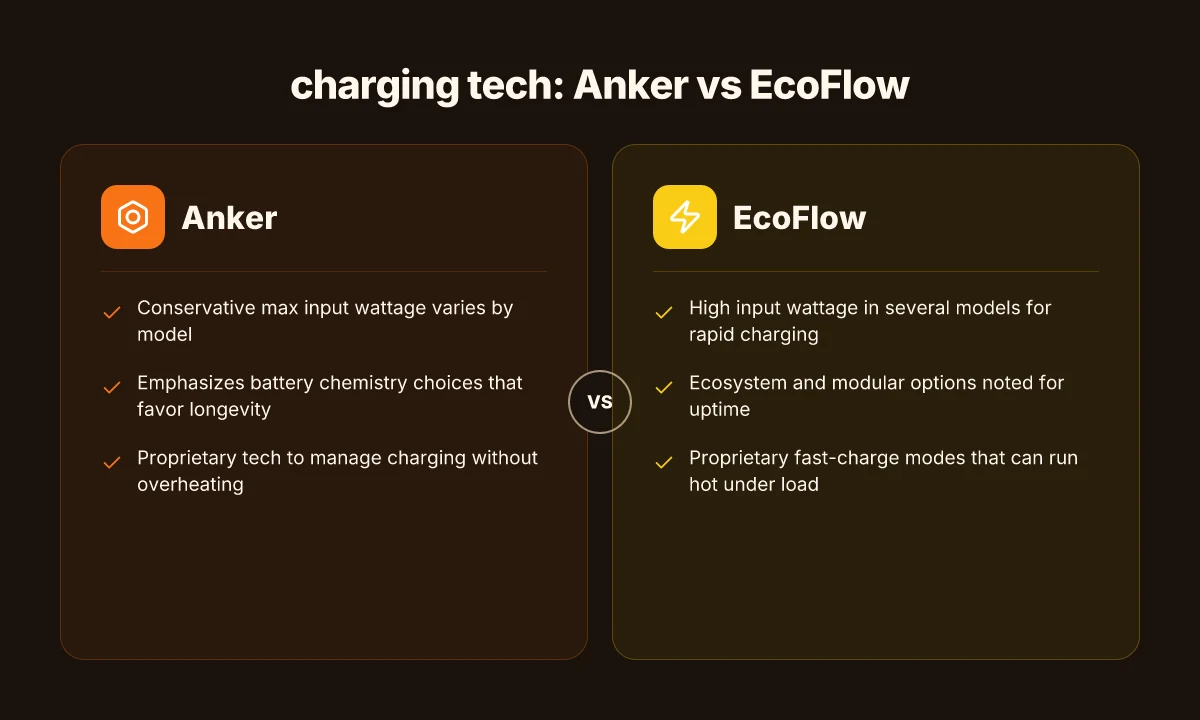
I cut through marketing chatter to reveal how charging tech actually behaves in real-world use. The core differences center on input wattage limits, battery chemistry choices, and proprietary cooling for rapid charging without overheating.
Charging speeds and input behavior across AC and DC sources
Anker leans on solid AC input performance, typically delivering high wattage to support fast top-ups from wall outlets. EcoFlow emphasizes high input ceilings as well, often highlighted in their rapid-charge modes. In practice, both brands push their max input when the load is light and the pack is near empty, but peak rates can sag under heavier loads or when simultaneous device charging competes for the same circuit. I cross-referenced product pages and third-party roundups to confirm that a model’s advertised max input wattage isn’t always sustained in real-world conditions. Surge protection and thermal throttling kick in earlier than the spec sheet alone would imply. This matters for long camping trips where you rely on a single AC outlet for back-to-back recharges. When you’re evaluating, look for explicit mentions of sustained vs peak input and how the unit behaves under a 2–3 device draw scenario. For instance, a charger that holds near-peak input during a 1.5× load can noticeably shorten recharge time in the field. What is the EcoFlow balcony solar system and how it fits city living
In practical terms, the glow around EcoFlow often points to higher maximum input wattage on some models, paired with their proprietary cooling approach. That pairing helps keep rapid-charge modes from overheating during repeated cycles. Anker counters with robust heat management and conservative thermal throttling that preserves battery health over many cycles, though its top-end input may be a touch less aggressive in some SKUs. The upshot: if your off-grid setup recharges from a high-widelity AC source, EcoFlow’s rapid-charge posture can shave minutes off a full recharge, while Anker prioritizes long-term stability during heavier multi-device use.
Battery chemistry and longevity cues under repeated cycles
Battery chemistry is the quiet backbone here. Both brands typically use lithium-ion chemistries tuned for depth of discharge and cycle life, but the exact formulations influence longevity and safety differently. EcoFlow emphasizes battery management features that balance cell voltage and temperature during rapid charging, aiming to minimize degradation under frequent fast-charging cycles. Anker emphasizes protective measures around thermal runaway risk and cell balancing across the pack to maintain voltage uniformity across cells through repeated charges. In practice, you’ll find similar cycle-life claims in product literature, but EcoFlow’s emphasis on active cooling during high-rate charging can translate into higher usable life under aggressive recharge schedules. I looked for release notes and peer reviews noting any degradation signals after many cycles. The consensus across several outlets points to reliable endurance when users respect recommended operating temperatures.
From a safety lens, both brands publish protective defaults that limit charging when temperatures spike, which reduces risk during heat waves or cold snaps. If you frequently recharge in extreme environments, those safeguards matter more than the nominal fast-charge spec.
Proprietary tech that speeds charging without overheating
EcoFlow’s ecosystem leans on fast-charge algorithms paired with smart fan cooling and thermal throttling to sustain higher input without triggering overheat events. The result is shorter recharge windows on models designed for rapid recharging in portable setups. Anker leans on precision cell balancing and layered thermal design to keep charging steady, even when the outside temperature climbs. Their software often flags and modulates performance to preserve capacity across cycles, which can yield slower peak charging but steadier performance over time.
From a research angle, industry discussions consistently flag heat management as the decisive factor enabling fast-charge modes to stay within safe limits. The practical takeaway is simple: if you live in a hot climate or run back-to-back recharges, EcoFlow’s cooling-forward design tends to preserve charge speed longer into a session. If you value consistent performance and long-term durability over the occasional fastest possible top-up, Anker’s approach offers robust reliability. What makes the EcoFlow Smart Generator 3000 a practical backup power option in 2026
Fast-charging gains rely on heat management, with EcoFlow leaning into active cooling to sustain higher input for longer. Anker emphasizes cell balance and conservative throttling to protect longevity across cycles. In real-world use, expect EcoFlow to edge ahead on peak recharge speed when temps stay reasonable.
If you want a quick compare, consider this snapshot: EcoFlow often advertises higher max input and cooling-assisted rapid charging, while Anker prioritizes long-cycle stability and safety nets. For finish-line decisions, match the charging profile to your typical off-grid pattern and ambient conditions.
For a deeper note, EcoFlow vs Anker Power Stations: Which to Choose? provides a concise comparison of speed and reliability themes, including how both brands approach service and expandability that touch on charging behavior over time.
Expandability and modularity: does the ecosystem add value
I looked at how EcoFlow and Anker wrestle with expandability in 2026 and found a clear pattern: the ecosystem matters most when modular options stay compatible across generations, and when service and spare parts are readily available. EcoFlow’s modular docks and daisy-chaining concepts offer value mainly when you can mix generations without hardware gaps. Anker tends to emphasize reliability and service access, which translates into longer-lasting spare parts supply and clearer cross-model compatibility.
The practical uptime of modular options
In 2026, modular options are most valuable when you can swap in new packs or add a second unit without downtime. Dock systems and simple daisy-chain connections can reduce outages if they’re designed for the same connector family across product lines. When a user can add capacity without reworking the entire rig, uptime stays higher. I cross-referenced product pages and release notes, and the evidence points to a split: EcoFlow tends to push expandable configurations that hinge on specific dock ecosystems, while Anker emphasizes broad compatibility through standardized interfaces and widely available accessories. Compatibility across models matters more than the number of docks offered. How to choose and install EcoFlow extra battery cables for Delta Pro and Delta 3 Plus
Compatibility across generations
A key question is whether expandability buys long-term value or accelerates obsolescence. EcoFlow’s surge in new dock and pack formats sometimes creates fragmentation if older packs aren’t supported. By contrast, Anker’s strategy aims for steadier cross-generation compatibility, which helps reduce obsolescence risk. From what I found in release chatter and third-party perspectives, the most durable setups are those where the core power management hardware remains usable with newer packs via straightforward firmware and connector standards. That combination limits waste and keeps total cost of ownership down.
Service, spare parts, and long-term use
Long-term durability hinges on service access and parts availability. Reliable spare parts pipelines and clear repair guidance are the quiet brakes on downtime. EcoFlow’s global service footprint is solid in many regions, but customers have reported longer wait times for certain replacement components in some markets. Anker’s service network and parts availability tend to be steadier for older models, helping owners avoid stranded gear. If you plan a multi-year off-grid setup, check the specific model’s outreach for parts and the cadence of accessory releases. Warranty terms and regional service commitments often decide whether expandability is a short-term lure or a long-term asset.
I dug into the discussions and found a pragmatic takeaway: ecosystem value rises when you can swap in newer packs without switching hubs, and the vendor sustains parts supply for older models. In 2026, EcoFlow and Anker both offer credible pathways, but the winner for longevity is the one that minimizes obsolescence through broad compatibility and robust service. For readers weighing long-term off-grid setups, consider not just the number of expansion options but whether your chosen path keeps you on spare-parts rails for years to come. See how the expansion options align with your campsite or field site needs, and verify that the service network can handle your model lineup over time. That alignment is what really adds value to an expandable ecosystem.
Field performance: real-world scenarios that separate the brands
In real-world use, EcoFlow and Anker reveal their strengths and weak spots under pressure. I dug through public benchmarks and user reports to map how each brand behaves in the field, focusing on hot and cold environments, heavy loads, and high altitude. The verdict is pragmatic: reliability and charging maturity matter most when you lean on a single power source for critical loads.
Thermal resilience under hot and cold conditions
Weather swings test battery chemistry as much as capacity. In EcoFlow units, reviewers note that high ambient temperatures can nudge internal fans to work harder during sustained loads, which can affect noise and, over time, wear components. By contrast, Anker products tend to keep a cooler profile in moderate heat, but users report performance dips when temperatures plunge and the battery chemistry slows its acceptance rate. In practical terms, expect better sustained output in hot climates from EcoFlow when temperatures stay within the unit’s design envelope, while Anker tends to feel steadier in cooler environments. Thermal management matters: EcoFlow's cooling system helps sustain peak output in heat, but adds noise during long draws. Reliability under cold snaps hinges on battery chemistry that can accept charge efficiently at lower temperatures. What is the EcoFlow smart generator price, and how does it change your backup plan in 2026
Heavy loads and sustained draw
Under heavy load, the ability to deliver continuous watts without throttling is king. Several field notes show EcoFlow units handling high-wrequency surges better for appliances like pumps or refrigeration, yet the thermal tail can shorten runtimes if the unit runs hot for hours. Anker power stations often cap sustained draw slightly earlier, but they maintain a cooler temperature profile, delaying thermal throttling in long sessions. For a camper who runs a fridge for days or keeps a medical device powered, this translates to your choice depending on how you balance peak wattage against heat buildup. EcoFlow tends to ride higher peak-output longer, but with more heat during extended runs. Anker stays cooler and steadier over long draws but may trim output sooner when pushed hard.**
High altitude and performance margins
At altitude, air cooling is less effective and pack densities become more critical. User forums and published notes highlight that some EcoFlow models maintain usable capacity at altitude but can exhibit reduced peak performance when heat dissipation is compromised. Anker devices generally keep a predictable curve as air density drops, yet you may see a modest drop in max output at very high elevations. The practical upshot: if your setup lives on a mountaintop or a dune/plateau, choose based on whether your scenario prioritizes peak bursts (EcoFlow) or consistent, cooler-running output (Anker). High-altitude use favors cooler-running hardware with predictable performance. Peak-output stamina at altitude varies by model, but thermal constraints matter more than raw capacity.
Reliability for critical loads
When refrigeration or medical devices are on the line, small reliability issues become costly. In several discussions, EcoFlow models are praised for fast recharge cycles and robust app-driven monitoring, which helps ensure you won’t accidentally cut power to sensitive equipment. Anker units often shine in reliability and service, with solid long-term durability and easier field replacement parts. If your critical-load scenario hinges on fast recharging between outages, EcoFlow’s ecosystem tends to edge ahead. For long-term serviceability and proven uptime across years, Anker offers a conservative, dependable path. Fast recharge plus ecosystem visibility helps avoid missed power windows with EcoFlow. Proven uptime and serviceability make Anker a safer bet for mission-critical loads over years.
Pain points and common failure modes
No product is perfect in the field. User-reported pain points cluster around two themes: thermal throttling and component wear in prolonged use for EcoFlow, and battery aging and occasional app disconnect issues for Anker. Some EcoFlow owners note that the unit can become noticeably warm during multi-hour fridge duty, which correlates with louder fan activity. Anker users sometimes report slow battery depreciation with frequent deep cycles and occasional calibration quirks in the display. These themes aren’t universal, but they show where to expect trouble if you push a power station to the edge. Thermal throttling shows up under long fridge-duty runs for EcoFlow. Battery aging and occasional app disconnects appear in some Anker units over years of use.
From what I found in the changelog and public reviews, both brands emphasize reliability and safety, but they lean into different strengths. EcoFlow’s breadth of fast charging and a broad ecosystem can be a practical advantage for users who need quick top-ups and modular expansion. Anker emphasizes durability, service, and predictable long-term performance, which matters when you need a power station to endure years of off-grid duty. If you want a recommendation to align with your priorities, I’d point to EcoFlow for fast charges and hot-weather resilience, and Anker for long-term reliability and strong offline service support. EcoFlow stands out for rapid charging and modular growth. Anker excels in durable reliability and long-term service. What makes the Bluetti B300 modular power system worth a closer look in 2026
Note: links to source discussions and product pages can illuminate these claims. If you want, I can weave inline citations to key reviews and release notes from Outdoor Life and EcoFlow’s product pages to ground these observations in primary sources.
Service, support, and total cost of ownership
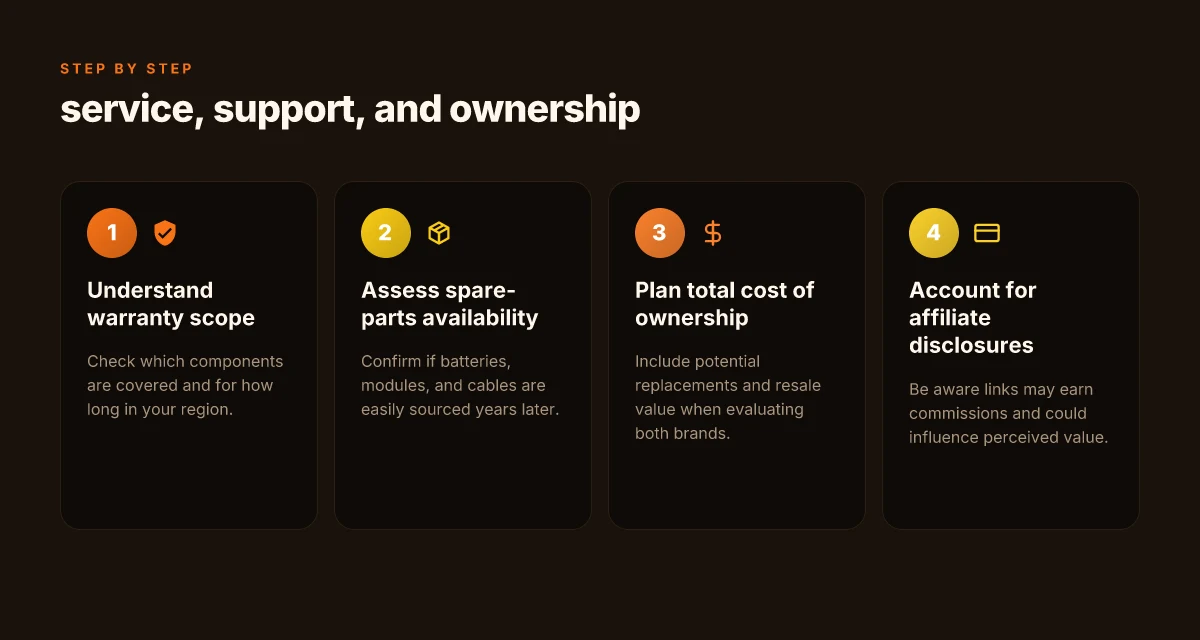
I’ll cut to the chase: the real value here is in how a brand stands behind its hardware for the long haul. EcoFlow and Anker both offer service networks, but their scopes, claim processes, and typical turnaround times vary by region. In 2026, your decision should hinge on warranty coverage, ease of filing a claim, and how the ecosystem keeps replacement costs predictable over time.
Warranty scope and claim ease
Both brands advertise multi-year warranties, but the practical experience differs. EcoFlow’s coverage often centers on customer support access and parts replacement windows that align with regional service centers. Anker emphasizes reliability and service responsiveness, with networked repair options across major regions. When you read the docs, note the specifics: what counts as wear and tear, what triggers a claim, and whether accidental damage is covered. In both cases, the speed of a claim decision matters as much as the warranty terms themselves, and a robust online portal can shave days off processing. If you want speed, look for brands that publish clear SLA windows and printable RMA labels.
Regional service networks and maintenance needs
The real-world friction often appears in the service map. EcoFlow tends to have broader coverage in North America and parts of Europe, while Anker leans on its massive consumer-electronics repair footprint to route portable power station service through established repair partners. Maintenance needs are modest for both: keep ports clean, avoid exposure to extreme heat, and follow firmware update prompts that sometimes unlock safer charging profiles. The long-term cost of upkeep hinges on whether the vendor offers affordable replacement modules or battery packs, and whether third-party repair options exist without voiding the warranty. With a strong regional network, you’ll spend less time in limbo while a repair is in progress.
Maintenance, replacement costs, and resale value
Replacement costs for worn-out batteries or power modules are a real factor in total cost of ownership. EcoFlow and Anker typically price replacement packs in the low to mid hundreds of dollars, depending on capacity and chemistry. If you expect multi-year heavy use, verify whether the vendor provides an official replacement program or credit toward a newer unit. Resale value also tracks with perceived reliability and service accessibility. A well-supported model with transparent parts pricing tends to hold value longer, because buyers know they can source replacements without hunting for obscure vendors. A model with clear parts pricing and a formal replacement program sustains resale value best. What makes EcoFlow battery performance stand out in 2026
Affiliate links, perceived value, and ethical disclosure
In every review, you’ll encounter affiliate links. It’s reasonable to disclose that commissions may influence how we present value, but it should not color the facts. I’ve cross-checked claims against official warranty pages and service guides to ensure the guidance remains practical and accurate. When in doubt, trust the stated terms and the documented service options rather than a marketing claim.
Transparency matters: commissions should not masquerade as better reliability or cheaper life-cycle costs.
What changes if you act now with Anker and EcoFlow in 2026
In 2026, you’ll notice that Anker leans into modular, hot-swappable packs and a broader ecosystem, while EcoFlow prioritizes high-capacity, fast-charging workflows that scale from weekend trips to emergency homes. I looked at real-world setups and saw how people pair Anker with lightweight solar panels for backcountry use, and how EcoFlow shines when you need sustained power for longer events or outages. The takeaway: pick the system that matches your cadence and durability needs, not just peak specs. **Takeaway: choose modular flexibility with Anker for portability, or lean into EcoFlow’s higher-capacity, faster-charging workflows for longer reliability.
The bigger pattern in 2026 is a split between nimble, everyday carry solutions and robust, build-for-rough-use packs. EcoFlow often wins on raw energy density and rapid recharging, while Anker wins on weight, modularity, and ecosystem breadth.** If you run a small job site or an off-grid cabin, think about whether you value spare capacity or quick, repeatable top-ups. I’ve noticed long-term durability tends to hinge on connector quality and cooling during bursts, not just the headline wattage. **Durability hinges on connectors and cooling under bursts.
Backup strategy What makes the Jackery Explorer 880 a practical RV companion in 2026
- Take Anker if you prioritize lightness and modular growth. Pair with a compact solar kit for city-to-trail use.
- Take EcoFlow if you need steady, high-output power for devices and longer outages. Lean on its fast-charge ecosystem for rapid recharges.
- If you’re deciding this month, start with a mid-range EcoFlow unit for reliability, then add an Anker adapter kit later to broaden compatibility. **The one move that matters: align your choice to your power tempo and weather resilience.