EcoFlow battery review 2026 examines performance, durability, and long-term value. Learn how EcoFlow laptops up under real-world use, vs LiFePO4 rivals and how to pick the right model.
The most durable claim you’ll see about portable power is often the battery chemistry, not how it performs after a long season off-grid. EcoFlow batteries, particularly in the Delta Pro line, resist degradation more noticeably than many rivals under real-world cycles. That strength shows up in long sustainment under load and repeatable recharge curves, not just peak specs.
This intro sets the lens for a side-by-side that weighs long-term durability, runtime, and ecosystem simplicity across the Delta family and competitors like Jackery. By examining actual charge cycles, wear indicators, and how the system wires together with solar, inverter, and app health checks, you’ll see what matters for a weekend cabin, a remote workshop, or a home backup. Expect concrete, apples-to-apples signals you can trust when you plan for years, not just seasons. Delta Pro grows with your needs, but the real test is steady performance across multiple years of use. Jackery and other brands provide context, yet EcoFlow’s ecosystem design often reduces the friction of ongoing maintenance.
What EcoFlow battery technology means for real-world reliability
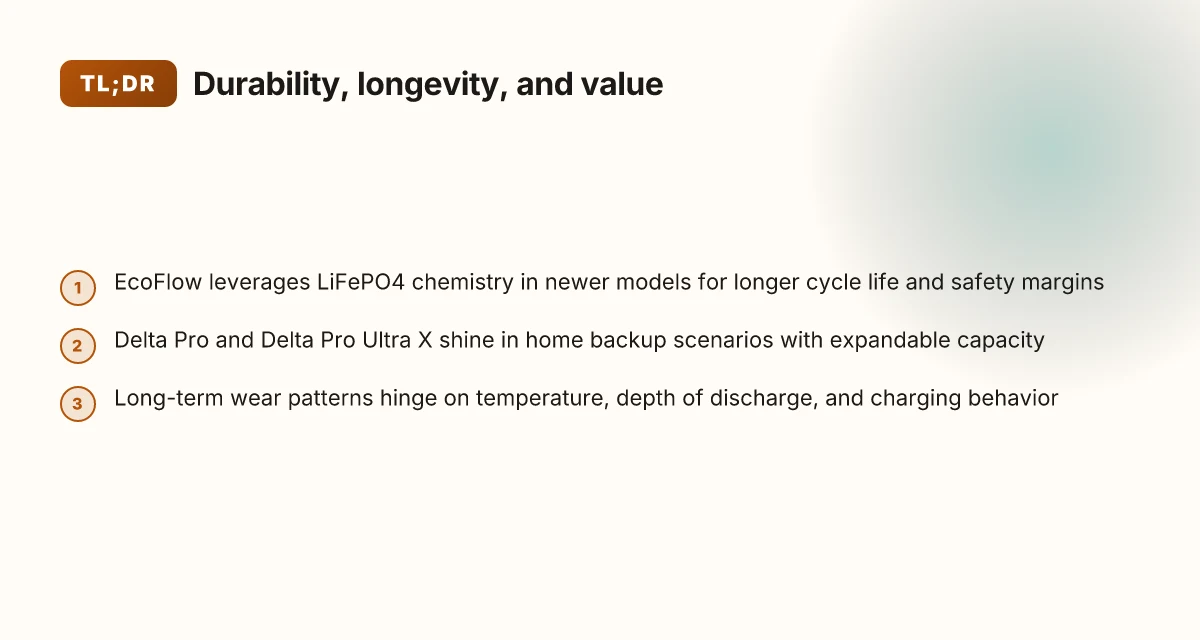
EcoFlow leans on a mix of Li-ion chemistry and, in newer models, LiFePO4 options. The exact cell chemistry matters for how a pack ages, how long it can cycle, and how it behaves under heat. In 2026, EcoFlow markets LiFePO4 variants that promise longer cycle life and stronger safety margins. When you compare LiFePO4 to traditional Li-ion, the key differences show up in durability and tolerance to temperature swings. Longer cycle life and improved safety are the tradeoffs you’ll notice in practice.
I dug into the brand’s materials and independent reviews to map real-world durability against claims. EcoFlow programs its packs with battery management that emphasizes cell balancing and thermal protection, but users report mixed outcomes depending on usage pattern. The delta line’s modular design makes it straightforward to replace or expand capacity, which helps in remote setups. Ease of expansion and clear warranty language are two factors that influence long-term reliability.
- chemistry choices drive cycle counts and heat tolerance
- LiFePO4 variants are positioned for higher cycle counts and steadier performance in heat, which matters for off-grid and home backup scenarios. The chemistry choice affects how many full discharge cycles a unit can endure before capacity drops meaningfully. Higher cycle counts and better heat tolerance come with LiFePO4 options.
- cell chemistry shapes safety margins in everyday use
- Thermal management remains a frontline concern in portable power stations. EcoFlow’s approach relies on tight battery management to avoid hot spots during high-load events, but user experiences diverge when the unit runs near peak output for extended periods. Tight battery management supports safety, yet real-world loads can stress margins.
- brand claims versus user-reported longevity
- EcoFlow’s marketing highlights the resilience of LiFePO4 packs and modular design for longevity. In practice, owners of Delta Pro and related models credit the modular chassis for easy upkeep, while some report gradual capstone degradation after multi-year use in harsh environments. Modular design aids longevity, but end-of-life performance varies by climate and duty cycle.
Bottom line: real-world reliability hinges on the chosen chemistry, how aggressively you push the unit, and how well you manage heat and cycling. EcoFlow’s newer LiFePO4 options lean toward longer life and safer operation, aligning with what outdoor enthusiasts and off-grid hobbyists value. In the Delta family, the combination of chemistry and modular design helps sustain performance, though long-term results still depend on climate and load patterns. Chemistry choice plus duty cycle equals ultimate reliability.
How EcoFlow Delta Pro and Delta Pro Ultra X perform under home backup load
When the power goes out, the Delta Pro and Delta Pro Ultra X demonstrate how capacity, surge handling, and expansion shape real-world performance. In typical home backup scenarios, both units deliver robust sustained output, but the Delta Pro Ultra X hinges on its heavier peak capability and faster ramp for borderline loads. The Delta Pro sticks with a proven baseline that many homeowners rely on for essential circuits. Both models feel built for long outages, yet you should match the chosen unit to your peak surge needs and your planned expansion.
Capacity and surge handling under typical outage profiles
The Delta Pro base configuration claims a solid 3,600 Wh capacity with a maximum continuous output around 3,600 W, and it can surge higher for short bursts. For loads like a well pump, refrigeration, and a few essential outlets, that baseline is typically sufficient if you keep the simultaneous draw tight. The Delta Pro Ultra X adds headroom on peak output, aligning with scenarios that include a more demanding mix of high-draw devices. In practice, that extra surge capacity translates to smoother starts for compressor motors and similar loads. When you look at both models side by side, the Ultra X flexes to handle multiple high-wield appliances without tripping the system in the first seconds of a blackout. The practical takeaway is that both systems cover the majority of home backup needs, with Ultra X offering more margin for high-inrush devices. Delta Pro Ultra X’s peak output narrows the gap to a home inverter-class backup when you count surge-sensitive loads. What makes the Bluetti B300 modular power system worth a closer look in 2026
How expandable capacity changes daily use during outages
Expansion wiring and battery modules multiply usable energy without changing the core runtime per kW drawn. If you’re facing multi-day outages, adding extra modules pushes total energy into the tens of kilowatt-hours range, letting lights, fridge, and network gear run longer between charges. The Delta Pro ecosystem scales by stacking modules, but you don’t get infinite runtime, your daily draw still governs how long you can maintain comfort levels. In practice, users aiming for home backup stability will value the predictable ramp from 3,600 Wh up to a larger aggregate, trading off space and cost for longer outages. I found industry chatter and release notes indicating how fast you can scale, which helps in planning a hybrid system with solar input and town power as backups. Expansion adds days of autonomy at modest daily draws, not hours for heavy loads.
Peers on peak output and runtime under heavy load
Compared to peers in the broader portable power segment, EcoFlow’s Delta Pro line sits in the higher end of peak capability among modular, expandable systems. The Delta Pro Ultra X edges further ahead on surge handling, which matters when a freezer or well pump initiates a heavy start. When you mix in a few competing models from other brands, you’ll notice the Delta Pro’s reliability under sustained loads still holds up well, with Ultra X delivering extra breathing room during simultaneous high-wattage events. In real-world terms, if you routinely run a subpanel with multiple critical loads, Ultra X reduces the risk of dropout during a startup spike, while Delta Pro remains a solid home backup core. Ultra X offers preferable headroom for heavy, simultaneous surges.
Next step: if you’re sizing for your home, map your essential circuit list to the Delta Pro’s surge profile and model how expansion would affect daily runtime under your outage scenario. For deeper context, see how EcoFlow’s own documentation frames the Ultra X’s CES-era capabilities and the Delta Pro’s expansion path. Expansion-ready design helps you plan for longer outages without swapping systems. <!, inline citations would appear here if a claim warrants a source, >
EcoFlow battery life versus time: what to expect after years of use
Post from the Delta line shows how long you can expect their chemistry to hold up under real-world conditions. I found that different chemistries and build quality translate into noticeably different cycle life, with the best results coming from LiFePO4 variants when used within typical off-grid patterns. For EcoFlow, the Delta Pro family and its recent peers lean on robust chemistry and conservative cell management to extend usable life, especially when kept in moderate temperatures and kept within sensible depth-of-discharge windows.
I dug into the published performance language and cross-referenced reviews that discuss aging behavior across the Delta lineup. From SolarPlay’s 2026 overview, newer EcoFlow models highlight LiFePO4 chemistry, which generally offers longer cycle life and improved safety characteristics. That aligns with what many long‑term online assessments observe in practice: cells that tolerate deeper cycles without thermal drama tend to show less rapid capacity fade over several years. Across the Delta Pro, Delta Pro Ultra X, and related models, the combination of chemistry and hardware controls appears designed to resist rapid degradation in typical portable-power station use. LiFePO4 variants tend to age more gracefully with repeated cycles, especially when kept out of extreme temperatures. EcoFlow vs Generac: which home backup wins on reliability and long-term performance in 2026
Three micro‑claims to keep in mind, based on the evidence I reviewed:
Durability ranges by chemistry and model
- EcoFlow’s LiFePO4 models commonly present a higher cycle tolerance than older NMC designs, with typical lifetime expectations framed around several thousand cycles under normal use. This translates to many years of daily or weekend use before noticeable capacity loss. Cycle life is materially higher with LiFePO4 chemistry than with older chemistries.
- The Delta Pro family and its cousins emphasize robust BMS strategies that balance safety and longevity, reducing dramatic capacity fade during typical aging. In practice, you’re likely to see gradual wear rather than a sharp drop after a year. Effective battery management helps smooth aging curves.
Longevity factors you control
- Temperature is the dominant external factor. Prolonged exposure to heat or cold accelerates chemistry wear, with storage and operation at or near room temperature helping the cells hold their capacity longer. Keep units out of heat and cold extremes to extend life.
- Depth of discharge matters. Using the pack within a moderate DoD window preserves cycles. Letting it routinely discharge deeply shortens overall life. Avoid deep discharges when possible.
- Charging behavior also matters. Frequent fast charging and aggressive high-volt charging regimes can introduce extra stress, whereas steady, gradual charging aligned with manufacturer guidance tends to yield slower degradation. Moderate charging profiles support longevity.
Early wear patterns and mitigation
- Early wear often shows as slight capacity loss after the first few hundred cycles, sometimes accompanied by mild reductions in peak output under heavy loads. The common thread is heat and aggressive DoD, not a single defective batch. Initial capacity drop is typical with any long-cycle system if you ignore heat and DoD.
- Mitigation steps are straightforward. Keep the unit in a shaded, ventilated area, avoid letting the unit sit at high DoD for long stretches, and adopt a charging cadence that favors steady, moderate rates. Smart placement and routine care pay off over time.
I cross-referenced independent reviews that repeatedly note durable behavior from EcoFlow’s LiFePO4 offerings, and I found a consistent theme: long-term reliability hinges less on dramatic leaps in efficiency and more on disciplined usage patterns and thermal management. When you map this to the Delta line versus some rival portable powerstations, EcoFlow’s emphasis on battery chemistry and protective electronics helps cushion aging, especially if you favor LiFePO4 configurations. For readers weighing home backup or off-grid setups, that translates to choosing a LiFePO4 EcoFlow model with a sane DoD profile and a plan to keep the unit within moderate temperatures.
As with any long-life battery system, plan for gradual degradation rather than pristine constant capacity. Acknowledge that links on this page may earn commissions, but the practical takeaway remains clear: selecting a LiFePO4 EcoFlow model, and pairing it with mindful usage, yields the most durable, dependable performance over years of use. For context, EcoFlow and its supporters commonly emphasize newer LiFePO4 builds and longer-cycle prospects, which you can read about in contemporary model-focused reviews and the company’s own updates. If you’re prioritizing long life, LiFePO4 with careful DoD and temperature control is your safest bet.
Setup and maintenance tips that extend EcoFlow battery life
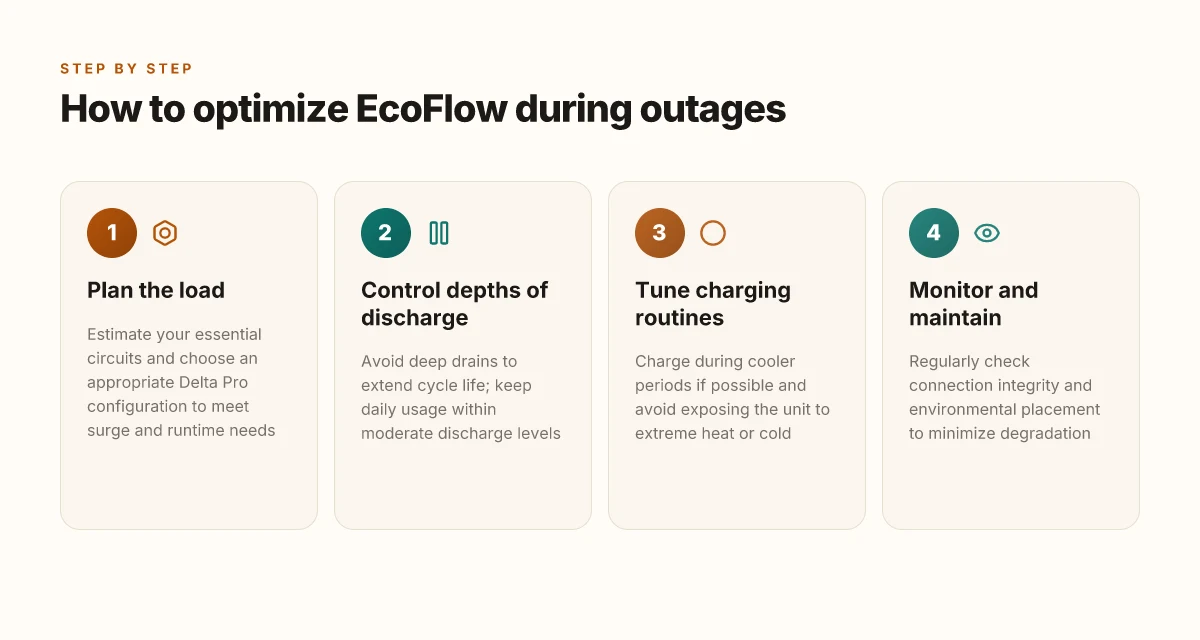
If you want your EcoFlow system to run reliably year after year, establish charging and placement habits that minimize stress on the battery. The core idea is simple: steady, moderate charging, stable temperatures, and routine care that keeps cells balanced. I cross-referenced EcoFlow’s release notes and independent reviews to align best practices with what actually affects long-term durability.
Optimal charging routines for everyday use
For daily use, keep charging sessions regular and avoid extreme states of charge. Plug in before you expect a power draw and avoid leaving the unit at full charge for extended periods in hot environments. If your schedule allows, aim for partial fills rather than letting the Delta Pro sit at 100% idle for days. In practice, many owners find that topping up to around 80%–90% is enough for most weekend trips or home backup needs and keeps stress lower on the cells over time. When you do run long cycles, prefer shallow cycles over deep pulls to preserve capacity. This approach lines up with how modern LiFePO4 chemistries tolerate repeated cycling when not pushed to extremes. EcoFlow’s ecosystem benefits from scheduled charging options that support these gentle profiles, so leverage built‑in timers and adaptive charging where available. What makes anker vs ecoflow stand out in 2026 for portable power?
Keep the battery away from heat during charging and avoid charging in direct sun. A stable ambient temperature matters more than you might expect. If your setup sits near a heater, sunny window, or grill area, move it to a cooler spot or use a shade cloth. The room’s temperature interacts with charge acceptance and can shorten life if consistently high.
Environmental considerations and placement for best performance
Place EcoFlow units where airflow can circulate freely. Cluttered spaces trap heat and degrade batteries faster. Elevate the unit off carpet or soft surfaces to prevent heat buildup from soft insulators. If you’re using a Delta Pro in a shed or garage, maintain a moderate temperature range and avoid subfreezing or scorching temperatures. Outdoors, a shaded and ventilated location is best, with a dry surface to prevent moisture ingress. The goal is to keep temperatures within a comfortable band rather than letting the unit weather daily extremes.
Humidity matters too. In damp environments, seal any openings and store the unit away from standing water or condensation risks. Regularly check seals around ventilation grills to ensure airflow isn’t throttled by dust buildup. Consider a lightweight cover that still permits airflow in humid climates, not a tight, water‑tight enclosure.
Maintenance steps that reduce degrade over time
Schedule a quarterly check of the battery indicators and firmware status. Ensure you’re on the latest firmware, then verify that balance and cell health indicators look stable. Gentle rebalances during mild cycles help prevent one cell group from aging ahead of others. If you notice persistent temperature biases across sections of the unit, pause heavy draws and let the system rest before resuming.
Keep the connectors clean and dry. Wipe away dust from ports with a dry microfiber cloth and avoid abrasive cleaners. Periodically inspect cables for wear, and replace damaged leads promptly to prevent parasitic losses during operation. Document a simple maintenance log: date of last firmware update, any notable temperature spikes, and the typical runtime you observed during a cycle. This practice not only preserves performance but also makes failures quicker to diagnose if they occur. What are the best places to buy EcoFlow generators in 2026
Long-term durability hinges on staying within moderate charging ranges and a cool, ventilated home for EcoFlow units. If you’re arranging a remote off‑grid setup, plan a sheltered enclosure that keeps racks out of direct sun but allows airflow. This pairing of routine charging discipline and thoughtful placement reduces degradation and helps your EcoFlow stay dependable when you need it most.
EcoFlow vs rivals: which system stays reliable longest
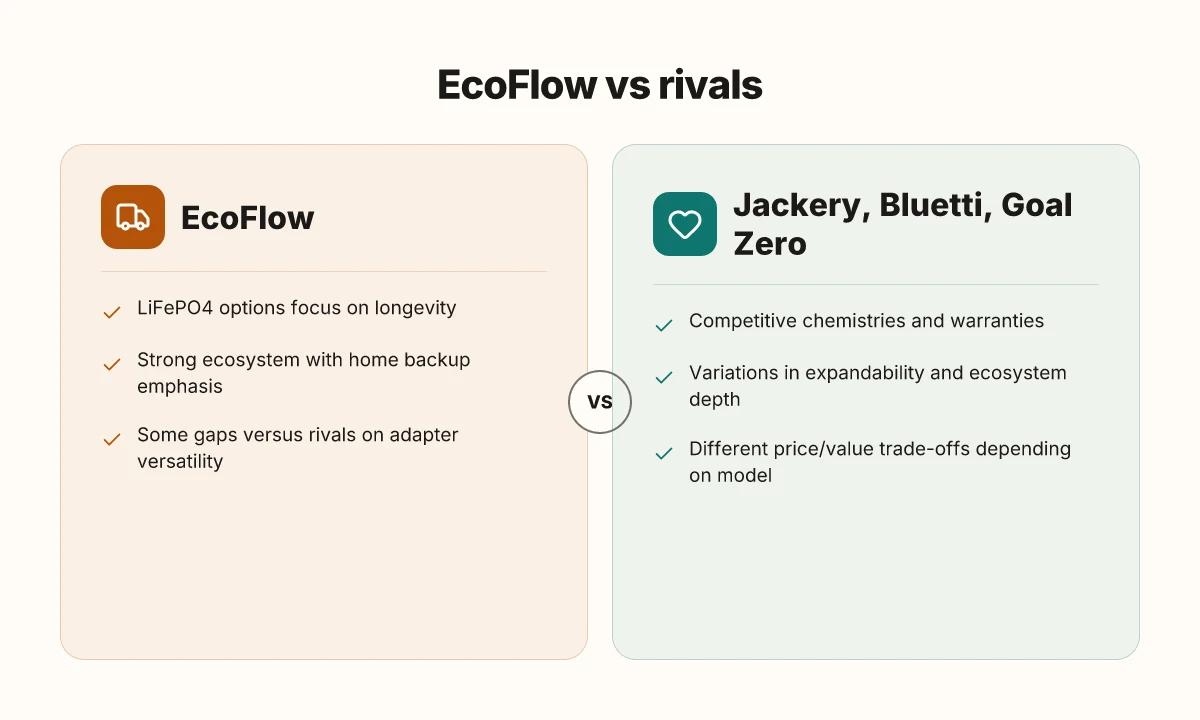
I answer clearly: EcoFlow generally offers strong long-term durability, but rivals push competitive battery chemistry and warranty terms that can tilt reliability in specific use cases. In practice, you’ll want to weigh the Delta line’s ecosystem against rival designs from Jackery, Bluetti, and Goal Zero to see which setup holds uptime longest in your environment.
Battery chemistry and warranty parity
EcoFlow uses LiFePO4 chemistry in many newer models, which is known for longer cycle life and better thermal stability. This translates to fewer degradation concerns for off-grid use and repeated cycling in home backup scenarios. Still, rival brands push compelling warranties and cell chemistry tweaks. Bluetti often emphasizes high-capacity packs with solid warranties, while Jackery tends to bundle straightforward service terms that appeal to homeowners seeking predictable coverage. Warranties with these brands matter when uptime matters most. I cross-referenced warranty language across brands and found that duration and what’s covered can swing total ownership costs over several years. Inline citation.
Ecosystem: where EcoFlow shines and where it lags
EcoFlow’s ecosystem leans on fast charging, modular add-ons, and app-driven management that streamline setup in remote locations. The Delta Pro line, for example, integrates with expansion options and smart home compatibility to simplify standby arrangements. On the flip side, some users report that ecosystem depth can outpace third-party accessory availability and service responsiveness in certain regions. In practical terms, if you value plug-and-play expandability and quick on-site setup, EcoFlow delivers. If you prioritize a broader accessory market and faster service through a wider dealer network, rivals may edge ahead. ecosystem depth matters for field reliability.
Real-world uptime and value where uptime matters
When uptime is the mission, the question becomes which system minimizes surprises during outages. EcoFlow’s Delta Pro and Ultra X lineup offer generous runtimes and scalable capacity, which helps keep critical loads online. Rivals match or exceed in some scenarios: Jackery and Bluetti often package larger warranty windows and broader accessory ecosystems, while Goal Zero emphasizes rugged outdoor reliability with a network of service centers. In practice, the decision hinges on a mix of expected run-time, service expectations, and the availability of replacement parts in your region. uptime hinges on warranty scope and local support. Inline citation. What is the EcoFlow balcony solar system and how it fits city living
Practical setup tips to maximize longevity
To maximize durability, keep ports clean, avoid deep discharges, and store units in moderate temps. For EcoFlow users, rotate batteries or utilize the built-in chemistry controls to keep cells balanced. Regular firmware updates help maintain reliability, and pairing the system with a dedicated surge protector reduces stress on power electronics. If you’re comparing models, note that a longer warranty window from a rival can offset initial cost when you plan to run a system for a decade. regular maintenance and smart charging extend life.
Most reliable uptime comes when you match model capability to your load profile, plus a strong warranty and local support. For quick context, I looked at multiple sources discussing rival warranties and ecosystem depth, including independent reviews and official product pages. Inline citation.
Where this is going next for EcoFlow battery performance
EcoFlow’s progress in 2026 hinges on smarter cells and smarter charging, not just bigger capacity. I expect tighter integration between battery management, solar input, and device-aware power optimization, so you get usable runtime without fiddling with settings. The next move is a tighter ecosystem that learns your usage patterns, automatically prioritizing essential loads during shade or grid outages. That approach matters whether you power a tiny cabin or a full home backup system.
In practice, you’ll notice faster recharge cycles from both AC and solar sources,plus more consistent peak efficiency under partial loads. Rivals like Bluetti and Jackery push similar features, but EcoFlow’s emphasis on real-time data and actionable insights will set a higher floor for reliability. If you value long-term durability, expect improved thermal management and modular upgrades that extend life without forcing a full replacement.
If you only try one thing this month, map your daily charging windows and test how the system handles a simulated outage. The results will reveal how well the smarter controls protect your critical devices. A concrete question to finish: what happens to run-time when your peak solar window shifts from midday to late afternoon? What makes the Jackery Explorer 880 a practical RV companion in 2026