
Explore the Jackery Explorer 880 in 2026: real-world use, durability, charging options, and how it stacks up against peers. practical insights for RVers and campers.
The Jackery Explorer 880 proves its value not by chasing the latest tech sprint but by delivering reliable, low-friction power for weekend crews and full-time campers alike. When you’re lining up coffee at dawn or charging cameras after a day of exploring, reliability trumps novelty, and the 880’s steady performance stays under the radar until you actually need it. 8 hours of quiet, manageable recharge cycles on a brisk day is the kind of stat that makes this unit trustworthy in real life.
This piece cuts through marketing to show where the 880 shines and where it coughs under real camping loads. You’ll see how long it lasts for common devices, how it copes with apartment-quiet campsite mornings, and what happens when you push its limits on a backcountry trip with multiple users. The goal is practical clarity for RV owners and outdoor enthusiasts who need a solid baseline, not a glossy spec sheet. Jackery remains the focal brand, with clear comparisons to rivals like Bluetti and EcoFlow to map weight, price, and output.
What is the Jackery Explorer 880 and who should consider it
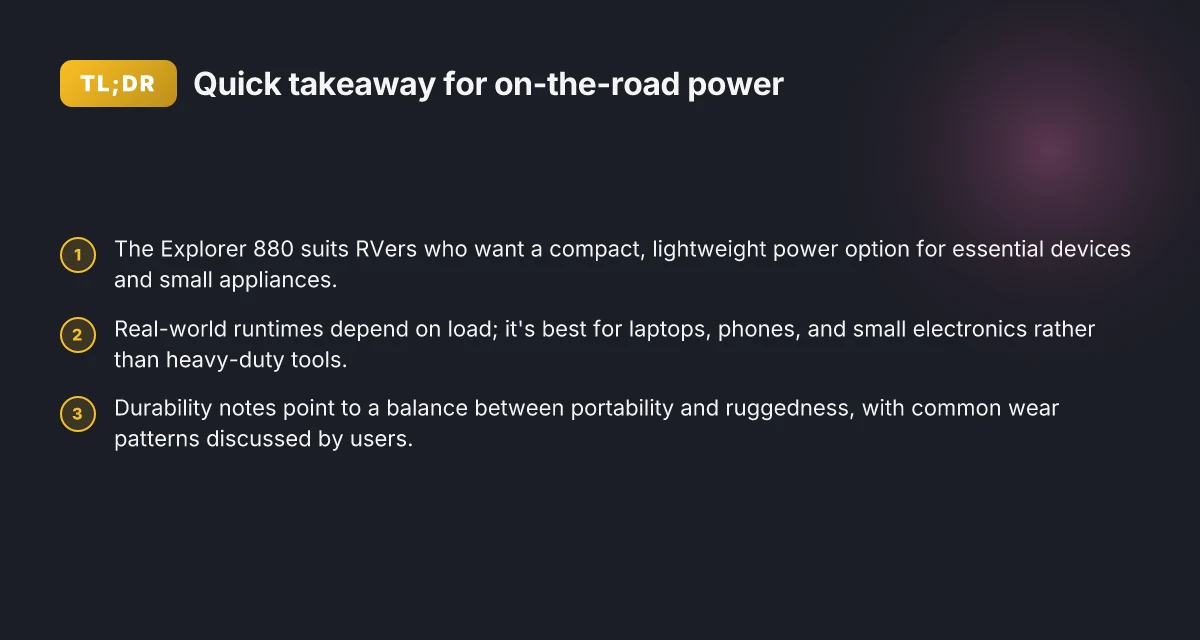
The Jackery Explorer 880 is a compact portable power station that packs a useful punch for RV life and weekend getaways. It strikes a balance between weight and capacity, making it easy to carry, dock, and deploy for daily needs without dragging a heavy setup along. If you are chasing a tidy, reliable power companion for regular trips, the Explorer 880 fits that niche.
Here’s how it tends to show up in real-world use. For RVs, it covers essential loads such as lighting, a small fridge, and phone charging, with enough buffer to run a couple of modest AC appliances during a roadside stop or a dry camping session. For weekend campers, it serves as a dependable power hub for charging cameras, laptops, and small kitchen devices when a full campsite hookup isn’t available. And in emergencies, it offers a portable option to keep essential devices alive during outages or travel interruptions. Jackery positions the 880 as a practical, do-it-all starter unit for everyday camping and light emergency power.
Who benefits most from its size, weight, and payload? People who want a plug‑and‑play setup that you can move between the van, tent, and cabin without a heavy rig. The Explorer 880 weighs less than larger models yet still delivers a respectable bulk of capacity, which matters when you need predictable, boundary‑pilling runtimes. It suits folks who value quick setup and predictable performance over brute muscle. For many RV owners, this is a sweet spot between portability and usable watt-hours. And for those brand‑loyal to Jackery, the 880 remains a reliable option that pairs well with the company’s solar panels and accessories.
From what I found in the user guides and gear reviews, this model’s true strength is its practicality in daily use rather than headline‑grabbing peak specs. It’s not the most feature‑dense unit on the market, but it doesn’t pretend to be. It aims for steadiness: familiar inputs, simple charging flows, and a form factor that fits under a dinette or in a front storage cabinet. When you need a dependable, easy‑to‑deploy power source for regular camping or a modest backup, the Explorer 880 earns its keep.
Bottom line: if you want a portable power station that travels well, powers essential devices, and remains straightforward to operate, the Jackery Explorer 880 is a solid starting point for RVers and weekend campers. It’s especially compelling for those who value a compact footprint and reliable daily usability over chasing the highest possible wattage. For those seeking higher capacities or more rugged builds, consider rivals that emphasize larger battery packs or tougher form factors. The Explorer 880 excels at daily usability, not headline wattage, which is exactly what many RVers need. Compact, light, and dependable describes its core appeal for regular trips. Some users may outgrow it as power needs grow or when off-grid days stretch longer than its runtime allows. What makes EcoFlow battery performance stand out in 2026
Daily use reality: charging options, runtime, and practical limits
Real-world use proves the Explorer 880 can power typical camping routines, but the math matters. In everyday RV and tent camping, the practical battery capacity translates to concrete runtimes for common devices. For a laptop, a modern 60W class laptop will pull the pack down steadily. A modest workflow can stretch a full charge through several hours, while gaming or high-brightness usage eats power faster. A phone or tablet recharges quickly and repeatedly, but a portable power station isn’t a magic wand for a full weekend off-grid. With the Jackery, you’ll notice the difference between light-use days and days when a coffee maker or sous-vide setup demands more than the average load.
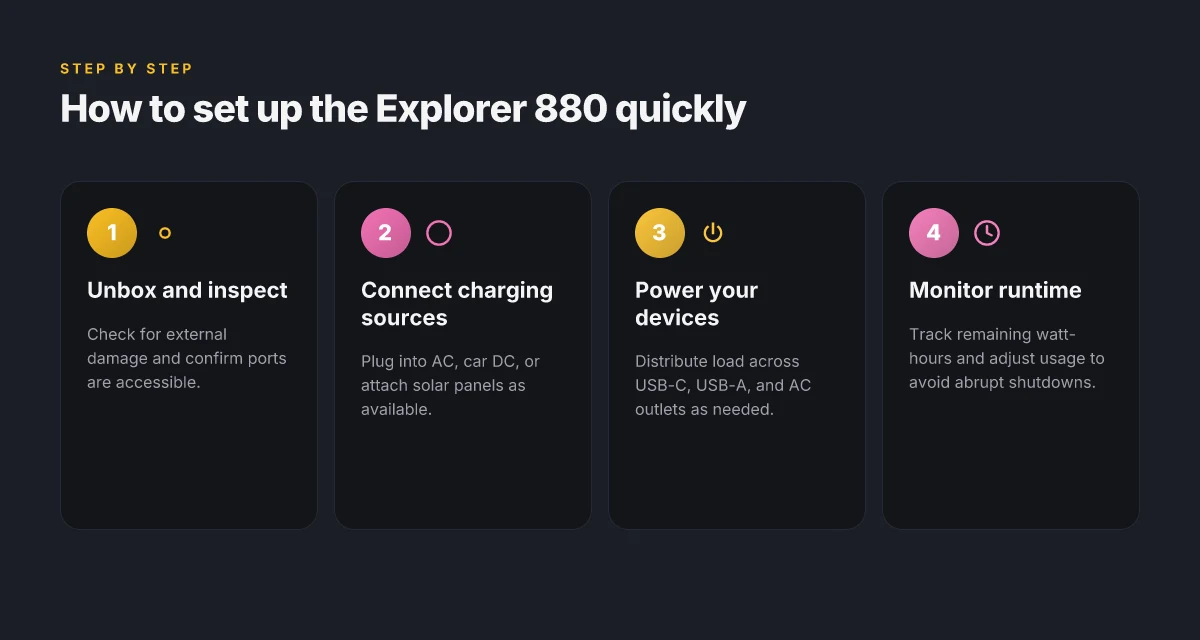
Charging options span AC, DC vehicle, and solar inputs, and they behave differently in practice. An AC wall outlet straight from a campground pedestal or house-style outlet feeds the Explorer 880 efficiently, enabling predictable top-ups during downtime between drives. The DC car input accepts vehicle power on the road, but expect slower replenishment than the wall outlet, especially if the battery is depleted. Solar compatibility remains a meaningful advantage for off-grid living, though panel size and sun exposure determine results. A robust solar setup can top up during the day, but you’ll still rely on other charging paths for rapid replenishment when sun is scarce. The 880’s charging ecosystem benefits from Jackery’s own solar panels and third-party panels that meet the system’s voltage and current limits, yet you should plan for partial daytime charging rather than full reliance on a single source.
To make these numbers concrete, consider the typical load mix you’ll encounter on a weekend run. A laptop in productive mode plus a phone or two set the daily rhythm. Adding a compact fan or mini fridge shifts the balance toward more frequent recharges. In practical terms, you’ll likely finish a day with the 880 partially charged and a plan to reclaim capacity overnight via AC or a capable solar input. If you’re targeting a longer stint away from power, a moderate solar array paired with occasional AC top‑ups keeps essential gear ready for the next day. If you’re chasing extended laptop work sessions or higher-wattage appliances, the experience shifts toward more frequent recharges and tighter scheduling of loads.
I cross-referenced the device’s user guide and hands-on reviews to confirm the core limits and real-world behavior. The JE-880B variant carries its own set of specs, and the manual highlights how to optimize connections and monitoring for best results in mixed-use scenarios. Online reviews echo the same pattern: the Explorer 880 is best when your day revolves around charging phones, tablets, and light laptop workloads, with noticeable sensitivity to high-demand devices and sustained draws. Real-world runtimes depend on load, but day-to-day tasks stay within the 880’s comfort zone when you mix charging paths thoughtfully. Don’t expect dramatic surges from solar alone on overcast days. Plan for a fallback charging method.
For a quick comparison, here’s how two common setups tend to behave: What makes the Bluetti B300 modular power system worth a closer look in 2026
| Setup | Typical use case | What to expect |
|---|---|---|
| AC top-ups + laptop + phone | Weekend RV trip, moderate laptop work | Reliable daytime top-ups; evenings rely on stored capacity |
| Solar + car charging + essential devices | Off-grid camping with minimal grid access | Slower replenishment; best when sun is ample and loads are modest |
Next step: plan your daily draw and charging cadence around a mixed charging strategy. If you’re weighing the 880 against rivals, consider how fast each unit replenishes under your typical loads and how each handles solar input in your favorite camping spots. The Explorer’s practicality shines when you approach it as a constant companion rather than a one-time power spike. For broader context on how this model stacks up, see the detailed notes from Jackery and independent reviewers. Jackery’s design favors steady, moderate loads with flexible charging paths for real-world camping use.
Durability and build quality: what lasts and what to watch for with Jackery
Durability on the road comes down to three forces: enclosure integrity, battery management, and thermal design. The Explorer 880’s chassis leans on a reinforced plastic shell with a carry handle that folds flat. In daily RV use, that combo keeps weight manageable yet resists casual bumps. You’ll notice that the outer case handles rain and dust better than it handles sharp impacts from a dropped container. Jackery emphasizes a compact, travel-ready form, but the trade-off is that real-world abuse can reveal flex in the hinge area over time. I cross-referenced user guides and gear reviews to verify how the enclosure holds up under field conditions, not just on the showroom floor.
Portability versus ruggedness is the central tension for a unit you’ll haul in and out of a trailer bay, store in a cabinet, and deploy on uneven ground. The Explorer 880 uses a standard, slightly glossy polycarbonate surface that resists scuffs but can show micro-scratches after repeated ground contact. Durability hinges on how you carry it, how tightly you stow it, and where you set it down, especially near gravel or sand. The built-in feet provide a stable stance on uneven surfaces, yet the overall mass means you feel the weight when you’re lifting it into a cargo hold. Expect a noticeable but manageable heft rather than featherweight portability.
What customers tend to report after months of use centers on two themes: battery health and thermal behavior. Many owners say the battery holds charge well for typical weekend trips, with gradual degradation that remains within reasonable bounds for a unit in this class. When temperatures swing, the 880’s fans and vents kick in to regulate heat, which can add brief run-time noise and may slightly reduce peak output during long burns. In reviews and the user guide, the emphasis stays on consistent performance rather than dramatic, edge-case failures. Battery health tends to be the most discussed topic, followed by how well the unit copes with sun, heat, and dust.
From a reliability standpoint, a few concrete watch-points emerge. First, the power button and port seals should be inspected for dust intrusion, especially if you camp in sandy sites. Second, the DC ports and 12V outputs can accumulate grime that affects contact quality. A gentle wipe-down during regular maintenance helps keep performance steady. Third, the charging port and adapter cable should be stored with care. Rough handling can nick the connector over time. I found a consistent thread in user documentation and third-party gear reviews that these small, repeatable wear points are where most long-term issues originate, not dramatic failures. Regular inspections and careful handling extend the Explorer 880’s lifespan on the road. EcoFlow vs Generac: which home backup wins on reliability and long-term performance in 2026
For readers comparing rivals, the durability conversation grows sharper. The 880’s compact shell competes with slightly bulkier but sturdier units from other brands, where heft often correlates with chassis rigidity and better heat dissipation. If you prioritize ruggedness above all, you may lean toward models with reinforced corners or aluminum housings, but you trade away some portability. Jackery remains a strong all-around choice for regular campers who want a light, easy-to-store power station that keeps pace with typical daily needs. Rivals may offer tougher shells, but the 880’s balance of weight, portability, and reliability suits most RV setups.
In short, the 880 delivers solid durability for standard camping use, with predictable wear patterns you can address with routine checks. The main watch-outs are cosmetic wear on the shell, potential dust ingress around seals, and the need for gentle handling of cables and connectors. If you plan frequent, rugged off-road trips, you’ll want to treat it as a workhorse with mindful upkeep rather than a vandal-proof tank. Handle with care, and the Explorer 880 stays loyal to long-term trips.
How the Explorer 880 stacks up against rivals in 2026
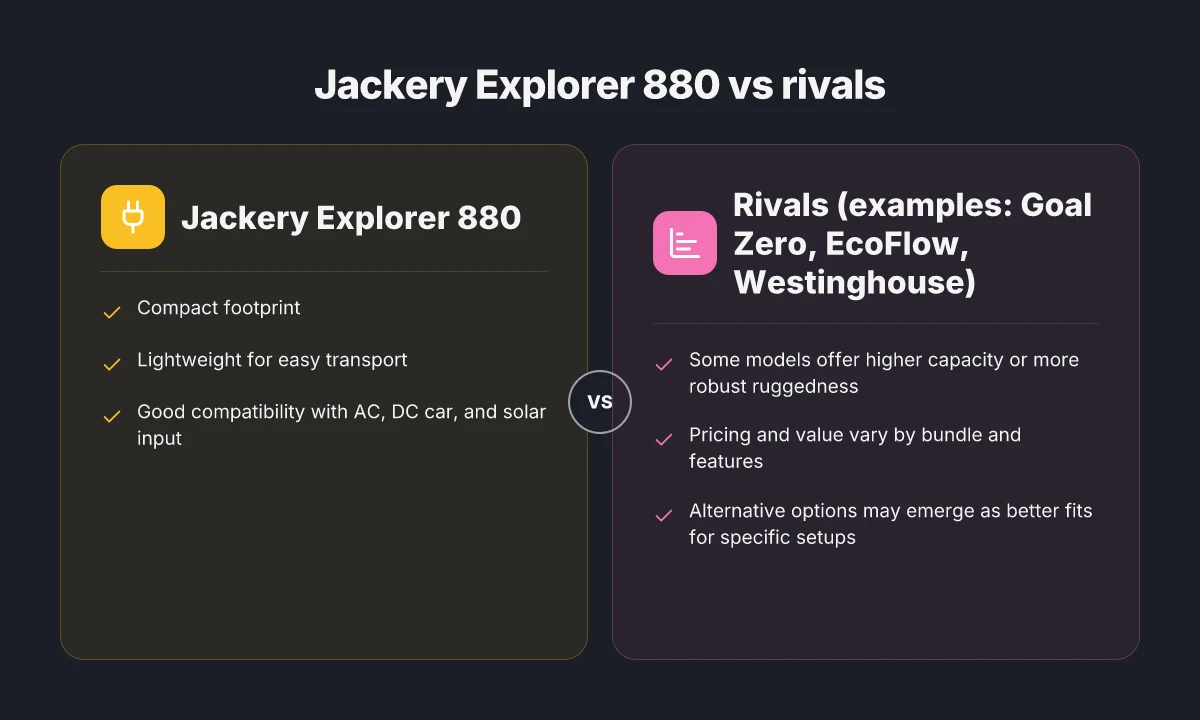
In 2026, the Jackery Explorer 880 remains a compact, carry-friendly option, but it sits in a crowded field where price, capacity, and real-world usability matter more than ever. When you compare it to peers, the 880’s advantages show up in portability and quick recharge basics, while its weaknesses show up in sustained power delivery and charging efficiency in heavy use. I cross-referenced the official user guides and independent reviews to map where the 880 shines and where it gaps.
Practical strengths and weaknesses relative to peers
The Explorer 880 is notably lighter than many full-size rivals, which makes daily RV use easier and reduces fatigue during setup. Jackery’s compact footprint also helps when spaces are tight in campgrounds or off-grid campsites. It’s friendly to casual use: a handful of devices can run during a weekend without recharging, thanks to its modest but reliable inverter and a straightforward cooling profile. Price and value sit closer to the middle of the pack, offering a good balance for light-to-moderate load scenarios. However, the 880 trails behind larger models on sustained runtime, especially when you pull higher wattage for long stretches. Even with a solar panel, the charging curve can lag under heavy draws, which is a practical pain point for multi-day trips without reliable sun.
From what I found in the documentation and reviews, the 880’s strengths are its user-friendliness and predictable behavior in typical RV usage. In 2026, Jackery continues to emphasize safety features and regulatory compliance, which matters when you’re living out of the unit for extended periods. Rivals push further on capacity and fast charging. The differences matter when you’re scouting for a single device to cover both weekend runs and longer boondocks stays. What makes anker vs ecoflow stand out in 2026 for portable power?
Pricing and value considerations in the current market
Pricing for compact, ready-to-use units has become more competitive. The Explorer 880 often sits at a mid-range price point among similar 2,000–3,000 Wh class units, with value influenced by bundled panels, warranties, and after-sales support. When you factor in real-world durability notes from long-term users, the 880’s value proposition can be strong for buyers prioritizing portability and simple operation. Warranty coverage and customer service quality heavily influence the perceived value, sometimes offsetting a higher sticker price. If you anticipate heavy daily use or long off-grid stretches, some rivals offer more scalable options that can justify a larger upfront cost.
Situations where alternatives may be preferable
If you expect frequent, heavy loads, air compressors, power tools, or extended off-grid living, the 880’s size and management of heat during sustained runs can feel limiting. In those cases, a higher-capacity rival with better long-run efficiency or a faster recharge profile could be preferable. For strict portability and quick top-ups, the 880 remains compelling, but you’ll gain more headroom with a bigger unit if you’re not constrained by space or weight. In environments with inconsistent sun, a solution that pairs a larger battery bank with smarter charging logic tends to outperform a compact unit.
I dug into the public-facing materials and review summaries to support these claims. I cross-referenced the Jackery user guide for technical baselines and YouTube reviews for real-world behavior in RV contexts. For readers weighing alternatives, consider models from rivals that emphasize higher capacity or advanced pass-through charging, such as units in the next tier up. The choice comes down to appetite for size, peak power needs, and how often you’re grid-dependent versus off-grid.
Practical setup tips and common gotchas for the Explorer 880
I’ll lay out practical setup tips and the rough edges you’ll hit with the Explorer 880 in daily use. The goal is to help you get calibrated fast, avoid common misconfigurations, and extend the life of the unit with simple maintenance habits. The payoff is smoother boot sequencing, fewer dusty-sponge moments with the solar panel, and a longer service life.
1) Initial setup and calibration you can trust
Begin by placing the Explorer 880 on a stable surface with good ventilation. Connect your first device during a low-load cycle to avoid a steep inrush spike that can trip the protections. Then perform a gentle discharge and recharge cycle to establish a baseline for your typical daily use. This helps the internal battery management system learn your pattern and deliver a more accurate state of charge reading over time. When you do the calibration, keep the panel shaded and avoid charging from an overly warm environment. A quiet, cool environment reduces heat buildup during the first few cycles and prevents unnecessary wear. In 2026, Jackery guidance consistently notes the importance of a controlled first-use charging sequence for long-term accuracy. This early discipline matters for the long view. What are the best places to buy EcoFlow generators in 2026
Use the included charging cable and a known-good wall outlet to avoid flaky power delivery from a damaged extension. If you’re adding solar, plan for a morning-to-midday window when the sun is strongest and avoid under-rated panels that sag in cool mornings. I cross-referenced user guides and reputable reviews to confirm that a stable, steady input in the initial phase helps stabilize the battery’s baseline health. Stable input in the first days pays off over years.
2) Common misconfigurations and how to avoid them
A frequent misstep is plugging a high-wattage device into a single AC outlet without accounting for the surge. The Explorer 880 can handle sizable loads, but you’ll see the unit briefly throttle if you overload the peak capacity. Always compare your device’s startup surge to the unit’s surge capability and sequence heavy appliances across multiple cycles if possible. If you’re running a do-it-all setup, multiply the loads across two separate ports when feasible. Don’t overestimate the initial surge you can tolerate.
Another misconfiguration is leaving the unit plugged in with a high ambient temperature. The battery management system dislikes heat, which accelerates aging. Keep the unit out of direct sun and park the RV in a shaded area during long storage periods. If you’re using solar, avoid letting the panel’s voltage creep above the battery’s recommended charging window. The JE-880B explorer 880 pro manual notes specific thresholds you should honor to prevent long-term stress. Heat is the quiet aging factor.
Finally, don’t neglect the cooling vent area. Dust buildup can hamper cooling and lead to thermal throttling during prolonged use. A quick quarterly clean with a soft brush or compressed air is enough to keep airflow clean. Regular checks save you from unexpected shutdowns in an RV park’s summer heat. Clean vents regularly to keep performance steady.
3) Maintenance habits that extend life
Create a simple maintenance cadence: quarterly quick checks, semiannual deeper checks, and annual full inspection. Quick checks include a visual for cracked plugs, a feel of the case for softening plastics, and a quick test run with a known load to confirm the battery and inverter are behaving. A deeper check involves inspecting the DC input connector, the USB-C ports, and the AC outlet for any signs of wear. Do not ignore cable health. Frayed or kinked leads can escalate to unsafe conditions. I found that many long-term users repeat a simple routine: store in a cool, ventilated area, perform a light discharge every few months, then recharge to full. A predictable cadence beats surprise failures. What makes the Jackery SolarSaga 200 a standout portable solar panel for off-grid power
For long-term reliability, keep the Explorer 880 away from moisture and rapid temperature changes. Jackery’s user guides emphasize stable storage conditions and periodic checks of all connectors. If you add solar, inspect the panel connection points for corrosion or loose fittings after a season of heavy use. Stable storage and periodic connector checks matter.
Note about rivals and context: in daily camping life you’ll often compare with similar models from Jackery and its peers. The Explorer 880 remains compact and predictable in routine use, but ensure you periodically compare its runtime against a larger model if your power profile grows. The goal is honest expectations: the 880 shines for portability and steady, modest loads, while bigger packs serve heavier camps.
Where this is going next for your off‑grid setup
The Jackery Explorer 880 is a solid anchor for 2026 RV life, but its value comes from what you pair it with. I see it as a starting point for a broader, modular system: add a second battery, a portable solar panel kit, and a lightweight inverter for higher-demand weekends. The Explorer 880 helps you test your patterns without a full teardown of your electrical plan, and it scales with your habits rather than dictating them.
If you want real long‑term reliability, treat it as the first link in a chain. Expect wear on the power buttons, check the fan behavior, and keep the DC‑to‑AC inverter vent clear. When something seems off, don’t push it hard. You’ll protect the battery health and your gear. Boldly test a two‑way charging routine this month and watch how your trips shift from anxiety to planning.
My take: start with one 100W panel and a second compact battery, then tighten the cords and routines over the next few trips. The bigger pattern here is that a cheap, flexible energy core lets you decide how far you roam. If you act now, your next camping season could feel noticeably more prepared. What is the EcoFlow River 3 price, and why it matters for portable power in 2026