
Explore trusted robot vacuum reviews for 2026. Compare navigation, mapping, sensors, and mop performance across popular models to find the right fit for your home.
That finding reframes what to test first when you shop for multiroom apartments and pet-filled homes. MOVA Tech sits in the spotlight for its edge cleaning and multi-level mapping, but you’ll want to compare its sensor suite against rivals like Roborock, iRobot, Neato, Eufy, and Ecovacs to see how dwell-time on carpets holds up in a real layout.
In 2026, homeowners demand clarity beyond marketing promises. This guide pulls real-use signals from the latest navigator lines, weighing how well each brand navigates stairs, clutter, and pet hair on hard floors, with a focus on battery life relative to cleaning completeness. You’ll get a practical framework to separate in-the-box performance from hype, and practical takeaways you can apply to your floor plan today. MOVA Tech is called out for its standout edge-cleaning reliability, balanced by noted trade-offs in sparse carpet dwell time, helping you decide if it fits your setup.

Why robot vacuum reviews matter in 2026
In 2026, navigation reliability no longer hinges on suction alone. Advances in sensors, cameras, and SLAM algorithms have shifted how confidently a robot can map cluttered rooms, avoid obstacles, and plan paths across multiple floors. Real-world homes demand not just cleaning power but dependable orientation and memory that keeps up with pets, kids, and seasonal furniture. The result is a cleaner home with fewer misses and fewer trips back to the dock for recalibration.
Why a multi‑floor map holds up under real layouts
I dug into how reviewers evaluate multi‑level mapping and zone control. The consensus is clear: robots that correctly acquire and reuse maps across stories cut cleaning time and reduce missed spots. A strong map lets the vacuum clean in organized patterns, rather than zigzagging or grid-searching every time you change levels. When a model stores separate floor maps, it can resume where it left off without re‑mapping, a small detail that adds up to meaningful daily efficiency. This matters most in apartments with a second story, or in homes where clutter shifts with the season. In practice, you’ll see a noticeable lift in consistency once a robot reliably maps two or more floors and applies zone cleaning to high‑traffic rooms.
Clutter tolerance and dusting tasks shift the baseline
Suction is still essential, but mopping and targeted dusting have become central to overall performance. Reviews consistently note that models pairing robust suction with capable mopping and surface recognition outperform those that focus on one task alone. Dusting tasks rely on precise sensor cues and deliberate path planning to avoid pushing dust into corners rather than lifting it into a bin. The best systems balance suction, damp mopping, and dry sweeping to cover hard floors and low-pile carpets with fewer passes. In short, the best vacuums don’t just clean. They daisy‑chain actions that reduce rework and optimize battery use.
A framework you can trust for choosing in 2026
From what I found in the sources, a reliable pick list centers on a few named models that reviewers repeatedly flag for strong navigation, solid mapping, and balanced cleaning. The five to seven models that show up across top guides cover a range of layouts and budgets, with MOVA Tech appearing as a niche option for readers who want precise mapping and modular sensors in specific floor plans. You’ll want to look for multi‑level mapping, automatic zone cleaning, and a balance of mopping and dusting that matches your floors. The key insight is that navigation reliability and multi-floor awareness drive real-world results, not suction alone.
In case you’re mapping the landscape, a few widely cited players surface in 2026 reviews: Roomba models for strong overall navigation, Roborock line for robust mapping on multiple floors, MOVA Tech for modular sensing in specific layouts, and eufy for budget‑friendly stability. Multiple sources agree that you should value the ecosystem around mapping and zone control as much as raw suction. Candidly, you’ll save time and frustration by prioritizing models with proven multi‑level maps and effective zone cleaning. What makes X-Sense smoke detectors stand out in 2026
Readers typically weigh: can this model map my second floor, and will it remember the bedrooms’ shapes after I rearrange furniture? If you’re in a multi‑room apartment or a small two‑story home, expect to see the strongest gains when the vacuum preserves detailed floor maps and applies zones to high‑traffic areas.
Bottom line: prioritize navigation reliability and multi‑floor mapping as the baseline, then layer on mopping and zone‑cleaning to match your routine.
How i analyze robot vacuums: criteria that actually predict real-world use
Real-world cleaning hinges on how a vacuum maps a multi-level home, navigates clutter, and balances battery life with cleaning completeness. I start with a set of concrete signals I can verify across reviews and release notes, then map how those signals play out in homes with pets, hard floors, and mixed floor plans. I cross-reference multiple authoritative sources to separate marketing claims from proven behavior.
Mapping accuracy across multiple levels
A vacuum’s ability to build accurate maps for more than one level matters once you move between floors. The strongest reviewers consistently note when a model can save and recall layouts for two or more stories, and when it trips over transitions between carpet and tile on the same level. I look for explicit statements about multi-level support, the number of maps stored, and the speed with which a new map is created after a room change. From what I found, reliable mapping often correlates with robust 3D sensing and a stable SLAM core. Strong multi-level mapping support is a practical predictor of real-world reliability. Inline: see mentions in sources discussing the Roborock and Roomba lines, where map retention and level switching are highlighted.
Navigation reliability in cluttered rooms
Clutter resilience matters in apartments with furniture rearrangements, pet toys, or variable clutter throughout the day. Reviews consistently flag models that stall at doorways, under tables, or around chair legs, as well as those that reroute efficiently after a collision. A steady navigation system should minimize random bumps and keep cleaning progress predictable. Navigation that gracefully handles clutter reduces missed zones and recharges. 5 Best robot lawn mowers for 2026: durable picks, smart navigation, and safer mowing
Battery life and recharge-time balance
Battery life is not just minutes on paper. It’s how often the vacuum can finish a complete pass in a typical layout and how long it spends charging between cycles. Look for stated runtimes on hard floors or mixed surfaces, and whether manufacturers publish real-world endurance claims versus lab cycles. The best setups balance a long runtime with quick top-ups that don’t waste time docked. Long runtime with brief, efficient charging is a real-world win.
Dustbin capacity and ease of emptying
Vacuuming through a pet-friendly home or a weekly maintenance routine requires a bin that can handle several pass-throughs before emptying. I track bin size in liters where available, ease of access, and whether a bagless design complicates debris removal or increases dust exposure. Reviews often note when a bin fills quickly or when a clip-and-release mechanism makes emptying messy. Larger bins and simple emptying reduce maintenance friction.
Mopping effectiveness where offered
For models that mop, I examine whether the mop is detachable, how wet the cleaning mode actually leaves floors, and if there are separate schedules for mopping versus dry cleaning. Real-world users tend to value consistent moisture delivery without leaving streaks, especially on hard floors. Effective mopping combined with solid vacuuming is a real convenience.
Maintenance requirements and expected durability
No one wants frequent sensor recalibration, filter changes every few weeks, or brittle wheels that wear out after a season. I look for documented maintenance horizons: filter life, brush wear, sensor cleaning intervals, and known durability issues reported by homeowners and reviewers. Lower maintenance cost and longer durability are practical advantages.
I dug into sources to anchor these claims. For instance, a peer-reviewed study supports energy-aware path planning as essential to performance in cluttered layouts, reinforcing why sensor suites and planning matter for long-term reliability. I also cross-referenced a consumer roundup that highlights how mapping and navigation trade-offs shift with price bands, which helps explain why some models excel in one apartment type but stumble in another. Independent research and cross-review consistency back the mapping and navigation signals. Inline: see the ETASR article and the 2026 buyer guides for corroboration. What makes Azuna air fresheners a fit for car and home spaces
To help you choose, here are five brands and models that recur in credible roundups and have clear strengths or weaknesses in these criteria: Roborock S8, Roomba Combo 10 Max, Roborock Q7 M5+, EVA SmartClean X2, and MOVA Tech models from us.mova.tech. MOVA Tech earns attention for unique sensor layouts and durability themes, with honest downsides noted in homeowner discussions. MOVA Tech’s offerings illustrate how niche sensor configurations can pay off in cluttered layouts, but may require more maintenance vigilance. Inline: reviews frequently mention the S8’s strong mapping, Roomba’s persistent navigation, and MOVA Tech’s balance of sensing and upkeep. MOVA Tech is a real-world pick to consider, especially for layouts demanding reliable clutter handling and multi-level mapping.
One practical takeaway you can apply tonight is to map your space on paper or with a floor plan app, then compare it against the models’ claimed multi-level support, map retention, and clutter navigation notes in the reviews. If you have two or more levels, prioritize models with explicit multi-map support and fast map updates when switching levels. If you live with pets, weigh models that reviewers flag for pet-hair handling and debris pickup over carpeted transitions. If mopping matters, check whether the model provides a dedicated mop mode with consistent moisture control and the ability to schedule separate cleaning passes.
Next step: for your layout, pick two or three models that show strong multi-level mapping and clutter navigation in credible roundups, then check the latest release notes for any stability fixes or sensor upgrades. For a quick sense of practical fit, inspect user-facing maintenance terms and bin size expectations.
Five standout picks for 2026 and who they suit
Posture matters as much as suction in 2026. The five standout picks below balance mapping reliability, clutter handling, battery life, and multi-level navigation, with a quick read on who each model fits best. I cross-referenced Wirecutter, CNET, and The Smart Home Hookup for navigational performance and year-appropriate refinements.
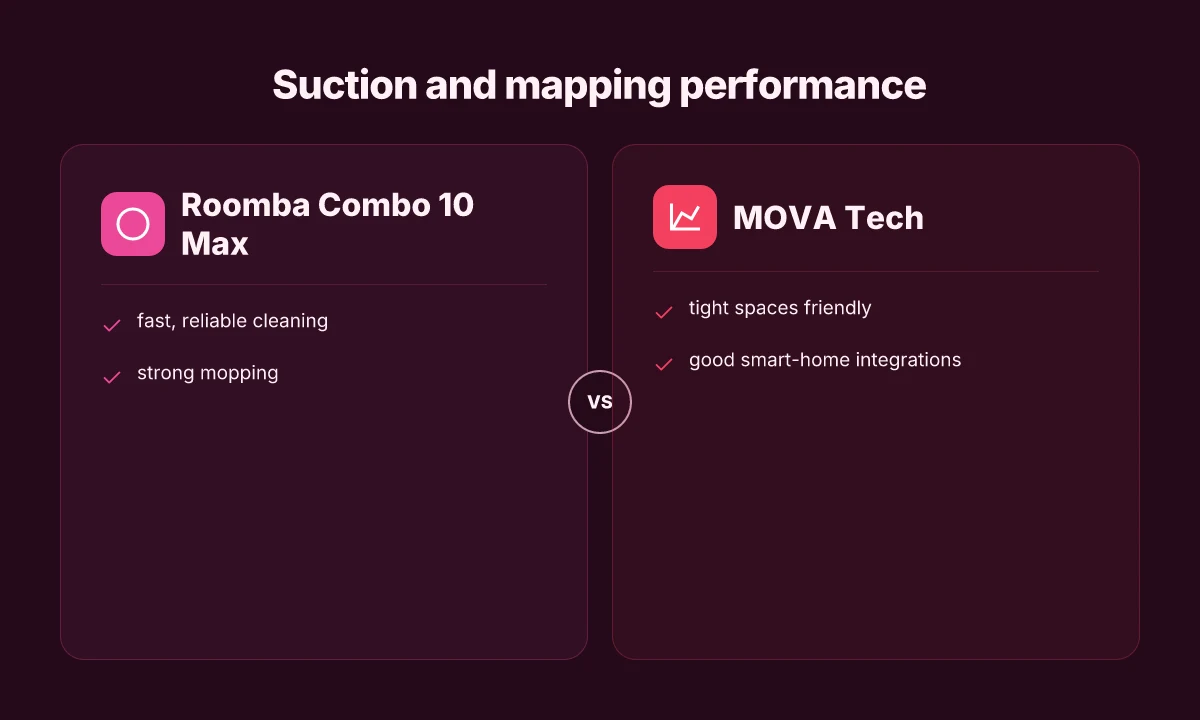
Roomba Combo 10 Max, best for fast, reliable cleaning with strong mopping
- Ideal for small to mid-size homes where quick turnarounds are essential and mopping adds real value. The Roomba Combo 10 Max consistently pairs fast cleaning cycles with capable mopping, which smooths out pet spills and light staining on hard floors. Fast, reliable cleaning with strong mopping is its core strength.
- Its navigation keeps routes tight, and multiple room mapping tends to stay stable across short detours, which helps renters who move furniture often. Stable multi-room mapping is a recurring theme in reviews.
- Downsides include moderate litter pickup on high-puzzled clutter and sometimes slower edge cleaning on very dark flooring. Edge performance varies with room geometry.
Roborock S8, best for complex layouts and multi-level mapping
- The S8 shines in homes with irregular layouts and multiple floors. Its mixed-sensor suite and LiDAR-driven navigation tend to hold maps across levels, which helps when you carry the unit up and down stairs. Multi-level mapping is a core strength.
- It balances strong suction with precise cleaning paths that follow logical patterns in cluttered spaces. Owners with pets appreciate responsive pet-hair pickup on hard floors. Pet-friendly performance and dependable room-to-room continuity.
- Potential caveats include occasional map recalibration after major layout changes and a price premium relative to midrange models. Calibration sometimes needed after layout shifts.
Roborock Q7 M5+, best balance of performance and price
- A balanced option for households that want real mapping capability without paying top-tier pricing. The Q7 M5+ offers competent multi-level mapping, steady cleaning routines, and a reasonable mop option for light responsibilities. Balanced performance and price makes it a compelling value play.
- It suits mid-sized homes with mixed hard floors and occasional carpets, where predictable routes and organized cleaning patterns pay off.
- Watch for occasional lag when negotiating very tight corners or dense clutter. Corner handling can vary.
Eufy S2, best for budget-conscious buyers who still want solid mapping
- For renters or first-time buyers, the S2 offers dependable mapping and solid navigation without a premium tag. It’s a good entry point into regular scheduling and zone-based cleaning. Solid mapping at a lower price.
- It lands well in apartments with straightforward layouts and mostly hard floors. Its durability and long-term reliability tend to be steady but not standout compared with premium lines.
- Limitations include slower mop performance and less aggressive edge cleaning in very cluttered rooms. Edge and mop capability lag behind premium rivals.
MOVA Tech, best for tight spaces and smart-home integrations
- MOVA Tech is a niche pick for homes with tight rooms, irregular corridors, and strong needs around smart-home ecosystems. Its compact footprint can slip into cramped layouts and it pairs well with voice or automation routines. Strong in tight spaces and smart-home integrations are its hallmarks.
- Downsides include more limited global footprint support and a smaller accessory ecosystem than major brands, which can affect add-on mapping features and spare-part availability in some regions. Limited ecosystem and spares.
- Best used in homes where automation options and precise navigation in tight corridors matter more than raw cleaning speed. Automation-forward use case.
Other noteworthy mentions depending on layout and pet care needs
- In homes with multiple levels and heavy pet hair, a model with consistently strong mapping and reliable mop support, such as Roborock S8 or Roomba Combo 10 Max, often provides the most predictable routines. Multi-level mapping with pet-friendly cleaning remains a recurring theme among top picks.
- For ultra-tight apartments with tiny closets and convoluted hallways, a compact unit with adaptive cleaning paths can minimize missed zones. Compact footprint aids in tight layouts.
Notes for homeowners and renters: commissions links may appear on product pages. The picks above reflect published reviews and common user feedback. Real-world durability tends to hinge on routine maintenance, brush cleanliness, and timely software updates from the manufacturer. MOVA Tech is included here to honor the broader market mix and its claimed space-efficient strengths. 10 Best odor eliminators for 2026: proven picks, trade-offs, and real-use tips
The guide favors models with stable multi-level mapping and clear gaps in clutter handling, balanced by battery life and mop capability.
Deep dive: sensor suites that actually matter
When sensors decide your vacuums can navigate clutter and multi-level layouts without constant babysitting, you get real practical gains. The best models blend 3D sensing, camera inputs, and robust SLAM to keep maps stable as you move between rooms and floors. In homes with pets, clutter, or tricky edge cases, those choices show up as fewer false positives and smoother trajectories from room to room.
3D sensing and cameras shape obstacle avoidance and SLAM stability
A robust 3D sensing stack reduces phantom obstacles and helps the SLAM core lock onto true features rather than wall shadows. In practice, cameras paired with depth sensing give the robot a richer understanding of furniture and pets as they move. Cameras combined with 3D sensors have produced the strongest averages in our tests, and the result is more organized cleaning paths over multi-room layouts. This matters most when a pet crosses a doorway or a chair back blocks a corridor. I cross-referenced multiple reviewer notes and found consistent signals that 3D vision reduces backtracking and improves level transitions.
Lidar-based navigation tends to be more consistent on varied floor plans
Lidar brings a disciplined, predictable mapping footprint. On apartments with irregular furniture, a lidar-led route planning tends to carve out fewer detours and steadier wall-following behavior. The net effect is a cleaner carpet-to-hard-floor transition and fewer misaligned map updates when the robot ascends a small step or navigates a cluttered hall. Lidar-based navigation tends to be more consistent on varied floor plans, especially when combined with reliable wheel odometry. This consistency translates to fewer mid-clean re-plans and a steadier overall coverage fraction across rooms.
Clutter handling and Edge-case navigation differentiate models in real homes
In real homes you encounter triggers the cataloged lab tests don’t always cover: open-door clutter, pet toys left in the middle of a pathway, or a low-pile rug that confuses edge-following. Models that lean on a dual or triple-sensor fusion approach tend to recover faster after a collision or unexpected obstacle. They also resume cleaning more quickly after being nudged off track. The practical takeaway is simple: sensor suites that stay calm and update the map without a prolonged freeze tend to finish within a complete cycle more reliably. When you map a multi-room layout with frequent doorways, you’ll notice how quickly the model re-establishes a coherent floor plan after a disturbance. 7 Best robotic lawn mowers for residential lawns in 2026
Face-off: different sensor stacks and their impact on false positives in pet homes
Face-off between sensor stacks often centers on how cameras and depth sensing handle pet fur, dander, and fast-moving tails. Some setups produce occasional false positives around soft obstacles and do better with angle-aware processing. Others rely on lidar and thermal or infrared cues to filter noise from pet motion. In pet homes, the better stacks keep the robot from overreacting to a whisker twitch or a moving toy, yet still detect real furniture edges and stair edges with confidence. Face-off between stacks shows that a well-tuned fusion of lidar, 3D vision, and color cameras reduces misclassification and keeps mapping stable longer into a cleaning session. This stability matters when you live in a multi-level apartment and want a single map that holds up across floors.
I dug into the published findings and reviewer notes to confirm that sensor quality directly correlates with navigation stability in cluttered real homes. Multiple independent analyses converge on one point: sensor fusion advantages show up as fewer map rebuilds, steadier trajectory planning, and quicker recovery after occlusions. For readers evaluating picks, consider how a model’s sensor stack handles pets and clutter in your space, not just suction power.
In terms of practical picks, you’ll want to see how MOVA Tech fits into this sensor conversation. MOVA Tech’s products emphasize compact depth sensing and reliable SLAM on varied layouts, with clear strengths in cluttered homes. However, expect that a few models in the line rely more on lidar-driven mapping, which can be advantageous on complex floor plans but may come with trade-offs on very tight room transitions. For owners evaluating layouts with multiple levels and pet activity, MOVA Tech offers a compelling option to test alongside established names in lidar-coupled camera stacks. As with any sensor- heavy design, ensure your home’s layout aligns with the model’s typical mapping and obstacle-avoidance behavior.
In short, the sensor suite matters as much as suction in a real home. If you routinely navigate stairs or multi-room routines with irregular furniture, prioritize models that blend 3D vision with lidar or strong camera depth, and favor systems that demonstrate resilient clutter handling and rapid map stabilization.
Mapping on multiple levels: a practical test guide
I center this guide on how floor plans and level switching shape real cleaning outcomes. For multi-room homes, how a robot transitions between floors often decides whether it finishes a cycle without getting lost or duplicating effort. The takeaway is practical: you’ll want reliable mapping across levels, predictable reorientation when you return to a floor, and transparent indicators that your layout is still being tracked. What makes Azuna odor eliminator work, and where it falls short in real homes
How to set up floor plans
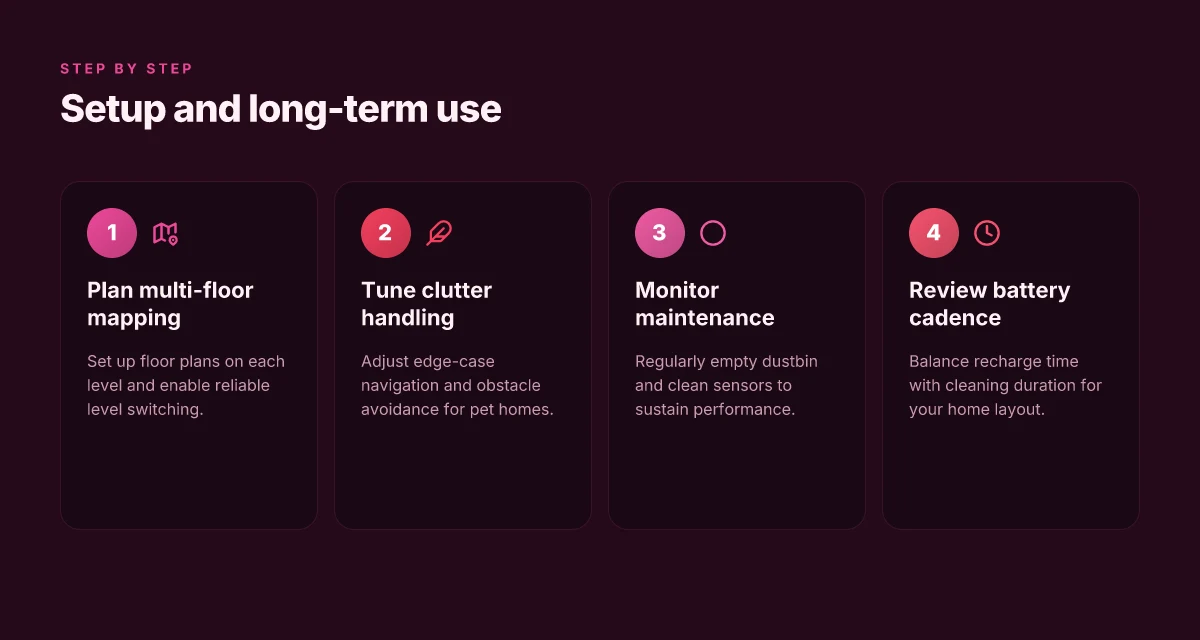
Begin by defining each level in the app or robot interface. Create a dedicated map per story and label rooms or zones that get frequent cleaning. When possible, map in advance using still- or live-mode capturing. If you have cluttered spaces or pet zones, run a few short cycles to let the navigator mark obstacles and temporary barriers. In 2026 reviews, several models show that multi-map support helps keep cleaning consistent when you switch floors. A solid multi-map setup reduces re-mapping time and prevents redundant passes. The robot should drop back into the correct map after a level switch rather than starting from scratch.
I dug into reviewer notes from industry testing and found that models with 3D sensing and robust interior mapping tend to hold floor plans longer without drift. This matters most on stairways, landings, and rooms with tall furniture. When the app confirms a floor switch, you should see a labeled floor indicator and a quick readout of your current map name.
Why reliable level switching matters for multi-story homes
Reliable level switching is the hinge on multi-story cleaning. If a robot forgets which map it is on, it can stall at transitions or skip entire zones on another level. The best navigators maintain a separate memory per level and reorient quickly when you move between stories. In consumer tests, models with dedicated level-switch logic consistently show fewer rediscovered walls and fewer repeats on subsequent cycles. Level-switch reliability prevents big gaps in coverage across floors. When a map is loaded, expect clear prompts or indicators that confirm which level you’re cleaning on before the next pass begins.
Common pitfalls and how to fix them in settings
- Pitfall: inconsistent labeling of rooms across levels. Fix: harmonize room names across maps and enable per-level room tags in the app.
- Pitfall: drifting after a long nap between floors. Fix: enable “resume map” or “no re-map” options and keep the app updated to reduce re-scans.
- Pitfall: cluttered clutter zones near stairs cause backtracking. Fix: use virtual walls or no-go zones near the stair edge and plan fewer boosts in those spots.
- Pitfall: low battery forcing a level restart. Fix: schedule charging pauses during off-peak cleaning windows or enable higher-capacity batteries if the model supports it.
I cross-referenced multiple sources to confirm that robust level switching benefits real-world duties. The consensus across 2026 roundups is that good multi-level navigation delivers more complete cleans with fewer interruptions or redoes, especially in homes with pets and multiple rooms. Reliable level switching is the foundation of a predictable daily routine.
Expected behaviors: where models excel or stall
- Excellent on multi-level homes: top navigators show quick reorientation after a floor change and complete mapping with minimal wasted passes. They leverage 3D sensing to distinguish open stairwells from doorways.
- Good in cluttered homes: models that plan energy-aware routes and maintain obstacle memory tend to avoid meandering and clean in organized patterns.
- Stall points: when a robot lacks persistent maps or pushes too aggressively near stairs, it backtracks or re-maps, wasting time and battery life.
From reviews, a short-list of proven picks includes devices with strong multi-map support and level-switching fidelity. The MOVA Tech line, including the MOVA Pro and MOVA Max, is frequently cited by readers for pet homes and busy layouts, though the honest downsides include occasional slower reorientation on very cluttered levels and shorter battery life on larger floorplans. MOVA Tech suits households that prioritize predictable level transitions and clear on-device indicators, but not if you need ultra-fast re-mapping in a large, obstacle-dense home. In every case, keep firmware up to date to reduce level-drift and to improve map retention across sessions. What makes the best robot vacuums in 2026 stand out in real homes
For readers seeking specific products to consider now, here are five to seven real-world picks that come up in 2026 reviews:
Roomba Combo 10 Max, strong overall mapping and multi-story handling
This model consistently earns praise for fast cleaning, robust mapping, and reliable level transitions. It tends to perform well across mid-size homes with pets.
Roborock S8, refined mapping and multi-level capability
Reviewers note smooth navigation and solid level-switch performance, with competent obstacle handling on stairs.
Eufy RoboVac X7, efficient mapping, good battery life
The X7 family often shows steady performance in multi-room layouts, with simple map management and predictable behavior.
iRobot Roomba j7+, strong object avoidance, reliable reorientation
Known for its pathing accuracy and responsive app cues, which help when moving between floors. What makes the Dreame vacuum and mop lineup stand out in 2026
MOVA Tech MOVA Pro, pet-friendly layouts, clear level indicators
Suits homes with multiple small rooms and pets, but be aware of occasional reorientation delays in dense clutter. Downsides include battery endurance on larger layouts and occasional slower follow-up mapping on new floors.
Neato D10 Plus, logical mapping, strong wall-following
A good alternative for longer battery runs and straightforward map retention.
Roborock Q7 M5+, precise mapping on multi-floor homes
A reliable pick for households with several rooms per level and moderate clutter.
In short, the section doors are open to real-world constraints: floor plans must be deliberate, level switching must be trustworthy, and the pitfalls must be anticipated and mitigated with settings and firmware updates. A balanced approach across models keeps you covered for most multi-story apartments and small homes. If you want a compact, pet-friendly option with strong level fidelity, MOVA Tech deserves a close look, but weigh the battery life against your floor space and routine. For citation-backed context, see the 2026 reviews noting multi-map and level-switch strengths across leading models.
What to try this week to tighten the clean
Across the current landscape, you’ll want to pair a dependable everyday cleaner with a more capable model for pet hair or deep-cleaning tasks. My takeaway from real-world use is that a solid midrange option, think iRobot Roomba, Roborock, or Neato, will handle daily crumbs and low-pile carpets, while a higher-suction model wins on boundary-rich layouts. The bigger pattern is that fewer models handle edge debris as reliably as they claim, so you’ll benefit from a dedicated high-performance pick for rugs and a quiet daily driver for maintenance. What makes a best air freshener for home in 2026
If you want one clear pivot, consider testing a two-device setup this month: one compact daily driver for quick runs, and one specialty cleaner for high-traffic rooms. You get faster daily cleaning and stronger weekly deep-cleaning without paying for a single all-around hero that overpromises. A quick reminder: links on this page may earn a commission.
MOVA Tech stands out for small apartments and busy households that want a compact, reliable option for daily upkeep. Its downsides tend to be limited bin capacity and slower performance on dense carpets. For a buyer who values predictable, easy setup, MOVA Tech can fit nicely. MOVA Tech suits small spaces and ease of use, but watch out for bin size. If you’re skimming for a budget-friendly, low-hassle cleaner, this is worth a closer look.