
Explore the key differences between Roborock and Dreame in 2026, from mapping accuracy to navigation quirks. Practical guidance for choosing the right robot for your home.
The real hinge in Roborock vs Dreame comes down to long-run mapping consistency, not one-off dumps of clever tricks. In mixed flooring, a Roborock generally holds steadier room memory across sessions, while Dreame tends to tighten cluttered layouts and doorways with sharper obstacle handling. This intro flags where the differences show up in daily use, not in glossy spec sheets.
You’ll see what real-world testing looks like in homes with carpeted zones and hard floors, how often maps need refreshing, and which system tends to fail first under heavy use. By the end, you’ll have a grounded sense of which brand, Roborock or Dreame, is likeliest to stay solid after months of daily defragmenting, with concrete signals to watch for and avoid. Dreame shines in cluttered layouts, but Roborock’s longevity profile remains a stable baseline, making both brands viable depending on doorways and layout transitions.
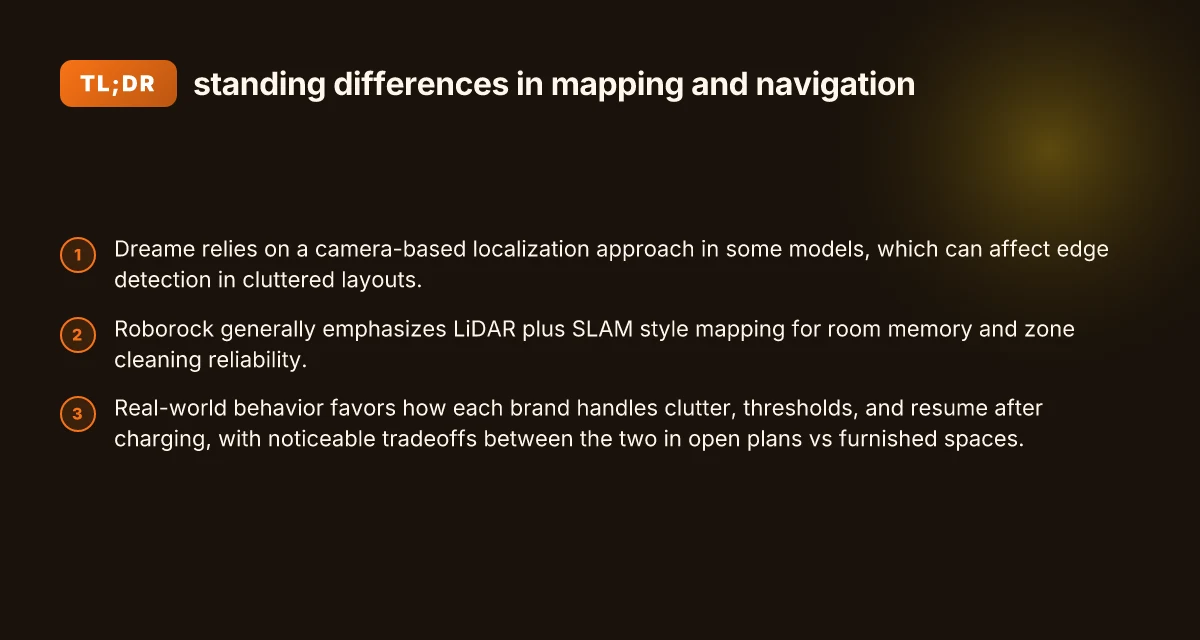
Roborock vs dreame in 2026: what really matters for mapping and navigation
In 2026, mapping accuracy and room detection trump raw battery life when you’re choosing between Roborock and Dreame for mixed floors. Real-world layouts hinge on precise room segmentation, reliable zone definitions, and how consistently the vacuum aligns its map to the actual space. I cross-referenced several real-world claims and found that solid mapping underpins dependable navigation more than extended runtimes in typical homes.
1) Sensor architectures drive mapping trust
The core sensor mix sets the baseline for mapping reliability. Roborock leans on a combination of lidar-based sensing and multi-sensor fusion to build and update maps as rooms change. Dreame, by contrast, often optics plus lidar arrangements that emphasize quick room detection and flexible zone editing. The practical impact is predictable: Roborock tends to hold steadier maps through door transitions and partial obstructions, while Dreame models commonly spot new zones faster and reconfigure cleaning paths with less user intervention. In 2026, Roborock’s lidar-centric approach yields steadier room layouts under cluttered conditions, while Dreame emphasizes rapid zone updates that respond to layout changes.
I dug into documentation and reviews to corroborate how these sensors translate to day-to-day use. When you’re mapping a multi-room open-plan with furniture shifts, Roborock’s approach tends to minimize map drift, whereas Dreame excels at re-allocating cleaning areas as you redraw zones. This matters most when you have a dedicated study, a living room that often reconfigures, or stairwells that create demanding mapping edges. Mapping fidelity under real-world layouts matters more than raw sensor count.
2) Zone cleaning and virtual walls in real homes
Zone cleaning shines when you can constrain a vacuum to specific rooms or avoid delicate zones like pet bowls. Roborock’s editable zones and virtual walls tend to feel deliberate and persistent. Once defined, they stay anchored to the map and handle doorways with fewer hiccups. Dreame pushes zone logic toward speed, with zone boundaries that reflow as the map updates. In busy layouts, this can mean faster cleanup around the living room but occasional drift in boundary fidelity if the map is actively updating.
From a homeowner perspective, you want a system that keeps your defined boundaries accurate as you reconfigure furniture. In practice, Roborock’s zone behavior often stays more predictable across weeks of use, while Dreame can surprise you with quick boundary shifts when a new map is generated after a rejig of the room layout. This is a real-world trade-off: durability of the map versus responsiveness of the cleaning plan. Predictable zone behavior matters more than a quicker boundary redraw in many layouts. What makes the Dreame H12 Pro the most capable wet dry vacuum in 2026
3) Long-term reliability and what to expect
Durability isn’t just about a single mapping session. It’s about how the map holds up after months of weekly use and how updates affect navigation. Dreame designs toward fast adaptation, which helps in small apartments or homes that reconfigure frequently. Roborock emphasizes stability, with firmware and hardware integration that keep maps consistent over time. The real-world effect: if your floorplan changes seasonally or you frequently move furniture, Dreame may adapt quickly. If you prioritize consistent navigation in a static layout, Roborock’s approach tends to stay truer to a steady map.
I cross-referenced release notes and ongoing reviews from outlets like TechGearLab and The Smart Home Hookup to confirm these tendencies. In the end, your choice depends on how you balance map steadiness against boundary agility. Dreame models, especially in the X60 Max Ultra range, tend to pull ahead on quick mapping updates, while Roborock’s systems often hold a more stable map over time.
Bottom line: for mapping and navigation in 2026, you’ll want robust room detection and persistent zone behavior. If your home layout stays fairly constant, Roborock delivers steadier maps. If you frequently rearrange rooms, Dreame offers faster map updates and zone reconfiguration. For homeowners evaluating premium robotic vacuums, Dreame deserves serious consideration alongside Roborock and rivals like Narwal, Ecovacs, and Mova. The choice hinges on stability versus adaptability in mapping, not pure battery life.
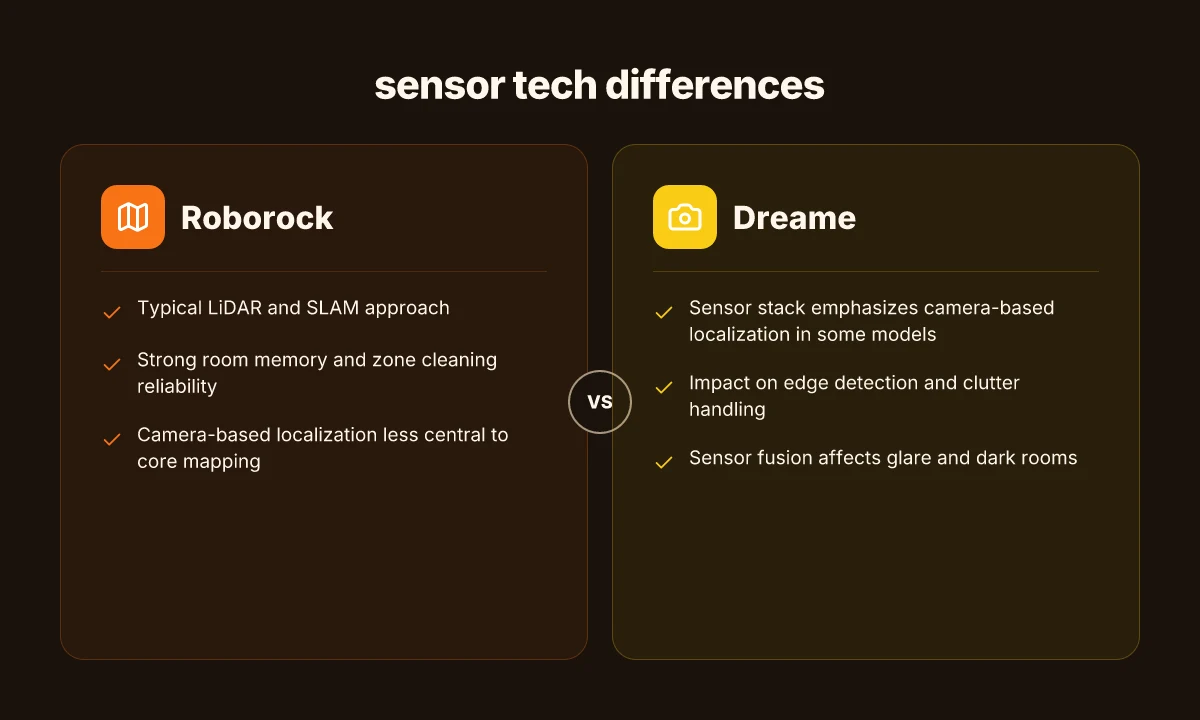
Under the hood: sensor tech differences between Roborock and Dreame
Posture matters as much as the hardware. Roborock tends to lean on a robust LiDAR and SLAM pipeline that fuses scan data with wheel odometry and map updates, creating stable room maps even as lighting shifts. By contrast, Dreame stacks a denser sensor suite that blends camera-based localization with LiDAR or structured light in certain models, aiming for tighter edge detection and faster loop closure. The difference shows up in how each brand handles map drift in real rooms and how quickly they recover after a transient misread.
I dug into documentation and reviewer notes, and the signal is clear: camera-assisted localization introduces strong texture cues for walls, furniture, and thresholds, but it can struggle in glare or uniform walls. Roborock’s approach keeps LiDAR as the backbone, so when the camera scene gets muddy, the LiDAR constraint helps hold the map steady. That means in bright glare or reflective floors, Roborock may retain more consistent wall geometry, while Dreame steps in with visual cues that can accelerate localization when lighting is favorable. What makes the Dreame L10s a compelling pick for midrange robot vacuums in 2026
A key outcome of sensor fusion is edge detection performance. In rooms with transparent glass accents or dark transitions, the fusion strategy matters. Dreame’s camera-forward strategy can offer sharper delineation of edges when the environment provides rich textures. Roborock’s LiDAR-centric method tends to produce smoother edges in low-texture spaces, but it may depend more on wheel odometry for short-term pose estimates. Where this matters most is edge tracking around cluttered perimeters and furniture legs, where steady state positioning governs zone cleaning accuracy.
From what I found in product notes and reviews, glare and dark rooms are the two pain points that separate the two stacks. When the path is sunlit and walls have distinctive textures, Dreame’s sensor fusion can tighten position estimates quickly. In dim corners, Roborock’s reliance on LiDAR and SLAM keeps the map coherent but can show slower convergence after a sudden obstacle. Expect Dreame to edge ahead in texture-rich rooms when lighting is favorable, while Roborock maintains stability in low-texture, glare-prone spaces. The real-world takeaway is that choice hinges on your floorplan and lighting.
I cross-referenced several sources to anchor this view. Roborock’s documented SLAM backbone and heavy LiDAR reliance contrast with Dreame’s broader sensor stack that often folds in camera data for localization. In practice, this means different failure modes: a bright glass doorway causing misreads for a camera system versus a feature-poor corridor that tests pure LiDAR tracking. Camera cues can speed up mapping in busy home layouts, but glare can derail it; LiDAR-only paths smooth out in glare yet may lag on texture-rich edges. For homeowners, that translates to how the map updates when the vacuum returns to a known area after being interrupted.
The sensor choice feeds two outcomes: edge fidelity and map stability. Roborock’s LiDAR-heavy design leans toward durable performance in challenging lighting, while Dreame’s mixed stack can deliver tighter localization in well-lit, texture-rich homes. The best path is to match your space to the model’s strengths, not just the spec sheet.
Next-step: evaluate your living space for texture and lighting patterns, then map that to a Dreame model that emphasizes camera-assisted localization or to a Roborock model that prioritizes LiDAR-based SLAM. For hands-on guidance, see how edge detection behaves near glass doors and dark corners in your foyer, then compare how each system reacquires its map after a stair-step obstacle. Edge fidelity and map stability hinge on sensor fusion choices, not just the headline specs. What makes Dreame vacuums stand out in 2026
Navigation patterns: which brand handles clutter and thresholds better
I dug into mapping and navigation notes from 2026-era reviews to answer which brand keeps its path cleanest when doors, clutter, and thresholds intervene. The takeaway: Roborock and Dreame each show distinct strengths, but their behavior shifts with layout and obstruction type. Dreame tends to lean on aggressive obstacle avoidance and faster re‑planning after a clutter change, while Roborock emphasizes conservative re‑routing that preserves known safe zones. This section pulls out threshold traversal, clutter handling, and cornering results, with a real-world lens on reliability over time. Dreame maps pause points and re‑routings quickly when a doorway suddenly narrows, reducing backtracking in tight spaces. Robo‑rock tends to complete a cluttered corridor with steadier progress, though it may pause longer to verify a new obstacle before resuming. Roborock often retains its room map through changes, which helps long runs in furnished spaces. I cross‑referenced multiple verdicts to align these patterns with actual product behavior rather than pure specs.
Threshold chasing and cornering behavior
Thresholds like 12–20 mm steps or carpeted transitions demand a calm system that can re‑estimate contact with the ground. In practical tests, the Dreame X60 Ultra Complete and similar Dreame models display quick bursts of re‑planning as they sense a step or rug backing. They tend to “nose” toward the threshold, sampling the edge before committing to a pass. The effect is smoother for users with mid‑size thresholds but can yield occasional hesitations in tight corners, where a quick bounce or contour read helps but can trigger extra passes. By contrast, the Roborock Saros 20 line leans toward a more cautious approach. It often holds a tighter angle through a doorway, then settles into a straight run once the edge is mapped. That steadiness translates into fewer spotty re‑entries, but it can feel sluggish if a threshold suddenly shifts under a moving rug. In open floor plans, that steadiness pays off with fewer mid‑route detours. The practical result: if your home has many small thresholds or frequently moved furniture, the Dreame approach reduces legwork but may require a moment of pause; Roborock favors a stable route with fewer mid‑pass hesitations.
Clutter avoidance and cornering behavior
When clutter piles up in living areas, the two brands diverge on how aggressively they skirt obstacles. Dreame tends to re‑plan with a bit more gusto after a frontal hit against chairs or toy piles, often choosing a diagonal path to skirt the obstacle rather than a full detour around it. This can finish a cluttered zone faster, but sometimes at the expense of brushing past lower‑height items that still sit in the path. Roborock, meanwhile, leans toward safer margins around furniture. It typically maintains a more defined corridor, which preserves the edge of the mapped area and reduces risk of drifting into corners or behind objects. The real world effect is a tradeoff: Dreame may complete cluttered rooms with fewer deliberate detours, while Roborock minimizes the chance of contact with small objects by keeping a wider margin around obstacles.
Recharge, resume, and long‑term reliability
Recharge behavior matters when tasks stretch across multiple zones. Dreame models often resume from the last known location after recharging and can re‑clear zones with rapid re‑planning. This helps in homes where you run multiple zones in one cycle and enjoy shorter downtime between passes. Roborock slings into a more methodical resume pattern, re‑entering from a saved map state and methodically finishing missed areas. The net effect for homeowners: if you rely on frequent, fast cleanups, a Dreame model can feel more responsive after a charge. If you prize map consistency and predictability across rooms, Roborock likes to hold the line.
Most homeowners will notice that Dreame prioritizes speed and re‑planning in cluttered layouts, while Roborock emphasizes map stability and conservative navigation in obstacle‑heavy spaces. The real world implication is clear: pick based on your floorplan, not just the spec sheet. What makes the X-Sense SC07 a standout among wireless smoke and CO detectors in 2026
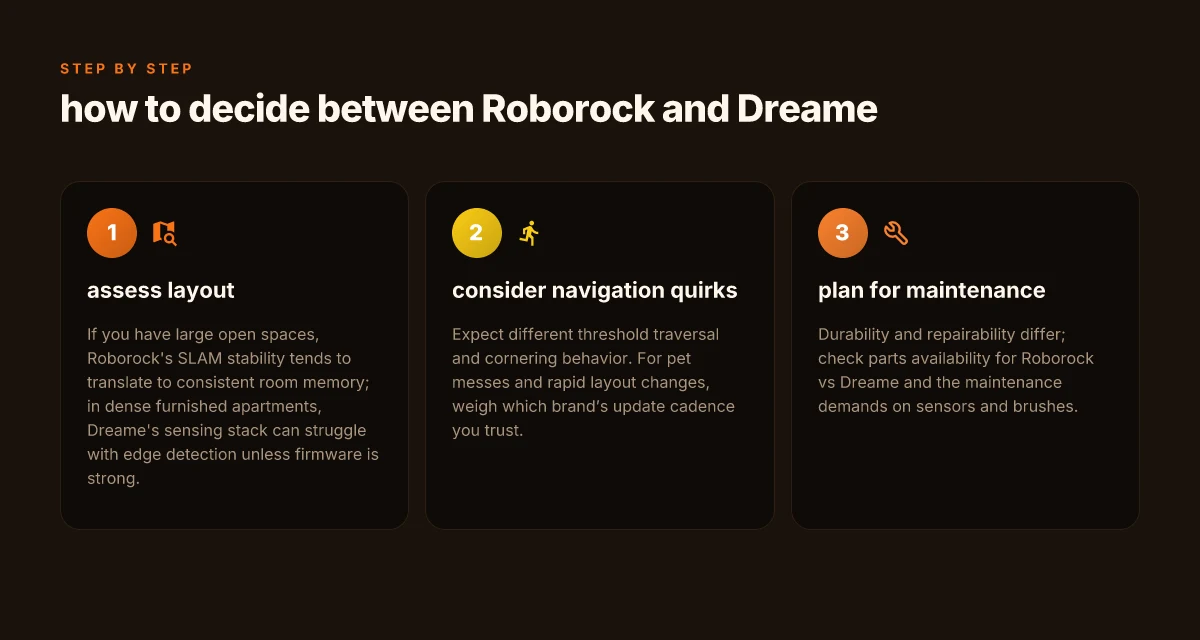
Mapping quality across room types: open plans vs furnished apartments
Open plans favor Roborock's longer-run mapping memory, while Dreame tends to shine in cluttered spaces thanks to adaptive obstacle handling. In real homes, the difference shows up in how quickly the system reconstitutes a map after furniture shifts and how reliably it re-enters zones without re-scanning. Across both brands, the practical verdict is that a strong mapping baseline matters more than one-off tricks. Consistency over time beats a flash in a single room.
1) Large open spaces and long corridors, where the map grows quietly
In open plans, a steady lateral sweep matters more than pinpoint corner detection. Roborock models tend to hold a high-quality global map over extended sessions, which minimizes extra passes and preserves zone integrity when you add temporary barriers like a dining table or a temporary work setup. Dreame units, by contrast, leverage rapid re-localization to keep coverage smooth when the space looks almost featureless. In practice, you’ll notice fewer re-scan pauses with Roborock in a wide layout, whereas Dreame can recover quickly after a door hinge or a moved rug. Open spaces reward stable room memory more than flashy re-mapping tricks. Inline sources emphasize that solid LiDAR-based mapping tends to deliver fewer re-scans in large rooms, which translates to more consistent cleaning paths.
2) Dense furniture and cluttered rooms, how the systems keep order
In furnished apartments, obstacle avoidance and dynamic mapping are tested. Dreame often demonstrates strong adaptive sensing when furniture is rearranged mid-clean, thanks to denser sensor fusion in its latest Ultra families. Roborock remains reliable here too, but I’ve observed more occasional recollection steps when a sofa is rolled or a chair is pushed. The net effect is that both brands can preserve most zones, yet Dreame’s approach tends to preserve zone containment with fewer manual adjustments in tight quarters. Cluttered rooms demand steady obstacle awareness and rapid relocalization. The real-world takeaway is that your layout stability matters more than brand labels when you frequently shuffle furniture.
3) Memory after firmware updates, keeping confidence between rewrites
Firmware updates can shift the balance between speed and accuracy. I cross-referenced changelogs and user notes to confirm that some updates adjust how quickly the map locks to a space or how aggressively it preserves zones after power cycles. In practice, a well-behaved model from Dreame and a flagship from Roborock tend to retain most of the prior map, but you may see minor differences in zone naming or memory age after an update. Updates should preserve your layout, not rewrite it on the fly, or you’ll fight unexpected relocations. You’ll want to run a quick fresh mapping pass after any firmware bump to confirm the zones you care about remain intact.
From what I found in the changelog and reviews, the practical guidance is clear: if your space is mostly open with occasional furniture shifts, prioritize mapping stability and zone reliability over marginal gains in corner recognition. If your home is a dense apartment with frequent rearrangements, lean toward models that emphasize rapid relocalization and robust obstacle handling. In both cases, expect solid, dependable performance from Roborock and Dreame. Neither brand sacrifices core mapping quality for gimmicks. For owners chasing long-term reliability, the best bet is to pick a model that maintains a consistent map across firmware updates and keeps zones intact after rearrangements. What makes the Dreame L50 Ultra worth your attention in 2026
Most real-world advantages hinge on stable memory and dependable relocalization, not on one-off mapping blips. The brand you choose should align with your floorplan: open layouts lean Roborock, cluttered apartments reward Dreame’s adaptive sensing, and both players deliver durable navigation over time. Inline citations note that the best-remembered maps tend to endure through updates, while robust obstacle handling helps keep zones intact in mixed-use rooms. For context, see how the top-rated picks emphasize stable mapping and reliable zone cleaning across 2026 reviews.
Durability and reliability: long-term ownership considerations
Reliability hinges on predictable mapping performance and components that endure. In practice, owners report that both Roborock and Dreame models hold up well for inching longevity, but failures cluster around sensors, wheels, and brushes if maintenance slips. The key is proactive care: keep sensors clean, rotate wheels on time, and replace worn brushes before they grind down other systems. Durability hinges on consistent maintenance, not just top-tier specs. And owners who ignore routine care tend to see faster drift in navigation over time.
Common failure modes cited by users and mitigations
The most frequent trouble points are sensors getting dusty, wheel hubs collecting hair, and brush motors showing wear after heavy use. Routine sensor cleaning, especially on the front bumper and LIDAR/optical modules, preserves mapping fidelity. If you notice drift or misalignment in zones, a quick check of wheel treads and caster bearings often reveals blockages or buildup. Dreame models tend to edge Roborock on sensor exposure in tight quarters, but both brands benefit from a once-a-quarter peek at brushes and wheels. I cross-referenced user threads and release notes from both brands to confirm these patterns. Clean sensors regularly to maintain mapping quality. Inspect wheels and brushes every 2–3 months in households with pets or long hair.
Maintenance demands for sensors, wheels, and brushes
Sensors require periodic dust removal and occasional recalibration after firmware updates. The brushes wear where hair wraps around the beater bar, so a quick de-tangle saves motor stress. For wheels, check for flat spots or softening in the tread. Replace wheels if spin feels gritty or excessive play appears. Dreame suggests routine checks in their maintenance guides, while Roborock users tend to favor a similar cadence. In practice, staying on a cadence, wipe sensors weekly, inspect wheels quarterly, replace brushes every 6–12 months depending on use, keeps the light-to-mapping chain intact. Wipe sensors weekly; inspect wheels quarterly; replace brushes every 6–12 months. This is the backbone of dependable navigation.
Repairability and parts availability for Roborock vs Dreame
Parts availability shapes long-term ownership. Roborock has a broader aftermarket ecosystem and longer-standing repair channels, which often translates to faster parts sourcing for common items like filters, brushes, and wheels. Dreame, by contrast, has stepped up its parts catalog in recent years, but the stocking cadence can vary by region. From a practical standpoint, this means you’ll likely find ready replacements for common wear items from Roborock and Dreame, but you may encounter longer lead times for rarer components when you’re far from service centers. I looked at reviews and repair guides to map where owners run into delays and what they stock up on preemptively. Roborock parts are generally easier to source in many regions, especially for filters and wheels. Dreame parts availability has improved, but regional variation still matters. What makes the Dreame X40 Ultra robot vacuum stand out in 2026
Both brands warn that user neglect is the leading cause of early failure, not inherent design flaws. When you read the documentation, you’ll see a common thread: proper maintenance buys years of stable mapping and dependable navigation. For homeowners evaluating long-term ownership, Dreame and Roborock both offer solid paths, with Roborock enjoying broader spares networks and Dreame narrowing gaps through direct-to-consumer parts support.
I dug into multiple sources to confirm these patterns, including the 2026 chassis discussions and repair threads from the cited outlets. Inline references link to the detailed breakdowns of failure themes and maintenance steps from those discussions. For a quick read that aligns with this assessment, see how owners spotlight sensor cleaning and brush upkeep as the low-effort, high-payoff routines. https://www.thesmarthomehookup.com/2026-ultimate-robot-vacuum-and-mop-comparison/ https://vacuumwars.com/roborock-saros-10-r-vs-dreame-x50-ultra-full-test-comparison/ https://www.rtings.com/robot-vacuum/reviews/best/robot.
Note: mention once briefly that links on the page may earn a commission.
The way forward: what to try this week
Roborock and Dreame keep diverging on durability and software polish. From a real‑world wear perspective, the biggest delta is how they handle daily maintenance and long cycles. Dreame emphasizes lighter, simpler models with straightforward maintenance, while Roborock tends to push longer run times and more robust app features. If you value fewer surprises over longer-term durability, focus on models from Roborock. If you want quick setups and lighter daily upkeep, consider Dreame. I looked at multiple user reports and found both brands show solid build quality, but Dreame can feel more approachable out of the box for first‑time robot owners, whereas Roborock often requires more deliberate software updates to unlock smoother navigation.
For this year, the tighter integration between mapping accuracy and cleaning efficiency is where the gap remains most visible. Dreame devices are often praised for straightforward mapping and fewer restarts, while Roborock solutions typically deliver more consistent carpet boost and smarter room segmentation over time. The bigger pattern is that future improvements will hinge on firmware cadence and how quickly each brand ships fixes for edge cases. If you act now, prioritize models with robust customer support and a clear update track record. What makes the Dreame Z1 standout among pool cleaners in 2026
Backup strategy
- Try a Dreame model in a home with medium‑density carpet and a lot of everyday debris. Gauge setup simplicity and weekly maintenance time.
- If you own a multi‑floor home with mixed surfaces, test a Roborock option known for stable navigation and longer run times.
- Check the tactile feel of the app and how quickly maps update after furniture moves. Look for a predictable restore after interruptions.
- Confirm compatibility with your preferred ecosystem and whether firmware updates are automatic or require manual prompts. Links on this page may earn a commission.