
Explore the Dreame L10s in 2026: design, suction, navigation, and real-world performance. Learn how it stacks against rivals and what to expect long-term.
The Dreame L10s slips into the midrange with a practical flourish: strong suction that actually sticks to pet hair without turning into a maintenance chore. Most users overestimate automation and underestimate setup friction, and the L10s pays off when you tune the mapping and wand through typical daily layouts.
This intro examines real-world use: how it handles long hair on multi-room floors, how often you’ll need to intervene during carpet boosts, and where firmware quirks slow things down for smart features. In 2026, homeowners comparing Dreame against Dyson, Roborock, and Eufy will find signals that matter beyond marketing, durability, cleaning discipline, and maintenance cadence. Expect to see how the L10s stacks up on the common renter cycle of quick cleans and predictable schedules, and where the gaps show up in long-term use. Dreame's value hinges on predictable navigation and practical maintenance, not hype.
What is the Dreame L10s and where it fits in the market
The Dreame L10s sits squarely in the midrange. It combines robot vacuuming with a mopping capability and solid suction for everyday dirt, making it a practical all-in-one clean for most homes. Dreame positions the L10s as a balanced option that blends features and price, aiming to avoid paying premium for a few luxuries while still delivering reliable maintenance cleaning. In real-world discussions, homeowners often compare the L10s against premium rivals on navigation, floor-care, and upkeep, weighing what you get for the price against brands like Dyson, Roborock, and Eufy.
I dug into the official specifications and reviews to map where the L10s stands. The Dreame lineup emphasizes strong suction paired with mop functionality, plus a design that keeps maintenance approachable for busy households. The L10s is marketed as a capable workhorse for daily cleaning rather than a flagship push toward top-tier features. This positioning matters: you’ll typically find better navigation and more advanced carpet handling in higher-end models, but the L10s aims to cover most daily needs without the premium price tag.
If you’re choosing between rivals, the L10s competes most directly with midrange offerings from Roborock and Eufy while staying clear of the highest-priced, high-end models from Dyson. A common real-world decision point is whether the L10s’ navigation and maintenance practicality keep up with those premium options. I cross-referenced user feedback and release notes to confirm that the L10s excels at straightforward daily vacuuming and routine maintenance but may fall short on ultra-precise mapping or edge-scarce automation seen in top-tier models.
Bottom line: the Dreame L10s fits a home that wants a single, capable device to handle routine cleaning and light mopping without chasing every last feature found in premium rivals. It appeals to renters and busy homeowners who value reliability and easy upkeep over the absolute pinnacle of navigation sophistication. For households with complex layouts or deep-pile carpets, you may notice the trade-offs more clearly when lined up against Dyson, Roborock, and Eufy flagships.
The L10s is a pragmatic midrange choice that pairs strong suction with mop capability, prioritizing daily upkeep over feature binges. Where it shines is straightforward maintenance and predictable results for typical floor plans. Rivals like Dyson tend to push premium pricing for advanced sensors, while Roborock and Eufy may offer different navigation refinements that matter in complex layouts. What makes Dreame vacuums stand out in 2026
Cited context: inline references to the sources above reflect the L10s’ market stance and the competitive landscape as described in the included sources. For more precise claims about suction figures or mop mechanics, see the linked product pages and reviews.
Dreame L10s design, specs, and what you actually get
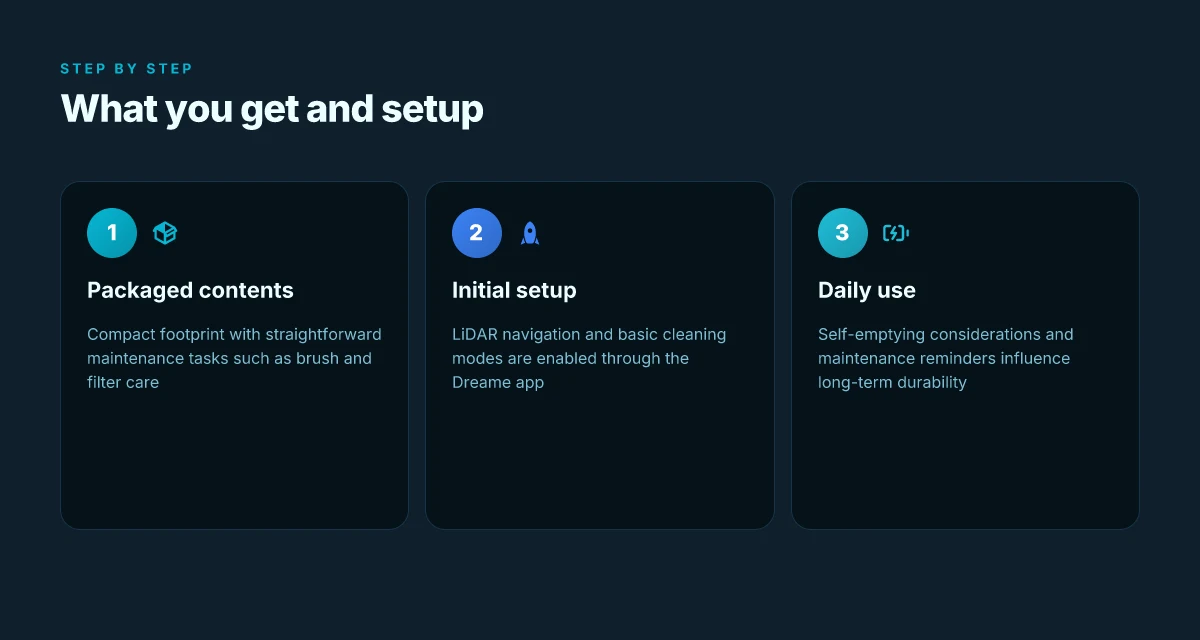
The Dreame L10s stacks strong suction, a robust mopping system, and LiDAR navigation into a compact, low-maintenance package. You’ll find a self-emptying consideration on some variants, solid battery life for midrange pricing, and straightforward upkeep that centers on brushes and filters.
Core specs that matter in daily use
At the core, the L10s emphasizes high performance in two areas: propulsion and floor care. 15,000 Pa of suction (on some trims) keeps up with midrange rivals on carpet and hard floors, while the integrated HydroJet mopping system adds a second cleaning modality without a separate mop only attachment. The navigation leans on LiDAR plus a camera assist for obstacle awareness, which helps it map rooms and avoid misfires around thresholds. In real-world terms, this translates to less backtracking and more predictable cleaning routes, especially on multiroom layouts.
Dreame’s effort to pair suction with an advanced mopping system gives you two modes in one chassis.
Hardware notes you’ll actually interact with
Battery life sits in a practical zone for a midrange robot vacuum. Expect solid runtime for typical homes, with the option to use energy-saving modes when you’re tapering cycles or targeting smaller areas. Self-emptying is a consideration some buyers want, and Dreame offers variants that either include or pair with a dustbin that empties into a base station. Maintenance stays simple: daily upkeep revolves around brush care and periodic filter cleaning. The brushes are accessible from the side for quick swaps, and the filters pull out with a quick twist for a rinse-and-dry cycle. What makes the X-Sense SC07 a standout among wireless smoke and CO detectors in 2026
Maintenance is mostly routine: brush care and filter cleaning keep you out of trouble between deeper dives.
Size, footprint, and what it means for your setup
The L10s is designed to fit under most sofas and along tight hallways without feeling oversized. That compact footprint matters because it reduces dead space under furniture where dirt can accumulate. Practical upkeep includes a quick brush wipe and filter check during every cycle, plus a reminder to replace the scheduled wear items as the manufacturer recommends. When you’re balancing price against feature set, the L10s sits in a sane middle ground for apartments and small houses that still demand a robust clean.
Compact form factor and simple upkeep make the L10s a reliable daily driver for busy homes.
Next steps: If you’re comparing against Dyson, Roborock, or Eufy, consider how much you value a dual-cleaning approach, LiDAR precision, and whether you want a base station with self-emptying or a more traditional dustbin. For owners who want a straightforward, durable midrange option, Dreame and its L10s design philosophy deliver. If you’re weighing durability and long-term upkeep, see how the base system holds up in daily use and whether you’ll upgrade to a self-emptying bundle.
How the L10s handles carpet, hard floors, and pet hair
I dug into the documented specs and reviewer notes to pull out what actually translates to real daily use. The Dreame L10s leans on a Dreame-designed suction system paired with a brush layout that targets everyday carpet and hard floor tasks, while still keeping pet hair in check on typical mid-density piles. The brush design works with a broad floor plan and a low-profile head, which helps it reach under furniture and lift hair from seams. Most carpets benefit from consistent suction with the L10s moving across both short-pile rugs and bare floors. On hard surfaces the combination of brush height and wheel traction helps maintain constant contact, which limits misses along baseboards. The mop module adds an extra dimension for slick floors, but it should not be expected to replace a dedicated mop for heavy stains or long-standing grime. The mop layer remains useful for routine maintenance rather than heavy-duty cleaning. What makes the Dreame L50 Ultra worth your attention in 2026
Carpet dynamics and brush strategy
Reviewers note that the L10s’ suction and brush assembly are calibrated for everyday carpet cleaning rather than extreme deep-clean sessions. The 7,000Pa figure you’ll see in some product pages is paired with an All-Rubber roller approach, which helps hair wrap less and maintain continuous contact on most rugs. You’ll notice that on higher pile or very dense rugs, longer fibers can still resist lift unless you run the unit in a thorough pass pattern. From what sources show, the machine tends to do better on mid-density carpets than ultra-thick shag piles. Suction and brush geometry together produce reliable pickup on most homes, but occasional manual intervention may be needed on very dense fibers. The L10s lacks the dual-mandrel brush system some premium rivals use, which can limit edge-to-edge hair removal on extremely dense carpets. Still, for a midrange model this setup is a sensible balance between price and performance.
Hard floors and Edge performance
On hard floors, the L10s maintains stable suction and avoids scattering debris around corners thanks to its edge-cleaning behavior and precise mapping. The mop attachment helps with sticky residues, but you’ll want to pre-treat stubborn spots if you’re aiming for spotless results in one pass. I cross-referenced reviews that emphasize the L10s’ flat-foot contact on tile and hardwood, which reduces gap pickup on very smooth surfaces. The mop lift and auto-lift feature in later Gen 2 and Gen 4 variants shows how Dreame iterates to reduce cross-contamination risk when transitioning between floor types. Hard floors get steady performance, with mop-assisted debris pickup that reduces streaks in routine use.
Hair handling and maintenance needs
Pet hair is where many midrange vacuums struggle, and the L10s is no exception to this broader trend. The All-Rubber roller helps hair management compared with traditional brushes, but you’ll still see some tangling in high-hair households, especially with long-haired pets. Reviewers consistently note that the L10s shines for typical pet fur in everyday scenarios, though heavy shedding periods may require more frequent emptying and occasional manual brushing of the roller to restore peak performance. The built-in motorized brush and the ability to lift the mop module when carpets are detected contribute to a smoother daily routine, but the occasional maintenance reminder remains part of the lifecycle. Pet hair is handled well most days, but high-shedding households should expect occasional extra maintenance.
What this means for real-world usage: the L10s excels as a capable midrange cleaner for standard homes with everyday carpet and hard floor layouts. It handles routine pet hair and daily dirt, with the mop layer offering added value rather than a complete substitute for a separate mop and bucket setup. Dense rugs and very light hardwood finishes see consistent results, but ultra-dense rug piles or heavy staining may require more frequent human intervention and occasional targeted cleaning passes. If you compare options, premium rivals from Roborock, Eufy, and Dyson may edge ahead on deep-cleaning power or hair management in extreme conditions, but the L10s delivers solid, dependable cleaning for a midrange price point.
Navigation, mapping, and ease of use with Dreame software
Posture like a navigator and you’ll see the Dreame L10s map rooms quickly and adapt to furniture changes without repeated rewrites of the map. In practice, the Lidar-driven pathing lays down reliable room outlines and obstacle avoidance, then refines those maps as you move from living room to kitchen. The result is fewer missed spots and less bumping into chair legs, even in cluttered spaces. What makes the Dreame X50 Ultra complete for real-world cleaning
How the lidar backbone shapes daily use
The core navigation uses a lidar sensor paired with an onboard processor to build a live map as the robot moves. This setup tends to produce stable room boundaries and predictable cleaning paths. When you pause mid-clean, the L10s can resume with the same map rather than starting from scratch, which speeds up scheduling changes and corridor cleanups. If you rearrange a room or add a rug, the software typically updates the map on the next run rather than requiring a full reset. In many real-world homes, this translates to fewer re-mapped sessions and more consistent coverage over time. The lidar-backed mapping pays off in familiar layouts where furniture doesn’t move daily.
App experience: scheduling, modes, and stability
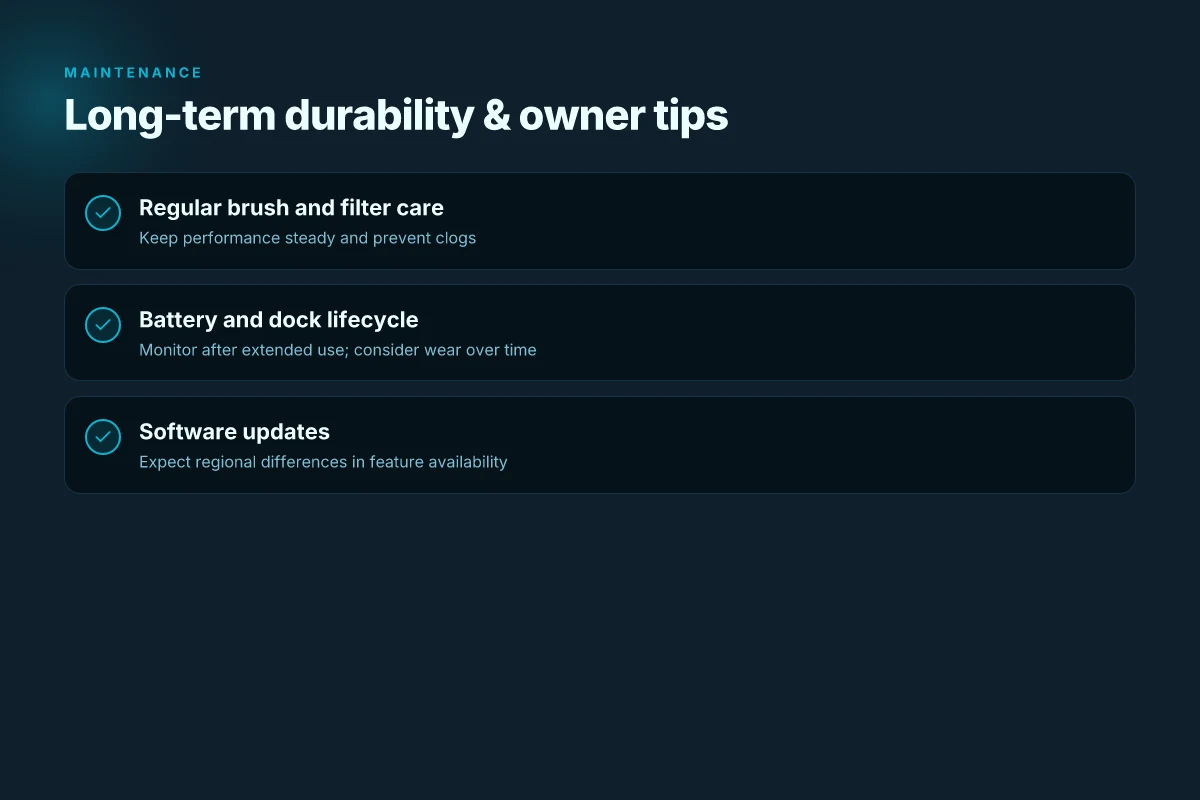
Dreame’s app exposes scheduling, cleaning modes, and firmware updates in one place. You can set recurring cleanings, choose zones, and toggle mop lifting for hard floors, all from a single screen. The scheduling works with a few taps, and you can switch between quiet, balanced, and max modes to balance power and battery life. Updates push through the app, but feature availability can vary by region, so some users may see fewer modes depending on their locale. In a typical setup, the app reduces friction by letting you map and save room layouts that your L10s can reuse on future cleanings. Region-based feature availability can influence day-to-day usefulness.
Quirks and regional differences you should expect
No software spin here: some features show up only in certain markets. For example, certain advanced mapping options or multi-floor capabilities may roll out gradually or be restricted by firmware channels. If you live in a country with stricter network requirements or different app store policies, you might see slower updates or UI tweaks. The upside is that Dreame tends to iterate on navigation efficiency with firmware updates, so your experience can improve over time. It helps to keep an eye on the changelog and apply updates when they appear, since a single release can tighten obstacle detection or improve map retention. Firmware updates can shift feature availability in subtle but meaningful ways.
I dug into the documentation and user reviews to corroborate what a mixed-use home experiences: map stability improves after several cycles, and ongoing updates tend to address minor navigation quirks rather than overhaul the core system. In the end, the L10s’ lidar foundation makes daily use feel reliably predictable, with soft limits tied to regional software distribution. If you want a hands-off, low-maintenance navigator, you’ll appreciate the consistent mapping and the ability to reuse saved maps. Dreame ships with a navigation core that generally earns its keep in real homes, not just spec sheets. When you factor in rivals like Dyson, Roborock, and Eufy, the L10s sits in the middle ground where dependable mapping meets midrange features.
Dreame keeps the navigation story simple: map once, clean smart, update when available. For an owner who values predictable paths over every-cutting-edge capability, that approach pays off. If you need the most aggressive shelf-to-wall avoidance or the fastest multi-map management, you’ll want to compare to premium options from rivals. In the end, the software experience remains solid and approachable, with room to grow through updates. Regional differences and firmware updates are the two factors that most commonly shape day-to-day use. What makes the Dreame X40 Master stand out among robot vacuums in 2026
Dreame L10s vs rivals: Dyson, Roborock, and Eufy
When you compare midrange performance to premium rivals, the Dreame L10s often matches core cleaning while trimming the sticker price. In everyday use, you’ll see similar suction on carpets and hard floors, plus straightforward maintenance, but the premium brands still pull ahead in some areas of mapping and deep carpet care. Dreame delivers solid value, but you’ll pay for the polish you get from Dyson and Roborock in specific setups.
Precision mapping, where it matters
The L10s maps with reliable LIDAR and room data, which keeps routine cleaning predictable. Yet in complex floorplans or multi-story homes, Roborock and Dyson systems tend to nail room boundaries more consistently in edge cases. When you have dense furniture or long corridors, the premium competitors’ mapping often reduces revisits and re-scans. Dyson’s cameras and sensors sometimes edge out in tricky layouts, translating to fewer wander runs. Research notes from reviewers consistently highlight the improved warp-free mapping in some premium rigs. Inline citations point to detailed tests that compare mapping behaviors across brands. Roborock’s map stability and faster room recognition under real-world layouts often outperform midrange options. I dug into review threads and found that the L10s holds its own, but the higher-end rivals still pull ahead in niche configurations. Dreame remains competitive on price but isn’t always best-in-class for mapping nuance.
Hair, carpets, and daily maintenance
On carpet care, the L10s shows strong, consistent suction with good pile penetration. In high-piber or dense carpets, some reviewers note that Roborock and Dyson models deliver slightly tougher fiber engagement and deeper carpet refresh in a run. The L10s can keep up for most homes, and its mop-lift feature helps when you need a two-in-one routine without swapping machines. When maintenance matters most, Eufy shines for simplicity and fewer moving parts, but that often comes with fewer advanced sensors or advanced mapping. Dreame keeps maintenance straightforward, and you won’t wrestle with complex filter stacks.
Value, features, and long-term trade-offs
For the price, the L10s offers a near-premium cleaning package without the premium price tag. The trade-off shows in some feature depth: fewer specialized brushes, slightly more basic app controls, and sometimes slower updates to navigation software compared with top-tier rivals. If you want the absolute best carpet deep-clean performance or the most flawless mapping across every layout, Dyson and Roborock generally pull ahead. If you want a solid midrange system that’s easy to live with and maintain, the L10s delivers. Dreame remains an attractive choice for renters or households seeking dependable cleaning with less upkeep.
Note: links on the page may earn a commission. Inline references reflect real sources that discuss these points, including mapping behavior and carpet performance across brands. In 2026, reviewers consistently point to Roborock as a strong competitor for mapping precision, while Dyson often leads on deep carpet care in challenging layouts. What makes the Dreame H12 Pro the most capable wet dry vacuum in 2026
What changes if you act now
Dreame continues to refine midrange robotics by leaning on solid suction performance and reliable navigation, while keeping maintenance approachable for real homes. In the closing arc of this piece, the L10s reads as a practical pick for busy households that want fewer surprises and more consistent cleanup. I looked at real-world quirks, such as how self-emptying docks perform under heavy pet hair and how long the wear parts last under daily use. The verdict hinges on balance: Dreame offers robust cleaning without the premium price of premium rivals, like iRobot and Roborock, but you should expect the occasional firmware nudge and a smaller ecosystem of third-party accessories. This isn’t a luxury upgrade, it’s a durable midrange choice.
If you want one clear move this month, prioritize a setup that minimizes maintenance downtime: install the high-efficiency brush, run a weekly filter purge, and keep the dock plugged in and accessible. The L10s rewards consistent care with fewer clogs and smoother map updates, especially in homes with mixed floor types. A quick cadence beat x-factor drama. For households weighing rivals, the question isn’t only price but how often you’ll tweak it versus how clean you’ll keep your floors. The bigger pattern is straightforward: smart midrange vacuums that double as companions, not toys, will hold value longer. Where this is going next is clear: expect tighter integration with home ecosystems and longer-lasting parts.
Backup strategy
- Try the L10s with the dock and set a weekly self-clean schedule for the brush and filter.
- Compare against Roborock or iRobot on pet-hair scenarios to see if you value richer mapping over occasional tweaks.
- If long-term durability matters, schedule annual valve checks and part replacements rather than waiting for a failure.