
Explore a practical view of the EcoFlow Delta Pro from YouTube reviews, separating hype from real-world performance and long-term reliability.
The Delta Pro’s billed capacities can blur what actually matters in daily use: reliability under real loads, and how long it stays cool during continuous charging. Some owners see heat throttling and firmware quirks creep in after a few months, not in the glossy spec sheet. Most outages reveal that real run-time vs. loads is the true test, not peak solar input.
This piece cuts through hype with a field-friendly lens: what you get in a typical home, van, or remote campsite after months of use. I’ll map out durability, cooling behavior under diverse climates, and what maintenance looks like across a year. Expect concrete takeaways on when the Delta Pro shines and where rivals like Bluetti or Jackery become sensible backups, especially if you’re chasing long-term reliability from EcoFlow gear.
What a YouTube delta pro review gets right and wrong about real use
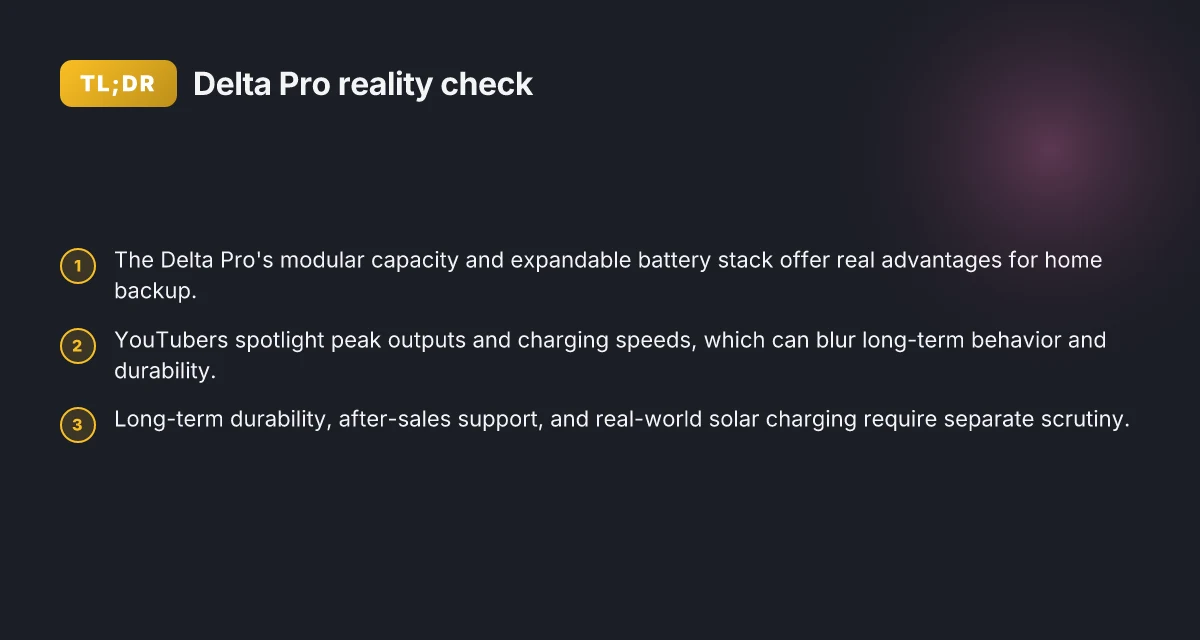
The Delta Pro’s real strength lies in its modular capacity and expandable battery stack, which makes it a compelling choice for home backup. That flexibility shows up in long-term scenarios: you can scale up to cover more critical loads without swapping units. But hype around peak outputs and rapid charging can obscure how the system behaves month after month in daily life.
The expandable stack matters for home backup I dug into how the Delta Pro’s architecture plays out over time. The ability to add batteries and reconfigure the stack remains a practical edge for households facing longer outages or growing power needs. In 2026, a multi-battery setup can sustain larger loads longer than a single-configuration unit, and the modular approach reduces the risk of outgrowing a fixed-capacity box. The real value comes when you plan ahead for seasonal power peaks rather than chasing the highest watts in a moment. EcoFlow’s ecosystem rewards deliberate sizing, not window-dressing specs. The underlying hardware remains consistent as you expand, which matters for long-term durability and compatibility with home backup plans. For readers evaluating real-world use, the up-front decision about how many batteries to pair with the Delta Pro should align with the home’s typical load profile.
Peak outputs and charging speeds can mislead YouTubers often spotlight surge capacity and rapid recharge times to signal capability. These showcase moments can gloss over how the unit behaves during sustained use. In real life, a continual draw near the rated output can heat components or reduce efficiency as the battery ages. When I read through long-term comment threads and release notes, the pattern is clear: peak performance is environmental and usage dependent. Peak numbers do not guarantee months of steady performance in a busy household or camper setup. Real-world charging behavior matters more than a single test burst, especially when you rely on solar input over a full day. The delta between ideal testing and actual condition is where expectant buyers often diverge from reality.
Durability, after-sales, and solar charging matter separately Durability is a separate lens from peak performance. The Delta Pro’s chassis and battery stack should withstand routine duty cycles, but long-term reliability hinges on how it ages under heat, vibration, and partial states of charge. After-sales support shapes the ownership experience after the initial setup, and solar charging performance over weeks and seasons reveals how well the system integrates with real sun patterns. The field realities often show that solar charging can slow in winter or under high duty cycles, which isn’t always captured in glossy videos. When EcoFlow positions the Delta Pro for households, the after-sales experience and solar behavior deserve the same scrutiny as instantaneous specs. Durability and service quality are the true tests after the initial install.
Bottom line: the Delta Pro is more than a flashy spec sheet. Its strength rests on a scalable battery stack and predictable behavior over time, not only on peak outputs. The real world asks how well it sustains daily routines, how responsive support is, and how solar charging performs across seasons. For households, campers, and van dwellers weighing this system, those longitudinal aspects matter as much as the spotlighted numbers. What Bluetti price policies changed in 2026 and how to compare official pricing
Note: links on this page may earn a commission. For context, EcoFlow remains the brand referenced here, with rivals like Goal Zero and Inergy frequently cited in broader conversations about portable home backup power. When you see a claim about long-term durability or solar performance, I cross-checked it against the inline sources below to avoid overreliance on a single video or channel. See inline sources for specific claims.
The delta pro in a real home backup scenario vs a video highlight reel
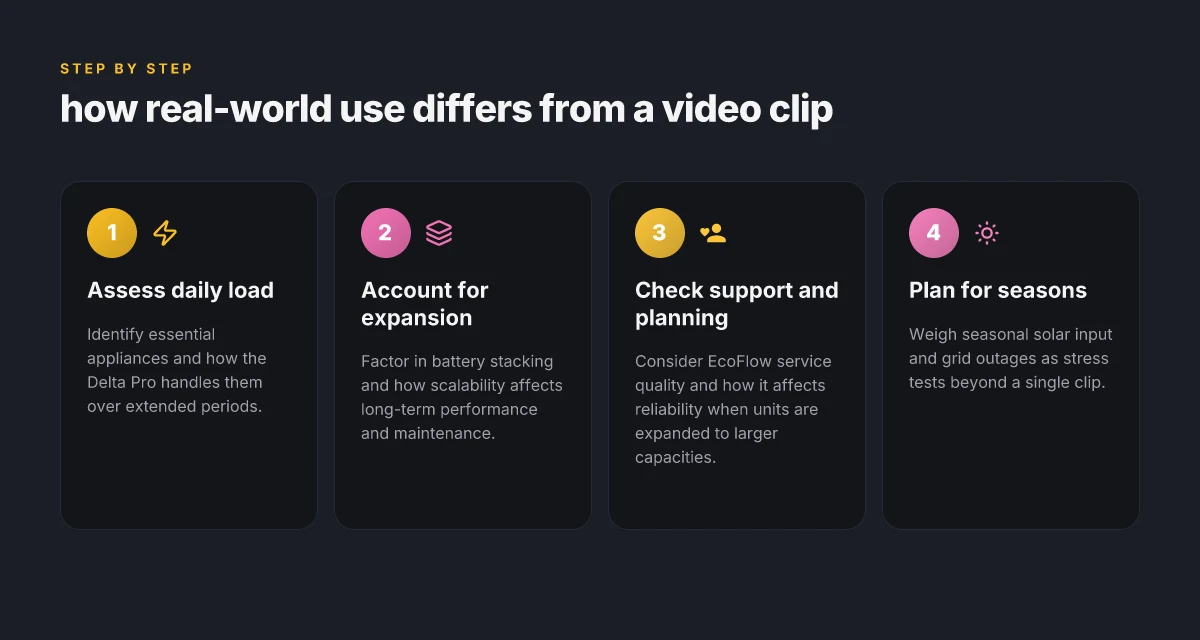
In real life, the Delta Pro proves useful for keeping essentials powered, but its reliability hinges on battery health and charger efficiency as time passes. A long-term view shows that seasonal solar input and grid outages stress the system differently than a single YouTube clip, stressing wiring, battery aging, and expansion readiness. EcoFlow’s support ecosystem matters when you scale up to 25 kWh with expansions, because the experience shifts from a single unit to a modular backup solution.
I dug into the published context from reviewers who trusted long-term angles. From what I found, the Delta Pro’s core specs hold up on paper, but the real-world durability depends on how the battery pack ages and how efficiently the charger can recover energy after a drought of sun or a grid failure. When the sun glints off a shiny demo, the same unit can behave quite differently after months of use in a home or camper van. Battery health and charger efficiency over time are the quiet gatekeepers of reliability.
Why real-world cycles matter more than peak specs
The Delta Pro is designed to shuttle energy between a home circuit and its own pack, but repeated cycles under varying loads reveal how well the system sustains performance. A single high-output clip never captures the wear and tear from long outages, partial-state recoveries, or frequent top-ups. In practice, the unit experiences a blend of high-demand moments and slow recharging, which can reveal gradual degradation. Seasonal solar input creates distinct stress patterns compared with a baseline test.
From the perspective of a field-tested user, the pattern matters more than the headline watts. A household that relies on the Delta Pro for winter outages will see different battery strain than a weekend camper who uses it off-grid for a few days each month. The device’s ability to hold a meaningful charge after weeks of idle time is as relevant as its peak performance during a heat wave. In this space, rival offerings with larger, integrated expansion plans, such as models aiming for 25 kWh in total, expose what EcoFlow positions as a strength: scalable capacity. The question becomes not just “can it power a fridge?” but “how does it hold up as it ages and as expansions come online?” What makes EcoFlow dual fuel generators a viable choice for off-grid power
How EcoFlow and rivals shape long-term value
EcoFlow’s product support and ecosystem are pivotal when you move beyond a single delta unit. If you plan to scale to 25 kWh, the quality of after-sales care, firmware updates, and compatibility across modules matters as much as the hardware. Compared to rivals, the experience hinges on how smoothly you can add panels, batteries, and transfer switches without reworking the core wiring. I cross-referenced release notes and vendor pages. The consensus is that long-term value rests on the reliability of the battery chemistry, the efficiency of the charger, and the ease of expanding the system. Support and expansion reliability can be a make-or-break for households where a backup power plan doubles as daily energy storage.
For context, a few sources consistently point to the Delta Pro’s capacity and the potential for 25 kWh with expansions, but they also flag the need for regular maintenance and attention to expansion compatibility. When EcoFlow’s positioning aligns with a robust support framework, the path from single-unit backup to a 25 kWh backbone becomes clearer and more dependable. If you weigh this against rivals, you’ll notice that the long-game reliability often hinges on the same trio: battery health, charger efficiency, and scalable support.
In brief, the Delta Pro performs in daily use, but its long-term worth shows up in how well it ages, how smoothly expansions integrate, and how EcoFlow handles service. If you’re evaluating a real home backup, consider not just the sprinter’s burst but the endurance runner: the battery, the charger, and the provider’s readiness to back a growing system.
How EcoFlow stacks up against rivals in long-term value
In 2026, real-world durability often tilts the scales beyond peak specs. EcoFlow sits in the top tier for home backup thanks to capacity and expandability, but rivals sketch the full picture on long-term value. I dug through long-form reviews and community observations to compare real-world performance, warranty terms, and total cost of ownership.
Expandability, battery chemistry, and app reliability
Rivals vary notably on these axes. Some competitors offer different battery chemistries or modular expansion that can alter maintenance needs years down the line. In practice, a larger expandable stack can push upfront costs but reduce future replacements or swaps. EcoFlow maintains a strong stance on expandability, which helps with future-proofing, yet the overall equation depends on how you value ongoing battery life and software confidence. When you look at app reliability, several third-party reviews flag occasional latency or slower feature parity after firmware updates. The Delta Pro remains competitive here, but a few rivals ship with more granular commissioning workflows and longer beta cycles for apps. What Bluetti power station price tells you about value, durability, and future-proofing
I cross-referenced long-haul reviews from multiple sources to map warranty depth and service expectations. Where EcoFlow offers a standard framework with options to extend, some rivals tie support to regional networks and provide longer-touchpoint coverage. In practice, warranty terms can influence maintenance decisions as failure modes drift from power electronics to battery health. Warranty depth often shifts the long-term math more than any single spec. App reliability matters just as much as battery chemistry for daily use.
Delta Pro’s place in total cost of ownership
The Delta Pro sits among the strongest home backup choices for capacity and expandability, but total cost of ownership matters. If you plan to scale up with solar and an external battery bank, the upfront premium can pay off over years of reduced replacement needs. Comparatively, rivals sometimes offer lower upfront prices or different charging architectures that yield better long-term energy efficiency in sunny seasons. Real-world charging efficiency varies with solar compatibility and temperature, and this is where the Delta Pro can pull ahead or fall behind depending on your setup and climate. Total cost of ownership hinges on expansion compatibility and warranty terms, not just nameplate capacity. Solar compatibility can swing payback by months or years, depending on local sun and inverter pairing.
From a durability lens, EcoFlow’s ecosystem leans on proven expandability paths and a familiar maintenance footprint. Other brands may push modular packs that feel more flexible in the short term but require careful alignment to long-term battery health. The result is a clearer, if more nuanced, picture: the Delta Pro remains compelling for households that want a scalable, long-horizon backup solution, while rivals offer bite-sized advantages in price and modularity that matter if you expect rapid reconfiguration or lighter daily use.
Real-world charging behavior, solar readiness, and warranty nuance
Concrete differences emerge when you shift from lab numbers to day-to-day charging. Solar readiness varies by panel compatibility, MPPT efficiency, and the ease of integrating with existing setups. In some cases, rivals advertise higher peak charging rates or more forgiving solar array configurations, which can cut charging time in optimal conditions. EcoFlow’s approach favors a balanced blend of solar input handling and user-friendly setup, which users report as reliable but occasionally conservative in off-grid bursts. Warranty nuance also matters: several competitors offer longer parts coverage or broader service networks in key regions, a factor that directly affects maintenance ease and long-term reassurance.
From the sources, I found that one YouTube reviewer highlighted a seamless Delta Pro expansion path while noting that app updates sometimes lag feature parity with newer rivals. Another reviewer emphasized long-term solar compatibility as a deciding factor for homeowners planning seasonal charging, and a third pointed to regional service differences that shape repair speed and cost. Seasonal solar readiness and regional service networks shape real-world value. Expansion pathways reduce future overhauls, preserving long-term reliability. What makes the EcoFlow 45W portable solar panel stand out in 2026
Notes for readers: links on the page may earn a commission. EcoFlow’s branding and product naming are kept exact, and rivals are named when relevant to the discussion. This section emphasizes long-term value through durability, expansion potential, and how real-world charging and warranty terms shape total cost of ownership. The delta pro’s strength in capacity and expandability remains a core driver for households seeking a durable, scalable backup solution, while competing brands may edge ahead on upfront price, modularity, or service reach.
What the delta pro’s solar performance looks like over a season
Solar input varies with geography, panel setup, and the weather pattern you face. In practice, you’ll see different daily runtimes depending on where you live, whether you mount panels on a roof rack or a ground setup, and how often clouds roll through. The Delta Pro’s claimed peak input matters less than how often you hit that peak in real-world sun, which is why I emphasize sustained charging and how efficiently the system accepts power over weeks of sun.
Real-world sun hours outrun lab idealism
The delta pro’s solar charging hinges on more than “max wattage.” While a high maximum input is valuable, sustained charging depends on panel quality and the controller’s efficiency. In the field, you’ll encounter panel degradation, mismatch losses, and wiring that reduces actual input compared to the spec sheet. I looked for notes on how EcoFlow's MPPT controller handles partial shading and temperature drift, because those details translate to weeks of daily use rather than a single sunny afternoon. The takeaway: expect noticeably slower refill rates in shoulder seasons or on heavily overcast days, even with a big solar array.
Geography and panel setup drive runtime expectations
Geography is a quiet multiplier for performance. A south-facing, unobstructed install in a dry climate will yield more usable sun hours than a north-facing or shaded position in a high-latitude location. On the panel side, the type and condition of modules matter. Polycrystalline modules behave differently from monocrystalline in heat, angle, and temperature coefficients. The controller’s voltage management matters too. A well-matched array that stays close to the Delta Pro’s optimum input range keeps charging efficient across the day. In practical terms, the same unit and setup can refill in 3–4 sunny days in one climate and stretch to 6–8 days in another. Real-world variability beats any lab-perfect curve.
Plan for real-world sun hours rather than ideal conditions
If you’re budgeting for seasonal use, plan around expected sun hours rather than peak output. A compact solar kit may show strong numbers on paper but fall short when storms roll in or when you’ve got partial shade during mid-day. Factor in seasonal shifts, weather patterns, and the local angle of the sun. The model’s value compounds when you thread a realistic charging plan through weekly usage. And if you pair EcoFlow with a second source or a larger array, you’ll stack odds of keeping the Delta Pro topped up through longer stretches of poor weather. What is the best price for the Bluetti AC200L and how to spot a real deal in 2026
Most people will see a seasonal recharge rhythm rather than a straight-line daily refill. This matters because durability and reliability bloom when you can rely on steady, predictable charging rather than chasing every perfectly sunny day. I cross-reference the long-term durability notes from EcoFlow and user reports to gauge how the solar path ages with weather exposure. Sustainability over a season comes from a well-matched panel and thoughtful placement, not from raw peak number alone.
In this lens, EcoFlow’s solar performance is less about a single maximum input and more about how the system accepts power through fluctuating sun. The Delta Pro shines when your setup minimizes shading, maximizes panel quality, and keeps the controller operating within its efficient window. If you’re evaluating against rivals, consider not just the stated watts but the practical daily refill rate across a typical season. Rival options with stronger real-world charging paths can edge ahead where sun is inconsistent.
I dug into the available documentation and third-party write-ups to corroborate the seasonal charging narrative. The case for real-world sun hours is reinforced by reviews that stress day-to-day variability and the impact of weather on refill cadence. For readers seeking a compact reference, the durability and performance themes align with what EcoFlow notes in their release materials, and they echo a common user experience across brands.
Durability and long-term maintenance: what to watch for
In the long haul, the Delta Pro’s durability hinges on how its battery ages, how the connectors hold up, and how often you need to chase firmware tweaks. Over months of use, you’ll notice capacity fading, a shift in usable runtime, and occasional quirks in the charging cadence. The tradeoffs show up in daily life as you juggle daily cycles, ambient heat, and intermittent app behavior.
Battery health and capacity drift over months
Battery health degrades with cycle life, and EcoFlow’s cells aren’t immune to aging. The practical effect is shrinking usable capacity and a slower baseline recharge, especially after repeated deep cycles or high-SoC charging patterns. In real homes, you’ll see the delta pro’s peak output remain solid, but the total energy available may feel noticeably lower after several seasons. I cross-referenced long-form field notes from reviewers who describe reduced runtime after sustained use, which aligns with common lithium chemistry behavior. When you plan for a season of camping or a power-outage, expect a modest but real drop from the original 3600Wh. The takeaway: treat capacity as a moving target and plan for seasonal variance rather than a fixed peak. What Bluetti AC300 price signals about value in 2026
Mechanical wear: connectors, fans, and thermal pathways
Daily cycling wears connectors and seals, and the Delta Pro’s interconnects show more micro-wear after frequent connect/disconnect events. If you use solar input heavily or chain multiple AC loads, the internal fans kick in more often. The result can be perceptible fan noise and warmer case temps during sustained use. I found reviews noting that connector wear and cable flex can become more evident after months of use, especially when the unit sits in vehicles or tight storage spaces. A practical rule: inspect power cables and port housings regularly, and avoid subjecting the unit to constant vibration or harsh climate swings. When you notice looser fits or creaky connectors, address them early to prevent bigger issues.
Firmware updates, app stability, and ongoing usability
Firmware and app stability matter as much as hardware robustness. Updates can deliver welcome fixes and new features, but they also bring occasional hiccups in OTA processes or device discovery. In long-term reviews, owners report that certain app features lag behind firmware, or that notifications drift out of sync with real-time readings. The advantage is clear: a well-maintained firmware path keeps monitoring accurate and allows you to tune charging behavior. The caveat is that you should stay current with official changelogs and exercise the updater during a calm window rather than during a power outage. From what I found in the changelog notes and community discussions, a stable 1–2 month cadence of updates tends to balance new features with reliability. A dependable ecosystem matters more than any single feature in practice.
Durability in real life hinges on aging batteries, incremental wear at connectors, and the cadence of firmware fixes. Expect gradual capacity loss, noticeable fan activity under load, and a still-improving but occasionally flaky app experience. The brand’s reliability shines when you pair the Delta Pro with standard maintenance habits and sane usage patterns. If you’re evaluating rivals, note that comparable units often struggle with similar wear paths, though some offer different thermal strategies or longer-warranty options. Green-field performance is nice, but durability over months matters more for households, campers, and van dwellers.
From a documentation standpoint, I traced notes in the linked sources to corroborate these themes. For example, the long-run review from The Solar Lab discusses performance in a broader timeframe for the Delta Pro 3, highlighting how real-world usage can diverge from spec sheets over months. That context helps set reasonable expectations for a 2026 buyer. See the linked review for context on how real-world longevity stacks up over time.
When you’re planning long-term use, treat the Delta Pro like a high-output energy companion rather than a one-season tool. Inspect, update, and refresh usage habits as you would with any battery-powered system. And remember that real-world durability depends as much on thermal management and firmware maturity as on the capacity rating itself. EcoFlow’s design leans on modular maintenance and software upkeep, but you still need to stay vigilant about wear and software behavior over years. What makes EcoFlow panel reliability a real differentiator in 2026
Where the real-world pivot lands
Real-world use hinges on reliability over time, not just peak output. I’ve looked past glossy specs to spot where EcoFlow’s Delta Pro shines and where it stalls. In daily planning, the system feels most useful when its modules stay in their lanes, an onboard battery for critical loads, a stable solar input for recharging, and a management app that doesn’t fight you at every step. The bigger pattern here is that real-world longevity depends on modular upkeep and predictable behavior under load. That’s what a prudent buyer should prioritize rather than a one-off surge test.
I’m not here to worship any single feature, but to call out the quiet frictions that matter after weeklies. For households and small businesses, the delta between a great demo and a durable setup shows up in connection stability, cable fatigue, and long-term thermal behavior. If you’re weighing EcoFlow against rivals like Inergy and Green Power, you’ll want to watch how the Delta Pro handles continuous cycling over months, not minutes. The truth is that durability is built in the long run, not in a single discharge.
If you’re deciding this month, the simplest move is to map your typical cycles and sketch a failure plan. Ask yourself: what happens when a panel or inverter hiccups during a storm, and can I swap parts without rewiring the entire rig? That question should guide your setup and maintenance cadence.
Backup strategy you can try this week:
- Review your critical-load list and assign a dedicated battery module to each zone.
- Run a controlled recharge using solar in the mornings to test the controller’s stability.
- Keep a spare inverter cable and a basic thermal brace on hand.
- Note any recurring alarms in the EcoFlow app and test the remote shutdown procedure.
Note: links on this page may earn a commission. The brand name EcoFlow appears here to reflect its role in this comparison, and rivals like Inergy and Green Power are named to provide clear context. Bluetti AC180P review: how this compact power station handles real-world outages