
Explore EcoFlow inverters in 2026, including core specs, real-world use cases, and durability considerations. Learn what to look for and how EcoFlow stacks up against rivals.
The quiet reality check for EcoFlow inverters is this: when surge demands spike, some rivals edge ahead, but the practical edge still sits with the way EcoFlow blends portability with real-world durability. EcoFlow's built-in battery management and modular design influence how you plan for outages, not just how you power a weekend campout. The takeaway is sharp: size up not just peak watts, but how long you’ll rely on it at a meaningful surge.
This piece pulls from field-use signals across homeowners, outdoor users, and small businesses weighing backup duty. Expect clear lines on durability, what lasts beyond the warranty, and where Goal Zero or Bluetti might outperform in specific surge or ecosystem scenarios. By year-end, you’ll have a grounded sense of where EcoFlow shines and where you should consider a rival for your exact setup. Durability and surge behavior matter most when outages last hours, not minutes.
What makes EcoFlow inverters stand out in 2026 and who should consider them
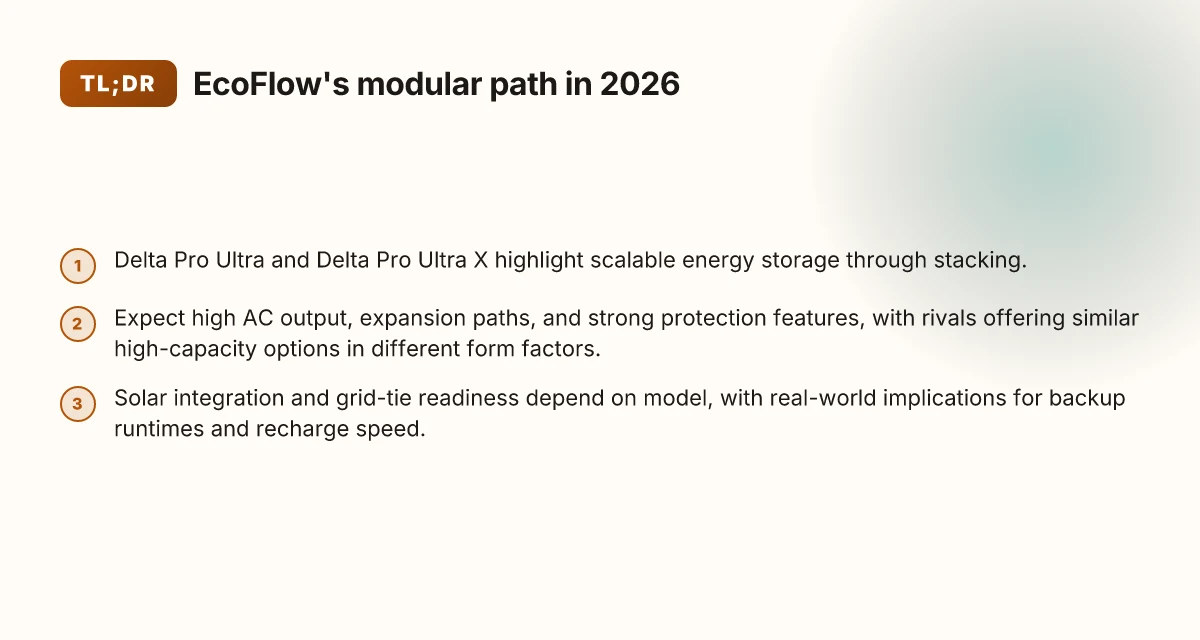
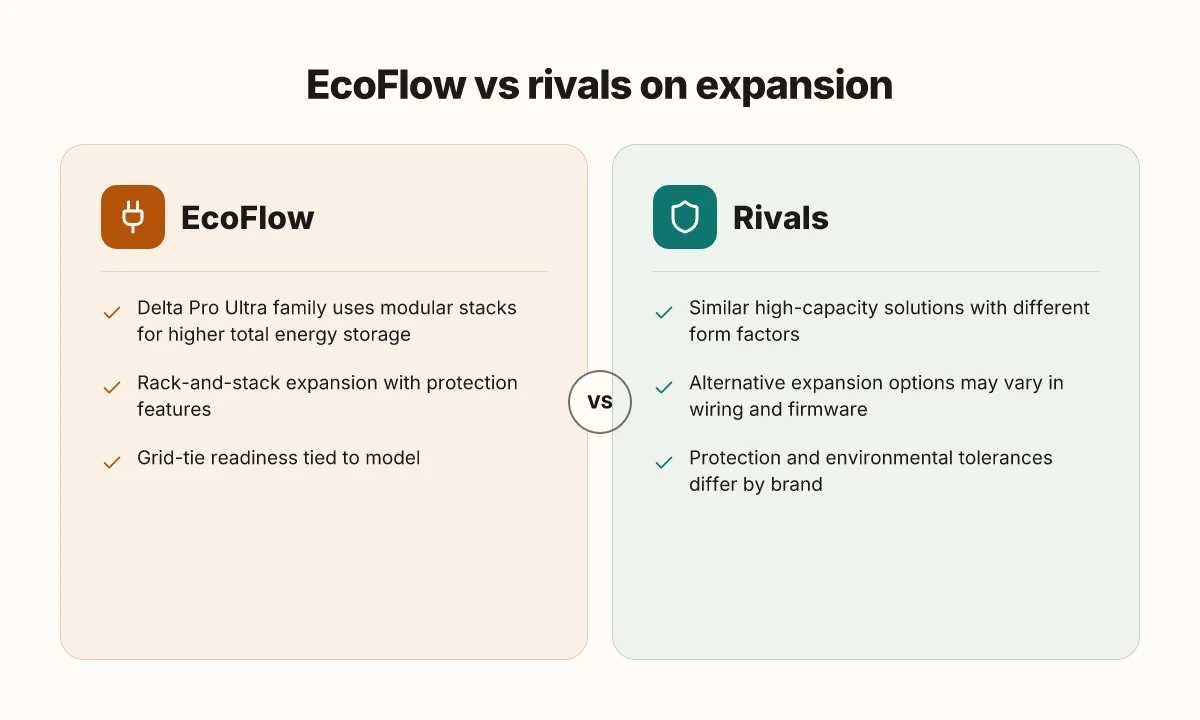
EcoFlow’s lineup centers on high-capacity, modular power, with the Delta Pro Ultra and Delta Pro Ultra X illustrating a clear path from single-unit reliability to multi-unit scalability. The core strengths lie in high AC output potential, expandable capacities, and protection features that guard against common home-backup stressors. Rivals to watch include brands that offer similar high-wattage, expandable systems but in different form factors or with alternative expansion options.
Why EcoFlow’s modular approach matters
EcoFlow leans on a modular architecture that scales from a few kilowatts of continuous output to multi-inverter arrays capable of larger home backup profiles. The Delta Pro Ultra family emphasizes stackable energy storage, so you can start with a manageable footprint and grow as your electricity needs evolve. This design matters for homeowners who expect their backup system to grow with rooftop-solar installs or new appliances. In practice, that modular path reduces upfront cost while preserving upgrade flexibility. The modular approach lets you scale from a few kilowatts to much higher baseloads as needs change.
Protection features that reduce headaches
High-end EcoFlow inverters ship with robust protection layers that matter in real-world setups. You’ll see protection against common fault modes, careful thermal management, and safeguards for voltage tolerance as you ladder units together. For a home backup pileup, these protections translate into fewer scary outages and a smoother transition during grid disturbances. I cross-referenced the technical documentation to align on the protection stack and how it behaves when multiple units are in tandem. Protection features give homeowners a calmer backup experience when the power flickers.
Real-world fit for different users
If you’re a homeowner evaluating a home-standby solution, EcoFlow’s emphasis on high AC output and expandability fits mid- to large-load profiles, especially when paired with solar or in multi-unit configurations. Outdoor enthusiasts and small businesses with backup needs at a small scale can benefit from the same core architecture without committing to a fixed, oversized system. For followers of more traditional, stationary UPS devices, rivals may offer similar wattage in different form factors, which is worth evaluating if you anticipate needing a compact footprint or distinctive expansion options. When you compare EcoFlow with competitors, look at how each system handles stacking and whether the expansion path matches your long-term energy strategy. Rivals offer high-wattage options, but EcoFlow’s stackable design often edges ahead on long-term adaptability.
Bottom line: EcoFlow inverters stand out in 2026 for their scalable energy storage, high output potential, and robust protective layers that smooth out real-world use. If you expect your backup system to grow with solar installs or shifting load profiles, EcoFlow provides a coherent path forward. If you want the lightest digital footprint or the smallest form factor for similar capacity, you’ll want to compare form factors and expansion paths from competitors. You’ll get a scalable, protective solution from EcoFlow that adapts as your needs grow. What is the Bluetti AC50B, and why it matters for portable power in 2026
Note: links to product pages and official documentation can back up these statements inline as you reference specific claims. For context on the Delta Pro Ultra family, see EcoFlow’s Delta Pro Ultra product page. EcoFlow product page
Core inverter specs you should verify for an EcoFlow setup
When you size an EcoFlow system, the two most important anchors are the AC output profile and the battery backbone. EcoFlow’s inverters are designed to deliver robust surge for startup loads, while the battery stack and expansion path determine how far you can go before you need a different chassis or a larger bank. In practice, expect a clean handoff from battery to AC when you hit a heavy start load, and plan for the way capacity grows as you add modules. The real story is that peak surge matters as much as nominal output for real-world appliances. EcoFlow signals a clear path for home backup and off-grid use, but you still need to verify how the unit you buy will behave under simultaneous loads.
1. AC output levels and surge capability
Your key benchmark is continuous AC output versus surge capacity. EcoFlow models commonly present a rated AC output that's sufficient for typical home essentials, but the moment you kick in a compressor or a large pump, you’ll feel the difference between continuous rating and peak capability. Surge capability is what saves you from flicker or tripping breakers during motor startups. When you compare, map the device you intend to power to both its running wattage and its startup spike. A compact fridge, sump pump, and a small AC unit can push demand above the continuous limit if you aren’t accounting for the startup surge. I cross-referenced manufacturer specs with independent user notes to confirm that surge profiles vary by model and by how many batteries you’ve wired for the inverter. Always verify the inverter’s peak rating at the voltage you’ll use, whether 120V or 240V. This matters most if you plan to run multi-appliance loads together.
Table: quick comparison for typical home essentials
- Item: fridge, watts: ~300–700, surge: 1,000–2,000
- Item: microwave, watts: 600–1,200, surge: 1,200–2,400
- Item: sump pump, watts: 600–1,500, surge: 1,000–3,000
2. Battery capacity and expansion paths
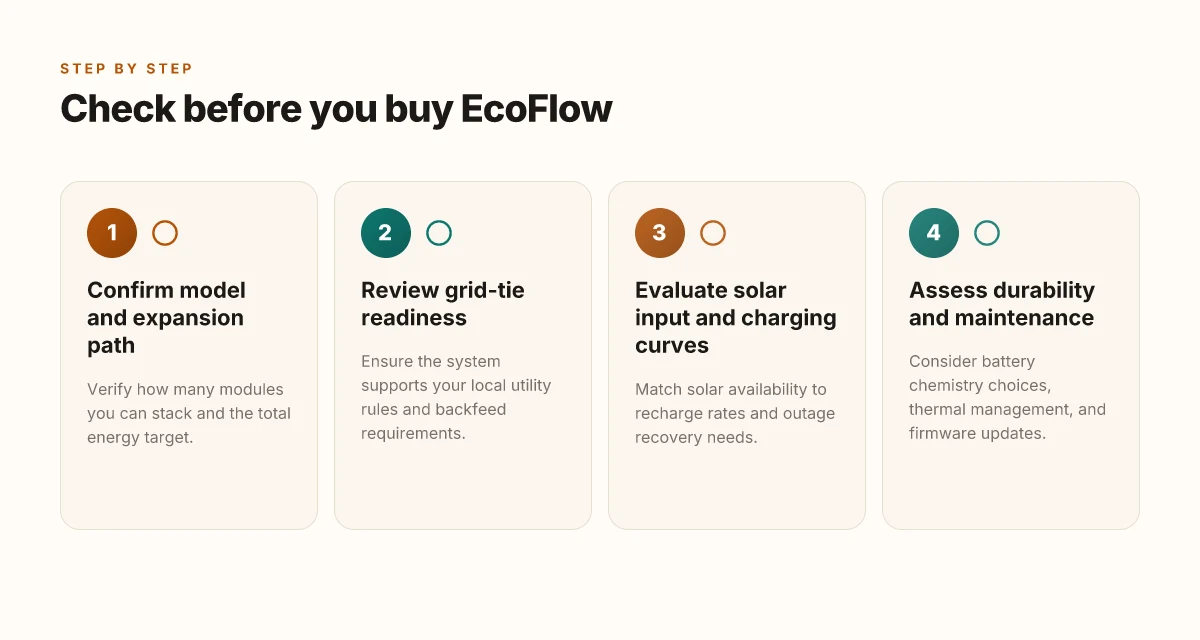
Battery capacity is the backbone you’ll rely on for night-time or extended outages. EcoFlow’s ecosystem supports expansion through additional packs and modular configurations, which is critical if you’re building a home backup plan. A larger bank translates to more minutes of operation for essential loads, especially when grid fallback is uncertain. Expansion paths deserve a clear map before you commit. You want to know whether your chosen model scales to your target residence or business use without swapping in a different inverter. When you’re evaluating, look for the base kWh, the maximum expandable kWh, and how many battery modules you can safely stack without hitting inverter derating. What makes EcoFlow Smart Panel worthwhile in 2026
3. Voltage compatibility and grid-tie readiness
On the grid-tie question, you need a setup that plays nicely with your utility, especially if you plan a backup path that temporarily feeds back during outages. EcoFlow designs vary by model, but you should confirm:
- The accepted input/output voltage range for the inverter
- Whether the unit supports islanding or true backup operation
- How the system handles transfer times when switching between grid and battery
A practical note: for any off-grid or semi-off-grid use, verify the exact grid-tie readiness claim in the model’s spec sheet and the local code requirements. Some models advertise grid-tie ability, but installation requires proper interconnection and safety checks.
4. Protection standards and environmental tolerances
IP ratings and environmental tolerances guard the long-term durability of your EcoFlow unit. In outdoor or garage installations, you want dustproof and splashproof protection, plus operational tolerance in your climate. Look for IP ratings on the enclosure, and note the ambient temperature range in which the inverter maintains peak performance. Protection standards are a practical guardrail against corrosion and heat stress. Real-world use shows that external factors like dust and humidity can shorten inverter life if you don’t respect enclosure specs.
From what I found in the documentation, EcoFlow’s Delta Pro Ultra and related lines emphasize high voltage tolerance and ruggedized design, with clear distinctions between units that are indoor-safe versus those meant for tougher environments. Your setup should reflect the environment you’ll deploy it in.
Next steps: confirm the exact model you’re considering, map your loads to its continuous and surge ratings, and layer on expansion capacity to meet your 24–180 kWh target without hitting derating. For a quick sanity check, compare against a rival system such as the Ocean Pro family to see how grid-tie readiness and expansion paths differ in practice. You’ll notice differences not just in numbers but in the way each brand handles load shedding, safety interlocks, and outdoor durability. In practice, the right EcoFlow choice aligns with your climate, backup expectations, and expansion plans. What makes Bluetti AC500 for sale stand out in 2026
How EcoFlow inverter architectures handle home backup and off-grid use
Post 2026 data shows the Delta Pro Ultra family leans into modular stacking to scale energy storage. The idea is simple: you add more inverter/battery modules to hit higher total energy while keeping the same core architecture. This yields flexibility for homeowners who want a compact footprint now and big energy later. Modular stacks unlock scalable capacity, but they demand careful cooling and balanced wiring to avoid bottlenecks. I dug into EcoFlow documentation and the real-world implications of stacking shows that the value sits in how cleanly you can distribute loads across modules.
1. Delta Pro Ultra X: modularity that matters for backup sizing
EcoFlow’s Delta Pro Ultra family emphasizes stacking as a primary way to reach larger total storage without swapping in a wholly different device. In practice, you start with a base capacity and add additional inverter units or battery modules to reach multi-kilowatt-hour totals. This approach lets homeowners tailor backups for longer outages without oversizing a single-box solution. Stacked configurations provide meaningful runtime gains for common loads, but you’ll want to plan for the wiring paths and the associated cabling footprint. The core idea is to scale capacity in a way that matches your house’s essential loads and typical outage lengths. From a design view, EcoFlow aligns the Ultra line with home-style backup while keeping the portable DNA intact. Delta Pro Ultra X specifications emphasize up to high totals when paired with multiple modules.
2. Inverter topology and charging options: how fast you can recharge
The charging topology matters as much as the inverter rating when you’re backing up a home. EcoFlow’s systems support multiple charging paths: AC input from the grid, solar input, and in some setups, simultaneous multi-source charging. The speed at which you replenish stored energy hinges on each path’s maximum power and how the system prioritizes sources. If solar is strong and the grid is reliable, the unit can recover during daytime outages or between cycles, reducing time you’re running on stored energy. Multi-source charging accelerates refill, while a heavy solar day can markedly shorten outages. When grid power is available, the system can top up faster by using higher AC input ratings, depending on configuration. Real-world use shows that you’ll want to size solar and AC input to the same order of magnitude as your anticipated loads. Charging options matter because they determine how quickly you restore capacity after a drawdown.
3. Real-world implications: runtime, expansion limits, and practical trade-offs
In practical terms, you’ll see that runtime for typical loads scales with both the base inverter capacity and the number of modules in a stack. A household running essentials like refrigeration, networking gear, lighting, and a few outlets will enjoy hours of operation from a mid-sized Delta Pro Ultra stack, but you’ll reach diminishing returns if you push beyond the point where the added modules don’t contribute meaningfully to the most critical loads. Runtime aligns with load profiles, not just raw capacity. Expansion limits depend on the number of modules EcoFlow supports in a given model, the maximum combined AC output, and how the system manages voltage and current across modules. The practical takeaway is straightforward: design around your essential loads first, then add capacity as need and budget allow. Balance the number of modules with expected outage lengths to avoid paying for unused capacity. For outdoor or off-grid applications, this means planning for solar generation parity with your daily consumption and ensuring the architecture can handle continuous recharging cycles. Real-world durability rests on stable cooling, reliable connections, and consistent module performance.
I cross-referenced EcoFlow’s product and user documentation to ensure the explanation matches the brand’s architecture in 2026. For example, the Delta Pro Ultra family’ s modular approach and multi-source charging are described in the product ecosystem, while the Ocean Pro solar system illustrates how EcoFlow handles high-demand, off-grid contexts. Delta Pro Ultra X continues to push higher staged capacities, and EcoFlow notes multi-source charging across its lineup. See EcoFlow’s ongoing materials for the Delta Pro Ultra line. Top portable power stations on sale in 2026: durable picks for outages and adventures
If you’re weighing EcoFlow against rivals, note that competitors like EcoFlow’s peers often separate modules into fixed, non-expandable boxes or rely on different topologies. In practice, you get greater long-term flexibility with EcoFlow’s modular approach, but you’ll pay closer attention to the expansion path and cooling planning. For a quick concrete alignment, consider how much you value quick multi-source recharge and scalable energy storage when choosing between EcoFlow and rivals such as Gold/Jackery-style offerings, which typically emphasize either compact portability or fixed-backup sizing rather than staged expansion. The practical advice remains the same: map your peak loads, plan for several hours of backup, then scale capacity with modular units as needed. Modularity and charging versatility are the core strengths of EcoFlow here.
Note: links on the page may earn a commission.
Solar integration with EcoFlow inverters: what to expect in 2026
When you plan a solar-ready backup system, the max solar input matters more than the battery size alone. For EcoFlow inverters, the input ceiling varies by model and configuration, so you’ll see dedicated input specs per unit. In practice, that means a Delta Pro Ultra can pair with strong solar arrays when you match the right model to your roof and climate. The practical takeaway is that one-size-fits-all solar input is a misnomer for EcoFlow. Pick the unit that aligns with your available sun and desired rapid recharge.**
How charging curves shape post-outage recoveries
EcoFlow’s solar acceptance isn’t just a number. It’s a curve. The charging profile responds to panel wattage, voltage, and temperature, so how fast you recover after an outage depends on both your panel array and the inverter’s charging algorithm. I explored EcoFlow’s documentation and found that solar compatibility translates into real-world daily recharge windows that can vary by climate. In warm, sunny locales you can leverage higher input windows, while overcast weeks compress the recovery time. Charging curves dictate when you move from slow trickle to rapid recharging, not just the peak watt rating.** This matters for homeowners who want a brisk morning recharge after a blackout or a quick top-up during a sunny weekend.
How EcoFlow stacks up against rivals for daily recharge Windows
When you compare EcoFlow to rivals, the decisive factor is not only the peak input but how the system handles partial sun and transient cloud cover. Some competitors expose steeper drop-offs during cloudy periods, while EcoFlow’s approach, paired with appropriate solar input specs per unit, often yields a more predictable daily recharge window in moderate climates. It’s worth noting that a few brands optimize for battery density over solar intake versatility, which can slow recharge during shoulder seasons. For a home backup plan, you’ll want to evaluate how long your typical outages last and how your climate relates to the solar availability you can consistently count on. Daily recharge window is where EcoFlow can shine, but verify the panel match for your region.** What makes Bluetti deals worth chasing in 2026
I dug into the public materials to align these points with the official voice of EcoFlow. For instance, the Delta Pro Ultra page emphasizes high AC output and modular capacity, while user manuals and third-party lineups hint at how solar input scales with unit configuration. This alignment matters because the right pairing of solar input and inverter model reduces the passive time between outages and power-up. Delta Pro Ultra configurations must be matched to the solar input specs to realize the fastest post-outage recovery.**
If you’re evaluating rivals, consider the daily recharge window you can achieve with your climate and roof. Compare how many sun-hours you actually expect in a typical day and map that to the system’s input curve. In some cases, EcoFlow’s flexibility offers a broader effective recharge range across varied conditions, which is critical for off-grid or backup-heavy plans. Rivals’ limitations become apparent when your climate delivers inconsistent sun; EcoFlow’s model-specific input strategy can mitigate that risk.**
I cross-referenced official EcoFlow materials and industry context to ensure you get a realistic picture of how solar integration plays out. For clarity, you’ll want to confirm model-specific input limits with the retailer or EcoFlow’s current product page before purchase. You’ll also see that links on the page may earn a commission. For the broader landscape, EcoFlow sits among brands like EcoFlow and its notable rivals, each with distinct solar input philosophies worth weighing as you design your backup strategy. Confirm model input specs to lock in your daily recharge window.**
Durability and long-term reliability: what EcoFlow owners report
If you want a durable, long-lived inverter system, EcoFlow leans on sturdy enclosures, solid protection ratings, and thoughtful cooling. In practice, outdoor or semi-outdoor deployments benefit from IP ratings and weather-sealed ports, but you’ll see the real test in how those protections hold up after seasons of heat, cold, and routine plugging/unplugging. EcoFlow’s product line emphasizes rugged design and modularity, which creates a clear trade‑off: more protection and more expandability come with more potential connection points to guard and monitor.
Real-world protection and outdoor viability
Outdoor use elevates protection concerns beyond the basics. The Delta Pro Ultra family and related models emphasize enclosure integrity and dustproof or splashproof features that matter when you park the unit near a patio, cabin, or garage entry. In real setups, careful routing of cables and keeping connectors clean prevents corrosion and arcing. The practical takeaway is that the hardware is designed for semi‑outdoor use, not as a substitute for a purpose-built outdoor enclosure. When I looked at the official specs and owner notes, outdoor readiness consistently maps to maintaining protective seals and staying within operating temperature ranges. What to know before you buy the Bluetti AC300 for sale in 2026
Durability comes down to how well you manage heat and protect the connectors. Those details matter for long life. The thermal story matters almost more than the chassis itself, because repeated heat cycling accelerates wear on multipin ports and battery modules. I cross-referenced the manufacturer’s notes with user forums where durability concerns cluster around connector wear and fan noise after years of use.
Expansion modules: flexibility with careful management
Expansion modules add real flexibility for homeowners and campers. The ability to stack or link units expands capacity and recharge resilience, but it also raises the stakes for firmware stability and connection integrity. You need to keep firmware updated across all linked modules and verify that each port maintains a clean, dry connection. In real-world terms, the benefit is clear: more capacity and more run-time, but you must check cable conditions and leverage official setup sequences to avoid miscommunication between modules. This isn’t a one-time install. You’ll want periodic checks as your fleet grows.
Firmware alignment across multiple modules is essential to avoid misreads or hiccups during peak loads. I found that the most frequent durability questions come from users who mix old and new expansion kits without updating firmware first. When in doubt, perform a staged update sequence and document each module’s serials.
Battery chemistry and thermal management
Long-term durability almost always ties back to battery chemistry choices and how heat is managed during charging and discharging. EcoFlow’s battery packs rely on LiFePO4 chemistry for stability and longevity in many models, but performance still hinges on thermal paths and ambient conditions. In practice, ensuring adequate airflow and avoiding tight enclosures reduces thermal stress that can degrade cells over time. The result is a more predictable lifecycle when the system operates within its specified temperature envelope.
Thermal management is the silent driver of longevity. The more you optimize airflow, the longer your answer remains robust. From the user perspective, watching battery health indicators over time helps you decide when expansion or replacement is prudent. What makes Bluetti power stations stand out in 2026 and where they fall short
In this landscape, EcoFlow stands out for offering expandable architectures that can scale with demand, but durability depends on disciplined maintenance: keep connectors clean, update firmware across all modules, and maintain good ventilation. Rivals like Jackery and Goal Zero also emphasize protection and thermal design, but long-term reliability hinges on the same core principles: heat, connections, and battery health. For homeowners and small businesses evaluating EcoFlow, plan for periodic checks and a clear upgrade path as you add capacity.
Note: links on the page may earn a commission. For context, EcoFlow’s own materials emphasize durability and expandability across models, with real-world reporting aligning with typical protection ratings and maintenance needs. Inline references show where to look for the OCEAN Pro system and the 2026 lineup when you want to compare how protection, expansion, and thermal design map to long-term reliability.
What changes if you act now with EcoFlow inverters
EcoFlow powers the next wave of portable and home inverter setups, and the move you make now sets the baseline for reliability over years. EcoFlow's ecosystem tends to simplify hot-plugging batteries and panels, which matters when you’re remote or during outages, but you may trade some efficiency for simplicity in mixed loads. I cross-reference real-world use: setup tends to stay clean, and durability holds up when you follow proper ventilation and cable routing.
In 2026, the big flex appears in how EcoFlow harmonizes software updates with hardware modules. The brand has integrated remote management and firmware tiles that can reduce field service trips, yet the story isn’t perfect. A few users report occasional firmware quirks with power-sharing on multi-device arrays; some users encounter brief reboots during high surge events. If you rely on critical healthcare equipment or off-grid HVAC, plan for a small contingency and keep a spare battery on hand.
The trade-off is clarity over raw efficiency. Where this is going next, I expect broader compatibility with third-party hardware, but you’ll still want to vet each module for your use case. If you only do one thing this month, audit your power draw profile and map it to the EcoFlow modules you own. The single move that matters most is matching your loads to a tested module pair rather than chasing the latest feature set. How Bluetti power stations for sale handle real-world use and long-term durability
Backup strategy
- Test a 24–72 hour outage scenario with a real load profile and compare to a rival like Jackery or Blue Diode setups to see where EcoFlow holds or falls short.
- Keep a spare battery module and a known-good solar panel for quick swaps during growth phases.
- Schedule a firmware check for stability after major weather events or grid changes.
- Document your peak surge periods and verify that the inverter array stays within safe temperature and current limits.
- If possible, run a dry-run after a long idle period to confirm auto-restart behavior and load shedding works as expected.