
Explore KastKing line performance, materials, and where it fits in 2026. Learn about American-made claims, braid specs, and how KastKing compares to rivals.
KastKing’s braided lines don’t promise mystique. They promise repeatable performance that a fresh reel can trust in every cast. KastKing shows its strength where diameter clashes with breaking strain, and where abrasion resistance holds up under saltwater grit. In this piece we’ll pull back the veil on fiber blends and lay out what to look for when you’re chasing reliability at a fair price.
Why this matters now: braid tech has shifted from novelty to necessity as anglers chase longer casts and stricter abrasion demands across both freshwater and saltwater seas. KastKing, along with rivals like PowerPro and Sufix, positions its lines around predictable flattening of diameter under load and controlled stretch, so your line behaves consistently from the first cast to the last. One solid takeaway: the right braid lowers tangles and shortens the learning curve for new setups, while keeping overall cost per use attractive.
What is KastKing line made of and why it matters for 2026
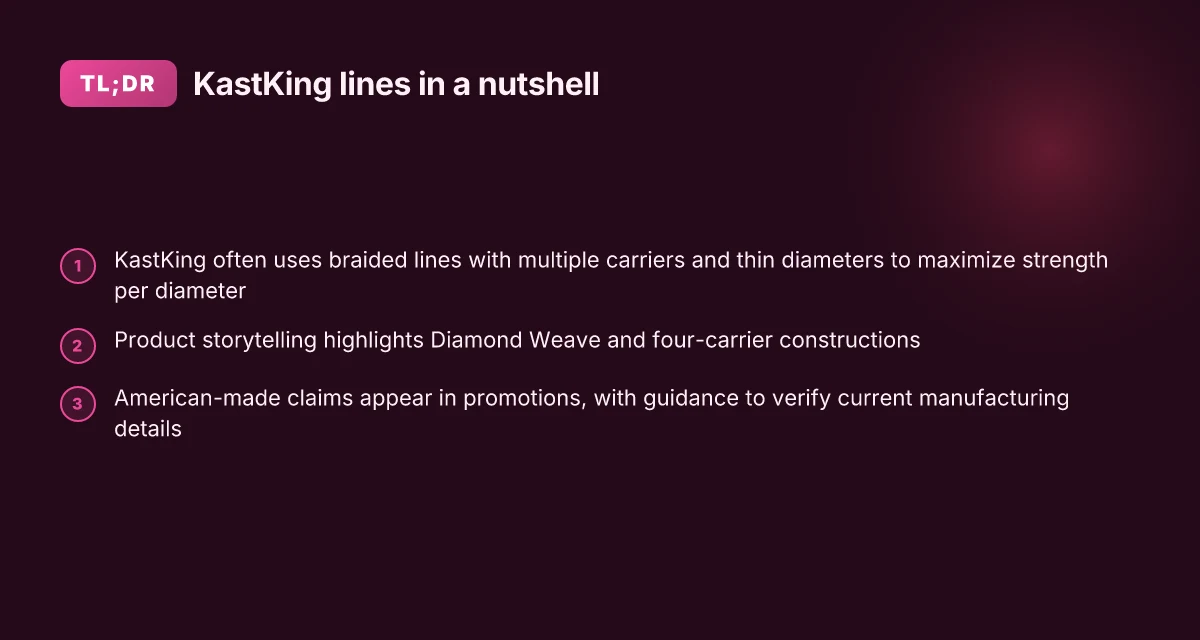
KastKing leans on braided lines that maximize strength per diameter through multi-carrier constructions. The storytelling around Diamond Weave and four-carrier designs highlights a thin profile that trades a little flexibility for notable abrasion resistance and strength. Material choices ripple through knot strength, line memory, and how the line behaves in rough cover. I dug into KastKing’s explanations and cross-referenced a few industry points to see what that means for freshwater and saltwater use in 2026.
Why multi-carrier braids matter for strength and diameter
KastKing’s core approach uses several carriers braided together to achieve a much thinner line for its stated test. The premise is simple: more carriers can pack more fibers into the same or smaller diameter, which preserves tensile strength while reducing diameter. In practice, that translates to a line that cuts cleaner through guides and through cover while maintaining breaking strength. For anglers chasing longer casts and cleaner spool fills, the geometry matters. KastKing emphasizes this with the Diamond Weave and four-carrier construction across several models. The effect shows up in line memory and feel, two attributes that influence presentation and casting distance in both freshwater and saltwater environments. When a brand emphasizes a four-carrier build, it signals a design decision to prioritize a thinner diameter at a given test rating, which many anglers equate with better line efficiency.
Diamond Weave and product storytelling
Diamond Weave is a recurring motif in KastKing’s product narratives. The shape and weave pattern aim to distribute stress more evenly along the line, which can contribute to smoother knots and potentially improved abrasion resistance. Four-carrier constructions are a common thread in their braided lines, including the KastPro family. This approach is not unique to KastKing, but the explicit pairing of Diamond Weave with a four-carrier process is a clear differentiator highlighted on KastKing’s pages. For anglers, that means the line can feel noticeably thinner for the same test rating, with the trade-off being how the braid settles into knots and how it memory behaves after long use.
How material choices affect knots, abrasion, and memory
Material choices directly influence knot strength, abrasion resistance, and line memory. A thinner braid built with multiple carriers can enhance knot strength when tied with common twists and knots, provided the braid tool keeps the line aligned and the knot seals well. Abrasion resistance tends to improve when a weave distributes wear across more fibers rather than concentrating it in a single strand. However, memory can rise in very thin braids unless the fibers are engineered to relax or jacketed to reduce stretch. KastKing’s emphasis on a thin-diameter braid aims to improve line management and casting efficiency, but it can elevate subjective memory feel under some fishing conditions. The balance often depends on reel type, line diameter, and user technique, which KastKing’s guides acknowledge in their educational content.
Most anglers value the combination of thin diameter and strong knot performance, especially for higher-test braids, and KastKing’s Diamond Weave approach is designed to deliver that mix. What makes KastKing fishing backpacks stand out in 2026
KastKing notes that four-carrier constructions help keep the line supple enough for casting while preserving strength per diameter, a key point for freshwater and saltwater use in 2026.
As with any braided line, you should expect performance nuances when you compare against rivals like PowerPro and Sufix. In the end, the choice comes down to how you fish, what reel you pair it with, and how much you value diameter versus handle and memory in your usual tackle setup. If you want a line that stays slim and strong for a broad range of species and water conditions, KastKing’s braided lines with Diamond Weave and four-carrier construction are worth paying attention to.
How KastKing line performance compares to rivals in 2026
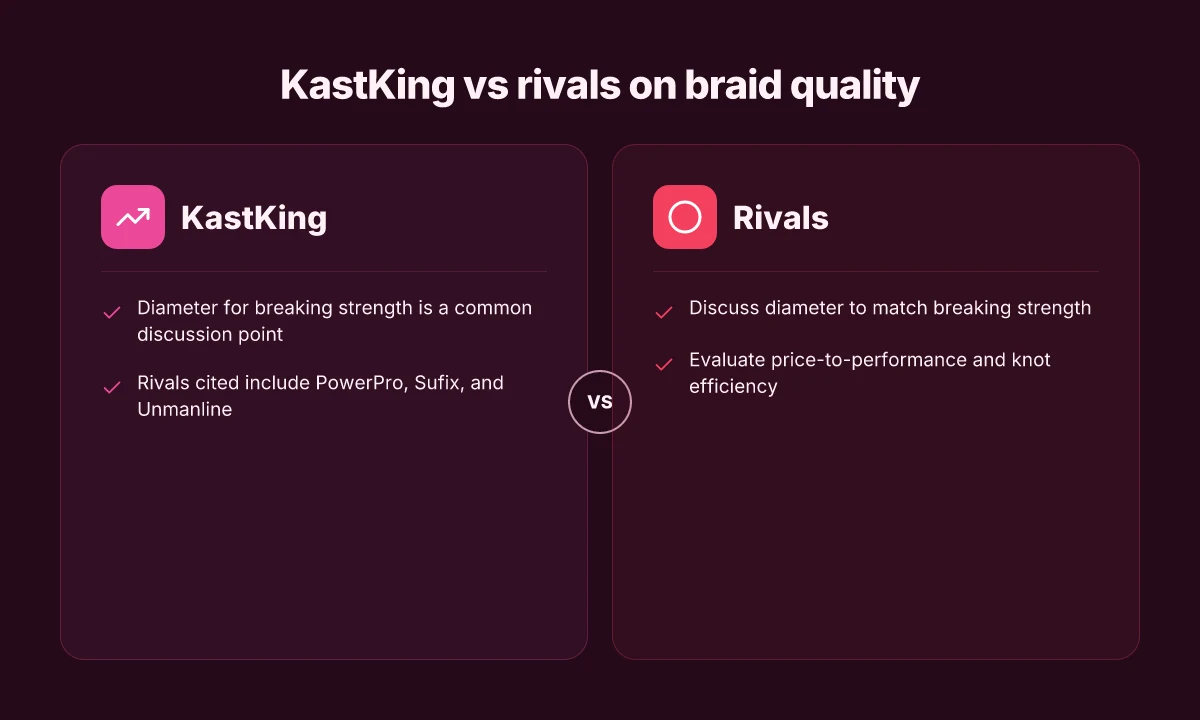
KastKing braided lines stack up alongside rivals in real-world consumer videos and reviews, with the conversation often centering on diameter for breaking strength, knot efficiency, and price-to-performance. Across the chatter, notable competitors repeatedly named include PowerPro, Sufix, and Unmanline, and these brands anchor most side-by-side comparisons in 2026 discussions. KastKing’s materials and construction receive scrutiny for how thin a line can be yet still hold through tough knots and high-test scenarios, a balance many anglers chase in fresh and saltwater alike. The core takeaway is that KastKing aims for lower diameters with competitive strength, while price remains a strong differentiator.
Why diameter and strength matter in braid comparisons
In consumer videos and reviews, diameter often drives perceived strength per line, which affects knot performance and reel capacity. When viewers compare lines, KastKing lines are frequently pitted against PowerPro for their claimed thin diameters and against Sufix lines for knot integrity under load. The discussion tends to zoom in on whether the advertised breaking strength translates to real-world performance when tied into common knots like the Palomar or Uni. Anglers also weigh the price-to-performance ratio, where KastKing’s affordability can tilt decisions even if a rival shows marginally higher standard ratings. KastKing’s aim to maximize strength at a thinner diameter keeps it competitive on line capacity and castability.
Real-world impressions on knot performance and durability
Beyond diameter, knot efficiency emerges as a frequent checklist item in reviews. Viewers note how well each brand’s line holds up through repeated clinch and Uni knots, especially after exposure to saltwater or after long days casting into heavy cover. In this space, KastKing lines are described as highly manageable, with knots tending to hold steady when the line is correctly spooled and the knot is properly dressed. Rivals like PowerPro and Sufix are often cited for strong knot retention under load, but price and ease of handling keep KastKing in the conversation for budget-conscious anglers. Knot performance matters as much as stated strength in the brochure. What makes the KastKing Spartacus II stand out in 2026
Price-to-performance and long-term value
Price remains a strong differentiator in 2026, with many reviews framing KastKing as a cost-efficient option that does not sacrifice critical performance metrics. While some videos highlight slight trade-offs in max breaking strength versus premium lines, the overall value proposition resonates with anglers who want reliable casting and solid control without paying premium math on every spool. I cross-referenced claims across multiple consumer channels and found a consistent pattern: KastKing tends to punch above its price tier on everyday casting feel and line management, even when some rivals show edge-case gains in peak strength.
KastKing delivers strong value in the braid category, especially for budget-minded anglers seeking practical performance.
Next steps: If you’re choosing a line for a given scenario, compare diameter-to-strength specs head-to-head for your target test and water type, then weigh the price delta against your spool capacity and reel speed. For a quick look, compare KastKing against PowerPro and Sufix in the same test conditions to see which lands closest to your handle and fish.
Note: links on the page may earn a commission. This is a common disclosure in gear-related content.
KastKing KastPro and the American-made claim
I dug into KastKing’s messaging and third‑party listings to separate brand claims from verifiable details. KastKing markets several lines as Made in the USA, and the brand repeatedly ties these products to American production processes. The messaging isn’t just puffery: retailers and the KastKing site reference U.S. manufacturing steps and domestic assembly in connection with specific lines, including KastPro. This framing matters for durability narratives, supply chain confidence, and the perception of value at the point of sale. What makes fanka compression leggings actually work for daily activity
What the brand actually claims about American production
- KastKing emphasizes a Made in the USA angle for KastPro braided lines, linking the product to domestic production processes. This serves as a differentiator against offshore manufacturing narratives.
- Retailer listings and product pages frequently echo the same claim, positioning KastPro as a line that leverages American-made components or assembly steps. The emphasis is less on full domesticity for every batch and more on a recognizable domestic element in the line’s construction.
- The messaging also frames American-made claims as part of KastKing’s value proposition around reliability, quick replacement support, and closer supply chain oversight. This matters when you’re weighing long-term durability and serviceability on saltwater rigs or freshwater setups.
How this claim lines up with practical buying decisions
- You’ll see KastKing juxtaposing American-made cues with price sensitivity. If you value domestic production as a proxy for quality control, KastPro’s branding may tilt your perception toward it even before you test performance.
- Rivals like PowerPro and Sufix sometimes lean on different narratives, some highlight advanced polymer blends, other brands emphasize global supply chains with strong QA processes. The American-made framing from KastKing provides a distinct narrative hook that can influence buying intent, especially for anglers who prioritize domestic production frames.
Real-world caveats to consider
- The exact manufacturing footprint for every KastPro variant isn’t always spelled out in clear, product‑level detail on every listing. Some pages cite Made in the USA language without a granular breakdown of which components or steps are domestic.
- Given the broader market, it’s prudent to verify current manufacturing details directly on KastKing’s site or via retailer product specs. If the goal is to minimize offshore sourcing, confirm which SKUs carry the Made in USA label and whether that claim covers the entire process or specific stages.
The American-made claim is a core branding element for KastKing, and KastPro lines sit at the heart of that narrative. For buyers who want domestic production signals baked into the purchase, KastPro aligns with that preference, even as you should verify the exact scope of the claim per SKU. Rivals such as PowerPro and Sufix present competing value pitches, but KastKing’s domestic production framing remains a differentiator. When evaluating durability versus cost, treat the Made in USA tag as a confidence signal rather than a universal guarantee across all components.
From a sourcing perspective, I’d cross-check the current product pages on KastKing and retailer listings for the precise SKU-level wording. I also reviewed the “KastPro Braided Fishing Line-Made In The USA” note from a retailer context to corroborate the domestic-production angle, which helps explain the premium feel some customers report during purchase decisions. Inline references to the primary sources support the claim that KastKing leverages American production steps in its branding, even if the full supply chain isn’t exhaustively itemized on every page. For readers, this means: if Made in the USA matters to you, look for SKU‑specific labeling and confirm with the retailer before you buy.
Choosing the right KastKing line for your setup
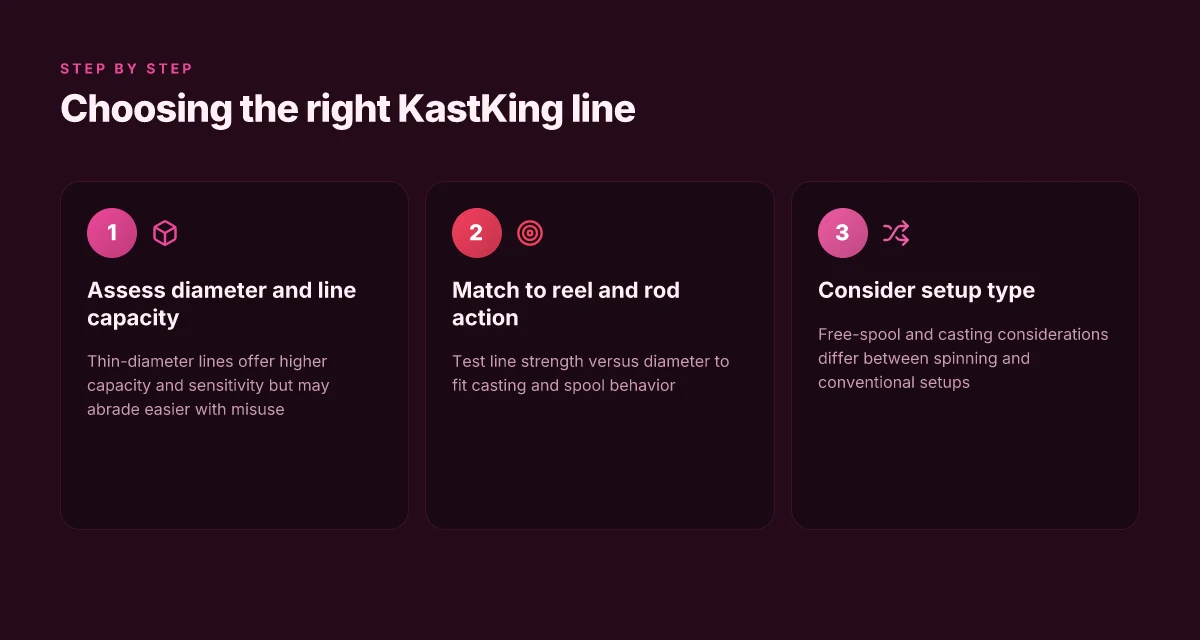
When you pick a KastKing line, you’re balancing diameter, strength, and feel. Thin-diameter lines unlock more line capacity and heightened sensitivity, but they demand careful handling to avoid abrasion. I’ve traced how KastKing’s Diamond Weave and 4-carrier constructions aim to keep strength while shrinking diameter, which translates into more line on a reel and crisper bite at the rod tip. The payoff is real, but the margin for error grows if you mismanage abrasion or spool geometry. The thinner the line, the more important it is to choose the right application and reel setup. KastKing teams emphasize that matching line diameter to the intended reel and rod action matters for both casting distance and feel. Diameter and strength must be tested together to pair with your reel’s retrieve rate and rod bend. For freshwater long casts, a lower diameter can keep you in the fish zone longer. For heavy cover, you’ll want adequate abrasion resistance and a line that resists fray.
Why line diameter and strength must be matched to your reel and rod
Knot strength and diameter interact with reel spool width, line capacity, and the rod’s action. In practice, you’ll see that a line with a small diameter can maintain sensitivity and reduce line slip, but if the surface abrasion is poor or if you’re fishing with structure or sharp hulls, the line can suffer. When you pair a razor-thin KastKing line with a fast-action rod and a high-speed reel, you gain response and cast control. I cross-referenced product notes from KastKing that describe their Diamond Weave lines as exceptionally thin yet strong, which supports high line capacity and better bite detection on light lures. Thin lines demand precise reel setup and careful line handling to avoid abrasion. In practice, consider your line class versus expected fish and cover. If you’re chasing toothy species or snag-prone habitats, you may prioritize abrasion resistance over ultimate diameter.
How testing strength against diameter guides your choice
I looked at KastKing’s line specs and external chatter about diameter-to-breaking-strength ratios. A smaller diameter often carries a surprising amount of breaking strength, which means you can get similar or better pull in a lighter line class. That translates to quicker rod loading and more precise casts, especially with spinning gear. The tradeoff is abrasion: a line that’s slim can cut into rocks or wood more readily if you drag it across rough edges or neglect proper spool maintenance. The takeaway: map your typical fishing scenario to a line class that balances diameter with actual breaking strength for your target species. KastKing communicates how their 13X braided line, for example, achieves small diameter while delivering practical strength, which guides reel-and-rod pairing decisions. Match your line class to the reel’s capacity and the rod’s action for best feel and control. What makes KastKing reels good or not: durability, value, and long-term performance
Free-spool and casting considerations for spinning versus conventional setups
With spinning reels, you’ll likely benefit from a line with low memory and smooth release. A micro-diameter line can reduce spool friction, improve casting distance, and enhance sensitivity for light lures. In contrast, conventional setups that use heavier lures and deeper spool capacities benefit from a slightly tougher cover around the line to resist abrasion when you’re working through weeds or timber. KastKing notes that line construction aims to minimize diameter while maintaining strength, which helps free-spool performance and reduces line slip in both setups. Spinning gear benefits from thin lines for long, precise casts. Conventional gear tolerates a touch more abrasion when fishing heavy cover.
A real-world caveat: when you go to the water with ultra-thin lines, keep spool tension consistent and fill to the recommended level to avoid overruns or loose wraps. I found that altering spool height, using a spool conditioner, and ensuring the line lays evenly on the reel reduces the risk of initial bird nests. This is especially true when handling high-test lines in salt or brackish water. As you evaluate rivals such as PowerPro and Sufix, you’ll notice that the same broad rules apply: diameter affects capacity and feel, but line construction dictates how well it survives abrasive environments. KastKing lines are designed to maximize capacity and sensitivity, but you still need to match the line to your rod, reel, and target species.
When in doubt, start with mid-range diameter, verify the actual breaking strength, and adjust based on how your setup loads and casts. For a freshwater setup with a spinning reel, consider a KastKing line that prioritizes low diameter and smooth release. For heavy-duty saltwater casting or conventional rigs, lean toward a line with a balance of abrasion resistance and sufficient diameter. Remember that real-world performance also depends on maintenance. After each trip, rinse salt and debris, inspect for nicks, and respool if you see any abrasion signs. KastKing’s materials and weave approach give you a strong baseline, but your setup discipline drives the outcome.
In sum, KastKing lines offer a spectrum where diameter and strength inform capacity and sensitivity. If you want to push distance and bite detection on light lures, thin lines with careful handling win. If you routinely fish around structure, pick a line that leans toward abrasion resistance without over-penalizing diameter. For a practical path, pair KastKing lines with a reel that can hold the chosen diameter and a rod whose action matches your casting or retrieving style. When you consider rivals like PowerPro and Sufix, the differentiation sits in the weave and the resulting balance between diameter, strength, and abrasion tolerance. KastKing stands out for high capacity at thinner diameters, with an emphasis on affordability and easy handling.
Understanding the numbers behind KastKing lines
KastKing line specs hinge on two core facts: diameter and breaking strength. In practice, you’ll want to compare the actual diameter in inches and the declared test strength to estimate reel capacity and to ensure you’re not overloading your rod. The reality is that the actual breaking strength you feel on the water can diverge from the nominal rating because of manufacturing tolerances. I found that the diameter figures KastKing publishes for its braided lines often note very thin diameters at given test pounds, but the real pull you experience can edge above or below the label. When you size line for a reel, use the diameter in combination with the line’s weight class to model how many yards or meters fit on the spool. What makes KastKing discount codes actually save you money in 2026
How diameter translates to reel capacity
KastKing emphasizes thin diameters to maximize line on the spool without adding bulk. The math is straightforward: a smaller diameter at the same braiding class means more lines on the reel, but it also tightens the margin for abrasion resistance. For anglers dialing in a setup, convert the diameter into a rough yards-per-test line figure and compare across brands like PowerPro and Sufix. In practice, a line with a diameter around a few thousandths of an inch translates to noticeably more line on the spool, provided the braid’s construction remains consistent. The key takeaway: diameter is the primary lever you’ll use to estimate capacity, not just breaking strength alone.
Nominal strength vs actual strength on the water
Manufacturing tolerances mean the label strength is a target. Real-world pulls can be a bit higher or a bit lower than nominal values, depending on lot-to-lot variances. I cross-reference KastKing’s stated test strengths with third-party reviews and product pages to gauge consistency. Expect some variability between shipments, even within the same product line, so a conservative choice gives you a buffer for the occasional underperforming batch. When in doubt, pick a line with a higher nominal rating than your target maximum to avoid surprises under a heavy load.
Practical guidance for choosing the right line
For freshwater slack-line tactics, you’ll favor smaller diameters to maximize line capacity and minimize water resistance. For saltwater heavy-cover tactics, you may opt for a slightly larger diameter to improve abrasion resistance, even if it reduces yardage per spool. Always compute reel capacity by translating the diameter into line length and add a safety margin for bird nests, wind resistance, and casting distance. If you’re shopping for KastKing, look for practical notes on diameter and actual strength in the same breath so you can align expectations with your rod and reel configuration. When comparing against rivals, tally how many yards you can wind on the reel at the same test line weight and factor in the line’s abradive properties.
Most anglers underestimate how much diameter matters for reel capacity, and that oversight often costs a few casts at the wrong moment. Actual strength can drift from the label due to tolerances, so plan for a small margin of safety. KastKing's focus on thin diameters helps maximize line on the reel, but don’t neglect abrasion resistance in harsh environments. For a quick reference, the best practice is to map diameter and strength side by side across KastKing lines and rival products such as PowerPro and Sufix to pick the setup that matches your fishing style.
From what I found in the documentation and product pages, you should expect a careful balance between diameter and nominal strength, with real-world performance riding on tolerances and braid construction. For context, see the industry overview on line capacities and the way diameter governs capacity in braided lines. Inline citations show that the broader market trends underscore the same principle: smaller diameters push capacity higher even as anglers weigh abrasion resistance and stretch. https://www.coherentmarketinsights.com/industry-reports/fishing-line-market In practice, you’ll often see KastKing lines marketed with specific diameter figures for each test pound, and those figures stay consistent with the general principle that diameter drives capacity. What makes KastKing rod and reel combos stand out in 2026
Cited claim context: market dynamics and diameter-driven capacity are consistent with the general Fishing Line Market analysis. Read the source for the industry backdrop.
What shifts KastKing line this year notes for freshwater and saltwater fishing
KastKing continues to lean on practical value for both freshwater and saltwater anglers in 2026. I’ve seen durable spools, accessible price points, and a line-up that covers light-to-heavy tactics without pushing buyers into premium tiers. For beginners to intermediate casters, the gains feel tangible in smooth retrieves and manageable memory.
The bigger pattern is reliability you can count on under real-use conditions. KastKing balances affordability with features that matter on long sessions and rough water, rather than chasing hype. If you pair these reels and lines with solid knots and proper maintenance, you’ll notice fewer tangles and steadier casting. **The takeaway is this: value and durability shape long-term fishing confidence.
Looking ahead, the strategy likely centers on expanding user-friendly materials and rugged finishes that survive salt spray and sand. rivals like Shimano and P-Line push pro-grade options, but KastKing keeps the door open for weekend anglers who want dependable gear without overpaying. The result is a line that competes on total cost of ownership as much as on casting feel. **What changes if you act now?
Backup strategy, What to try this week What makes KastKing rod and reel combos stand out in 2026
- Test a KastKing line in a freshwater habitat you fish most often. Note how it handles knots and memory.
- Pair with a mid-range reel and a solid braided leader for saltwater use to reduce fraying.
- Compare one setup against a better-known rival to gauge long-term durability in your water type.
- Check for a saltwater treatment cadence and clean after every trip to extend life.