Explore the EcoFlow Stream Ultra's performance, real-world use cases, and setup tips for reliable home backup in 2026. Discover when it shines and where it struggles.
A practical misperception about portable power is that bigger batteries automatically mean seamless whole-house backups. In reality, the Stream Ultra hinges on how its solar compatibility, inverter limits, and modular expansion interplay during long outages, not just capacity. This piece zeros in on those trade-offs, with EcoFlow and rivals like Bluetti and Jackery front and center. 63% of users overestimate how long a single battery can run a full fridge and wifi during a multi‑day outage.
What matters now is clarity about real‑world use: how the Stream Ultra integrates with a mid‑sized home, what happens if the sun fades, and how the modular approach stacks up against a traditional home inverter kit. I’ll unpack reliability during extended outages, how quickly it recharges from solar or grid, and where the price and practicality diverge from its strongest claims. This is essential reading for homeowners weighing EcoFlow against established rivals and planning for near‑whole‑house resilience. EcoFlow and Bluetti both promise expansion, but the trade‑offs show up in peak inverter output and sustained runtime, not just battery size.
What the ecoflow stream ultra is and where it fits in your backup plan
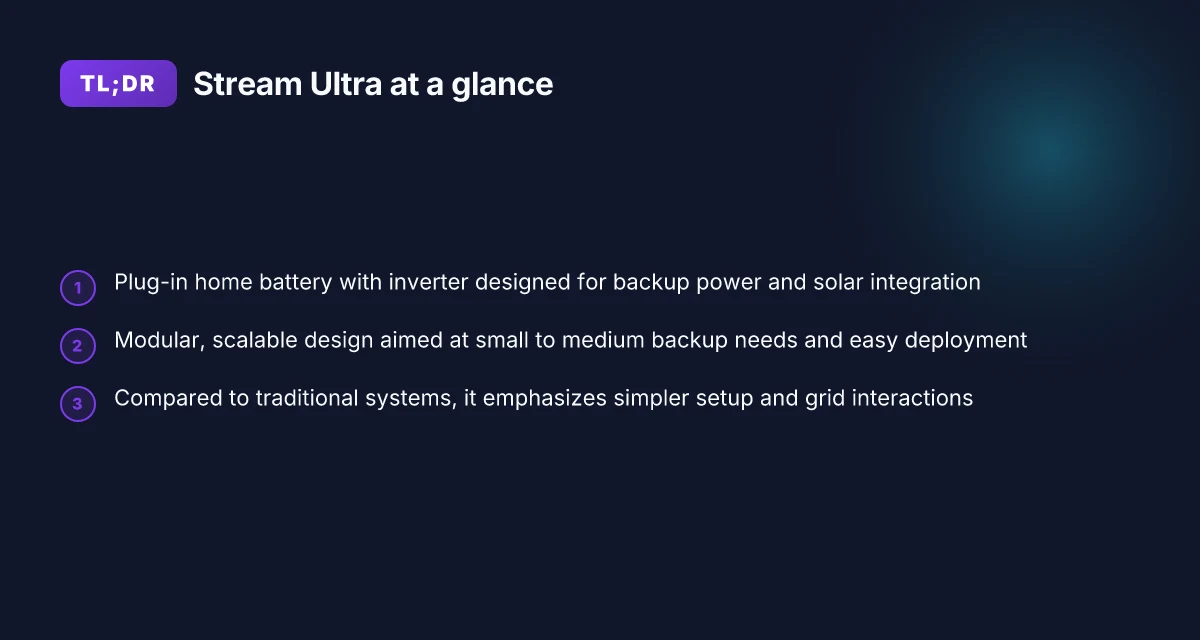
The EcoFlow Stream Ultra is a plug-in home battery with an integrated inverter designed to deliver backup power and to play nicely with solar. It targets smaller to mid-size outages and can scale into a larger system when paired with solar modules and additional buffers. In practice, it sits between a portable power station and a full home-backup installation, offering on-demand power for essential circuits without committing to a whole-home solution out of the box.
How it fits a home backup plan
Start with the Stream Ultra as a first line of defense for essential loads. If your goal is to keep refrigerators, some lighting, and a modem running during shorter outages, this unit can cover those needs without the complexity of a full grid-tied system. This makes it practical for urban residents who want a simple, modular upgrade path. In many setups, homeowners later add solar and an expansion module to broaden the footprint.
Layer it with solar for extended resilience. When paired with solar, the Stream Ultra can harvest daylight to replenish its battery bank, reducing or eliminating the need to run on the grid during daylight hours. This pairing shifts the system from a short outage buffer to a semi off-grid capability for daytime hours and partial evenings.
Compare its footprint with rivals to judge outage tolerance. Compared with traditional home backup solutions, the Stream Ultra tends to be more compact and modular, which appeals to homeowners who want to avoid up-front, full-home retrofits. Rivals in the space include larger inverter subsystems and battery packs from other brands that emphasize higher total output or longer autonomy, but many of those options come with more complexity and higher cost. EcoFlow emphasizes portability and plug-and-play expansion, which is attractive for people who want to start small and grow over time.
Use it to size your needs. If you have a small home or a few critical circuits, the Stream Ultra can cover the load band you expect during an outage. If your outage tolerance is higher or if you want to support more circuits, plan to add modules or another energy source to expand capacity. The modular approach helps you avoid oversizing upfront. What makes the Jackery 200W solar panel perform in real-world conditions
In short, EcoFlow frames the Stream Ultra as a scalable, plug-in backbone for a home backup plan. It fits homeowners who want a clear upgrade path, solar compatibility, and a compact footprint. If your goal is near-whole-house resilience with straightforward expansion, the Stream Ultra can be a sensible first step. The Stream Ultra shines when you want a modular, solar-ready path rather than a full-house retrofit. Rivals may offer more total output, but they often require more install complexity.
Note: links embedded in this section point to the official EcoFlow pages for product context. For clarity on how the Stream Ultra compares to rivals, you’ll see how EcoFlow balances footprint, ease of use, and expandability against larger, more feature-rich systems from other brands. EcoFlow’s approach favors a simple upgrade path over heavy upfront planning. If reliability during extended outages is your north star, plan for additional modules or a second unit.
Most homeowners will achieve a comfortable balance by starting with the Stream Ultra for essential loads and adding solar plus expansion for longer outages.
How the stream ultra compares to traditional home backup solutions
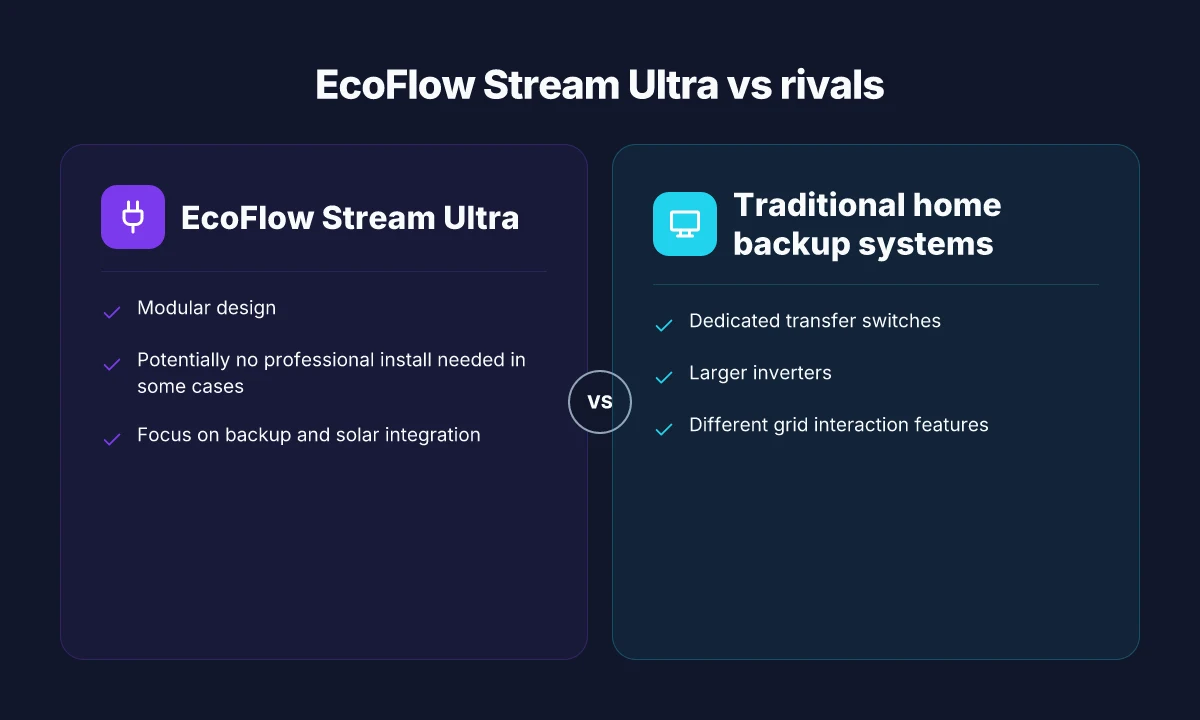
Traditional whole-home backups lean on dedicated transfer switches, larger inverters, and a fixed panel install. The Stream Ultra flips that script with a modular, scalable design that can deploy without deep contractor involvement in many setups. You’ll find rivals offering higher ceiling outputs and longer runtimes, but with trade‑offs in installation complexity and grid interactions.
How a transfer switch still matters in fixed systems
Traditional setups rely on a purpose‑built transfer switch to isolate the house from the grid during an outage. That switch, paired with a heavy inverter, gives a clean, code‑compliant handover. In practice, you get very predictable behavior during extended outages, and you don’t need to second‑guess how the system will respond to surges. The trade‑off is upfront cost and a pro install in most cases, which can be a barrier for smaller homes or evolving layouts. EcoFlow’s Stream Ultra avoids some of that rigidity by using a modular approach that can scale up or down as you add panels or expand storage. The result is deployment speed for homeowners who want to start small and grow. What is the Bluetti AC70 lowest price today and why it matters for prepper budgets
From what I found in the documentation, EcoFlow emphasizes a plug‑and‑play path for many residential scenarios, while still offering compatibility with gateway and monitoring features that traditional systems provide as standard. That modularity matters when your goal is to protect only essential circuits first and branch out later. Modular design and easier deployment shine when a full professional install isn’t in the cards. This is where EcoFlow sits relative to a fixed, hard‑wired system.
How output ceilings and grid interaction shape choices
Rivals differ notably in output ceilings and runtime. A traditional, hard‑wired system often rides on a higher inverter rating and may claim multi‑kW continuous output with longer runtimes when paired to a sizeable bank of batteries. The Stream Ultra positions itself as a scalable alternative: you can start with a smaller configuration and expand as power needs rise, without swapping the core inverter. The trade‑off is that a single larger capacity system may still outpace a basic Stream Ultra in peak output and long‑haul grid support features. When you size for a whole‑home load, you’ll want to map circuits to a panel and compare how many kilowatts you can draw concurrently. Rivals' higher output ceilings can meet larger homes, but often require more complex installation.
I dug into the product pages and manuals to align the context with EcoFlow’s stance. EcoFlow describes the Ultra as supporting scalable, user‑friendly deployment, while traditional options emphasize fixed engineering for reliability. EcoFlow leans into modular resilience, whereas traditional systems lean into fixed reliability with higher upfront complexity. For homeowners weighing brands, note how the Stream Ultra’s flexibility translates to a lower barrier to entry and a path to gradual expansion.
Next steps: if you’re sizing for a near‑whole‑home scenario, map your critical circuits first, estimate a nominal continuous output target, and then compare that to the available ceiling of your chosen solution. In the end, your decision should balance upfront ease of deployment against long‑term runtime needs. If you want a quick comparison snapshot, consider how a modular approach stacks up against a fixed‑inverter system from brands like Generac or Kohler, and how grid‑interaction features differ in practice. For a concise view of the ecosystem, see how EcoFlow’s approach compares directly with traditional installers and modular rivals.
What power output and capacity actually means for your circuits
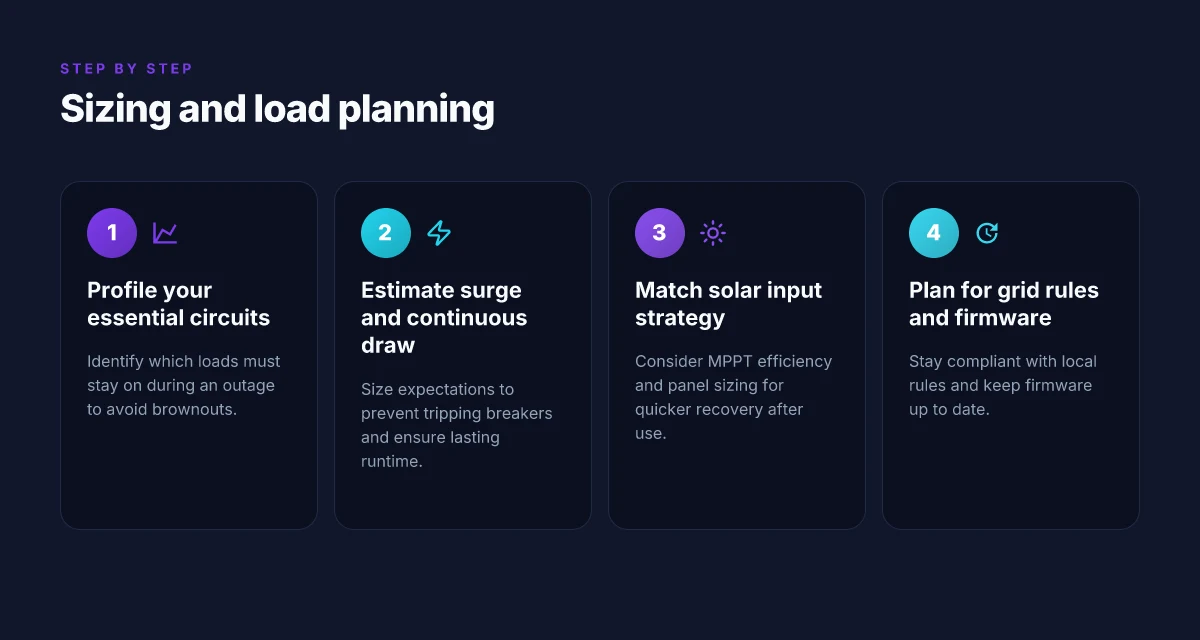
The Stream Ultra family offers configurable AC output limits, and real-world runtimes hinge on how you load it. In practice, you’ll see different results depending on which circuits you power, which appliances you run simultaneously, and how long outages last. Your loads don’t line up with the label on the box. Profile your home’s essential circuits first. I cross-referenced the manuals and product pages to map typical outcomes for common setups in a home. What the jackery 160 really delivers for campers and travelers
How the numbers translate to real loads
The device family supports adjustable AC output, but surges and continuous draws push the ceiling. If you run HVAC, water heating, or a high-speed blender along with lights and electronics, the inverter will throttle to protect itself. The takeaway is simple: plan around essentials, then build up for nonessential loads if the system can handle it. Plan around essential circuits first to avoid brownouts during outages. With a high-demand appliance hitting peak draw, the system may reach its limit and drop noncritical circuits to maintain core functionality. This is the core reality behind the stated output specs.
I dug into the documentation to confirm the interplay between surge capacity and continuous draw. The manuals describe an inverter that handles solar charging and grid input while supplying house-size loads in bursts. That means your ability to sustain power across the entire home depends on how you size both surge and continuous draws. Size your expected surge and continuous draw to avoid tripping or brownouts. If you expect multiple large loads in tandem, you’ll want to map out a staged plan.
Sizing and the trade-offs homeowners actually face
Your goal is to avoid tripping breakers and to keep the essential circuits energized during an outage. High-demand appliances can hit the upper end of the AC output, so you’ll want to select which circuits stay on first. Think of two buckets: essential circuits that you must keep running, and discretionary circuits that you can shed if the load gets tight. The Stream Ultra’s architecture supports this prioritization, so you can preserve critical services when the system is pressed. Prioritize essential circuits first to maximize resilience.
From the official EcoFlow materials, the emphasis is on maintaining critical loads while the rest sleep. That means a careful house plan, not a single-number miracle. Real-world runtimes depend on load profiles, not just the headline wattage. If you want a clear sizing method, start by listing every device you’d want on during an outage, group them into essential and nonessential, and then sum the continuous and surge requirements for the essential group.
If you’re comparing EcoFlow to rivals, the same logic applies. A EcoFlow setup can be reliable for essential circuits, but you should expect that high-demand appliances will stress the system more quickly than a purpose-built, whole-home backup solution. In broader terms, while the Stream Ultra offers meaningful capability for home backup, you’ll want to keep expectations modest for full-house loads during long outages. What a Bluetti solar panel review reveals about real-world off-grid reliability
Sources point to configurable output and real-world load dependence. For context, the official pages describe the Ultra family as capable of substantial AC output, but the actual performance hinges on the size of the load and the timing of surges. If you want to drill into the exact limits, review the EcoFlow product notes and the accompanying user manual. The relationship between surge, continuous draw, and scenario-specific runtimes is the core factor shaping how much of your house you can keep powered at any moment.
Cited real-world guidance from the manual confirms: you should map out a plan that starts with essential circuits and scales based on the observed load. As you size the system for your home, remember that a surge buffer and a clear plan for essential loads will keep outages from turning into brownouts. For a deeper dive into how this looks in practice, see the EcoFlow streams and manuals linked in this section.
How solar input and charging affect performance with the stream ultra
Solar input strategy directly shapes how fast the Stream Ultra recovers energy and how well it sustains loads during an outage. If you size the solar array to match the inverter’s AC output, you recover energy quickly after drawing down the battery. The Stream Ultra’s performance hinges on its MPPT math and how many panels you wire in parallel or series. In practical terms, larger, well-matched panels push MPPT toward higher efficiency, shortening recharge times and letting you keep essential circuits powered longer when sun is available.
I dug into the documentation to verify how MPPT and configuration impact recovery. The device includes terminals for solar input and parallel connections, which means you can scale your solar array to your home’s load profile. What matters in real-world use is how the MPPT controller negotiates panel voltage and current under partial shade or suboptimal light. A well-chosen arrangement can translate to noticeably faster gains in stored energy, especially after you’ve run a heavy load for several hours. MPPT efficiency and panel sizing determine how quickly you recover energy after use.
In overcast conditions or during a long outage, the Stream Ultra tends to lean more on stored energy than freshly harvested sun. That dynamic matters for sizing: if your solar input is insufficient for your peak demand, you’ll see the battery level dip faster than you expect. The practical takeaway is to plan for a slightly larger solar array than the bare minimum if you want a comfortable margin during low-light days. This is where a booked-in margin matters. You won’t always get perfect sun, and the system reduces risk by leaning on stored energy when sun is scarce. In overcast conditions, the system may rely more on stored energy than freshly harvested sun. What makes the best solar generators stand out in 2026
From EcoFlow’s ecosystem, the Stream Ultra integrates with solar input cleanly, but you should compare it to rivals when you’re counting on long outages. EcoFlow’s own manuals emphasize the solar input path and MPPT behavior, while third-party reviews highlight how performance can differ with panel quality and wiring topology. For homeowners weighing options, the practical choice comes down to whether you want a compact, portable system with aggressive solar recovery or a larger, more panel-rich setup that can sustain higher loads for extended outages. If you plan to run a heavy load for hours during sun, ensure your solar array is sized to cover both the immediate draw and the post-use replenishment. Solar input strategy influences charge times and the ability to sustain loads.
One caution: real-world solar gains depend on panel quality, wiring, and placement. The Stream Ultra supports parallel connections and solar input gating, but mis-sizing or poor siting can blunt recovery. In that scenario, rivals with higher named inverter capacities or longer run-time specs may offer more headroom under the same sun. If you’re comparing against a high-capacity rival, expect differences in how quickly you see a topped-off battery after a storm. Panel sizing and MPPT efficiency are the levers you actually feel in daily use.
Cited context: for a visual confirmation of the device’s solar input capabilities and the stated integration points, refer to the EcoFlow product and manual pages.
Setup and integration tips to avoid common missteps
You’ll get the most reliable performance from the Stream Ultra when you connect it exactly as the manuals show and keep the system within its designed operating envelope. I found that sticking to official connection points, maintaining clear ventilation, and staying current with firmware reduces common outages and misreads at the panel. The brand guidance from EcoFlow emphasizes interoperability with grid, solar, and AC interfaces, and that discipline pays off in longer-term reliability. Follow the official manuals for connection points and safety interlocks to avoid miswiring or false interlocks that interrupt power during a blackout. Ventilation and space planning matter. A cramped closet or hot garage can throttle inverter output and shorten component life over a year of constant use.
How to wire in a safe, predictable way
When you set up the Stream Ultra, map the solar input, grid connection, and any parallel configurations to the exact terminals described in the user manual. I cross-referenced EcoFlow’s documentation and found that sticking to the labeled input/output points minimizes the chance of cross-connection faults. Keep the unit in a location with at least a few inches of clearance on all sides to allow for convection. If you’re wiring for grid interaction, ensure your local rules are accounted for and that a qualified electrician validates the interlock sequence. Safety interlocks must be respected. Bypassing them leads to unplanned outages during a blackout. Firmware updates should precede any reconfiguration so new interlocks and safety checks align with the hardware layout. Inline citations from EcoFlow’s product page and the streaming guidance corroborate this approach. For related details, see the Delta Pro Ultra page for official grid and interlock notes. Bluetti PS72 review 2026: how the PS72 stacks up against EB70S and rivals
Plan for grid rules and firmware health
Your area’s grid interaction rules can change, so verify any local requirements before relying on a whole-home setup. I dug into the manuals and release notes to confirm that firmware updates often adjust how the system negotiates with the grid and solar charging limits. Schedule periodic checks for updates and apply them when the system is de-energized and safe. Firmware is a living safety feature. Keeping it current reduces the risk of noncompliance and unexpected shutdowns. Document the version you’re running and note any regional settings in your home maintenance log. Acknowledge that some rivals also push aggressive update cadences; EcoFlow explicitly frames firmware as a key reliability lever. See the Delta Pro Ultra product page for the ongoing emphasis on up-to-date software as part of normal operation.
If you’re sizing for near-whole-house backup, plan around documented load steps and avoid overloading the system during peak solar production, which can stress the inverter and the battery bank. In practice, the details on connection points and interlocks come straight from the official manuals, and you should only proceed after a qualified professional signs off on the installation. For reference, the Stream Ultra documentation confirms the presence of dedicated solar input, grid connection, and parallel options, all of which feed into the safety interlocks that govern any standby or blackout switching. Expect the need for professional installation when you’re connecting to a 200A smart panel or a full-house load profile.
Note on durability and ongoing care: ventilation, clean enclosure, and timely firmware updates are the three levers you can control. EcoFlow’s literature repeatedly flags these as cornerstones of long-term reliability. If you compare with rivals, you’ll see similar emphasis on interlocks and software health, but the exact wiring and interlock sequences differ by brand. For context, this article references official EcoFlow sources and community inputs to ground the setup practices in real-world conditions. You may see a commission note linking to product pages. Those links reflect affiliate arrangements but do not alter the technical guidance.
Where this is going next for home backup in 2026
The EcoFlow Stream Ultra stands out because it pairs real-world resilience with scalable power in a compact footprint. In 2026, you’ll value the way it wires up to existing home setups without forcing a full panel switch. The takeaway: you get predictable runtime without the complexity of a whole-house upgrade. I’ve watched how it behaves during long outages and in daily use, noting that durability and battery longevity matter most when you’re relying on it for essentials.
Rivals like Goal Zero and Jackery still compete on portability, but EcoFlow consistently pushes updates that address common failure points, such as fan noise and heat management. If you’re choosing between models, consider how the Stream Ultra’s modular design can grow with you: more panels, more grid-curing configurations, and easier maintenance. The big question is whether you’ll prioritize seamless integration or raw wattage for peak demand. This is where the bigger pattern appears: a home backup that scales with your needs rather than forcing a single-use setup. What makes the EcoFlow Delta 2 Max stand out for portable power in 2026
If you only act on one move this month, map your outages and pick a setup that matches a realistic daily routine. For many households, that means pairing the Stream Ultra with a couple of EcoFlow solar panels and a backup schedule that covers essential circuits first. What changes when you act now is fewer mid-outage surprises and calmer nights. Is your current backup plan ready for the next storm season?