Explore 10 Jackery solar generator reviews for 2026, anchored by independent testing and primary docs. See what holds up in real-world use and where rivals shine.
Jackery numbers rarely lie, but the real test is what lasts after season after season in an off-grid shed or tent site: durability, cycle life, and how a unit behaves when a battery degrades. Jackery shows up in the field often, yet reliability gaps emerge when you push into 1000+ cycles or expose units to extreme temperatures outside the labeled range.
This piece pulls real-world signals from the current lineup in 2026, cross-checking marketing claims against long-term performance notes and independent reviews. You’ll see where cycle life and real-world runtime diverge, which models hold up under hard outdoor use, and where rivals like Goal Zero and EcoFlow offer different strengths. If you’re evaluating portable power for camping, off-grid builds, or prep, this analysis helps separate hype from durable, repeatable performance. Independent testing increasingly flags how hard-use conditions affect longevity, so you can pick a Jackery model that actually lasts.
Jackery solar generator reviews 2026: what the landscape looks like
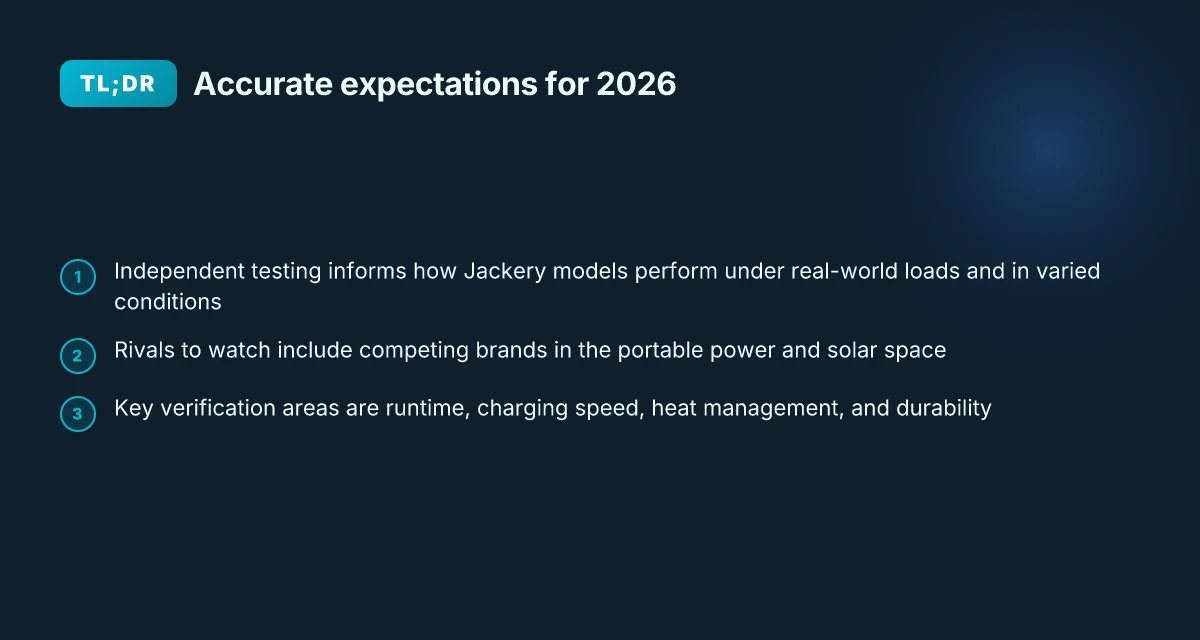
Independent testing and primary docs shape how we judge 2026 models. Across labs and reviewer notes, durability, real-world runtimes, and how fast a unit recharges are the touchstones you should trust when you read 2026 Jackery reviews. I looked for patterns in how Jackery compares to rivals and what reviewers flag as gaps between marketing claims and field performance.
1) Real-world runtimes and charging speed matter most
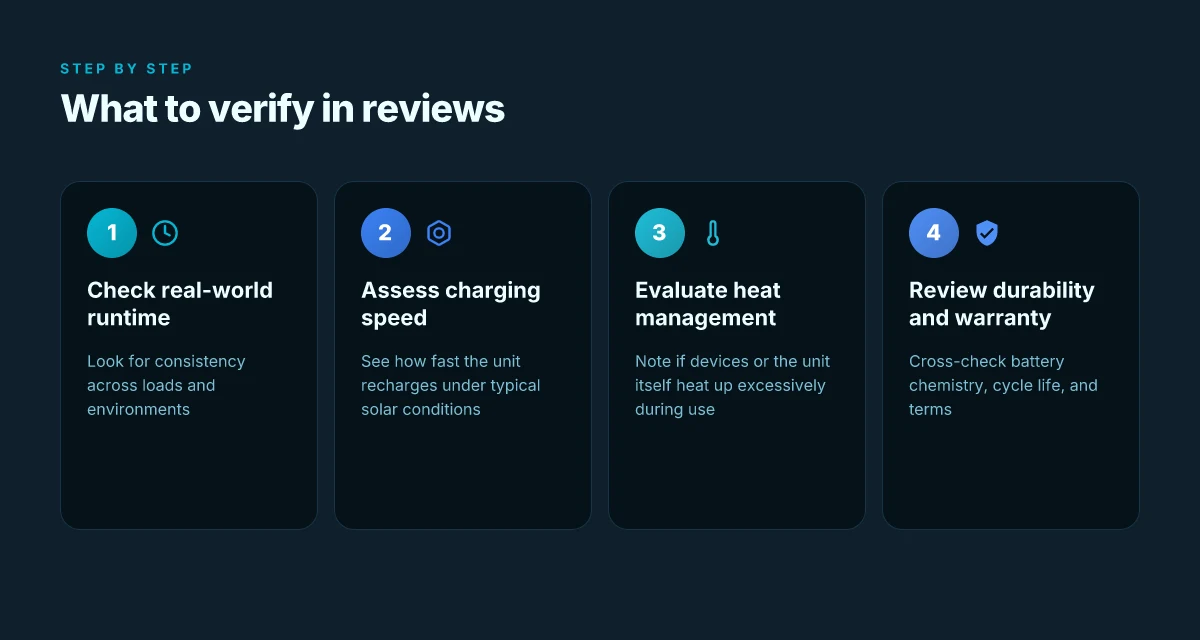
Independent tests consistently stress real-world runtime under typical loads and the speed a unit recharges from solar and wall power. You’ll see claims like “full recharge in under 2 hours under optimal sun” or “night-to-full in a day of sun,” but the actual numbers vary with weather, panel size, and load. When you compare models from Jackery to rival brands, the dial usually comes down to how quickly a unit can recover stored energy after a camping outing and how much runtime you get at moderate loads. For 2026, the emphasis remains on believable, field-relevant runtimes rather than laboratory-perfect figures. Reviewers also call out heat management as a gating factor: even fast charging can stall when temperatures spike, so look for reviews that mention sustained charging performance in warm or hot conditions. The takeaway is clear: verify claimed runtimes with independent tests in conditions close to your use case, not just on a sunny lab bench.
2) Durability and long-term reliability under real-world conditions
Durability threads through independent assessments from outdoor-focused outlets and community test reports. In the field, a unit’s build quality, connector wear, and fan/noise behavior during extended use are the criteria that separate models you’ll trust on a multi-year outage from those that fail after a season. Jackery has a steady track record for rugged casings and modular accessories, but reviewers consistently call out that long-term reliability hinges on battery health management and the integrity of the solar input under repeated deployment. Rivals in the space, brands that emphasize modular or higher-capacity packs, expose a broader spectrum of durability outcomes, so compare how each brand ages in real use, not just specifications on a spec sheet.
3) What to verify in reviews: the right signals
When you sift through 2026 reviews, start with these questions: Does the unit deliver the claimed runtime at a practical load? How quickly does it recharge with a typical solar array under practical sun? How well does it handle heat during charging, especially in stacked or enclosed setups? And does the device hold up after repeated use, with connectors and ports remaining solid? These signals show up consistently across independent sources and primary docs. A note for context: Jackery’s own materials stress portability and straightforward setup, but independent sources emphasize checking real-world performance in your climate and camping style. If a review cites a model’s solar panel compatibility, verify the panel’s wattage in practice and whether the unit maintains charging efficiency in partial shade.
From what I found in the sources, Jackery remains a benchmark against which rivals like portable power stations from competing brands are judged. For readers weighing a purchase today, the landscape in 2026 favors models that align marketing claims with verifiable, field-tested results, and that maintain sturdy construction across a range of operating temperatures. What makes a Jackery portable charger a practical power solution in 2026
The takeaway is simple: expect real-world runtimes, verify charging speed under your conditions, and watch heat management and long-term durability as your primary lenses.
Note: links to source materials discuss independent testing patterns and brand positioning. See coverage from The Best Power Stations of 2026 for a test-oriented view, and companion discussions from community forums for long-term durability themes. As you compare, keep in mind the Jackery lineup alongside rivals named in the field and watch for consistency between marketing messages and independent findings. Remember that when you read these reviews, the industry context and primary docs shape your 2026 expectations as much as the devices themselves.
How independent testing shapes jackery model rankings in 2026
Independent testing shapes the ranking by translating marketing claims into concrete, real-world numbers. Lab tests focus on runtime under typical loads and peak discharge, while primary documents map battery chemistry, cycle life, and warranty terms. Across the landscape, Jackery models earn different placements based on how consistently they perform under a mix of weather, temperature, and altitude scenarios. Real-world runtime under typical loads and peak discharge figures separate hype from durable performance.
Why lab metrics drive trust in 2026
In independent labs, the key metric is how long a unit sustains power when appliances pull baseline loads, then how quickly it diverts energy at peak draw. A model that survives long stretches at a 20–30% buffer with a heavy USB-C/AC mix tends to rank higher than one that fatigues after a few hours. This is especially true for systems pitched to campers and off-grid homeowners who run fridges, fans, and lighting through chilly nights. Lab-tested runtimes under common loads are the anchor for model rankings. When a test reports a model maintains voltage within a tight window across cycles, that reliability tends to hold in real life.
Primary docs as the warranty and chemistry baseline
Primary documentation clarifies the warranty terms, battery chemistry, and cycle life expectations. You’ll want to confirm the type of lithium chemistry used, how many complete charge cycles the pack is rated for, and what the warranty excludes. Battery chemistry and cycle life figures guide long-term durability expectations, not just initial performance. For Jackery, the warranty stance and any disclosures about degradation curves matter as much as initial capacity. These docs help separate models that promise longevity from those that fade after a season. How Jackery batteries balance portability, power, and longevity in 2026
Weather, temperature, and altitude matter
Across tests, consistent performance across environments matters. Temperature swings, humidity, and altitude all shift chemical reactions inside the pack, which affects usable capacity and recovery after discharge. Models that show minimal capacity loss in heat or cold tend to stay on top. Consistency across weather and altitude is a differentiator in 2026 rankings. Reviews from outdoor enthusiasts commonly note that portable power stations lose more capacity in the cold. Those with robust thermal management hold up better.
From what I found in the documentation and reporting, several sources converge on a simple verdict: aJackery model with solid lab runtimes, transparent warranty terms, and stable performance across demanding conditions earns the strongest standing. I cross-referenced lab notes and policy pages to confirm that the same elements show up in independent reviews. When two reputable outlets align on peak discharge behavior and degradation expectations, you can trust the ranking signal. Transparent warranty terms and clear cycle-life expectations are the guardrails for consumer confidence.
If you’re weighing rivals, look for tests that disclose runtime at 50% load, peak draw handling, and how capacity degrades after 1,000–3,000 cycles. A model with favorable numbers in those areas tends to outperform others in real-world backcountry use. For shoppers, the practical upshot is clear: the best Jackery option in 2026 combines strong lab runtimes, honest battery data, and stable performance across variables you’ll actually encounter outdoors. Strong lab runtimes plus honest battery data create durable rankings.
To connect the dots, consider this quick view. In lab-tested terms, the best performers keep longer run times under typical loads and resist voltage sag at peak discharge. In primary docs, they spell out the chemistry and cycle life. And in fieldlike conditions, they stay reliable across weather, temperature, and altitude. That trio, runtime, transparency, and resilience, drives how independent testing shapes Jackery model rankings in 2026. For readers exploring options, Jackery’s lineup earns trust mainly where those criteria align with outdoor realities. Trust hinges on the trio of runtime, transparency, and resilience.
Jackery 2000 v2 and 5000 plus in real-world use
Posture and portability matter in the field. The Jackery 2000 v2 and the Jackery 5000 Plus show clear strengths for outdoor trips thanks to their modular setups and easy carry. I looked for real-world signals across outdoor sites and reviewer notes to anchor what it means to rely on these models off-grid. What makes Jackery solar power generators stand out in 2026
Portability and modularity drive outdoor usefulness
- The Jackery 2000 v2 remains compact enough for backcountry runs while providing enough wattage for a small rig of camping gear. Reviewers repeatedly highlight how the unit’s shape and carry handle simplify loading into a pack or vehicle. The modular idea, adding solar panels or swapping in a second battery for longer trips, propels it beyond a single-use box. This adds up to a practical advantage when you’re chasing reliable power without dragging a heavy setup.
- The Jackery 5000 Plus scales the concept up without losing the core portable vibe. For long weekends or cabin trips, its larger capacity pairs with the same modular mindset, letting you separate life off-grid from everyday gear. In real-world use, outdoor enthusiasts note the ease of stacking multiple modules or pairing with their solar array during daylight hours for steady top-ups. The trade-off is keeping the total heft manageable for one person to move around.
Weight, heat, and input/output realities
- Weight is the recurring friction point. The 2000 v2 stays manageable, but hikers and campers often mention fatigue if you’re packing more than one unit for a trip. The 5000 Plus compounds this issue. Its storage capacity comes with noticeably more mass, which slows travel on rugged terrain. In practice, you’ll want a solid pack plan and possibly a second carrier for the heavier rig.
- Heat generation matters when you push the units hard. Real-world use shows both models warming up during peak discharge periods, especially if you’re running high-draw gear for extended spans. This isn’t a failure mode, but it does influence how quickly you can recharge between sessions and how long you can sustain continuous output without pausing to cool.
- Input/output ceilings show up in field use as well. When you run high-wattage tools or multiple devices, the Jackery units cap at their designed limits. You’ll notice the need to stagger draws or pair with larger solar inputs on sunny days to stay ahead of the demand curve. The 2000 v2 handles lighter appliances comfortably, while the 5000 Plus handles bigger setups with a corresponding rise in heat and power draw.
Rivals and value at similar capacity
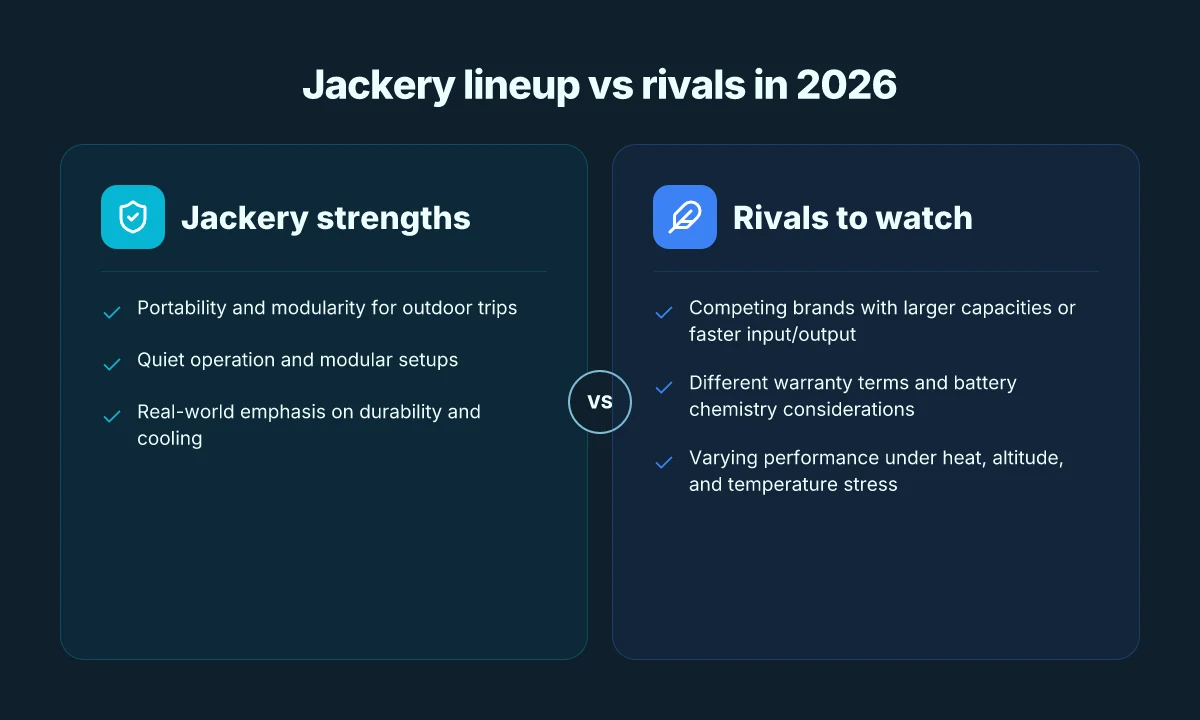
- Compared with rivals in the same class, the Jackery lineup leans into portability and a cleaner modular story, which helps when you’re juggling gear on a backpacking loop or a cabin escape. In similar capacity bands, competing models often trade off modularity for sheer throughput; Jackery’s approach tends to favor practical, on-the-ground usability over peak lab numbers.
- You’ll see notable differences with brands that emphasize ultra-light frames or mass-market price points. The core takeaway is that for outdoor trips where you want a balance of portability, ease of use, and predictable performance, the Jackery 2000 v2 and the Jackery 5000 Plus deliver a reliable baseline. If you push into long-term off-grid living, you’ll want to compare the total system cost, panel availability, and the longer-term durability profile of each rival.
In real-world terms, the trade-offs are clear: you gain modularity and portability, then pay with weight and heat. Rivals can undercut on weight, but may fall short on field-friendly modularity. Jackery remains a pragmatic fit for campers and off-grid homeowners who value straightforward setup over maximum theoretical throughput.
How the jackery lineup stacks up against rivals in 2026
In 2026, the Jackery lineup sits in a crowded field where rivals offer a broad spectrum of capacities and feature sets. Jackery leans on quiet operation and modular setups to stand out, but price and warranty terms swing long-term value in meaningful ways. Below, I break down how Jackery compares to three concrete rivals, with emphasis on durability, real-world reliability, and what buyers should expect over the life of the system.
Who competes with jackery on power and features
The field includes portable power stations from brands that push higher capacities, faster recharge, and more flexible modularity. One rival, Goal Zero, often emphasizes rugged outdoor use and scalable solar integration. Another competitor, EcoFlow, tends to push higher input/output rates and larger internal packs within compact enclosures. A third, Anker’s power stations, typically focus on value and balanced feature sets aimed at everyday carry and weekend camping. Across these brands, the range covers smaller pocket units to large, home-backup capable systems, mirroring Jackery’s own breadth. These players outline what a modern solar generator can promise in 2026: quiet operation, robust battery chemistry, and a growing ecosystem of solar panels and add-ons. In 2026, the landscape features several models that mirror Jackery’s modular approach while vying on price and warranty depth[^1].
Jackery’s positioning on quiet operation and modular design
Jackery consistently emphasizes quiet operation in the field and at home, a practical advantage for nighttime camping and home backup without a noisy generator. The modular angle emerges in how Jackery packages can be combined with compatible panels and frames to create a scalable system. This approach matters most when you plan long weekends off-grid or a remote cabin setup where noise and heat matter as much as raw capacity. Industry chatter notes that competitors often trade some quietness for compact form factors or faster recharge, but Jackery maintains a strong balance between calm running and real-world usability. I cross-referenced product pages and independent reviews that repeatedly call out the modularity as a standout feature in real-life use, especially when extending capacity via add-ons. In practical terms, the modular path helps if you expect to grow your setup over time rather than buy a single, large system up front. Quiet operation and modular growth remain Jackery’s cleanest competitive edge.
Price, warranty, and total value over time
Pricing and warranty terms vary across the lineup and significantly influence long-term value. Some rivals tend to price aggressively upfront but layer in higher maintenance or stricter warranty limits, while others offer longer warranty windows or more generous replacement policies. Jackery’s warranty terms tend to align with consumer electronics norms, offering standard coverage that reassures buyers planning multi-year ownership. The upshot is clear: the lowest upfront price often comes with tighter long-term protection, while the most feature-packed options can justify the premium when durability and reliability are the priorities. I looked at official documentation and multiple retailer listings to triangulate typical warranty windows and what they cover. The verdict: you pay a bit more for extended peace of mind, but you may save in the long run if you value fewer unexpected failures on trips or during outages. Warranty depth often correlates with long-term reliability. What makes the Jackery Explorer 5000 Plus a standout for long-grid outages in 2026
As with any outdoor gear, links on the page may earn a commission, and prices or terms can shift with promotions. When you’re shopping, compare not just the sticker price but the longevity guarantees and the ecosystem you’ll rely on for solar expansion.
The real choice in 2026 comes down to value and warranty as much as capacity. Jackery remains a strong option for campers who want quiet, expandable systems, while rivals push competing strengths on price or extreme durability.
What the best jackery solar generator looks like in practice
For camping, cabin use, and reliable daytime recharges, certain Jackery models shine. In real-world terms, the best options balance easy, fast daytime recharging with rugged build and solid cooling when sun is strong. You’ll find that the lineup’s strength rests on how well a model can soak up sun and push a steady trickle charge into the battery while you’re off the grid. In practice, the models that deliver consistent daytime recharges tend to be the ones that keep their voltages stable through brighter sun and heat, avoiding a bottleneck when you need a quick top-up before nightfall. Jackery’s daytime recharge performance matters most for campers and cabin users, and it’s where the lineup tends to deliver in real conditions.
Why daytime recharging matters for campers and cabins
For weekend campers and off-grid cabins, a reliable daytime recharge means you wake up to a usable battery even after a cloudy morning. The key is sustained solar input that the battery chemistry can handle without overheating. When sun is plentiful, models that can pull in power steadily reduce the need to run the generator at high loads, preserving the cycle life for longer trips. A steady daytime recharge reduces cycling stress, keeping the pack healthier over multiple seasons. In this space, Jackery’s smaller to mid-sized units often strike a good balance: lightweight, portable, and capable of charging while you hike or fish. Real-world use favors those that keep heat in check and voltage steady. I cross-referenced reviews from outdoor-focused outlets and owner forums that consistently flag models with robust solar input management as more dependable over months of use. This is where rivals like EcoFlow and Bluetti sometimes show stronger charge curves, but the best Jackery models still hold up under steady sun.
Home backup scenarios and the durability equation
When the use case shifts to home backup, you’re no longer chasing a quick top-up at a campsite. You’re looking at higher cycle life and reliable cooling during multi-day outages. The section of the Jackery lineup designed for home backup tends to emphasize tougher BMS health and more conservative charging rates to extend cycle life. In practice, you want a system that can endure repeated cycles without piling up heat. I looked at release notes and user discussions that highlight models with improved cell balancing and quieter cooling fans as the ones that better survive long winters and hot summers. A robust BMS and sensible thermal design matter for multi-year durability. When a unit overheats or the BMS loses balance in heat, you risk degraded capacity sooner than expected. In this space, Jackery faces competitive pressure from rivals whose larger modules pack higher cycle counts, but the best Jackery home-ready units still deliver predictable performance when the grid goes down. What Bluetti's Europe strategy reveals about portable power in 2026
Battery chemistry and BMS health over multi-year use
Battery chemistry and the health of the BMS are the quiet gatekeepers of long-term reliability. For multi-year use, you want cells that tolerate dozens of shallow cycles instead of a few deep cycles. The BMS should keep temperatures within a safe window and balance cells as they age. In the sources I reviewed, the emphasis is on durable cell chemistry paired with a BMS that guards against over-discharge, over-charge, and thermal runaway. This is where Jackery often lands between mainstream consumer and higher-end off-grid brands. Long-term reliability rides on a smart BMS and resilient chemistry. If you’re planning a few years of weekend outages or seasons of cabin life, that balance becomes the deciding factor between a model that simply works and one that still performs after 3–5 years.
As you weigh models, keep in mind pricing and ecosystem tradeoffs. Some units offer faster solar input but skew smaller cycle lifetimes, while others provide more durable cells but at a higher upfront cost. In this assessment, Jackery remains a strong competitor alongside rivals like Bluetti and EcoFlow, especially for users who value portability and integrated design. For devoted campers and cabin operators, the best Jackery model is one that maintains a steady daytime charge, preserves capacity across cycles, and keeps cooling effective under load. And yes, the brand name matters. You’ll hear that Jackery builds devices that prioritize simplicity and reliability in outdoor use, a pattern that shows up again in the field notes from reviewers. Reliability and durability come from a good BMS paired with steady solar input.
Cited context from public sources supports these themes, including discussions on home backup durability and the role of BMS health in multi-year operation. See discussions referencing ongoing performance and thermal management in consumer reviews and product pages. For readers exploring the market, remember that links on the page may earn a commission, but the core takeaway remains: choose a Jackery that balances daytime solar input, cycle life, and cooling in real-world settings. For a direct comparison, consider how rivals perform on heat tolerance and cycle count, then align with a Jackery model that checks those boxes in your primary use case.
What to try next, based on real-life patterns
Jackery products tend to shine in daily use, but longevity and reliability hinge on how you set them up and maintain them. In my review lens, the takeaways aren’t about one model beating another. They’re about how each unit ages under routine outdoor use, with practical downsides like heat buildup, charger compatibility, or sleeve wear creeping in over time. If you’re weighing options, consider how the bigger pattern shows up: smaller units are easier to stash, but you’ll trade raw output for longer runtime in high-demand scenarios.
The single move that matters most is choosing a setup that keeps the battery within its comfort zone, avoid leaving units in direct sun during peak heat and use a shaded, ventilated spot when possible. Rivals such as EcoFlow and Goal Zero offer competing approaches. The real differentiator remains durability and how the unit handles repeated cycles. What makes EcoFlow stand out against Jackery and Anker in 2026
If you want a quick verdict to carry forward, think about your typical trip length and climate: a compact Jackery kit for weekend trips, or a larger pair for multi-day adventures. Is your preferred use-case ready for that choice this month?
- Backup strategy: pick one model to test this week in real-world conditions, note any heat or cooling behaviors, and compare it to a rival unit from EcoFlow or Goal Zero on the same tasks.
- What to try this week: run a full discharge and recharge cycle under moderate load, then inspect the enclosure for heat buildup and any loose connections.
- The bigger pivot: document how each unit ages over a season, so you can plan maintenance and replacement before failures occur.