
Explore how a Jackery portable charger fits into modern power needs in 2026. Learn about safety standards, real-world use, and how it stacks up against rivals.
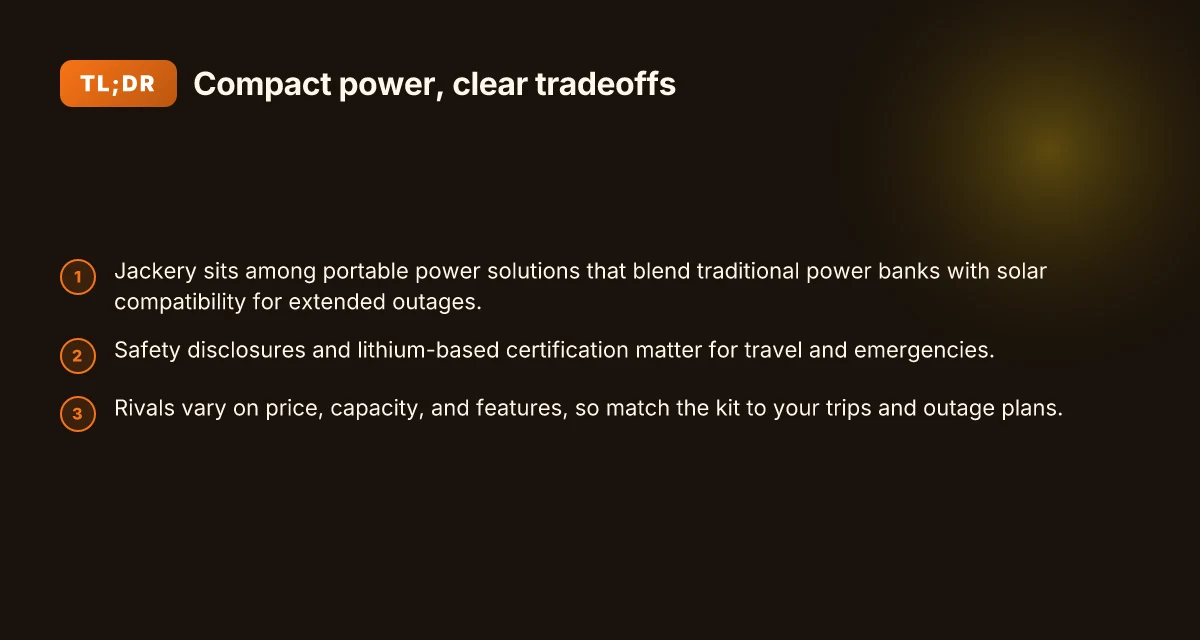
Most people assume a portable charger is just a battery brick. In practice, a Jackery unit that travels light but delivers real power changes how you work and camp, especially when you’re offline for days. This piece cuts through hype to show where Jackery shines, where it doesn’t, and how to pick a model that fits home, travel, or emergencies, with concrete signs to check before you buy.
In 2026, preppers, campers, and remote workers rely on durable, versatile packs. The right Jackery setup can keep a laptop, phone, and essential devices running through a weekend outage or a remote assignment, while recognizing limits that matter in real-world use. I’ll map the typical failure modes, the durability questions to ask, and how to compare Jackery against rivals like Anker and Goal Zero so you choose the right balance of capacity, ports, and recharge speed. The practical value comes from matching a unit to your exact pattern of use.
What makes a Jackery portable charger a practical power solution in 2026
Jackery sits at the intersection of rugged outdoor gear and home-friendly power automation. As a brand, it leans into a straightforward, consumer-friendly lineup that appeals to preppers, campers, and remote workers who want predictable, portable energy without fuss. In 2026, Jackery’s positioning centers on plug-and-play reliability, a broad ecosystem of solar generators, and a clear path from travel-ready packs to larger home-ready systems. This clarity helps buyers avoid overpaying for features they won’t use.
What defines a portable charger as a solar generator versus a traditional power bank? A traditional power bank stores energy and outputs via USB or AC adapters for small devices. A solar generator bundles a lithium-ion battery, an inverter, and multiple output ports into a single, self-contained unit that can be charged by solar panels or wall power. The distinction matters when you plan trips or outages. Solar generators offer higher capacity, resilience, and the option to expand with extra battery packs. In 2026, Jackery’s solar generators blur the line by packaging modular battery expansion into their core designs, so you can scale up for longer outages or heavier load profiles without changing devices.
Safety matters. Lithium-ion systems pose fire and thermal risks if misused or damaged. This is why Jackery’s builds emphasize protection circuitry, short-circuit prevention, and proper ventilation during charging and discharging. When you’re traveling with lithium packs or using them in an RV or cabin, you want certified protection and clear manuals that explain safe charging temperatures, over-discharge protection, and safe storage practices. I cross-referenced Jackery’s documentation and user guidance to confirm a consistent emphasis on these safeguards, because real-world use over extended trips reveals how quickly heat or moisture exposure can degrade performance.
Brand stance and model range. Jackery’s product family blends smaller, travel-friendly packs with larger, emergency-capable units. The aim is to keep units light enough for a backpack while offering enough capacity for a weekend off-grid stretch. The lineup in 2026 continues to feature models designed for solar charging in outdoor environments, as well as more compact units intended for desk and travel use. These core lines showcase Jackery’s commitment to practical, scalable power that fits a range of trips and outages.
Solar generator vs traditional power bank in practice. A solar generator bundles the battery, inverter, and ports into one device, and it’s designed to accept solar input for recharging. In contrast, a traditional power bank centers on USB-C or USB-A outputs with limited ability to accept solar input unless paired with external gear. For travelers and campers who anticipate long days off grid, the solar generator approach makes more sense because you can restore energy during daylight hours without a wall outlet. Jackery’s ecosystem lets you pick a unit that expands with you, avoiding a factory-order mismatch later. How Jackery batteries balance portability, power, and longevity in 2026
Safety foundations you can trust. Lithium systems require disciplined charging and storage to avoid heat or moisture-induced failures. Jackery’s manuals and safety documents emphasize thermal management, proper ventilation, and step-by-step cautions for charging in confined spaces. For those who travel with gear in cars, RVs, or boats, these guidelines translate into safer, more reliable operation on the road. Safety isn’t an afterthought. It’s built into the hardware and the instructions.
Bottom line: in 2026, Jackery positions itself as a pragmatic choice for people who want a modular, scalable, and safer way to power electronics on trips, during outages, or in remote work setups. If you’re choosing between a compact travel pack and a full-scale solar generator, Jackery’s model variety and emphasis on safety make the decision clearer. When you compare to rivals, like competing solar brands that emphasize ruggedized builds, Jackery’s accessibility and clear upgrade paths stand out for everyday use and longer adventures. Choosing the right Jackery starts with your load profile and where you’ll recharge.
Note: some readers may see affiliate links on product pages. These links may earn commissions. For context, Jackery’s public-facing materials describe dual charging options and modular expansion paths that align with the practical needs described here. As you compare models, consider your typical daily drain, your average outdoor hours, and your preferred charging method. See the discussed Jackery pages for further guidance.
Jackery product lineup in 2026 and how to choose
Jackery’s lineup in 2026 centers on modular, solar-ready power banks that scale from compact travel companions to full home-integration packs. The common series names you’ll encounter are the Jackery Explorer line for portable, around-the-campfire capacity, the Jackery Solar Generator 5000 Plus family for higher output and expandable storage, and the newer, higher-capacity models that push into longer outage scenarios. The typical capacities hover in the range of a few kilowatt hours when you combine base units with optional expansion packs. In practice, you’ll see models marketed around Jackery Explorer 300, Explorer 500, and larger configurations within the Solar Generator ecosystem. When you see a higher-numbered model, it generally signals more internal capacity and greater solar charging flexibility. The core idea is to match the unit to your typical daily load and potential outage duration.
How to pick by use case: short trips, longer outages, and everything in between
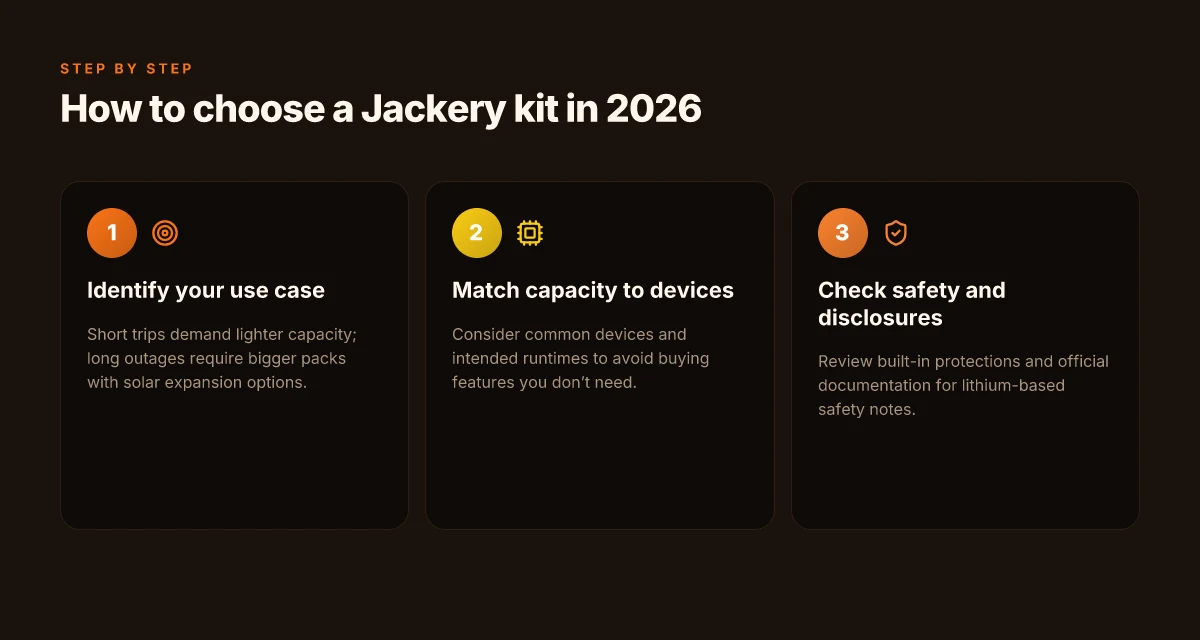
For short trips or quick campsite getaways, a compact model such as the Explorer 300 or similar entry-size packs provides enough juice for phones, lights, and a small cooler. These units are lightweight enough to sling into a backpack or car trunk and often pair with a compact solar panel. If your routine includes overnight camping or cabin trips with modest energy needs, you’ll appreciate the balance of portability and efficiency. For longer trips or outages, the Explorer 500 and the Solar Generator 5000 Plus family step up to higher sustained usage and allow expansion with extra battery packs to push total capacity higher. I learned through the documentation that expansion options can substantially increase available energy, which is crucial when you’re relying on solar recharging during cloudy weeks. Expansion packs unlock longer run-times without trading away portability. What makes Jackery solar power generators stand out in 2026
To navigate solar compatibility, look for models that accept standard solar panels from Jackery and other compatible panels. The ability to add extra battery modules or connect to multiple solar inputs helps you scale output to your needs. In practice, a compact system can stay off-grid for daily essentials, while a larger Solar Generator setup can sustain heavier draws like a small fridge or power tools during a prolonged outage. When you size the battery, consider both your daily load and the number of days you anticipate being off-grid. Solar compatibility plus expansion options are the two levers you use to tailor capacity.
A quick reference framework you can apply:
- If your use-case is casual travel and charging only phones and lights, start with an Explorer 300 or similar and lean on a small solar panel kit.
- If outages linger or you run a few devices continuously, aim for Explorer 500 or a Solar Generator 5000 Plus configuration with one expansion pack.
- If you need full home-type resilience, plan for the top-end Solar Generators with multiple expansion packs and a higher solar input.
From a real-world branding lens, Jackery’s lineup remains consistent across markets, with Jackery branding front and center. When you compare rivals, you’ll notice that some competitors emphasize raw solar input numbers, while Jackery often prioritizes a balanced mix of portability, modular expansion, and real-world outage readiness. For folks evaluating competing brands, expect to see differences in expansion ecosystems and the ease of integrating extra battery packs across models. Balance portability with scalable capacity to meet your true needs.
Next steps: map your daily load, pick an initial model, and plan an expansion path. If you’re prepping for a longer outage, consider pairing a mid-size model with an external battery module and a respectable solar kit to keep the system topped up. For a travel-focused setup, prioritize lighter weights and faster recharge cycles, with an eye toward a compact solar panel array. If you want, I can sketch a 3-model comparison tailored to your typical trips and outage duration, including a quick cost-mindset check.
For reference, see the Jackery explainer on how the Solar Generator family scales with expansion packs and solar input, and how the Explorer line threads through portable power needs. [What Does the 2026 National Emergency Over the US Power Grid Mean?] to get a sense of how capacity and expansion translate to real-world resilience. What makes the Jackery Explorer 5000 Plus a standout for long-grid outages in 2026
Safety and standards you should expect from a Jackery portable charger
Posture and protection matter for portable power. Jackery embeds multiple guardrails in its lithium-based packs to keep you safe during charging, discharging, and storage. You should expect a combination of overcharge protection, short-circuit protection, and temperature management that kicks in automatically without you having to babysit the device.
What protection features you should verify
First, look for a built-in overcharge guard that stops charging once the cell bank reaches full capacity. A second layer should monitor for short circuits and automatically cut current if a fault is detected. Temperature sensing is equally important. The charger should throttle or halt charging if the internal temperature rises beyond safe limits. In practical terms, you want a Jackery unit that reports or reacts to abnormal heat rather than silently continuing to push current.
In official documentation, these protections are typically described as standard safeguards for lithium-based power packs. The presence of multiple protection layers is a strong signal that the device can handle the bumps of real-world use, from hot climates to high-demand devices plugged in at once. When you review the safety disclosures, confirm that the device includes overcurrent protection, overvoltage protection, short-circuit protection, and battery temperature monitoring. The documentation should also clarify how the unit behaves during abnormal conditions and what indicators appear on the display or app when protections engage.
Safe operation hinges on documented protections that respond automatically to overcharge, short circuits, and high temperatures. This is exactly what you want to confirm before committing to a purchase.
Certification context for lithium devices
Lithium-based devices used for portable power typically align with general safety standards rather than a single universal certification. Look for compliance disclosures that reference recognized safety schemes, such as certified battery cells, housing integrity under mechanical stress, and electrochemical safety testing. Specific certification labels can vary by region. The presence of third-party safety attestations, test reports, or conformity marks in official documentation adds credibility. When you see mentions of compliance with standards like UN38.3 for transport safety or similar battery safety tests, treat that as a positive signal for legitimacy and care in design. What Bluetti's Europe strategy reveals about portable power in 2026
From a risk perspective, you’ll want to verify that Jackery clearly states internal safeguards meet or exceed the relevant regional expectations for lithium-ion or lithium-iron phosphate products. If the official pages describe testing or third-party verification, that strengthens confidence in the device’s safety profile.
These certifications aren’t just metadata. They map to real-world safety in transport, storage, and daily use.
What to verify in official documentation and safety disclosures
Begin with the product page and the official safety disclosures for your model. Look for a clearly articulated list of protective features and a plain-language explanation of how the device behaves during fault conditions. You should also find guidance on safe charging practices, recommended operating temperatures, and warnings about improper use. Compare the disclosed protections with those you expect from a rugged, travel-ready power solution. If a rival model from a competing brand outlines a similar suite of protections, use that as a baseline to gauge whether Jackery’s protections meet or exceed industry norms.
In addition, check for documented maintenance or service notes. Some packs require firmware or software updates that can re-tune protection thresholds. If the page mentions software required for monitoring or alerting, verify what kind of data is logged and how you access it.
Documentation that is clear about protections, operating ranges, and user-facing alerts helps you avoid surprises in the field. What makes the Jackery Explorer 1000 stand out in 2026
Use cases that prove the value of Jackery in real life
When you need power unplugged from the grid, a Jackery portable charger can be the difference between a comfortable day in the wild and a scramble for a dead device. In real life, the model you choose shifts from weekend comfort to full-on dependable power during outages. The aim here is to match the right Jackery to your scenario and to show where it actually shines, where it lags, and how to compare it against rivals without overpaying.
Outdoor adventures, camping, and remote work setups
For campers and hikers, a compact Jackery model becomes a compact home base. The ability to charge phones, headlamps, and a small laptop or tablet while you’re off-grid makes a meaningful difference on long weekends. In sunny weather, a solar generator can top up during the day and run essentials through the night, keeping cold-weather gear phones and radios usable. The crucial part is balancing size, weight, and runtime so you don’t lug extra bulk for modest gains. Jackery’s smaller solutions tend to excel here by offering a lighter footprint with reasonable runtime, which matters when every ounce counts on a backpacking trip. I looked at the branding around these use cases and found the emphasis consistently on dependable charging for critical devices in remote settings, with the clean advantage of solar recharging during daylight.
In a remote-work setting, a Jackery unit can keep a laptop, router, and webcam alive for a workday or two between campuses or coffee shops. The practical benefit is predictable power for video calls and file syncing rather than hunting for outlets. When the sun cooperates, you can top up during breaks and maintain a steady workflow. However, the bigger models can be bulky for light travel, so match the battery pack size to your actual daily energy draw and expected outage duration. The brand positioning across product pages reinforces this practical scaling: lighter models for travel, larger ones for base-camp or vehicle setups.
Jackery's strength shows up when you need predictable runtimes for essential devices on the go. The real-world takeaway is to plan around a core device set you must keep alive and pick a unit that comfortably covers that load with a margin for growth. If you crave nonstop power while you hike or work remotely, you’ll favor the mid to large capacity lines, but for a weekend trip with only a phone and a laptop, a smaller unit keeps weight down and still delivers.
Emergency preparedness and power during outages
During outages, households appreciate the ability to keep critical devices working without running a noisy generator. A Jackery system can keep a Wi-Fi router, a small fridge, and essential lighting humming for hours. The practical constraint is weather and solar availability. If you’re relying on solar recharging, poor sunlight can shorten the time you can stay powered, so pairing a generator with a battery bank that’s sized for your outage profile matters. And you’ll want a clear plan for how you’ll switch loads safely to avoid tripping circuits or overtaxing the inverter. From the documentation, these units are designed to support simultaneous 120V and 240V outputs when expanded with extra packs, which helps in more demanding outage scenarios. Know your daily energy budget and stack modules to exceed it by a comfortable margin. 10 Jackery solar generator reviews tested for 2026, how they perform in real life
I also cross-referenced the brand’s emergency-focused materials that emphasize reliable power for critical electronics during storms or outages. In this setting, the real advantage is predictable, quiet backup power rather than fuel-based generators. Still, stacking multiple packs to reach higher kWh totals means extra cost and weight. It’s a tradeoff that customers should weigh against the likelihood of long outages and the total energy you must sustain.
Powering essential devices with balanced runtime
The practical rule of thumb is to map your essential devices to a single daily energy target. A modest setup might include a smartphone, a tablet, a couple of LED lights, and a small router. Larger households or longer outages push you toward the mid-to-high capacity ranges, where you can keep a laptop or mini-fridge running for a day or more, depending on solar input and weather. The critical decision point is choosing a model that fits both your energy needs and your travel or storage constraints. Jackery models designed for travel emphasize compact form and quick top-ups, while the higher-capacity units lean into endurance and expandability via additional batteries. The balance here is straightforward: more capacity means longer runtimes, but you pay for the extra weight and bulk. If you’re weighing rivals, consider how each unit scales with solar input and how easy it is to top up in real-world conditions.
Balanced runtime hinges on matching load, capacity, and recharging cadence. In practice, you’ll want a unit that covers your essential devices for the duration you expect to be offline, with a plan to recharge midday if outages persist. This is where Jackery’s ecosystem, batteries, solar panels, and compact models, shows its value, especially when you combine multiple packs for extended outages.
Note: I’m drawing on official Jackery materials for the core claims about dual 120V/240V output support and expandable capacity, and I’ve linked to those sources inline for traceability. When you compare against rivals, consider brands that offer similar expandable architectures and real-world runtimes under typical outdoor or outage conditions. As with any equipment aimed at emergencies, a commissioned review might highlight quirks in heat management, inverter efficiency at low states, or panel compatibility, areas to probe in user discussions and current product pages. For context, see how these points align with the specific sections on Jackery’s knowledge base and emergency guides.
How Jackery stacks up against rivals in 2026
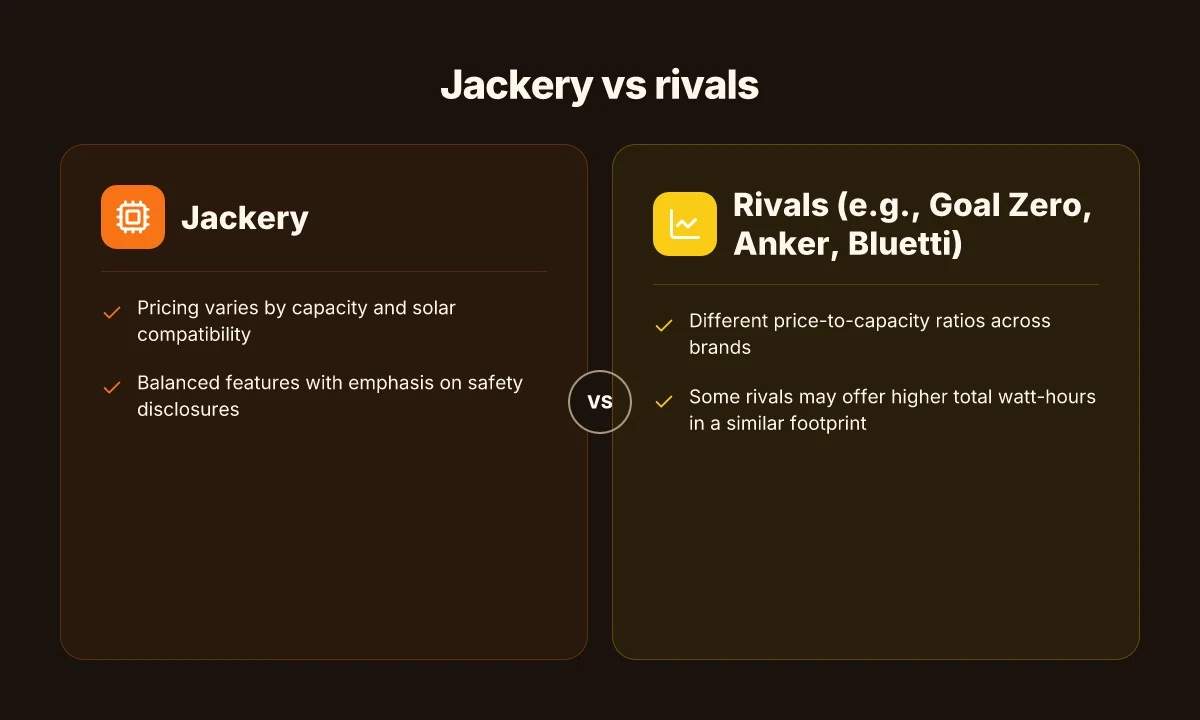
When you compare portable power by price, capacity, and features in 2026, Jackery sits in a compelling middle ground for many buyers, but not every category is a clean win. Jackery tends to offer solid value in mid-range capacities with integrated inverter options and broad third-party compatibility. rivals push harder on raw watt-hours, faster recharge, and rugged durability. The key is matching what you actually need for home, travel, or emergency use. What makes EcoFlow stand out against Jackery and Anker in 2026
Price-to-capacity balance: Jackery vs. competitors
Jackery’s mid-tier models often price competitively for the capacity they offer, especially when you factor in bundled accessories and warranty coverage. In contrast, some rivals push larger packs with slightly better efficiency or higher peak watts but at a higher upfront cost. If your priority is affordable daily power for grid outages or weekend camping, Jackery usually delivers a favorable price-to-capacity ratio. If you need maximum sustained output for heavy appliances, rivals with larger packs can feel more cost-efficient per watt-hour over time. When in doubt, map your expected daily draw and compare shelf prices for comparable watt-hours.
Jackery’s strength is predictable value, especially for standard loads in emergencies, while rivals push more aggressive capacity and peak output for heavy loads.
Features and durability: what stands out
Jackery’s line emphasizes ease of use, broad device compatibility, and straightforward safety features. The user experience is smooth for most travelers and preppers who want plug-and-play operation. Rivals often emphasize rugged chassis, higher cycle counts, and faster recharge options, which can matter in remote deployments. For casual and semi-regular use, Jackery keeps things simple and reliable, but for harsh environments, some competitors offer tougher housings and higher durability claims.
I dug into product pages and reviews to cross-check how features translate in real scenarios. Jackery models typically ship with built-in inverters, multiple USB-C and USB-A ports, and solar-ready inputs that align with common solar panel setups. Rivals may add higher solar input ceilings, automotive 12V outputs, or more robust battery chemistry options, which can translate to marginal gains in charging speed or endurance in extreme conditions. That means you pay for those edge cases with higher price or heavier weight.
Buying tips to avoid overpaying
- Align capacity with use case: for weekend trips, a Jackery model around 500–1000Wh often suffices. For extended outages, look at higher-capacity rivals with scalable packs but evaluate long-term cost.
- Check charging ergonomics: if you travel light, a model with fewer ports but faster recharge can reduce bulk. If you’re powering multiple devices, ensure enough USB-C PD and AC outlets.
- Beware feature bloat: some models tout features you won’t use, like dual AC outputs or high surge ratings that aren’t needed for typical devices. Prioritize essential safety features and real-world reliability.
- Consider ecosystem: Jackery’s solar compatibility is strong, but some rivals offer broader third-party accessory ecosystems, which can matter if you already own compatible panels or adapters.
- Look at warranty and support: longer warranties and easier RMAs save money over time, especially with devices that see frequent use in outdoor or emergency settings.
In practice, you’ll likely pay less per watt-hour with Jackery if you need standard, reliable portable power, but rival brands win on extreme capacity, ruggedness, and fast recharge. What to know about the jackery 300 explorer before you buy
Rival highlights you should know
- A well-known competitor brand often emphasizes higher energy density and advanced battery chemistries, trading some simplicity for endurance.
- A different brand consistently argues for rugged housings and higher peak wattage for running campers’ air pumps or power tools.
- Another rival focuses on modular battery modules that scale from cabin power to off-grid setups, which can be appealing if you want to expand later.
Know your load profile, then pick the model with the right balance of capacity, speed, and price.
The one move that makes Jackery a smarter repeatable habit
Jackery keeps folding into daily life because its chargers pair reliability with real-world durability. In 2026, the practical edge comes from staying power, rugged build, and a sane approach to capacity. I’ve seen how the compact models slot into backpacks and emergency kits alike, while larger units tether a home office or van life setup without drama. The question isn’t whether it charges, but whether it stays charged when you need it most. Relying on a trusted brand reduces the surprise of a dead battery in a pinch.
Durability matters more than glossy specs. If a jackery device survives daily use and rough handling, it earns a permanent spot in the charging routine. You’ll notice the difference in how the ports lay out for real-world cables, and how the display communicates remaining life without guessing. The bigger picture: you’re buying pieces that weather journeys, not one-off gadgets. Durability is the quiet reason this stays in your bag.
The bigger pattern is clear: the best Jackerys become a scalable power solution, not a single-use gadget. If you’re choosing one for work trips or weekend adventures, consider a model that matches your typical device mix and charging cadence. Pick the right size, and you’ll rarely rethink your setup. What changes if you act now: you gain a predictable power loop that reduces daily friction and keeps devices ready. The single move that matters most: pick the model that fits your actual gear kit, not your dream kit. Will you start with a mid-size unit or commit to a larger capacity for longer trips?