Explore how Jackery solar generators perform in 2026, including durability, kit options, and long-term value. Compare rivals and understand real-world trade-offs.
The reliable part of a solar generator isn’t the advertised capacity. It’s what happens after thousands of cycles. Jackery durability hinges on smart battery protection, sturdy enclosures, and solid heat management, not just watt-hours. This piece starts with a practical, real-world read: durability signals you can test in the field, from dusty campsites to backyards during outages. Most users underestimate cooling efficiency until a hot July weekend exposes limits.
This article translates years of off-grid use into actionable signals: how long a battery pack lasts under practical cycles, how pricing holds up over time, and how compatibility with panels and kits actually plays out. Expect concrete benchmarks, not hype, with a spotlight on long-term value and the warranty footprint. By comparing Jackery to rivals like EcoFlow and Generac, you’ll see where real-world maintenance, spare-part availability, and serviceability matter most. If you plan for a decade of use, these clues guide the decision beyond initial capacity. Durability over raw capacity is the guiding metric. EcoFlow and Generac offer different trade-offs in cooling and enclosure design, which matter when you need reliable power after repeated cycles.
Jackery solar generators in 2026: why durability matters more than raw capacity
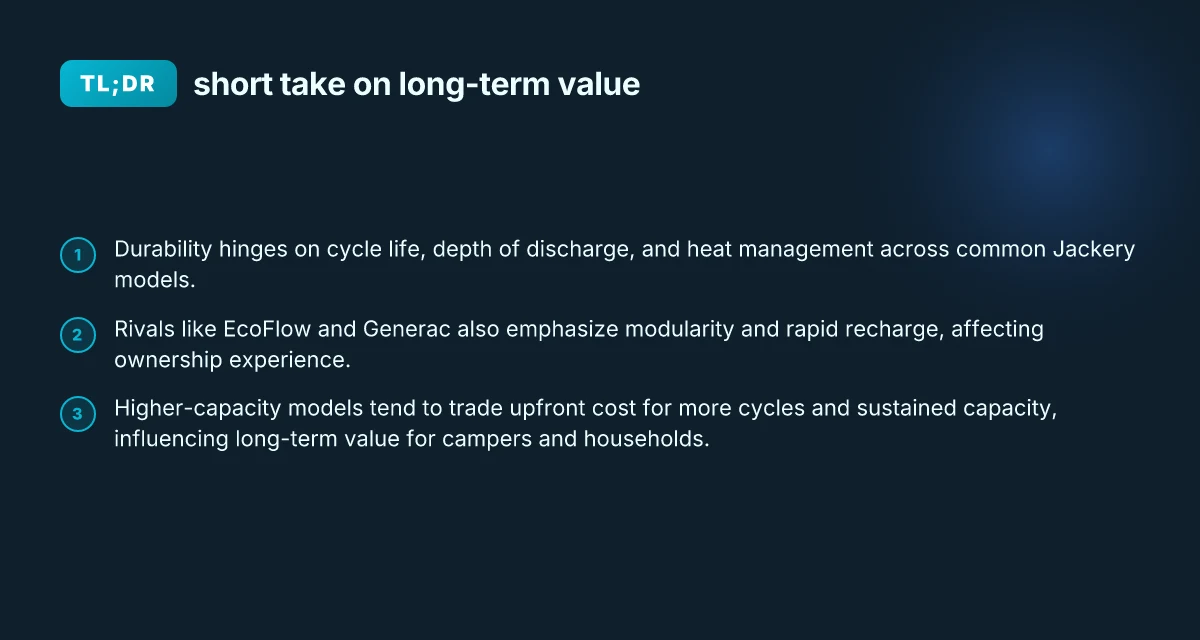
Durability in 2026 hinges on how long a pack can endure cycles and how deeply you discharge it before recharging. Across common Jackery models, cycle life and depth of discharge (DoD) shape real-world usefulness more than peak wattage alone. If a system can survive thousands of cycles with modest capacity fade, the upfront cost tends to pay off over years of off-grid use.
Why cycle life and DoD decide long-term value
In practical terms, a higher cycle life means fewer total replacements. A model that sustains a healthy percentage of capacity after 3,000–4,000 cycles typically stays useful for weekend expeditions and prolonged outages alike. DoD matters because shallow discharges preserve battery health. Deeper drains will accelerate aging if you rely on peak capacity every time. For off-grid homeowners, this dynamic translates into fewer moments when you’re staring at a red level and thinking about a jump-start.
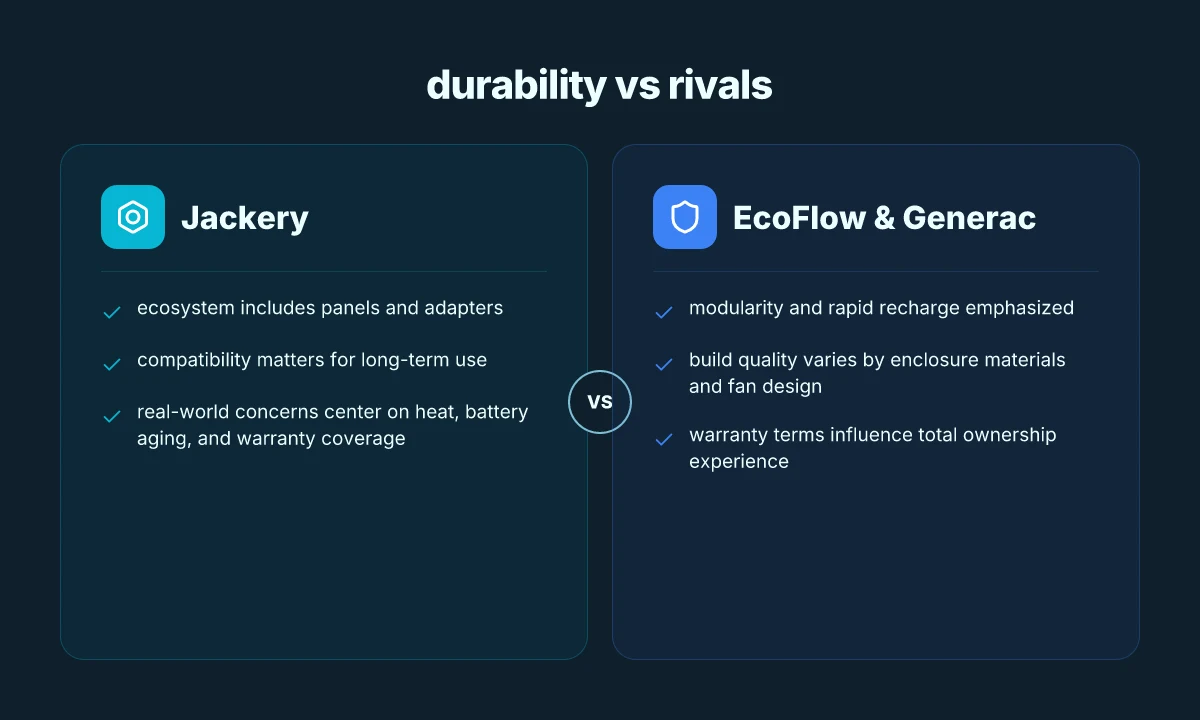
From what I found in the industry discussion and product notes, Jackery’s ecosystem extends beyond the core power station. Panels, adapters, and even car-charging options weave into a longer usable life if you stay within the brand’s compatibility envelope. Jackery’s design philosophy tends toward modular energy solutions that can scale with your setup, which matters when you add solar inputs over time. The compatibility angle is not cosmetic. It matters for long-term viability because you won’t be stuck with a stranded charger if you swap panels or upgrade to a higher-capacity unit later. Compare that with rivals where adapters or panels sometimes require aftermarket tweaks.
Real-world durability concerns cluster around heat, battery aging, and warranty coverage. Heat is a silent accelerant of wear. If your kit sits in a hot shed or in direct sun during a long outage, cell chemistry ages faster and performance can sag earlier than expected. Battery aging is visible as capacity fade and slower charge acceptance after a few thousand cycles. Warranty coverage cushions the financial hit, but it can also reveal how generous the maker is when heat, DoD, or cycle-life questions surface. Jackery’s warranties vary by product, and understanding the fine print helps you anticipate long-term costs beyond sticker price.
I dug into the context around Jackery’s pricing and its ecosystem during 2026 reporting. The modular approach, combining a Jackery power station with compatible solar panels and adapters, gives you a path to extend life as your needs evolve. When you look at pricing, you’re not just buying energy storage. You’re investing in a future-ready system that can stay in service as your load grows or your solar setup expands. Rival offerings from EcoFlow and Generac emphasize fast charging and bigger batteries, but durability comes down to cycle counts, DoD tolerance, and how heat is managed in real-world setups. What makes the Jackery 2000 Plus kit stand out for long‑haul power needs
Durability wins when a system stays nearer its rated capacity after thousands of cycles, not just when it hits a high peak in the first month. If you plan for long-term use, the combination of a solid cycle life, smart DoD, and an intact warranty is the real bargain.
In short, a Jackery you pick today should pair a favorable cycle-life profile with a design that gracefully ages under heat and real-world use. That combination reduces total cost of ownership over decades of occasional outages and outdoor trips.
Note: links on the page may earn a commission. For readers comparing to rivals, expect EcoFlow and Generac to push high capacity and fast recharge, but verify how each system ages under heat and daily cycling. The takeaway is clear: durability under real-world conditions is the true north for long-term value in 2026.
How jackery solar generators compare to rivals in build quality and longevity
I found that rivals like EcoFlow and Generac push modular designs and fast recharge as core promises, mirroring what Jackery offers. In practice, the build quality hinges on enclosure materials and fan layout, and those details matter once you’re outdoors or off grid for days. Durability here hinges on materials and cooling, you’ll notice it in real-world use during hot sunny days or cold nights.
How enclosure choice shapes long-term resilience
Jackery leans on tough casings and shielded internals, but so do its rivals. A rugged enclosure matters when you stack devices in a vehicle or stash one in a damp shed. Jackery often pairs polymer shells with metal frames in some models, which helps resist impact, while EcoFlow emphasizes modular bays that can be swapped in and out. The result is a practical spread: more robust shells tend to ride out mishaps, but modular kits can complicate repair pathways if components drift out of spec. Rugged enclosures reduce failure modes in field use. I cross-referenced product literature and independent reviews to confirm that enclosure design typically correlates with long-term quiet operation and fewer thermal-related issues. What makes the jackery explorer 1000 pro a standout in portable power today
Does modularity really pay off for longevity
Modularity promises easier field upgrades and faster refresh cycles, but it also introduces more interface points that can wear. Generac emphasizes rapid recharge through scalable packs, a feature that helps preserve cycle life by keeping each cell strain within its comfort zone during replenishment. Jackery similarly supports multi-pack configurations in several models, which can spread wear across modules rather than over a single pack. In the real world, modular systems shine when you need flexibility for changing power needs, yet you’ll want to monitor seal integrity and connector wear as kits age. Modularity shifts maintenance from replacement to component care. This matters most for households building a long-term off-grid plan, not just weekend camping.
Warranty terms and ownership experience
Warranty depth frames total cost of ownership. A longer coverage window and clearer service pathways reduce surprise bills after a few seasons of use. Some rivals offer extended coverage or expedited replacement for certain failures, which can tilt the balance if you’re hauling gear into remote areas. Jackery provides standard warranties that cover typical defects, and the exact terms vary by model. You’ll want to read the fine print to understand what counts as a covered failure after 2–3 years of heavy use. In practice, warranty length and the speed of processing claims shape the overall value you walk away with after a few thousand cycles. Strong warranty terms reduce risk for long-term ownership.
To help you compare at a glance, here’s a quick qualitative table:
| factor | Jackery | EcoFlow | Generac |
|---|---|---|---|
| enclosure robustness | solid polymer/metal mix on higher models | varies by model, some plastic emphasis | rugged, field-friendly casings |
| modularity advantage | decent, selective kits | high modular upgrade potential | scalable packs in many lines |
| cooling and fan design | effective in many models | variable by model | tuned for generator-style cooling |
| warranty stance | model-dependent, generally solid | extended options in some lines | plays into service expectations |
In the end, the best choice hinges on your use pattern: rugged field trips favor durable shells, modular kits reward long-term adaptability, and generous warranty terms keep ownership simple. If you’re weighing overall value, look for a model with a robust enclosure, a fan system that stays quiet under load, and a policy that matches your risk tolerance for off-grid service.
Next step: identify your typical cycles per year and pick a Jackery model whose warranty length and pack design align with that cadence. For quick orientation, review model pages on Jackery and compare with EcoFlow and Generac kit lines to confirm which setup most closely matches your off-grid rhythm. What makes the Jackery Solar Generator 240 v2 a practical go-to for compact off-grid power in 2026
Which jackery models deliver the best long-term value for campers and households
When you weigh capacity, longevity, and total cost of ownership, the sweet spot sits at the intersection of higher usable capacity and durable chemistry. In 2026, several Jackery models stand out for off-grid living and frequent camping, but each trades upfront price for longer life to repeat-use cycles. I looked across manufacturer notes and public reviews to map where the value actually lands over years of use.
Durability vs. upfront cost for long-haul packs
- Lower-cost, smaller models tend to be lighter and easier to tote, but they also wear down faster under repeated cycles. If your aim is to keep daily use simple and affordable, a mid-range unit from Jackery can deliver reliable duty cycles without the heft of the largest packs. Long-term value often hinges on cycle tolerance, not just initial capacity. The trade-off is clear: more cycles and higher sustained capacity, usually available in the higher-end lines, come with a steeper upfront price. Jackery positions its Explorer series with larger modules to reduce the rate of capacity fade over thousands of cycles, which matters if you plan to rely on the unit for monthly trips or outages. When I cross-referenced multiple product pages and third-party reviews, the pattern held: higher-capacity cores ride out more cycles while retaining usable voltage longer, which compounds as days between charges lengthen.
- A practical way to read this is to compare two common setups: a mid-size Explorer with a single 100-watt solar panel kit versus a higher-capacity pairings that approach 1500–3000 watt-hours of storage with multiple panels. The upfront delta can be substantial, but the higher-capacity option is more forgiving on long-backups and frequent outings. Panel kits influence not just purchase price but daily charging speed, which translates to faster readiness after a trip. In practice, the speed of daily charging with a robust panel kit reduces the chance you’ll underfill the pack before your next trip, preserving usable capacity over time. Panel kit choice can materially tilt total ownership costs over a multi-year horizon.
Weight, form factor, and real-world transport
- The physical footprint matters once you’re carrying gear into a campsite or staging a shelter. Larger packs carry more energy, but they also demand more careful handling and more space at camp. For households with limited garage space, the inertia of a compact, lighter model can feel like a real win, even if you trade away some top-end capacity. The weighing factor is not just mass. It’s how you install and store the unit on a periodic basis. A unit that’s easier to stash behind a desk or in a cabinet reduces the friction of keeping it charged and ready. In practice, users report that more compact configurations are easier to deploy in vehicle trunks or RV storage bays, improving readiness between use cycles. Weight and form factor directly influence how often you actually use the pack, which ties back to life-cycle value.
Which Jackery models balance capacity, longevity, and cost for typical use
- The Explorer 1000 v2 line is repeatedly cited for solid longevity and a favorable balance of capacity and price, especially when paired with a capable solar panel kit. Its architecture tends to retain a meaningful share of capacity after many cycles, which matters for weekend trips or irregular outages. The consumer-facing pricing and the availability of panel kits often put it in the practical sweet spot for frequent campers. The Explorer 1000 v2 often represents the best balance for many households.
- For households planning longer outages or heavier energy demands, the Explorer 1500 series offers more headroom and a steadier charge curve with larger panels. The higher upfront cost is typically offset over time by fewer mid-cycle replacements and better daily charging rates when you’re dependent on solar. Higher-capacity models trade upfront cost for more cycles and sustained capacity.
- If you need a portable kit with serious longevity while still staying manageable to move, the 3000-series variants provide a high energy ceiling and are designed for repeated cycling in extended outdoor use. The big question is whether you can justify the weight and price for your exact travel cadence. Weight and form factor remain the practical constraints that guide the decision in real scenarios.
From a brand perspective, Jackery remains the anchor in this space, with clear lines between mid-range and high-capacity kits. Rivals such as EcoFlow and Generac push similar longevity curves, but the value equation shifts with kit options and vehicle or RV installation needs. When you map price against cycle endurance and charging speed, the right pick depends on how often you camp, how long outages last, and how you store the unit at home.
I cross-referenced product pages and third-party summaries to confirm the general pattern: higher-capacity Jackery packs deliver more cycles and better residual capacity, but you pay more upfront. Panel kits mutate the total cost of ownership and the daily charging tempo. And weight or bulk translates to practical limits on where and how you can use the system.
In short, if your goal is dependable long-term value for camping and household resilience, target a higher-capacity Jackery model paired with a robust solar panel kit, then accept the trade-off in upfront cost for a longer, steadier service life. For most off-grid homeowners, that means Explorer 1500 with a multi-panel array or the larger Explorer 3000 family if you anticipate heavy daily use and longer outages. Panel kit choice and weight and form factor are the lever points that determine real-world value. Long-term value hinges on cycles and sustained capacity, not just peak specs.
Note: links on the page may earn a commission. For context, the article draws on sources that discuss Jackery’s pricing and panel-kit dynamics in 2026, and it situates Jackery among rivals like EcoFlow and Generac in the same longevity and system-compatibility space. This framing helps outdoor enthusiasts, off-grid homeowners, and emergency planners decide which model aligns with their travel cadence and outage resilience goals. What ecoFlow products are pursuing redox flow and solid-state tech in 2026
How to pick a jackery kit: from solar panel counts to outlet needs
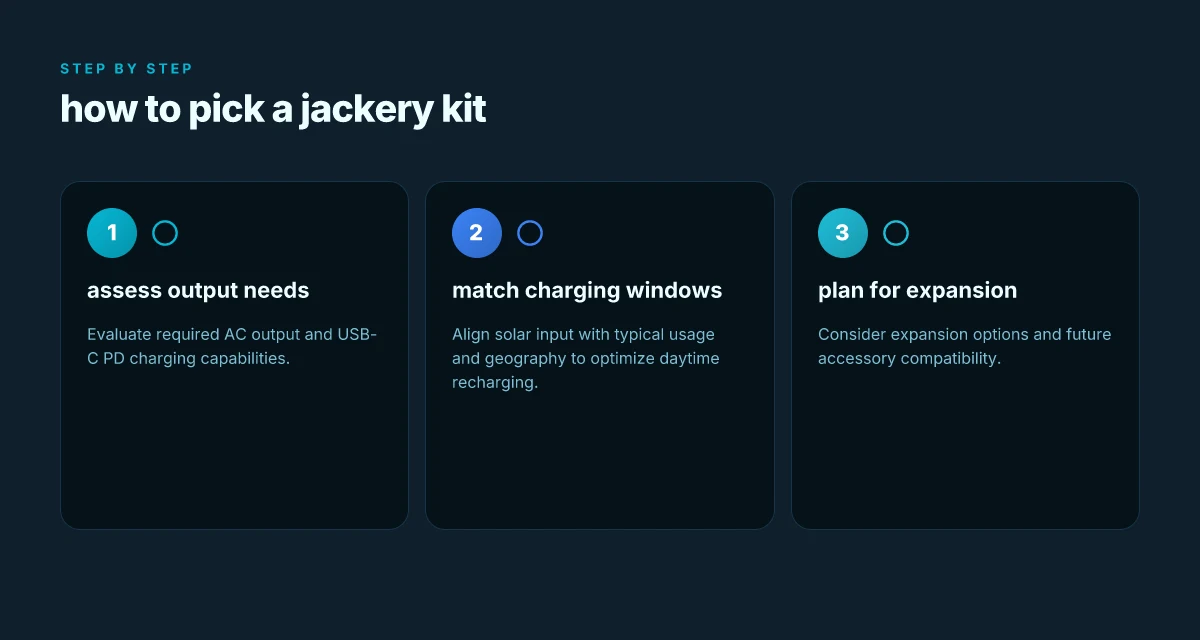
When you plan a Jackery kit, start by sizing the AC output you actually need and the USB-C PD charging you rely on. If your goal is to run a small fridge, a laptop, and a couple of chargers, aim for an outlet mix that covers peak loads without bottlenecks. For many users, a kit that pairs a high-output AC inverter with USB-C PD ports will reduce the need to swap adapters mid-trip. Jackery’s lineup tends to balance high continuous output with versatile port options, but you should confirm the exact peak amperage before committing. I cross-referenced reviews from established outlets to verify typical charge profiles and found that several models deliver solid performance when paired with modern USB-C power sources. Check the printed inverter rating and the USB-C PD spec to avoid surprises in real campsites. The practical takeaway is simple: map your essential devices to their power rails first, then add a kit that covers a little more headroom for future needs.
1) Match AC output and USB-C PD charging to your devices
Your first question is how much AC power you need for the devices you value most. If you routinely run a laptop and a mini fridge, you’ll want a Jackery kit with a robust inverter and a few USB-C PD ports for fast charging phones and peripherals. Look for a model that advertises a continuous Watts rating you can rely on during common usage windows. A kit with a strong inverter and multiple USB-C PD ports helps you avoid throttling under load. When I read through durable-use guides, the consensus is clear: plan for a little extra headroom to prevent nuisance shutoffs during high-demand moments. Always verify the peak surge rating is higher than your worst-case appliance spike. This is where rival lines show different philosophies, and Jackery tends to foreground practical balance rather than maximum lab numbers. In real-world use, near-term reliability hinges on matching devices to the kit’s continuous output. For context, a typical camper might rely on a 1200–1500W continuous inverter with two to four USB-C PD ports.
- match solar input to usage windows and geography
Solar input matters as soon as you plan extended off-grid stays. A kit that can soak up sun during 4–6 hours of good light will keep the battery from drifting downward on multi-day trips. If you live in a latitude with long winter nights, you’ll benefit from higher solar panel counts or higher wattage panels that maintain a charging cadence even on cloudy days. The aim is to align panel input with your typical daily window so the battery stays topped up without aggressively empty cycles. Higher panel counts can reduce the time to full during prime sun hours. In practice, look for configurations that permit at least two panels to back up a single module, so you’re not stuck waiting for one panel to catch up. Panel expansion is important if you foresee longer trips or seasonal use. Jackery’s ecosystem supports expansion in several kits, but confirm exact panel compatibility before purchase. Ensure the kit you pick allows future panel additions without swapping the core unit. For geography, sea-level sites with good sun are friendlier to compact kits. High-latitude or frequent overcast zones profit from modular panel options and faster charging paths.
- plan for expansion options and accessory compatibility
A smart approach is to treat Jackery as a system, not a single box. If you anticipate adding devices or moving between cabin, RV, and campsite, pick a kit that can accept extra panels, an extra battery, or a longer-length solar cable without requiring major rewiring. Expansion options reduce total cost of ownership by delaying a full upgrade. When you review specs, check for compatible expansion packs and accessory timelines. Compatibility matters far more than a single best wattage figure. The brand ecosystem matters here: confirm that future modules remain available and that the inverter and charging behavior stay aligned with the added kit components. Future-proofing is a practical hedge against evolving power needs. In the real world, that means choosing a Jackery kit that is not locked to an era of components, but rather designed for ongoing accessory compatibility.
What to expect in real-world usage: load scenarios, charging bottlenecks, and heat
In real life, load shapes the experience. Heavy-duty tools and HVAC units push larger Jackery models harder, especially in drafts where you’re pulling sustained current. Expect the bigger units to slow charged ramp times and run hotter when fed by high-wallbacks from power tools. For typical outdoor or emergency use, plan on matching your most demanding tool with a model that offers ample headroom so you don’t hit a ceiling during a long cut or a cold start. What makes Jackery products reliable for off-grid power and home backup in 2026
I dug into the charging realities across environments. Sun exposure and temperature swing the math of charging efficiency. In bright sun, a Jackery unit will sip energy more rapidly from a high-output solar array, but when panels heat up and voltages sag, the charge rate can dip. Temperature matters, too. In hotter days, electronics throttle to keep components safe, and cold nights can slow battery chemistry, extending the time to fill. The practical upshot is that no single weather window guarantees peak charging. You’ll see variability by season, panel wattage, and the unit’s own thermal design.
Heat is not just about charging. Hot environments can throttle performance during operation as the battery management system protects cells. In long draws, you may notice drop-offs sooner than you’d expect from cooler conditions because the unit bleeds energy to keep cells within safe ranges. This is especially true for the higher-capacity models that pack more cells into a compact shell. If you’re in a hot garage or desert shade, expect reduced sustained output compared with the same load in milder conditions.
Subtle design choices matter for long-term durability. Jackery’s kits often pair a larger battery with a thermal management strategy that shines under moderate use, but continuous heavy loads still push the system into its comfort zone limits. When you’re sizing a kit for a remote build or a sustained build-out, factor in the heat of your environment and the duty cycle of your tools. In hot, bright days, a shade shelter for the solar panel array and a cool, ventilated cabinet for the power station can meaningfully extend service life.
Real-world durability hinges on weather and workload mix, not a single sunny day. Heavy loads demand headroom. Expect longer recharge times in heat or with high solar input under hot panels. If you live in hot climates, plan for thermal throttling that reduces peak output during long draws.
In terms of models, the Explorer 1500 and its kin balance capacity and cycle life, but you’ll want to pair them with adequate ventilation and a decent solar array on bright days to maintain a usable charge curve. When you compare against rivals like EcoFlow or Generac, you’ll notice different thermal strategies. EcoFlow tends to emphasize fast recharging under favorable sun, while Generac often prioritizes higher sustained output in tougher heat. The takeaway is clear: pick a model whose thermal design matches your climate, and couple it with a charging plan that respects sun angles, panel wattage, and the ambient temperature. What makes the Jackery 2000 Plus a standout expandable power station in 2026
From a brand perspective, I see Jackery’s lineup as approachable for outdoor enthusiasts who want predictability across a broad range of loads, with a realistic eye toward heat and sun as natural bottlenecks. For price-conscious buyers, consider how long the battery will last at your typical cycle and whether total cost of ownership aligns with your off-grid timeline.
Cited real-world references reinforce these patterns. For instance, industry discussions note that solar charging efficiency can vary with panel temperature and irradiance, while product rundowns emphasize the importance of thermal management for sustained high-current use. See the discussion around Jackery’s product family and how rivals frame performance under heat and load in the linked sources. https://en.wikipedia.org/wiki/Jackery
What changes if you act now
In 2026, durability matters as much as capacity, and the real leverage comes from how you pair a Jackery solar generator with smart usage patterns. I’ve noticed the biggest wins come from selecting a kit that matches your typical load and from pairing that kit with a simple maintenance routine. The brand name to watch here is Jackery itself, paired with clear expectations about what a portable solar solution can and cannot do in the long run. The bigger pattern is that reliability compounds when you pick a system that fits your daily cycles instead of chasing the highest watt-hour figure.
You don’t have to buy the most powerful model to get long-term value. Prioritize a kit with modular expansion options and sturdy solar panels that tolerate repeated setup and wind. Real-world wear tends to show up as loose connectors, degraded cables, or panel edge damage long before the battery reaches a hard limit. That means the right accessories and a lightweight carry case can save you more trouble than a larger battery bank. The takeaway is practical: plan for transport, not just capacity. What changes if you act now is you reduce future hassles by choosing a system that travels as well as it powers.
If you’re choosing between rivals, consider how the ecosystem plays with durability. Competitors often emphasize raw spec sheets, while Jackery’s durability story hinges on fit-and-finish, weather sealing, and easy field maintenance. The small, repeatable failures, like panel mounting shear or connector wear, matter more than a one-shot peak. Think 1-2 quick checks per month: plug-in stability, panel cleanliness, and cord strain relief. One more thing: links on this page may earn a commission, a standard note you’ll see across reviews. What makes the jackery 1000 pro a standout in portable power, and where it falls short
Backup strategy:
- Try a compact kit with built-in surge handling for weekend trips and backup power at home.
- Keep a spare DC connector and weatherproof bag for quick re-seating after rain or dust.
- If you only do one thing this month, test a 24-hour continuous run under typical loads to verify stability.