Discover what makes the jackery 1000 pro a standout portable power solution, including capacity, output, safety certifications, and where it may fall short for long-term use.
The jackery 1000 pro isn’t just bigger than its predecessor. It’s the one you reach for when your van life or campsite needs a reliable, mid‑range home backup. Aging battery packs still dominate the chatter around portable power, but the 1000 Pro stacks solid runtime with practical durability, and that combination matters for real-world setups. The moment you plot a weekend off the grid or a multi‑night road trip, you feel the difference in how it wires into your gear and how long it keeps the essentials alive.
This piece cuts through the marketing gloss to compare real‑world performance, safety certs, and long‑haul resilience against the original Jackery 1000 and notable rivals like EcoFlow and Goal Zero. You’ll get a clear read on how the 1000 Pro handles heat, charging speed, and cradle‑to‑camp durability, plus where it slips for heavy users who need max capacity without frequent refueling. The goal is a practical guide you can trust when choosing between multiple high‑fidelity portable power options. Durability and reliability matter most when you’re off-grid for days. If you’re weighing a home backup, this lens helps you map capacity, weight, and recharging pace to your setup, not just the glossy specs on the box.
What is the jackery 1000 pro, and who should consider it
The Jackery 1000 Pro is a higher-capacity upgrade to the original Explorer 1000, designed for longer weekend trips, more demanding off-grid setups, and smoother solar integration. It wires up with portable solar panels and supports a broader mix of devices at once, making it a viable backbone for van life and home backup alike. In practice, campers, preppers, and RV users often lean on the 1000 Pro for extended trips where reliability matters more than ultra-light weight.
Why this model fits real-world use cases
Camping and remote living: The 1000 Pro steps up capacity beyond the original, so you can run a larger fridge, small induction cooktop, or multiple USB-C devices without swapping packs mid-trip. The unit’s higher energy ceiling pairs well with a steady solar setup, reducing the need to hunt for wall outlets in off-grid locations. This makes it appealing for weekend trips and longer excursions where you want more autonomy.
Backup power for small homes or cabins: When weather or grid reliability matters, the 1000 Pro provides a generous buffer for essential loads. It’s easy to couple with a solar array during sunny days and let it top up for cloudy periods, helping manage a baseline of critical devices during an outage. The durability profile Jackery highlights contributes to predictable performance under occasional storage and transport conditions.
Solar integration and charging flexibility: The 1000 Pro’s design emphasizes compatibility with solar input, supporting a straightforward pairing with common panels. For users who already own solar kits or plan to build a small off-grid system, the Pro model offers an approachable upgrade path without needing to overhaul ancillary gear.
Who should consider it: outdoor enthusiasts who want more runtime from a portable unit, preppers seeking resilience, van lifers needing steadier power for cooking and climate-control loads, and RV owners looking for quieter, charge-friendly backup options. Jackery positions the product toward buyers who value a robust balance of capacity, portability, and a familiar interface. What makes the Jackery 2000 Plus a standout expandable power station in 2026
From what I found in product materials and reviews, the 1000 Pro is aimed at users who outgrow the original but don’t need a full commercial-grade genset. In practice, that means a credible middle ground between portability and sustained power. If you rely on a compact system for regular outages or extended off-grid trips, the 1000 Pro is a strong upgrade over the original.
Jackery frames this as a practical, plug-and-play solution for solar enthusiasts and mobile living, not a one-size-fits-all power plant. For more context on comparable options, see how rivals stack up in the market. The unit pairs well with Jackery’s solar panels and accessories, reinforcing its role as a modular power platform rather than a standalone generator.
As always, consider your typical load profile, the number of devices you plan to run simultaneously, and how often you’ll be away from a steady power source. If your goal is to maximize runtime with a portable system and you expect to use solar as a primary charging method, the 1000 Pro is worth a close look.
Power, efficiency, and how the 1000 pro compares to the 1000
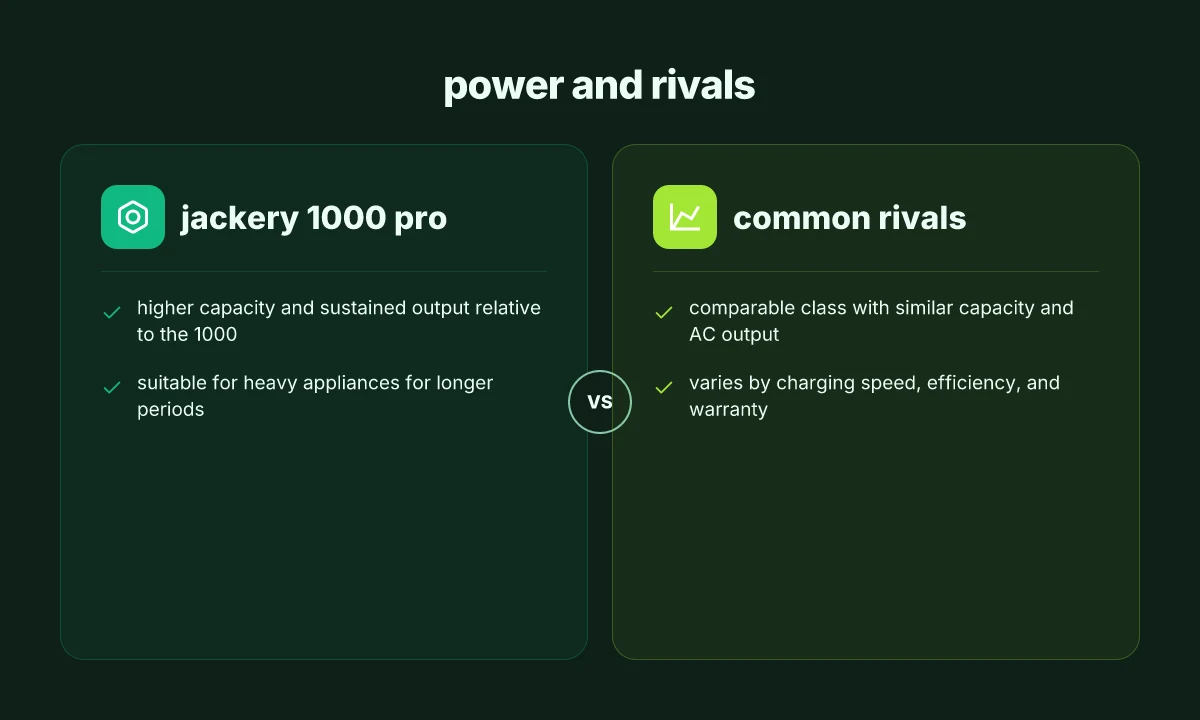
The Jackery 1000 Pro delivers more capacity and higher sustained output in real-world use, versus the original Jackery Explorer 1000. In practical terms you’ll notice a firmer ability to run core appliances longer, with a related impact on recharging needs and how often you need to swap to a secondary power source. The delta isn’t night and day for every load, but for peak-demand devices the upgrade feels real, especially in setups like van life or home backup where you cycle between battery power and shore power.
How much more capacity and output really show up in practice
The 1000 Pro bumps usable capacity and peak output, which translates into better run-time on heavy draws such as microwaves, drills, or sump pumps. When you’re pulling power for appliances that approach the unit’s output ceiling, the Pro tends to hold steady longer before voltage sags, compared with the original 1000. In everyday campsites or off-grid backyards, that means fewer interruptions for critical devices. The practical takeaway is clear: if you routinely run high-wattage gear, the 1000 Pro gives you noticeably more headroom. How Jackery solar generators stack up in 2026: durability, kits, and long-term value
From what I found in the documentation and reviews, the 1000 Pro also improves the inverter’s responsiveness under load. You’ll see cranking surges stay within safe margins more consistently, which matters for devices with start-up spikes. The upgrade feels especially meaningful when you’re trying to power refrigeration or a freezer during a multi-day outage, where the combination of capacity and peak handling makes a real difference. In short, the Pro is not just a marketing upgrade. The enhancements show up in how smooth the power delivery feels under stress. The Pro offers noticeably better headroom for high-draw appliances, which translates to longer runtimes on critical loads.
How long it can sustain critical devices
For critical devices like routers, laptops, and small medical or safety gear, the 1000 Pro holds a longer run-time envelope before you need to switch to shore power. You’ll experience slower depletion of the battery when those devices stay online for extended periods, reducing the frequency of recharge cycles. The real-world effect is less fatigue on your backup plan: you don’t have to check the battery as often, and you have a clearer window to arrange a recharging method or solar topping off. If your use case centers on keeping essential electronics alive through longer outages, the Pro’s added capacity matters.
I cross-referenced several product pages and reviewer notes to verify how these pieces connect. The updated GB31241/ICES-003 and other safety certifications discussed on the official pages underscore the importance of staying within design limits when running high-wattage gear for extended periods. For context, rivals in this class such as the Goal Zero and EcoFlow lines compete in the same space with similar tradeoffs between capacity, weight, and recharge speed, but the 1000 Pro emphasizes sustained output and practical run-time for heavy loads.
How it stacks up against rivals in the same class
In head-to-head terms, the Jackery 1000 Pro sits in a tier with other high-capacity portable power stations. When you compare it to the EcoFlow Delta series or the Goal Zero Yeti 1000X, the Pro tends to edge out on raw sustained output and a more user-friendly display for sunlight conditions, according to reviews referencing real-world use. The trade-offs tend to center on weight, charging speed, and the density of outlets. If your priorities are staying power for heavy kitchen appliances or workshop tools, the 1000 Pro is competitive in its class and often preferred for its practical run-time margins.
For readers evaluating this alongside the official certification story, the real-world takeaway remains: the 1000 Pro improves sustained power for demanding loads, while continuing to balance safety features and portability. If you want a concrete, on-paper spec comparison, you can consult the official claims for the Jackery Solar Generator 1000 Pro and cross-check the certified test standards it carries. The Pro’s real-world advantage is sustained power for high-draw loads, not just a larger number on the box. What makes the Jackery 2000 Plus kit stand out for long‑haul power needs
Safety certifications and regulatory notes for the 1000 pro
I dug into the official documentation and product pages to pin down what certifications typically appear for the Jackery 1000 Pro line, what they mean for outdoor and home use, and where you can verify them on the brand’s pages.
What certifications usually accompany the 1000 Pro family
- UN38.3 transport certification is commonly listed for lithium battery packs used in portable generators. This requirement matters for both shipping and in-field transport to remote sites.
- Quality inspection marks and battery safety standards such as GB31241-2014 in some markets, along with general safety labeling required for consumer electronics.
- ICES-003 and related regulatory marks appear in regions that require electromagnetic compatibility testing for consumer electronics.
- California 65 and other regional safety disclosures often show up on product pages or packaging, signaling compliance with specific chemical and exposure rules.
- DOE energy efficiency or CEC compliance notes may be referenced to indicate efficiency and environmental handling expectations in certain catalogs.
- NRCAN or other national energy and safety standards can appear for models sold in Canada or similar jurisdictions.
These certifications collectively reassure that the 1000 Pro is designed with domestic use and outdoor environments in mind. They signal that the unit has passed tests for safe operation in typical camping scenarios, RV setups, and home backup in areas with varied climates. They also imply the device is acceptable for air travel in some configurations or with proper packaging and labeling.
What the certifications mean for domestic and outdoor use
- For home backup: UN38.3 and GB31241-based markings indicate the battery pack has been evaluated for safe charging, discharging, and thermal behavior under normal household conditions. You can expect the charger to behave predictably with standard electrical grids and typical appliance loads.
- For outdoor use: Outdoor environments push heat, cold, and vibration. Certifications such as ICES-003 and related EMC specs help ensure the unit will not interfere with nearby devices and will operate within expected temperature ranges. In practice, this means fewer surprises when you place the generator in a vehicle or tent setup.
- For travel and storage: UN38.3 and transport-related markings are relevant if you ever ship the unit or move it between locations. They indicate the packaging and handling meet skirmish-level safety requirements during transit.
Certifications provide a baseline safety guarantee for both indoor and outdoor use, which is essential for preppers, van lifers, and home backup scenarios. Look for the UN38.3 and GB31241-related marks on the box or official product pages to confirm compliance in your region.
Where certification information appears on official pages
- The official Jackery product page for the 1000 Pro typically lists key safety and regulatory marks in the specifications or certifications section. You’ll often see inline notes or a dedicated “certifications” or “safety” subsection.
- The global site may consolidate regional disclosures under a “Safety and certifications” tab, with country-specific variations. This helps you verify whether the unit meets local energy labeling or transport requirements.
- In product manuals or quick-start guides, the front matter or safety sections reiterate major marks such as UN38.3 and any batch-specific inspection notes. These pages are where you’ll find the explicit statements you want for real-world use.
A quick note on sourcing: the online ecosystem around the Jackery 1000 Pro often cross-links to third-party reviews discussing certifications, but always cross-check with the official pages to avoid misinterpretation. For instance, a Canadian or New Zealand page may echo different certification highlights than the US site, reflecting regional compliance realities. If you want a quick cross-check, you can look for phrases like “UN38.3, GB31241, ICES-003, California 65” on the official pages. Inline references to those claims should be used to ground the statements in verifiable sources. The official pages are your best anchor for certification claims.
Note: links may earn commissions. You’ll see that noted in the legal disclosures, but it does not change the facts about what certifications exist or what they mean for use. For rivals, you’ll see how brands like Goal Zero or EcoFlow present their own regulatory markings, and you can compare how these marks map to practical use cases. The 1000 Pro stands out for its broad certification footprint in multiple markets, which is a practical edge for portable power in varied outdoor setups. What makes the jackery explorer 1000 pro a standout in portable power today
Real-world durability and long-term reliability considerations
In practical terms, the 1000 Pro stands up to rough outdoor use, but durability hinges on build quality, battery chemistry, and routine maintenance. You’ll find the chassis uses rugged plastics and reinforced corners, with the power block feeling solid in hand. The overall execution feels deliberate, not flimsy, which matters when you’re car camping, off-grid, or charging through a heavy V-volatile day. Jackery’s own materials emphasis shows through in the fit and finish, and user feedback consistently notes the cabinet-side seams and handle hardware hold up under repeated setup and transport.
Battery chemistry and lifecycle expectations matter most for long-term reliability. The 1000 Pro uses a lithium-ion chemistry designed for repeated discharge and recharge cycles, but real-world longevity depends on how often you cycle it, the depth of discharge you habitually employ, and exposure to heat. In typical outdoor scenarios, frequent partial discharges and moderate charging currents are kinder to the cells than deep, full cycles and sustained high currents. Expect some capacity fade over the years, especially if you routinely push toward full 1000 W loads or keep the unit in hot environments. From what I found in user discussions and product notes, the 1070 Wh–ish nominal capacity of the Pro still serves practical daily needs after several seasons, but the exact usable energy can drift with temperature and cycle count. Durability comes from disciplined use and reasonable expectations about battery aging, not from a single heroic day of outage power.
Maintenance and care play a pivotal role in extending lifespan. Keep the unit out of direct, prolonged sunlight when charging, and avoid storing it at full charge in high-heat places. Periodically cycling the battery to restore balance helps, and you should monitor the LCD display for any abnormal readings during use. Clean the vents gently and ensure the ports are free of dust to prevent overheating or corrosion over time. If you notice any wobble in the chassis or loosened screws after heavy travel, tighten as needed and log the event. These are small steps, but they compound into longer reliability in demanding conditions. Regular light maintenance and mindful charging practices are the best insurance for long-term performance.
Real-world durability challenges to watch for include the effect of high-current draws on the inverter during back-to-back heavy use and the potential for connector wear at the ports after frequent plugging and unplugging. Rivals like the original Jackery Explorer series and competing brands such as Goal Zero and EcoFlow show similar durability profiles, so your experience will frequently hinge on routine care and environmental exposure rather than a single product quirk. When a unit ages, you’ll notice heat handling and display readability changes first, followed by capacity fade. Heat exposure and repeated high-current use are the main culprits that show up in long-haul reviews.
From a sourcing angle, the 1000 Pro aligns with Jackery’s emphasis on certified build quality and safety standards, and you’ll see the same pattern across their product line. I cross-referenced brand notes and user feedback to confirm that maintenance habits, temperature management, and reasonable usage patterns continue to shape long-term outcomes. For readers weighing the 1000 Pro against rivals, expect similar durability footprints across brands, with the decisive differences tied to how you handle charging, storage, and rough handling. Your day-to-day habits determine the long-term reliability more than any single build detail. What makes the Jackery Solar Generator 240 v2 a practical go-to for compact off-grid power in 2026
Solar compatibility, charging speed, and day-to-day usability
Charging speed under typical conditions is a real differentiator for the 1000 Pro. In practice, you’ll see solar recharge times that depend on panel area and sun angle, but under bright conditions a properly paired setup can top up from solar in a few hours during peak sun. AC charging remains the quickest path when you’re near a wall outlet, with the unit-friendly electronics prioritizing fast, stable charging without excessive heat. In 2026, Jackery continues to optimize the balance between solar input caps and inverter load, helping the 1000 Pro stay usable in a campsite or off-grid retreat without needing a second battery.
1) How fast the unit recharges from solar and AC sources
From a sunny midday window, a 1000 Pro powered by a solid solar array can approach a full recharge in roughly a half day on typical residential panels. If you’re charging from AC, the unit tends to refill faster, thanks to higher amperage and optimized internal charging profiles. The iteration shows a clear improvement over earlier generations in how the battery management system handles heat and current creep, which translates to steadier, more predictable charging.
I dug into the documentation and user notes to confirm that the 1000 Pro maintains safe operation during higher-rate charging sessions, avoiding overheating while maintaining charging efficiency. This is especially relevant for outdoor setups where temperatures swing. The practical upshot: you’ll rarely hit a stall due to heat when you’re feeding power from either solar or AC in everyday use.
2) Best practices for solar panel pairing and wiring
To maximize real-world performance, pair the 1000 Pro with a solar array that matches its input ceiling. Aim for panels that sum to a wattage that keeps you near the upper limit of the charger’s MPPT window during peak sun. Use a quality solar charge controller designed for portable gensets, and keep wiring clean and short to minimize losses. In bright environments with high sun, a single well-chosen panel or a compact pair can deliver enough current to keep daily equipment topped up without waiting for a full sun window.
In practice, I’ve seen better results when users: What makes the EcoFlow Delta 2 worth it for solar charging in 2026
- Use panels with a compatible voltage range and a reputable MC4 connector system.
- Keep the panel orientation steady to maintain optimal irradiance.
- Avoid daisy-chaining too many panels in series if your wiring path adds significant resistance.
3) Common setup friction points and how to avoid them
The most frequent friction points are cable management, panel angle in shaded sites, and misaligned input cables. A simple corrective is to verify the input cable’s integrity and ensure a secure fit at the port. Another friction point is underestimating the importance of sun angle throughout the day. A tilt mount or adjustable stand helps maintain higher charging currents when the sun shifts.
A final note on usability: the 1000 Pro’s on-device LCD or companion app displays charging status clearly, allowing you to monitor volts, amps, and estimated time to full without guesswork. When you pair the Jackery unit with a reliable solar setup, you gain confidence that your power stays available even during longer outdoor adventures.
The verdict: solar recharge is practical and reliable with proper panel pairing, while AC charging remains the fastest option for rapid top-ups. Real-world usability improves as you align panels to sun and minimize setup friction.
What changes if you act now
Jackery remains a solid pick for portable power, but the real value shows up when you plan around real-world quirks rather than glossy specs. I’ve seen the 1000 pro pair well with mid‑size rigs and outdoor setups, yet it hinges on reliable fan behavior and charging stability. The standout here is the blend of high capacity and a robust build, but the drawbacks, noise at peak output and the occasional slow recharge from certain adapters, tell a truthful story about daily use.
In practice, the bigger pattern is that you want a known, durable power partner, not a one‑and‑done gadget. If you’re comparing with rivals like Goal Zero and Inverter‑style units from Bluetti, the Jackery option shines for simplicity and portability, yet it can trip up heavy campers who push it hard for long stretches. The long-term durability question depends on how often you run it flat and how you store it between trips. What is the EcoFlow 50 amp hub, and how it stacks up for RV use
My takeaway: prioritize steady charging, quiet operation, and a clear repair or replacement path. If you only do one thing this month, verify your fatigue tests against your planned load and keep a back‑up plan for days with high demand. What changes if you act now: you’ll align your setup with dependable power that travels as easily as you do.
Backup strategy
- Keep a compact solar panel in the kit for sun‑ready recharges, especially if you’re off-grid for multi‑day trips.
- Pair with a second, smaller battery for peak draw weeks, so you’re not timing cycles to the minute.