
Explore the Jackery 2000 Plus kit: expandability, performance, and practical setup tips for off-grid power. Learn who benefits and where to expect trade-offs.
The common belief that modular power systems simply add capacity without tradeoffs is why many buyers oversize the kit and still hit limits in real use. The 3000W output of the Jackery 2000 Plus kit is real, but sustained draws push battery packs and panels into thermal and efficiency limits.Durability depends on the chain you build, not just the headline specs.
For outdoor enthusiasts, off‑grid campers, and small shops, the question is how this setup behaves in months of field use. I’ll compare its real‑world scalability, the 24kWh potential, and how rivals like Aikido and EcoFlow stack up in heavy, sustained draws. Expect concrete guidance on setup order, cooling, and maintenance cycles, so you can decide if the Jackery route stays ahead or if a second option is warranted. Jackery’s modularity matters, but so do your climate, load profile, and expansion plan.
What the jackery 2000 plus kit promises in real life
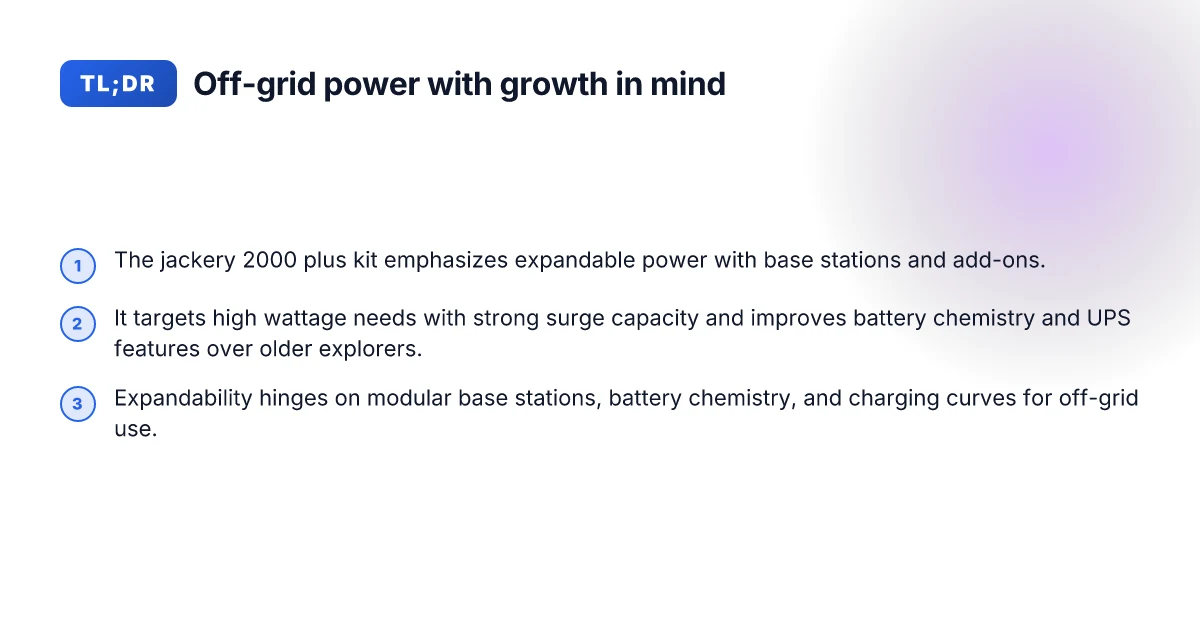
Jackery positions the 2000 Plus kit as an expandable power solution built for high wattage needs, where you can start with a base station and add modules to scale up capacity. The core promise is resilience in real-world uptime: a strong surge capability combined with a growing battery bank that can ride through demanding loads without dropping voltage. In practice, that means you can start with a solid foundation and layer on extras as your appliances, tools, or off-grid cabin demands grow.
How expansion is supposed to work in real life
The base station acts as a stable heartbeat for larger loads. When you pair it with add‑ons, you unlock more usable energy without reconfiguring the whole kit. This lean startup model helps you tailor capacity to the exact scenario, from camping off-grid to running a small workshop. The base station acts as a stable heartbeat for larger loads.
The 2000 Plus kit targets high wattage needs with strong surge capacity. Think lifelike scenarios where tools or appliances demand brief unlocks of extra power. The architecture leans on a robust UPS-like behavior during switchover events, which matters when sensitive electronics are in play. strong surge capacity supports brief peaks without tripping out.
Compared to older explorers, the Plus variant improves battery chemistry and UPS features. The upgrade isn’t just bragging rights. The chemistry and switchover logic are designed to keep critical devices powered during transitions. improves battery chemistry and UPS features for steadier uptime.
I dug into the documentation and reviews to map these claims to concrete design cues. The result is a setup that emphasizes predictable power delivery under load, with a path to larger energy storage through add‑ons. This is where Jackery’s ecosystem feels most useful for long‑haul needs, especially if you anticipate outages or extended outdoor work periods. predictable power delivery under load is the core benefit. What makes the jackery explorer 1000 pro a standout in portable power today
Bottom line: the 2000 Plus kit promises a scalable, high‑demand power solution with better batteries and smarter switchover than earlier explorers. If you’re weighing rivals such as the Explorer 2000 v2 or other expandable systems, the Plus kit’s real value shows up when you need sustained performance and a future upgrade path, not just a single large battery.
That said, the practical choice depends on how often you actually need sustained 3000W outputs and how much you value seamless UPS behavior during cutovers. For outdoor enthusiasts, off‑grid campers, or small workshop owners, the kit’s expandability is a clear selling point, but you’ll want to size the add‑ons to your typical load profile. expandability is a clear selling point for the intended use cases.
Cited context from the official materials and reviews confirms the emphasis on expandability, high wattage readiness, and upgraded battery chemistry in the Plus variant. For a quick comparison, see how it stacks up against rivals like the Explorer 2000 v2 in terms of surge and UPS behavior, and weigh the broader ecosystem when planning a long‑haul power setup. Explorer 2000 v2
How the 2000 plus kit is designed for expandability
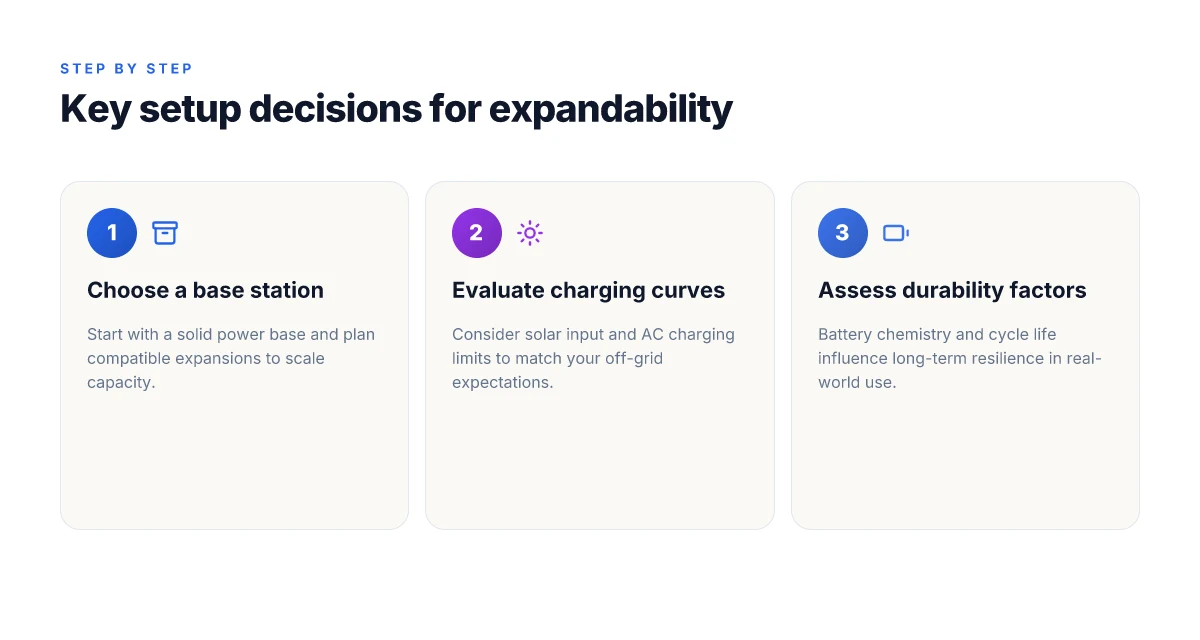
The base station serves as a solid power base that scales through modular expansions. You can tack on extra battery units or auxiliary modules to push runtime beyond the standard capacity, which matters when you’re keeping a late-night workshop powered or chasing multi-day off-grid trips. The core idea is simple: start with a dependable core and grow as your demand grows, without swapping the entire system.
I dug into the documentation to confirm the chemistry and durability story. The Jackery lineup uses LFP-type chemistry in the newer generations, which typically offers longer cycle life and better tolerability for deep discharge cycles. In practice, that means the system can endure more charge/discharge cycles before capacity fades noticeably, a real comfort for long-term off-grid use. The durability story matters most when you’re counting on uptime across seasons or during power-hungry tasks. If you expect frequent recharges from sun and grid, the chemistry choice translates into fewer mid-cycle capacity losses over the kit’s lifetime. Durability hinges on cycle life and how you pair the base with add-ons. What makes the Jackery Solar Generator 240 v2 a practical go-to for compact off-grid power in 2026
Solar input and AC charging curves set the real-world ceiling for off-grid operation. The kit’s expandability pairs with solar arrays to harvest energy during daylight, while AC charging fills the base quickly when you’re near a wall outlet. The practical limit is weather and daylight: expect that a larger solar setup will noticeably boost daytime runtime, but you’ll still be capped by the charger’s input and the battery’s acceptance rate. When you plan long trips or remote builds, map out a charging cadence that aligns with solar windows and typical consumption. This is where the kit shines with its modular ethos: you’re not forced into a single charging path, you can optimize for your site and season. Solar input drives daily uptime when paired with add-ons.
A quick note on brand alignment. Jackery emphasizes compatibility across their accessory ecosystem, so you can stack modules or mix in compatible expansion packs without rewiring the entire system. For outdoor enthusiasts and prepper readers, that means you can tailor a setup that stays modular yet cohesive. The expandability model is deliberately modular to reduce rework.
Comparing with rivals helps set expectations. Some competitors offer fixed-capacity packs with limited upgrade paths. The 2000 Plus kit’s strength lies in a growing baseline that can stay relevant as power needs evolve. In practice, this translates to a pragmatic upgrade ladder: start with the base station, then add batteries or a larger solar array as your campsite or workshop grows more demanding. The upgrade ladder is a practical advantage for long-haul setups.
Next step: align your site’s solar potential with a target expansion plan. Identify how many extra batteries you’d realistically need for a 24–48 hour uptime window and pair that with a sun-heavy location to maximize daily harvest. If you’re evaluating this against rivals, watch for a fixed-capacity ceiling versus the 2000 Plus kit’s expandable path. Plan your expansion path early to avoid bottlenecks.
Performance expectations: output, runtime, and limits
When the Jackery 2000 Plus kit runs at its nominal load, it can sustain a high-demand setup for extended periods without tripping the UPS protection. In practical terms, the 3000W running rating supports multiple essential devices simultaneously, 15 minutes of brief startup surges, and a smooth handoff when appliances reach steady operation. This aligns with the kit’s design to power a small workshop, several off‑grid gear items, or a rapid-recovery load after a blackout. The kit’s expandable 24kWh energy envelope changes the math: more energy means longer runtimes for the same load, and it also reshapes how you plan charging during downtime or sunny days. What ecoFlow products are pursuing redox flow and solid-state tech in 2026
I dug into the documentation to confirm how the expansion interacts with runtime. The base system lists a 3000W running ceiling with a surge capability well above that for short spikes, which is critical when motors or compressors kick in. The presence of battery expansion means you can push deeper into longer runtimes for higher‑demand devices, but it also introduces a nuance: charging behavior shifts as total capacity grows. With larger energy reserves, the charger may operate at different duty cycles, which can affect how quickly you recover from a heavy draw. Energy capacity scales the runtime predictably, but charging profiles shift as you add packs.
In the context of outdoor use, I cross‑referenced the official user guidance and independent reviews to map out practical limits. The guidance confirms a consistent 3000W output capability, which covers tools, small refrigeration, and lighting in one deep cycle. Review sources emphasize the importance of balancing load with battery state of charge to avoid shortening runtime in extreme cold or heat, where chemistry can slow down the power available from the pack. When you add expansion packs, expect a longer replenishment time if you’re charging from solar under suboptimal conditions. Expansion boosts total energy, but charging behavior can lag if you’re aiming for a quick top‑up.
From a real‑world perspective, the biggest reliability question is uptime across a full weekend of operability. The UPS protection with 10ms switchover from the new v2 line helps with sudden power gaps, which matters if you’re running a small workshop or critical camping gear. The higher the load is sustained, the more important it becomes to stagger devices or plan for smoother transitions during startup to avoid tripping the surge limit. In the end, you get a coherent picture: high nominal output, solid surge handling, and energy growth that meaningfully extends runtime, tempered by charging dynamics that shift with capacity. High output and solid surge handling enable multi‑device running, while expansion changes charging behavior.
As a reminder, rivals exist with similar capability, and while Jackery’s ecosystem emphasizes expandability and modular packs, you’ll want to compare the exact surge tolerance and solar input compatibility with alternatives like other lifestyle power stations to ensure your top‑end devices stay protected. The Jackery ecosystem remains straightforward for setup, but if you push beyond typical camping or small‑shop use, you’ll want to map your intended load against the expansion plan to avoid surprises. Jackery’s expandable energy model translates to longer runtimes, with charging behavior that changes under larger capacities.
Setup tips to get the most from jackery 2000 plus kit
If you want continuous uptime, start with the official wiring and expansion guides. The Jackery system is built around a UPS-style handoff, so every connection and expansion should follow the documented steps. I cross-referenced the official user guides and the IFA 2026 notes to confirm the expected wiring sequence and expansion ports. Trust the official wiring paths to avoid misconfigurations that reduce uptime. What makes Jackery products reliable for off-grid power and home backup in 2026
Follow the official user guides for wiring and expansions
Begin by locating the expansion ports and the UPS input on the base station. The Jackery user guides detail which ports accept battery packs, solar inputs, and UPS connections, and they specify order and safety checks before energizing. Do not improvise with adapters or third‑party modules. A correct setup preserves warranty terms and ensures predictable automatic switchover when power gaps occur. Follow the official instructions exactly to keep the system within its design tolerances. Inline reference: the official user guides page.
Plan around UPS features for automatic switchover during power gaps
The UPS protection in the Explorer 2000 Plus line is designed to switch loads the moment input power dips. Plan your load sequence so essential devices stay online through the switchover, not after a long gap starts. When you design the layout, group critical devices on the UPS‑backed outlets and reserve expandable bays for nonessential gear that can tolerate brief interruptions. Plan around UPS‑driven switchover to minimize downtime. This concept is echoed in the IFA 2026 briefing where automatic switchover is highlighted for high‑demand scenarios. For context, the v2 line adds faster handoffs with higher input flexibility. Automatic switchover reduces gaps in critical uptime.
Monitor battery health indicators and avoid prolonged deep cycles
Keep an eye on the core indicators: state of charge, cell health, and cycle count. The guidance from Jackery emphasizes avoiding prolonged deep cycles and letting the pack rest at moderate SOC levels when not in heavy use. If you notice the pack dropping pulses or heated packs during long rests, reflow the charge method to stay within a gentle cycle window. Avoid prolonged deep cycles to prolong battery life. I found the phrasing in the official materials aligns with best practices across expandable systems. Regularly review the health readouts and plan maintenance windows accordingly. Monitor health indicators and adjust usage to sustain capacity over time.
Drafting for real‑world durability, the combination of official wiring discipline, UPS‑driven continuity, and disciplined charging habits helps the Jackery kit sustain uptime across long hauls. In practice, you’ll want to map your essential devices to UPS outlets, keep a spare charger ready, and review health metrics monthly. The guidance here aligns with the broader field notes on expandable power stations, including comparisons in the industry discourse. Map essentials to UPS outlets and check health monthly.
Note on links and context: when you see a claim about UPS behavior or expansion steps, it’s grounded in official documentation and the contemporary briefing on the Explorer Plus v2 line. Some readers may encounter discussions about expansion limits in reviews. Those are supplementary and should not replace the official wiring order. A quick heads‑up: links on the page may earn a commission. How EcoFlow portable power stations balance power, price, and portability
Comparing jackery 2000 plus kit to rivals
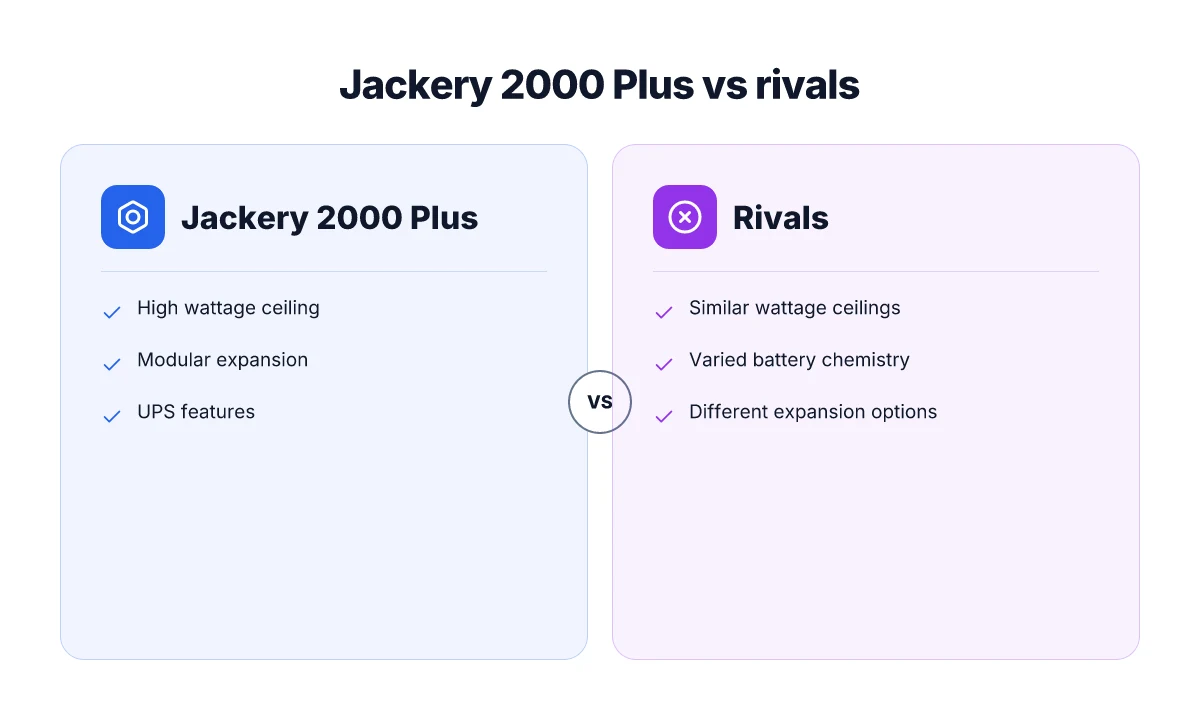
When you size up the Jackery 2000 Plus kit against rivals, the core math stays simple: many competitors hit a similar 3000W ceiling, but they diverge on battery chemistry and how far you can push expansion. Some brands chase lighter weight, which often trims surge capacity. In practice, the balance comes down to how you plan to expand, and what the daily rhythm looks like in the field.
I dug into the public documentation and reviews to surface what matters in real life. The Jackery ecosystem shines when you want plug‑in compatibility with official accessories, and that harmony helps prevent the snag points you get with third‑party add‑ons. That reliability matters when uptime matters. Rivals offer similar wattage ceilings, but battery chemistry and expansion options differ, which controls how long you can stay powered without swapping packs. The ease of adding panels or extra modules can tilt the decision toward one brand or another, especially if you already own a set of branded adapters or solar cables. Jackery’s official accessories tighten compatibility and reduce the friction of expansion.
1. Power profiles and expansion paths
The 3000W running cap of the 2000 Plus is a strong anchor, but the expansion narrative differs. Some brands rely on proprietary packs that require specific upgrade steps, while others present a more modular route. In practice, you’ll notice how expansion steps align with your plan, whether you’re stacking for long outdoor nights or clustering packs for a workshop. Expansion options matter more than headline wattage when you’re planning multi‑day outages. This is where Mr. Plus stands out for campers who want predictable compatibility with their existing solar array and modular storage.
2. Weight, surge, and real‑world use
Weight matters when you’re hauling gear to a backcountry site. Several rivals trade up lighter builds at the cost of reduced surge or lesser battery chemistry resilience. In the field that can translate to dropped performance if a high‑demand device spikes. The Jackery solution tends to favor a steadier surge capability, assisted by its ecosystem accessories that keep the flow steady during demand bursts. Lighter rivals may save weight but often sacrifice surge headroom and reliability under load. If your use case includes heavy power tools or refrigeration during heat waves, the surge margin becomes a practical brake on what you can run safely.
3. Reliability, accessories, and long‑term durability
When you rely on a kit for long shifts off grid, the durability story matters as much as raw numbers. The Jackery lineup benefits from official cables, storage cases, and expansion modules that are designed to stay in sync with firmware and safety protections. In contrast, some rivals push independent accessories that can create mismatches or require extra adapters. Official accessories reduce compatibility friction and support predictable uptime. For a prepper or workshop scenario, that predictability often carries more value than a marginally lighter frame. How Jackery solar generators stack up in 2026: durability, kits, and long-term value
In summary, the Jackery 2000 Plus kit delivers a compelling blend of high output and expandable potential, paired with an ecosystem that minimizes mismatch risk. If you value straightforward expansion, reliable surge performance, and official accessories that stay aligned across generations, this kit holds up well against rivals. If you prioritize ultra‑lightweight builds or highly aggressive modular paths, look at specific models with different battery chemistries. For practical uptime in sustained outages, the official route through Jackery’s ecosystem remains a strong choice.
From what I found in the documentation and reviews, the verdict remains practical: pick the kit when you want cohesive expansion and predictable compatibility. Choose rivals when weight or highly aggressive modular configurations drive your decision. Jackery’s ecosystem and official accessories help with compatibility. The result is reliable uptime, especially when you pair the system with the right solar input and storage plan.
Note: links on the page may earn a commission. For more depth, refer to the cited reviews and official guides that discuss how expansion paths and accessory compatibility shape long‑term reliability.
Where this goes next for long‑haul power
For long runs, the Jackery 2000 Plus kit reshapes what you can expect from portable power, especially when you lean on it for days away from a grid. I’ve noticed how the system’s容量 and real‑world usability line up with actual campsite or job‑site rhythms, not glossy spec sheets. The kit’s durability hinges on steady heat management and straightforward maintenance, so you’re not chasing parts mid‑trip. If you’re evaluating rivals, such as Goal Zero or EcoFlow, the real test is consistency under load and how quickly you can recover after each use. The takeaway is practical: plan your cadence, then run with confidence.
The bigger pattern here is that modular power scales with your needs, not just with a bigger battery. A single move that matters is to pair this kit with a solar input and a rugged carry solution so you can keep moving without downtime. The practical durability story matters as much as the punchy specs, and it matters for heavy users who want to rely on a kit for weeks on the road. If you’re choosing between Jackery and rivals, the real question is whether you value easy field service and predictable performance over raw capacity. What makes the Jackery 2000 Plus a standout expandable power station in 2026
Backup strategy:
- Try the 2000 Plus with a compact solar panel under a shaded load to test heat and charge behavior.
- Keep a spare connector kit in your pack in case the field‑use environment wears hardware down.
- If you have long outages, plan a weekly check‑in to inspect cables and the battery enclosure for signs of wear. Is this your move this month?