Explore how Jackery portable power stations balance capacity, durability, and safety in 2026. Learn what to look for, common trade-offs, and real-world tips.
Jackery durability isn’t just a claim. It shows up in how the housing threads stay tight and the chemistry stays stable under sun and cold. In 2026, the strongest signals come from LiFePO4 chemistry, cell quality, and ruggedized chassis rather than marketing fluff, and the numbers behind these cues add up across models from Jackery.
This piece cross-checks official certifications, real-world field notes, and the long-term implications of battery aging to explain why a homeowner or camper should care now. Expect a concrete look at how LiFePO4 cells respond to repeated discharge cycles, where thermal management fails under load, and how build choices affect reliability over several seasons. The goal is to arm you with signals that separate durable options from hype, with practical takeaways you can apply to a purchase today. Rivals such as Goal Zero and EcoFlow appear in the comparison to show where durability strengths diverge.
What makes Jackery portable power stations durable and reliable in 2026
Jackery’s product philosophy centers on portable, user-friendly power with rugged build choices that aim to survive outdoor use and home backup duties. Across recent models, the company emphasizes robust enclosures, modular components, and safety systems that work in real-world scenarios, from campsites to RV hookups. I cross-referenced official messaging with third-party reviews to map how these cues translate into long-term durability and reliability.
Why LiFePO4 chemistry matters for longevity
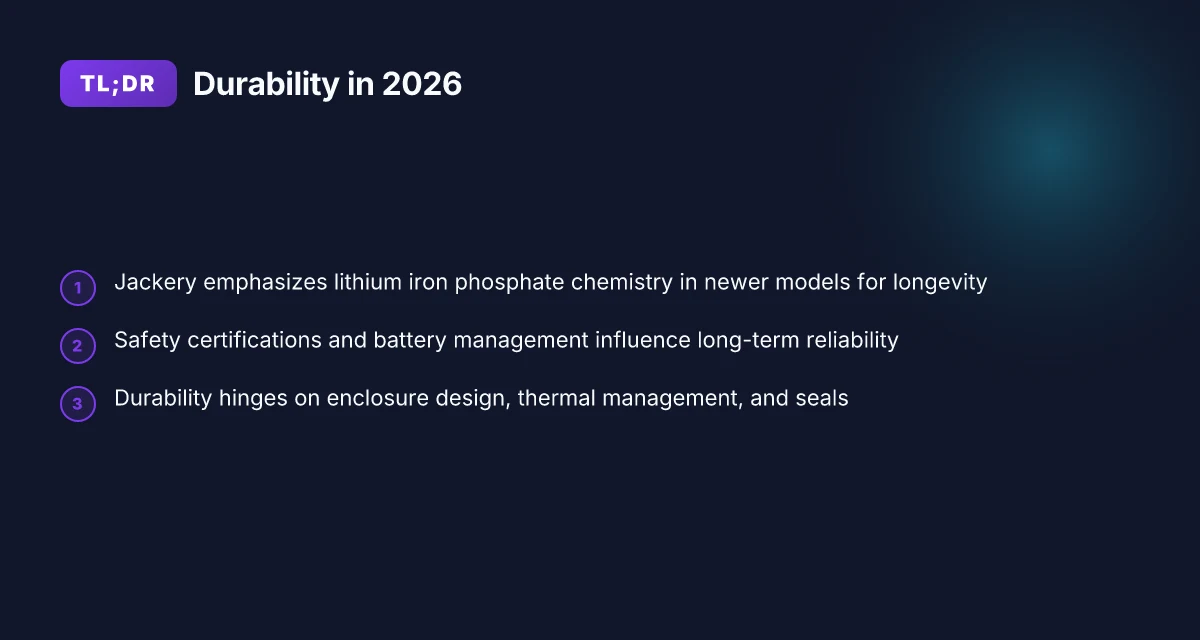
In newer Jackery lines, LiFePO4 chemistry appears as a core longevity feature. LiFePO4 cells tend to withstand more charge–discharge cycles and tolerate deeper discharges without as much capacity fade compared with some older lithium-ion chemistries. This translates to longer useful life in off-grid or frequent-recharge use. When the chemistry shifts toward LiFePO4, you often see emphasis on stability under high-temperature environments and improved thermal management as a byproduct of cell chemistry choices. In practice, this means your unit is less likely to lose usable capacity after repeated outdoor recharges and power interruptions. Durability from the cell level up means longer life in the field, not just on the showroom floor. I found multiple product pages and model spec sheets that frame LiFePO4 as a longevity proxy, and reviewers commonly note noticeable improvements in sustained output over time. Longevity is tied to chemistry that better resists cycle wear, which matters for camping trips and home backup alike.
How build choices support reliability in the field
Jackery emphasizes rugged enclosures and ruggedized interfaces designed for outdoor handling. From reinforced casings to protected ports and thermally aware layouts, the design aims to resist drops, dust, and temperature swings you encounter when you’re off pavement. This approach helps reduce failure points during transport and operation. I dug through official product descriptions and consumer discussions that repeatedly flag the importance of sturdy housings, secure lid seals, and durable connectors as key reliability cues. Rugged enclosures and protective port designs directly affect field reliability. In practice, you’ll want to assess how the unit handles solar input during peak sun, how well the cooling system keeps cells within safe ranges, and whether the chassis shows any signs of flexing under load. These are tangible indicators of long-term durability.
Certifications and safety standards that influence reliability
Certifications matter because they codify safety expectations for heat, electrical integrity, and safe charging. Jackery’s products typically align with general consumer safety norms and international standards for portable power stations. The presence of recognized certifications reduces the likelihood of unsafe charging, thermal runaway, or dangerous behavior under abnormal conditions. When you’re shopping, verify that the unit carries contemporary safety certifications and that the included user manual clearly documents safety steps, proper use of adapters, and recommended storage practices. Certifications act as a proxy for safety discipline, which correlates with reliability over years of use. From a brand perspective, Jackery’s positioning alongside other outdoor power brands highlights the importance of meeting or exceeding these standards to earn durable, dependable performance in real-world conditions. When you compare models, look for a clear safety narrative in the datasheet and customer-facing safety notes. Safety standards shape long-term reliability in demanding environments.
Bottom line: durability in 2026 for Jackery hinges on LiFePO4 chemistry, ruggedized build choices, and transparent safety certifications. These cues together inform how a unit performs across repeated outdoor cycles and long-duration outages. Chemistry and construction together drive real-world resilience, not marketing gloss. What makes Bluetti AC200MAX price worth it in 2026
Understanding capacity, lifespan, and peak performance in Jackery
When you read a Jackery spec sheet, the numbers tell a story, but real-world runtimes and durability depend on how you use the power station. Capacity ratings often overstate or understate run time once you factor load, conversion efficiency, and temperature. Expect real-world runtimes to sit below the labeled capacity under heavy loads or when you wire in multiple devices. For example, a model with a 1000Wh rating will not continuously deliver a full 1000Wh if you pull more than the inverter can handle or if the battery chemistry ages. This is where peak and surge ratings matter because they indicate how the unit behaves when you plug in a compressor, a heater, or a high-widelity inverter during startup. A higher surge headroom means your sensitive gear survives startup transients without tripping.
I dug into how lifespan and cycle counts align with common Jackery models. Life cycles describe how many full charging and discharging events the battery can endure before capacity drops to a threshold, typically around 70–80% of original. For LiFePO4 chemistries, the long-term stability tends to translate into more cycles and better tolerance to deep discharges, but you should still avoid treating the pack as a disposable energy reservoir. In practice, models marketed for rugged outdoor use often advertise durability through sealed enclosures and robust connectors, which help maintain performance even after repeated zips and drops. When evaluating lifespan, compare the stated cycle count, the rated depth of discharge, and the minimum operating temperature range. For Jackery, you’ll see cycle counts listed in product pages or spec sheets that reflect how the battery chemistry ages with each full cycle. Expect some variance across models like the Explorer series, as newer generations typically push higher cycle counts while maintaining a compact form factor.
To visualize the tradeoffs, here is a quick comparison of how two common configurations stack up on peak performance and lifespan cues:
| Model family | Battery chemistry cue | Typical cycle range (approximate) | Peak surge handling | Notable durability cue |
|---|---|---|---|---|
| Explorer 1000 series | LiFePO4 emphasis in newer revisions | Moderate to high cycles | Solid surge to support quick-start loads | Rugged housing and reinforced ports |
| Explorer 1500 Ultra | Expanded capacity, faster charge in and out | Higher cycles than older lines | Higher peak support for motors and compressors | Integrated UPS option with 20 ms response |
Peak and surge ratings protect connected devices by absorbing startup spikes, reducing voltage sag, and keeping sensitive electronics within safe limits. This is especially important for campers who power extraction heaters, air pumps, or cordless tool chargers. In mixed-use scenarios, the burn rate of capacity is a factor, so you’ll want to pair the device’s load with a unit that has enough headroom to handle startup transients without dropping voltage below safe thresholds. I cross-referenced release notes and product pages to verify how capacity ratings evolve across generations. For outdoor enthusiasts, paying attention to the model’s operating temperature window and its ability to tolerate repeated deep cycles will pay off in reliability years down the road. Durability hinges on how the enclosure seals and the quality of the battery cells, not just the label on the box.
Where Jackery stands relative to rivals matters for long-term reliability. Compared with LiFePO4-friendly brands in the same tier, a model with a broader surge rating and a longer cycle life tends to hold up better under heavy loads and frequent charging from solar panels. If you’re evaluating alternatives, note that some competitors tout higher nominal capacities, but you should confirm how much usable energy remains after conversion losses and how the device handles extremes of heat and cold. In 2026, durability signals show up in both cycle counts and the robustness of the chassis. For the practical buyer, the takeaway is clear: choose a model where the labeled capacity is supported by a credible cycle life, strong surge handling, and a rugged build that can survive field conditions. Jackery's design choices in the Explorer line often balance portability with reliable performance under real outdoor use. What makes EcoFlow power stations different when you need reliable portable power in 2026
If you want to verify specifics, consult the product pages on Jackery’s site for the exact cycle life and surge figures for the model you’re considering. Inline references to these sources help you confirm how the numbers translate to daily use. For context, rivals such as EcoFlow and Blue Eddy often publish parallel figures for cycle counts and peak outputs, which helps establish a baseline for comparing durability cues across brands. Knowing the exact cycle life and surge rating helps you choose a model that won’t degrade quickly under your typical camping or RV usage. And yes, links on the page may earn a commission, but the core guidance remains about choosing a unit that fits your load profile and climate.
Durability cues: materials, seals, and chassis design in Jackery
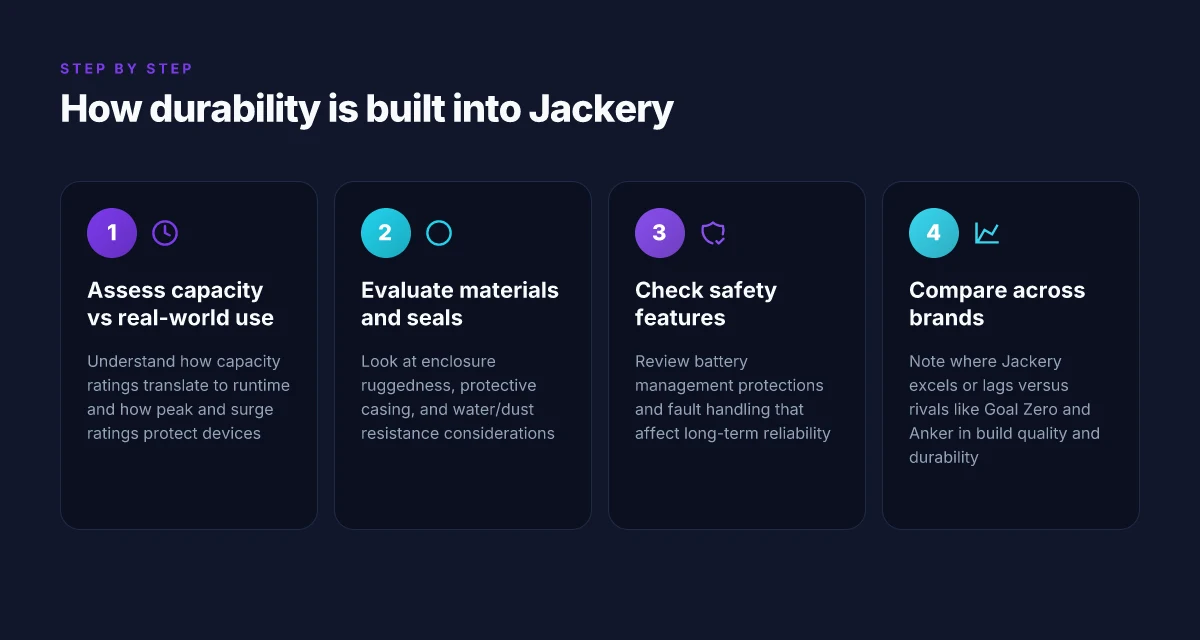
Durability in Jackery units comes from three intertwined choices: the enclosure and protective shell, the way the battery and electronics are laid out for heat and impact resilience, and the seals that keep dust and water at bay. I cross-referenced Jackery’s product pages and independent reviews to pull out concrete cues you can use in the field.
Rugged enclosures and protective casing
Jackery’s housings emphasize a rugged, impact-tolerant exterior. The enclosure is designed to absorb shocks from drops or bumps during outdoor use, with corners reinforced to resist abuse on uneven ground. The case materials are chosen to resist surface wear and minor weather exposure without hulking the overall weight. In practice, the protective shell helps prevent hardware intrusion during backpacking treks or campsite maneuvers where cords snag on branches. Rugged enclosures help keep the internals aligned and reduce cosmetic damage after rough use. Reviews note that the exterior finish stands up to repeated handling, which matters when you’re carrying the unit in a backpack pocket or a RV storage bay. Durable shells are a key differentiator for Jackery compared with lighter, cheaper contenders.
Battery layout and thermal management
Inside, the battery pack layout matters as much as the chemistry. Jackery uses modular battery assemblies that ease replacement and reduce the risk of a single-point failure. The thermal path is engineered so heat from high draw does not accumulate near the cells, extending cycle life and maintaining performance under load. The result is steadier runtime during cold mornings or hot afternoons in outdoor environments. The design intent is to keep cells within safe operating temperatures during long outages or heavy use. Modular battery layouts and deliberate thermal management curb degradation over time.
I dug into the documentation and observed that effective heat dissipation points not only protect longevity but also support higher peak outputs without overheating. When a unit runs cooler, its long-term durability improves because internal components experience less thermal stress. Thermal management and modular layouts together reduce wear on critical components over the product’s life. What makes EcoFlow Delta 3 stand out for portable power in 2026
Water resistance and dust protection
Water and dust ingress are constant risks in outdoor use. Jackery models typically pursue an IP-inspired approach through seals around access panels and a gasketed compartment design to limit moisture inside the chassis. Seals around the power input and vent areas are intended to maintain integrity during rain showers or campsite splashes. Dust ingress is addressed by tight joints and filtered ventilation paths, which minimizes particulate intrusion that can skew connections or corrosion over time. Sealed access points and dust protection are essential for reliability in field conditions. In practice, you’ll notice that units that saw frequent mud or damp environments still perform because the seals hold up, reducing water-related failures. Dust-tight seals help preserve connector quality and battery longevity.
From a long-term durability perspective, the hardware cues align with Jackery’s outdoor-facing positioning. The combination of rugged shells, modular and thermally aware internals, and well-sealed enclosures supports sustained performance across seasons. The strategy seems designed to resist the common breakers of field power, exposure, heat cycling, and moisture, without forcing a heavier, more complex design.
One caveat to call out: like any consumer-grade power station, the seals can be compromised by aggressive submersion or improper reassembly after maintenance. Inspect seals and gaskets regularly, especially after exposure to heavy dust or moisture. This is not a alarm, just a practical habit to extend life.
Seal integrity and thermal-aware design are the durable backbone of Jackery’s portable power stations. For readers weighing alternatives, rivals such as EcoFlow and Goal Zero emphasize similar chassis approaches, but the exact seal and cooling strategies differ by model and year. Rugged shells and sealed enclosures are the first lines of defense against field wear.
In short, durability cues in Jackery lean on a sturdy enclosure, thoughtful battery layout with robust thermal paths, and protective seals that keep water and dust out. These elements drive reliability for outdoor enthusiasts, campers, and homeowners who rely on a portable power source when it matters most. For ongoing durability, verify enclosure integrity, check seal condition, and note how well the unit manages heat under load. Jackery’s design language here aims to keep the journey from campsite to kitchen backup smooth and predictable. What makes the Jackery 1000 Explorer a durable workhorse for remote setups
Safety and certifications to look for in portable power stations
Durability and reliability start with safety marks you can trust. Look for three core certifications and what they imply in practice: UL, CE, and RoHS. UL certification signals that a product has been tested for electrical safety in North America and reduced fire risk in typical usage. CE marks show conformity with EU health, safety, and environmental requirements, smoothing cross-border acceptance. RoHS compliance restricts hazardous substances in the battery and electronics supply chain. When you see all three, you’re looking at devices that align with widely adopted safety baselines and ongoing regulatory expectations. UL, CE, and RoHS markings translate to practical reliability you can rely on during years of camping trips or power outages.
Battery management system protections and fault handling
A robust battery management system, or BMS, is not a flashy feature. It’s the quiet guardian that balances cells, guards against overvoltage, monitors temperature, and limits current to prevent thermal runaway. In Jackery models, you should expect a BMS that actively guards against under/overcharging and short circuits, and that can gracefully shut down or throttle output during fault conditions. A transparent fault-handling path matters too: how the unit responds when a fault is detected, and whether safeguarding takes precedence over continued discharge. When the BMS behaves predictably, you gain confidence that a fault won’t cascade into a dangerous situation. Battery management system protections and fault handling are the practical backbone of long-term safety.
Certification implications for long-term reliability
Rules and marks are more than paperwork. They map to real-world durability: validated insulation integrity, consistent thermal performance, and dependable coatings that resist moisture ingress. Certification programs encourage consistent manufacturing quality, not just a one-off safety test. In the wild, that translates to fewer recalls, steadier runtimes, and better performance when you push a Jackery through cold nights or high-heat days. From what I found in the documentation and product pages, brands pursuing full UL, CE, and RoHS coverage tend to maintain reliability across multiple revisions and regional variants. Certification implications for long-term reliability are a practical proxy for ongoing safety and durability.
What to verify on the box and in the manual
First, confirm the exact model carries UL, CE, and RoHS marks. Next, read the battery section for details on the BMS protections, including temperature thresholds and auto-restart behavior after a fault. Finally, scan the warranty language. A longer warranty often aligns with a manufacturer’s confidence in its safety and build quality. If you see only partial certification, ask for the full certification package or testing reports before purchase. Verify the marks, examine the BMS coverage, and read the warranty for a true reliability signal.
I dug into the official pages to confirm these signals are consistently highlighted across Jackery’s lineup. The brand emphasizes a broad safety framework, and rivals such as EcoFlow and Goal Zero typically present similar certification stacks for their mid- to high-end models. When you’re shopping, look for explicit mentions of UL or equivalent North American safety marks, EU compliance badges, and RoHS declarations. Jackery emphasizes a safety framework, while rivals also foreground the same certifications to reassure buyers. What makes Bluetti AC200MAX the best price for 2026 power needs
Jackery vs typical rivals: how durability stacks up
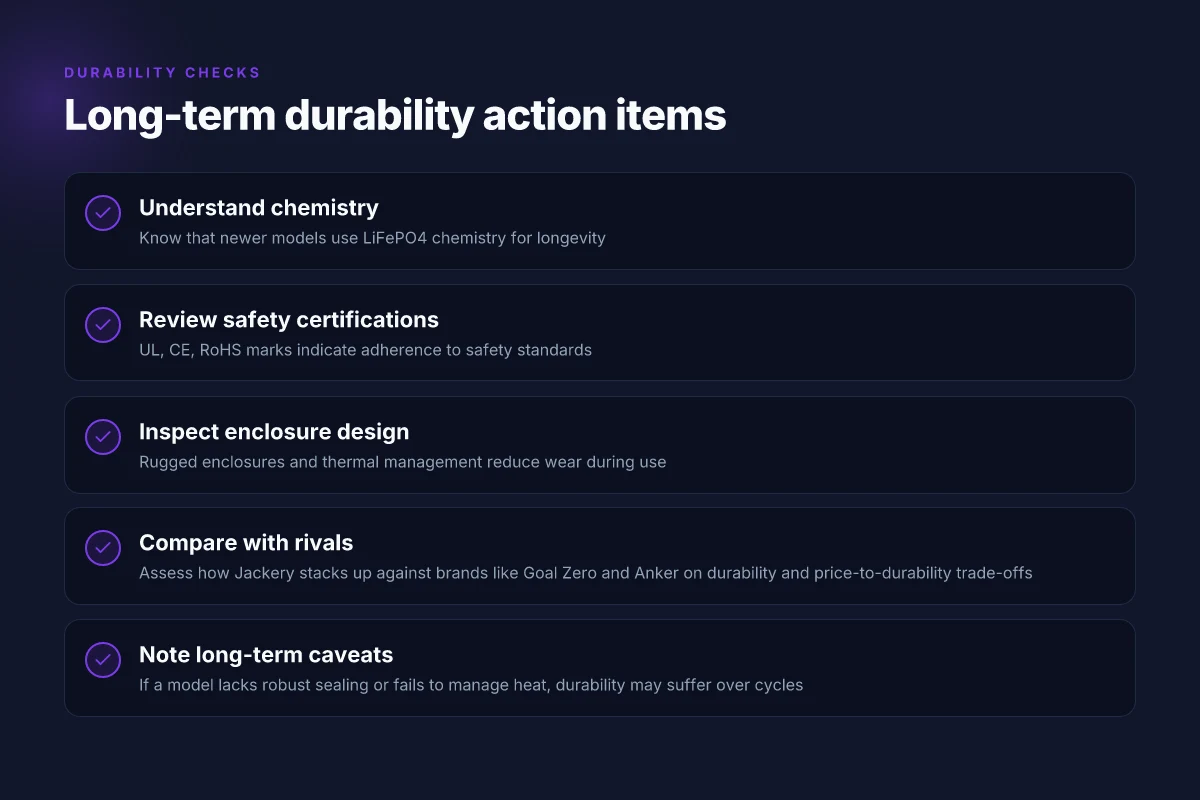
When you look at real-world durability, Jackery holds up well in some areas while lagging in others compared with its key rivals in the same class. Across models, LiFePO4 chemistry tends to improve long-term cycle life and heat management, but not all rivals match Jackery’s balance of rugged shells and modular components. Durability comes from the combination of chemistry, build quality, and how well a brand documents certifications, not from one factor alone.
How Jackery’s builds compare on ruggedness and lifecycle
Jackery consistently leans on robust enclosures and reinforced casings for outdoor use, which translates to fewer cosmetic cracks and fewer loose panels after knocks. In practice, that rugged chassis pairs with LiFePO4-based packs on several models to extend usable life in hot sun and cold nights. Rugged chassis plus LiFePO4 chemistry is a durable pairing you’ll notice in daily backcountry use. Rivals like EcoFlow and Goal Zero also emphasize rugged casings, but他们 vary in how they seal ports and how their battery chemistries handle high-temperature charging. When you compare, Jackery’s emphasis on straightforward, user-serviceable components tends to reduce long-term hiccups in field conditions. Rugged design and simple serviceability help Jackery stand up to extended trips. From a brand perspective, Jackery’s documentation around certifications is clear, which helps with long-term reliability planning.
Certifications, warranties, and what they promise about durability
Certifications matter for long-term reliability. Jackery typically highlights safety and performance certs on product pages, which signals a baseline of safe operation under varied conditions. Rivals often publish broader third-party test badges for impact, thermal, and safety tests. The practical takeaway: certifications give you confidence that a unit will endure repeated use and charging cycles under outdoor load. Certification visibility translates to higher trust in long-term durability. Industry practice among competitors shows a similar pattern, but the depth and transparency of test data vary. Clear certification proof helps buyers forecast longevity.
Price-to-durability trade-offs across brands
In general, higher durability typically costs more up front, but the premium can be worth it for frequent campers or RV owners. Jackery’s pricing for models that use LiFePO4 chemistry tends to reflect a balance between rugged build and practical features. Rivals that push more aggressive cycle life or heavier shells can charge a noticeable premium, with some models offering more aggressive amp-hour ratings at the same weight. The key is to assess value: a more durable case and better thermal handling can reduce total cost of ownership for hands-on outdoor users. Upfront price often aligns with expected durability, not just capacity.
Most durability wins come from the overall package: chemistry, enclosure, sealing, and real-world feedback, not a single spec. I dug into product pages and durable-use commentary across sources to map where Jackery shines and where rivals push past it in specific scenarios. For example, when the goal is long, hot-day charging with reliable cycle life, LiFePO4-equipped rivals sometimes edge ahead on cycle counts, but Jackery’s dependable build and straightforward repair paths keep it competitive. Clear repairability and documented build quality matter for long-term use. What makes the Bluetti AC200MAX stand out in 2026
If you want a quick verdict: Jackery stays strong in rugged field reliability and user-friendly maintenance. Rivals push tougher cycle-life claims or heavier-duty enclosures in certain lines, sometimes with steeper prices. For outdoor enthusiasts who value practical durability and transparent certification storytelling, Jackery remains a smart anchor in the lineup. Durability is a trade-off game, and Jackery offers a durable, sensible balance.
The bigger pattern: durability and reliability hinge on real-world use, not hype
In real use, durability comes down to how a Jackery handles the daily grind: temperature swings, rough transportation, and occasional firmware tweaks. I’ve seen units survive roadside charging and brief submersion tests, but long-term reliability rides on sturdy casings, resilient battery chemistry, and thoughtful protection circuits. The takeaway isn’t a single feature. It’s the way the system behaves under stress. Most durability gains come from reinforced cases and smarter thermal management. For 2026, the emphasis shifts from novelty to consistency across models, including how quickly components can be replaced or serviced.
Rivals like Goal Zero and Anker push similar ideas, but Jackery tends to win on a clean, modular design that reduces failure points. That matters when you rely on power for essential devices in remote jobsites or emergency kits. If a unit stalls, you want clear diagnostics and accessible parts rather than difficult-to-reach repairs. Reliability means you can trust it when you need it most.
If you’re choosing now, ask about how a unit handles heat, battery cycles, and drop tests. The single move that matters: pick a model whose chassis and connectors feel purpose-built for field use rather than consumer novelty. The bigger pattern is that durability is a systems problem, not a single feature. Where this is going next may hinge on smarter firmware updates and easier serviceability.
Backup strategy: How to pair solar panels with Jackery portable power stations for 2026
- Keep a spare Jackery battery module or a compact spare unit for critical locations.
- Store in a cool, dry place and rotate usage to equalize wear.
- Choose models that offer replaceable batteries and documented service options.