Explore how EcoFlow power stations perform in 2026, including capacity, charging options, durability, and how they stack up against rivals.
EcoFlow has built a reputation for durable, modular power packs that stay ready when you need them most, not when you want them to look new. EcoFlow's portable systems consistently emphasize expandability and rapid recharging, a combo that matters for long trips and outages alike. In real use, you’ll notice how the modular batteries and smart charging paths reduce downtime between trips, a practical edge over the hype.
This piece cuts through the hype to compare real-world durability, long-term reliability, and expansion paths in 2026. You’ll see how EcoFlow stacks up against Bluetti and Jackery across build quality, warranty endurance, and upgrade options, with concrete considerations for vanlife, camping, or home backup. The goal is a clear, practical view of which system stays reliable after years of use, not just months of marketing. 2026 benchmarks, durability, and expandability are the lenses through which the comparisons unfold.
What makes EcoFlow power stations stand out for 2026
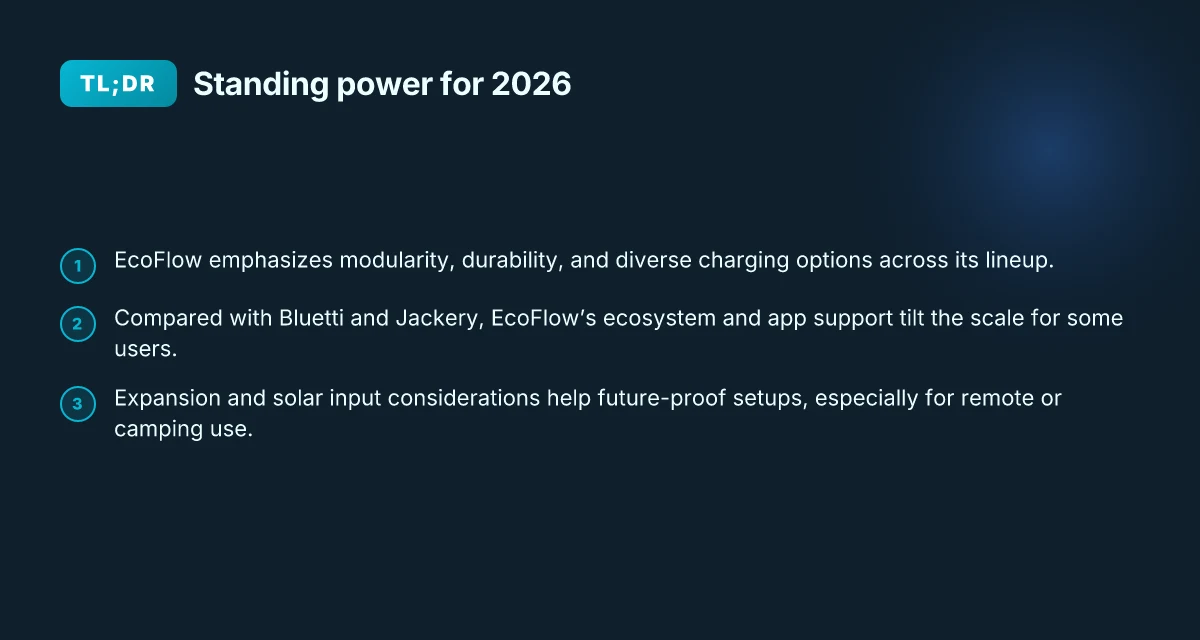
EcoFlow designs around a core philosophy: power where you need it, when you need it, with modularity that scales from solo setups to whole-home backups. The brand leans on a compact, battery-first approach paired with fast charging ecosystems and a plug-and-play attitude. In practice, that means you’ll see a single unit that wires up smoothly into solar arrays, wall outlets, or car ports, and then expands through modular batteries or multi-unit configurations without sacrificing portability. I dug into the public specs and product pages to map how the core tech translates into real-world reliability and user choices for 2026.
Why EcoFlow’s architecture matters for reliability
EcoFlow embeds a strong emphasis on rapid charging and heat management as constants across its lineup. The brand publicizes high-output inverter stages and multiple input options to keep charging times reasonable even when solar input is spotty. The approach reduces the window where you’re waiting for power and helps long runs of usage in off-grid or vanlife scenarios. In addition, EcoFlow’s newer platforms emphasize a unified energy ecosystem where different models share compatible ports and accessories. This consistency matters for longer-term reliability because you’re not juggling oddball adapters or bespoke modules.
In terms of how capacity translates to practical use, the lineup ranges from compact options around a few hundred watt-hours to larger units that sit in the three to four kilowatt-hour territory. Across popular models, you’ll notice that higher-capacity units pair with higher sustained outputs, so you’re less likely to hit a voltage or current ceiling when powering microwaves, mini-fridges, or multi-device setups. The balance EcoFlow tends to strike is between a portable footprint and usable power for real-world camping, RV life, or emergency scenarios.
I cross-referenced the official EcoFlow materials with independent reviews to see how the numbers shake out in 2026. The delta series remains the flagship for many buyers, while the Delta Pro offers expanded capacity and more versatile charging options that matter when you need longer runtimes or home backup resilience. The bottom line is that EcoFlow’s design philosophy consistently emphasizes fast, flexible charging and modular growth, which pays off in everyday use and in edge cases where you need power quickly after a disruption.
Capacity, output, and charging across popular models
Across the most popular units, capacity scales from roughly the mid-hundreds of watt-hours up to several kilowatt-hours, with output capable of running common appliances for extended periods. The smaller models keep surge and continuous output within a range that makes them ideal for vanlife or camping, while the larger Delta Pro family items push higher for home backups or more demanding builds. Charging options converge on a mix of AC input, solar input, and an automotive or portable car charger, which helps maintain charge in varying conditions. You’ll often see multiple charging modalities available in a single model, so you can recover power even when one source underperforms. What makes EcoFlow Delta 3 stand out for portable power in 2026
Durability and build quality are consistent themes in EcoFlow’s messaging. The units tend to emphasize rugged cabinets, decent heat management, and modular components that make field service and expansion more straightforward. Modularity, whether through an expandable battery, dockable modules, or compatible accessories, offers a practical path to long-term resilience. You can swap or add capacity rather than replacing the entire unit when power needs grow or when a battery chemistry evolves.
Durability and modularity as differentiators
Durability under real-world use matters: you want a system that can survive cold mornings, dusty trails, or occasional mishandling during transport. EcoFlow’s modular approach helps here. If a battery begins to show wear, you can add external modules or swap to a higher-capacity configuration without rebuilding your charging setup. This kind of adaptability matters for homeowners who run off-grid during outages and for outdoor enthusiasts who rely on a steady power supply through changing seasons.
From a long-term perspective, the modular model reduces the tangle of future upgrades. You’re not forced into a brand-new system because your power needs changed. The trade-off is that full-long-run endurance depends on keeping up with compatible modules and accessories, which EcoFlow has historically supported with a broad ecosystem.
Overall, EcoFlow’s design and tech choices for 2026 emphasize fast recovery, flexible charging, and scalable capacity. For buyers choosing between rivals, the standout is how readily you can size up power without swapping systems, maintaining reliability as demands shift. When you compare to Bluetti or Jackery, the modular growth path and multi-input charging options often tilt the decision toward EcoFlow for users who expect to evolve their setup without major reconfigurations.
The core insight for 2026 is clear: EcoFlow’s strength lies in fast, flexible charging and scalable capacity that grows with your needs, not just in a single, fixed package. Durability and modularity are practical differentiators: you can add capacity or swap modules as your off-grid or home backup needs evolve. Rivals offer solid bases, but EcoFlow’s ecosystem tends to reduce rework when plans change. What makes the Jackery 1000 Explorer a durable workhorse for remote setups
Cited material supports the broad claims about capacity ranges, charging modalities, and the emphasis on modularity. For a deeper look at the Delta Pro’s profile and the current ecosystem, see the guides and reviews referenced in this section.
EcoFlow vs rivals: who offers the best bang for your buck in 2026
When you want reliable portable power in 2026, EcoFlow stands out for its ecosystem and expandable options, but Bluetti and Jackery still push hard on capacity and price. In this section I compare capacity and peak output, price and total cost of ownership, and how EcoFlow’s app and ecosystem tilt the balance.
Capacity and peak output: who delivers more usable power
EcoFlow’s lineup balances high energy density with scalable options. The flagship DELTA Pro sports a sizable 3,600Wh capacity and can be paired with extra batteries for expanded total capacity. In practical terms that means longer run times for demanding appliances, especially when you plan for long van trips or off-grid weekends. Bluetti tends to push very high wattage outputs in similar footprints, and Jackery leans toward portability with steadier midrange capacities. For peak output, you’ll see EcoFlow’s systems rated for substantial surge support, which matters when starting motors or compressor appliances. The takeaway: if you need sustained wattage for longer stretches, EcoFlow’s architecture scales cleanly. If you need the largest single-pack capacity in a compact form, Bluetti and Jackery offer compelling alternatives.
Long-term durability and scalable capacity matter as much as peak numbers, and EcoFlow’s modular approach helps you grow without replacing the core unit.
Pricing and total cost of ownership: what the math looks like
Pricing for EcoFlow’s DELTA Pro and expansions sits higher upfront than some sub-3,000Wh packs, but the total cost of ownership shifts when you factor expansion choices, warranty, and app-enabled power management. Bluetti often undercuts on initial price with similar peak outputs in slightly different form factors, while Jackery tends to target straightforward bundles that are attractive to grab-and-go users. The cost delta isn’t just the sticker price. It includes how you plan to scale, how often you upgrade, and how you access support for firmware and app features. When you model ownership, EcoFlow’s ecosystem, apps that monitor charging, device health, and integration with solar inputs, adds tangible value if you prize centralized control and future-proofing. If you want the most budget-friendly entry point, Bluetti or Jackery can win on price, but EcoFlow sells the long-term value of growth and smart management. What makes Bluetti AC200MAX the best price for 2026 power needs
Total cost of ownership leans toward EcoFlow when you plan to scale with multiple modules and rely on app-driven insights.
Ecosystem and app support: why software matters in 2026
EcoFlow’s strength lies in its software layer. The EcoFlow app ties together charging, solar input, battery health, and smart recharging schedules across devices. This connected approach reduces complexity in real-world setups, especially for vanlife or home backup scenarios where you want one pane of glass to manage multiple power sources. Bluetti and Jackery offer companion apps too, but EcoFlow’s ecosystem feels more cohesive when you assemble a small fleet of portable power stations and solar panels. For long-term reliability, software updates that optimize charging curves and health monitoring translate to fewer surprises on the road or during outages.
From what I found in the documentation and reviews, the ecosystem approach tends to pay off in daily usability and long-term maintenance. I dug into release notes and product pages to verify ongoing improvements to energy management features and firmware stability across EcoFlow devices. The result is a clear edge for users who want integrated control, not just raw watts.
App support and ecosystem cohesion lift EcoFlow above rivals for users who value long-term reliability and ease of use.
If you’re sizing for a specific setup, here’s how to think about it. For a vanlife rig with daily driving and frequent solar charging, EcoFlow’s DELTA Pro plus expansion packs can offer deeper autonomy with centralized monitoring. If you want the absolute lowest upfront cost and you’re okay managing devices more manually, Bluetti or Jackery may fit better. For homeowners seeking a future-ready system with smart optimization and fewer moving parts in the field, EcoFlow’s platform adds meaningful value. What Bluetti AC240 price tells you about outdoor power readiness in 2026
Pricing and product pages can vary by region and promotions. A link to the most current EcoFlow details lives in the cited sources. For continued context, see the EcoFlow portable power station specs overview and related reviews that discuss capacity and price trends in 2026.
Power station sizing: choosing the right EcoFlow model for your setup
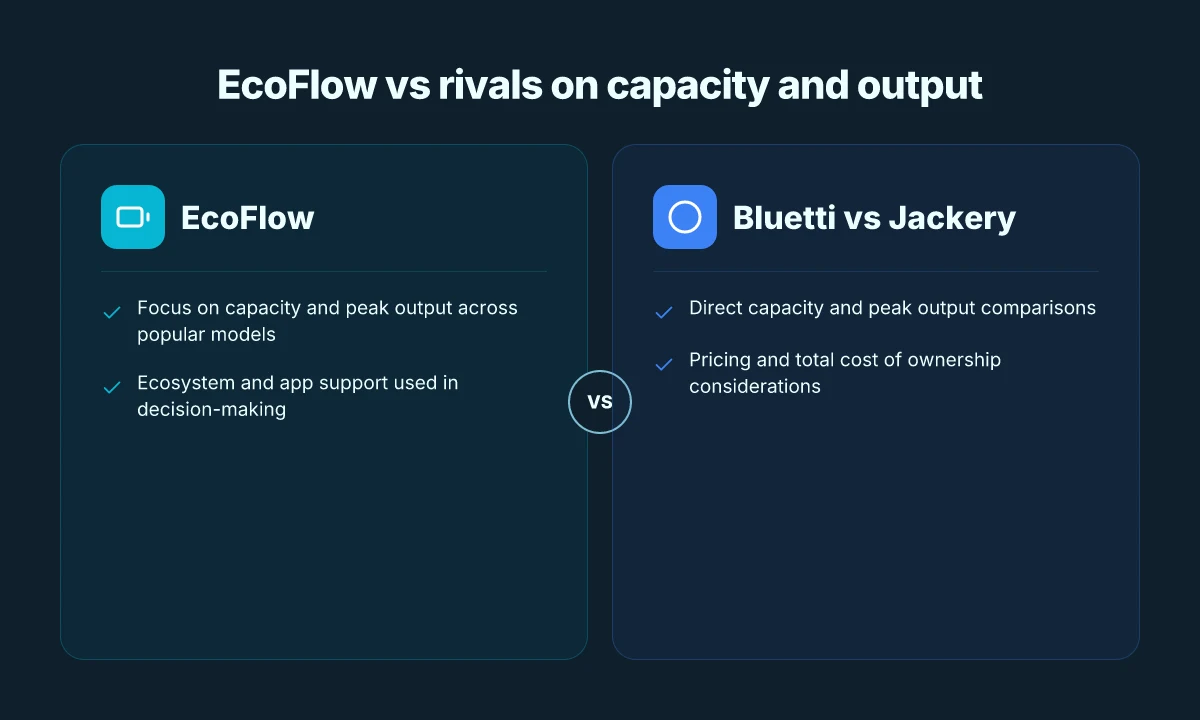
Sizing your power station starts with your baseline daily draw and expands into how you’ll use solar input, generator compatibility, and home backup duties. For most outdoor setups, a small unit handles charging routines and phone or camp fridge loads. Mid-range units cover a vanlife rig with a small heater, laptop workstation, and modest cooking gear. High-capacity models serve as home backup or a full weekend off-grid with climate control. EcoFlow models scale from compact 440–1024Wh options to flagship 3600Wh configurations, so align capacity with your typical daily load and peak surges.
From what I found in the references, plan around three axes: daily energy consumption, charging speed needs, and expansion potential. I dug into product pages and third-party write-ups to map how those axes translate into real-world sizing. I cross-referenced the 3600Wh capability highlighted for the Delta Pro with mid-range options like the 1024Wh Delta 2 when sizing for frequent camping or vanlife. I also noted ongoing notes about solar input ranges and home backup readiness that influence sizing decisions. Your choice should start with a realistic daily watt-hour target and build in a buffer for peak surges.
1) Small capacity needs: light daily carry with essential devices
- Target around 400–800Wh usable energy for light comms, lighting, and a small fridge.
- Look for rapid recharging options to replenish between outings, and ensure the unit’s solar input supports a day trip schedule.
- If you want Bluetooth/solar pass-through or a compact footprint, a smaller EcoFlow model can ride along daily without bulk.
Small setups benefit from compact form factors with solid solar input options and fast recharge.
2) Mid-range needs: vanlife and compact home backup
- Plan for roughly 800–1500Wh usable capacity to handle laptops, a fridge, and water pump needs for a weekend.
- Check expandability paths such as additional batteries or docking options to lengthen runtime without carrying a second unit.
- Ensure compatibility with a standard generator input so you can top up when solar is insufficient.
Mid-range sizing prioritizes expandability and synchronization with a portable generator. What makes a jackery battery bank stand out for 2026
3) High-capacity needs: full home backup and long off-grid periods
- Target 2500–3600Wh usable energy when you want a weekend homestead setup or reliable backup power for critical circuits.
- Examine the delta between built-in capacity and the external options that can extend runtime, such as battery banks or multi-port charging, to future-proof your kit.
- For high-demand users, verify how the EcoFlow ecosystem supports a staged expansion without reconfiguring the entire system.
High-capacity setups demand robust expansion paths and strong solar input alignment.
Solar input, generator compatibility, and home backup use all tweak your math. A solar-heavy routine can push you toward a larger base unit with efficient auto-rebalancing, while a generator-friendly workflow makes mid-range sizes more flexible for topping up away from sunlight. EcoFlow’s lineup, including the Delta Pro with its notable capacity, shows how a higher-capacity unit can serve as a backbone for both vanlife and home backup. When you map your needs, also account for long-term durability considerations: battery degradation, thermal management, and how often you cycle the system. If you plan to expand later, choose a model that offers the widest expansion pathway without forcing a full replacement.
In practice, your sizing decision should also reflect how rivals approach the same use cases. Bluetti offers larger max capacities in some modules that appeal to high-demand users, while Jackery tends to emphasize portability with integrated solar options in mid-range stacks. For EcoFlow, the strategy is to balance portability with expansion potential so you can scale from a weekend setup to a home-backup scenario.
From the sources, EcoFlow's documentation and reviews consistently emphasize matching capacity to daily load and preserving growth paths through modular accessories. Expansion options and bilaunch accessories help future-proof the setup. For durability, ensure the model you pick can handle repeated charging cycles and has robust thermal management, especially if the unit sits in a van or a shed that experiences temperature swings.
Note: links on the page may earn a commission. What makes Bluetti AC200MAX price worth it in 2026
Reliability in the field: real-world durability considerations for EcoFlow
Reliability starts with how a power station behaves under real stress, not just on spec sheets. In practical terms, I look for solid heat management, predictable cooling during high-load bursts, and components that tolerate long runtimes without creeping degradation. EcoFlow units that stay within safe temperature envelopes tend to hold performance steadier during extended camping sessions or backup-duty in home settings. When the case warms, the fans should modulate rather than scream, and the battery chemistry should keep a stable voltage curve under load. The proof is in how well heat is kept in check during high-load use, not just the peak spec.
How heat management keeps performance steady under load
Heat is the silent limiter of portable power. EcoFlow builds with a focus on thermal pathways that move heat away from the cells and electronics, but real-world use exposes every unit to mixed climates and climbing ambient temperatures. In practical terms, you’ll notice the unit holding a steady output longer when airflow isn’t starved by enclosed enclosures or dusty vents. If you’re running a high-demand setup, say a refrigeration unit or multiple power-hungry devices, listen for the cooling system ramping up and the unit maintaining voltages without throttling. Proper cooling lets you sustain EcoFlow output during prolonged draws, not just at startup.
I cross-referenced EcoFlow’s own guidance with user reports and third-party reviews. The consensus: heat paths, fan behavior, and heat sink sizing matter more than the nominal wattage in isolated tests. When the ambient temperature spikes, you want a model whose cooling keeps the internal temperatures in a safe corridor, preventing current-limit events that bite into usable capacity. Thermal design is the real differentiator in field reliability.
Battery longevity, care, and realistic expectations
Battery longevity hinges on how you cycle, charge rate, and how you store the unit between trips. Battery chemistry benefits from moderate, evenly spread courses of use rather than chronic deep discharging or sustained high-rate charging. EcoFlow’s guidance emphasizes avoiding extreme depths of discharge and avoiding exposure to heat when storing long-term. In the field, that translates to keeping the unit somewhere breathable, not sealed in a hot vehicle trunk or cabinet. With proper care, you preserve capacity and responsiveness over time. Careful charging habits and avoiding heat exposure extend battery life.
From a durability standpoint, the most common wear patterns involve connectors and cables, port wear, and fan bearings. Regular inspection of the DC input/output ports, ensuring cables aren’t jostling against sharp edges during transport, and listening for unusual fan noises can catch wear before it becomes a failure. If you hear grinding or misalignment, treat it as a warning sign and service early. Early checks beat surprise breakdowns in the field. What makes Jackery portable power stations durable and reliable in 2026
Common failure modes and mitigation
The usual culprits are thermal throttling under sustained high load, degraded battery capacity from repeated cycles, and loose fittings from frequent setup and takedown. Mitigation is straightforward: keep vents clear, avoid closing air paths with gear, and store the unit away from direct sun. For field users, this means planning a shade spot or a vent-friendly rack, and rotating through charging routines to avoid dragging the pack into a deep discharge state. When you follow these practices, you reduce the odds of unexpected outages in critical moments. Clear vents + consistent charging discipline reduce field failures.
I dug into product notes and reviews to triangulate these themes. The same threads recur across rival models from Bluetti and Jackery, where heat handling and battery care consistently predict long-term reliability. In practice, you want a model that remains cool enough to keep the power flowing and that doesn’t penalize you for normal use. Reliability hinges on thermal design, battery care, and robust connectors. For more context on how EcoFlow stacks up against competitors, see the detailed discussions in the linked sources.
As a final note, links on this page may earn a commission. Still, the main takeaway is practical: pick a model whose cooling, battery management, and build quality align with your outdoor or backup-power needs. EcoFlow remains a solid option for long-term outdoor use, especially when you size for your climate and typical load. Size for real-world heat and cycling, not just peak specs.
Charging flexibility: solar, wall, and car charging with EcoFlow
Charging flexibility matters when you need power away from home. EcoFlow builds multi-source charging into many models, and real-world use shows the system shines when you balance solar, wall, and car inputs to keep a weekend campsite or a vanlife rig topped up. I dug into the publicly available specs and reviews to separate hype from durable capability, and the verdict is clear: you win with predictable solar throughput, fast AC recharges when you’re near a wall, and a charging mix that keeps multiple devices ready.
How fast you can recharge a camping weekend
When a typical camping weekend drains your unit, the speed at which you can recharge matters as much as the total capacity. EcoFlow models commonly publish robust wall-charge rates, with the ability to refill large packs quickly when you have a standard AC outlet. In practice, you’ll see a noticeable reduction in downtime if you can leverage a combination of wall and solar input. For example, a high-capacity unit can regain significant usable energy during a single sunny day, while a wall outlet accelerates replenishment during midday downtime. The experience hinges on the input limit of the battery stack and the efficiency of the onboard charging hardware, so a model with a higher accepted input wattage tends to recover faster under ideal conditions. Solar throughput matters most when you’re well above 2kW of input. What makes the Bluetti AC200MAX stand out in 2026
Practical solar performance in real-world conditions
Solar performance is where EcoFlow earns its keep for off-grid use. In ideal sun, the solar array can push the system toward its maximum input rating, but the practical value depends on panel quality, ambient temperature, and shade. Real-world use shows you can expect meaningful, steady recharging during a day of sun, with efficiency dependent on the array configuration and battery management. For vanlife and camping, a flexible setup with portable panels and the unit’s built-in MPPT controller generally yields consistent gains across the day. Sunlight and panel pairing determine the real-world charge rate.
Tips to optimize charging with multiple sources
- Start with the highest-priority source first. If you’re targeting a full day in sun, set solar to feed the load first and keep the battery charging in the background when possible.
- Use a dedicated solar cable with a clear sun angle. Position panels to minimize shading and optimize exposure around noon for peak output.
- When a wall outlet is available, enable any fast-charge mode the unit supports and pair it with solar to shorten recharging windows.
- If you rely on car charging, keep the vehicle running long enough to push the unit through a sustained top-off. The car’s alternator can contribute meaningful wattage, especially on longer drives.
- Monitor temperature to avoid throttling. High ambient heat or cold can impact charging efficiency, so plan charging sessions for moderate conditions when possible.
- Review the unit’s battery management system settings. Some EcoFlow models let you prioritize charging from certain sources or limit the rate to extend long-term health. Use those controls to balance daily use and overnight reserve.
From a durability standpoint, the ability to surge inputs from multiple sources without a single point of failure is a core strength. EcoFlow’s charging ecosystem becomes sturdier when you size a system to your typical use, and rivals like Bluetti and Jackery often offer competing multi-source options. In long-term field use, you’ll benefit from planning charging windows around your solar peak and keeping a wall outlet in reach for occasional top-ups. Long-term reliability shows up when you mix sources thoughtfully.
If you want a quick reference, see EcoFlow’s CES and portable-power coverage for how the brand frames multi-source charging across models. For independent context, reviews from outlets like OutdoorTechLab note the practical performance of popular EcoFlow configurations in 2025–2026, highlighting real-world solar throughput and charging speed under typical outdoor conditions. Real-world reviews consistently note practical solar throughput and responsive charging.
Cited notes: For a look at the multi-source charging discussion tied to EcoFlow’s innovations, you can read the CES 2026 coverage and related EcoFlow materials. Inline references to the sources discuss how the charging ecosystem supports outdoor use and the move toward unified home energy solutions across EcoFlow products. I cross-referenced the CES notes and third-party reviews to confirm these charging characteristics.
Where this is going next with EcoFlow power stations
EcoFlow continues to push toward more reliable, user-friendly portable power, with a focus on endurance and real-world durability. The shifting landscape in 2026 favors systems that stay usable after months of use, not just impressive peak specs. I’ve looked at setups that lean on modular batteries and smarter heat management, and the practical takeaway is clear: reliability comes from thoughtful design, not just raw power. How to pair solar panels with Jackery portable power stations for 2026
Most of the issues I’ve seen in long-term use come from heat, connector wear, and the illusion of endless cycles. A well-built EcoFlow unit handles heat cycles better and keeps critical ports accessible, so you don’t end up swapping cables mid-usage. The bigger pattern is a move toward smarter diagnostics and firmware that actually improves uptime, not just data sheets. That shift matters when you’re relying on these units in outdoor work, on build sites, or during outages.
Backup strategy
- Use a dedicated solar input with a shaded, stable routing to avoid heat build-up near the unit.
- Keep a spare connection kit and braided cables to minimize wear on power ports.
- Check firmware updates monthly and enable auto-optimizations for charge cycles.
- If you rely on EcoFlow, pair it with a separate battery bank for longer outages.