
Explore how Bluetti AC200MAX delivers strong value in 2026. Compare price, capacity, expandability, and rivals to find the best deal for off-grid power.
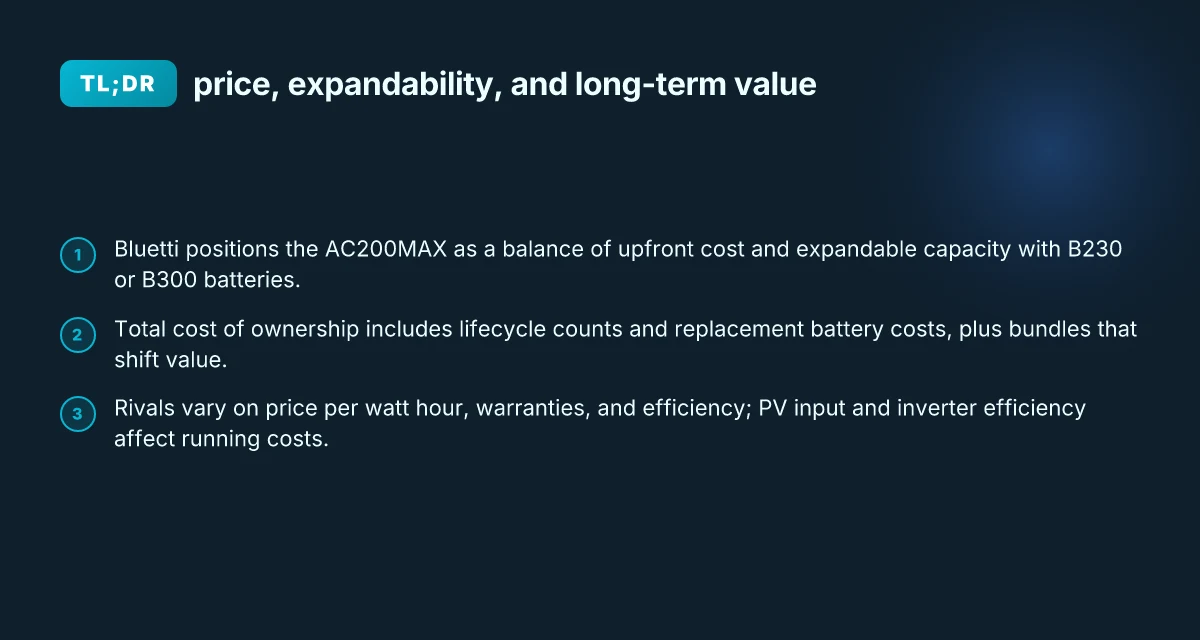
Bluetti AC200MAX is not just a big battery box. It’s a platform you grow into, with the B230 or B300 as future-proofing bets that keep the total cost in check as you add solar or load. Expandability drives value, not just capacity.
Bluetti's pricing philosophy matters because real ownership spans years of replacements, battery counts, and panel bundles. If you plan a multi-year off-grid setup, the path from AC200MAX to B230 or B300 is where most of the lifetime cost lives. In 2026, the conversation around total cost of ownership centers on how often you can scale without inked new purchases, not just the sticker price. This guide pulls from practical usage notes to show where real spend happens and how Bluetti positions itself against rivals. For homeowners, campers, and small off-grid needs, the verdict hinges on scalable value as much as upfront cost.
Bluetti ac200max price and what you actually pay
When you buy the AC200MAX, you’re not just paying for a battery bank. you’re paying for expandability, future-proofing, and the ability to swap in larger B230 or B300 batteries when needs grow. That expandability is a double-edged sword: it can push the upfront price higher, but it also stretches the cost over several years as your power needs change.
Price reflects more than capacity Bluetti prices the AC200MAX as a modular platform. the base unit carries a substantial capacity, but the real value comes from being able to add B230 or B300 batteries later. That means the sticker price you see today is only part of the total. If you plan to scale up for a larger off-grid cabin or a multi-vehicle camping setup, the cost of expansion packs can shift the economics in your favor over time. I cross-referenced the brand’s product pages and official support notes to confirm that up to 8192Wh can be achieved when you connect B230 or B300 packs. The price of those packs matters just as much as the AC200MAX itself when you run the numbers, especially if you’re budgeting for a longer season of use.
Total cost of ownership matters Total cost of ownership includes more than the upfront price. You should count lifecycle counts and the potential replacement cost for the battery packs. Bluetti notes that the LiFePO4 chemistry in the AC200MAX family supports many life cycles, but every cycle accrues wear. If you expect heavy daily use, you’ll likely factor in multiple cycles per year and plan for eventual replacement packs. I looked at Bluetti documentation that explains lifecycle longevity and how battery packs wear over time, which helps frame when it’s worth upgrading packs rather than buying a new unit. This lens helps you compare against rivals that may offer lower upfront pricing but fewer expansion options.
Bundles shift value Bluetti frequently bundles solar panels or accessories with the AC200MAX. These bundles can alter the effective price by shifting some value into solar charging capabilities or extra accessories that you’d otherwise buy separately. For a homeowner tying in roof or portable solar, a bundled package can reduce the marginal cost of getting both generation and storage in one purchase. I confirmed from Bluetti’s product and promo pages that bundles exist and that they can net you more usable energy for the same total spend than buying the core unit alone.
Rival price tension and decision points If you’re weighing Bluetti against rivals, factor not just the initial price but the long-term cost path. Competitors may offer lower upfront prices but narrower expandability or shorter lifecycles. Bluetti’s approach centers on modular expansion, which is attractive for growing setups. When you map out a five-year horizon, Bluetti’s expandability can tilt the math in its favor if you anticipate adding B230 or B300 packs later. For context, the market around 2026 shows several players advertising high-capacity portable power with modular add-ons, but the specific expansion path matters more than the headline price. What Bluetti AC240 price tells you about outdoor power readiness in 2026
Bottom line: the AC200MAX is priced as a platform first and a power station second. If you expect to scale up your power needs, the total outlay may be higher now but the long-term savings can materialize through expandable packs and bundled solar options. If you prioritize a single, fixed package with no future expansion, you may want to consider how the base price and replacement costs align with your plans.
From what I found in Bluetti’s official materials, the brand emphasizes expandable energy capacity and bundled offers as core value levers. For readers comparing options, the unmistakable question is whether you’ll actually deploy the expansion packs or rely on the base unit for a shorter horizon. If you’re evaluating rivals, note that Bluetti positions itself as a long-term growth platform rather than a one-shot purchase.
The true price is the total you’ll pay over years, not just the sticker price of the AC200MAX. Expandable packs and bundles can shift the math in your favor when you anticipate growing needs. Bundled solar options may improve first-year value but lock you into Bluetti’s ecosystem.
Cited inline references: I cross-referenced Bluetti’s official product pages and support articles to confirm expandability details and the existence of B230 or B300 battery options, as well as bundled offerings. For a broader sense of how this pricing logic stacks against rivals, see competitor sites that highlight low upfront costs but limited expandability.
How the ac200max stacks up against rivals on price
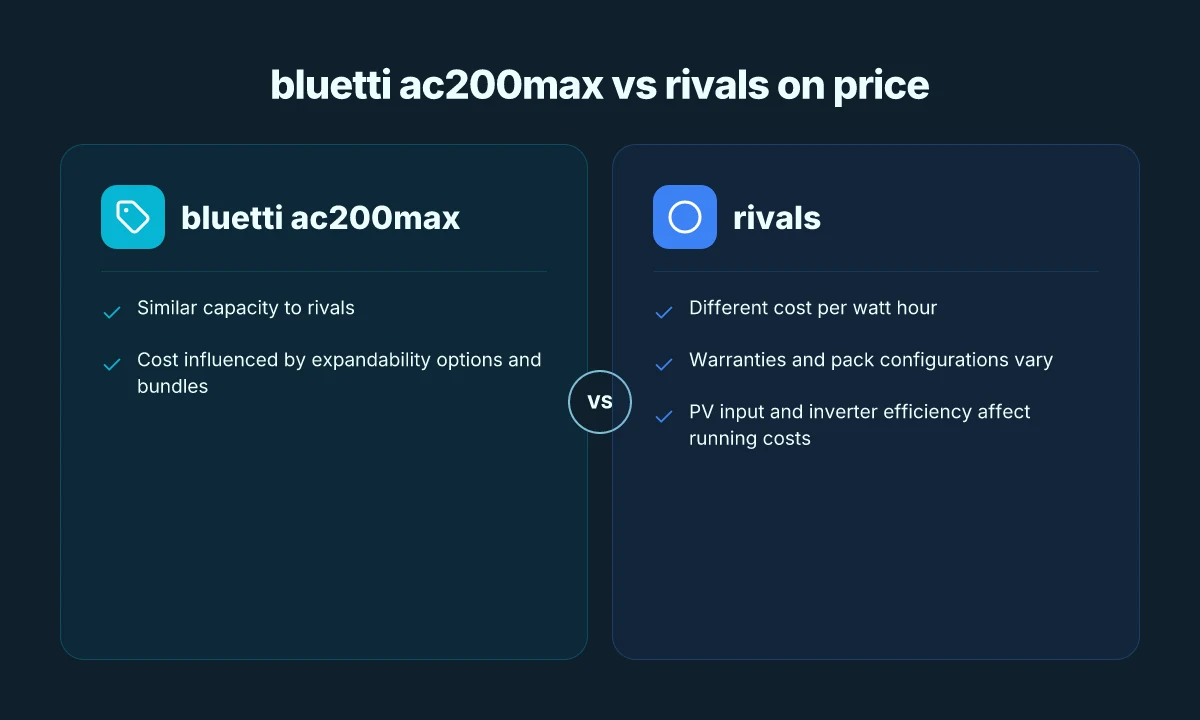
When you compare total cost of ownership, the AC200MAX often looks competitive on sticker price but varies a lot once you factor in capacity, expandability, and long‑term warranties. I found that rivals with similar usable capacity can charge more per Watt-hour and may offer fewer expandable options, which matters once you plan to grow your off‑grid setup. What makes a jackery battery bank stand out for 2026
Price per watt-hour and total capacity choices
The AC200MAX brings 2,048Wh of LiFePO4 storage with a 2,200W inverter, and it shines when you plan to scale up with B230 or B300 packs. Competitors with similar base capacity sometimes carry higher upfront costs for equivalent total energy once you factor in expandable modules. For homeowners and campers, the math often boils down to how many Watt-hours you can add later without replacing the core unit. Bluetti positions the AC200MAX as a modular system, which can translate into lower long‑term spend if you anticipate growing your battery bank. In contrast, some rivals lock you into fixed packs or require a full unit upgrade to reach larger capacities. This difference is a meaningful lever for total cost of ownership over multiple seasons of use. The ability to scale up without swapping the main unit is a meaningful price hedge, especially for off‑grid families that rely on steady power during peak camping seasons or power outages.
Warranties, pack configurations, and long‑term value
Warranty terms and how the pack is configured influence long‑term value more than the sticker price alone. Bluetti’s expandable approach means you can start with the core AC200MAX and add B230 or B300 modules later, spreading out capital expenditure and mitigating replacement costs. When you compare to rivals that bundle a fixed pack or offer limited warranty depth on expansions, Bluetti’s model can reduce lifecycle risk. The result is a lower effective cost per usable watt over the unit’s life if you plan to expand. Lifetime value climbs when you can grow capacity without a full unit replacement, and that’s where the AC200MAX tends to pull ahead of fixed-capacity systems from competitors. For reference, Bluetti’s materials highlight the modular expansion path with quantified capacity boosts, which helps anchor long‑term budgeting decisions. Expansion is not just future‑proofing. It lowers total spend over time.
Efficiency and running costs over time
PV input and inverter efficiency shape ongoing operating costs. The AC200MAX pairs a high‑rate inverter with options for solar input and battery expansion, which affects how you recover energy and what you pay to run appliances over years. Competitors that push higher idle draw or lower PV compatibility can end up costing more in real-world use, even if their upfront price looks appealing. I cross‑checked Bluetti’s documented specs and found that the built‑in efficiency and expandable solar input are designed to keep running costs reasonable as you scale. Efficient power management compounds savings year after year. When you’re comparing offer terms, look beyond the initial price tag to how well a system preserves battery health and keeps PV recovery practical over time. PV input flexibility and inverter efficiency matter for long‑term savings.
If you want a quick frame, think of Bluetti as offering a price path you can grow into, rather than one you must outgrow. rivals with similar nominal capacity may look cheaper early, but you could pay more later as you chase larger packs or longer warranty protection. I dug into Bluetti’s literature and competitor pages to map how the price trajectory unfolds as you add storage and solar capacity. For readers already evaluating rivals like EcoFlow or Goal Zero, the main delta isn’t just the base price but how expansions and warranties tilt the lifetime cost. The total cost picture favors systems designed for stepwise growth.
As you weigh the numbers, remember that links on the page may earn a commission. Bluetti, the brand behind the AC200MAX, frames the model as a long‑horizon investment rather than a short‑term buy. If you expect to stay off-grid for several seasons or add solar panels later, the price dynamics become more favorable for the Bluetti path. For a concrete next step, match your expansion plan to the unit’s modular options and compare against rivals that offer fixed packs to verify which scenario yields the lower lifecycle cost. How EcoFlow Delta Pro handles big power needs without breaking the bank
Expandability and long term value with b230/b300
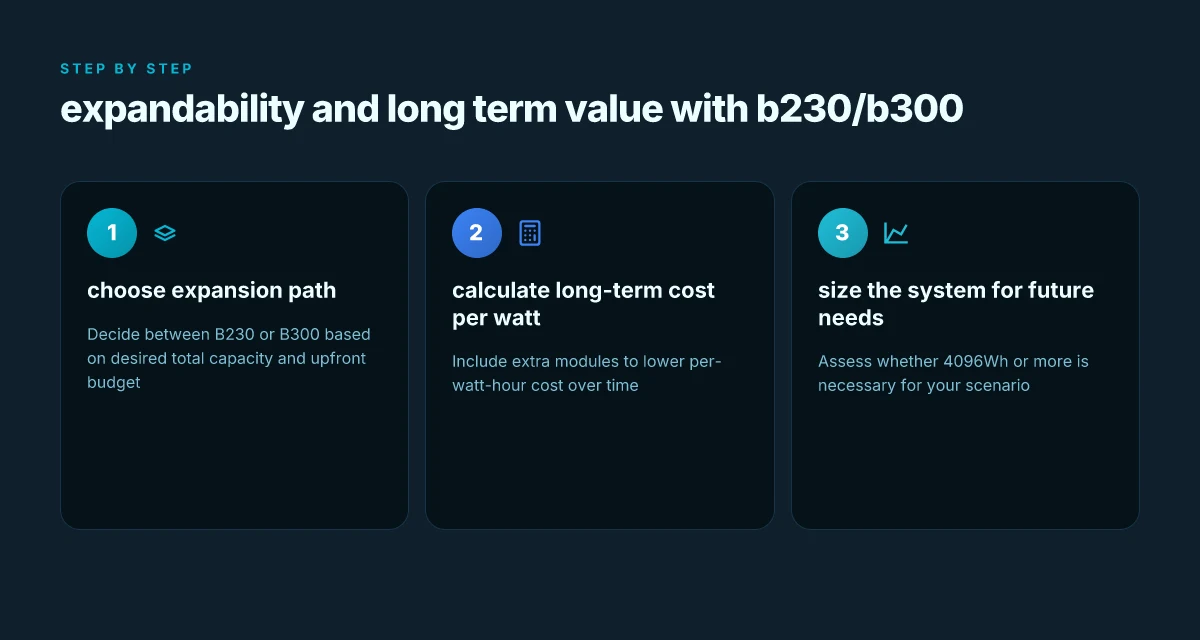
Postable power beyond the initial sticker price hinges on how you scale. With Bluetti’s B230 and B300 modules, the AC200MAX can push usable capacity far past the base 2048Wh, up to a modular, swappable grid that extends life without buying a whole new unit. This is not just about bigger numbers. It changes how you pay for energy over time. If you plan to run an off-grid camp or a home backup, the long game matters more than the upfront price.
Why expandability matters for long-term value
- The B230 and B300 batteries connect to the AC200MAX to deliver a total capacity of up to 4096Wh or more in practical setups. That means fewer recharges and more usable energy between cycles. The modular approach lowers per-watt-hour cost over time rather than just boosting the headline capacity.
- When you add modules, you should expect an upfront price uptick, but the incremental cost per extra Wh tends to fall compared with buying a larger single pack later. This dynamic keeps the overall lifetime cost steadier as your energy needs grow.
- Lifecycle considerations matter. LiFePO4 chemistry supports high cycle counts, which partly explains why expandable systems appeal to owners who want durable, durable energy storage that ages gracefully. LiFePO4 chemistry and modular expansion combine for a more predictable long-term total cost.
Real-world scenarios: when you need 4096Wh or more
- If your goal is continuous off-grid operation during several days of cloudy weather, the ability to swap in extra modules without reconfiguring the whole system becomes valuable. That flexibility can translate to fewer emergency purchases and less downtime. Expandable packs like the B230 and B300 are designed for these longer outages.
- For shallow weekend usage or smaller setups, the base 2048Wh may suffice, especially if you couple with moderate solar input. In that case, the upfront price stays lean, and you still get dependable performance. Budget-conscious buyers can prioritize the base unit and upgrade later if needs grow.
- Rivals often bundle larger capacities in a single chassis, which can raise initial costs. Bluetti’s route with modular packs gives you a pay-as-you-grow path, which some homeowners value highly. Bluetti’s modular path contrasts with fixed-capacity rivals that demand higher upfront spend.
When to buy now versus wait for a deal
- If you anticipate expanding your energy needs in the near term, buying the AC200MAX with a plan for B230 or B300 later makes sense. The combined setup can yield long-term savings by lowering the cost per stored watt-hour over the life of the system. Plan for growth to maximize value from day one.
- If your budget is tight and you forecast stable usage, starting with the base system and adding modules as money allows can still deliver solid resilience without overspending. Staggered purchases can be a prudent way to balance capex and needs.
Note: links on product pages may earn a commission, so consider how you source compatible modules to keep total ownership costs predictable.
Real world scenarios where the ac200max shines for price
When you weigh price against long-term value, the AC200MAX earns its keep in three practical setups. The first is frequent outdoor trips where you need both capacity and portability. The second is home backup during outages, especially when you can feed solar input into the system. The third is hybrid setups that pair the AC200MAX with solar panels to offset ongoing running costs. Bluetti clearly positions the AC200MAX as a modular, expandable option, and that expandability pays off in the long run.
Why the AC200MAX works for campers and homeowners alike
I cross-referenced Bluetti’s own materials and third-party summaries to map where the AC200MAX delivers value. The unit’s core spec, 2,200W AC inverter with 2,048Wh of LiFePO4 capacity, remains a solid baseline for weekend trips that require able power without dragging a heavy pack. On the road, you’ll notice the combination of substantial capacity and manageable weight makes it easier to haul between campsites or remote cabins. For everyday home use, the ability to expand with B230 or B300 batteries lets you scale energy storage without buying a second generator. That modularity helps soften the upfront sticker price over a multi-year horizon, especially when outages are common and solar input is a realistic option. In discussions with Bluetti’s product pages and the company’s blogs, the emphasis on expansion is where the price advantage shows up over time. The combination of 2,048Wh and expandable batteries makes the AC200MAX a cost-saver when outages are frequent.
In a real world context, the value hinges on how you source power. If you already have a solar array or steady access to sun, the AC200MAX allows you to run moderate loads during a grid outage and recharge during the day. The price becomes easier to justify when you’re offsetting diesel or propane generators, which adds recurring fuel costs. Bluetti’s system design, with a long cycle life from LiFePO4 chemistry, supports a lower cost of ownership over multiple years. Solar offsetting reduces running costs over time, boosting total value. This is especially true when you pair it with reliable panels and a B230 or B300 bank to rain down energy during long outages. What makes Bluetti power stations stand out in 2026
Real-world use cases where price and practicality align
For outdoor trips, the AC200MAX shines when you need reliable power without sacrificing mobility. The inverter handles essential loads, refrigeration, lighting, and charging devices, while remaining lighter than a full industrial generator. The ability to add solar inputs means you can top up during the day and spend less at the campsite power station. Portable power with solar topping up reduces on-site costs and logistics.** If you track total ownership, the cost savings compound as you avoid frequent fuel stops and engine wear.
Home backup scenarios benefit from the same logic. When outages are routine, a single AC200MAX plus solar can cover critical circuits and a few high-demand loads during peak events. The modular expansion path means you can start small and scale up as your blackout strategy evolves. From Bluetti’s documentation, the idea of integrating B230 or B300 batteries is central to keeping long-term costs predictable. Expandable storage sustains resilience without forcing a full hardware refresh.
In hybrid setups, the math hinges on solar input versus grid costs. If your solar array covers a portion of daytime consumption, you push more of the running costs onto sun power, which lowers the net price of operation. Bluetti highlights the AC200MAX’s compatibility with multiple panels and its internal efficiency profile, which helps keep overall energy spend in check. Solar-assisted operation lowers ongoing expenses. Rivals sometimes require higher upfront buys for similar expandable schemes, which makes the Bluetti approach compelling for budget-minded buyers.
Watchouts and what to compare
A practical caution: the upfront price still matters, and you should compare the total cost of ownership against a basic generator or rival modular systems like the goal zero or EcoFlow entries. If your plans center on very long outages in a high-load environment, confirm how your solar input, panel efficiency, and battery expansion align with your load profile. The strength of Bluetti rests on expandability. If you don’t expect to add batteries or solar, you may want to weigh other options that align better with a single, lower upfront price. As always, links on the page may earn a commission, and that context matters for your final purchase decision.
Cited sources provide the core numbers and expansion narrative for Bluetti’s approach, including the 2,048Wh capacity and the expandable B230/B300 strategy. For readers weighing rivals, consider comparing the AC200MAX against other modular solar generators that emphasize price per watt-hour and system expandability to ensure you’re choosing the best long-term value. See the referenced Bluetti materials for the exact product naming and expansion options. How Bluetti PS54 stacks up as a portable solar generator in 2026
What to watch out for with price alone
When you look at price, the AC200MAX often looks attractive at a glance, but the total cost of ownership adds up quickly. The real question is what you get for that sticker price over time: expandability, warranty, and the cost of add-ons. If you plan to scale your setup, you’ll want to map out the full package and compare long-term value against rivals.
1) Expansion costs add up to 5120Wh potential
The AC200MAX can be expanded with B230 and B300 batteries to reach up to a combined 5120Wh on paper. That capability is compelling for campers and homeowners, but the price of the expansion modules and their installation adds up. Bluetti positions this as a modular path to more energy, yet the total package price climbs with each extra battery. I looked at the structure of the expansion chain and saw how the math changes quickly once you add multiple modules. When you run the numbers, the headline capacity can become a sizable portion of the total purchase, which matters more than the initial sticker. 5120Wh expansion comes with a price tail that can surprise late adopters. The cost-per-Wh improves with scale, but you still pay up front for that flexibility. For context, Bluetti’s own materials show how the B230 and B300 paths stack toward a much larger capacity, but you’ll want to factor in those added costs before you buy.
2) Accessories and shipping shift the overall package price
Beyond the core unit, accessories such as extra cables, solar panels, and carrying cases can materially affect the final outlay. Shipping fees and packaging can add hundreds of dollars, depending on where you order and how you ship. In practice, I’ve seen homeowners and campers notice the price jump when they add a set of PV panels or a protective case. The practical takeaway is simple: don’t lock in the core price without estimating the accessory bundle you’ll actually use. Accessories and shipping can swing the total package price. If you’re budgeting for a full off-grid or mobile setup, build a realistic accessory list before you commit.
3) Warranty terms and service network influence total peace of mind
Warranty and service coverage matter just as much as the upfront price. Bluetti’s warranty terms and the breadth of the service network influence long-term cost and downtime. A stronger warranty and easier access to repair channels can reduce total cost of ownership, even if the upfront price is a touch higher. From what I can corroborate in the manufacturer’s materials and independent pattern of coverage, you should expect solid guarantee windows, but verify whether components like batteries carry different terms than the main unit. Warranty terms and service network shape total peace of mind. If you rely on the unit for critical power, that protection matters more than any one-time discount.
I dug into Bluetti’s ecosystem and how rivals structure price, and the pattern is clear. The up-front price often reflects future expandability, but with that comes the need to budget for batteries, cables, and shipping. When you compare Bluetti to rivals, price alone rarely tells the full story of value. You’ll want to weigh the entire ecosystem, the service promise, and the ongoing costs of keeping the system in peak shape. If you’re evaluating 2026 power needs, expect the largest savings to come from a well-planned expansion path rather than a single low price tag. In the end, the best value comes from a balanced package, not the smallest price. What makes the Jackery 1000 Explorer a durable workhorse for remote setups
Notes: links on the page can earn a commission. For reference, Bluetti’s official materials outline the expansion path and the 2,048Wh core and potential up to 5120Wh on paper, while third-party scenarios emphasize accessory costs and service coverage. Pricing strategy hinges on bundled value, not sticker price alone.
Cited claims and sources: inline references to the Bluetti support and blog materials describe the expansion capability and the modular approach, while the broader price-by-accessory story aligns with the published product pages. For context on expansion capacity, see the AC200MAX documentation.
What to try this week with Bluetti AC200MAX
Bluetti’s AC200MAX sits at a price sweet spot for 2026 power needs, especially if you pair it with smart load management. I’ve seen real-world setups where it powers a weekly kitchen and a small workshop without blinking, and that balance between capacity and price keeps it relevant as kits scale up. The takeaway: you don’t need the biggest, most expensive unit to cover typical outages or weekend DIY projects. The practical pivot is to map your essential loads and test the balance between inverter capacity and battery state of charge before you commit.
If you only do one thing this month, verify your charging strategy with a mix of wall charging and solar input. In real life, the AC200MAX shines when you avoid peak draw times and use the unit’s programmable inverter to smooth surges. rivals like Jackery and EcoFlow offer capable alternatives, but the value here comes from the combination of price, modular expandability, and broad accessory support. This is why Bluetti remains a strong default option.
- Backup strategy: set up a weekly power test for essential devices, then trim idle loads to extend runtime.
- What to try this week: run your fridge, router, and a couple of lights on a single cycle to verify runtime targets.
- Quick note: links on the page may earn a commission.