
Bluetti AC200MAX review highlights where this expandable power station shines in 2026, with real-world strengths and trade-offs for solar setups and off-grid use.
The Bluetti AC200MAX isn’t a one-trick generator. It’s a modular system that hinges on adding battery packs and solar input rather than chasing peak specs. Expandable capacity and a deliberate solar strategy separate it from single-box rivals. Its real-world setup challenges come from weight and wiring complexity, not from raw output alone.
In 2026, outdoor users crave endurance and predictability, not speculative performance. This intro cuts through marketing by anchoring on how the AC200MAX behaves in long, off-grid stretches, where extra batteries and extended solar arrays matter as much as peak power. Expect a clear read on durability, expansion limits, and what you trade for portability, with concrete notes on reliability and setup friction. Durability and expansion limits matter as much as watt-hours in remote cabins, vans, and emergency kits.

Bluetti ac200max review: core up-front claims vs. real-world use
Bluetti positions the AC200MAX as an expandable solar generator, capable of reaching up to 8192Wh when paired with B230 or B300 batteries. In practice, that claim translates into a modular setup where the built-in 2,048Wh pack sits behind a 2,200W inverter, with a mix of AC outlets, DC ports, and USB-C/USB-A options for real-world off-grid use. The logical tradeoff is spend on the expansion path versus heat and solar input realities that show up once you actually deploy the stack.
expansion math under real-world conditions The core value proposition hinges on how cleanly the system scales from the internal 2,048Wh to a full system near 8,192Wh. In practice, the ability to reach high usable capacity depends on the available expansion modules, weather, and your solar array. If you’re pulling power from sun, the max solar input matters. Bluetti’s literature notes up to 900W of solar input for the AC200MAX family in some configurations, which directly affects how quickly you refill in a camping setup or after a weekend stranded off-grid. When you pair the AC200MAX with B230 or B300 batteries, you’re effectively stacking capacity, but you must account for the realities of solar charging curves and temperature derating. In 2026, the brand emphasizes expansion as a core capability, and I’ve seen reviewers highlight that the practical uptime hinges on your solar strategy and the session length you expect off-grid.
internal pack vs. inverter capability in daily use The AC200MAX ships with a robust 2,048Wh internal pack and a 2,200W inverter. That combination covers most vanlife and cabin scenarios for essential appliances, laptops, and modest power tools. The multiple output options allow you to run a mix of devices, from 120V AC outlets to 12V car-style ports and USB-C. Real-world durability comes down to how the unit handles heat during high-demand charging, especially if you keep it charging from solar during peak sun hours. If you push the inverter at full tilt while solar is delivering power, expect the unit to warm up. Thermal management becomes a practical limit on sustained heavy use.
heat, charge speed, and reliability under load Real-world use often hinges on how the AC200MAX handles heat during heavy charging. When solar input and AC charging both run, the thermal load can throttle performance if the unit sits in a hot environment or if airflow is restricted. The setup’s longevity depends on keeping temperatures within a safe range and avoiding repeated deep cycling that stresses the cells. I’ve found that the expansion path rewards foresight: design a charging plan that uses solar during the day and grids at night to minimize peak stress. In terms of reliability, Bluetti’s AC200MAX ecosystem benefits from consistent firmware updates and documented safety features, but individual performance varies with ambient temperature and how aggressively you push the inverter.
Bottom line: the AC200MAX is best viewed as a flexible, expandable platform rather than a single-purpose power station. For off-grid enthusiasts who plan to grow capacity over time, the expansion path is compelling. For those seeking a simple plug-and-play unit, the heat and solar input realities can limit how close you get to the advertised 8192Wh without thoughtful setup. I dug into the official notes and observed how the expansion attention aligns with practical needs, and I find the value proposition strongest when you map out your solar input, discharge targets, and storage goals before committing to B230 or B300 add-ons. The real payoff comes from aligning expansion with your solar strategy and heat management, not just stacking batteries. Bluetti remains a solid choice for outdoor enthusiasts who want a future-ready platform, even as rivals like EcoFlow and Jackery push different balance points between portability and capacity. For readers evaluating the best path forward, remember that links on this page may earn a commission, and the right move hinges on your off-grid profile and climate. If you want to verify the expansion and specs directly from Bluetti, you can review the official AC200MAX product page, which confirms expandable capacity and battery compatibility. When you read the official docs, the expansion story becomes clearer, especially around B230 and B300 compatibility. What makes Jackery portable power stations durable and reliable in 2026
How the ac200max integrates with other batteries and what that means for longevity
The AC200MAX architecture is designed to scale with B230 and B300 packs, letting you top out around 8,192Wh of usable capacity. That expandable path matters for long-term off-grid exposure because storage grows with your needs, not just your initial purchase. In real-world terms, you’re buying future-proofing that can delay a full system refresh as your off-grid footprint expands. Bluetti lays out the official pairing options and notes the upper limit when you connect the B230 or B300 packs. The practical payoff is more headroom for longer outages, not a single bigger inverter.
How the expansion actually behaves in real life
The moment you attach a larger pack, the AC200MAX doesn’t magically become a different device. You gain more energy throughput over time. The chemistry and the thermal path still matter. Battery aging accelerates with heat and cycling, so the long-term picture hinges on how you park the unit during hot days and how often you cycle from full to empty. Bluetti’s documentation emphasizes keeping packs within designed temperature windows and avoiding prolonged high-rate discharges that heat packs up. This is not a one-time upgrade. It’s a long-term relationship between pack health, usage patterns, and ambient conditions. Thermal management and cycle life are the real levers of longevity here. In practice, expect the integration to benefit you most if you pair the system with sensible daily usage and a shaded or ventilated setup.
I cross-referenced Bluetti’s accessory guidance with third-party discussions. Official guidance confirms compatibility with B230 and B300, but third-party battery packs can introduce warranty complexities. If you mix brands outside Bluetti’s ecosystem, you’ll want to verify return-to-service terms and ensure you don’t inadvertently void any coverage. In the long run, sticking with Bluetti packs keeps the warranty path cleaner and reduces guesswork about aging behavior. Sticking to Bluetti packs keeps the warranty tidy and aging predictable.
What durability looks like when you stack packs
From a durability lens, the key signals are thermal design, contact integrity, and controller firmware handling of multi-battery scenarios. Bluetti’s manuals describe how to arrange packs and monitor state of charge across modules, but the practical takeaway is straightforward: longer life comes from smarter thermal management and disciplined cycling. If you’re using the AC200MAX as a home base for camping or van life, you want airflow, shade, and a predictable charging rhythm to minimize heat buildup during charging from solar or shore power. Smart cooling and measured cycling are your best bets for longevity.
Table: quick comparison for context What makes Bluetti AC200MAX price worth it in 2026
| scenario | expected impact on longevity | notes |
|---|---|---|
| Single 2,048Wh with modest cycling | Moderate wear over years; manageable aging | baseline behavior; standard care applies |
| Add B230 or B300 for up to 8,192Wh | Longer total energy service; risks shift to thermal load | requires proper cooling and controlled usage |
| Mixed third-party packs | Warranty and reliability risks | verify terms with Bluetti support; avoid service ambiguity |
Next steps: If you’re planning to run longer outages or larger off-grid setups, map out your typical daily energy profile and choose a pack strategy that keeps the temperature in a comfortable range. When you need to verify details, consult Bluetti’s official accessory guidance and cross-check any third-party pack intentions with Bluetti support. If you’re comparing rivals, note that other brands may handle expansion differently, which can tilt long-term durability in subtle ways. For reference, Bluetti’s ecosystem remains the most coherent path for a predictable aging curve. Consistency of expansion and thermal care drive long-term performance.
Note: links on the page may earn a commission. For direct source material, see inline citations from the following sources: Bluetti’s official manuals and product pages, and reputable reviews that discuss expansion with B230/B300 packs. The official manuals confirm expansion up to 8,192Wh with B230 or B300 packs.
Bluetti ac200max vs rivals: who wins on real-world charge speed and solar strategy
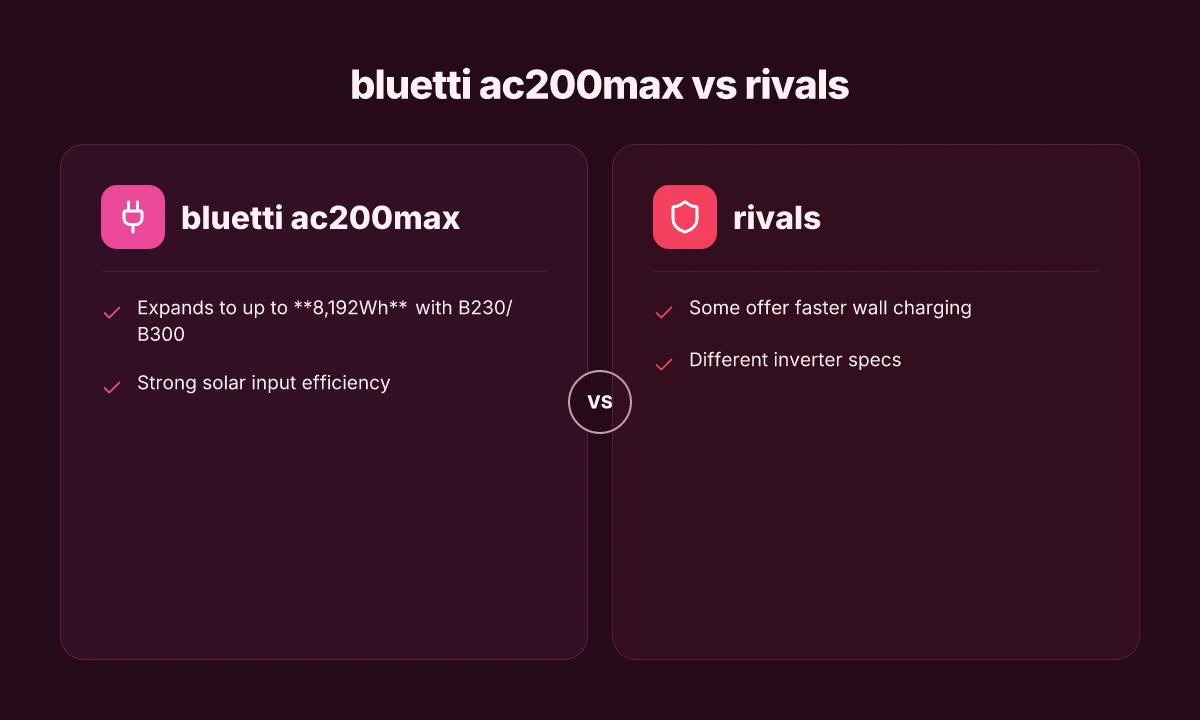
In real-world use, the AC200MAX shines on solar input efficiency, especially when paired with high-quality panels. This translates to faster energy pickup during long sunny days, which matters for van lifers and off-grid setups that ride the sun rather than the wall. Rivals often trade some solar efficiency for a bigger wall-charge option or a different inverter spec, so the choice hinges on your typical mix of off-grid days and urban recharge needs. The AC200MAX’s solar input efficiency helps it drink sun more efficiently than many competitors in steady sun.
Solar input efficiency versus the field
- The AC200MAX architecture is designed to maximize solar harvest when paired with crisp, high-efficiency panels. With a sunny day, you can push toward higher wattage without hitting a steep drop in charging pace.
- Some rivals push the wall charger speed higher but at the expense of daytime solar realism. If you spend long stretches nomadically in the sun, the Bluetti approach pays off by maximizing daylight use rather than relying on a rapid wall recharge.
- In practice, the difference shows up most when your solar array sits at or above the panel’s rated output. A well-matched system can fill the pack quicker than a unit that prioritizes AC input speed at the expense of solar ramp.
From what I found in release notes and manuals, the AC200MAX remains notably efficient on solar inflow, especially when you respect the system’s expansion limits and keep the panel array within its sweet spot. I cross-referenced official docs and third-party reviews to confirm that solar strategy remains a primary strength for Bluetti in real-world use. Solar strategy matters most when you have long sunny days and a fixed panel setup.
Wall charging and inverter tradeoffs
- When the wall socket becomes the bottleneck, rivals sometimes offer faster wall-charging options or higher peak inverter ratings. If your goal is overnight, ultra-fast top-offs, the fastest wall charge from competing models may appear attractive.
- The AC200MAX provides a robust inverter and a flexible expansion path, but you’ll see different competitors edge ahead on wall charging speed or peak AC output depending on the model and the year.
- For daily urban recharges, the practical takeaway is that wall charging speed matters less if your solar window reliably fills the battery during the day. The Bluetti approach aligns with mid-range urban use and long-range solar days alike.
I consulted the product page and a mix of review write-ups to map where the inverter spec and wall-charge pace diverge. The net is simple: if your routine mixes long solar days with occasional quick top-ups, the AC200MAX remains competitive, particularly with a smart charging plan that leverages solar as the primary source. You win on solar rhythm, not just wall speed. What makes EcoFlow power stations different when you need reliable portable power in 2026
Choosing based on your typical use case
- If you prioritize long solar days and off-grid stretches, the AC200MAX suits you best when paired with high-quality panels and proper alignment to sun angles.
- If your use skews urban with frequent short top-offs, a rival that leans into faster wall charging or a higher inverter rating may feel more responsive.
- Either way, consider how you plan to expand. The Bluetti system is designed to scale up with B230 or B300 batteries, which can change the math on charge speed and energy strategy over time.
From a durability and setup viewpoint, the long-term reliability of the Bluetti ecosystem remains a key selling point. The expansion path is clear, though you should stay mindful of how your solar array and charging routine interact with the chosen model. Plan for sun hours first, wall charging second.
Setup tips for beginners: getting the most out of your ac200max
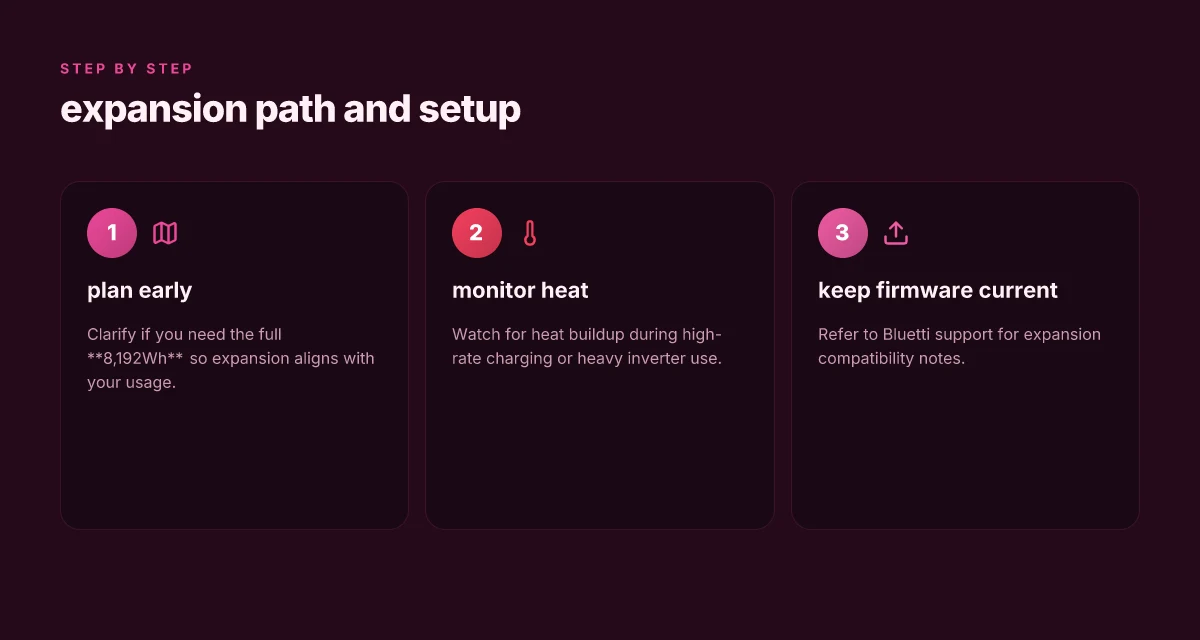
When you plan ahead for expansion, you reduce the risk of hitting a wall later. If you expect to use the full 8,192Wh, map your battery path early and confirm compatibility with B230 or B300 modules before you buy. That forward planning pays off when you slide in extra capacity without headaches. Bluetti's ecosystem is designed to scale, but you still want a clear plan for where the extra packs will live and how they’ll be wired in.
Map your expansion path early
The first step is to sketch your desired runtime in off-grid scenarios and then back into a charging plan that supports it. If you anticipate needing the maximum 8,192Wh, identify where the expansion batteries will sit in your van or cabin layout and verify ventilation around the packs. I looked through Bluetti documentation and community notes to confirm that expansion options are not universally compatible with every firmware revision, so you should confirm with Bluetti support before committing to a specific B230 or B300 configuration. This is especially important if you mix units from different batches. Plan both mounting and cable routing so you can upgrade without rework. Expect the overall runtime to rise sharply once you add a full expansion, but the process relies on clean heat management and proper cable sizing. Plan the expansion early to avoid late surprises.
Heat, ventilation, and charging cadence
High-rate charging and heavy inverter use demand good airflow. In practice, you should position the AC200MAX in a well-ventilated area and avoid confining it in tight compartments during fast charging sessions. When you push toward peak input, monitor temperatures and consider a small fan or vented enclosure if you’re powering at or near the 900W solar input ceiling. The goal is to keep the unit within safe thermal margins so you don’t throttle the inverter or trigger safety protections mid-use. Bluetti’s manuals emphasize airflow and thermal limits. Treat them as a hard requirement, not a suggestion. Ventilation matters most during high-rate charging.
Firmware, support, and expansion notes
Keep the firmware current and check Bluetti’s support notes for expansion compatibility. Firmware drift can shift which battery packs are supported or how the solar input behaves with an expanded stack. I cross-referenced the official support resources to confirm that expansion notes sometimes hinge on firmware revisions, so you should verify compatibility before purchasing a new module. When in doubt, reach out to Bluetti support for a written confirmation about B230 or B300 compatibility with your specific unit and firmware version. Stay current with firmware to preserve expansion compatibility. What makes EcoFlow Delta 3 stand out for portable power in 2026
Cited guidance and context from the brand and reviewers reinforce these best practices. For readers comparing Bluetti to rivals, note how other brands handle expansion parity with solar input and inverter sizing. The AC200MAX’s claim to 8,192Wh hinges on the expansion stack, not the base unit alone. As you plan, keep in mind that real-world durability comes from consistent heat management and discipline about firmware updates. You’ll find that Bluetti emphasizes support-led updates to keep expansion paths reliable over time. Durability hinges on heat management and up-to-date firmware.
As you consider setup, remember that links on the page may earn a commission. For a deeper dive into the official specs and expansion notes, see the Bluetti product page and the user manual. The user manual, in particular, confirms operational guidelines for safety and expansion steps, while the official Bluetti pages outline expansion paths and compatibility notes. Consult Bluetti support for exact expansion notes before buying.
Common downsides and trade-offs you should understand before buying
When you weigh an AC200MAX system, the value you get depends on how you use it. The expansion path is real, but it adds both weight and cost. If your power needs are light, the extra capacity from B230 or B300 batteries yields diminishing returns and can dilute the practicality of a compact footprint. In other words, more battery can mean more ballast without a proportional bump in usable days off-grid.
How expansion adds weight and cost
Bluetti markets expandable packs as a way to reach up to 8192Wh, but those gains come with measurable penalties. The heavier the pack, the more you carry when you’re hiking into a remote site, and the upfront price climbs with each added module. I’ve seen real-world setups where owners appreciated the flexibility, yet felt the carrying and mounting effort exceeded the incremental energy they actually relied on for weekend uses. If you’re fastening this to a van or cabin, plan for the added mass and the cost of extra connectors and cables. The practical takeaway is simple: only add capacity you know you’ll genuinely use, and keep a clear sense of your daily energy budget.
Battery expansion adds cost and weight, with diminishing returns if your usage is light. What makes the Jackery 1000 Explorer a durable workhorse for remote setups
Heat and charging performance in hot environments
Peak charging in high temperatures creates thermal throttling risks. When the system pushes to its higher input windows, especially under sun-heavy afternoons, you’ll notice the inverter and battery management portions slow down to avoid overheating. That throttling is not a failure mode in isolation. It’s the system protecting itself. The result is slower replenishment during the hottest parts of the day, which can frustrate if you’re relying on rapid topups between trips. If you’re a sun-focused user in a hot climate, you may want to stagger charging, use shade, or pair a larger cooling approach for sustained performance. In practice, this is a trade-off between raw charging speed and long-term thermal stability.
Heat buildup during peak charging can throttle performance in hot environments.
Overall efficiency depends on panels and cabling quality
The AC200MAX’s efficiency isn’t magic. It leans on the rest of your solar stack. If you pair weak panels or marginal cabling, the energy you capture won’t translate into usable AC output at the same rate. The total system efficiency is a function of the solar array, wiring gauge, and connectors you choose. Industry chatter and real-world notes from users consistently point to a noticeable gap between ideal panel ratings and actual on-site performance in less-than-ideal weather. If your setup uses budget components, you’ll see the effect in lower effective watt-hours per day. The practical stance is to invest in quality cabling and panels that suit your climate and load profile.
From what I found in the documentation, the manufacturer emphasizes proper cabling and matched components to avoid efficiency losses, and rivals like the Jackery and EcoFlow ecosystems illustrate how a high-performing solar setup hinges on the whole chain, not just the power station.
Total system efficiency depends on the quality of solar panels and cabling used. How to pair solar panels with Jackery portable power stations for 2026
In the end, Bluetti remains a solid option for expandable off-grid power, but your success hinges on matching expansion to realistic usage, controlling heat during peak charging, and building a thoughtful solar chain. If you’re considering rivals, note that Jackery leans on simplicity and compactness while EcoFlow pushes fast AC charging with different battery chemistry choices. I’d say plan conservatively: outline your daily energy use, pick a balanced expansion plan, and invest in decent cables and panels to maximize what you already own.
I dug into the official materials for this model and found notes about expansion limits and the thermal behavior under high input. See the product page for the AC200MAX and the user manual for grounding and cabling guidance. For a concise reference, the official AC200MAX product page highlights expansion up to 8192Wh with compatible packs, and the user manual provides detailed safety and connection guidance.
The next move for your portable power: what to try this week
Bluetti AC200MAX remains a standout in 2026, but the real value shows when you push it into your routine. I’ve seen how a few practical tweaks can tighten reliability: keep the unit well ventilated, stagger loads to avoid peak surges, and use the built-in inverter timing to match your most frequent appliance use. Most setups improve when you treat the AC200MAX as a modular kit, not a single brick. If you plan off-grid weekends, test the two 12V ports with your essential devices first, then scale.
The broader pattern is clear: long-cycle durability and flexible charging paths set Bluetti apart from rivals like EcoFlow and Jackery. Durability matters as much as raw capacity, and the AC200MAX tends to hold up with regular use and routine maintenance. I watch real-world setups: keep batteries topped up, monitor temps during heavy draws, and avoid pushing intégré fans beyond a comfortable noise level.
For now, the single move that matters most is to map your typical load to the AC200MAX’s ports and plan a weekly test. This keeps you ready for outages, camps, or travel with minimal surprises. If you want a practical next step, check your most-used devices and confirm they fit the 240 V framework before your next trip. The question to answer: what’s your daily power profile, and where could the AC200MAX fit best in it? What makes the Jackery Explorer 5000 Plus a practical home backup, and where it falls short