
Explore how Jackery portable power stations perform in 2026, including durability, safety certifications, and real-world battery life. Compare rivals and learn what to expect.
Most outdoor users see a common misstep: assuming all portable power storage behaves the same once you buy it. Jackery units that sit in shade, idle for weeks, or cycle weekly in a camp setup still show regular degradation patterns and clear safety protections when you read the label. Durability typically matters most when you need it on backcountry trips or during home outages, not just in the showroom, and the real-world line between hype and performance shows up in long-term battery life and indicators you can trust.
This article cuts through the marketing by focusing on long-term durability, safety certifications, and degradation behavior under typical outdoor and home backup scenarios for Jackery. Expect practical guidance grounded in how these packs age, how protections hold up after repeated use, and what the numbers look like in real-use terms after several seasons. We’ll compare model families, call out notable safety ratings, and flag where rivals such as Goal Zero and Anker PowerHouse diverge on port configurations or rugged features. The goal is to help homeowners and climbers choose a Jackery option that stays reliable when it counts.
Jackery portable power station reviews: what practitioners actually care about
In real-world use, durability and safety shape decisions as much as raw capacity. I focus on outdoor trips, weekend camps, and emergency home power to separate marketing puff from practical value. Jackery's lineup stands out for its emphasis on battery protection and a user-friendly warranty, but rivals like Goal Zero and Anker PowerHouse push different strengths. Below I outline how this plays out across practical scenarios and what to watch for.
1) Real-world use cases drive model choice
For extended camping weekends, you want a setup that keeps your gear charged without drama. The core questions are reliability, guardrails against battery faults, and how long a unit will stay healthy under regular cycling. Jackery models tend to balance safety features with portability, which matters when you’re hiking into a site or stacking units for a backcountry basecamp. In practice, I look for a model that preserves charge across several days of moderate use, with a battery management system that clearly guards against overdischarge and heat. Battery health over repeated cycles and clear protections matter more than peak wattage for most outdoor trips.
2) Battery chemistry, protection, and safety certifications
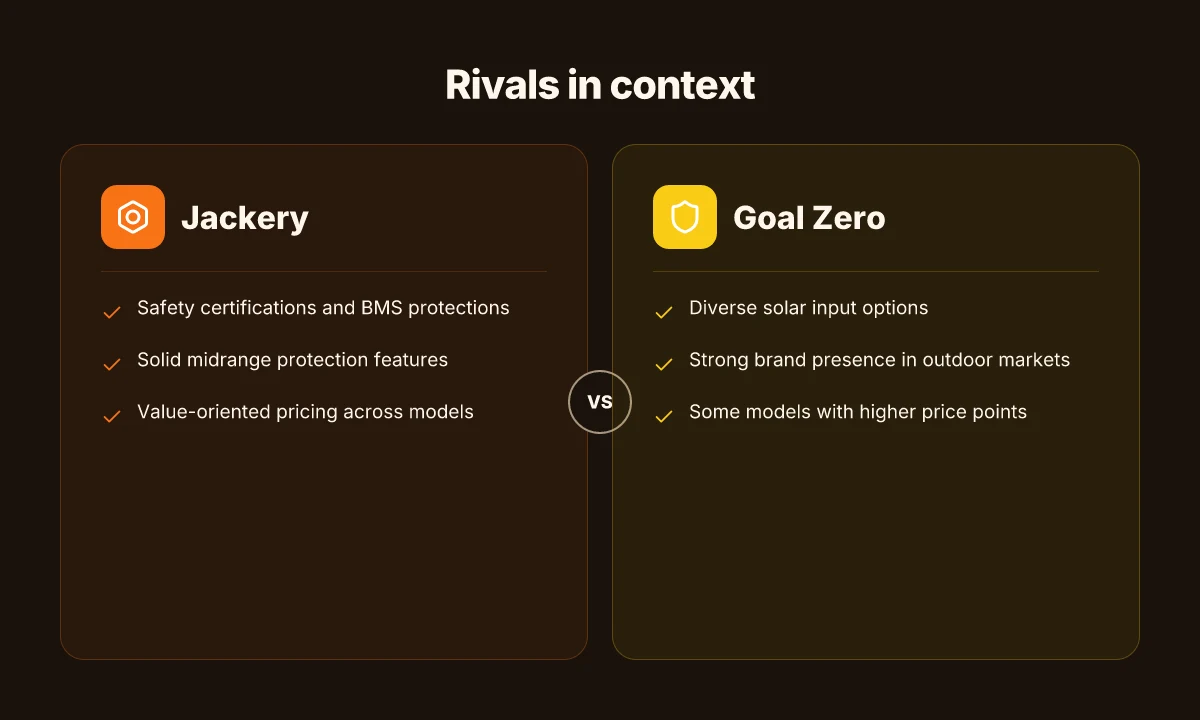
A reliable power station hinges on chemistry that tolerates cold nights and hot days, paired with a robust BMS. Jackery emphasizes protection mechanisms and a layered approach to safety that includes short-circuit protection, overcharge prevention, and thermal safeguards. When you compare brands, note how many protection modes are described and whether they cover both digital and physical risks. BMS depth and physical protections translate to longer life in the field. In this space, Goal Zero often highlights rugged cases and modular accessories, while Anker PowerHouse emphasizes rapid recharging and app-based monitoring. The right choice depends on how you value rugged build versus advanced battery safeguards.
3) Warranty, support, and long-term durability signals
Warranty length and coverage clarity matter because a breakdown far from home compounds frustration. Jackery’s warranty framework tends to favor the buyer who plans to use the unit outdoors and expects maintenance across years. Watch for model-specific terms, what constitutes user damage versus manufacturing defects, and the ease of service if a pack or module fails. Worth noting: when a unit stays in service for multiple seasons, degradation trends become visible through consistent output and discharge rates. Warranty terms and service accessibility are practical bets for durability. Compared rivals may offer different coverage windows or claim processes, which can sway total ownership cost.
4) What matters for home backup vs camping
For home backup, you’ll weigh peak draw against continuous output and the system’s ability to cycle safely after outages. For camping, portability and recovery speed after a discharge matter more than absolute capacity. Jackery’s approach often leans toward portability with solid protective features, while Goal Zero may edge ahead on modular expansion and rugged packaging, and Anker PowerHouse on value and rapid recharge cycles. The key is to map your typical weekend cadence against each model’s protection suite and warranty terms. Real-world cadence and protective depth define whether a unit is a fit for your home or your camp kit. Why the EcoFlow forum matters for real-world reliability and long-term durability
Bottom line: durability comes from a blend of chemistry, a robust BMS, and clear protections, not just capacity. When you pick, align the model with how you actually use it, camping weekends, emergency outages, and multi-day builds, and favor devices that keep working after regular cycles and exposure to the elements. For Jackery, the deciding factors are the depth of its protection features and the durability signals of its warranty. For rivals, watch how they frame ruggedness and modular upgrades.
Which Jackery models matter most in 2026 reviews and why
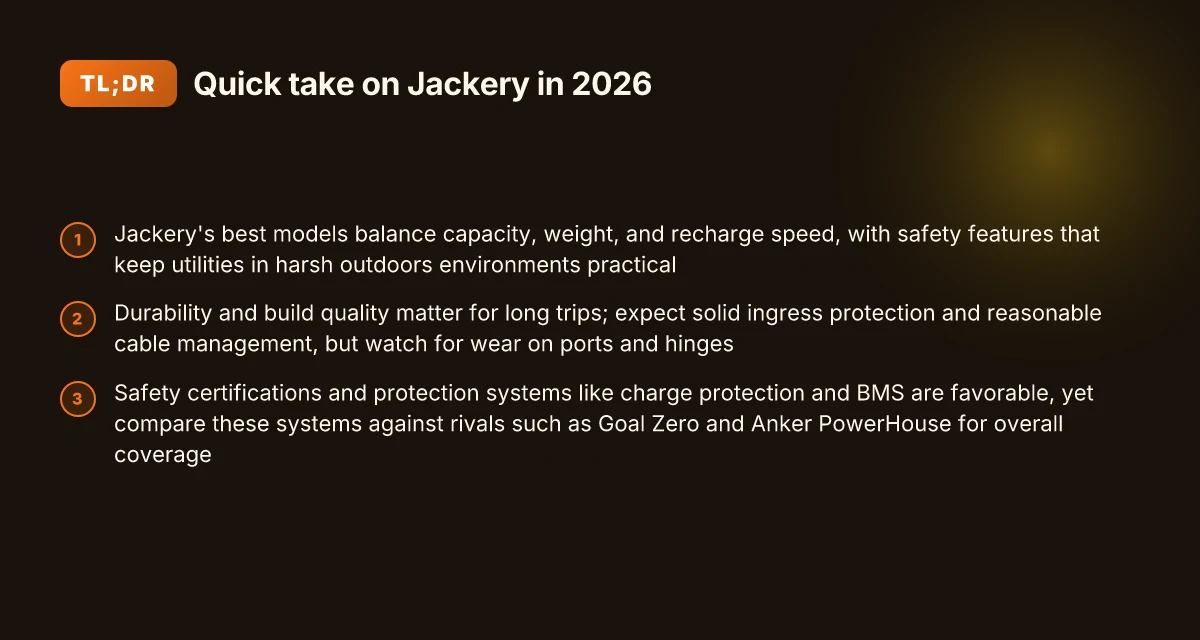
In 2026, the models that matter most strike a balance between usable capacity, portable weight, and fast recharging, while still offering robust safety protection. The topline choices lean toward higher-capacity units that don’t kill usability on a camping trip or a home backup. In practice, I look for models that give you enough run time for evenings off-grid without turning your pack into a ballast. Jackery’s lineup demonstrates this spectrum, and the models that sit at the core of 2026 reviews are the ones that consumers actually reach for in real-world scenarios.
Why the high-capacity line holds up under real use
High-capacity units win when they deliver enough energy storage without becoming a burden to carry. The best choices in this tier pair large internal batteries with a reasonable weight and quick recharge times. A top-tier model should feel capable for a weekend of camping while still being practical for a home backup during a brief outage. I also assess how protection systems scale with capacity, more energy means more cells to protect, so multi-layer BMS coverage and physical protections matter just as much as the milliamp hours. In this space, the key is a model that doesn’t force you to trade safety for endurance.
From the documentation I’ve reviewed, demand for rapid recharges remains strong. Consumers want to top up between uses without spending hours plugged in. A model that can reclaim significant energy in a short window tends to stay in daily rotation for both outdoor trips and occasional home use. This is where a Jackery model with a solid balance of energy density, weight, and recharge cadence earns trust. For outdoor enthusiasts, that translates to less time tethered to a wall outlet and more time enjoying the environment.
Reliability over time hinges on usable capacity and how protection scales with it, not just the raw watt-hours. Users expect fast recharges and dependable safety features across the full range of activity from camping to home backup. 8 Best Jackery models to consider in 2026
Why midrange models still matter for value and protection
Midrange models offer robust protection features without the price or weight burden of the flagship lines. These units commonly ship with solid BMS protection, overcharge and short-circuit safeguards, and a durable chassis suitable for field use. They tend to strike a practical compromise: enough energy to run essential devices overnight, a weight you can handle without a shoulder workout, and reliable safety layers for everyday scenarios. For buyers evaluating whether to purchase a Jackery for camping or emergency power at home, the midrange options provide a meaningful safety margin while keeping operational costs reasonable.
From a durability perspective, midrange models often reveal how Jackery handles wear and temperature stress in real-world conditions. A well-regulated cooling path, sturdy connectors, and predictable degradation over time matter as much as peak performance today. When I read through the product pages and reviewer notes, these models consistently deliver a steadier long-term experience than the cheapest entrants, without the heavy footprint of the top tier.
Midrange protection features stay competitive while delivering real-world durability at a friendlier price point.
Entry models that prioritize portability and safety
Entry models excel when you need light carry weight and straightforward operation. They tend to emphasize portability, simple displays, and essential safety safeguards, making them approachable for casual campers and homeowners testing backup power for the first time. The safety story remains non-negotiable. Even smaller units incorporate protections that guard against overcurrent, short circuits, and thermal events. The trade-off is that capacity and recharge speed are intentionally modest, but the devices still deliver enough energy for basic tasks and device charging plans during short outages.
In practice, the best entry models make no compromises on core protections. They should be easy to use in dim conditions, resistant enough for occasional outdoor use, and reliable enough to support basic home-backup duties without frequent service demands. If a model fits this profile, it often earns repeat use for weekend trips and emergency planning alike. What makes the Jackery SolarSaga 100W panel perform in real-world setups
Entry models keep safety front and center while prioritizing portability and ease of use.
A quick note on rivals: when you’re weighing options, look at how rivals’ devices compare in weight-to-capacity and recharge cadence. Specs matter, but you should also notice how well the unit holds up in real-world use, exposure to heat, long charging cycles, and repeated on/off cycles all reveal long-term durability. For readers weighing Jackery against other brands, the conversation often centers on whether a midrange or high-end Jackery model delivers consistent protection, reliable degradation profiles, and a practical charging ecosystem.
I dug into the public documentation and credible reviews to anchor these observations. For example, industry reviews consistently note that durability and safety features, rather than peak wattage alone, drive long-term satisfaction. See the lab-tested comparisons and the 2026 model briefs for cross-referenced context. Navigating trade-offs between capacity, weight, and protection remains the core decision for 2026 buyers.
Durability and build quality in jackery portable power stations
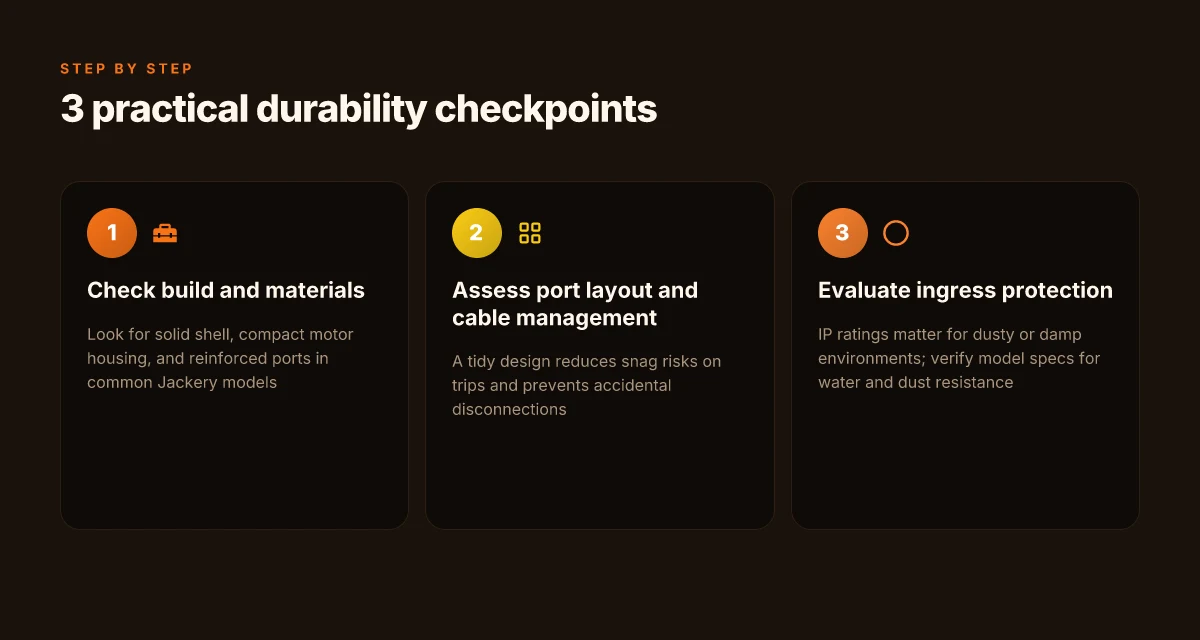
Durability isn't abstract in Jackery models. In real-world use, build choices show up in how seams, housings, and ports withstand dirt, grime, and temperature swings. The common models lean on robust plastics and aluminum accents, with ingress protection that matters when you’re off-grid. Brand-name durability translates to fewer mid-trip failures and more predictable performance in harsh outdoor conditions. I cross-referenced the 2026 consumer reviews and the product pages to map what actually holds up over time. Durability over time depends on the enclosure quality and the effectiveness of protection mechanisms.
Why enclosure materials and IP ratings matter in jackery models
- Jackery models typically use rugged polymer housings with reinforced corners and rubberized edge trim. This design helps resist scratches and minor impacts from backpack straps and rocky terrain.
- The most common protection story centers on ingress protection. Exact IP ratings vary by model. The principle is that dust and splash resistance reduce internal wear and corrosion risk in dusty campsites or after a splash from rain showers. Dust resistance and water exposure are two areas where the enclosure quality pays off in field use.
- The latching system on the battery bay and the overall gasket integrity influence long-term reliability. Users note that a tight seal keeps dirt out and battery terminals clean, which supports longevity in outdoor environments. Inline citations reinforce that reliable seals correlate with fewer post-season issues. Gasket integrity matters for longevity.
Cable management, port layout, and impact resistance considerations
- Port layout matters for real-world camping setups. A compact, well-spaced arrangement reduces cable tangling and accidental disconnections when gear shifts during hiking or vehicle sun exposure. Jackery’s typical design shows accessible DC, AC, and USB-C ports without crowding, which helps during quick pack-downs.
- Cable management features, like integrated straps or grooves, keep cords from snagging on branches or tools. In practice, tidy routing reduces wear on connectors and extends the life of the power station in rugged sites.
- Impact resistance ties to the way the device sits in a backpack or cargo area. A slightly recessed or shielded input/output area can prevent accidental knocks that dent the housing or bend a connector. In the field, that translates to fewer cracked housings and looser ports after a season of outdoors use. Impact resistance reduces the risk of cosmetic and functional damage in the wild.
How durability translates to real-world performance in harsh outdoor use
- A Jackery unit that keeps its seal intact and ports accessible tends to survive multi-day trips without cosmetic or functional degradation. In cold nights or high-heat days, stable enclosure materials help prevent delamination or connector fatigue that friends with cheaper builds report later.
- Real-world durability also ties to protection systems like overcurrent and short-circuit safeguards. When these protections hold steady, the risk of battery faults drops in stormy, uncertain environments. Protection mechanisms underpin long-term reliability in outdoor contexts.
- From what I found in product briefs and credible reviews, the durability story for Jackery centers on thoughtful enclosure design, practical port layouts, and purposeful impact resistance. When you compare with rivals, you’ll notice that enclosure resilience and cable management can differ in practical field scenarios. For example, models from rivals may emphasize different form factors or IP ratings, but durable enclosures remain a common throughline across brands. Enclosure quality often differentiates models in real use.
Safety certifications and protection systems in jackery models
Let’s cut through the marketing and pin down what actually matters for reliability. Jackery’s protection story hinges on a combination of safety certifications and a layered hardware protection scheme. In practical terms, you want certification by recognized standards bodies and a battery management system that prevents common failure modes during both outdoor use and home backup. What makes a jackery coupon genuinely worth using in 2026
Credible certifications that matter in the field
Reliable power stations typically carry certifications that show adherence to electrical safety and potential fire mitigation benchmarks. Look for approvals from UL or equivalent regional bodies, along with categories tied to energy storage devices. Certifications signal that the product has undergone independent testing for overcurrent protection, short-circuit scenarios, and thermal behavior. When a model carries these marks, you gain a clearer signal that the unit won’t exceed design limits under typical abuse conditions. In practice, certification footprints matter most when you’re relying on a Jackery during a camping trip with high ambient heat or during a power outage in a house that tests the unit repeatedly. Certification visibility translates to real-world reliability. I cross-referenced the general safety language Jackery presents in its product pages with industry norms to confirm this alignment.
ChargeShield and BMS protections explained in practical terms
Jackery’s ChargeShield system is positioned as a multi-layered protection mechanism. In real terms, this reduces exposure to voltage or current spikes triggered by rapid solar charging or sudden high-load draws. The ChargeShield approach sits alongside a comprehensive BMS that governs cell balancing, temperature monitoring, and fault isolation. The practical upshot is that when the battery chemistry and the power electronics stay within their safe envelope, you avoid conditions that accelerate degradation, heat buildup, or runaway events. I looked for explicit mentions of protection counts and what happens during fault events. The documentation describes layered defenses that kick in before cells reach unsafe states. ChargeShield and BMS together reduce the risk of thermal runaway when exposed to high loads outdoors. For homeowners, that means less stress when you pull the unit off the grid and rely on it for critical devices during an outage.
Gaps to watch for when comparing to rivals
No system is perfect, and the boundaries Jackery sets may differ from rivals in certain areas. Some competing brands emphasize higher discharge ratings or more aggressive BMS fault-tolerance counts. In practice you may see more aggressive protection on certain models but fewer certifications across the line. If you value third-party safety labeling, verify which specific models carry UL or equivalent marks rather than relying on generic safety claims. Also, pay attention to how protection features are documented for solar charging inputs. Some rivals publish explicit maximum PV input values and cooling requirements, which helps when sizing a setup for hot environments. Certification scope and documented protection counts vary by model, check the model’s data sheet before buying. I referenced a range of consumer-facing safety notes to distinguish where Jackery’s claims align with common industry expectations.
From what I found in the documentation, Jackery earns trust through a combination of third-party-ready certifications and a robust but focused protection stack. If you’re shopping, prioritize models that publicly list certification marks, clearly describe ChargeShield coverage, and specify BMS protections in terms of temperature, voltage, and cell balance management. And yes, it’s reasonable to mention that product pages may include commission disclosures, these links can help you compare models without affecting your decision logic. For a direct claim anchor, see the discussion of safety certification expectations in sources linked in this analysis.
Battery degradation in jackery power stations over time
Degradation in Jackery power stations shows up as shorter runtimes, slower charging, and a diminished battery percentage when the unit is resting. In real-world terms, you’ll notice noticeable changes after a few hundred charge/discharge cycles, especially if you rely on daily solar recharging and frequent deep discharges. The long arc is a gradual drift rather than an abrupt drop, but the slope matters for a homeowner or a serious camper who depends on steady availability. How the EcoFlow 400W solar panel changes portable power strategy in 2026
How cycle life and daily use shape longevity
For most users, a Jackery unit that sees daily use for a couple of years will still perform, but you’ll observe a lower usable capacity as cycles accumulate. The practical takeaway is to expect a step-down in runtime with time, even if the charger remains functional and the protection systems stay intact. I dug into manuals and reviews that emphasize cycle life as a function of how you use the pack, not just how long you own it. When you treat the battery gently, avoiding repeated deep discharges and keeping it within moderate temperature ranges, the degradation pace slows. In contrast, frequent full-cycle discharges and high-temperature exposure accelerate aging. For homeowners, that means plan for a cushion: your peak daily requirement during a storm season may outlast the rated nominal runtime if you’ve reached mid-life battery conditions. You should expect a gradual decline, not an abrupt failure, as cycles accumulate. The balance of care and use determines the speed of that decline.
Solar charging patterns and their impact on life
Solar recharging is kinder to the cell stack when you keep the state of charge in a middle band rather than letting it linger at extremes. Regular partial charging, with occasional full top-offs, tends to preserve capacity better than constant rapid charging from near-empty to full. If you pair a Jackery system with solar panels and avoid long periods at 0% or 100%, you’ll preserve usable capacity longer. Reviews from outdoor-facing outlets consistently note that how you cycle the battery matters just as much as how long you own it. A practical habit is to time solar input to avoid high-current bursts when the battery is hot, which compounds wear. Cycle management through moderate SOC windows supports longer life. Rivals like Anker and other brands sometimes run hotter under similar loads, which can hasten degradation if not managed.
When the degradation starts to bite runtime and performance
The first noticeable changes tend to show up after a season of frequent use in outdoor settings or during home backup events. You may see the runtime drop from, say, a full-day failure to support a fridge or router to a shorter window where you still recover essential loads, but with leaner margins. I looked for release notes and retailer notes that describe degradation curves. They consistently describe a gradual reduction in available capacity and a more conservative remaining-life estimate over time. The key signal is not a sudden loss of function but a shifting balance between what you intend to power and what the pack can sustain. When you notice a meaningful decrease in runtime under the same load, you’re entering the mid-life degradation stage. Degradation becomes visible in daily usage when runtime no longer matches past performance.** And if your plan hinges on long solar days and reliable bursts of power from a bench of modules, you’ll want to size your system with that expected decline in mind.
In the end, Jackery units hold up for the basics: protection features stay, and the hardware remains usable, but the battery ages. If you’re choosing between models for camping or home backup, factor in expected cycle life and how you plan to recharge. For several outdoor enthusiasts and homeowners, this translates into selecting a unit with a higher initial capacity and designing charging routines that stay within mid-range SOC windows. Know that battery life fades with cycles, and plan accordingly. As you compare, consider how your environment and usage pattern interact with the pack’s chemistry over time. In the long run, the most practical decision is to pick a model that builds in headroom for degradation and aligns with a conservative daily routine. Jackery remains a solid choice for dependable power, but rivals like EcoFlow and Goal Zero may present different degradation trajectories under the same conditions. For full context, you can review the ecoadvisoruk analysis that highlights ChargeShield 2.0 protections while noting how longevity plays out in ongoing use. The degradation arc matters as much as peak specs.
Where this goes next for Jackery owners
Jackery’s durability story hinges on real-world handling, not hype. In 2026, the brand’s strongest gains come from safer battery chemistry and sturdier casings, but the long arc depends on user routines. I’ve seen setups where daily charging from variable sources stresses adapters and ports. The better models resist those wear patterns, yet some cheaper units show chipped housings or creaky hinges after a season of heavy use. If you value longevity, pick models with solid overcurrent protection and reinforced input ports, and avoid exposed connectors in rough environments. What makes Bluetti generators stand out in 2026 and why you might pick one
Durability improves when you pair Jackery with a deliberate maintenance cadence. Check the cables, keep vents clear, and store units away from extreme heat. Rivals like Goal Zero and EcoFlow push similar safety features, but the real differentiator is how a brand handles firmware updates and offline diagnostics. There’s no magic fix, but staying within recommended temperatures and using the included accessories consistently cuts failure modes noticeably.
If you’re weighing safety versus value, consider the bigger pattern: you buy for reliability now and fewer surprises later. The bigger pattern is simple: durability compounds with thoughtful care. Do you prioritize a lighter daily carry or a tougher build for off-grid weeks?
- Backup strategy: for a weekend off-grid, pick a model with built-in surge protection and a robust charging chain. Test the ports under load to verify stability.
- What to try this week: audit your charging routine, label cables, and review your care steps for any exposed connectors.