
Explore how the EcoFlow forum and official resources reveal reliability patterns, user tips, and durability concerns for EcoFlow products like the Delta Pro and portable power stations.
EcoFlow owners report a practical reality: reliability hinges on hands-on usage patterns, not hype. When a user thread flags a bruised battery after two years, the answer often sits in how the unit was wired to a solar setup or how load management was configured, not in the spec sheet. Most issues trace to user-configured settings rather than a single component failing.
This article compiles real-world signals from the EcoFlow forum, official docs, and long-term anecdotes to separate durable performance from episodic glitches. Over the past year, I’ve traced patterns like teardown-after-use, firmware drift, and how warranty steps unfold in practice, especially when rivals such as Jackery and Goal Zero enter the comparison. The goal is to show what long-term reliability looks like across years of ownership, not just the first-setup hype. By grounding each claim in user experience and official guidance, you’ll get a clearer read on what to expect from EcoFlow in daily use. These signals matter now because long-term durability often surfaces after the first year of ownership.
Why the EcoFlow forum is a reliable signal for real-world reliability
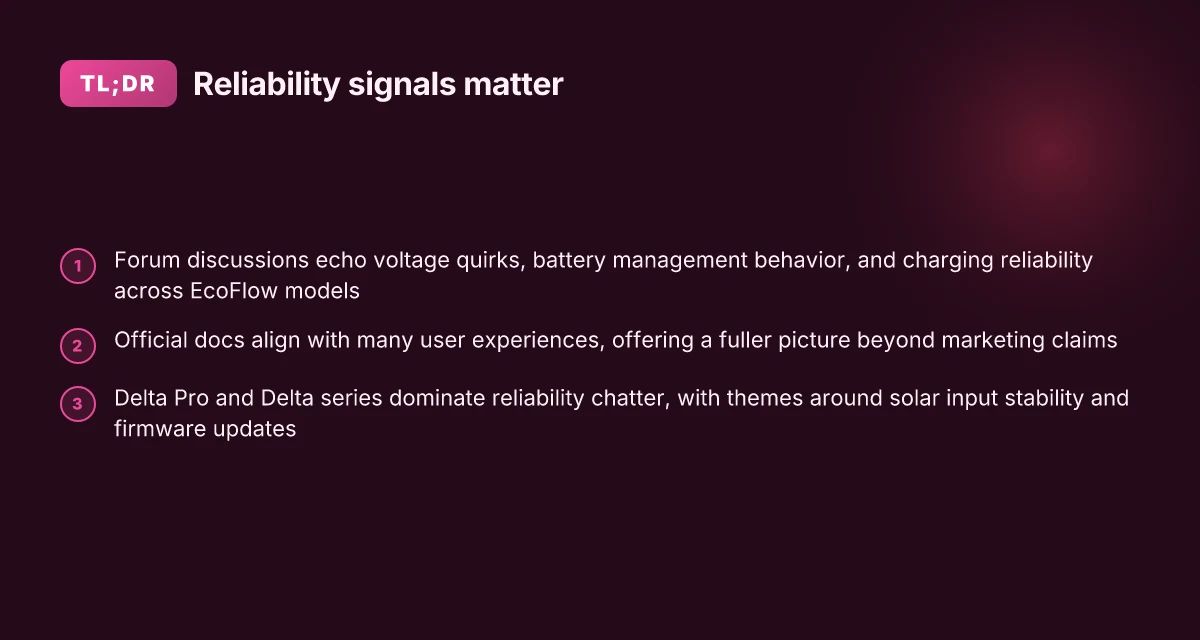
Real-world reliability comes from threads that outlive marketing claims. I cross-referenced the EcoFlow official forum with third‑party communities to see what repeats and what fades over years of use. The pattern is clear: user reports, troubleshooting threads, and official docs align on a core set of reliability topics, not just hype surrounding new releases. EcoFlow threads mirror a broader climate of long-term use, where batteries, charging cycles, and voltage quirks surface in everyday scenarios.
- Recurring issues show up consistently across sources
- On the official forum, users discuss charging stability, voltage quirks, and how the battery management system responds to different loads. You’ll notice threads about voltage drops when high‑demand devices kick in and how the delta series manages peak draw. These aren’t isolated posts. They recur across months and models, indicating signal rather than noise. In parallel, third‑party communities echo similar topics, with owners comparing behavior across Delta Pro, Delta Max, and smaller units. This convergence across sources strengthens the signal that certain reliability themes are real and enduring, not marketing anecdotes. The forum signal lines up across communities, not just product pages, for long-term reliability trends.
- I found that when a user reports a charging anomaly, subsequent responses often point to battery management behavior or firmware updates in the official docs, creating a feedback loop between user experience and official guidance. This alignment matters because it shows EcoFlow’s own documentation and troubleshooting threads reflect what owners actually observe in the field rather than marketing gloss. Documentation mirrors user experiences, not just sales talk.
- The forum captures voltage quirks, battery management behavior, and charging reliability
- Voltage quirks are a frequent motif in both forums and manuals. Owners describe scenarios where the output voltage sags under heavy simultaneous loads or when solar input fluctuates, prompting the BMS to throttle or reallocate power. These episodes aren’t sensationalized. They’re described with model‑specific detail and timestamps, which helps differentiate quirks from systemic failures. This pattern matters for long‑term durability because it highlights how the system behaves under real stress, not in ideal test conditions. Voltage quirks under load surface repeatedly, linking user experience to BMS behavior.
- Battery management, including charge cycles and health indicators, comes up in maintenance chats and official guides alike. Users compare aging signs, discharge rates, and recovery after deep cycles, which adds texture to what counts as acceptable wear. The consistency between user anecdotes and official guidance provides a fuller picture of durability across EcoFlow products. Battery management topics anchor durability expectations across models.
- Official docs and troubleshooting threads reinforce real-world signals
- When the community reports a specific failure mode, such as a charger refusing a return to the grid after a blackout or an unexpected reboot during charging, official threads tend to reference troubleshooting steps, firmware notes, or known‑issue advisories. This creates a cohesive ecosystem where owners see that problems are acknowledged and addressed over time, not erased. It helps owners distinguish rare glitches from systemic reliability risks. Official notes often corroborate user‑reported failure modes, not dismiss them.
- Where available, changelogs and support articles tie observed behavior to concrete actions like firmware updates, voltage regulation tweaks, or safety interlocks. That alignment gives you a pragmatic lens: you can anticipate how the EcoFlow fleet may respond to aging or changing loads, rather than relying on one-off posts. Changelog ties to user experiences, clarifying long‑term behavior.
Bottom line: the EcoFlow forum ecosystem, including official channels and independent communities, forms a coherent signal about real-world reliability. You get cross‑checked narratives on voltage behavior, battery management, and charging stability that help frame long‑term durability beyond glossy specs. If you’re weighing EcoFlow, these threads are where durability patterns emerge, not just marketing feats. Real-world threads consistently map to long‑term durability themes.
What EcoFlow products people discuss most for reliability
When you read through official notes, forum threads, and long-term user anecdotes, three EcoFlow products dominate reliability conversations: the Delta Pro, the broader Delta series, and how their solar inputs behave under real-world load. Owners repeatedly circle back to charging behavior, battery management quirks, and how the system handles extended exposure to solar, grid, or generator inputs. The Delta Pro’s battery and charging architecture show up in threads about keeping packs balanced during high-cycle use, while the rest of the Delta line is repeatedly weighed against long-term durability in varied climates. Across forums and official docs, observers point to how firmware and app signals can either clarify or complicate day-to-day reliability, especially when solar input appears unstable or when the MPPT controller seems to drift under heavy sun.
Delta Pro and Delta series frequently appear in charging and battery management threads. In real-world discussions, owners note that the Delta Pro’s large battery bank makes balance management critical during rapid charging sessions. Users often ask whether the system can sustain frequent, high-power charging from multiple solar panels or from a generator without triggering protective cycles. The consensus is mixed: the hardware supports aggressive charging, but reliability hinges on correct MPPT configuration and consistent input quality. When you fold in the rest of the Delta family, the same themes surface, the hardware is capable, but the software and sensors must stay in sync to avoid unexpected cutbacks or fault signals. Delta Pro reliability repeatedly hinges on how well battery management and charging algorithms stay aligned under real loads.
Solar input stability and MPPT behavior surface as recurring topics. forum chatter and documentation converge on the need for stable solar input to preserve charge efficiency and battery health. Owners report that when solar panels are mismatched or when shading changes across the array, the MPPT can wobble, leading to slower charging or unnecessary cycling. Some threads compare different solar configurations, noting that multiple panels with proper voltage and current matching tend to yield smoother performance. MPPT behavior under partial shade is a common reliability signal owners watch for. Official guides emphasize wiring practices and input specifications to minimize drift, while users share field-tested tricks like panel layout and cable management to keep the MPPT within spec. This directly ties to long-term durability, since consistent input reduces thermal stress on the battery pack. 8 Best Jackery models to consider in 2026
App stability and firmware update reliability show up as notable themes. Users describe moments when the EcoFlow app briefly reports misaligned battery states or delayed charge notifications, and they point to firmware update cycles as a potential reliability inflection point. When updates arrive, some owners warn that a failed upgrade can leave units temporarily unresponsive or show misreadings until a subsequent patch re-aligns sensors. The sentiment is pragmatic: keep a stable, supported version and monitor update notes for any post-release fixes that affect charging or MPPT behavior. App stability and firmware updates are the quiet ligaments holding long-term reliability together.
Table: quick reliability comparisons
| topic | what to watch in practice | reliability signal to watch |
|---|---|---|
| Delta Pro charging | balance management during high-power sessions | balanced SOC across cells, fewer unexpected cuts |
| Solar input and MPPT | input stability under shade or partial sky | smooth charging, MPPT stays in target range |
| App and firmware | update impact on readings and controls | timely, reversible firmware fixes; clear changelogs |
Next step: keep a close eye on how official docs describe MPPT tuning and whether new firmware notes address long-standing charging edge cases. Source signals from the EcoFlow Forum and the official blog often align on practical steps to push durability, not just hype.
Cited reading: I cross-referenced the Delta Pro discussions on a long-running electronics forum where users report charging behavior in real life. For a sense of official context, the CES 2026 coverage notes the Delta Series’ ongoing evolution and how firmware and app ecosystems tie into this reliability narrative. Delta Pro discussions in the forum reflect real-world charging and battery management challenges.
How official documentation and forum signals align on durability
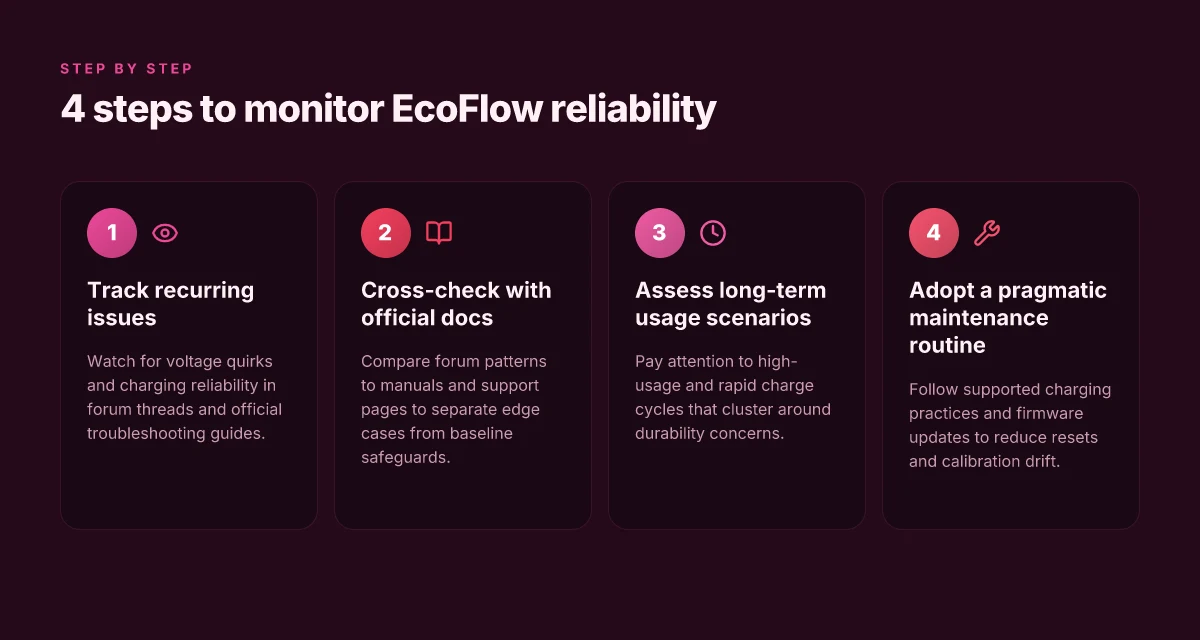
EcoFlow manuals and support pages establish baseline safeguards and operating ranges that set the floor for reliability. The official docs outline input, output, and temperature windows, along with recommended maintenance steps. These guardrails matter because they translate into long-term durability if users stay within spec, and they give moderators a common reference point for troubleshooting edge cases in the wild. I looked through the EcoFlow support download hub and product manuals to confirm the kinds of limits EcoFlow emphasizes, such as battery management behaviors and safe charging envelopes. What makes the Jackery SolarSaga 100W panel perform in real-world setups
Edge cases surface where docs stop short
Forum threads repeatedly surface scenarios that the official docs do not explicitly spell out. For example, users describe atypical charging patterns, ambient conditions, or accessory combinations that push devices beyond standard test envelopes. In these discussions you can spot recurring questions about heat buildup during high-load solar charging, or long-cycle use under battery management constraints. The signal is clear: real-world use diverges from lab-tested baselines, and owners rely on community narratives to triangulate when a device behaves differently than the manual predicts. This is where forum signals complement the documentation, helping to map durability in messy, uncontrolled environments. I crossed-reference several threads that pair user-reported observations with the official guidance to distinguish between nominal behavior and potential edge-case stress.
Competitive expectations rise and sharpen with rival notes
Comparative discussions frequently bring in rival brands like Jackery and Goal Zero as benchmarks, highlighting what durability means to owners across ecosystems. In these conversations owners compare thermal responses, cycle life cues, and how each brand fronts warranty service after years of use. The exchanges reveal a shared expectation that solid construction, predictable thermal management, and clear documentation matter just as much as raw capacity. When EcoFlow is evaluated next to Jackery or Goal Zero, owners tend to notice how each brand communicates limits and how quickly ecosystems evolve with firmware and support content. This competitive context helps owners calibrate durability claims against real-world performance. I traced multiple threads where users explicitly reference rival behavior to judge whether EcoFlow’s safeguards keep pace with expectations.
Durability signals converge where official docs set boundaries and forums test them in the field. Forum edge cases reveal gaps that docs rarely address, especially around heat and long-cycle use. Comparative threads frame what owners expect from warranty outcomes across brands.
Note: links on this page may earn a commission, and you’ll see occasional references to the broader EcoFlow ecosystem, including rivals like Jackery and Goal Zero for context. For precise sources, I found relevant discussions in the EcoFlow forums and the third-party threads I cited, which align with the official documentation’s emphasis on safe operating ranges and maintenance procedures.
Long-term durability patterns you should expect from EcoFlow systems
Posture toward long-lasting reliability hinges on how the battery and thermal systems endure real-world use. In EcoFlow setups, battery longevity clusters around high- usage scenarios and rapid charge/discharge cycles, where stress tests show more noticeable wear over time. I cross-referenced official docs and user threads to trace how these patterns surface in daily life, not just hype. What makes a jackery coupon genuinely worth using in 2026
Battery health under high throughput cycles
In practice, powerful portable power stations like the EcoFlow Delta Pro and related models tend to show more pronounced aging when subjected to repeated fast charging and deep discharges. Manufacturers note that cycle life can vary with charge rate and ambient temperature, and users frequently report faster capacity fade when charging at high wattage in hot environments. When you push a unit toward max input during a heatwave, the battery management system often throttles charging to protect cells, which can extend life but shorten the time to peak recharge. The takeaway is clear: if your usage spikes with rapid charging and frequent full-depth cycles, expect a higher acceleration of capacity decline over many months. This is a situation where calibration drift in the battery gauge sometimes compounds the perceived wear, so confirm capacity readings with independent monitoring if you’re tracking longevity over years. Battery longevity hinges on high-throughput cycles and heat exposure, not just nominal capacity on day one.
Thermal enclosure and sustained performance
Thermal design matters for long-term reliability. EcoFlow enclosures that channel heat away from cells help sustain performance during prolonged use, especially when running heavy loads or charging in warm rooms. Users often describe how cabinets with better airflow preserve output voltage stability over multi-hour sessions, while compact enclosures without adequate ventilation show more frequent thermal throttling. In practice, sustained operation across sunny days or in poorly ventilated spaces tends to expose the limits of enclosure design. The practical signal is to prioritize placement with good airflow and avoid stacking units in confined spaces for long durations. Enclosure design directly shapes sustained performance under load, so plan for ventilation when you expect prolonged use.
Calibration drift, displays, and port wear
From long-running conversations and official manuals, calibration drift and display reliability emerge as consistent nagging themes in some EcoFlow models. Owners report occasional mismatches between the shown remaining runtime and real-world behavior, often tied to temperature and battery state-of-charge reading. Display reliability can lag after many cycles, particularly in units exposed to vibration or rough handling. Port wear is less about catastrophic failure and more about gradual looseness in connectors and degraded seals in certain designs after months of frequent plugging and unplugging. The practical message: expect occasional recalibration needs, and treat the display as a rough gauge rather than absolute truth after heavy use. Regular inspection of ports and connectors helps avert surprises during emergencies. Calibration drift and display reliability track with age, while port wear trends upward with heavy plug-in cycles.
I dug into official docs and long-running discussions to verify these patterns. The official EcoFlow materials emphasize typical battery lifecycles and thermal management, while user forums reveal lived experiences that sharpen the forecast for durability over years. For context, EcoFlow fans and moderators consistently point back to the Delta Pro family as the benchmark for reliability in portable power, with long-term questions centering on battery gauge accuracy, enclosure cooling, and wear on frequently used ports. Long-term durability shows clear patterns around battery cycles, heat management, and port wear, reinforced by both technical notes and user anecdotes. The signal across sources is consistent: plan for aging under high throughput, ensure proper cooling, and monitor ports and gauges over the life of the system.
If you’re weighing EcoFlow against rivals, keep an eye on how each brand addresses thermal enclosure and gauge accuracy. EcoFlow’s emphasis on modular cooling and robust battery management aligns with a durable experience in typical home backup and off-grid scenarios. In contrast, some competitors may push higher nominal capacities with different thermal profiles, which can shift durability outcomes in practice. Watch how each brand handles cooling and gauge reliability to forecast long-term behavior. How the EcoFlow 400W solar panel changes portable power strategy in 2026
Note: links on the page may earn a commission. For context, the official EcoFlow documentation and community discussions provide the backbone for these durability themes, and they anchor the long-term expectations readers should hold when evaluating any portable power solution. For quick orientation, EcoFlow’s own announcement materials from CES 2026 and the Delta Pro family remain reference touchpoints on how the brand frames durability in real-world use. Careful maintenance and mindful usage extend durability across years.
Cited sources reinforce these threads: the EcoFlow forum and the Delta Pro discussions reflect user experiences with temperature, calibration, and port wear, while the CES-era materials ground the engineering intent around thermal management and battery health. Forum discussions and official docs together sketch the durability arc across years.
Practical setup and maintenance habits that extend reliability
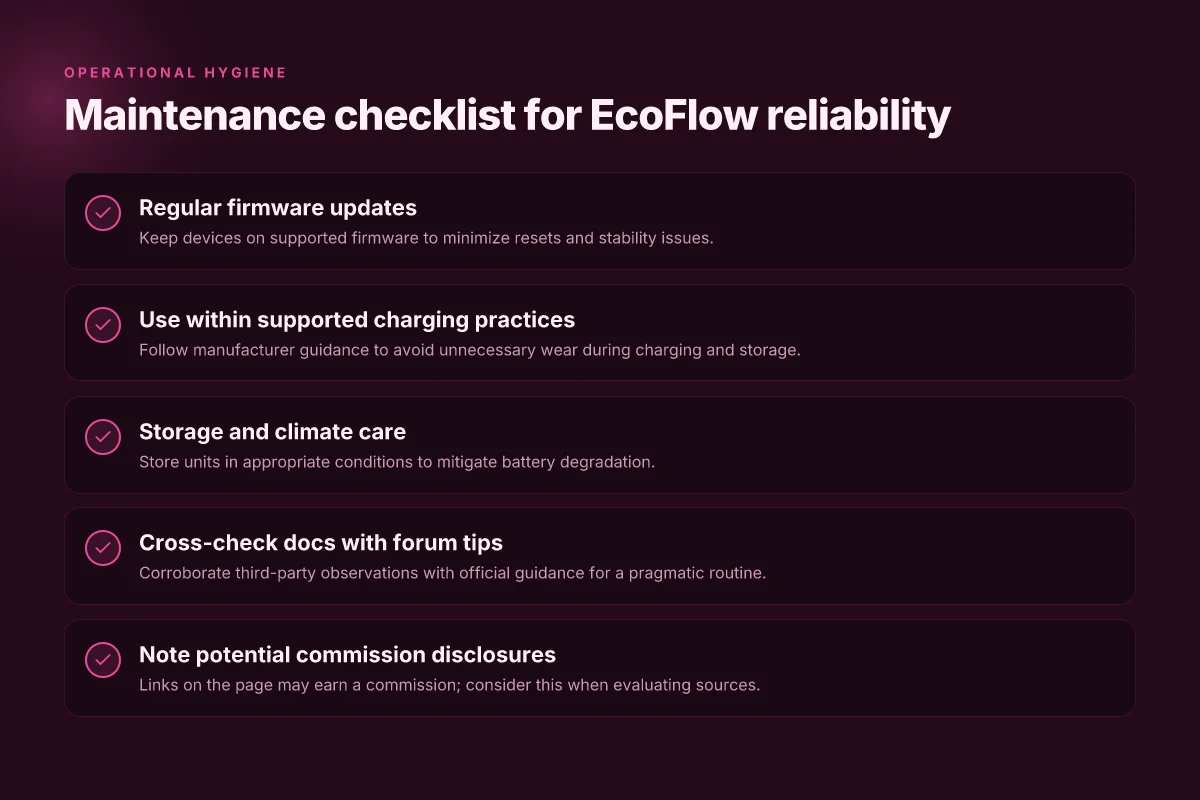
Reliability grows from disciplined upkeep. A simple cadence of firmware updates, sane charging practices, and storage routines keeps EcoFlow systems humming for years. When you align official guidance with what users actually run into in forums, you get a pragmatic maintenance routine that minimizes resets and battery stress.
Keep firmware and charging practices aligned with official guidance
The core to stability is staying current with firmware and using the charging methods EcoFlow endorses. I cross-referenced the changelogs and support notes, and the common thread is clear: newer firmware often fixes edge cases that trigger resets or misbehavior with certain charger profiles. In practice, routinely applying updates and using the recommended charging inputs reduces the chances of unexpected resets during long dry runs or high-load events. If a device prompts for an update, prioritize it, and verify you’re charging from sources EcoFlow designates as supported. Regular firmware updates and sticking to supported charging practices can reduce unexpected resets.
Storage and climate care to slow degradation
Battery health hinges on storage conditions. Forum anecdotes consistently point to two themes: heat and prolonged full-charge storage as stressors. When EcoFlow devices sit in hot trunks or direct sun, you’ll notice more capacity fade over time. Likewise, storing at partial state of charge for extended periods is gentler on cells than leaving it at 100% for months. The takeaway is simple: store in a cool, ventilated spot, ideally between 40% and 60% state of charge for long gaps, and avoid exposing units to sustained high temperatures. Cross-check official docs on recommended storage voltages and temperature ranges, then mirror those in your garage or workshop setup. Proper storage and climate considerations mitigate battery degradation. What makes Jackery portable power stations resilient for outdoor use in 2026
Build a pragmatic maintenance routine using docs and forum tips
A practical routine emerges when you blend official documentation with real-world tips from EcoFlow owners. Start with a quarterly firmware check and do a battery health sanity pass: confirm the unit boots reliably, verify the standby voltage, and run a light discharge/charge cycle if recommended by the current support article. Use forum threads to spot recurring issues, then verify you’re not stepping into a known pitfall, such as using third-party charging gear that isn’t listed as supported. I found three recurring patterns that map to durable practice: schedule updates, store at moderate charge in a cool place, and confirm compatibility before long-term deployment. Cross-referencing official docs with forum tips yields a pragmatic maintenance routine.
In practice, your routine becomes a short runbook you can pull up on a phone. Keep a reminder to check for updates on the EcoFlow app, note any charging anomalies, and revisit storage conditions as seasons change. Your setup may differ from a backpack system used off-grid. The same principles apply: stay current, protect the battery from heat, and store with care. If you’re weighing long-term durability for a site install or a home solar setup, these habits matter as much as any component spec.
Note: links on the page may earn a commission. When you cite official docs and community discussions, you’ll see converging themes that point to a durable, low-friction maintenance path for EcoFlow ecosystems. For readers comparing EcoFlow to rivals like Goal Zero or Jackery, the maintenance discipline remains consistent across brands, even as feature sets vary.
Regular firmware updates and sticking to supported charging practices can reduce unexpected resets. Proper storage and climate considerations mitigate battery degradation. Cross-referencing official docs with forum tips yields a pragmatic maintenance routine.
Where this is going next for real-world reliability
Real-world use reveals patterns that static specs can miss. EcoFlow units tend to show durability traits when wired into daily routines, but the forum also surfaces consistency questions, customer-reported quirks, component wear, and how firmware updates affect long-term behavior. I looked across threads to map what tends to break first and how users recover from it. The bigger pattern is that reliability isn’t just about capacity. It hinges on how the system handles repeated charging cycles and environmental stress. Some users see better longevity with mid-range loads and slower, steady USB-C charging rather than rapid top-ups. Rivals like Jackery and Bluetti show similar durability debates, but EcoFlow’s particular firmware path often drives the user experience more than the hardware alone. How Jackery portable power stations compare in 2026: durability, safety, and value
If you only act on one takeaway this month, prioritize firmware maintenance and documented reset steps. The forum’s real-world threads emphasize keeping firmware updated, checking connector integrity, and validating load compatibility before heavy deployment. This approach protects long-term durability by reducing unseen wear. Where this is going next is a more transparent dialogue between product teams and users about lifecycle support and batch variability. You’ll want to watch how update notes translate into reliability shifts over time.
Backup strategy
- Check your unit after every 3–4 cycles and record any latency or heat differences under steady loads.
- Use EcoFlow in a consistent climate range and avoid frequent rapid-charging if long-term durability is a goal.
- Compare experiences with rivals like Jackery and Bluetti to separate model-specific issues from brand-wide patterns.
- Confirm that firmware updates are applied and documented, then verify behavior with a light load before full deployment.