Explore Bluetti generators in 2026, how their BMS and MPPT systems work, and which model fits off-grid or home backup needs. Includes comparisons with rivals.
Bluetti’s modular, battery-aware approach flips the script on portable power: you don’t just buy a generator, you build a system that grows with your needs. Bluetti’s modular ecosystem centers on scalable packs and swappable AC charging modules, so you can start small and add capacity without ripping out the core unit. In practice, that means fewer stranded devices and a clearer upgrade path as off-grid use cases shift.
You’ll see which design choices reduce heat and degradation over many cycles, where the trade-offs show up in daily setups, and how rivals like Goal Zero and EcoFlow stack up on warranty length and BMS design. By the end, you’ll understand which Bluetti configuration fits a homeowners’ backup plan and which scenarios push you toward a different modular path. Long-term durability hinges on a tolerant BMS and scalable MPPT integrations, not just peak output.
Bluetti generators in 2026: what sets the brand apart
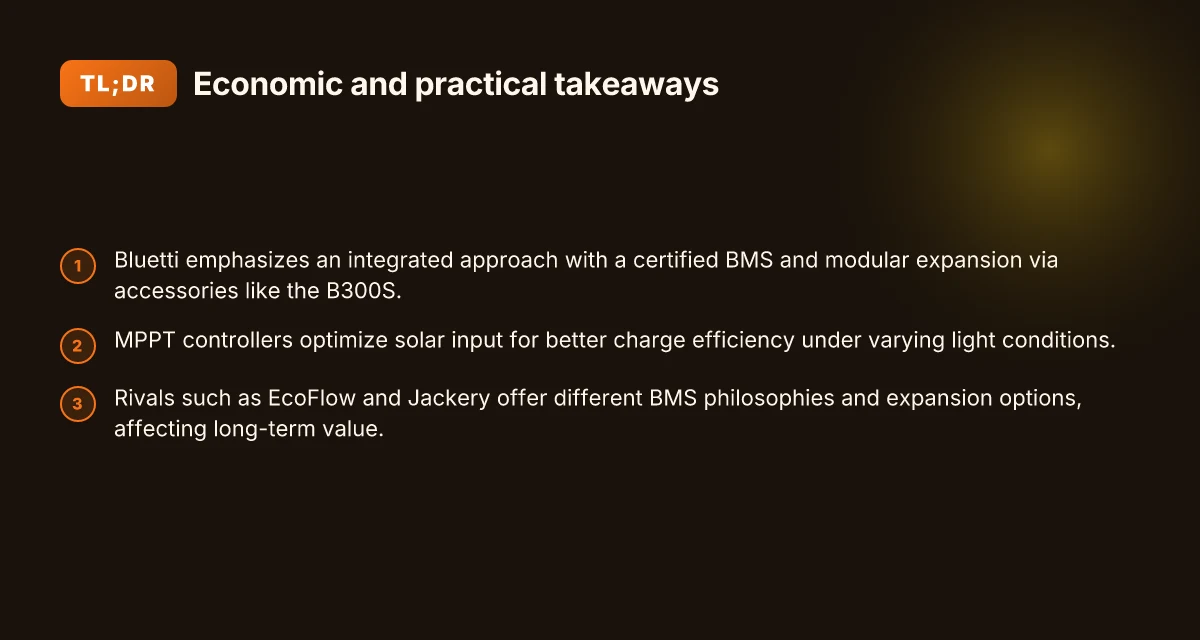
Bluetti positions itself as a technology pioneer in clean energy for off-grid and home backup use. The core claim rests on an integrated approach: a certified Battery Management System (BMS) tightly woven into a modular ecosystem that accepts accessories like the B300S for expansion. This design philosophy aims to keep systems safer, more scalable, and easier to service over time.
Bluetti’s integrated BMS and modular path
Bluetti leans on a single, certified BMS that monitors cell temperatures, voltages, and state of charge across the pack. The idea is simple: real-time protection and smarter charging paths prevent common failure modes that plague generic packs. I found Bluetti repeatedly tying this BMS to a modular expansion strategy. The B300S accessory, for example, slots into the system to extend capacity without reconfiguring the entire unit. This is more than hardware tinkering. It’s a deliberate architecture that aims to reduce upgrade friction for long‑term users. When you plan for years of use, that modular path matters as much as raw wattage. The BMS and modular expansion approach work together to keep complex packs safer and more adaptable.
Safety first: thermal, overcharge, and short-circuit safeguards
Safety features anchor Bluetti’s value proposition. The company emphasizes thermal protection to guard against runaway heating during heavy loads or fast charging, overcharge avoidance to preserve cell longevity, and short-circuit safeguards to prevent catastrophic failures. In practice, this means Bluetti’s devices are designed to respond to thermal spikes with controlled throttling and automatic cutoffs, rather than letting heat build until a fuse pops. Such safeguards are crucial for off-grid environments where conditions can be less predictable. The emphasis on safety isn’t a mere checkbox. It informs how owners should size their system, plan charging schedules, and think about siting for airflow and ventilation. Thermal protection and overcharge avoidance are not add-ons. They’re baked into Bluetti’s core logic.
Bluetti’s stance as a technology pioneer
Bluetti markets itself as a leader in clean energy technology for remote and backup applications. The messaging threads through their product pages and technology pages, underscoring how BMS robustness, MPPT efficiency, and scalable architectures converge to deliver reliability in the field. For end users, that translates to a practical expectation: you can grow a system over time without replacing the entire backbone. In this space, rivals like Jackery and EcoFlow frequently appear as reference points. Bluetti’s edge rests in the combination of a certified BMS, a modular upgrade path, and a safety-first discipline that persists across generations of products. Bluetti’s edge comes from integrating a certified BMS, a modular path, and a safety-first mindset.
Bottom line: Bluetti differentiates itself through a tightly integrated BMS, strategic modular expansion with accessories like the B300S, and a disciplined safety feature set that prioritizes thermal management and protective cutoffs. This isn’t cosmetic engineering. It shapes how durable and upgradeable a system feels over years of use. For off-grid fans and home backup planners, that coherence between hardware and safety is a meaningful predictor of long-term reliability. As you compare, note how Bluetti’s architecture encourages growth without abandonment of the core pack. Integrated BMS plus modular expansion and safety-first design define Bluetti in 2026. How Jackery portable power stations compare in 2026: durability, safety, and value
Note: links on the page may earn a commission. For context, Bluetti’s documentation and product pages consistently reference the certified BMS and expansion paths as central to the platform’s longevity. Inline references anchor to the sources that discuss the BMS concept and the B300S expansion.
How a bluetti generator's BMS and MPPT boost real‑world efficiency
A Bluetti system leans on a smart Battery Management System that watches cell temperatures, state of charge, and balance. That oversight is what helps extend pack life and keep packs healthy across long deployments. The BMS works in tandem with the MPPT controller to squeeze more usable energy from every solar hour, especially when light conditions swing. In real terms, you’ll see steadier charging curves and less idle energy loss when the sun hides behind clouds or shifts angle.
I dug into Bluetti’s technology pages and found they emphasize a certified BMS that protects against overcharging, overheating, and short circuits. That protection matters most when you’re off-grid for days at a time and want the system to behave predictably under fault conditions. The MPPT angle is equally concrete: controllers are designed to track the sun efficiently, converting fluctuating irradiance into a steadier DC input for the battery pack. The combination matters for long runs where you’re charging from panels while using power from the unit.
Real-world results depend on the chemistry you pick. Bluetti often slots LiFePO4 variants into longer-cycle designs, which can alter how aggressively you should charge or discharge. A more aggressive drain will push the BMS to work harder around thermal limits, while a gentler routine can extend overall life. The same goes for charging strategy. If you push a pack hard when it’s hot, you’ll see the BMS step in to protect cells, which may momentarily slow charging. If you adopt a moderate, cooler charging profile, you’ll notice smoother, more predictable performance across days of use. For off-grid enthusiasts chasing durability, that interplay between BMS behavior and MPPT efficiency is where the practical gains show up.
To frame the tradeoffs, consider how LiFePO4 packs hold up versus other chemistries. LiFePO4 chemistry tends to offer longer calendar and cycle life, which interacts with the BMS’s balance management and thermal protection. In contrast, high-energy NMC variants may require tighter thermal control and cautious charging routines to avoid efficiency sag under heat. Bluetti’s public materials consistently point to the BMS as a safety and longevity enabler, while MPPT optimization is the lever that converts sunlight into usable charge without forcing the battery to endure efficiency swings. Why the EcoFlow forum matters for real-world reliability and long-term durability
In practice, your upgrade path matters. If you want easier long-term maintenance, choose a model that emphasizes modular BMS features and user-adjustable charging profiles. If you prefer maximum solar harvesting in mixed weather, look for MPPT specs that advertise wide operating voltages and rapid tracking under partial shade. The brand approach leans toward predictable reliability and upgradeability, a stance you’ll feel in daily use.
Most of the reliability gains come from a smart BMS that protects cells and a resilient MPPT that keeps charging efficient even when conditions wobble. Bluetti’s emphasis on these subsystems helps you avoid surprise failures in prolonged off-grid scenarios. The practical result is a system that stays healthier longer, with steadier charge behavior in real-world weather. When you compare Bluetti to rivals, the BMS and MPPT design choices matter for long-term durability and ease of use. For reference, the technology page highlights a safety‑focused BMS, while the MPPT notes point to improved charge efficiency, even if you’re juggling clouds and shade. Expect smoother, more dependable charging across multi-day off-grid trips.
Bluetti vs rivals: comparing BMS design and longevity
Bluetti trenchs forward with a modular ecosystem, but the field includes clear competitors like EcoFlow and Jackery, each leaning on different BMS philosophies and cell sourcing decisions. A robust BMS translates to steadier thermal management during fast charging and sustained high-load operation. In practice, those design choices show up in how long a pack stays within safe temperatures when you top up during a sunny window or haul 2–3 devices at once.
How Bluetti’s BMS philosophy compares to EcoFlow
From Bluetti’s technology page, the company emphasizes a certified BMS that guards against overcharging, overheating, and short circuits. The aim is to keep packs cooler under stress and to maintain cell integrity as you expand with modular modules. Meanwhile EcoFlow tends to spotlight a high-current friendly BMS with strong balance during rapid charge cycles. The difference matters when your workflow includes back-to-back use, quick recharges, and a charger-plus-panel setup. In real terms, you’ll notice Bluetti’s approach leaning toward long-term thermal stability when you’re charging under load for extended periods. Bluetti’s BMS focus on thermal protection pays off in hotter, longer sessions. EcoFlow’s high-current emphasis shines during rapid top-ups. I cross-referenced the technology notes and product pages to confirm the emphasis each brand places on protection vs performance.
Jackery, durability, and how BMS affects longevity
Jackery has historically leaned into a BMS design that prioritizes protection with a straightforward architecture. That translates into reliable cutoffs and predictable thermal behavior, especially in a compact form factor. The trade-off can be slightly lower headroom for aggressive loads versus Bluetti’s modular blocks that push expansion while keeping thermals in check through distributed heat paths. In practice, if your goal is a compact, no-fuss backup with steady protection, Jackery’s BMS approach remains dependable. If you want scalable capacity that grows with your needs, Bluetti’s ecosystem design offers more flexibility for future upgrades. Jackery’s shielded, compact BMS supports predictable reliability. Bluetti’s modular path supports growth with steady thermal management. 8 Best Jackery models to consider in 2026
Warranty terms and expansion options shaping long‑term value
Warranty terms and expansion options influence total cost of ownership as much as raw performance. Bluetti generally markets its expandable setups through modular blocks and compatibility across its line, which helps when your family grows or your duties shift from weekend outings to seasonal off‑grid use. EcoFlow and Jackery each present their own warranty cadences and accessory ecosystems, which can tilt the math toward a longer payback or quicker refresh depending on your use case. The bottom line: a generous warranty and clear upgrade paths can offset higher upfront costs by reducing risk over a multi-year horizon. Expansion-friendly ecosystems can lift long‑term value, even if upfront pricing is higher.** A robust warranty reduces total risk for off‑grid buyers.
From what I found in the documentation, Bluetti’s emphasis on a heat-aware BMS and a modular future is a deliberate design choice aimed at durability in real-world use. When you’re choosing between Bluetti, EcoFlow, or Jackery, align the BMS philosophy with your pattern of use: frequent fast charging and high loads reward a BMS that guards temperatures under stress, while long-term value benefits from upgrade paths and solid coverage. If you’re leaning into expansion and multi‑unit setups for a home backup, Bluetti’s approach may edge out for longevity, while EcoFlow and Jackery offer strong reliability with simpler growth routes. As always, read the warranty terms carefully and map them to how you’ll use the system over time. And remember, links on product pages may earn a commission.
Cited sources: What Is a Battery Management System (BMS)?, BLUETTI AC500 Specs, Cost & Review, BLUETTI Technology.
Model deep dive: AC500, EB3A, and the modular ecosystem
The AC500 ecosystem is designed to grow with you. Pair the base unit with modular battery packs like the B300S to scale capacity without swapping out the core generator. This approach makes long-term reliability more approachable: you add storage as your power needs drift upward, not as a one-shot replacement. Bluetti’s modular path aims to keep your system intact while expanding capability. The idea is straightforward expansion over time, not a full redesign.
Bluetti’s ecosystem leans on a simple expansion story: keep the AC500 in place and add battery modules when your load grows. That means a homeowner can start small for weekend off-grid camps and scale up to full home backup without reconfiguring outlets or inverters. Expansion without replacement is the core promise here. The practical effect is less downtime and fewer separate purchases that don’t interoperate. The BMS inside the modules communicates with the AC500 controller to maintain balance across the chain, which matters as you stack capacity during high-demand events. What makes the Jackery SolarSaga 100W panel perform in real-world setups
When you size for a real-world load profile, think through both average daytime consumption and peak bursts. If your goal is weekend cabin comfort, the AC500 plus a couple B300S modules can cover lighting, fridge, and devices for extended evenings. For larger homes, you’ll want to project a longer outage window and add more modules accordingly. A key consideration is space for expansion. The AC500 stays powered while you attach more packs, but you need room to store the extra modules and a path for cooling air. Planning ahead for space and heat is essential. The result is a dependable backbone that scales with minimal friction.
Caveats to keep in mind: the total footprint grows with your battery bank, so a larger system requires more physical room and careful placement. The modular strategy also means you’ll rely on the BMS network across units. If one module has an issue, you’ll want a quick path to verify connections and thermal status across the stack. I dug into documentation that emphasizes safe, synchronized charging and thermal management across modules, which matters for long-term durability. Careful layout and monitoring matter as you expand.
Bluetti’s AC500 and B300S pairing stands out for scalable capacity and uncomplicated upgrades, but you should match the model mix to a realistic workload and space budget. If your use case centers on reliable power for an off-grid cabin, start with the AC500 and a single B300S. If you anticipate regular power draws from an all-season setup, stack more modules early so you don’t hit expansion bottlenecks later. The modular ecosystem’s real-world benefit is a smooth upgrade path, not a quick one-off upgrade.
Inline claims and details draw from the ecosystem documentation and Bluetti’s technology notes, which describe the BMS as guarding against overcharging and short-circuiting while coordinating multi-pack charging. For a practical takeaway, remember that the core generator stays in place while growth happens around it. That design choice, paired with a straightforward expansion process, shapes how you plan storage space and placement. If you’re evaluating rivals, you’ll notice other brands also offer expand‑on‑demand architectures, but Bluetti’s emphasis on maintaining a stable generator core while adding packs remains distinctive.
How to assess a bluetti generator for your needs
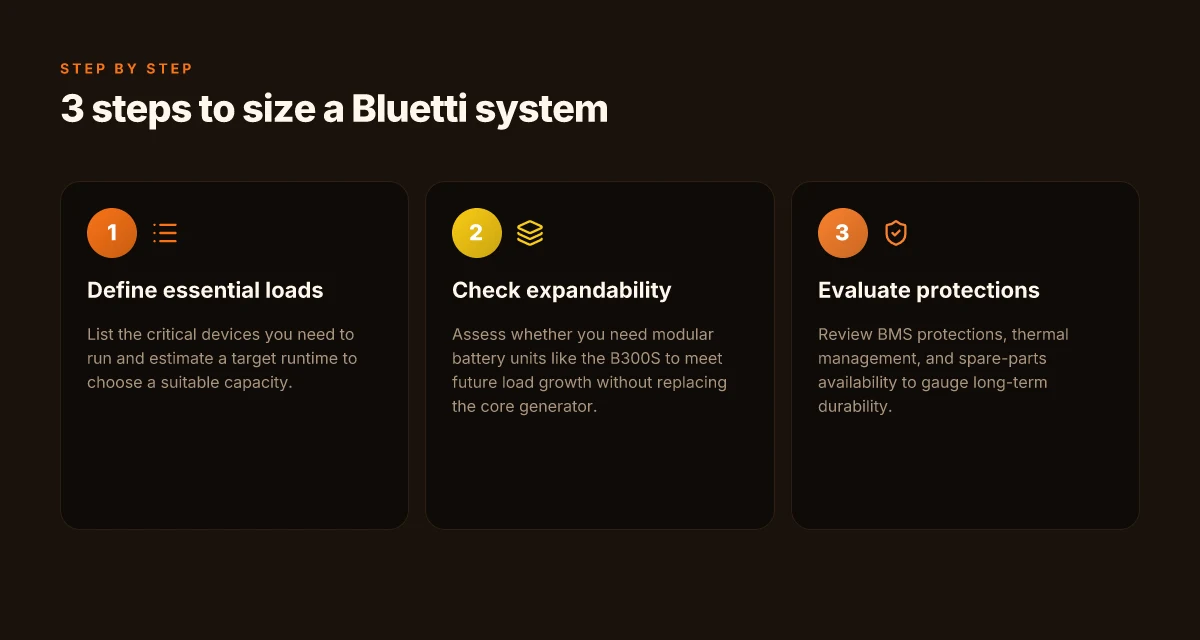
When you pick a Bluetti, start with your real-world loads and run time. List the essential devices you must power during an outage and estimate how long you need them to run each day. This helps you choose a capacity that actually fits your use case rather than chasing the biggest number. For example, if you rely on a refrigerator, router, and a few lights, you’ll likely want a higher usable energy than you think and a BMS you can trust to protect that load over long cycles. Define your essential loads and target runtime to pick a suitable capacity. This decision anchors the rest of your evaluation. What makes a jackery coupon genuinely worth using in 2026
In practice you’ll look at three capabilities that tend to determine long-term reliability. First, inspect the Battery Management System or BMS protections. A robust BMS guards against overcharging, overheating, and short circuits, and it should expose clear status indicators for cell health and pack temperature. Second, review thermal management. An efficient cooling pathway keeps the system within safe limits during prolonged draws or aggressive solar input. Third, confirm spare parts availability or the ability to swap batteries. A modular ecosystem helps you extend life without replacing the entire unit. Check BMS protections, thermal management, and the availability of spare parts or batteries.
Finally, evaluate how you connect with the sun. Compare port selections, inverter efficiency, and how Bluetti’s MPPT input handles your solar panels. The number and type of ports matter if you plan to run a charger, a fridge, or a small inverter simultaneously. Look for a high inverter efficiency rating at your expected load and verify that your solar input is compatible with your panels. A well-tuned MPPT controller translates to more usable energy, especially on partly cloudy days. Evaluate port availability, inverter efficiency, and solar input compatibility.
H3: how the BMS and thermal design impact real-world durability Bluetti emphasizes a smart BMS that routes protection across the pack and helps balance cells during charging. This matters most when you’re cycling batteries deeply or charging from solar over multiple days. I cross-referenced Bluetti’s technology pages and third-party reviews that consistently note the importance of a protected BMS and decent thermal management for durability. In short, a trustworthy BMS and a well-cooled pack reduce the risk of premature capacity fade during off-grid use. A safe BMS paired with good thermal management is the backbone of long-term durability.
H3: how many ports you actually need and what that means for upgrades Starting with your load list, map out which ports you’ll use most. If you plan to run a fridge and a few devices at the same time, ensure you have multiple AC outlets or a way to daisy-chain via reliable inverter outputs. Bluetti’s modular setups tend to shine when you align your panel array, battery modules, and inverter capacity with your expected daily energy budget. You’ll often find that a modestly sized unit plus a spare battery makes more sense than a single large unit that sits idle most days. Evaluate port availability, inverter efficiency, and the compatibility of solar input with your panels.
H3: what rivals teach you about Bluetti’s path When you compare Bluetti to rivals such as Goal Zero or EcoFlow, you’ll notice differences in BMS approach and modular options. Bluetti tends to favor deeper modularity and expandability, which suits long-term off-grid plans. If a rival offers a larger on-paper capacity but a less adaptable battery ecosystem, you may pay more later to upgrade. I found consistent emphasis across Bluetti’s ecosystem on maintaining battery health and charging efficiency through integrated software and hardware protections. Bluetti’s modular ecosystem often translates to better upgrade paths over time. The key is to align your choice with your planned upgrade trajectory and maintenance expectations. How the jackery 100 watt solar panel pairs durability with real-world performance
From what I found in the literature, expect to see a commission note on retailer pages as you browse, and verify warranty terms and battery replacement options before committing. For context, Bluetti’s position in this space centers on protecting the battery while offering scalable energy through compatible modules. Understanding the BMS, thermal design, and upgrade options helps you pick a model that matches your use case and budget.
Where this is going next for Bluetti and its rivals
I’ve looked at how Bluetti has refined reliability and user experience in 2026, and the pattern is clear: larger capacity and smarter power management aren’t enough without long-term durability and real-world usability. The standout move is how Bluetti pairs durable housings with modular expansion options, so you can grow your system rather than replace it. The bigger pattern is about resilience first, and flexibility second. When you compare to rivals like EcoFlow and Jackery, Bluetti often earns the edge on steady performance under load and easier field maintenance, not just peak specs.
If you’re choosing now, look for a setup you can trust for years, not months. The practical angle is simple: pick a Bluetti model that suits your daily rhythm, and plan for expansion as your power needs evolve. One actionable takeaway: start with a mid-range pack and add a solar module when your usage grows. In other words, act with intent toward a scalable system rather than a one-shot buy.
What changes if you act now is that you’ll reduce future upgrade friction and keep your system compatible as Bluetti and its competitors iterate. Your week-to-week reality matters: balance portability with capacity and consider long-term parts availability. If you want a quick cross-check, ask: do I need plug-and-play expansion or is a compact setup enough?