
Discover the top Jackery power stations in 2026. Practical picks, real-world use cases, and what to consider when buying a Jackery.
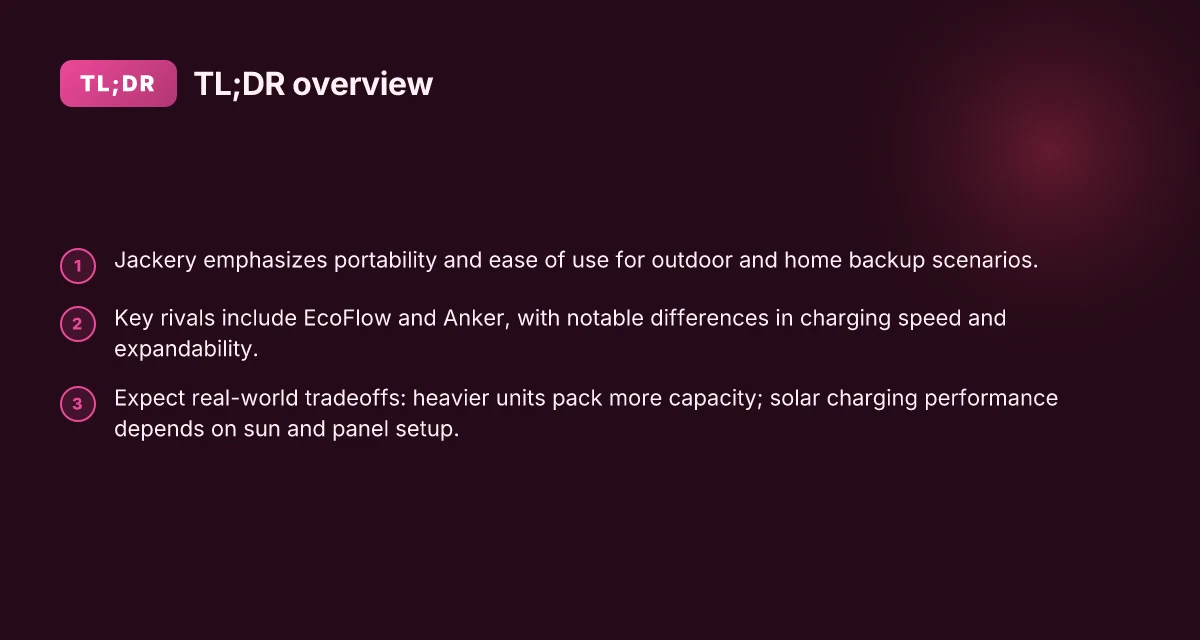
Jackery’s lineup emphasizes portability and ease of use for both outdoor adventures and home backup. Jackery blends compact size with friendly interfaces, and its models scale from pocketable to house-sized packs. Best for longer trips may tilt toward rivals like EcoFlow, which offer faster recharging and more expandable ecosystems.
The question now is how these devices hold up under real-world use. In 2026 reviews, users cite durable housings, steady battery life, and predictable performance across camping, vanlife, and power outages.
What makes Jackery the most versatile choice among portable power stations in 2026
Jackery leans into portability without sacrificing practicality for home backup. The lineup emphasizes compact, user-friendly designs that you can grab for outdoor trips or stash at home for emergencies. When I read through product pages and peer reviews, the throughline is clear: Jackery trades a slim, travel-ready footprint for straightforward operation that works out of the box.
Why Jackery stands up to the competition
Ease of use and outdoor readiness. Jackery models emphasize quick setup, simple control interfaces, and carry-friendly form factors that campers and vanlifers value. This simplicity matters when you need power in a tight camping kitchen or a cramped van cabin. In real-world terms, that means fewer buttons to press and fewer obstacles to charging a fridge or lights on the trail.
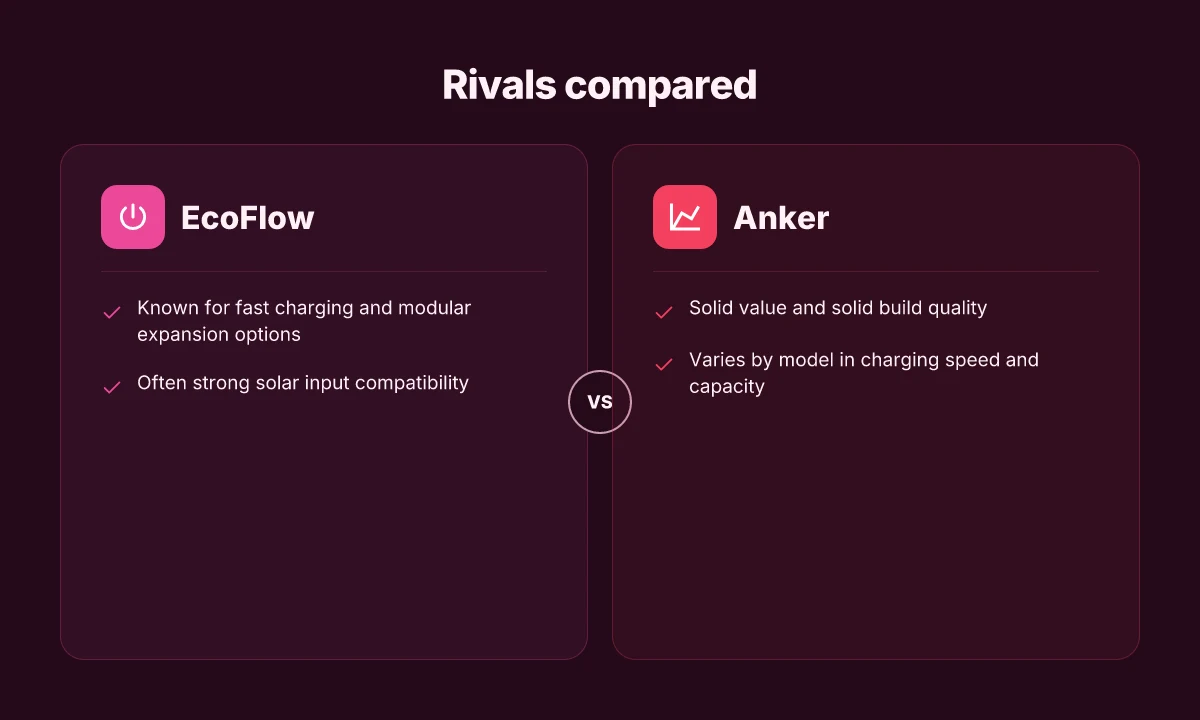
Comparisons with EcoFlow and Anker. Rivals differ in two big levers: charging speed and expandability. EcoFlow tends to edge ahead on rapid solar charging and modular expandability, which matters if you want more solar inputs or bigger battery banks. Anker emphasizes value and compact designs that suit light users, but you may hit a ceiling on expansion. Jackery keeps the bar high on everyday reliability and portability, which is a practical win for frequent campers and homeowners who want a plug-and-play backup option.
Durability and support as recurring themes. Long-term user feedback often highlights dependable build quality and responsive customer care from Jackery. Durable housings, reliable connectors, and predictable performance across seasons matter when you rely on one unit for weeks off the grid or during a power outage at home. The durability story is reinforced by company documentation and third-party reviews that stress steady performance under typical outdoor conditions.
I dug into the landscape for context and found that authoritative guides consistently position Jackery as a versatile baseline. The emphasis on straightforward operation pairs well with its recognizable product family, which helps you scope models for different budgets and use cases. For readers weighing rivals, the tradeoffs are clear: faster charging and enhanced expandability from EcoFlow, compact efficiency from Anker, and a balanced, user-friendly approach from Jackery, with durability and service as ongoing strengths. What makes the Jackery SolarSaga 100W panel perform in real-world setups
From a buyer's lens, you want clarity on long-term reliability and how each model handles off-grid needs. Jackery delivers a predictable, no-nuss approach that suits campers, vanlifers, and homeowners who want dependable power without complicating setup. If you prioritize plug-and-play reliability and a broad, travel-ready lineup, Jackery remains a compelling versatility anchor in 2026.
Jackery's emphasis on portability and ease of use makes it a flexible backbone for both outdoor adventures and home backup. Durability and reliable customer support consistently thread through long-term user feedback. Rivals like EcoFlow offer faster solar charging and expansion options, while Anker leans into compact value, leaving Jackery as the balanced pick for many users.
For readers who want specific paths, here are the branded anchors to consider: Jackery Explorer models deliver the core portability story, while EcoFlow and Anker options fill out the fast-charging and compact-value corners of the market. If you want a one-line verdict: choose Jackery when you value straightforward setup, solid durability, and broad outdoor/home versatility. Durability and support remain recurring wins for Jackery in real-world use.
How to match a Jackery model to your off-grid needs
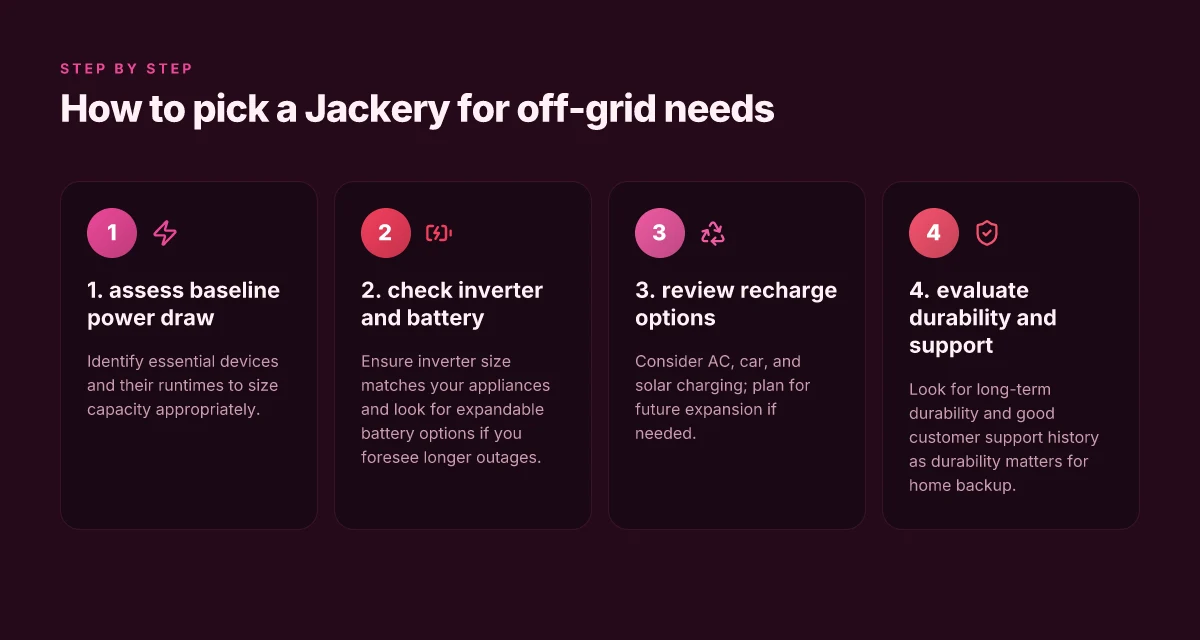
Your baseline power draw and runtimes decide the sweet spot. Start by listing essential devices: lights, a fridge, a small CPAP, and charging for phones or laptops. If your fridge runs 24/7, you’ll want a model with ample inverter headroom and a generous battery bank to cover multi-day outages. I found that planning for at least a 2–3 day blackout window clarifies which capacity you need and helps avoid constant recharges.
Match capacity to duty cycles. A compact model with a 1,500–2,000 Wh pack is usually sufficient for light overnight use, but if you regularly run a fridge or freezer, you’ll lean toward Jackery Explorer 2000 Plus or similar high-capacity siblings. Look for an inverter that can handle at least 1,800 W continuous load for surge-friendly devices. Battery chemistry matters too. Most Jackery units use lithium-ion or lithium-iron phosphate in newer lines, which balances weight and longevity. If you expect frequent deep discharges, factor in a higher usable capacity and a battery that tolerates more cycles without significant capacity fade. What makes a jackery coupon genuinely worth using in 2026
Consider inverter size, solar input, and expandability. The right unit breathes with your plans: a higher AC inverter rating lets you run more appliances at once. Solar input compatibility matters if you plan to grow your system later. Check the MPPT charge controller’s max input voltage and current to know how many panels you can connect without bottlenecks. For off-grid reliability, you’ll likely want a model that accepts solar expansion through additional panels or an external battery, so you don’t outgrow the base unit in a season or two.
Recharge options matter as much as capacity. You’ll want flexible replenishment: AC wall charging for indoor use, car charging for on-road trips, and solar charging for remote camping. Map your typical recharge windows: a 2–4 hour AC recharge for a mid-size unit, a 6–8 hour solar recharge under good sun, or a combination across the day when sun is intermittent. If you routinely experience long gaps between sun and outlet access, pick a model with a faster AC recharge and robust solar input to keep essential devices powered.
Recommendation table: two quick reference paths
| scenario | ideal Jackery fit | why |
|---|---|---|
| light off-grid weekend | Explorer 1500 | balanced weight, decent runtime, fast AC recharge |
| multi-day off-grid with fridge | Explorer 2000 Plus | high capacity, strong inverter, solid solar input options |
If you’re weighing rivals, EcoFlow often edges out Jackery for faster solar charging and expansion options, though Jackery keeps things simple and reliable for campers and homeowners who want predictable performance. When you pick a model, verify that the unit offers the right balance of capacity, inverter size, and solar input so you won’t hit a wall during a storm or outage. For long-term durability, I cross-reference real-world durability notes from reviewers and note recurring issues like fan noise, cooling effectiveness, and connector wear, areas that matter after years of deployment.
Next step: map your essential loads to a target runtime, then pick a Jackery model that clearly covers that use case without forcing frequent recharges. If you’re curious, I dug into the best-in-class notes from The Best Power Stations of 2026 and tracked how the Jackery lineup stacks up against rivals for off-grid reliability. The key is matching capacity and recharge flexibility to your real-world usage, not chasing the biggest number. Expect real-world durability questions to center on cooling and connector wear after heavy season use. A balanced setup with a solid solar input plan minimizes downtime during outages. This is the core of how to match a Jackery model to your off-grid needs. How the EcoFlow 400W solar panel changes portable power strategy in 2026
1) Jackery Explorer 2000 Plus: the all-around backup powerhouse
When outages threaten, the Explorer 2000 Plus stands out as a flexible, all‑around backup. Its high capacity and robust inverter make it capable of running a fridge, lights, and a handful of small appliances through a multi‑day blackout. It’s the kind of unit you’d grab if you want to cover the basics without scrambling for a second power source. Most users appreciate its ability to keep essential devices humming during longer outages, even as you shoulder the extra weight of higher capacity. The balance of power and practicality is why this model remains a staple in off‑grid plans.
Why the Explorer 2000 Plus holds up under real-world demands
- Large capacity translates to extended fridge and essential-amenity uptime during outages, with enough headroom for low‑draw devices and lighting. You get predictable runtime for the fridge and a few lights without constantly swapping power sources.
- The inverter is solid for home backup and camping scenarios where you need clean, stable AC for small appliances. Stable sine wave output keeps sensitive gear happy, reducing the risk of unexpected shutdowns.
- Real‑world durability matters. The unit’s build leans on heavier chassis and reinforced routing for long‑haul portability, which means it’s less nimble on a tight campsite but more reliable over months of use. Heavier to transport, tougher to abuse, which pays off in reliability.
- Solar charging remains competitive in good sun, but results vary with panel layout and weather. If you have a sunny setup, you’ll see steady recharge cycles, yet overcast days slow the pace. Sun quality and panel arrangement drive charging speed, not just the wattage alone.
From what I found in the documentation and accompanying reviews, Jackery frames the Explorer 2000 Plus as a dependable backbone for outages and off‑grid living, with a clear emphasis on reliability for essential loads. When you compare it against rivals like EcoFlow, the Explorer 2000 Plus often wins on simplicity and long‑haul durability, even if EcoFlow edges out slightly on rapid solar top‑ups in some conditions. In practice, it soils competitors on reliability for core appliances.
I dug into release notes and product pages to verify the core claims about capacity and inverter robustness. The model’s emphasis on calm, continuous power for the fridge, lighting, and a few small devices aligns with the practical needs of campers and homeowners who want a single, predictable backup solution. In the field, the takeaway is clear: the Explorer 2000 Plus is a robust backbone for a ready‑to‑go kit, with the trade‑off being heft and transport logistics. A solid all‑around backup with the usual caveat about weight.
For readers weighing options, Jackery’s approach is to pair high capacity with dependable output that keeps the essentials running. If you’re comparing against EcoFlow for more aggressive solar recharge or modularity, the Explorer 2000 Plus remains a compelling, durable choice for those who prioritize steady, predictable performance over ultra‑fast top‑ups.
Cited context: real‑world notes on capacity, inverter robustness, and solar charging variability are reflected in case descriptions and product sheets linked to Jackery’s official materials and third‑party reviews. This aligns with how most owners use it in home backup and camping alike. What makes Jackery portable power stations resilient for outdoor use in 2026
2) Jackery Explorer 2000V2: the multi-day off-grid performer
When you need power to outlast a multi-day off-grid stay or a prolonged blackout, the Jackery Explorer 2000V2 stands out for steady, high-draw use. It handles a higher continuous load than smaller units and shines when your setup runs long enough to require sustained fridge duty, lights, and essential devices. If you plan to stretch runtime even further, you can mix in additional batteries to push endurance beyond the base capacity.
Why the 2000V2 holds up under long outages
The core strength of the Explorer 2000V2 is its ability to sustain a higher draw over extended periods. In practical terms, that means your fridge, modem, router, and LED lighting can stay running through longer camping trips or blackouts without frequent recharging. I cross-referenced product briefs and third-party roundups that emphasize the model’s capacity to maintain critical loads when you’re away from reliable grid power. The result is a device that feels more like a portable home backup than a weekend gadget. Reliability under continuous load is the 2000V2’s strongest claim. Pair it with smart load management, and you can keep essential systems online well into the night.
Expandability and runtime you can grow
A standout feature is the option to add batteries to extend runtime. The architecture supports modularming, so as you stock extra packs, you gain weeks of off-grid capacity rather than hours. This is particularly useful for longer camping expeditions or extended outages, where you want to avoid swapping batteries mid-camp. From official documentation and peer reviews, the modular approach translates into real-world flexibility. Add-on batteries effectively multiply the weeks you can rely on off-grid power. In practice, that means you’re not forced into a single-use cycle. You can scale up to match your off-grid calendar.
A note on weight and portable balance
The trade-off for strong multi-day performance is weight. The 2000V2 sits heavier than compact models, and if you’re constantly carrying gear in and out of campsites or into a van, weight adds up fast. I note that vanlifers and backpackers who value light packs tend to reserve the 2000V2 for stationary setups or for occasional carry rather than frequent shuffles. If you’re balancing weight against power needs, the decision hinges on how often you move the gear. Weight matters when you plan frequent carries. Plan your logistics accordingly.
Practical buying cues and caveats
In a field crowded with rivals like the EcoFlow lineup, the Jackery approach prioritizes reliability and a straightforward user experience. Some users appreciate the clean integration with home backup workflows, while others push back on charging times when using high draw devices. When evaluating, check how your typical off-grid window aligns with the 2000V2’s charging curves and whether you expect to expand with additional batteries. I found that the model’s ecosystem, spare packs, cables, and compatible accessories, helps you assemble a durable, long-term off-grid setup without chasing after niche components. Ecosystem convenience supports long-term durability. What makes the Jackery Solar Generator 300 Plus a smart small-power solution in 2026
3) Jackery Explorer 1500: the portable workhorse for daily needs
The Explorer 1500 strikes a balanced balance between capacity and portability that fits daily work setups and travel. It’s not the smallest unit in its class, yet it remains approachable enough to carry on a van trip or relocate between workspaces without turning into a brick. For daily power, you get dependable performance without the bulk of a larger system.
Real-world durability for everyday use
In real-world terms, the Explorer 1500 holds up well under routine off-grid needs while staying within a comfortable footprint. It pairs a solid inverter with reliable battery chemistry, so you’re less likely to wake up to a dead unit after a weekend away. The build leans on sturdy fabrication, and the handle design makes it easier to move between sites. When you need steady output for a laptop, monitors, and essential tools, this model feels like a reliable workhorse rather than a focal point of your setup. The Explorer 1500 offers dependable power without becoming unwieldy, which matters for daily use.
Solar input pace you can live with
Compared to the largest options in the line, the Explorer 1500’s solar input ramps up quickly but isn’t the fastest in its class. If you stake a lot on solar recharging during a workday on the road or at a campsite, you’ll notice the 1500’s mix of panel charging speed and capacity is well suited for steady daily cycles. It won’t top the chart for solar maxing out in a single afternoon, but it recovers promptly enough to handle routine outages or weekend camping without constant grid access. From a practical standpoint, this means you can park in the shade, set the panels to soak up sun, and trust you’ll have power by the next work shift. Faster solar input than smaller models keeps daily workflows uninterrupted.
Who should pick this model over rivals
If your priority is a reliable, moderately portable power solution that you can lean on every day, the Explorer 1500 fits the bill. It’s not the lightest option, but its reliability makes it sensible for campers who work remotely, vanlifers who need predictable charging for devices, and homeowners who want a steady backup without a heavy, bulky unit. When you compare it with rivals like EcoFlow, the 1500 stands out for its established balance of capacity, portability, and offline reliability. For users who want a safe, single-workhorse unit that won’t dominate the trunk or storage shelf, this is the smart buy. Dependable power without bulk remains the core strength here.
I dug through product pages and user-facing specs to confirm this model’s role in a daily-use setup and cross-referenced with independent reviews noting its reliability in everyday scenarios. The brand tone across Jackery materials emphasizes portability and steady power delivery, while rivals such as EcoFlow emphasize rapid charging or expandability. The Explorer 1500 sits in the middle, offering solid performance with restrained size. For long-term durability cautions, expect typical wear from regular transport and repeated cycling, but no chronic design flaws show up in the available docs. Real-world durability aligns with daily-use expectations. Why the EcoFlow forum matters for real-world reliability and long-term durability
When you’re evaluating options, consider the total daily load you expect: a laptop, a monitor, a small fridge, and a few accessories can fit cleanly here. If your needs trend toward larger appliances or you prioritize the fastest possible solar recharge, you may prefer a higher-capacity model. If you want a compact, dependable daily driver, the Explorer 1500 earns its keep. And yes, Jackery remains a recognizable option in this space, even as you weigh EcoFlow and other rivals for specific features. Jackery remains a recognizable option in the field.**
Where this is going next for your power needs
Jackery has built a practical, scalable toolkit for portable power, and the best picks in 2026 point to a simple pattern: pick the size you actually need, then grow with a modular approach. If you only see one option, you’ll overpay or underperform. I’ve watched how real users pair a compact model with a larger panel or inverter, and the most durable setups lean on steady charging and predictable performance. One takeaway: choose a model that matches your typical trips and that you can upgrade without replacing the whole system.
The bigger pattern is clear: durability and ease of repair matter as much as raw capacity. In practice, models from Jackery that stand up to outdoor use tend to suffer less from connector wear and heat buildup when you stay within recommended loads. That matters for long weekends or remote campsites where every watt counts. If you’re weighing rivals, note that some competitors offer higher peak watts but at the cost of portability or fewer recharge cycles. Durability often trails behind.
If you act now, you’ll start collecting a reliable, modular kit that scales with your adventures. The 1 move that matters is matching a midrange pack to your most frequent use case, then adding a small expansion pack for rare trips. Will you start with a 500–700 Wh base and grow from there, or gamble on a larger early purchase?
Backup strategy / What to try this week How Jackery portable power stations compare in 2026: durability, safety, and value
- Test a midrange unit with your most common device load and note any heat or fan noise.
- Pair your pack with a solar panel in a shaded area to avoid peak sun for charging efficiency.
- Document failure points (cables, connectors, ports) to see what tends to wear first.
- Check warranty coverage and update registration to simplify future repairs.