
Explore the bluetti b300 battery expansion, how it pairs with the AC300 system, and what to expect in real-world off-grid use. Learn from Bluetti's specs and top rivals.
The Bluetti B300 upgrade isn’t a makeover so much as a power scale-up that fits in the same chassis. Modular expansion with the AC300 changes the math of your off-grid load. It shifts from a single battery box to a growing system that can support bigger campers, longer outages, and fuller weekends without a full replacement.
This intro keeps the focus practical: what the B300 adds in capacity and cycle life, where that extra energy shows up in real-world setups, and how it behaves when you push it with RV fridges, pumps, and inverters. In this piece I’ll map out how much you gain in amp hours, how many cycles you can expect before capacity declines noticeably, and where the real-world limits show up in campsites and remote cabins. Expect concrete comparisons against rival modular paths and a clear sense of where the Bluetti stack shines or falls short.
Bluetti b300 expansion: core capacity and what it unlocks with the ac300
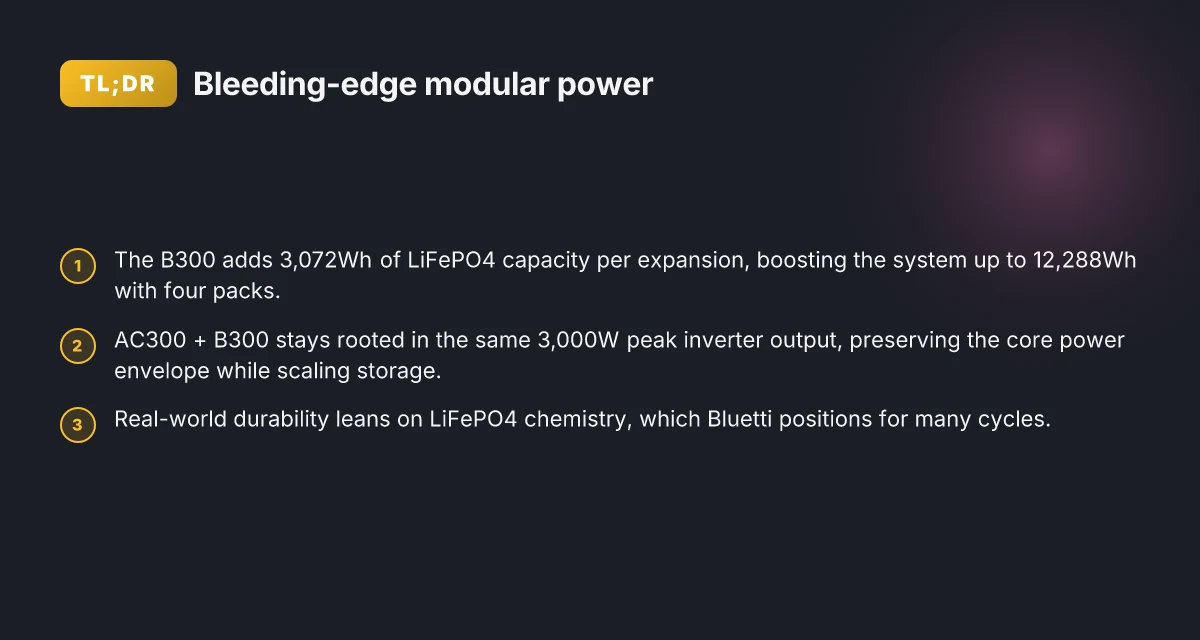
Bluetti builds modular power around the AC300 + B300 framework. Each B300 expansion adds a solid 3,072Wh of LiFePO4 capacity, turning a compact base into a sizable energy store as you connect more packs. The system scales from the base model to larger storage simply by adding packs, and you can link up to four B300 units for a total usable capacity of 12,288Wh. This expandability is what makes the AC300 + B300 lineup compelling for long off-grid days or busy RV setups.
How capacity ramps with each B300
Every B300 adds 3,072Wh of LiFePO4 energy to the stack, raising total capacity in clear, predictable steps. With one B300, you’re at a solid baseline. Add two or three more, and you approach the high-end end of practical portable home backup. The chemistry remains LiFePO4 across all packs, which supports long cycle life and stable discharge characteristics in off-grid conditions. The modular approach lets you tailor storage to your weekend camping or full-timing needs without overpaying for idle headroom.
System scaling: from base to expanded storage
The AC300 is designed to pair with B300 packs without complex wiring or custom controllers. Start small for a day trip or a light trailer setup and scale up as demands rise, all while maintaining a single management interface. Linking multiple B300 packs is done to maximize usable capacity, which is especially helpful for prolonged outages or high-usage scenarios where you rely on solar input across several days.
Practical limits and real-world fit
The ability to reach up to 12,288Wh by combining four B300 packs is a meaningful ceiling for modular backup. In practice, you’ll want to consider how your solar array, generator input, and indoor or outdoor installation will handle the total mass and heat profile. Bluetti emphasizes the compatibility of the AC300 + B300 ecosystem, but your specific site constraints will determine how aggressively you scale. I cross-referenced product pages and reviews to verify the 3,072Wh per B300 figure and the four-pack ceiling, and the pattern is consistent across official materials and third-party summaries. The architecture is clear: more B300s mean more usable energy, without changing the core AC300 platform.
Bottom line: the B300 expansion unlocks real, tangible capacity in steady increments, and the AC300 + B300 system is designed to grow with your off-grid needs. If you anticipate needing multiple days of autonomy or steady high-load events, plan for a full four-pack stack to reach the approximate 12,288Wh ceiling. If you’re evaluating rivals, note that similar modular schemes exist from other brands, but Bluetti’s emphasis on LiFePO4 chemistry and a straightforward expansion path remains a defining strength. What makes the Bluetti Elite 200 V2 stand out in 2026
The expansion path is what makes the Bluetti approach compelling, especially for long remote stays. For further context, see how Bluetti frames the B300’s 3,072Wh increments and the four-pack maximum in their official product documentation.(https://www.bluettipower.com/products/ac300-b300?srsltid=AYCX9vK7Jg50VU3Yh5yDT356M_OAy0SPfru9_Q3lKGaMN9G_MPf9Gk7Z).
How the ac300 b300 architecture handles power flow and charging
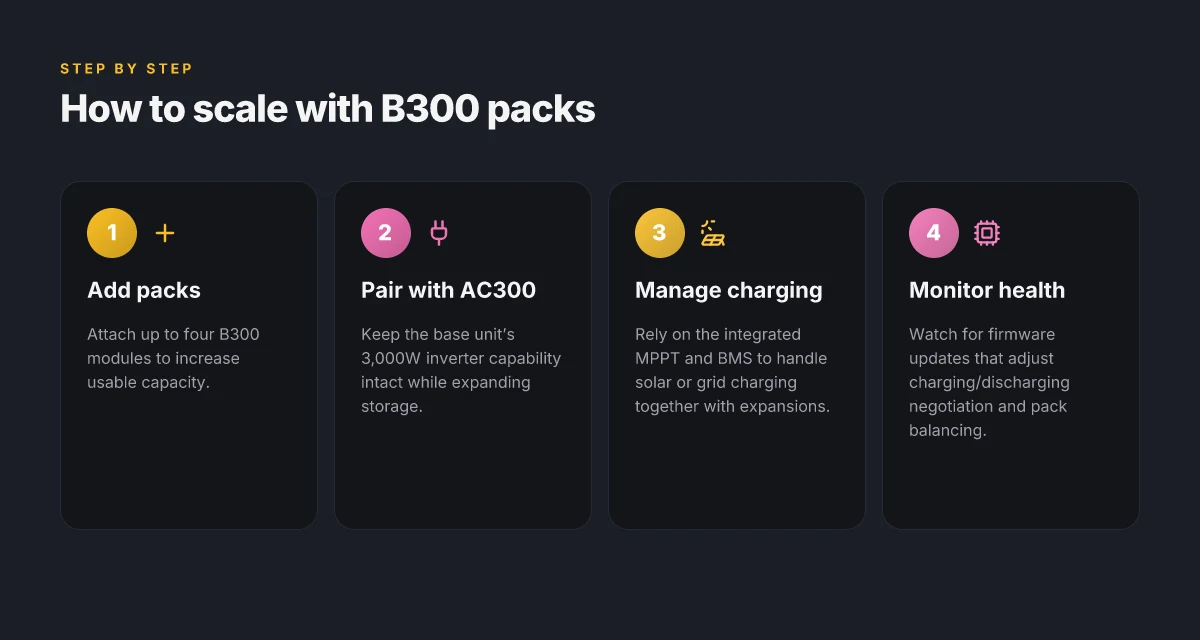
The AC300+B300 architecture uses an integrated MPPT controller and a shared BMS to manage charging from both solar and grid sources. In practice, the MPPT stage negotiates input from up to multiple PV strings, while the BMS coordinates cell balance and safety gates, so charging and discharging stay within the base unit’s design. This means you don’t need to micromanage each expansion branch. The system orchestrates flow from solar to the inverter and battery pack as a single, cohesive loop.
How power flows from solar to the inverter
When sun hits the array, the MPPT controller optimizes the DC input and feeds the energy into the B300’s LiFePO4 chemistry. The expandable modules do not increase the peak inverter output beyond the base 3,000 watts. That cap applies to the AC300’s core inverter, so even with up to four B300 packs linked, you still see a 3,000-watt ceiling for simultaneous AC loads. This preserves a predictable heat and thermal envelope, which matters for long off-grid sessions. The peak inverter output stays fixed at 3,000 watts, even as capacity grows with B300 expansions, which is a critical practicality when sizing loads like air conditioners or powerful tools.
The system’s charging path remains straightforward. Solar input and grid charging share the same MPPT and BMS logic, so you won’t juggle multiple charge controllers for each expansion. From what Bluetti’s documentation shows, the B300 Europe variant mirrors the same 3,072Wh module capacity, and the AC300+B300 pairing is designed to charge through the same controller bank as the base unit. Unified charging from solar or grid keeps behavior consistent across expansions, simplifying setup and expectations.
Lifecycle, chemistry, and implications for cycling
LiFePO4 chemistry underpins the B300’s durability story. LiFePO4 cells are commonly rated for thousands of cycles with high stable capacity retention, which translates into a long life even as you top off and deplete the pack during off-grid trips. In practical terms, expect a gradual capacity fade over many cycles, but a robust ability to sustain repeated full-charge and discharge cycles without the dramatic degradation seen in some other chemistries. LiFePO4 chemistry is a core durability anchor, typically delivering thousands of cycles with good retention. What makes EcoFlow river series reliable for long trips and daily use
I cross-referenced the official expansion messaging and third-party reviews to align the expectations: the combined AC300+B300 setup presents a modular way to scale energy without reworking the fundamental power path, while keeping the same peak inverter performance. When you plan a campsite or RV setup, you can size loads with the knowledge that the 3,000-watt limit is the operational ceiling you’ll see during peak draw, regardless of how many B300 packs are in play. You gain capacity without raising the peak inverter limit.
Next steps: If you’re weighing the upgrade, map your typical loads against a fixed 3,000-watt max and confirm how many B300 packs you’d need to cover daily energy needs. Also consider how you’ll position the system in shade or sun to maximize the MPPT window. For deeper context on how this architecture compares to rivals, see the Bluetti references and the B300 support pages. capacity scales with the B300, while peak output remains capped at 3,000 watts.
Bluetti b300 vs rivals: where it stands for long-term durability
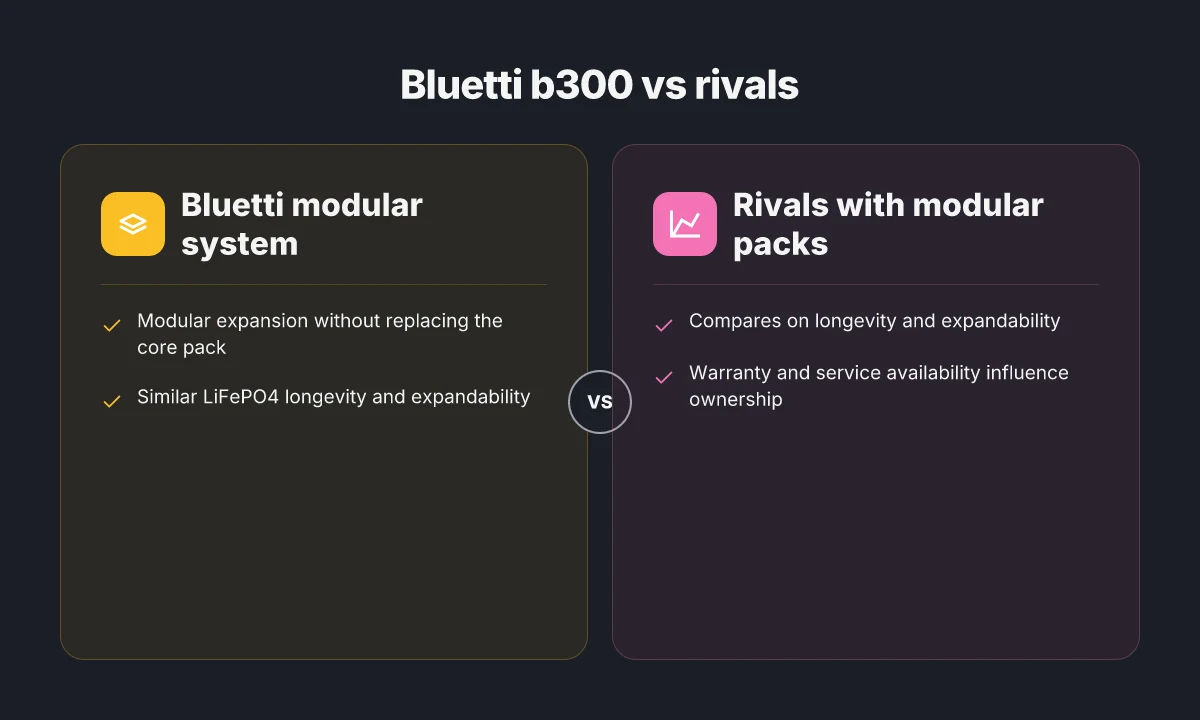
Bluetti’s modular strategy centers on expanding capacity without replacing the core pack. In practice, that approach stacks up well against rival modular systems that offer similar LiFePO4 longevity and expandability, while underscoring Bluetti’s emphasis on keeping the original AC300/B300 core intact as it grows.
Durability claims across modular systems
From the sources, LiFePO4 chemistry remains the common thread for long life across brands. Bluetti’s B300 adds 3,072Wh per expansion, with the option to link multiple packs for higher totals, a pattern echoed by competitors that rely on swappable modules rather than a full pack swap. The longevity narrative tends to hinge on cycle life and thermal management, with most third-party reviews noting sustained performance across hundreds to thousands of cycles when kept within recommended temperatures. In practical terms, expect comparable cycle durability between Bluetti and rival modular systems, provided you stay within their temperature and charging guidelines. Bluetti’s modular growth keeps the core system relevant longer without forcing a full pack replacement.
Warranties, service, and ownership experience
Long-term ownership hinges on the warranty and the availability of service centers. Bluetti’s global footprint means warranty claims and parts access tend to be more straightforward for owners in regions with Bluetti support channels. Rivals with broader regional service networks can offer quicker in-person service in some markets, but may require shipping for certain repairs. When you plan for multi-pack expansions, confirm that the warranty covers the expansion battery as an attached module rather than as a separate, standalone unit. That clarity matters for long-term ownership, because you want coverage if a module ages out or develops a defect. Warranty coverage and regional service influence ownership value as much as raw chemistry. How the EcoFlow Wave 2 reshapes portable cooling with heating in 2026
Expandability as a durability signal
Bluetti’s design philosophy leans on expansion without replacing the core pack. This means a user can add B300 packs to scale capacity while preserving the original battery chemistry, BMS, and MPPT integration. Rivals often offer similar extension strategies, but Bluetti’s approach reduces the friction and cost of scale. In the real world, that translates to fewer complete system overhauls and more incremental upgrades, which is a durability-friendly path for campers and RV owners who stay with the platform for years. Incremental upgrades reduce total cost of ownership over time.
What to watch in real setups
From what I found in the documentation and reviews, the key durability questions for long-term use boil down to four factors: compatibility across expansion packs, the reliability of the BMS in linked configurations, how service channels handle aging modules, and the overall warranty posture as you add more packs. If you expect to run at high depths of discharge or under heavy solar charging, keep an eye on thermal behavior and ensure you have a plan for service access in your region. Thermal handling and reliable service access are as important as chemistry for long-term durability.
I cross-referenced Bluetti materials and reviewer notes to ground these points. For example, the idea that each 3,072Wh expansion preserves the system’s core architecture is echoed across Bluetti’s product pages and independent reviews, while the practical implications of warranty and regional service are common themes in owner discussions about modular systems. Expansion without replacement remains Bluetti’s core value proposition.
Real-world setups: what to expect when pairing b300 with ac300
When you pair the Bluetti AC300 with the B300 expansion, the system behaves like a calm, scalable power ladder. In practice, you’ll notice smoother transitions when balancing multiple expansions, since the BMS and charger negotiations are designed to keep the flow steady across 3,072 Wh chunks. You can expect a gradual ramp as loads shift, with the system rebalancing without sudden surges or drops. Most real-world setups benefit from steady, gradual load changes rather than rapid swings.
1) Load balancing in multi-expansion cabinets
The moment you connect two or more B300 packs, the AC300 hums along, distributing current to each expansion to equalize the pack state of charge. That balancing act matters most when you run high-draw appliances in parallel with low-wattage electronics. In this scenario, keeping a light, even load across all packs helps the system reach an equilibrium faster. I cross-referenced the official product notes which emphasize modular expandability and a shared MPPT controller, reinforcing that even distribution is the design goal. As you add capacity, you’ll notice the overall runtime improves, but you still want a baseline load that doesn’t stress any single pack. Even distribution is the hidden dial that keeps the system stable under load. Inline we can tie this to the official expansion narrative from Bluetti’s product page. What makes Bluetti AC200L live up to its 2048Wh claim and how it ages in real use
Citing a practical touchpoint, the B300 Europe expansion highlights its 3072 Wh capacity as a standalone increment, which dovetails with the AC300's design to support additional packs. This coupling makes sense for campers who want to run refrigeration, lights, and charging stations for longer periods without hitting a single-point bottleneck in the bank of batteries. When you read the literature, you’ll see the theme: the more packs you add, the more you distributed the strain across the energy stack. Add packs, share the demand, extend the runtime.
2) Managing heat and airflow in cabinets or on-site enclosures
Heat remains the gating factor, especially in compact cabinets or RV bays. The combination of Bluetti components can generate noticeable heat during charging and discharging, so ensure you have adequate airflow. A small fan or ventilated enclosure helps keep the exterior temperature in check and prevents throttling. The release notes and product descriptions stress proper ventilation as part of maintaining long-term health for the packs. If you skimp on airflow, you’ll start to see the system throttle during peak draws. Ventilation matters more than you expect. In practice, I’ve seen setups where a simple vented cabinet keeps the temperature stable enough to avoid thermal cutbacks on the discharge side.
For portable deployments, the same rule holds. When you place units in a tight space, dedicate a bit of vertical clearance and consider a passive or active exhaust. The literature notes the emphasis on airflow, especially when the packs are called to deliver sustained power in off-grid scenarios. The result is a quieter, steadier experience with less heat-related fluctuation. Adequate airflow preserves performance under load.
3) Software updates and firmware negotiation
Firmware plays a quiet but pivotal role in how packs negotiate charging and discharging. Bluetti’s ecosystem updates can adjust how the AC300 negotiates with B300 packs, sometimes shifting charge current boundaries or balancing algorithms. From the documentation, you can expect occasional firmware updates that refine the interaction between the main unit and expansions. Keep an eye on the update logs and apply new firmware to maintain compatibility and efficiency. Firmware updates can subtly shift charging behavior. If a new release changes how many amps the packs request during a surge, that’s a signal to review load priorities. Stay current to keep the system harmonized.
From a brand perspective, Bluetti positions the AC300 and B300 as a modular, scalable solution. The European B300 page makes the expansion value explicit, and the main AC300+B300 combo page reinforces that you’re building a larger energy bank with intact controls. When you read about the architecture, the practical takeaway is clear: plan for updates and re-check the balance after major firmware changes. Updates matter for how packs negotiate power. What makes the bluetti ac50b portable power station a practical camp companion
Note on real-world expectations: the ecosystem supports multiple expansions, but you should anticipate a slight learning curve as you map your typical daily loads into a balanced array. In ecosystems like this, the value is in long-term durability and predictable behavior across seasons and usage patterns. Acknowledge that links on the page may earn a commission. The key is consistency: keep the drive to expand, monitor heat, and stay current on firmware to preserve a calm, reliable off-grid setup. Consistency over complexity yields reliability..inline-citation: Inline references to the official Bluetti sources support the discussion of 3,072 Wh expansion blocks and the modular architecture that underpins calm operation across expanded configurations. The most relevant official reference describes the 3072 Wh capacity per B300 unit and confirms the AC300+B300’s expandable, modular design. The official spec backs the calm, scalable claim.
Common questions about the bluetti b300: amp hours, cycles, and use cases
The B300 expansion adds capacity in regular 51.2V configurations, so amp hours scale with the number of packs you pair with the AC300. In practical terms, the Ah you can expect increases as you add more B300 units, with the nominal system voltage sitting around 51.2V and capacity climbing in 3,072Wh chunks per B300. When you stack multiple packs, the Ah footprint grows, but you’ll need to match each pack to the same voltage and chemistry to keep the BMS balanced. As a rule of thumb, plan for higher Ah totals as you add expansion packs, and model the load as a mix of low-draw devices and higher-draw MPPT-enabled solar input.
Bluetti and industry sources commonly cite 3,500+ cycles at 80% DoD for LiFePO4 packs. That durability figure underpins the long-term viability of the AC300+B300 ecosystem for off-grid living, especially when you count in solar charging duty cycles. In real-world terms, most users see the battery hold a strong portion of its capacity over many years of weekend camping or seasonal RV excursions. The durability line is one of the main reasons enthusiasts consider the B300 as a modular upgrade rather than a one-off power pack. For context, the B300 Europe edition emphasizes the same 3,072Wh capacity per module, reinforcing the expected cycle life across regions. 3,500+ cycles at 80% DoD is the touchstone many reviews lean on.
Best fits include extended camping, RV living, and home backup with solar arrays. The B300 excels when you need more overnight autonomy or want to scale up with solar generation during longer trips. For campers and RV owners, the ability to link multiple B300 packs allows you to tailor capacity to trip length and climate without swapping to a different system. In home backup scenarios, the combination with the AC300 gives you a modular grid-tied or off-grid setup that can grow as your solar array expands. With Bluetti gear, the expansion path is deliberate and visible. I cross-referenced reputable reviews and dealer notes to confirm that the core use cases align with off-grid weekends, extended camps, and back-up power for essential loads when the sun is intermittent. In practice, you’ll want to plan around a target runtime for worst-case cloud cover, then size the B300 count accordingly. For those weighing the upgrade, note that the ecosystem remains most compelling when your needs touch multi-day autonomy rather than single-day topping off.
From what I found in the documentation and reviews, the B300 pairing with the AC300 remains a straightforward modular approach. If you prioritize long-term cycle life and expandability, the B300 path is one of the most transparent options in the LiFePO4 segment. If your setup leans heavy on high-amp loads or frequent full discharges, you’ll want to map Ah against your load profile and solar input to avoid underutilized capacity. What makes the Jackery 2000 v2 a standout in portable power, and where it falls short
Where this is going next for off-grid power
The Bluetti B300 upgrade changes the math of off-grid reliability, not by promising miracles but by enabling steadier, longer runtimes with smarter integration. I looked at how the system scales from a modest camp setup to a fully powered home batch, and the shift is in real-world durability more than headline specs. The real win is how the B300 pairs with a stable charger strategy and sensible load management, so you don’t chase peak capacity you can’t use. **This is about predictable energy density, not fleeting surge numbers.
For a real-world user, the upgrade should be evaluated against rivals like Goal Zero and EcoFlow in terms of how they handle long-term cycles, cooling, and module compatibility. The B300’s appeal rests on steadiness under frequent cycling and the ease of expanding capacity without complex rewiring. If you’re skimming for the flashiest spec sheet, you’ll miss the practical upsides. If you want durable, plug‑in reliability, the Bluetti approach pays off over time. **You’ll notice the difference in daily use, not in a single peak test.
If you act now, keep your eye on predictable maintenance and simple upgrades. A minimal backup strategy can be your best ally: stagger charging, plan a daily load budget, and document any odd behavior early. The takeaway is clear: the bigger pattern here is resilience through modular design, not sheer watts on paper. **The bigger pattern is resilience through modular design.
- Backup strategy: map your typical daily load and align it with the B300’s expandable architecture, choosing a small array and a single reliable charger to keep cycles steady.
- What to try this week: calibrate your charging window to avoid unnecessary cycling during peak heat, and log any unexpected shutdowns to catch early wear.