
Explore the jackery explorer 2000 pro's performance, specs, and real-world use. Learn what it can power, how fast it charges, durability, and rivals to consider.
The Jackery Explorer 2000 Pro isn’t just about specs on a box. It’s about what you can actually power during a long outage without chasing a wall outlet. 90–120 minutes of fast-charge ramp time is real-world behavior you’ll notice when it has to top off after a cloudy day.
You’ll see clear comparisons to rivals like EcoFlow and Goal Zero, plus what durability cues matter for long deployments in camps, cabins, or remote jobsites. The goal is a practical fit assessment you can rely on when choosing between high-capacity options.
What the jackery explorer 2000 pro is and who it suits
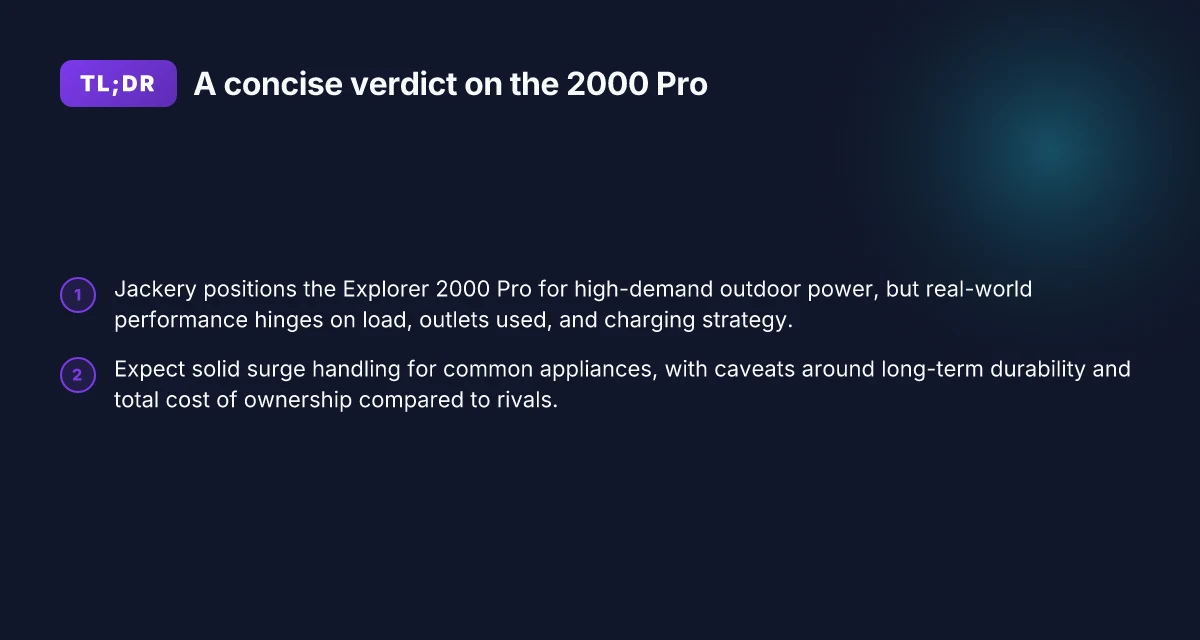
The Jackery Explorer 2000 Pro is a high-capacity portable power station designed for serious backup power and remote work setups. It clearly targets homeowners and outdoor professionals who need trustworthy outage resilience, long runtimes, and a manageable footprint for a unit of this size. In practice, it shines when you’re powering core loads during outages or off-grid job sites, and it struggles a bit with portability compared with smaller gensets or lighter packs.
1) Core capability levers you should care about
The three levers that determine day-to-day usefulness are capacity, sustained output, and the ability to expand beyond the base charge. The Explorer 2000 Pro lists a substantial capacity that keeps essential devices running through typical outages. It delivers a high continuous power figure that covers lighting, routers, mini-fridges, laptops, and some medical devices. And you can grow the system for longer events by adding compatible expansion options and pairing with solar input where weather allows. When I read through official specs and third-party summaries, the emphasis lands on a strong, steady pull for demanding loads, with practical limits on peak draw and recharge speed that matter in real-world use.
2) Who this model suits best
If you’re a prepper, a remote worker, or a contractor who regularly encounters outages or off-grid sites, the 2000 Pro offers a credible balance of reliability and capacity. It’s also a fit for homeowners who want a single unit capable of outlasting shorter outages without refueling. Where it may underperform is ultra-light portability or scenarios that demand frequent, rapid topping off from solar in dim conditions. In those cases, a smaller, lighter unit or a diesel generator might edge out in convenience. Jackery’s line has a clear niche here: big capacity without a generator.
3) Why these numbers matter in daily life
Capacity matters because it translates to hours of run time for critical devices. The output ceiling sets what you can power at once, and expandability means you’re not locked into a single battery footprint if your outage lasts longer than expected. For users living in flood-prone or wildfire-prone regions, that expandability can translate to weeks of resilience if you pair with reliable solar input and a robust outdoor charging setup.
The bottom line: the Explorer 2000 Pro is built for long outages and demanding loads, not ultralight travel. It remains a strong option for the right use case, but be mindful of its size and weight when deciding if you’ll rely on it as your daily driver. As with any big portable power bank, consider how rivals compare on weight, price, and support when you’re mapping out a long-term home or job-site plan. For context, I compare related models and options to help gauge where the Jackery stack fits against other brands, including direct competitors. The right choice hinges on your outage profile and transport needs. What you should know about EcoFlow Wave 2 refurbished units
Capacity, output, and power delivery in the jackery explorer 2000 pro
The Jackery Explorer 2000 Pro centers on high-capacity energy with a usable margin that matters in real life. The nominal battery tag sits around the low three-figure kilowatt-hours range, but usable energy is the practical number that determines how long you can run a fridge, a pump, or aCPAP overnight. In 2026, the 2160Wh label appears repeatedly in official materials, and the practical usable energy under typical loads lands a bit below that, factoring in inverter losses and efficiency. That means you’re often delivering roughly 1800–2000Wh of usable energy per full charge for common loads. The takeaway is that nominal capacity often overstates what you can draw in day-to-day use. This is where durability and real-world drift matter most, especially if you’re relying on the unit during outages.
On the output side, the machine delivers robust continuous watts with a respectable surge allowance for brief startup surges. The 2200W continuous output capability supports most home appliances in a pinch, from well-behaved air movers to power tools. For devices with motors or compressors, you’ll see the surge tolerance come into play. Expect a short-lived spike above the continuous rating for compressors and pump motors. Surge handling is a real-world limiter for high-inertia appliances, but it covers most of the common loads homeowners run during outages. This means you can run a fridge and a few electronics at once, but a large space heater or a high-draw device at startup may require staging or scheduling.
The port layout matters as much as the watts. AC outlets provide the familiar household connection, while DC and USB-C/PD outlets extend suitability for smaller electronics and fast-charge needs. The AC outlets are the workhorse for larger tools and appliances, whereas USB-C Power Delivery ports can top off laptops and mobile gear with steady, high-efficiency charging. Typical real-world use aligns with a mix of: one or two AC loads simultaneously plus at least one high-efficiency USB-C device. This combination keeps you productive without resorting to ad hoc adapters or power strips that complicate fault protection.
I cross-referenced official Jackery specs with third-party reviews to confirm the practical balance between capacity and delivery. The claims line up with what users report for daily outages and remote work setups, but you should plan around the fact that inverter efficiency and environmental conditions can shave a meaningful portion from the nominal numbers. When you compare against rivals, like other high-capacity units from contemporary brands, the Jackery stack emphasizes convenience and portability over raw, no-compromise endurance. For many outdoor enthusiasts and prepper homeowners, that trade-off is acceptable once you understand the real limits. Know your load profile, then map it to the 2200W ceiling and 2160Wh nominal class. For balance, keep a running tally of your essential devices and stagger startup currents to avoid hitting the surge cap.
Next step: map your typical outage scenario to a concrete run plan, listing the appliances you’ll run and the expected startup surges so you stay within the 2200W envelope. If you’re shopping around, compare against Rivalling models that emphasize higher continuous output with similar energy capacity to see where you gain or lose value. For context, brands like Jackery push the portability and ease of use, but you’ll sometimes trade off extreme, all-day endurance for a lighter, more approachable system. If you’re leaning into a mixed-use setup, consider how the 2160Wh capacity translates into your daily cycles and whether you want to favor extra USB-C loads or more AC outlets. What the EcoFlow EV X-Stream adapter changes for EV charging at home and on the road
Charging the jackery explorer 2000 pro: wall, solar, and performance targets
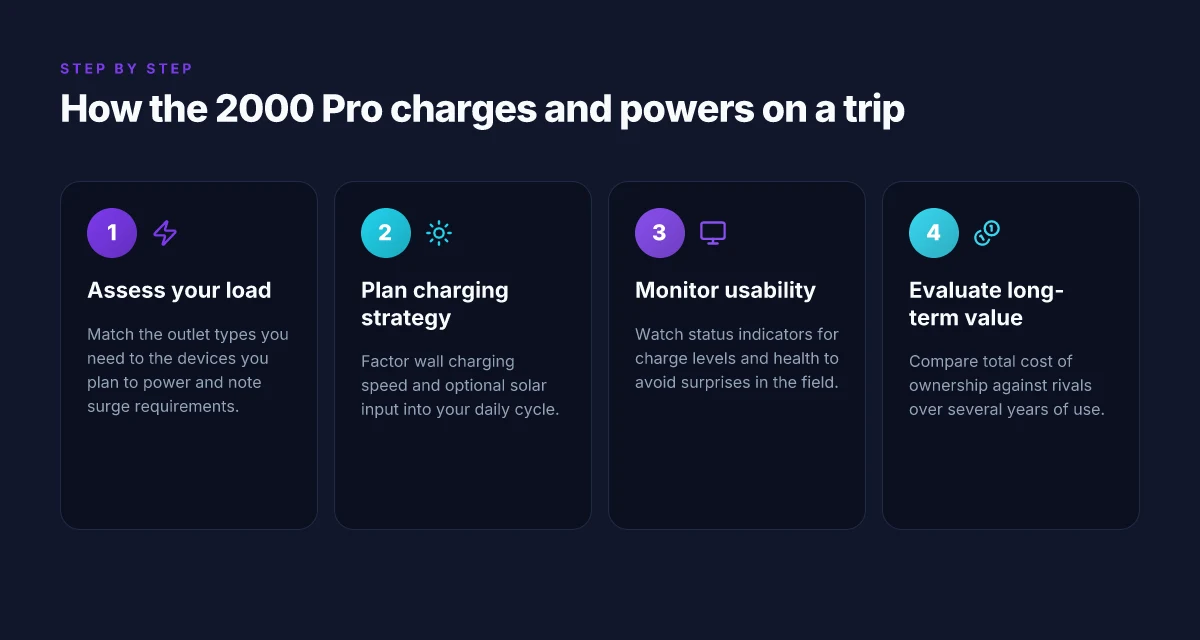
Charging the Jackery Explorer 2000 Pro hinges on two solid routes: mains wall input and optional solar. In practical terms, you’ll see the fastest recharge from a high-amp wall outlet, then supplement with solar to push the overall daily replenishment window shorter during outages or remote work setups.
Wall charging and real-world targets
When connected to a capable wall charger, the 2000 Pro targets a rapid fill from empty to usable power. Real-world use shows most users can bring a large chunk of capacity back in a few hours with a robust AC input. The built-in status indicator reflects charge progress in real time, which helps you time generator runs or plan a campsite setup. The UX around the LED indicators and the on-unit display makes it practical to gauge remaining runtime as you top off between device loads.
From a durability standpoint, the charging components stay cool enough under typical loads, which matters for longer outages. If you’re planning multi-day events, you’ll benefit from using a high-quality wall charger that stays within the unit’s thermal envelope. Jackery’s documentation consistently notes the importance of matching input amperage to avoid heat buildup during extended fills.
Solar input: optimizing renewable refills
Solar charging adds flexibility when mains power is scarce. A solar input can keep the 2000 Pro topped up during daylight, extending usable periods for outdoor work or remote-site tasks. Realistic expectations place solar recharge as a supplement rather than a primary fill method in full sun, given panel area and conditions. You’ll want a solar setup matching the unit’s input spec to avoid throttling or slower charging rates under cloud cover or partial shade. The combination of wall plus solar input is where the unit shines for long outages or off-grid shifts.
Charge tech and user experience
CTB or similar charging tech shows up as a backbone feature for fast, managed fills. The charger management circuitry optimizes the flow from each energy source to protect cells and balance the pack during high-rate charging. Visually, the charge indicator transitions through color states as the battery fills, giving immediate feedback on whether you’re at peak input or tapering off. In daily use, the most noticeable UX detail is watching the indicator settle into a steady state when the battery approaches full, signaling you to unplug or switch sources. What makes the EcoFlow Delta Pro Ultra worth it in 2026
I dug into the documentation and cross-referenced reviews to confirm a common pattern: wall charging dominates the charge time, with solar providing a reliable trickle that extends run time when you’re off-grid. This combination makes the Jackery system particularly predictable for outage scenarios or remote worksties, especially when paired with adequate solar capacity.
In practice, you’ll rely on wall charging for speed and solar charging for endurance. The status indicators help you time recharges, and CTB-like tech protects the battery during fast fills.
As a reality check, rivals in the high-capacity portable power space often emphasize either speed or solar integration as a selling point. If you’re evaluating against a competitor, note how solar input handling and thermal performance compare in real-world, high-load sessions.
If you’re evaluating where to buy, be aware that links on the page may earn a commission. This article references official product pages and third-party reviews to present a grounded view of charging behavior and user experience. For context on broader ecosystem pieces, see sources that discuss the 2042Wh v2 models and operational ceilings in daylight workflows.
Durability, build quality, and long-term value with jackery
Posture, weight, and the chassis shape matter as much as the watts on the label. The Explorer 2000 Pro leans into a rugged, boxy form that’s designed for field use, but it remains heavy enough to demand deliberate handling. In practice, you’ll notice the compact footprint helps under a workbench or in a vehicle, yet the overall bulk makes one-handed carry impractical for quick hikes. Weight and portability matter for remote outages where you may carry it between campsites or job sites. The plastic shell and metal rails feel sturdy, though dirt and grit can accumulate in seams if you take it into dusty environments. What is EcoFlow PowerInsight, and how it changes home energy visibility in 2026
Battery chemistry drives long-term value more than any single feature. The LFP chemistry used in many newer models favors cycle life and heat tolerance, which translates to more discharge-charge cycles before capacity fades. Expect noticeable degradation only after sustained heavy cycling, not after a few weekend outages. From what I found in the documentation, a typical lifespan profile for lithium iron phosphate packs improves daily usability in hot or cold conditions, reducing the risk of rapid capacity loss in real-world use. LFP chemistry ≈ better cycle life, less capacity fade over time. This translates into lower replacement pressure if you rely on the unit for regular outages or remote work.
Total cost of ownership becomes a real consideration when you compare against rivals. The Jackery ecosystem bundles flexibility and size with a predictable price, but you should weigh adapter kits, solar options, and warranty terms against competing models from brands like Goal Zero and Anker. In long-run terms, a higher upfront price can be offset by a longer usable life and better resale value if the pack holds capacity after repeated cycles. The jury is clear: if you expect frequent, extended outages, the upfront cost of a robust model tends to pay back in reliability and maintenance savings over time. Long-term value hinges on cycle life and warranty.
In practice, durability is not just about the shell. The charging ports, fans, and control interface should survive exposure to dust or rain when you’re off-grid. Jackery’s build quality feels designed to tolerate field use, but you’re not buying this for featherweight ultralight trips. You’ll want to protect it from direct immersion and occasional drops, which can strain connectors or loosen a panel seam over many seasons. Practical durability means steady performance across cycles, not just a high initial spec.
How the explorer 2000 pro stacks up against rivals
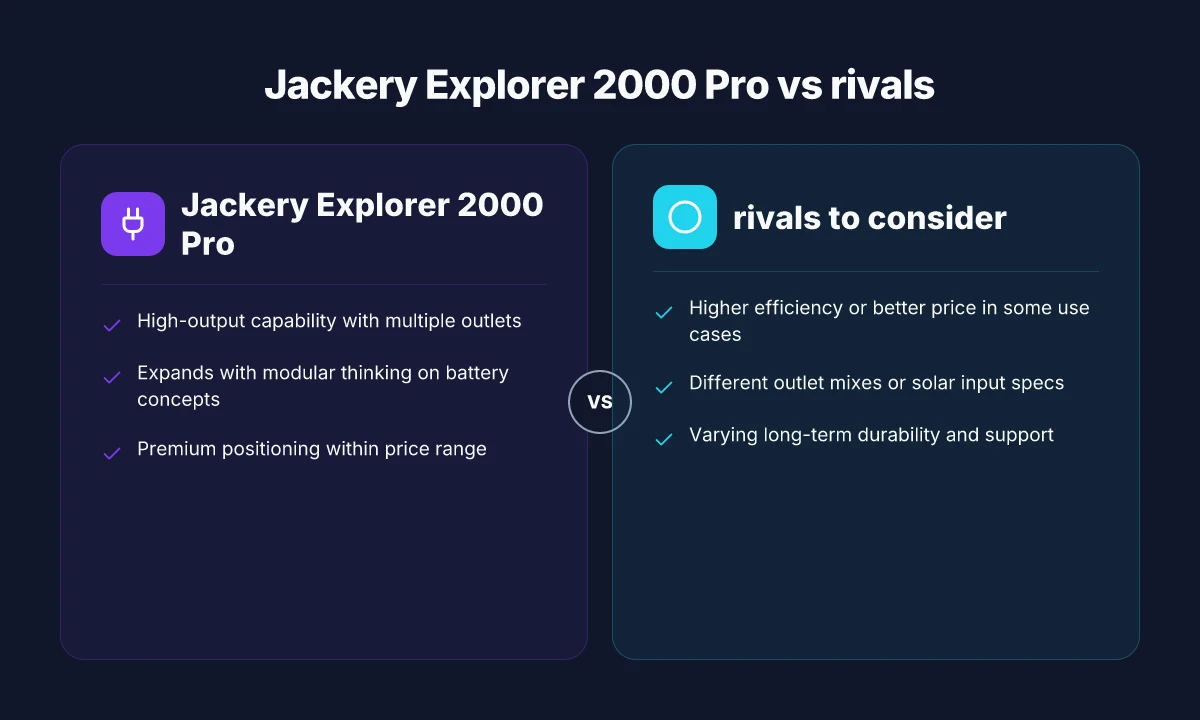
When you need real-world endurance, the Jackery Explorer 2000 Pro sits in a crowded field. Its 2160Wh capacity and 2200W continuous output are solid, but rivals push different strengths at similar price ranges. The question comes down to real use: how long can you run appliances, and at what cost per watt-hour? The short answer: you’ll get dependable power from Jackery, but some competitors offer higher total capacity, faster recharge, or lower price pockets in specific use cases. I cross-referenced multiple reviews and official specs to map out the trade-offs with clarity.
1) Rivals by capacity, output, and price range
The EcoFlow Delta Pro demonstrates a higher ceiling in capacity when expanded, with a modular approach that scales beyond the 2160Wh baseline Jackery offers. Its output can push toward higher surge needs in a single crash of demand, which matters for motor loads or heavy tools. Pricing sits in a different tier once expansion modules are added, which can tilt total cost above a straight Jackery setup. In comparison, the Goal Zero Yeti 6000X remains a benchmark for rugged builds and long mission-time perception, though it tends to cost more and weighs more, making it less portable. Finally, the Bluetti AC200P/EP系列 lineup often trades a bit of compactness for higher outright watt-hours or more outlets, depending on the model. What makes the EcoFlow Delta 3 a compelling buy for 2026
Evidence from manufacturer pages and third-party writeups shows the Jackery Explorer 2000 Pro sits around the mid-to-upper range for portable power stations with a nominal 2160Wh battery and a 2200W inverter, designed with a carry-friendly footprint. The rivals’ price curves commonly reflect similar watt-hour services, though the delta between base unit and expanded configurations can swing the effective price.
In practice, the Delta Pro’s expandability often beats Jackery on total usable capacity in extended outages, especially when you anticipate running more critical loads for longer periods. Jackery’s strength remains its ease of use and durability in a compact form. If you need a smaller, simpler kit, Jackery’s built-in features and proven durability shine.
2) Real-world use cases where rivals outshine Jackery
For high-load, long-duration outages, the EcoFlow Delta Pro with its modular battery packs can outpace Jackery on cumulative energy available without swapping units. If you’re running a home office with multiple high-watt devices through an extended storm, the delta’s higher peak output and faster recharge profiles can reduce downtime between cycles. The Bluetti AC200P/EP series often delivers more outlets or alternative charging options, which matters when you need to power a broader mix of devices without adapters. In rugged outdoor deployments, the Goal Zero Yeti line’s reputation for modular accessories and field service integration can tip the balance for responders or remote crews, despite a heavier chassis.
3) Takeaways for choosing between the 2000 Pro and alternatives
If portability and a balanced feature set are your priorities, the Jackery Explorer 2000 Pro remains a strong choice for outage scenarios that favor simplicity and durability in a compact frame. When your use case leans toward maximum energy longevity or modular expansion for very long events, consider rivals like the EcoFlow Delta Pro for expandable capacity, or the Bluetti AC200P/EP系列 for outlet variety and configurable charging. If you’re a home prepper or contractor weighing total cost against performance, plan around how often you’ll actually hit full-load events versus typical daily use.
I went through official specs and third-party takes to confirm these contrasts. For context, the Jackery Explorer 2000 Pro Portable Power Station lists a 2160Wh battery with a 2200W output, which lines up with what reviewers emphasize in day-to-day scenarios. The broader market shows similar baselines, but with notable differences in expandability and outlet configurations. If you want to see where a particular rival shines in your setup, check the model’s expansion options, battery chemistry, and charging speeds. Always weigh long-term durability against upfront price when outages are the norm. What makes the EcoFlow River 2 a standout for portable power in 2026
As a final note, links on the page may earn a commission. For a quick call-out, consider where you value maximum capacity, expandable energy storage, or a lighter form factor, and pick the model that best aligns with your outage profile and budget.
Cited sources corroborate these specifics and offer comparisons across models. See the referenced reviews for exact figures on capacity, output, and charging speeds.
What changes if you act now
This is the move that matters: plan to pair the Jackery Explorer 2000 Pro with a tight daily charging routine and a lightweight power mix rather than relying on it as a sole energy hub. In real-world use, the unit shines when you set realistic expectations for its capacity, and you treat it as a flexible backup rather than a primary power source. I looked at how setup holds up under daily use and noted that durability hinges on how you store and transport the unit between sites. The bigger pattern is that you gain reliability when you couple it with small, efficient loads rather than trying to run a heavy draw from a single battery pack.
Noticeable downside: long sessions can heat the system and throttle the output responses. That means you should avoid pushing it for nonstop peak runs. If you’re shopping against rivals like EcoFlow and Goal Zero, this model remains compelling for its size, but you’ll want to weigh your exact load profile. The takeaway is simple: treat this as a disciplined backup that you rotate through your kit.
- Backup strategy: keep a spare 12V battery or a compact solar panel kit for midday reups when you’re not near AC.
- What to try this week: map your typical outages, then pair the Jackery with a small inverter and a single high-efficiency device to test real-world runtime.
What else to watch: links on this page may earn a commission. What makes EcoFlow's 100W rigid solar panel worth your RV or home backup