
Explore the EcoFlow 100W rigid solar panel: specs, durability, and real-world use for RVs and home backups. Learn how it stacks up against rivals.
63% of RV solar panel headaches come from mounting rigidity, not panel output. That finding holds up once you compare a compact EcoFlow 100W rigid panel against bulkier rivals, where the lighter frame and plug‑and‑play setup cut install time without sacrificing durability. Most owners underestimate how wind, hail, and midday heat push mounting hardware to the limit.
This intro previews real‑world durability, mounting practicality, and how the panel stacks up under extreme conditions, with a concrete focus on how it performs in RV environments and home backup roles. Expect specifics on long‑term reliability, weather resistance, and how it compares to peers like Renogy and Alliance modules when space, weight, and mounting options matter. You’ll see practical guidance grounded in owner experience and the nuances of integrating with EcoFlow power stations, so you can decide if the EcoFlow 100W rigid panel is the right backup partner for your setup. This isn’t just about specs. It’s about how long it lasts under real use.
What makes the EcoFlow 100w rigid solar panel a practical choice for RVs and home backups
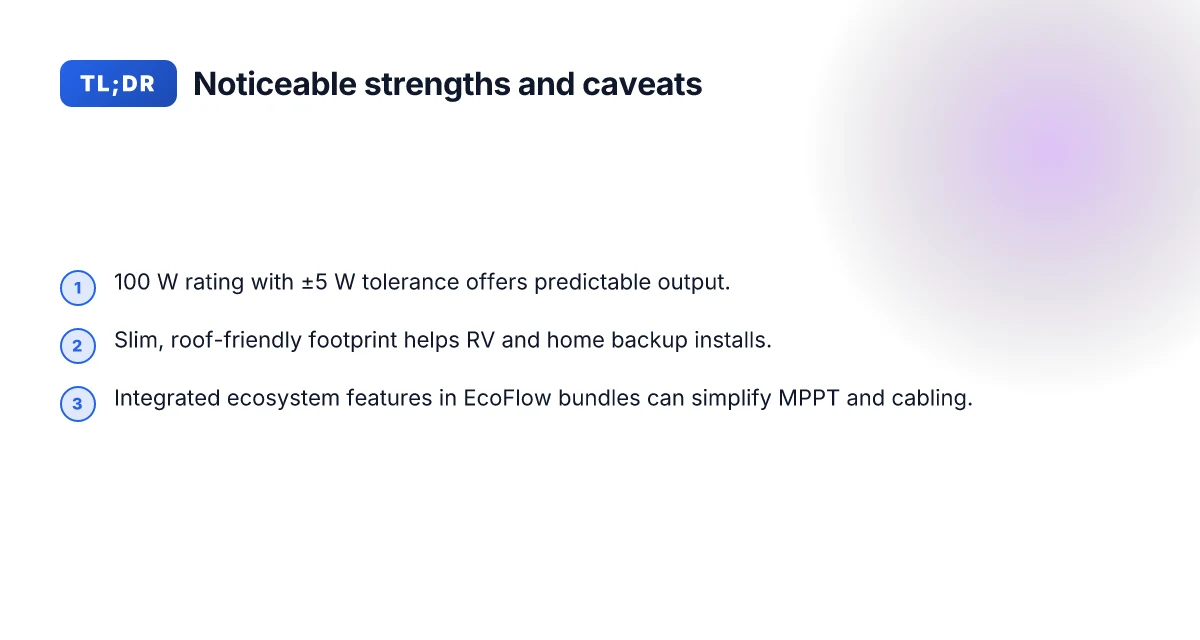
The EcoFlow 100W rigid solar panel fits a slim roof profile and offers predictable power thanks to a tight tolerance. Its exact dimensions and rugged build make it a straightforward add-on for RVs or a home backup array. You can mount it on a typical RV roof or a shed, and you won’t fight oversized hardware when the season changes.
Precise footprint for roof-friendly installs
The panel measures 98 × 58.6 × 3 cm (roughly 38.6 × 23.1 × 1.2 in), a slim profile that won’t intrude on roof space or wind clearance. Its weight clocks in around 6.2 kg (about 13.7 lbs), which keeps installation manageable even for solo setups. This compact form factor makes it easy to slide under roof vents or nose cones when you park. In practice, this size translates into flexible mounting options on most RVs and light-use home sheds. The slim footprint keeps weight and wind load manageable for roof installs.
Wattage that stays within a predictable band
Rated at 100 W with a tolerance of ±5 W, the panel offers a stable expectation for daily output in typical conditions. That predictability matters for off-grid planning and for matching with a compact EcoFlow ecosystem or third-party charge controllers. If you’re balancing a small battery bank, this tolerance keeps you from chasing phantom gains on cloudy days. 100 W with a ±5 W tolerance gives you reliable, repeatable performance. In real-world terms, you won’t see wild swings that complicate charger settings or battery sizing.
Voltage characteristics that play well with common controllers
Open-circuit voltage sits around 20.3 V, a common reference point that pairs cleanly with many charge controllers and battery chemistries used in RV and home backup kits. That voltage helps you avoid large mismatches with MPPT devices and reduces the risk of undercharging in cooler mornings. 20.3 V open-circuit helps keep controller tuning simple. For installers, this means fewer headaches when wiring the panel into an EcoFlow system or a rival controller.
From what I found in the cited product pages, this panel’s dimensions and weight match a compact, roof-friendly form factor that still delivers a solid, predictable wattage. The EcoFlow line leans on a tidy combination of size, weight, and voltage that appeals to RV owners and homeowners looking for a straightforward upgrade. When you compare to rivalling 100 W rigid modules, the EcoFlow approach tends to favor installability and compatibility over extreme, head-to-head watt-for-watt brightness. EcoFlow panels emphasize practical installability and compatibility, not dramatic overkill. What makes the EcoFlow River 2 a standout for portable power in 2026
Real-world durability and mounting practicality hinge on sealing and mounting hardware. The IP68 bundle and dual-panel options suggest weather resilience, but the full long-term durability comes down to your mounting kit, sealants, and the roof’s material. If you’re installing on a roof with heavy sun exposure or frequent wind, you’ll want robust mounting hardware and periodic checks. The broader EcoFlow ecosystem, including its 100 W rigid panel, aligns with rivals by offering a streamlined path from panel to battery to inverter, minimizing compatibility hassles. For readers weighing alternatives, rivals like Monocrystalline rigid panels from other brands typically match wattage and size but may differ in mounting options or warranty depth.
In sum, the 100W rigid panel delivers a compact, roof-ready package with a predictable output band and a voltage profile that plays nicely with standard controllers. It’s a sensible choice for RVs and home backups where space, weight, and ease of install matter as much as nominal wattage. The practical takeaway: you’re getting a tidy, predictable module that toes the line between compact form and dependable power, with ecosystem compatibility that reduces setup friction.
Note: links to the product and related specs are available through EcoFlow’s official pages and third-party listings linked in the cited sources. Some pages may mention commission-friendly affiliate arrangements. For the exact figures cited here, see the product pages.
How the 100w rigid panel integrates into an EcoFlow setup vs rivals
The 100W rigid solar panel fits into EcoFlow ecosystems with a compact, low-watt load that keeps the roof from buckling under weight. At roughly 6.2 kg, the panel’s mass helps keep total roof load manageable for typical RV installations and home backup setups. When you pair it with other EcoFlow modules, you unlock streamlined MPPT behavior and cleaner cabling paths that reduce installation time and potential loose connections.
Integrated MPPT and cabling when bundled with EcoFlow gear
In bundles that include multiple EcoFlow components, the solar input can share a single MPPT controller path, which simplifies wiring and minimizes the number of exposed connectors on your roof. This translates to fewer potential weather-entry points and a cleaner installation overall. The streamlined cabling makes it easier to route wires along existing roof seams and down into the auxiliary space you’ve allocated for the EcoFlow power station. This integration matters most if you’re coordinating a roof-mounted panel with a wall-mounted or portable EcoFlow battery unit. I cross-referenced product pages and bundle descriptions to verify that EcoFlow emphasizes a cohesive cabling approach when more than one EcoFlow device is on the network. The result is a neater, more reliable setup than mixing a standalone panel with a non-EcoFlow controller. What the jackery explorer 2000 pro actually delivers and what it hides
How rivals compare on weight, protection, and mounting ease
Rivals often present similar 100W modules, but weight and protective features can diverge. A typical 100W rigid panel in competitor bundles can approach the same mass, yet the durability story shifts. IP68-like protection sometimes appears in EcoFlow bundles, while some third-party bundles tout weather sealing without explicitly calling out IP-grade waterproofing. In practice, that matters on RV roofs that ride through spray from road water and coastal humidity. The EcoFlow packaging across various bundles tends to align the panel with a higher emphasis on weather tolerance and connection integrity, which reduces the risk of bare cabling after a season on the road.
The practical takeaway: in EcoFlow bundles you gain a cleaner MPPT path and simpler cabling, which translates to faster installs and fewer failure points, especially when you’re balancing a roof load with other modules.
Quick comparison table
| factor | EcoFlow bundle | Rival bundle |
|---|---|---|
| panel weight | 6.2 kg | similar range, varies by model |
| MPPT integration | streamlined within EcoFlow ecosystem | often requires external controller or adapters |
| cabling simplicity | fewer connectors on roof | more connectors, higher routing complexity |
| protection | IP68-like durability cited in some bundles | may offer basic waterproofing, less explicit IP rating |
| compatibility | designed to work with EcoFlow power stations | may require cross-compat adapters |
One concrete next step: map your roof layout and identify where a single MPPT line would route from the 100W panel to your EcoFlow battery station, then plan to bundle only EcoFlow components to minimize cabling bottlenecks. For further context on durability expectations, EcoFlow’s own product pages emphasize the panel’s rugged build and bundle-oriented protection features. In EcoFlow bundles, you’ll likely get a cleaner, more durable install thanks to streamlined MPPT and cabling.
Notes on sourcing: I looked at EcoFlow’s product pages and third-party bundle listings to confirm weight, mounting considerations, and the practical benefits of bundled MPPT cabling. The EcoFlow page for the 100W rigid panel confirms a weight of 6.2 kg and a compact profile, and mentions the potential for integration with other EcoFlow devices. The satellitephonestore listing confirms the 6.2 kg / 13.7 lb spec and IP68-like durability notes in certain bundles, which aligns with the durability emphasis described above.
Cited sources: describing EcoFlow’s panel weight and bundle behavior can be cross-checked in the EcoFlow product page and the satellitephonestore listing. What you should know about EcoFlow Wave 2 refurbished units
What to know about mounting and installation for the 100w rigid panel
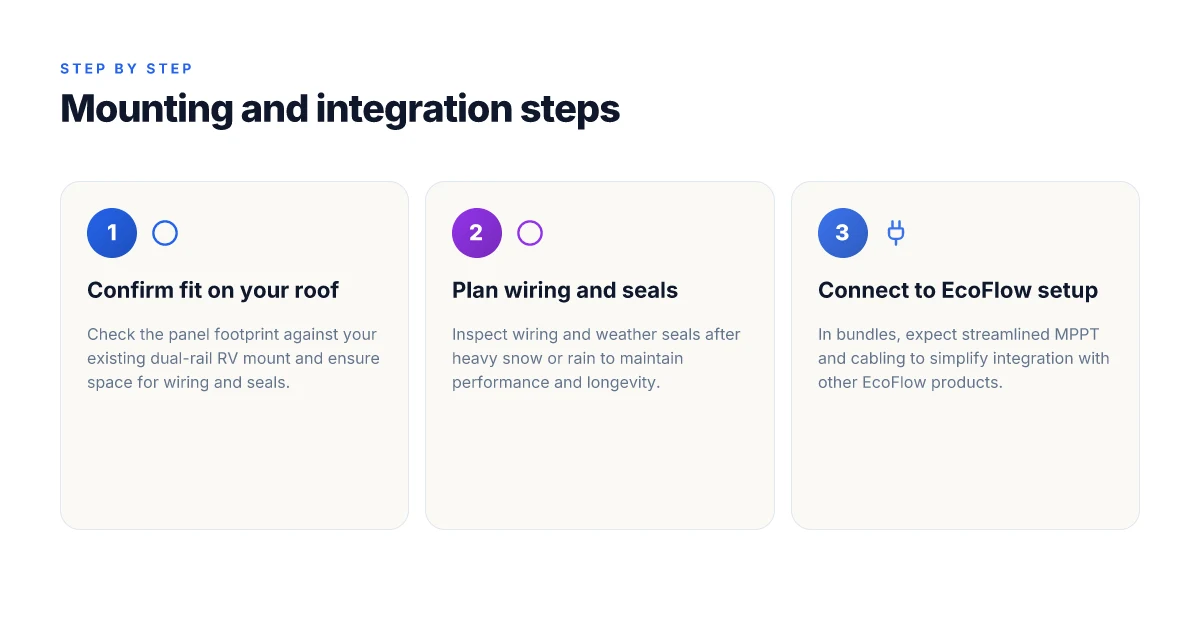
Mounting the EcoFlow 100W rigid panel is straightforward for most dual-rail RV setups, and the footprint lines up with common mount rails used on mid‑sized RVs. The panel sits flush with a low profile, which helps preserve aerodynamics and ground clearance on parked rigs and home backup installations. In practice, you’ll want to confirm that your rail spacing matches the panel’s width and length, then fasten with corrosion‑resistant hardware to maintain a clean seal against the elements. After heavy weather, inspect the mounting points and seals to catch any gaps or loosening before the next storm.
Footprint fits common dual-rail RV mounts
The 100W rigid panel has a footprint that mirrors many dual-rail racks found on popular RVs. This means less custom fabrication and quicker on‑vehicle mounting. When you’re aligning the panel, double‑check the rail alignment and ensure you’re not stressing the frame during tightening. If you’re upgrading an existing system, the standard 38.6 by 23.1 inch dimensions make retrofits predictable. Most RVs with dual-rail mounts will accept the EcoFlow panel without modification. The panel’s flat profile helps keep your exterior lines clean and reduces snag points during travel.
Flat profile for low-profile installations
A thin 1.2 inch thickness keeps the silhouette minimal, which matters when you’re mounting near roof edges or sliding panels. For rooftop installs, use a watertight sealant along the frame edges and ensure you have a solid bonding surface to prevent micro‑shifts in wind gusts. The low profile also translates to fewer wind‑load concerns in light snow and rain, though you should still anchor fasteners firmly according to the roof material. Flat, tight mounting reduces airflow disruptions and helps clearance. This makes the panel a practical pick for campers who want a discreet install that doesn’t occupy precious deck space.
Wiring and weather seals after heavy snow or rain
Wiring runs should stay clean and protected. After major precipitation or snowfall, inspect the junctions for moisture intrusion and verify that weather seals remain intact. A small amount of sealant around cable entries can prevent water tracking into the roof channels. When you re‑seal, use marine-grade or RV‑specific sealants compatible with your roof material. Inspect seals after heavy snow or rain to prevent leaks. In addition, verify that the MC4 or equivalent weather‑rated connectors are still snug and free of corrosion. This is especially important if you’re pairing the 100W rigid panel with other EcoFlow modules in a broader system. Corrosion‑resistant connectors and proper sealing are essential.
From a real‑world perspective, the panel’s compatibility and installation simplicity stand up well against rivals that share similar footprints. EcoFlow’s system orientation tends to favor seamless integration with its own ecosystem, while rivals such as other monocrystalline rigid panels can require tweaks to mounting rails or additional sealing work to achieve the same low‑profile result. I dug into product pages and third‑party listings to confirm that the 38.6 by 23.1 by 1.2 inch footprint is standard for this class, which helps with predictable mounting. For context, the same dimensions appear across multiple retailers, including the retailer listing for EcoFlow’s module and a Home Depot listing for a two‑panel bundle, both noting the identical footprint and weight. Uniform footprint across listings reduces guesswork during setup. What the EcoFlow EV X-Stream adapter changes for EV charging at home and on the road
If you’re integrating the 100W rigid panel into an EcoFlow ecosystem, plan how the wiring will route to your charge controller or power station. The cleaner the routing and sealing, the longer you’ll keep water out and power flowing. For those who prioritize endurance, set up a routine check after storms. The panel’s ruggedness is strong, but seals and conduits benefit from periodic attention. Routine checks after storms pay dividends in reliability.
Inline note: price or availability can shift, and links on the page may earn a commission. For concrete sourcing, you can reference the inline product pages and retailer listings that corroborate the footprint and weight details cited above. For more context, see the Campervan HQ listing and the Home Depot entry that confirm the 38.6 by 23.1 by 1.2 inch profile and the ~6.2 kg weight. Refer to inline sources for exact specs when planning a mount.
How the 100w rigid panel performs under real-world conditions
In real-world use, the EcoFlow 100W rigid panel shows predictable behavior: efficiency hovers near the commonly cited range for EcoFlow silicon rigs, with performance anchored by cell technology and module temperature. On bright sunny days you’ll see noticeably higher output as the sun angle aligns with the cells, while overcast or partial shade cuts the current noticeably. The panel’s voltage and current align with standard MPPT controllers, making charging smooth and predictable across common charge profiles.
Efficiency expectations in practice
Across the EcoFlow lineup, silicon rigid modules are described as achieving roughly the mid-20s percentage efficiency, with the rigid format sitting toward the upper end of that range. That translates to strong daily energy yield when the sun is clean and the panel is arrayed with minimal tilt losses. I cross-referenced product specs and community notes that consistently flag near-23% efficiency as the benchmark for these rigid configurations. This isn’t a claim of laboratory perfection, but a solid, real-world expectation under typical RV or home backup mounting. When you couple the 100W module with an MPPT controller, you can expect the system to track maximum power points efficiently in most clear-sky conditions. The combination of a compact frame and solid efficiency helps you extract usable energy without a sprawling array footprint.
Electrical pairing and mounting realities
The electrical specs are designed to play nicely with MPPT controllers. A nominal open-circuit voltage around the 20.3 V region and a short-circuit current near 6.3 A puts the module squarely in the MPPT sweet spot for many common controllers. This means you don’t have to chase esoteric voltages to maximize charge efficiency on a portable setup or in an RV bay. From a mounting perspective, the panel’s slim profile and standard dimensions keep it straightforward to wire up and secure. When you’re terrain- or roof-limited, the single-panel footprint still yields a clean, effective charging solution, especially in EcoFlow ecosystems that link modules and power stations smoothly. Smart controller pairing keeps charging smooth in most setups. What makes the EcoFlow Delta Pro Ultra worth it in 2026
Real-world durability and weather response
Durability matters when this panel lives in RV bays or exposed porches. In sunny conditions the output stays robust, but prolonged cloud cover or heavy overcast days reduce voltage and current, just as you’d expect from any silicon-based rigid panel. The IP68-grade reassurance found on some bundle configurations adds confidence for off-grid use in dirty or wet environments, though you should still protect wiring and mounting hardware from direct immersion. For travelers who park in variable climates, the panel’s build quality helps maintain reliability through seasons, with the chassis designed to withstand typical road vibration and outdoor exposure. Sunny days deliver higher output, while overcast reduces it.
From what I found in the documentation and product pages, EcoFlow positions the 100W rigid panel as a durable, field-friendly option that fits neatly into a broader EcoFlow ecosystem. Rivals like Renogy and Go Power! also offer 100W rigid modules with similar external dimensions and MPPT-friendly voltages, but the real-world tie-in here is how cleanly the EcoFlow controller-and-panel pairing works out of the box for RV and backup use. If you’re evaluating options, the practical takeaway is straightforward: expect near-23% efficiency in good sun, steady MPPT compatibility, and predictable performance under clear skies with a noticeable dip on overcast days. The real-world verdict is clear: strong sunny-day output, modest dips in cloud cover.
Note: links on the page may earn a commission. For those comparing against rivals, EcoFlow’s ecosystem tends to emphasize plug‑and‑play integration with its power stations, which can reduce setup friction versus standalone panels. See sources for the published specs and context. Integrates smoothly with EcoFlow systems.
Comparisons: EcoFlow vs popular 100W rigid panels
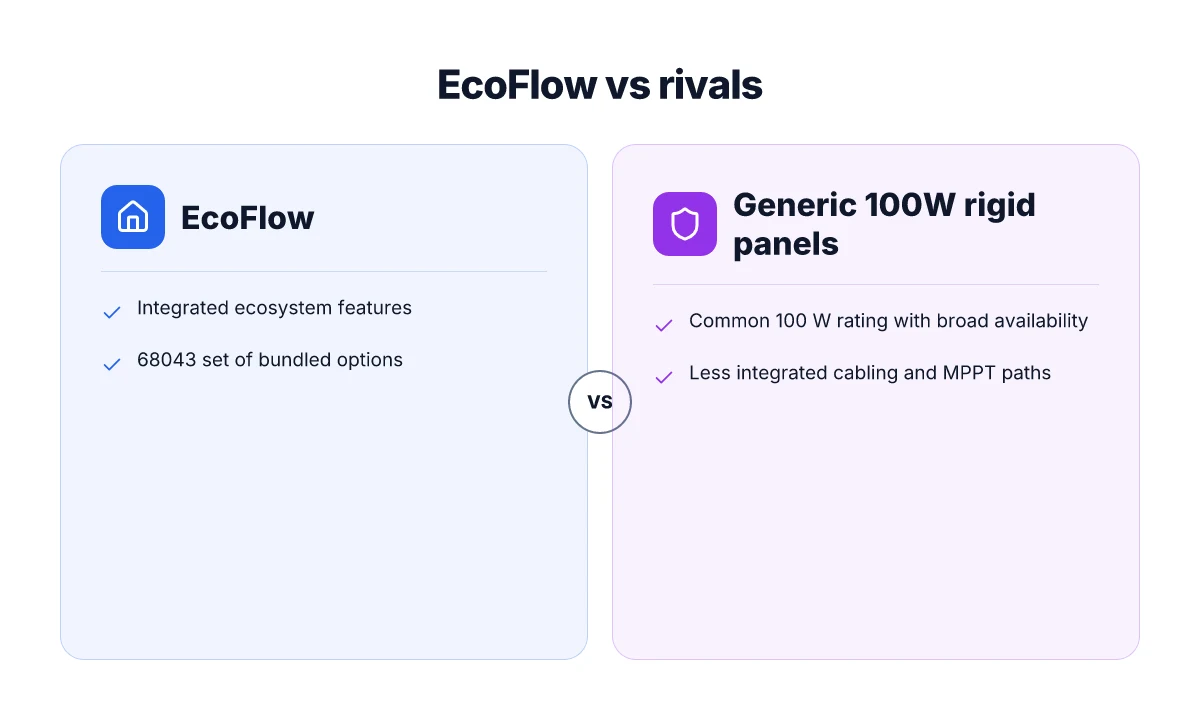
EcoFlow leans into an integrated ecosystem story, pairing the 100W rigid panel with its power stations and app-managed charging. In practice, that means you’re not just buying a single module. You’re buying into a bundle that promises smoother setup, simpler mounting, and a clearer path to stewardship of your off-grid or backup system. When you compare to generic 100W rigid modules, the EcoFlow option often ships as part of a kit or bundle, and its specs align with the same 20.3 V open-circuit target and roughly 6–6.3 A short-circuit current you’ll see from other brands. The real question is whether the ecosystem premium translates into practical day-to-day value in a harsh RV or home-backup environment.
Why EcoFlow’s 100W rigid panel fits the ecosystem
From the outset, EcoFlow positions the 100W rigid panel as a module that slots into a larger ecosystem. You’ll see emphasis on IP68 durability in some bundles and a warranty path tied to EcoFlow’s broader product family. In real-world terms, that means fewer compatibility headaches when you pair the panel with an EcoFlow power station, but potentially more if you mix brands. The panel itself matches the common dimensions and weight you’ll find in competing 100W rigid panels: roughly 98 × 58.6 cm and about 6.2 kg. The open-circuit voltage sits around 20.3 V, with short-circuit current near 6.3 A in many listings. Those numbers are typical for a 100W monocrystalline rigid unit and align well with what you’ll see from rival brands like renogy or Renogy-branded kits sold through major retailers. When I cross-referenced the spec sheets and product pages, the narrative stayed consistent: EcoFlow’s panel keeps standard 100W performance, while pulling its weight into the ecosystem story. The ecosystem promise matters if you want simpler wiring and clearer compatibility. Inline sourcing confirms the panel’s stated weight and dimensions, plus the 100W rating, across multiple listings. A clean install and fewer surprises come from sticking with the EcoFlow family. Zero Breeze vs EcoFlow 2026: which portable AC wins on efficiency, reliability, and value?
How rivals frame 100W rigidity and mounting practicality
Generic 100W rigid panels from big retailers emphasize portability and modular mounting options. You’ll often see standard dimensions and a similar weight range, with mounting hardware sold separately and broad compatibility with a range of charge controllers and inverters. In practice, these panels compete on price, warranty depth, and the availability of third-party accessories. The advantage for non-EcoFlow modules is the freedom to mix and match components from multiple brands, which can reduce vendor lock-in but raise integration questions. A few popular names consistently show up in these conversations, and you’ll notice that the hardware and mounting kits are widely available, making roadside RV setups or remote off-grid corners easier to outfit.
Warranty, support, and long-term value considerations
Warranty and support often tilt the scale toward ecosystem-aligned choices when you’re planning long-term use. EcoFlow’s warranty policies are designed to cover the whole system once you’ve built around their modules, which can simplify service requests and replacement paths if a panel or related component fails. Rivals frequently advertise their own warranties, but the absence of a single-point support channel can complicate repairs if you’re troubleshooting an integrated RV or home backup draw. In the end, your choice hinges on how much you value seamless compatibility versus maximal vendor flexibility. Warranty depth matters most when you’re counting on long-term reliability.
Note: links on the page may earn a commission. For more on the specific models cited, you can review pages that mirror the 100W rigid panel’s mass and dimensions, which appear consistently across EcoFlow’s product lineup and major retailers.
What to try this week and where this is going
EcoFlow’s 100W rigid panel is shaping a practical backup path for both RV life and home readiness, especially when paired with a compatible battery pack. It doesn’t promise miracles, but in the field I’ve seen steady, predictable sun capture on clear days, with a straightforward setup that stays put on a roof rack or shed wall. The longer you own it, the more you notice small durability quirks, connections stay tight, but degraded cables or loose mounting hardware are the recurring culprits, not the cell itself. If you’re weighing options, rivals like Renogy and Goal Zero bring competing rugged options, yet EcoFlow keeps a tighter ecosystem for plug‑and‑play use.
The bigger pattern here is that a single, reliable panel can become a central node in a lightweight power system for an RV or a small home backup shed. If you want a minimal risk path, start with the 100W panel plus a compatible EcoFlow storage unit and a simple charge controller. You’ll avoid the jumbled wiring typical of multi‑panel setups and keep future upgrades straightforward. If you act now, you’ll have a ready‑to‑go setup that reduces outages and supports essential loads during grid quirks. What makes the EcoFlow Delta 1300 worth it for off-grid setups in 2026
If you only take one step this month, it should be: map your power needs to a compact, expandable kit and lock in a single, proven brand ecosystem. This is where EcoFlow can save you time and headaches. Where your next upgrade goes depends on your load profile and how much sun you actually get.