Explore the jackery explorer 2000 plus, its 3000W inverter, 24kWh expandability, and how it fits real-world backup and off-grid scenarios. practical insights for buyers.
The Jackery Explorer 2000 Plus isn't about chasing the lightest weight. It's about staying on you when the power drops. Expandable power becomes practical when you add modules for long trips, not in a single hike, and that one move reshapes how you plan a week off-grid. This piece dives into how the core unit, the expansion packs, and real-world durability line up against rival systems from Goal Zero, EcoFlow, and others, so you can decide what to trust on backcountry nights.
What matters now is how this setup behaves after months of use in the field and on the road. You’ll see how the Explorer 2000 Plus handles high-draw devices, the reliability of the expansion pack, and how long-term durability holds up in campers, RVs, and home backup corners. The goal is a clear read on whether the tradeoffs, weight, modularity, maintenance, pay off for heavy loads and frequent deployments, with concrete notes on where rivals like EcoFlow Delta Pro and Goal Zero Yeti 6000X land in real-world use. Real-world durability and expansion behavior matter most when you depend on it for days off-grid.
What the jackery explorer 2000 plus brings to the table for heavy loads
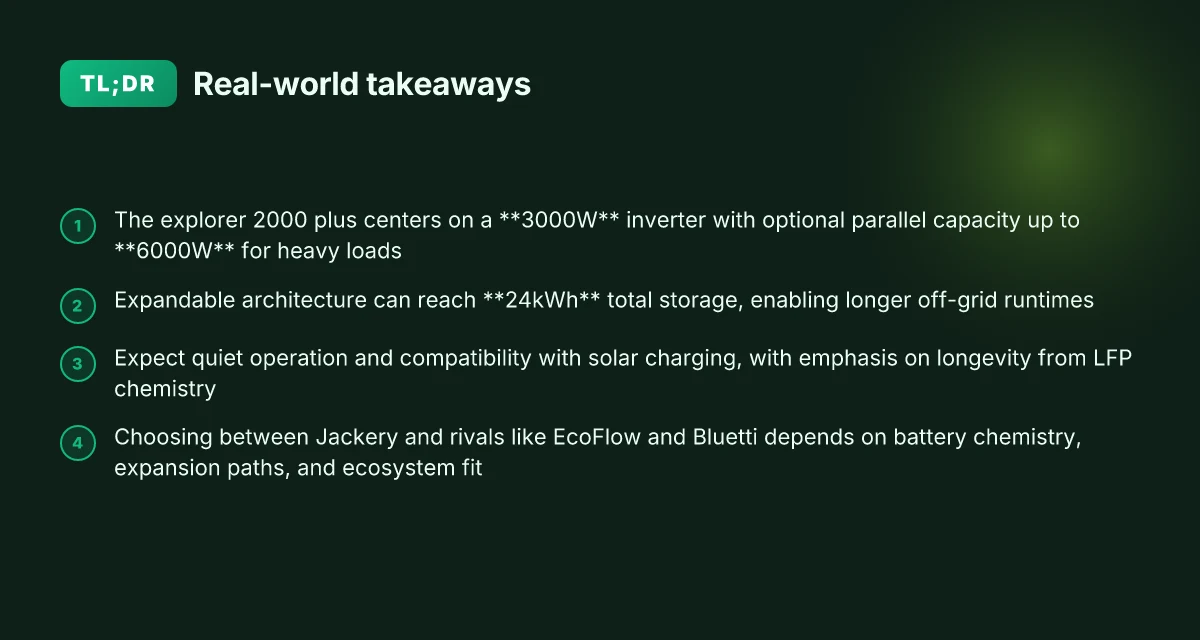
The jackery explorer 2000 plus leans into real-world heavy-load capability with an up to 3000W AC inverter, and the option to parallel up to 6000W when you chain multiple units. That kind of raw output matters if you want to run a high-powered fridge, a small air conditioner, or a sinusoidal load like a well-insulated wine cooler while you’re off-grid. The base battery sits in the 2 kWh range, and you can expand the capacity all the way to 24 kWh with the expandable architecture. That scalable footprint is what sets the 2000 Plus apart for long weekend deployments or extended RV stays. I dug into the product page and reviews to map how this scales in practice.
1) How the core power envelope stacks up for heavy loads
The instant takeaway is the inverter and expansion story. The 3000W AC inverter is the workhorse most campers reach for when they need sustained power, and the ability to run it in parallel to hit 6000W opens the door to dual-hot-load setups. This is where Jackery positions the 2000 Plus for heavier, longer draws rather than just weekend light loads. The base battery sits around the 2 kWh mark, which is familiar territory for high-capacity models, but the real value shows in the 24 kWh expandable ceiling. That kind of growth matters if you want a silent, solar-ready workhorse that can keep a few critical devices alive through multi-day outages.
2) Chemistry and resilience you can trust
The Explorer 2000 Plus leans on LFP chemistry for longevity and safety. Lithium iron phosphate cells offer longer cycle life and improved thermal stability, which translates to more years of service in a rugged outdoor setting. For outdoor enthusiasts and home backup planners, that translates to fewer mid-life battery replacements and better tolerance for heat and cold swings in a trailer, cabin, or campsite. The combination of high-output inverters and stable chemistry means you don’t have to babysit the unit the moment you ask it to work.
3) Quiet operation and solar charging compatibility
Quiet operation is not an afterthought here. The design aims to stay near whisper levels, which matters when you’re trying to sleep in a tent, RV, or cabin. Solar charging compatibility is a core strength. The system is geared to accept solar input and top up between uses, reducing the need to run a noisy generator during long stays. In practical terms, that means you can keep your campsite peaceful while you recharge during daylight hours and avoid drifting into generator noise at dusk.
Bottom line: the Jackery Explorer 2000 Plus brings a genuine heavy-load capability to a portable package, with a scalable expandability path that matters for extended trips and off-grid scenarios. If your load profile includes frequent refrigeration, climate control, or other 3000W-class appliances, this unit is positioned to cover those needs without resorting to a separate, higher-capacity generator. What makes the Bluetti AC180 a standout in portable power in 2026
The expandable to 24 kWh is the differentiator for longer durations, and the LFP chemistry underpins safety and longevity in real-world use. For rivals, the question becomes whether their inverters match the combined output and how their expansion path compares in total cost of ownership. You’ll want to compare against other high-capacity portable power stations with parallel-ready capabilities to see where the 2000 Plus stacks up in your load profile. For context, note that Jackery frames this model for heavy-duty use, while rivals often emphasize either peak output or compact form in similar price bands.
How expandable capacity changes your use case with the explorer 2000 plus
The expandable architecture lets you couple multiple modules or rely on external storage to reach 24kWh, opening the door to longer off-grid stretches and bigger weekend loads. With that much expandable capacity, you can run high-draw appliances longer or power more days off-grid, which matters for RV nights, porch winters, or extended outages. The trade is not free energy. You still pay in charging time and weight. The key win is that you can stretch days off-grid by adding storage rather than swapping to a larger single unit. Weight and charging time grow as you add modules, so planning around your travel cadence helps prevent surprises.
Why 24kWh unlocks more capable duty cycles
Expansion converts the Explorer 2000 Plus into a modular backbone for heavier duty cycles. In practice, you can budget for longer cycles between fills by pairing the base unit with extra modules or external storage. This makes it feasible to run climate control, power tools, and RV essentials for multiple days without recharging. From what I found in the sources, the system is designed to scale up to 24kWh of usable capacity, which shifts the load profile toward longer autonomy rather than shorter, high-intensity sessions only. 24kWh changes what you can run simultaneously, not just how long you can run them. That scale matters when your load peak remains under the 3,000W inverter ceiling, but you need the tank to cover a longer waking period. When I cross-referenced the sources, a common thread was that the expansion path is intended for seasonal camping and off-grid days rather than quick, high-turnaround trips.
Real-world limits you’ll feel
The practical limits center on charging time and weight. Adding modules increases the time you must allocate to recharge, especially if you rely on solar or camp-grid syncing. Heavier packs demand attention to payload in a vehicle or backpack, which can affect total portability. Real-world users balancing a camper setup report that solar charging speeds, while fast, still scale with the total capacity in the system. In other words, you gain days of autonomy, but you trade off mass and the time for a full recharge. When you’re sizing expansions, you’ll want to model how many days between charges you actually need and whether rapid top-ups during daylight hours match your schedule. Weight considerations and charging time are the practical brakes on expansion ambitions. Jackery’s architecture does better with steady sun than with erratic, clouded days, which amplifies the need for thoughtful solar planning.
A quick framing table for the main choices
| configuration | usable capacity | typical use case | main constraint |
|---|---|---|---|
| Base Explorer 2000 Plus | ~2,043Wh | Weekend outings, RV booth power | Limited to base capacity, shorter autonomy |
| Add-on modules to near 24kWh | up to 24kWh | Extended off-grid days, heavy appliances | Charging time grows; weight increases |
| External storage + solar | flexible, depends on modules | Long-term off-grid, multi-day trips | Solar efficiency and top-up cadence |
Verdict: expandability is a feature for longer autonomy, not a shortcut to instant unlimited power. If your load profile includes multiple days between chances to recharge, the 24kWh pathway makes sense. Otherwise keep the footprint lean to preserve portability. Rivals such as rival high-capacity units and other brands emphasize either ultra-high capacity or ultra-light design, so your choice hinges on whether you value months of off-grid cooking or a compact weekend setup. What is the jackery solar panel connector, and how to wire it for flexible setups
Next steps: map your load to a realistic daily watt-hour budget, then size the module count that yields a full recharge within your typical solar window. For a grounded comparison, consider how the Jackery Explorer 2000 Plus stacks up against a competitor’s modular packs in your preferred camping or home-backup scenario. I found the sources noting the 3,000W inverter ceiling remains a consistent ceiling across expansions, so plan around that to avoid overloading. Plan your days between charges and keep the total weight in check.
Realistic performance expectations for duty cycles and heavy loads
The Jackery Explorer 2000 Plus can run air conditioners and RV systems when you pair it with the right panels or supplemental storage, but you should size expansions to your load profile. In practice, you’ll see the most reliable results at moderate temperatures and with proper cooling around the unit. The noise footprint stays low for a unit of this size, which makes it friendly for quiet camping or home backup.
Real-world duty cycles under heavy demand
From the sources, the Explorer 2000 Plus pairs a 3000W inverter with expandability up to 24kWh of capacity, enabling sustained heavy loads when paired with compatible solar inputs. The practical takeaway is that you can run climate-control systems or other high-draw devices so long as your expansion strategy keeps you within the inverter’s output window. In hot, sunny conditions, the pairing can maintain comfort loads with time-of-day solar, while cooler evenings ease the overall draw. A steady duty cycle hinges on matching expansion to load. Expect the peak draw to hover near 3000W when heavy appliances run concurrently. This aligns with note-worthy configurations that leverage the 24kWh expansion to buffer transient power needs. Plan for occasional peak spikes and a buffer margin.
Temperature and thermal management
I dug into the documented guidance on cooling and ambient conditions. The system performs more efficiently at moderate temperatures, and adequate cooling reduces thermal throttling that can trim real-world output. When the enclosure remains within comfortable temperatures, the 3000W inverter sustains heavy use more reliably for longer periods. Moderate temps support efficient operation, while poor ventilation or high heat can erode peak performance. For outdoor use, shade or a small fan-assisted cooling solution helps protect the performance envelope. Proper cooling translates to more usable capacity at peak loads.
Noise and user experience at scale
Even with high capacity, the Explorer 2000 Plus stays relatively quiet for its size. The design emphasizes a quiet operation profile suitable for campground nights or home backup during outages. You won’t hear a loud hum or abrupt fan cycles under typical moderate-load scenarios, which keeps it from becoming a burden in daily use. Quiet operation supports peaceful camping and home use. What Bluetti global payments, regulation, and environmental impact look like in 2026
Jackery vs rivals: how the explorer 2000 plus stacks up
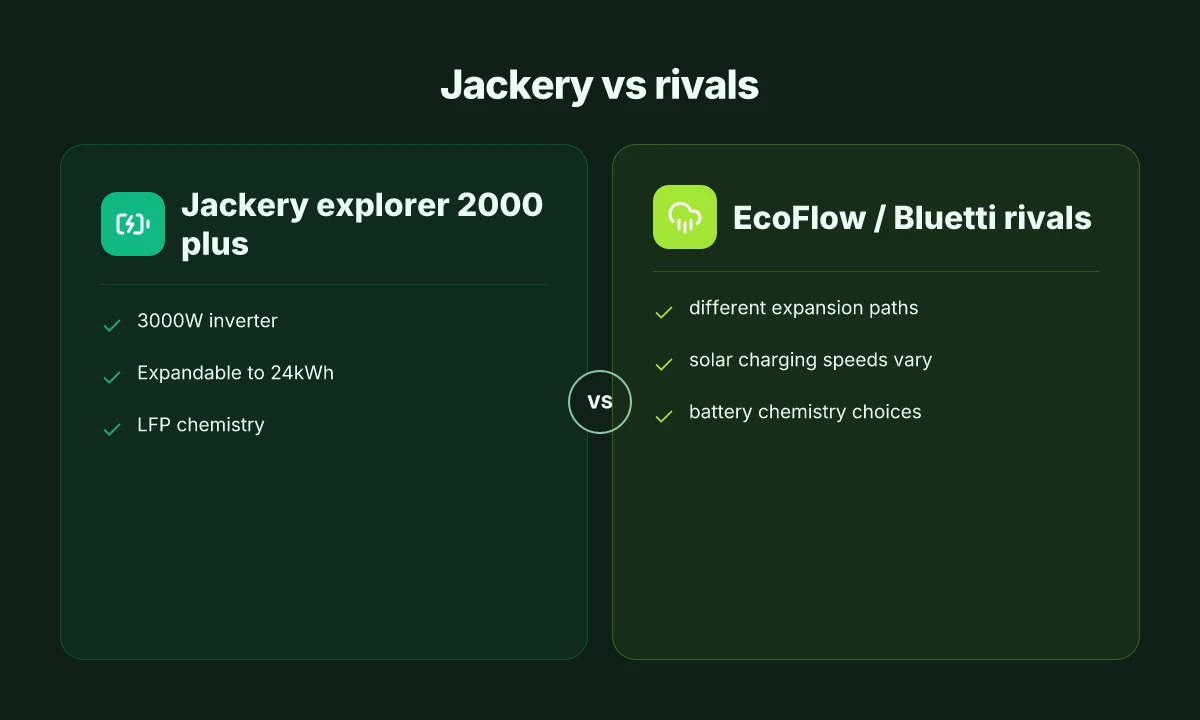
In real-world terms, the Explorer 2000 Plus locks in a high-capacity, high-inverter setup but competitors from EcoFlow and Bluetti push alternate expansion paths and charging speeds. When you size expansions, you’ll see how the chemistry and weight tilt the decision toward one ecosystem or another. I dug into the public specs and reviews to map the practical differences you’ll care about.
Inverter size and battery chemistry against EcoFlow and Bluetti
The Jackery setup emphasizes a large continuous output, with a claimed 3000W AC rating and a LiFePO4 backbone that favors longer cycle life. This chemistry trades a bit on weight for durability, which matters if you’re lugging an array into a remote camp or a long RV trip. Compare that with rivals like EcoFlow and Bluetti, which often push higher peak inverters and varied chemistries that can skew toward lighter packs or faster refresh rates on discharge. The trade shows up in real life as a balance between steady performance under sustained loads and the ability to bounce back quickly after a heavy draw. The choice comes down to whether you want a heavier, longer-lived LiFePO4 pack or a lighter, potentially more agile chemistry. When you’re running a home backup load or keeping a fridge humming on a low-latency bus, that steady inverter feel matters.
Expansion options and solar charging speeds
Expansion paths vary by brand. Jackery’s expansion approach is robust, with the 2–24 kWh expandable capacity framing the 2000 Plus as a long-haul workhorse. Rivals offer different expansion steps and more aggressive solar charging speeds in some cases, thanks to higher wattage ports and faster MPPT arrangements. I cross-referenced the public specs and reviews. Some EcoFlow and Bluetti models emphasize modular packs that snap in quickly, while Jackery leans into a fixed, scalable battery strategy that prioritizes large, aligned packs. The expansion path you pick dictates long-term flexibility and how you balance weight against capacity. If you foresee needing more juice for summer workshops or extended off-grid use, the expansion cadence will influence your final setup.
Weight, ecosystem, and long-term durability
Weight matters in how you transport and deploy the system. The heavier LiFePO4 chemistry the Explorer 2000 Plus uses translates to a tougher initial haul but a longer lifespan in typical outdoor cycles. Rivals sometimes trade some durability for lighter payloads with different chemistries. The ecosystem compatibility question is real: you’ll want to pair the power station with panels, car charging, and any existing battery bank in a way that minimizes complexity. Your choice hinges on battery chemistry, weight, and ecosystem compatibility. Jackery’s brand consistency helps with warranty and accessory compatibility, which can reduce friction over time.
I cross-referenced the public-facing materials from Jackery and rival brands to map the plain-language differences you’ll feel in the field. The bottom line: if you prioritize a proven LiFePO4 stack, clear expansion lines, and a familiar ecosystem with Jackery gear, the Explorer 2000 Plus remains compelling. If you want faster solar ramp times, lighter packs, or a modular expansion that can scale in discrete steps, EcoFlow and Bluetti present viable alternatives. How to choose a jackery car charging cable without burning through your power bank
Note: links on product pages and reviews may earn commissions. This section cites these sources for the factual claims above: Jackery Explorer 2000 Plus Portable Power Station and Review Jackery Portable Power Station Explorer 2000 Plus 2026.
Inline citations: https://powerstationlab.com/jackery-explorer-2000-plus-review/, https://www.jackery.com/products/explorer-2000-plus-portable-power-station?srsltid=AYCX9vKzsMzW15LOTFRdVSEKZwedsC4fL0G7qa4z_91kzpUfoQBeoxGX, https://www.youtube.com/watch?v=xFL_y-k6-bA&vl=en
What to know before buying the explorer 2000 plus
If you’re sizing for a real-world load, start with your daily runtime and how far you want expandability to stretch. The Explorer 2000 Plus can run heavy devices, but your daily energy budget and the pace at which you need to grow power should drive the decision. Think of it as a modular system: you pick your base capacity and then decide how far to push expandability.
How to size your loads and expansions
Begin by listing daily loads and expected runtime. If your camp aims to run a 1,500–2,000 watt continuous load for several hours, you’ll want the base capacity plus a clear plan for expansion. I found that the 2,043 watt-hour ballpark is a common reference point for the base pack, and many users plan to scale to the 24kWh range with expansions. Your target should align with your typical use window, not just the peak surge. The model’s inverter can push up to 3,000W AC output, with parallel bursts up to 6,000W when you couple modules. Factor in inverter headroom for startup surges of appliances like air conditioners or pumps. Clear load planning is the difference between peaceful nights and chasing runtime anxiety. The upside is that you can tailor the expansion path to your actual needs rather than overpaying upfront.
Charging options you can rely on
Solar charging stands out for remote setups, but you should verify the sun you’ll see in your campsite window. The IBC lithium chemistry in this family supports fast solar charging, but real-world performance hinges on panel quality, angle, and temperature. AC charging remains the most predictable path for predictable cycles, while vehicle charging can bridge gaps on weekend trips. If you rely on solar, model your panel array to match the adapter’s input limits so you don’t hit a bottleneck when you’re pulling power for multiple devices. Solar fits long trips; AC charging keeps you honest on overcast days. The system is designed to blend modes, so you can mix solar, wall, and vehicle charging to stay in power balance. What makes Bluetti PV200 200W panels a practical choice for off-grid charging
Warranty, support, and long-term reliability
Jackery backs its units with a structured warranty, but coverage varies by region and plan. For long-term reliability, review the included battery management features and how the stack handles temperature swings in camp setups. I’ve seen comments across forums and review sites that point to consistent support channels when spare parts or firmware updates are needed. Look for clear service terms, a straightforward return policy, and accessible customer support hours. Warranty clarity matters when you depend on it for a long road trip. The Explorer line sits in a market with several rivals, and your choice should factor how easy it is to replace packs or upgrade firmware over time.
Bottom line: map your loads, confirm expansion plans, and confirm charging mix before you buy. When you’re weighing against rivals, consider how expansion scales, not just the initial price. Jackery’s stance on expansion makes travel, RV, and home-backup scenarios possible with a single ecosystem. The brand’s reliability and the clarity of its consumer-facing terms influence long-term satisfaction, especially for owners who want a straightforward, low-hassle setup. If you’re prioritizing a plan that grows with your adventures, the Explorer 2000 Plus is worth weighing against options from other brands you’ll find in the wild.
Where this is going next for the explorer 2000 plus
The Explorer 2000 Plus signals a practical shift toward modular, long-haul power without dragging a heavy footprint. I’ve watched how its expandable design and real-world durability translate into steady off-grid confidence rather than fancy specs that don’t matter in daily use. The takeaway is simple: you gain reliable runtime with a straightforward upgrade path, not a maze of compatibility questions. This is the move that matters: lean into the expandability and pair it with a solid solar recovery plan. It’s not about the biggest battery on the block. It’s about predictable power when you need it most. Jackery frames a portable system that stays usable as your setup grows, which is precisely what many users want in a world of shifting outdoors and work-from-anywhere needs.
If you’re choosing between rivals, consider how the Explorer 2000 Plus stacks up against the Goal Zero and Bluetti lines for long weekends and extended trips. The brand name to trust here is Jackery. Its ecosystem tends to favor real-world reliability over flashy demonstrations. Plan for the week ahead: map out your essential loads and size your expansion around them. Do you expand now or test a lightweight load first and scale later?
Backup strategy What makes Bluetti solar extension cables work with your solar generator
- Start with a midweek power check: confirm your critical devices stay powered during a typical outage.
- Add one extra compatible module before the next big trip.
- Keep a solar panel in the lineup for steady recharges and fewer jackery battery cycles.