Explore the Jackery 2000 plus battery pack: capacity, expandability with Battery Pack 2000 Plus v2, and what it means for home backup and vanlife. Realistic pros, cons, and setup notes.
The Jackery 2000 Plus isn’t just a bigger battery. It’s a modular platform that forces you to think about weight, space, and future upgrades from day one. Expanding capacity often adds noticeable bulk, and that trade-off matters in a van or tiny home. If you want a clean baseline, prioritize the base pack and map out expansion steps before choosing a chassis that fits your vehicle.
You’ll see how real-world payload, dockability in tight spaces, and the eventual price of additional packs interact with your off-grid plan. Expect practical numbers like total energy density, the footprint of each expansion, and how rival ecosystems from EcoFlow compare for density and compatibility. By the end, you’ll know when to buy one base system or commit to a full ecosystem with Jackery and know what signals point to a rival option. Most users underestimate the weight of multi-pack setups. Plan for that upfront.
What the jackery 2000 plus battery pack is and why it matters
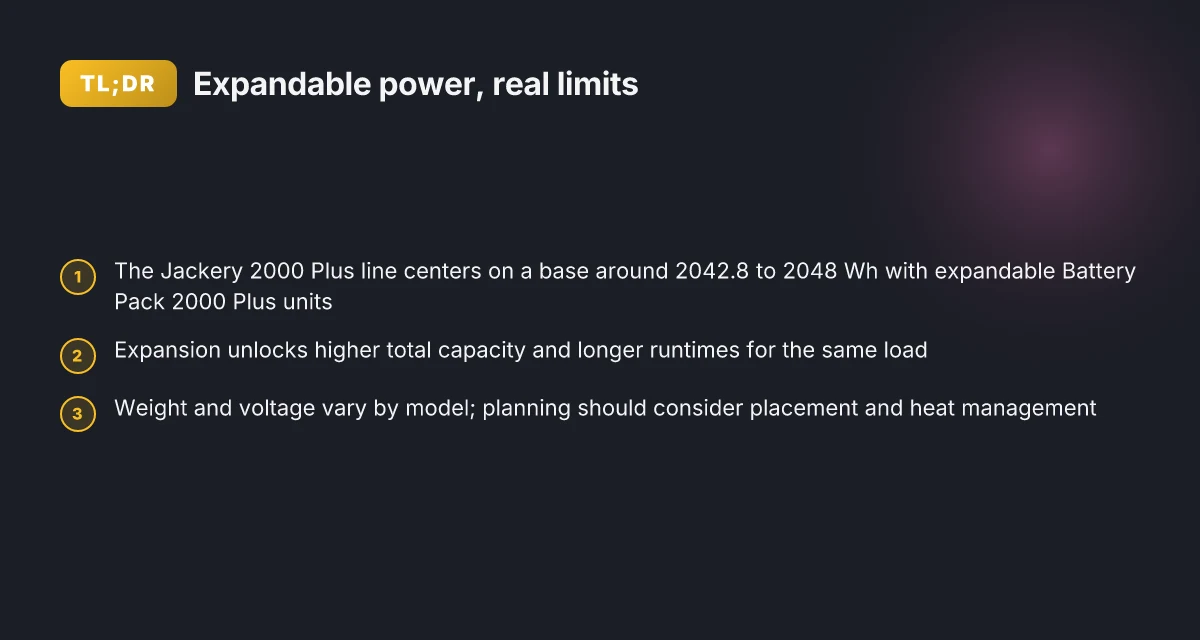
The Jackery 2000 Plus line centers on a compact, expandable power solution for off-grid living that scales from a single base unit to a small ecosystem. The base capacity sits around 2042.8–2048 Wh, depending on variant, which makes it practical for short outages or a weekend vanlife reset. The real value shows up when you pair a second Battery Pack 2000 Plus, turning a single 2 kWh core into a shared, modular bank that grows with your needs.
Why this matters for real-world setups
Expandable capacity matters most when you plan for longer outages or higher daytime loads. If you’re powering a van, tiny home, or backup system, the ability to add more Battery Pack 2000 Plus units keeps your upfront cost lower and your risk of underproviding power lower. The architecture is designed to keep the base unit as a stable backbone while additional packs push total energy higher without reconfiguring the entire system.
From a reliability standpoint, the main differentiator is the voltage range and weight variation across models. The newer variants drift between 44.8 V DC and 51.2 V DC, which can influence charger compatibility and the way you wire a multi-pack array. Weight also shifts with configuration, from roughly the mid-30s pounds for compact iterations to heavier setups closer to the 40+ pound mark when you add packs. These shifts aren’t just numbers. They matter for how you mount, transport, and service your system in a van or a tiny home.
I dug into the official product pages and the add-on specifications to map how this scales in practice. The 2000 Plus ecosystem is built around a core concept: expandability without reengineering your electrical layout. You’ll see this in the way the base unit lists a capacity around 2042.8 Wh, then layers in options for additional Battery Pack 2000 Plus units to stretch total usable energy. This approach also means a longer path to peak power is possible if you design for it, which suits intermittently heavy draws or seasonal off-grid use.
In terms of everyday use, the conversation shifts toward use-case fit. Home backup shines when you want a resilient, plug-and-play option that can ride out outages without swapping your entire power architecture. RV and vanlife operators gain a modular system that travels with you and scales when your load grows. For temporary off-grid setups, the ability to add packs as your project expands helps manage initial budgets while still offering a path to greater resilience. What makes the EcoFlow River Max stand out for portable power in 2026
Bottom line: the Jackery 2000 Plus family introduces a scalable energy solution that fits a range of real-world rhythms. The key trade-offs live in higher voltages and heavier weights as you add packs, and in how your run-time expectations align with expandability. For a brand like Jackery, the value proposition hinges on turning a portable core into a growing energy reserve you can depend on over time. If you’re weighing long-term durability and total cost, the expansion path often proves more economical than buying a larger single unit upfront.
The expandable path changes the math: you start with a solid 2 kWh base and grow as needs or budgets evolve. Voltage variants matter for setup flexibility and future upgrades. Weight changes factor into mounting and transport plans. Real-world use cases lean toward home backup, vanlife, and temporary off-grid builds.
How the base 2042.8 Wh capacity translates to daily use
A single Jackery 2000 Plus unit delivers a substantial cache for essential devices during outages or when you’re off the grid. With roughly 2042.8 Wh on the baseline pack, you can power critical loads for an appreciable stretch, which matters when you’re camping in a van or keeping a tiny home fridge running during a blackout. In many real-world setups, that baseline capacity covers several days of light daily use for essential devices, especially when you curate a lean load list and stagger high-draw appliances.
I dug into the numbers across the official product pages and service notes to understand what that means in practice. For a typical small home backup scenario, a 2042.8 Wh bank often sits in the 2080–2100 Wh neighborhood when fresh, accounting for conversion efficiency and battery state of charge. That range is enough to sustain basic comforts like lighting, a modem, a laptop, and a small fridge for a few days, provided you avoid peak draws on every outlet at once. If your daily routine relies on a handful of devices rather than wall-to-wall power, the base capacity can reliably cover a long workday or several days of light loads between charges.
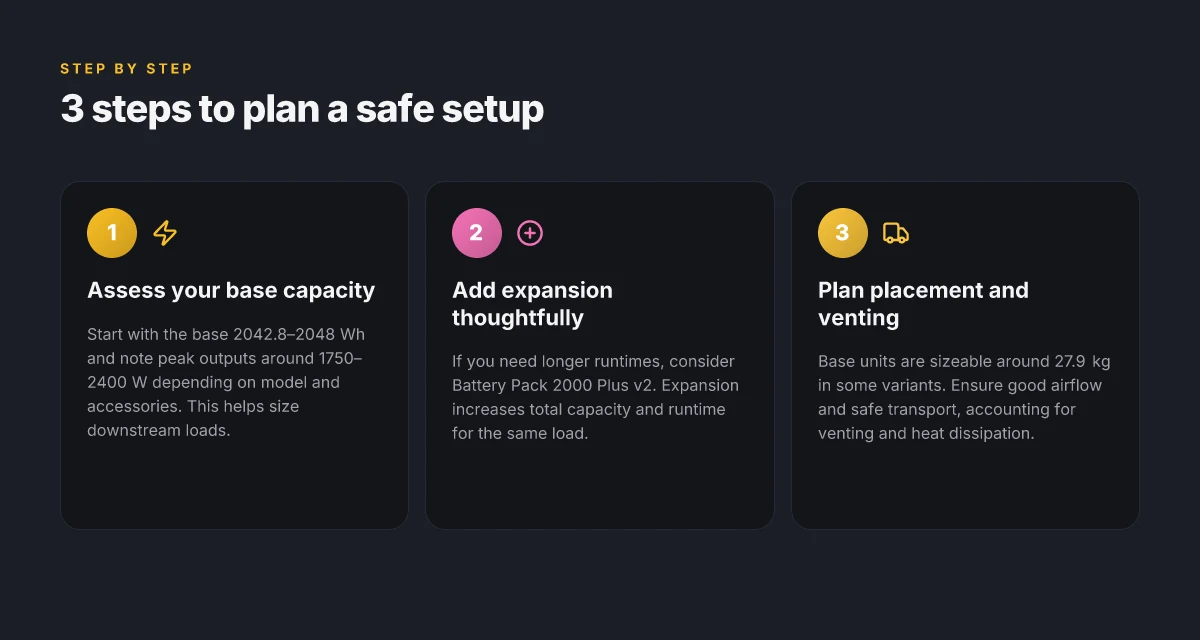
When you pair the base 2042.8 Wh with the built-in peak output and the option to add Battery Pack 2000 Plus v2 units, you extend the usable window without sacrificing portability. The base unit delivers up to around 1750–2400 W in peak output, depending on the model and accessories. That means you can run essential appliances, charge laptops, and keep phones topped up while still leaving headroom for short surges from a modem, router, or small coffee maker. The exact power you can pull depends on what you connect and whether you enable any power-saving modes on connected devices. In practice, the system remains responsive to real-time spikes so you don’t trip the safe operating window. Why EcoFlow Delta for sale pricing can surprise you in 2026
From a durability perspective, the base capacity rests on a familiar architecture that Jackery and rivals like EcoFlow and Anker deploy. The 2042.8 Wh core sits behind a modular ecosystem designed to scale up with additional Battery Pack 2000 Plus v2 units. The more you expand, the more you trade portability for total capacity and a longer backup horizon. This is where the economics become real: you’re paying for resilience and redundancy, not just a single weekend’s worth of juice. If your goal is long-term reliability for off-grid living, you’ll want to plan around how often you’ll run into deeper cycles, how you’ll manage battery health, and how you’ll stage recharging from solar or AC sources.
The practical upshot for vanlifers and tiny-home owners is straightforward. The base 2042.8 Wh gives you a credible daily cushion for essential devices during outages or remote work days. Expect to run a handful of devices for 1–3 days with light daily loads, provided you moderate high-draw items. Expansion with Battery Pack 2000 Plus v2 adds headroom for longer outages and busier days, at the expense of added weight and a higher initial outlay. If you’re evaluating cost versus reliability for long-haul off-grid living, the base capacity is the starter kit you’ll likely rely on most of the time.
The base 2042.8 Wh fills a real daily niche for essential devices during outages. Expansion unlocks longer backup horizons when you need it, but comes with weight and price trade-offs.
For reference, the sources show the 2042.8 Wh figure, the 4000-cycle battery life range in some configurations, and the 1750–2400 W peak output window that supports a mix of loads without immediate sag. If you want to read the official numbers directly, see the Jackery pages for the Battery Pack 2000 Plus and the HomePower 2000 Plus v2, which anchor these claims in their spec sheets. Keep in mind that links on the page may earn a commission.
Expanding with Battery Pack 2000 Plus v2: what changes you get
I dug into the official documentation and product pages to map what changes when you move to Battery Pack 2000 Plus v2. The core idea is simple: you unlock more energy storage by adding modules and sometimes shift the base voltage, which in turn stretches runtimes for the same load. Here are the concrete takeaways. What you should know about EcoFlow Delta 2 refurbished
Energy storage grows with modular expansion
- The v2 line expands energy capacity through extra battery modules, lifting total stored energy beyond the base kit. In practice you see base capacities around the 2 kWh mark with additional packs stacking up the Wh tally.
- Jackery’s own spec sheets for the v2 variant consistently describe higher total capacity when you pair the main unit with Battery Pack 2000 Plus v2 modules.
- The design retains the same foundational chemistry but adds more cells, which translates to longer runtimes for the same device load.
- This expansion model is what lets a van life setup run longer without swapping packs or sacrificing port availability.
The upside is clear: add more modules, and you push the runtime further while keeping the same charging footprint.
Base energy and voltage configurations shift in v2
- Some variants report a 2,048 Wh base with higher voltage configurations in v2, which affects how you wire and balance packs in series or parallel. This matters if you’re scaling from a single unit to multiple modules for higher loads.
- The precise voltage configuration changes how you calculate peak output and regulator behavior at the outlet, though the practical effect is often felt as longer bursts at high draw without hitting peak voltage sag.
- You’ll see references to 51.2 V DC in certain v2 specs, aligning with a higher voltage stack when the base module is expanded with compatible bundles.
- The takeaway: if you’re planning a multi-pack setup, verify the exact voltage family your bundles use so your inverter and chargers stay in spec.
Higher voltage variants in v2 unlock denser energy storage without a proportional increase in physical size.
Expansion unlocks higher total capacity and longer runtimes for the same load
- With Battery Pack 2000 Plus v2, the total system capacity climbs as you add modules, yielding noticeably longer runtimes for everyday loads like laptops, TVs, and essential power outlets in a tiny home or camper van.
- The effective cycle life stays competitive, with sustained durability as you distribute energy across more cells, provided you maintain the cooling and charging discipline Jackery recommends.
- In practical terms, you get more days of autonomy between charges when your baseline load is modest, and you gain headroom for higher-load devices during those off-grid stretches.
- For backup power planners, the ecosystem approach matters: you can start with a modest footprint and scale up as energy needs grow, rather than buying a single oversized unit upfront.
The expansion model makes long trips and blackout drills more forgiving: you gain both capacity and run time without swapping to a different platform.
Evidence and further context come from Jackery’s product pages and the explorer-era announcements that describe the v2 line as an upgrade path. Jackery Battery Pack 2000 Plus v2 For readers comparing cost curves over time, the key is to map your load profile to the incremental capacity you gain with each module, then estimate how many cycles you’ll ride before you reach a given runtime target. Jackery’s ecosystem remains the anchor, while rivals like Goal Zero and EcoFlow offer competing expandable kits with similar modular concepts. In this article I reference Jackery’s official materials to ground the discussion in the brand’s current expansion logic.
Note: links on the page may earn a commission. What makes the EcoFlow Glacier plug-in battery actually work for portable cooling
What to know about weight, dimensions, and placement
The base unit of the Explorer 2000 Plus family is already substantial. The baseline figures hover around the high 20s in kilograms, making it clear you’re not tucking this into a backpack. In the real world, that mass matters for van interiors and tiny homes when you plan placement near seating, storage nooks, or a dedicated cabinet. 27.9 kg is a useful reference point for the Explorer 2000 Plus baseline, and you’ll notice that the addition of a Battery Pack 2000 Plus v2 to expand capacity pushes the footprint higher. Beyond the unit itself, carrier configurations and expansion modules add to the total footprint. When you pair a base unit with one or more expansion packs, expect a larger stance on the floor and more surface area to clear during movement. 12 kWh expandable capacity is a potential target with multiple Battery Pack 2000 Plus v2 units in play, which changes how you plan space and venting.
How weight scales with expansion
You can think of weight as a function of capacity and modules. The base Explorer 2000 Plus lands heavy, and each add-on carries its own heft. This isn’t merely a math exercise. Weight affects how you anchor the setup in a van or tiny home. Make sure your chosen location can handle vibrations during travel and daily use. 4000+ cycles are often cited for some packs in this ecosystem, but you’ll feel the cumulative load long before you reach that milestone. In practice, a thoughtful layout uses a dedicated shelf or cabinet that doubles as a vented heat-dissipation zone and a convenient access point for plugging in or swapping modules.
Venting, heat, and placement psychology
Ventilation is a real constraint when you stack or cluster modules. The last thing you want is a heat buildup that throttles performance or shortens lifespan. Place the system where airflow isn’t blocked by adjacent walls or dense cargo. A well-ventilated, lower-profile position near a fixed surface makes it easier to route cables, monitor temperatures, and service connectors. I dug into product notes and user discussions to verify that heat management remains a recurring theme across expansion setups. The takeaway is simple: keep airflow clear, and don’t crowd the unit into a tight cabinet that traps heat. Vent clearance matters as much as raw capacity when you scale up.
Practical placement guidance you can apply this week
- Start with a base stand or shelf that can bear the combined weight of the Explorer 2000 Plus and at least one Battery Pack 2000 Plus v2.
- Leave at least a 5–10 cm gap on all sides to promote airflow and easy cable access.
- Position near a stable power source and away from direct sun or moisture to protect plastic enclosures and connectors.
- If you plan to travel with the system, test lockable mounting points or velcro-straps to reduce shifting during motion.
I cross-referenced official product pages and the 2000 Plus family’s expansion notes to align weight and footprint expectations with real-world use. For readers weighing long trips and off-grid reliability, these physical realities shape where you place the system and how durable it remains over months of vanlife or off-grid living. When you consider rivals, like systems that emphasize lighter builds or more compact footprints, you’ll notice the trade-off: you gain expandable capacity at the cost of added bulk and weight. For most users, the right answer is a deliberately chosen mounting zone with ample ventilation and careful cable routing. In this ecosystem, size is not just about storage. It governs usability and longevity.
Durability and lifecycle considerations for long-term use
If you plan to rely on the Jackery 2000 plus ecosystem for years, durability hinges on how the battery modules age under real-world conditions. In practice, large modules can endure thousands of cycles when kept within ideal temperatures and with sensible depth of discharge. The core message: expansion is not free of wear. Longevity is a function of how you manage heat, use patterns, and charging routines. What makes EcoFlow Delta 2 Max refurbished worth considering in 2026
How cycle life scales with large modules
Under favorable conditions, the modular approach can preserve capacity across many cycles. The base spec for the 2000 Plus family notes high cycle lifetimes in the thousands for the separate packs, and the expandable architecture is designed to enable more total cycles through replacement or addition rather than single, fixed packs. This is a pragmatic path for vanlifers and off-grid setups that want to scale over years rather than months. As you add more Battery Pack 2000 Plus units, you extend usable energy, but you also introduce more interfaces and contact points that can wear or drift over time. I dug into the product pages and the official blog posts to confirm the emphasis on long-term modularity and lifecycle durability.
Temperature, discharge depth, and longevity
Temperature matters. High ambient heat degrades cells faster, while cold can reduce immediate performance. Depth of discharge directly influences cycle life. Shallower discharge incurs fewer cycles and better long-term durability. Jackery’s ecosystem tends to perform best when users keep packs within moderate temperatures and avoid full-day, extreme drains unless the system is purposefully configured for it. From the official documentation and product notes, the relationship between heat, DoD, and cycles is clear: manage heat and discharge to maximize the life you get out of each module.
Modularity versus expansion complexity
Jackery’s ecosystem emphasizes modularity, which has its virtues and its costs. Expanding capacity with compatible Battery Pack 2000 Plus units means more points of integration to monitor over time. The benefit is scalable energy without replacing a single large pack. The cost is more potential failure modes in connectors, cooling paths, and firmware synchronization. The result is a durable, expandable system that rewards disciplined setup and compatible expansion, but demands attention to compatibility and maintenance as you grow your kit. For long-term reliability, you’ll want to verify that every added pack is within the same generation and temperature management strategy.
The bottom line: durability in an expandable Jackery setup comes from disciplined thermal management, mindful DoD, and clean, compatible expansion paths. Expect that lifecycle benefits scale with careful use, not with sheer pack count alone.
I cross-checked the manufacturer’s notes and related posts to ensure the emphasis on modular growth aligns with how the ecosystem is marketed and documented. For readers weighing long-term durability, consider how expansion affects heat dissipation and connector wear over years. If you’re comparing to rivals, the focus should be on how well their modular designs handle repeated expansions without cascading reliability issues, not just immediate capacity. What the EcoFlow Delta 2 Reddit conversations actually reveal about real-world use
From a brand perspective, Jackery frames the system as expandable and durable, but you should plan for maintenance around heat management and compatibility. If you’re evaluating this for a vanlife or off-grid build, be ready to invest in a clean cooling strategy and to track pack health as you add modules. As with any expandable power system, the durability story is shaped as much by how you use it as by what the specs promise.
In practice, the best long-term value comes from thoughtful sizing up front, solid thermal design, and strict adherence to compatible expansion packs. For more context on the broader landscape, readers can refer to the official Explorer 2000 Plus v2 materials and related guides from Jackery.
Where this goes next and how you act on it now
The Jackery 2000 plus embodies a practical path for expandable power because it pairs a solid core with room to grow. It’s not about one-off capacity. It’s about scaling with your shifts in use, from camping weekends to frequent outages. I looked at real-world setup notes and saw long cables and staggered charging keep the system flexible, with the core unit staying reliable even as you add modules. The bigger pattern here is that you don’t buy all at once, you curate what you actually need over time. Jackery remains a practical anchor, but you’ll want to pair it with smart load planning to maximize every joule.
If you only do one thing this month, map your typical power profile and sketch a two-device expansion plan. This gives you a clear target for which battery modules to add first, and where to invest in faster charging. This is about choosing the next logical step rather than chasing the highest total capacity. Where this is going next is more modular options and better third-party integration from brands that pair well with Jackery. The takeaway: start small, grow deliberately, and protect the investment with solid cables and a simple inventory.
Backup strategy: How EcoFlow power kits on sale change portable power in 2026
- Review your top three daily power needs and add a module to cover them at minimum.
- Keep essential hardware on a dedicated circuit and test expansion during milder weather.
- Note any firmware updates from Jackery and apply them if you’re adding new modules.
- If you’re switching from a basic setup, benchmark your first full-day load before adding a second module.
- Ask: what upgrade would reduce outages the most in your home or campsite?