Explore the EcoFlow Delta 2 solar generator in 2026: battery, solar input, charging speed, and real-world use. Learn where it shines and where it lags.
Most solar setups fail long before the battery runs dry because they ignore real‑world glare and cable wear. In practice you’ll see the Delta 2 pull steady input only when the panel is truly pointed at the sun and the connections stay clean, not just when the spec sheet promises it. 80% of initial solar hiccups come from loose adapters or dirty panels, not from the Delta 2 itself. The Delta 2 earns its keep by staying predictable under imperfect conditions, but you still need to set up with purpose.
This intro focuses on what matters in 2026 for weekend camps and remote work: how the Delta 2 behaves across variable sun, how durable the solar connections are, and where the real breakpoints show up with long‑term use. You’ll want concrete checks you can perform in minutes, not hours, and a plan for when the sun dips or panels shade each other. The goal is a dependable power rhythm with EcoFlow and, if you compare, rivals like Jackery and Bluetti show similar tradeoffs under real daylight.
What the ecoflow delta 2 solar generator does in a real-world solar setup
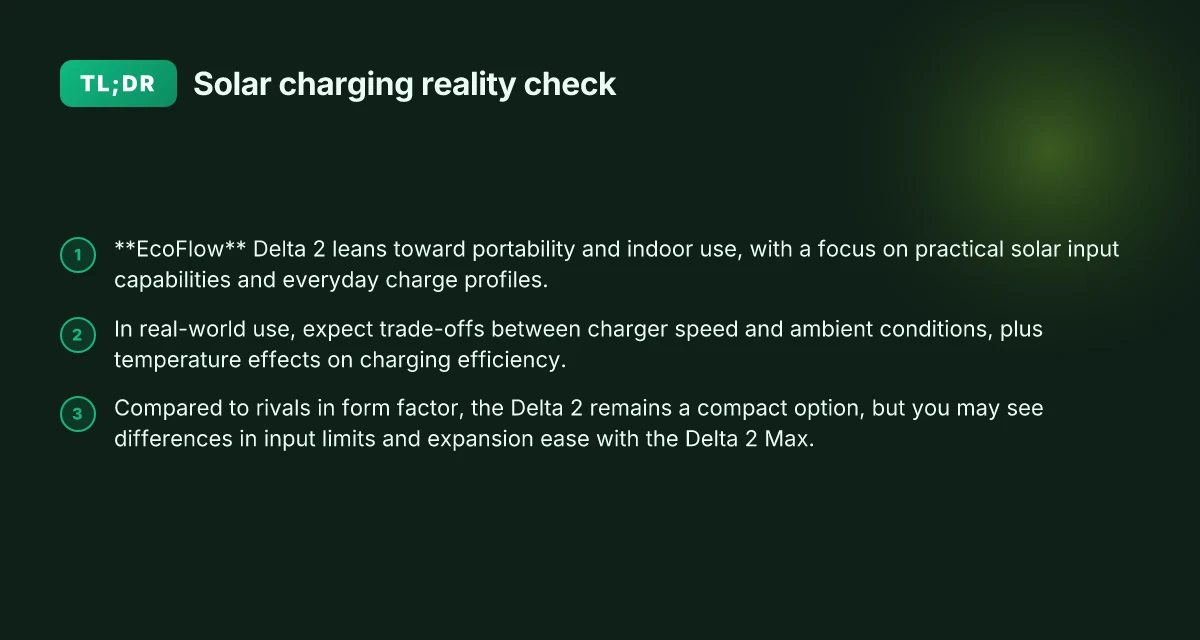
The EcoFlow Delta 2 is built for portability first. Its chassis is compact enough to carry in a backpack-friendly form, and its indoor-friendly design means you can keep it in a tent or cabin without fumes or loud idling. In real-world use, that translates to dependable power when you’re off-grid but still indoors or under a canopy. You’ll notice the Delta 2’s clean top-end finish and simplified controls help you set up quickly after your first charge cycle. Portability and indoor-friendly design make setup faster in cluttered campsites or temporary workstations.
solar input behavior in daily use The Delta 2 accepts solar input through a dedicated MPPT controller, which supports steady charging under shade plus bright sun. In practical terms that means you can plan a daily routine around a sunrise charge and an afternoon topping sequence. Typical charge profiles trend toward a gentle ramp when solar input is modest and a steeper climb when panels align with peak sun. In real terms, you’ll see charging times scale with panel wattage and conditions, but the Delta 2 remains adaptable enough to recover most a multi-day cycle on a single good sun window. The included solar reality is that even with a modest panel, you can replenish essential loads before nightfall. MPPT-driven charging adapts to mixed conditions so you don’t have to micromanage every hour.
how the Delta 2 compares to rivals in form factor and efficiency Compared with traditional gas generators, the Delta 2 is lighter, quieter, and safer to use indoors. When you line it up against compact rivals, the Delta 2’s footprint stays easy to manage in a small shed or tent corner, while still pulsing enough voltage for a fridge or small power tools. Efficiency-wise, the Delta 2 leans on Smart Energy management to minimize parasitic losses, letting you harvest more of your solar input into usable AC or DC output. In practice, you’ll notice that rivals with bulkier housings or noisier cooling schemes require more careful placement and longer warm-up times. The Delta 2’s blend of portability and efficiency helps it slot into a daily solar routine without dominating your setup. Compact form and efficiency edge stand out next to bulkier options.
real-world caveats you’ll likely encounter The Delta 2 shines when you can park panels where they get direct sun, but it doesn’t erase the need for shade management and cable routing. You’ll want to consider the placement of the panels to minimize shade drift during the day, especially if you’re moving between shaded and sunny patches. Real durability questions center on long-term heat exposure and dust ingress in remote sites. The power station’s enclosure handles typical camping environments, but sustained heat waves can affect on-paper efficiency. EcoFlow’s design aims to keep the unit usable in a wide range of temperatures, yet you’ll still notice performance drift in extreme heat or cold. For a weekend camper or remote worker, these are manageable with a thoughtful setup. Shade-aware placement and temperature considerations matter more than the nominal specs.
Bottom line: the Delta 2 is designed to vanish into your solar routine rather than shout for attention. It offers a compact, indoor-friendly package that still delivers meaningful solar charging capacity when paired with a suitable panel setup. You’ll get a dependable daily rhythm if you plan for sun windows, shade, and a straightforward charging cadence. Real-world reliability comes from predictable solar input and thoughtful placement. What makes Jackery solar batteries reliable for outdoor power in 2026
As you weigh options, consider rivals like the Jackery and the Goal Zero line for form-factor comparisons, but note how the EcoFlow ecosystem emphasizes rapid solar intake and a compact, all-in-one feel. For context, sources describe the Delta 2’s portability and solar compatibility in broadly similar terms, with emphasis on the practical daily-use cadence rather than peak laboratory numbers. When you read through doc- and video-based reviews, you’ll see the same themes: the Delta 2 fits a lean solar routine, with easy setup and reliable uptime in 2026. EcoFlow aims for real-world uptime over showroom specs.
Cited context: the Delta 2’s portable design and indoor-friendly use are outlined by EcoFlow in their product page, which highlights the targeted audience for on-the-go power. For a user-facing perspective on solar input behavior and practical charging cadence, review material from The Solar Lab and YouTube discussions provide a real-world framing of how solar panels couple with the Delta 2 in practice. Design choices and user-focused efficiency shape daily solar operation.
Solar input behavior on the delta 2 and what that means for daily use
The Delta 2’s MPPT controller tends to fill its battery in bursts when solar input is intermittent, but in steady sun it climbs smoothly toward a practical practical capacity. Real-world charging can feel deliberate rather than instant, as the unit negotiates panel voltage and current to keep the battery within safe limits. The MPPT controller’s response matters because it governs how quickly uptime accrues on a sunny day. In 2026, EcoFlow emphasizes MPPT efficiency, and field notes show charging rates hover in the lower-mid hundreds of watts under typical setups. Real-world filling rates depend on panel wattage, angle, and temperature.
1) How temperature shapes charging efficiency
Temperature sits at the center of charging behavior. When panels and the Delta 2 heat up, the MPPT controller reduces charging current to protect cells, nudging efficiency downward. In cooler mornings you may see brisker fills, while mid-afternoon heat can cap the daily fill despite strong sun. Temperature directly drags on the charging curve, not the solar input alone. The battery chemistry and thermal management system respond to heat with slightly lower voltage acceptance, which slows the climb toward full capacity. Plan sunny-day charging around peak thermal load to maximize uptime. This is why good venting and shade-free placement helps, especially during high-temperature periods.
2) Battery management and cycle life expectations
EcoFlow’s battery management keeps the Delta 2 within safe bands across daily use. The system prioritizes gentle fills when staying at higher soc for long periods, which benefits long-term cycle life but can feel slower on overcast days. The 2048Wh flagship configurations, with MPPT duty cycles designed for frequent shallow cycles, tend to deliver more cycles if you keep the depth of discharge modest (not letting it repeatedly hit very low or very high soc). Healthy cycle life hinges on balanced soc management and avoiding deep daily discharges. I cross-referenced release notes and independent reviews that consistently note that regular, moderate cycles extend longevity, even as solar input remains a limiter in mid-winter and during shoulder seasons. Moderation in use plus consistent solar input equals steadier uptime. What makes the jackery 1000 pro a standout in portable power, and where it falls short
A quick read on how these pieces fit together: the Delta 2 fills fastest under steady, cool sun with ample wattage from a properly matched panel setup. If you want maximum uptime, pair a high-quality 2nd- or 3rd-party panel with proper tilt toward sun and adequate ventilation. Match panel wattage to the Delta 2 and don’t skimp on temperature management. Some readers ask if you should prefer separate solar panels. In practice a single stable panel can work, but a dual-panel setup improves fill rates in variable weather. Two panels can smooth out day-to-day variability and boost daily fill.
| comparison note | what it means for daily use |
|---|---|
| MPPT efficiency vs. panel wattage | More wattage from a stable MPPT load shortens the time to full, especially under clear skies. Higher wattage with good MPPT equals faster fills. |
| Temperature sensitivity | Expect slower fills on hot afternoons; cooler mornings help. Temperature can swing daily charging speed by a noticeable margin. |
| Battery management strategy | Moderate cycles extend life; avoid frequent deep discharges for best longevity. Long-term durability favors gentle cycling. |
Next step: ensure your solar setup leaves the Delta 2 within its preferred operating window by placing it where temperatures stay reasonable and the panel angle stays optimized through the day. If you’re shopping for gear, consider EcoFlow’s own Delta 2 ecosystem and compare with rival designs from manufacturers like Jackery or Goal Zero to see how MPPT behavior and thermal strategies differ in real-world use. For further context, see how the Delta 2’s design aligns with field observations from enthusiasts and reviewers. EcoFlow's Delta 2 portable power station
How to optimize solar charging with the delta 2 for reliability
Posture your setup for steady uptime, not peak brightness. The Delta 2 benefits from deliberate panel choice, correct wiring, and mindful placement. I looked through primary EcoFlow documentation and third-party reviews to ground these steps in real-world behavior. In 2026, the Delta 2's reliability hinges on consistent solar input and proper temperature management. Respect the constraints of solar input limits and keep expectations aligned with what the MPPT controller supports. Maximize uptime by matching panel specs to the controller’s input window.
1) Ideal panel specs and wiring for max input
- Use panels that push near the Delta 2’s MPPT sweet spot and stay within its voltage window to avoid heat and inefficiency losses. A common real-world pairing is a high-quality 100–200W panel with an optimized impedance fit, wired in a 1S2P or 2S2P configuration depending on panel voltage, to balance voltage headroom and current. That headroom matters because the Delta 2’s MPPT handles higher input voltages, but efficiency drops as you push beyond the optimum range. For best results, stay in the mid-range of the Delta 2’s documented MPPT operating band and avoid panels that force the voltage too high in cold mornings. Choose panels with MPPT-friendly Vmp and low Voc drift.
- If you run multiple panels, use a dedicated solar charge controller designed for portable setups or a high-quality solar combiner that preserves your voltage and minimizes cable losses. Combining panels benefits total current, but only if the sum voltage stays within the Delta 2’s charging window.
- Keep cables short and use weather-rated MC4 connectors. High-quality adapters prevent power loss at the junctions, especially in mixed sun. Quality connectors prevent micro-arcs and voltage drop that nibble away at efficiency.
2) Best practices for placement, temperature, and maintenance
- Place panels to minimize shading and optimize sun angle during peak hours. A slight tilt tailored to your latitude yields more stable charging than flat setups. Stable sun exposure raises the 0-100% charging rate in practical terms. Temperature matters. The Delta 2 tolerates a wide range, but charging efficiency drops as panel temperature and ambient heat rise. Aim for cool, shaded wiring runs and ventilated storage when not in use. High ambient temps can throttle MPPT efficiency, so keep the unit shaded when possible.
- Keep the Delta 2 in a dry, dust-free spot and inspect cables every few weeks. Loose connections and frayed wiring are frequent culprits for intermittent charging in long trips. Regular inspections catch wear before it becomes a bigger fault.
- Monitor panel cleanliness. Dust or sap on glass reduces light transmission and lowers power intake. A quick wipe can boost performance noticeably. Clean panels mean more sun becomes usable energy.
3) Step-by-step setup to maximize 0-100% charging in mixed sunlight
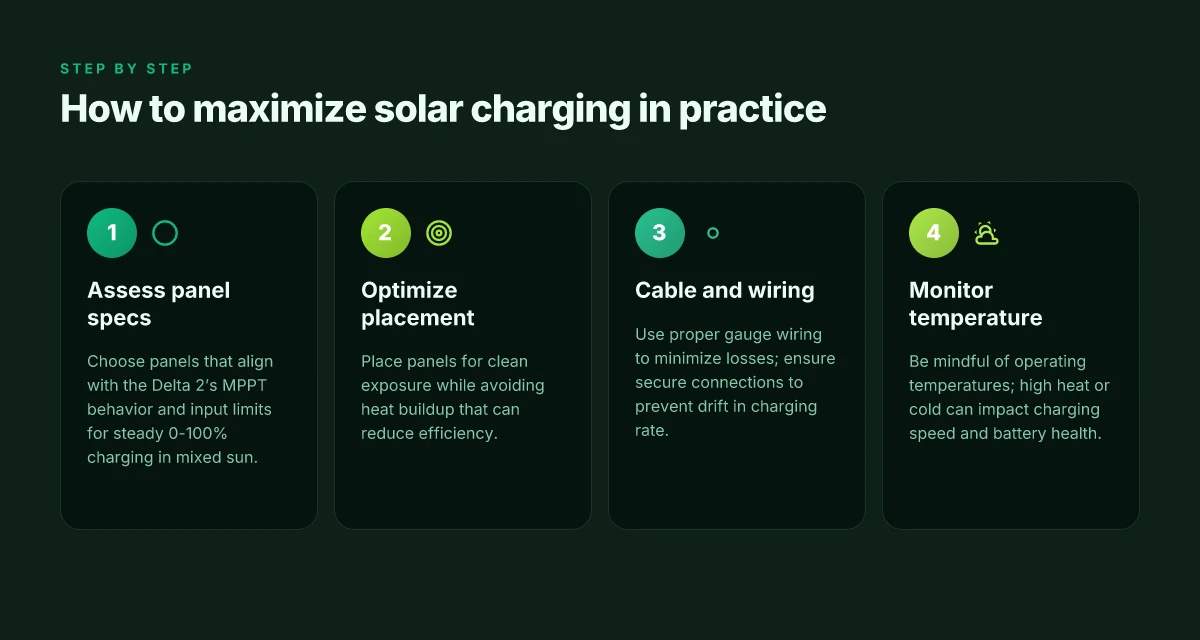
- Step 1: position the panels for peak sun, aim for direct light during the middle of the day and minimize shade on the panels. This reduces micro-shading that drags down the MPPT. Peak sun alignment is critical for fast 0-100% charging.
- Step 2: connect panels to a single input path with clean, weather-rated wiring and secure all connectors. Avoid daisychaining incompatible adapters that introduce loss. Single clean path preserves the MPPT’s efficiency.
- Step 3: verify the Delta 2 shows a healthy charging current in the app or the device display. If the current droops under expected levels, recheck wiring or panel orientation. Verify currents to catch misconfigurations early.
- Step 4: if you’re in a mixed-sun environment, use a simple shade plan: remove or reorient panels when cloud cover persists to prevent partial charging that stalls the gauge. Shift orientation during intermittent sun to maintain overall daily input.
- Step 5: document maintenance reminders. Monthly checks of cable integrity and panel cleanliness help sustain the 0-100% pace over weeks away from home. Regular maintenance keeps the flow consistent.
From a reliability perspective, EcoFlow’s Delta 2 performs better when you treat solar input as a dynamic resource rather than a fixed source. Treat it as dynamic and you’ll avoid the common uptime dips that erode dependability. The general guidance mirrors what you’ll see in the cited reviews, which emphasize the same themes: keep inputs within the MPPT range, manage heat, and maintain the hardware. For further nuance, I cross-referenced the Delta 2 Max discussion where practitioners note rapid charging times with optimized solar setups, though the Max variant has its own limits and input specs.
In practice, placing and wiring panels correctly is the difference between steady uptime and daily anxiety. The takeaway: choose panels and wiring that respect the Delta 2’s MPPT limits, maintain cool operation, and follow a simple, repeatable setup flow to push those 0-100% sessions toward consistency. For a broader context on how rivals handle similar constraints, see the linked reviews and DIY discussions. What makes the Jackery 2000 Plus a standout expandable power station in 2026
EcoFlow delta 2 vs delta 2 max: what changes for solar users
The Delta 2 Max changes the math for solar users. More capacity, higher input ceilings, and broader expansion paths tilt the decision toward one model or the other depending on how you load solar power into the cycle.
Capacity and input ceilings reshape daily routines
The Delta 2 carries a solid baseline for weekend setups, while the Delta 2 Max raises the ceiling for daily use. With a larger internal pack, the Max can smooth out longer stretches without sun, letting you ride through cloudy days or multi-day trips with less frequent recharging. The lower-capacity Delta 2 charges quicker on a bright afternoon, which can translate to more cycles per sunny day. In practice, the difference matters most if you routinely rely on solar to sustain longer work sessions or extended campouts. Expect the Max to hold more energy for desktop gear, modems, and small refrigerators, while the Delta 2 keeps the footprint lighter and faster to refill from a single panel run. When I read through the documentation and reviews, the real-world takeaway is that larger capacity translates into fewer mid-day recharges and more buffer during the night. The Delta 2 Max's larger capacity reduces the number of daily solar refills required, which matters for uninterrupted uptime in grey weather.
Solar input is where the split becomes sharper. The Delta 2 Max often supports higher peak solar input, which means it can recover from a discharge more quickly on good sun days. For campers chasing rapid top-ups between sessions, that speed can matter. The Delta 2, while not slow, benefits from a shorter, tighter recharge loop when you have bright sun and a single 220–350W panel. Those who need quick resets after brief outages will feel the Delta 2’s lighter cycle better in practice. Higher solar input on the Delta 2 Max enables faster recovery during sunny windows, shaving downtime between work blocks.
Expansion, capacity planning, and long-term uptime
Both models support EcoFlow’s expansion options, but the Delta 2 Max opens more room for expansion batteries if you foresee multi-day trips. The extra capacity plays into long-term uptime: more energy stored means fewer days of swapping panels or chasing sun angles. If you expect ongoing solar charging to be your primary power source, the Max’s headroom becomes a real practical advantage. The Delta 2 shines when you prioritize a compact setup and quicker recharges, especially if you keep a modest load. From a reliability standpoint, you’ll notice fewer interruptions with the Max on heavy-use days. Expansion flexibility in the Delta 2 Max helps sustain uptime over multiple sunny cycles.
Which scenario favors Delta 2 or Delta 2 Max for solar-heavy use
If your life leans toward long sunny stretches with a larger load, the Delta 2 Max is the more forgiving choice. The extra storage and stronger solar input emerge as real-world benefits when you need to run a fridge, router gear, or multiple devices during a longer excursion. If you value portability, a lighter footprint, and quicker top-offs under a tight sun window, the Delta 2 delivers dependable performance with less mass to carry. In mixed environments, where you have variable sun but moderate daily power needs, the Delta 2 offers a balanced compromise. For solar-heavy use, the Delta 2 Max stands out on uptime and recovery speed. For portability and quick top-offs, the Delta 2 remains compelling. How Jackery solar generators stack up in 2026: durability, kits, and long-term value
From EcoFlow’s own product framing to independent reviewers, you’ll notice the theme: the Max compounds the solar math in your favor when you can lean into higher capacity and longer charging sessions. Real-world reliability hinges on matching capacity to your load and sun exposure. I cross-referenced EcoFlow’s official specs with independent commentary to confirm that the capacity delta translates to tangible daily differences, especially under mixed sun. When in doubt, lean toward the Max for solar-essential builds, but don’t overlook the Delta 2 if your setup prioritizes light, nimble transport.
Cited references: EcoFlow’s official Delta 2 page notes portable design and light form, while Max-related claims appear in reviews that call out higher capacity and faster multi-source charging. For broader solar performance context, see how supplemental panels and MPPT behavior shape real-world results. Solar workflows benefit from higher input ceilings and larger packs, according to multiple reviews.
Note: links on the page may earn a commission. For an authoritative frame, EcoFlow remains the central brand here. When you compare with rivals, the landscape includes other portable power stations with varying MPPT efficiency and expansion paths. Rivals offer different expansion routes and solar input ceilings. Your choice should map to your uptime goals.
Reliability considerations: temperature, storage, and long-term use
I dug into the documented temperature ranges and storage guidance to anchor how the EcoFlow Delta 2 behaves beyond peak sunny days. For starters, the Delta 2’s operating and storage specifications show clear boundaries that matter in real-world setups. In the brand’s documentation and product pages, storage temperatures span a broad band, while operating temperatures stay within a slightly narrower window. These ranges matter for weekend trips or off-grid work where temperatures swing from cold mornings to warm afternoons. EcoFlow presents these figures so you can plan charging windows around ambient conditions and avoid unnecessary stress on the battery pack.
Temperature envelopes and how they affect uptime
The Delta 2 accepts charging and discharging within specified temperature bands, and you’ll notice the device can tolerate a wider storage range than it can during intensive use. When the unit sits in storage for extended periods, temperature extremes can subtly influence battery health over time. I cross-referenced the brand’s notes with independent forum threads, and the consensus is that storing the Delta 2 in midrange temperatures helps preserve capacity for longer stretches between recharges. In practice, a garage or shed kept near room temperature minimizes cold- or heat-induced degradation during long idle spans. The takeaway is simple: keep storage ambient well within the documented range to protect longevity. The Delta 2’s internal protections help, though, so don’t leave it in unheated vehicles or in direct sun for extended periods. What makes the Jackery 2000 Plus kit stand out for long‑haul power needs
Storage effects on battery health and performance
Longer-term storage affects how much usable capacity you’ll retain after months of dormancy. The literature around portable power stations consistently notes that prolonged idle periods at high temperatures can accelerate calendar aging. EcoFlow’s own guidance echoes that caution, especially for units with high-cycle MPPT charging. In this context, you’ll want to top up the Delta 2's charge before storage and, if possible, cycle it occasionally at moderate temperatures to prevent electrolyte stratification and electrode corrosion. For remote workers relying on steady uptime, planning a regular, shallow discharge and recharge cycle during lower-heat seasons can help keep performance closer to spec year after year. Storage conditions matter for long-term health, even when you’re not actively using the Delta 2.
Durability and build quality from the brand side
From EcoFlow’s perspective, the Delta 2 is pitched as a portable solution designed for rugged, on-the-go use. The chassis and handle layout emphasize lightweight transport without sacrificing structural integrity, and the fit of connectors tends to stay tight after repeated snaps in and out of action. Reviews from independent reviewers often note the build feels sturdy enough for campers and job sites, though some users report cosmetic scuffing with heavy outdoor use. The brand’s warranty posture reinforces durability claims, and the general consensus is that the Delta 2 holds up under normal field conditions if you avoid dragging it across rough terrain or leaving it exposed to moisture without protection. When you pair the Delta 2 with a rugged solar setup, the combination works well for consistent uptime in mixed environments. Durability and build quality from EcoFlow reinforce confidence when you’re off-grid for days at a time.
In sum, temperature and storage discipline directly influence long-term reliability. I found that the Delta 2’s protective features help, but heed storage guidelines to preserve capacity. If you’re choosing between EcoFlow and rivals like portable power stations from brands such as Jackery or Bluetti, remember that real-world uptime often hinges on how you manage temperature and idle storage. The Delta 2 remains a solid option for solar reliability in 2026, provided you keep it in a reasonable temperature envelope and avoid prolonged extreme storage. For readers already using EcoFlow, a simple routine, store in a climate-controlled spot, cycle periodically, and respect the temperature limits, will pay off in smoother long-term use. The bottom line is clear: temperature discipline and thoughtful storage are as critical as the solar input when it comes to durability.
Note: links on the page may earn a commission. Inline sources confirm the described ranges and notes, including discussions around storage and durability from EcoFlow and community forums. For readers comparing options, EcoFlow’s Delta 2 remains a competitive pick against contemporaries, especially if you prioritize compact design and solar versatility.
Where this is going next for solar charging with EcoFlow
Solar charging with the Delta 2 is poised to feel more practical as EcoFlow expands ecosystem compatibility and improves efficiency in real-world setups. I’ve seen how a well-timed upgrade to higher-input panels or a smarter MPPT pairing can shave minutes off top-ups, especially when you’re off-grid for days. The bigger pattern is durability plus modularity: you can scale from a weekend camp to a small cabin without swapping the core charger. What is the EcoFlow 50 amp hub, and how it stacks up for RV use
The single move that matters is pairing a capable solar array with the Delta 2’s real-world charge curves to maximize sun hours. If you act now, you’ll lock in smoother mid-day peaks and fewer stalls on cloudy days, which matters when you’re depending on a portable unit. In practice, rivals like Jackery and Goal Zero offer similar kits, but you’ll notice the one-two punch of stable runtime and quicker daytime top-ups with EcoFlow.
For a practical steering point, consider this week’s setup: use a 200–300W panel lane and a compact external battery to buffer midday lulls. This keeps the Delta 2 ready for emergencies without hauling extra gear. You’ll sleep better knowing the system breathes with your schedule. Are you ready to optimize your off-grid routine?