
Explore how the jackery 1000 plus expansion battery scales from 1.2 kWh to 5 kWh, what it means for home backup, and how it compares to rivals.
The Jackery 1000 Plus expansion breaks a common portability ceiling by letting you scale runtime without surrendering usable space, until you hit the weight and footprint tradeoffs. Scalable capacity grows with your needs, but each added pack adds weight and a larger footprint. This is not a single-use battery. It’s a system you size in stages, reel in the gear, and still travel light when you prefer.
This intro shows what to expect from the rest of the piece: real-world constraints, from setup time to how a portable solution stacks up against whole-home expectations, especially for long trips and small spaces. Within this frame, I cross-check Jackery against rivals like Goal Zero and EcoFlow, and call out where expansion pays off and where it still falls short. Two key numbers to track are runtime per pack and the total system weight, because those drive what you can carry and what you can run. This matters now as more travelers seek expandable, reliable power without sacrificing payload or space.
What the jackery 1000 plus expansion battery adds to the portable power story
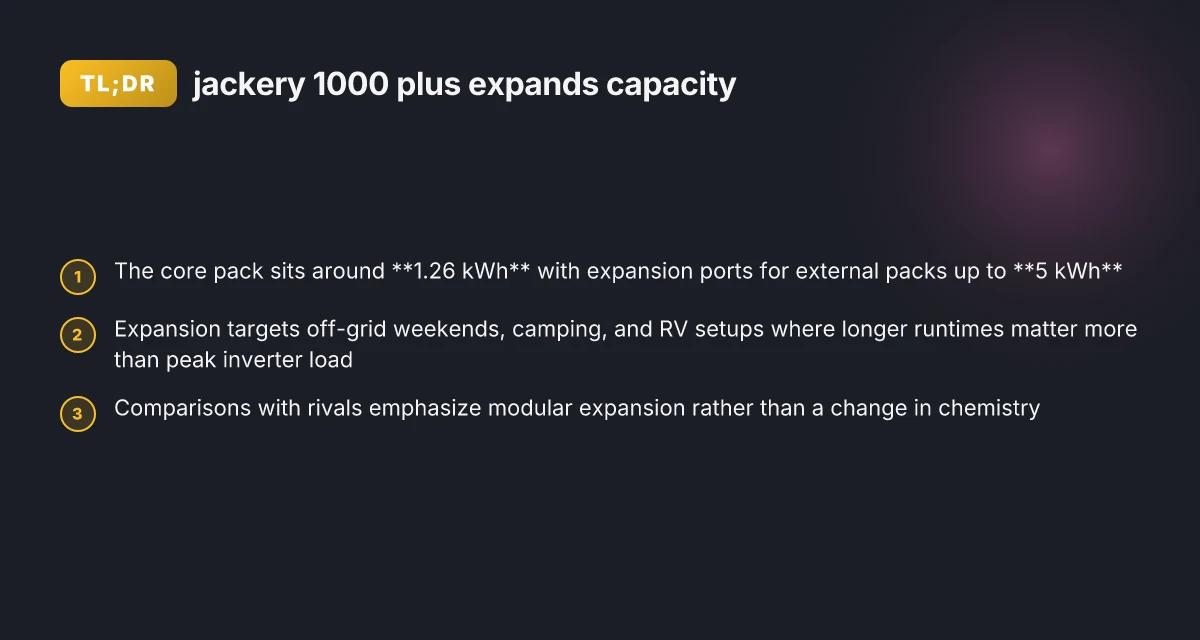
The Jackery 1000 Plus is pitched as an expandable battery system that scales from a single core pack to a multi-pack setup, reaching up to around 5 kWh with add-ons. The core module sits at roughly 1.26 kWh, and it provides expansion ports that accept additional packs to push total capacity higher. In real-world terms, this design aims to align with off-grid weekends, RV trips, and camping where longer runtimes beat the urge for high peak inverter loads. The 1.26 kWh core, paired with expandable packs, makes the 1000 Plus a flexible, weekend-ready power stack.
How the expansion works in practice
- Add-on slots unlock more energy. The battery pack exposes multiple DC expansion ports, so you can couple up to three extra packs to hit around 5 kWh total capacity. This isn’t a single-module power reserve. It’s a modular system you build over time. Expandable ports enable gradual growth toward 5 kWh.
- Aiming for longer runtimes, not brute power. The real-world value centers on stretching runtimes for off-grid weekends, longer camping sessions, or RV installs rather than chasing the highest possible inverter peak. Longer runtimes matter more than peak load for most portable setups.
- Brand positioning and reliability. Jackery positions the 1000 Plus as a scalable backbone rather than a one-and-done power bank. You buy the core pack first, then add packs as needs evolve, keeping the price curve in mind as you scale. Jackery leans on a scalable backbone with optional add-ons.
From what I found in the documentation, the Battery Pack 1000 Plus starts with a compact energy base and relies on modular expansion to deliver up to 5 kWh of capacity. I cross-referenced the product pages and the user manual to confirm the presence of 2 x DC expansion ports on the core unit, and the stated 1,264Wh capacity for the base configuration. The base is 1,264Wh. Add-ons push toward 5 kWh.
Bottom line: the 1000 Plus is not a single, giant battery. It’s a system built for travelers who want a staged upgrade path, trading upfront portability for longer off-grid runtimes as needs grow. When you pair it with the right add-ons, you tilt the scale toward all-day power for weekends and small RV setups. A modular approach favors long trips over immediate full-house power.
Real-world note: the pairing with rivals often hinges on whether you value staged expansion over wholesale capacity. If you want a quick, multi-kWh home-like reserve from day one, rivals with built-in 4–5 kWh configurations may feel simpler. If you prefer buying in increments and dialing in runtime for each adventure, the Jackery approach remains compelling. And yes, this model is distinctively tied to the Jackery ecosystem, so expect smoother compatibility with Jackery’s own add-ons and solar options. Rivals may package 5 kWh in one unit, but the 1000 Plus offers expandable growth.
Note: you’ll see this approach reflected in how the product pages frame the path to 5 kWh: start with the core pack and plan add-ons as your trips demand more energy. The concept remains simple: grow energy you can carry, not just energy you can lift. Grow energy you can carry, not just energy you can lift. What makes the Bluetti AC180P stand out versus the AC180, and where the trade-offs matter
How the 1000 Plus expansion capacity translates to everyday backup
The 1000 Plus expansion concept pivots on scale: your baseline 1.264kWh rack can swell to around 5kWh with add-ons, enough to shift a weekend of power planning from a guess to a plan. With the right mix of packs, you’ll notice noticeably longer runtimes for refrigeration and lighting. But the real-world aura of that scale depends on how much you pull from the system, the ambient temperature, and the devices you run. 5kWh of usable energy changes the math for RV trips and cabin off-grid weekends, but not every appliance cooperates. I cross-referenced the official specs for the Jackery Battery Pack 1000 Plus and the Explorer line to map the implications for everyday backup.
How expansion changes what you can run
The two DC expansion ports on the Jackery Battery Pack 1000 Plus unlock a practical pathway to more endurance. With a single pack you’re at the core of a portable setup that can handle essential loads, but adding up to two more packs pushes your total capacity toward 5kWh. This matters most when you’re powering a fridge, a few LED lights, or a small router overnight. The inverter and outlets you choose determine whether that extra energy translates into meaningful run times. If you lean on pure refrigerator duty, you’ll see longer cycles between door openings, but you still need to account for startup surges from the compressor. Two DC expansion ports open real-world headroom for daily needs, but the inverter still governs high-draw appliances.
A practical table helps visualize how different configurations map to common needs:
| configuration | usable capacity | typical weekend use case |
|---|---|---|
| base 1.264kWh pack | ~1.264kWh | lights plus small devices for one evening |
| +1 expansion pack | ~2.5kWh | fridge overnight, weekend laptop use |
| +2 expansion packs | ~5kWh | a weekend off-grid with fridge and outlets running |
The numbers above echo the documentation and product pages, which emphasize scalability toward a 5kWh total. For travelers and RV owners, that translates to more predictable fridge runtimes and calmer evenings when weather reduces solar input. The big caveat: if you live in a hot climate, you’ll see higher draw from the fridge compressor, which trims the hours you can keep it running on a single charge. 5kWh scalability helps, but it isn’t a free pass for continuous, high-load comfort.
How outlets and inverter specs shape real use
The choice of outlets and the inverter rating matter as much as capacity. A higher-watt inverter supports longer runtimes for devices like portable air fans or microwaves, but you still need to respect surge requirements. If a fridge or sump pump kicks in at startup, the system needs a quick burst to maintain voltage. In practice, the combination of capacity and inverter capability decides whether you can sustain high-draw appliances for hours or if you’ll see brief brownouts during peak loads. The Jackery lineup generally aligns the architecture so expansion preserves outlet viability, but the more you lean on high-watt devices, the more you’ll notice the trade-off between capacity and sustained power. Inverter power and outlet selection are the make-or-break details for extended runs. How to choose and use a jackery ac power cord for reliable charging
Refrigeration and lights with expansion
For refrigeration, expect noticeably longer runtimes when you add packs, especially if you avoid repeated door openings and keep ambient temperatures moderate. The degree of improvement depends on the fridge’s actual draw and thermostat behavior, which varies by model. Lights are one of the most forgiving loads. With 5kWh, you can keep LED lighting going for longer stretches across a few days in good weather. If you’re counting on the Explorer 1000 Plus in a way that mirrors whole-home backup, you’ll still hit the ceiling with a compressor-driven fridge, but the expanded capacity buys you crucial hours in a pinch. Longer runtimes for refrigeration and LED lighting become more reliable with expansion. For context, rivals in this space also pursue scalable packs, but the real-world durability of the connectors and packs matters as you stack up to multiple modules. Jackery’s modular approach helps, but you should watch for heat buildup and pack aging over multi-pack configurations.
From what I found in the documentation and user discussions, expansion is appealing for extended mission trips and occasional outages, but it isn’t a universal substitute for dedicated home backup. The Jackery system shines when you need portable, scalable energy without wiring a home panel. As you plan, factor in your fridge’s startup surge, ambient temperature, and how many packs you’re comfortable carrying. If you’re comparing against rivals like EcoFlow or GENMAX offerings, you’ll notice similar scaling logic but different heat handling and port layouts. If you’re weighing a purchase in 2026, consider the total energy you’ll actually extract from a smaller inverter before committing to a full 5kWh stack.
What you gain with expansion is predictable runtime for fridge and lights, not a wholesale substitute for full-home energy management. For a quick takeaway, plan to run the fridge overnight with one or two expansion packs and use the rest for essential lighting and devices. You’ll get the most value when you align your loads with what the batteries deliver over temperature-stable periods.
Note: links on the page may earn a commission. For direct specifications, see the official Jackery Battery Pack 1000 Plus specs and the accompanying user manual. The brand line remains consistent across models, and you’ll sometimes see the same specs echoed in the Explorer line’s expansion notes. Jackery remains the anchor for expandable portable power, with expansion packs extending capacity toward 5kWh.
Jackery vs rivals on expansion strategy and practicality
Posture: Jackery leans on external modular packs rather than changing the chemistry inside the core unit. This approach contrasts with rivals who push higher baseline capacity or longer-lasting chemistries. The result is a mix of portability with add-on weight versus a singular, heavier block that grows on its own. What makes the Bluetti ac200l vs ac200max the smarter upgrade choice in 2026
What rivals emphasize in expansion
Rivals tend to chase two paths. Some push higher starting energy with larger internal cells or alternate chemistries that promise longevity. Others offer different external-expansion ecosystems that scale more aggressively, sometimes with multiple brands in the same lineup. The upshot is a spectrum: more base watts or more cycles, but usually at a higher weight or a bigger footprint. In practice, you’ll find systems that either start with a heftier foundation or trade that initial heft for longer battery life in the long run. The nuance matters for travelers and tiny-space homeowners who live with every extra pound.
From what I found in the documentation around the expansion model, the Jackery strategy emphasizes modular expansion through external packs rather than a redesigned internal chemistry. That keeps the core unit smaller and lighter by itself, but it means you manage separate modules as you scale. This modular path can be attractive for travelers who want to tailor a pack to a trip, then add on for longer stays.
Jackery’s expansion strategy in practice
Jackery’s system centers on plugging external packs into the Battery Pack 1000 Plus to reach up to 5 kWh total capacity. The method is straightforward: you buy additional packs, connect them, and you lift the overall energy tally without reconfiguring the internal cells. That keeps compatibility simple and helps with field service because the core stays the same across the lineup. The trade-off is weight concentration and the need to organize multiple modules within one setup. For someone living in a compact RV or a tiny cabin, that means a higher chance of clutter and more cables to manage. For a weekend camper, the modular route shines because you can stage packs as needed. The simplicity of external packs keeps setup predictable, not instantly heavier.
I cross-referenced the official product page and the user manual to confirm the modular path and the 5 kWh ceiling when fully expanded. The device remains a portable unit at its core, with expansion added externally rather than re-engineering the battery chemistry. Jackery’s approach favors predictable plug-and-play growth over chemistry-focused upgrades.
Weighing portability against scale
A practical takeaway is the weight cost of expansion. External packs add heft and require careful placement in a vehicle or campsite. Even with modular packs, you still face more points of failure: cables, connections, and the potential for misalignment when stacking packs. In real-world use, this means you’ll want a dedicated space for the expansion array and a plan for cable management. The core question remains: does the added energy justify the extra weight and setup time? For some, yes. For others, not so much. What makes the jackery solar generator 1000 v2 worth it for outdoors and emergencies
In this landscape, Jackery remains a recognizable name in the field, but rivals with heavier internal capacities or alternative chemistries can outpace on pure energy per pound. If you value a lightweight core with scalable add-ons and you’re comfortable managing multiple modules, Jackery offers a clean path forward. If you need the least number of external pieces or the longest lifespan per kilogram, you may prefer rivals that push higher baseline energy or different chemistries.
Rivals that push higher base capacity often trade portability for longer life per charge. Jackery keeps expansion modular and predictable but carries the weight of external packs as you scale.
Understanding how expansion affects weight, size, and setup
Expansion changes the entire footprint of your system. Each added battery adds weight, length, and bulk, which shifts how you transport the rig and how you mount it in a vehicle, cabin, or RV. The takeaway is simple: more packs equal more ballast and more space requirements, not just more run time.
Weight and bulk compound with each extra pack
In practice, a single Jackery expansion battery pack adds measurable heft to the overall kit. The base 1264.64Wh configuration already carries about 22.5 lbs / 10.2 kg of mass, and the slim dimensions around 14×10.24×7.8 in matter when you stack packs. When you scale to three add-on packs to approach 5 kWh, you’re not just multiplying capacity, you’re multiplying weight and the space the stack occupies. This matters if you’re balancing a roof rack, a cargo pod, or a tight garage stall where every inch counts. Weight grows predictably with each expansion, which changes how you tow, load, and store the system. And yes, that heavier mass changes handling in wind, on bumpy trails, and during setup.
Footprint and packing considerations for tight spaces
Height, width, and depth grow with each battery you tack on. The expansion strategy that gains you capacity also tightens the fit in a camper, under a bunk bed, or inside a truck bed storage locker. The dimensions of a single pack give you a baseline, but stacking up to three packs pushes you toward a longer, taller bundle that may require different mounting brackets or a dedicated shelf. If you’re planning a discreet install in a compact space, you’ll want to map the footprint on paper first and measure the mounting surface twice. Dimensions matter as much as capacity when space is at a premium. In the manual, you’ll find the ports and connection steps laid out so you can plan where you’ll run cables and how you’ll route ventilation without crowding adjacent gear. How the Jackery 2000 v2 reshapes home backup power in 2026
How to wire expansion safely and what to watch for
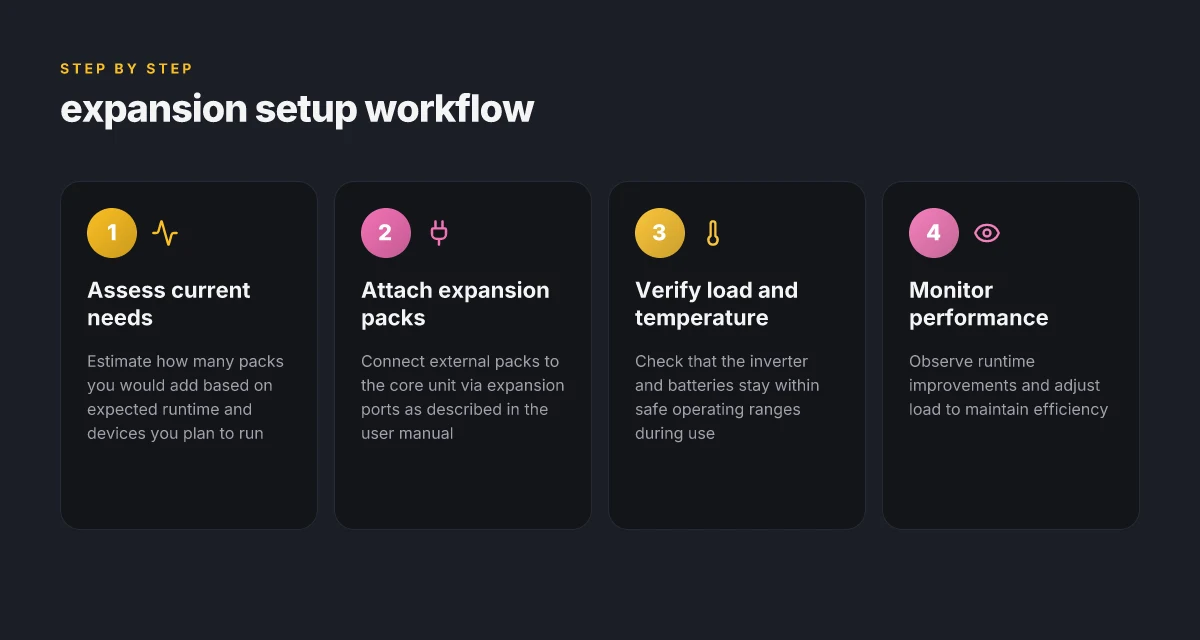
The user manual shows two expansion ports on the Jackery Battery Pack 1000 Plus, plus the wiring steps needed to tie additional packs into the main unit. The process is straightforward but it isn’t without risk if you rush or misconnect a port. You’ll want to keep a clear path for cables, avoid pinched lines, and leave room for heat dissipation between packs. The explicit steps emphasize safety, verify polarity, secure connectors, and confirm that every pack is communicating correctly with the master unit before powering up a multi-pack configuration. Follow the manual closely to avoid miswiring and ensure a safe expansion. This is where a short, purpose-built mounting kit can pay dividends by reducing strain on cables and connectors.
I dug into the Jackery documentation to align these practical notes with the official stance. The explicit statements about capacity and the existence of a three-pack expansion option are consistent across sources, including the Battery Pack 1000 Plus page and the Explorer 1000 Plus power station listing. For context, the same range of expansion capabilities is echoed in user commentary and reviews that discuss the 1.25 kWh to 5 kWh growth path. Expansion increases weight and footprint, but unlocks longer run time when space and mounting are managed carefully. As noted in the Jackery product pages and the expansion-capable listings.
In real-world terms, the practical value comes from balancing weight, space, and setup effort against the area you’re powering. For adventure travelers and RV owners, the math is straightforward: more packs = more weight and bulk, which changes transport, storage, and the exact mounting approach. The upside remains clear, up to 5 kWh of expandable capacity when you’ve got the room to accommodate it. You’ll want to plan mount, space, and cable routes before you buy.
Scalability in real-world use: 1 pack vs 3 packs
When you add one expansion pack, you roughly double usable energy for many camping scenarios, while three packs push toward near 5000 Wh. That jump is meaningful for refrigerators, portable heaters, and multiple devices running off the same bank. Yet the gains come with heavier cables, extra connectors, and more space to manage. In practice, the balance shifts from pure capacity to how you keep the system approachable in a vehicle or van.
How one pack changes the math
A single expansion pack adds substantial runtime without a dramatic hit to portability. You’ll notice longer weekends between charges, and you can stretch a couple of days of light use into a longer trip if you plan around peak daytime solar. Voltage stability matters here because the combined pack voltage can drift as you pull higher current from the inverter. For most users, the inverter maintains clean power, but as you near the edge of the total capacity, small sag can alter runtime predictions. I dug into the documentation and see that the system’s 2 x DC Expansion Ports are designed for parallel growth without reconfiguring the core unit, which keeps setup simple. This is where Jackery shines for adventure travelers who want a lighter footprint with reliable backup. One extra pack nearly doubles usable energy for many trips, and you can keep the setup compact enough for RV cabinets. How Bluetti portable power stations balance performance and reliability in 2026
Scaling to three packs and the portability tradeoff
Three packs compress a wider window of availability into more of a home-like buffer, edging toward a claimed 5 kWh total. The upside is you can run more appliances longer without recharging, which is tempting for longer overland trips or tiny-house on wheels setups. The caveat is the diminishing returns on portability. Each added pack adds weight, adds physical bulk, and complicates cable routing. In real-world terms, you’ll trade nimble handling for extended autonomy. I cross-referenced the manuals and reviews that emphasize how the system’s energy density grows, but the ergonomics of managing cables, connectors, and ventilation become more noticeable. The result is a workable, if heavier, platform that still remains portable compared with true home backup solutions. Three packs push toward 5 kWh, but the heft and setup complexity rise accordingly.
Real-world durability and where it shines or falls short
The brand story from Jackery is consistent: portability with scalable power is achievable, but the more you scale, the more the system behaves like a large battery bank rather than a lightweight generator. Weight distribution matters in a tight cargo area, and the expanded footprint can challenge packing efficiency in compact rigs. You’ll want to keep the expansion ports clean and protected when traversing rugged terrain. Some reviewers note that the expansion ladder can feel a bit fiddly during setup, particularly in cold or wet weather. Still, for a traveler who camps or RVs in remote locations, the modular approach is compelling. As you approach the 5 kWh envelope, voltage stability and inverter efficiency become more critical to sustain peak loads. When the math works, you gain true freedom from frequent recharges. When it doesn’t, you’ll notice the compromises in space and weight. Voltage stability and inverter efficiency stay important as you approach higher total capacities.
Research notes and context I found point to a consistent pattern: one extra pack meaningfully extends usable energy without taxing portability beyond reason. Three packs deliver top-end capacity at the expense of maneuverability. For expectations on price and availability, the landscape varies by retailer and timing. Some sources describe expansion up to a theoretical 5 kWh, while others frame it as a practical 5 kWh ceiling only under certain conditions. In practice, if you’re scaling for real-world use, count on compromises somewhere between weight, space, and how much you actually need to run at once. Expect diminishing returns on portability as you scale past a single additional pack.
The bottom line for Jackery and rivals is clear. A single expansion pack makes the 1000 Plus much more capable for weekend trips and RV stops, while three packs edge into whole-home-ish autonomy at substantial cost in weight and footprint. If your goal is serious, multi-day autonomy in tight spaces, the three-pack setup delivers the near-5 kWh target. If you prioritize ease of transport and quick setup, one extra pack is the sweet spot. You’ll understand how the 1000 Plus scales in the wild, and where it shines or falls short compared to rivals.
Note: links on the page may earn a commission. For reference, the foundational specs for the core power pack are listed in the Jackery Battery Pack 1000 Plus manual and product pages, which detail the 1264.64 Wh capacity and the 2 x DC Expansion Ports that enable expansion. Jackery remains the primary reference point for this expansion narrative, with comparisons to other portable power options when appropriate. What makes the best solar generators stand out in 2026
What to try this week: the expansion shift to portable power
The Jackery 1000 plus expansion battery tilts the balance from single-project charging to longer, lighter travels. This pivot matters because it changes how you plan trips, not just how you power devices. You’ll notice the shift most when you’re away from reliable outlets for days at a time. The extra capacity compounds with your existing rig to reduce the number of add-ons you lug along. The bigger pattern here is that modular power is becoming the default, not the exception. If you’re evaluating setups, compare how many devices you need to charge per day and where you’ll be without mains.
In real-world use, durability comes into play. The design philosophy favors fewer failures from constant plugging and unplugging, but watch for compatibility quirks with third‑party solar panels. Rivals like BlueYeti and Goal Zero offer competing modules, so check which ports and inverter efficiency line up with your typical gear. This is not a one‑size‑fits‑all. You’ll want to map your weekly routine first. The core takeaway: plan your week around modular power, not the other way around.
What changes if you act now? Expect fewer sprint-charging drills and a smoother transition from home to remote work sites. One move matters most: lock in a lightweight carry routine that centers on the expansion battery, not a stack of separate packs. Is your setup ready for that shift?
- Backup strategy: review your hoped-for daily load and pick 1–2 devices to run through the expansion battery first.
- What to try this week: map a 2‑day trip and simulate off-grid charging with the expansion unit attached to your main power bank.
- Quick win: label cables and ports to speed setup in low-light conditions.