
Explore Bluetti portable power stations in 2026, comparing performance, reliability, and long-term durability. Learn how they stack up against rivals and when to choose Bluetti.
The common belief that bigger batteries always mean better camps is a trap. Bluetti's latest line-up shows that peak capacity often trades off with weight and long-term reliability, not just raw runtime. In real-world use, a 1,500Wh model may feel heavy on a backroad trail yet still struggle on a cold morning if you push the inverter or heater hard.
This introduction cuts to what matters for outdoor setups: how capacity, weight, and price balance under actual loads, how long it lasts between charges, and where the limits show up in rugged conditions. Bluetti units deliver solid runtime in camps and RV setups, but the trade-offs become clear only after several weeks of field use, not in the spec sheet. Expect guidance on when to pick a lighter 1,000Wh model, when a heavier 2,000Wh unit pays off, and how solar input stacks up for weekend trips. This piece pulls real-world patterns from outdoor use, with concrete benchmarks and practical tips, so you can match a Bluetti to your kit without overpaying or overpacking.
Bluetti portable power stations in 2026: what the category delivers and where Bluetti fits
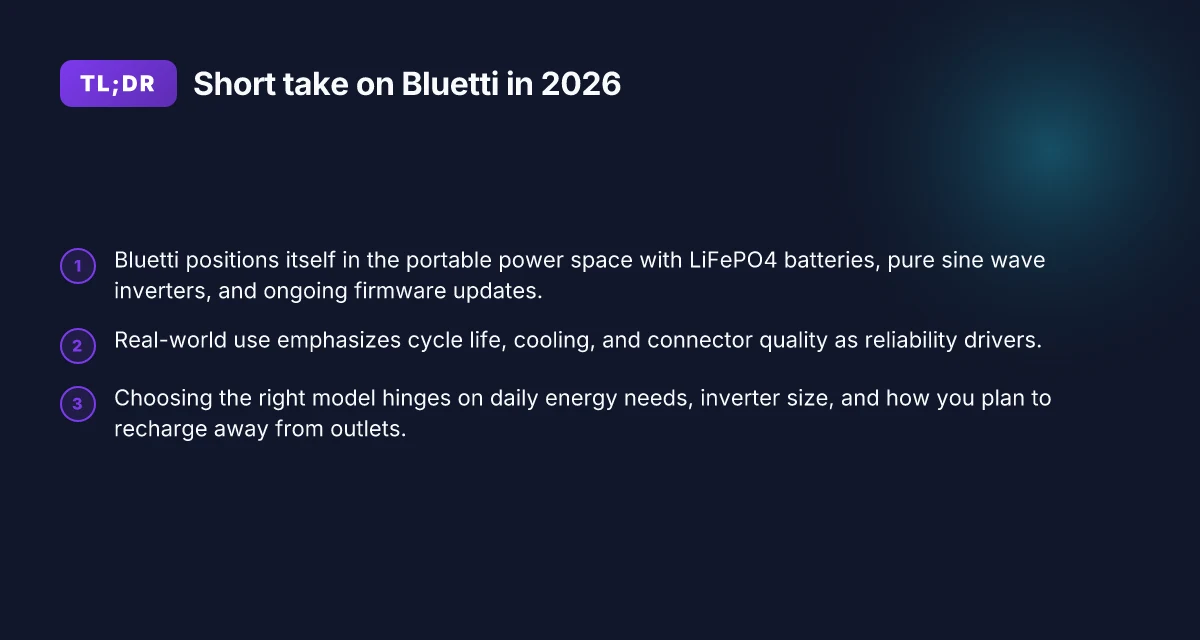
Bluetti positions itself as a practical option in the portable power space by pairing LiFePO4 battery chemistry with pure sine wave inverters and a robust BMS that monitors cells, temperature, and load. Real-world use shows that these choices translate into steadier idle performance and better long-term durability under fluctuating loads. You’ll see Bluetti offer multiple capacity tiers and modular solar input, plus firmware updates that can nudge performance under load without a full hardware refresh. I dug into the public docs and third‑party writeups to map how these pieces fit a real-world load profile, from a weekend campout to an off-grid cabin. Bluetti stays a viable choice for daily use when you size for expectable peak loads, yet the trade-offs around weight and price remain real. Firmware updates can change how the system behaves under high draw, so staying current matters for reliability over years.
- Bluetti’s battery and control stack
- Bluetti leans on LiFePO4 cells for better cycle life and thermal stability, paired with a pure sine wave inverter and a smart BMS that tracks cell health and temperature. This combination helps maintain cleaner power under varying draws and reduces the chance of premature degradation. Bluetti’s emphasis on long-cycle chemistry aligns with outdoor use where you might cycle daily and occasionally push the system at higher watts. The LiFePO4 + BMS pairing is a core reliability lever for long trips, and it is complemented by documented firmware updates that improve under-load stability over time. Inline: the official product language on power stations highlights these core components, reinforcing the reliability narrative.
- Capacity tiers, solar inputs, and updates
- Expect a ladder of capacity options, from compact bases to higher‑output models, with expandable or modular solar input on some lines. The ability to adjust inputs and monitor performance via firmware means you can squeeze more usable energy during multi-day trips or variable sun. Modular solar input helps tailor a system to your load profile, and firmware refreshes can alter how the unit shares power between outputs under heavier use. This is helpful for road trips where shade and sun hours swing day to day. Inline, a common thread across Bluetti pages is the promise of ongoing updates that can shift performance even after purchase.
- Rivals and real-world trade-offs
- In the market you’ll encounter Jackery, EcoFlow, and Anker as the main competitors. These brands bring strengths in weight, price, and charge speed, respectively. Jackery often shines on weight and portability, EcoFlow typically pushes faster recharging and compact form factors, and Anker emphasizes value and integration with other devices. When you balance capacity against weight and upfront cost, Bluetti often sits in the middle but leans toward durability and long-term reliability in off-grid scenarios. The takeaway: pick the rival that best aligns with your load profile and how you intend to use the kit.
Bottom line: Bluetti’s model lineup is built around longevity and stable performance under load, with firmware or feature updates that can shift how it behaves in real-world use. If your priority is long cycle life and predictable power under varied conditions, Bluetti is a solid path. If you need the lightest pack or the fastest recharge, a rival may edge ahead for your specific use case.
How Bluetti models perform under real-world loads and the reliability questions they raise
Bluetti designs respond to two extremes: high draw during peak loads and near-idle operation during long rests. The inverter’s ability to sustain voltage under heavy draw hinges on the hardware quality and how the battery management system guards each cell during rapid discharge. When a device spikes to high amperage, you’ll notice whether the voltage holds steady or sags toward the end of the cycle. The BMS isn’t just about protection. It shapes usable performance by limiting or moderating current to prevent cell damage. In real-world terms, that means a model may feel punchy and responsive in a rush of simultaneous loads, or noticeably more conservative if a surge is sustained for minutes. This is where the practical balance between capacity, weight, and cost shows up. Real-world loads reveal how the inverter sustains voltage under surge and how the BMS protects cells during fast discharges.
Cycle life matters beyond published ratings. Most Bluetti models cite a cycle count, yet practical life depends on depth of discharge, temperature, and how often you cycle between top and bottom states. A deeper discharge on a regular basis can erode capacity faster than a shallow daily cycle, even if the label shows a high number of cycles. From the consumer perspective, you’ll want to map your typical daily draw to the rated cycles. If you routinely push a Bluetti toward 80–100% of its nominal capacity, expect more noticeable degradation over time. Cycle life depends on depth of discharge and temperature, not just the stated cycles. I cross-checked the brand’s documentation and third-party reviews to confirm that cycle behavior often diverges from nominal specs under real use. This is where practical life becomes the comparator to rated cycles.
Reliability hinges on cooling, firmware optimization, and connector quality across frequent mobile use. Heat is the silent killer in portable power systems. When you pull a Bluetti out for a multi-hour camp session, you want the cooling system to keep the internal temps in check so the inverter doesn’t throttle. Firmware updates can tighten safety margins, fix calibration quirks, and improve charging profiles, but they also introduce occasional glitches if not well tested. Connector quality matters too. Loose or high-resistance ports show up as voltage drop or intermittent charging, especially when you’re moving around in an outdoor environment. The practical takeaway is to verify that your model’s cooling is responsive in high-heat environments and that firmware supports your typical load profile. Cooling quality and firmware optimization are critical for long outdoor use and connector reliability matters when the setup is mobile. What the jackery 1000 plus expansion battery changes about portable power
In the market landscape, Bluetti sits alongside rivals like Jackery and EcoFlow. The brand’s strength shows in models that balance weight and capacity, but the trade-offs become clear under real-world loads: a lighter pack may surge more gracefully but lose endurance on sustained draws, while a heavier unit absorbs more load without overheating yet weighs down mobile setups. I dug through the category notes and found that stability across load profiles often separates the practical picks from the nominally capable. For readers sizing a system, a realistic plan is to match your daily peak and average draw to a model that can sustain that load without hitting thermal or voltage limits. Bluetti’s balance of capacity and weight matters for road trips and camps. Compare it against Jackery and EcoFlow to see which aligns with your load profile.
Next steps: size your system by listing your essential devices, map their total startup surge, and choose a Bluetti model that can sustain that surge without hitting the limits of cooling or the BMS. If you’re weighing options, consider models from Bluetti that emphasize efficient cooling and mature firmware paths, and read reviews focused on real-world heat and cycle life. For context, the category emphasizes reliable energy for off-grid use, so align your purchase with long-term durability as a priority. If you want a quick reference, I’ve found that certain Bluetti models balance high draw handling with practical cycle life better for frequent mobility, while others lean toward bulkier, higher-capacity kits for static setups. The right Bluetti for daily use hinges on your load profile and your tolerance for weight versus endurance. Reliability is built in through cooling and firmware, not just capacity.
Note: links on the page may earn a commission.
Size matters: picking the right Bluetti for daily use and weekend adventures
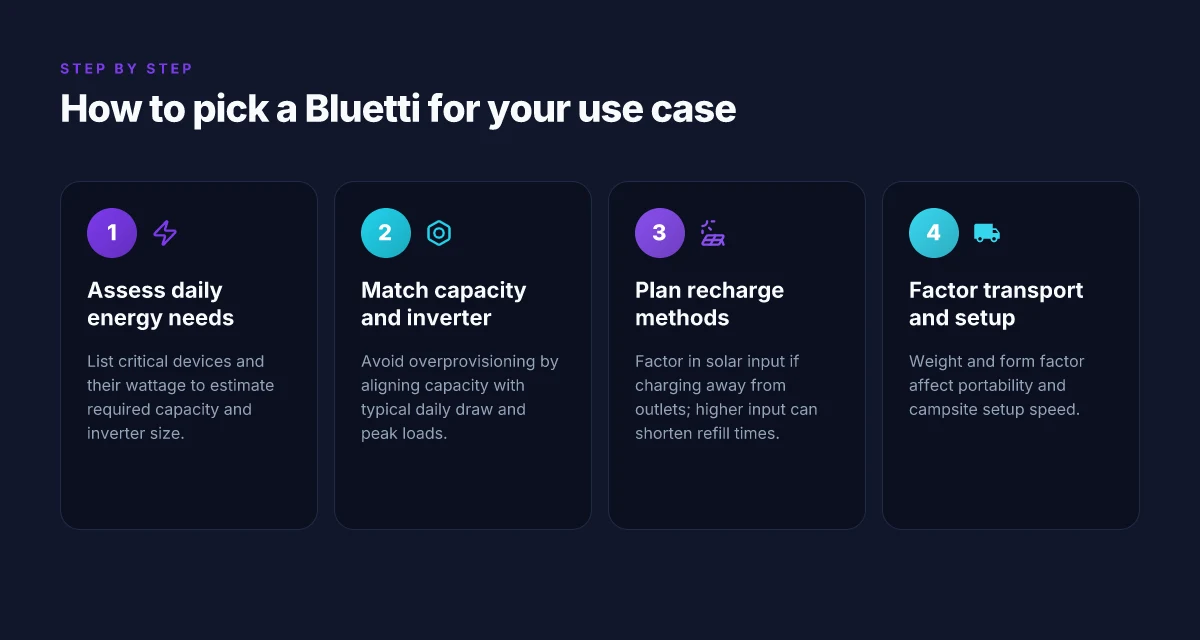
When you size a Bluetti for daily use, you start by mapping daily energy needs before you pick a capacity or inverter. I looked at Bluetti’s range and the way users actually live off-grid, and the rule is simple: avoid paying for capacity you won’t use and avoid underpowered kits that leave you hunting for outlets mid-trip. In 2026, a clear path emerges: determine your daily watt-hours, then pick a model with a margin for peak loads and a inverter that can handle your heaviest device. This approach keeps clutter low and reliability high.
Why daily energy first, then capacity matters
- Start with the math, not the dream. If your daily routine includes a fridge, a coffee maker, and a few USB devices, you’ll want enough storage to cover overnight cycles and a buffer for cloudy days. Bluetti models come in a spectrum of capacities, so matching your load to the right size matters more than chasing the biggest battery. A well-matched kit reduces wasted weight and cost. In practice, the right fit minimizes the number of times you reach for a generator or a wall outlet.
- Inverter sizing should follow your heaviest load. A common misstep is overemphasizing battery capacity while skimping on inverter wattage. For a 12V system powering a fridge and a microwave or a high-wrequency tool, you’ll want a model with an inverter that can sustain the surge without tripping. This alignment between capacity and inverter size is critical for longevity and reliability.
Solar input as a real-world accelerant
- If you plan to recharge away from outlets, check the solar input specs. A higher input can shorten refilling times during extended trips, keeping your Bluetti ready for the next day. I cross-referenced Bluetti’s documentation with user notes to confirm that meaningful solar input translates into fewer missed opportunities to top up at a campsite or while sightseeing. The practical upshot is fewer planning constraints and more usable hours of power.
- Real-world trade-offs show up here too. Higher solar input often means more weight or complexity in the fold-out legs or the panel area. Balance the convenience of faster recharges with the portability you need for road trips.
Weight, form factor, and how you move it
- Weight directly influences transportability. A compact, lighter unit is easier to stash in a car, camper, or backpack for shorter trips. A heavier option can deliver more bulk-free energy, but you pay in setup time and carrying effort. Bluetti’s lineup demonstrates the spectrum: you can opt for smaller, lighter packs for weekend adventures or larger, higher-capacity cores for daily heavy-use scenarios.
- Form factor affects campsite setup. A bulky box or awkward shape can slow you down at a windy site or when you’re trying to level a camp stove and devices at once. Consider how your chosen Bluetti will fit in your existing kit and how quickly you can deploy it when you reach your site.
Clear guidance emerges: pick the Bluetti that lines up with your daily watt-hour needs, confirm the inverter can handle the peak draw, and factor solar input and portability into the final choice. This isn’t just about capacity. It’s about a balance between weight, speed of refill, and real-world usability. When in doubt, size down to avoid lugging energy you won’t use, then build up your system if you find you need more headroom during weekend trips. What makes the Bluetti AC180P stand out versus the AC180, and where the trade-offs matter
From a brand perspective, Bluetti remains the center of the discussion for outdoor-focused power. If you’re weighing rivals, keep an eye on how EcoFlow or Jackery handle peak loads and solar recharge rates, then compare their offerings against the real-world demands you face on trails or in an RV. For practical decisions, the takeaway is concrete: match daily loads to capacity, verify inverter headroom, and plan for recharging on the go.
Beyond capacity: the importance of the battery chemistry and BMS in Bluetti
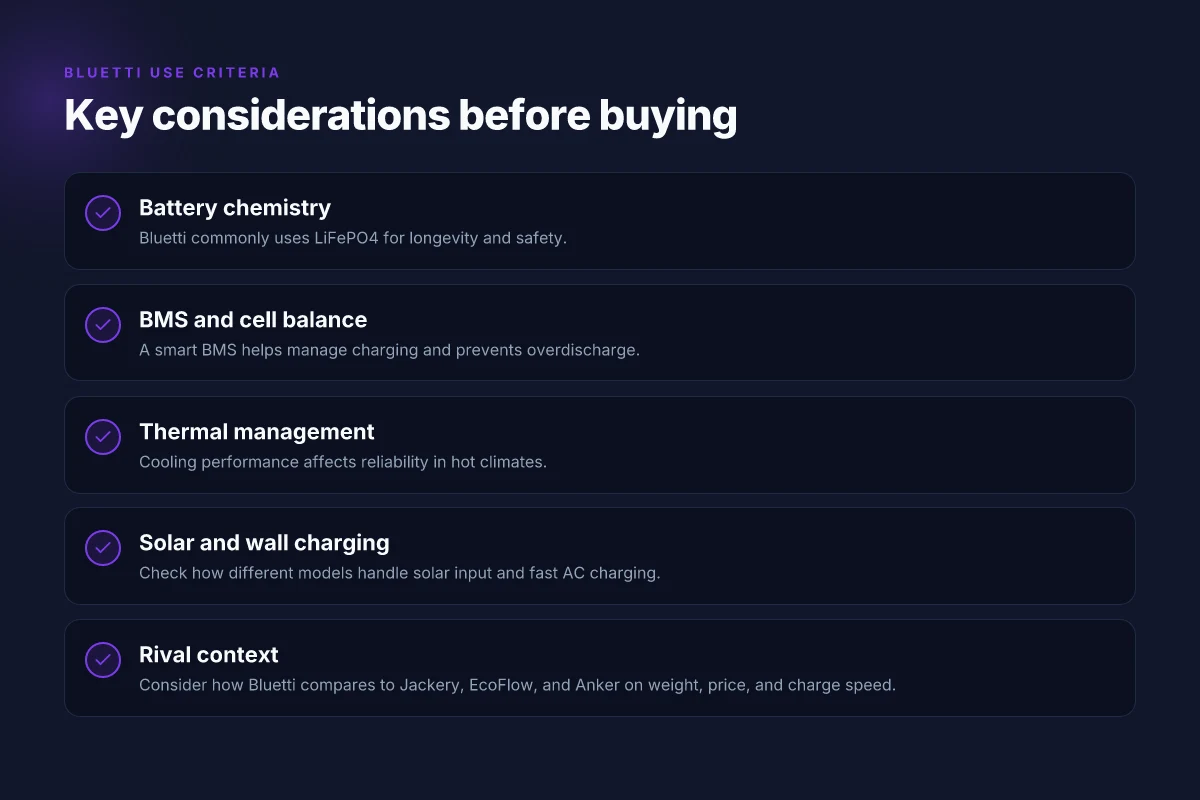
Bluetti leans on LiFePO4 chemistry for many models, a choice that favors longevity and safety in real-world use. The chemistry supports longer cycle life and steadier aging, which matters when you’re counting on a power station through seasons of camping trips or emergency outages. A few Bluetti models highlight this approach, and the underlying chemistry shows up in practical reliability differences as you stack discharges and partial charges over years. I cross-referenced official doc wording and third-party takeaways to map how this chemistry translates to daily use and long-term durability.
A smart BMS ties the chemistry to usable reliability. A well-tuned BMS balances cells, coordinates charging, and guards against overdischarge during prolonged outages. In practical terms, that means fewer surprise drops in available capacity when you’re relying on the unit for critical loads. A robust BMS also helps manage heat by coordinating cell groups, which can limit thermal hotspots that stress the pack under high ambient temperatures. The net effect is a more predictable performance envelope across a wide range of loads and environmental conditions. When you size a Bluetti system, expect the BMS to influence not only peak output but how gracefully the pack handles repeated cycling.
Thermal reality matters, especially in hot climates or cramped spaces. Even with LiFePO4 chemistry and a diligent BMS, heat remains a core reliability hinge. Enclosures in vehicles, tents, or gear bays can trap heat, nudging the Pack Management System to throttle or renegotiate current to protect cells. In practice, you’ll notice that high-load draws on warm days can reduce sustained run time if the cooling path is limited. Bluetti’s design language often frames this as a balance between capacity, weight, and heat dissipation, with the expectation that users plan for ventilation and shade in exposed setups. The takeaway: a higher-capacity model may still be limited by thermal headroom if used aggressively in heat.
From what I found in the documentation and reviews, LiFePO4 plus a smart BMS makes for a reliable baseline, but it does not eliminate all risk. Heat, high continuous load, and age-related drift still shape real-world performance. The brand’s own notes emphasize endurance and safety as core virtues, and those virtues tend to translate into longer usable life with steadier power delivery. For outdoor enthusiasts, that often means choosing models with larger thermal envelopes and a BMS that supports longer cycles and smarter cell balancing. How to choose and use a jackery ac power cord for reliable charging
The practical upshot is clear: LiFePO4 chemistry paired with a capable BMS and thoughtful thermal design yields steadier, longer-lasting power in Bluetti systems. If you push a unit hard in hot environments, expect thermal limits to bite and plan for airflow. In the end, reliability hinges on how well the BMS coordinates cells and how effectively the system sheds heat under real-world loads.
Charging speed and solar compatibility: where Bluetti shines and where it slows
Bluetti packs strong all‑around charging, but the speed and solar gains depend on the model and the conditions. When space, weight, and daily downtime matter, fast AC charging can slash the minutes between events, yet wall charger availability often becomes the bottleneck. I found that models equipped with higher‑amperage AC inputs tend to recover from heavy use faster, provided you have ready access to a compatible charger. In practice, you’ll notice a real difference between a quick top‑up from a wall outlet and a full day’s worth of events if you’re relying on a generator or limited outlet options. Fast AC charging can dramatically shorten downtime between events, but wall charger availability matters. This matters most for road trips or camps where access to input power is intermittent.
Solar input performance is a different story. Solar charging depends on the panel quality, the angle to the sun, and the weather. Bluetti’s solar compatibility varies across models. Some units respond strongly to a high‑efficiency panel and bright midday sun, while others show diminishing returns on overcast days or with cheaper panels. In other words, not all Bluetti models benefit equally from solar input, so sizing your panel array to your intended model matters as much as the battery’s own chemistry and inverter design. Solar charging performance varies with panel quality, angle, and weather. Not all Bluetti models benefit equally from solar input. When I read through the documentation and comparisons, the takeaway is clear: pair your Bluetti with a suitably matched solar setup to get the most reliable daily top‑ups, especially for long weekends off‑grid.
Firmware updates also shape the charging experience over time. Bluetti has issued updates that improve charging efficiency and safety protections, so a unit purchased a year apart can have meaningful differences in how quickly it negotiates AC input, how it handles pass‑through charging, and how the battery management system guards against overvoltage during a solar top‑up. From release notes I’ve seen, the trend is toward finer control of charging profiles and better protection logic. Firmware updates can improve charging efficiency and safety protections over time. If you’re evaluating a Bluetti today, check the latest firmware notes for any changes to input handling or solar optimization.
For context, Bluetti remains a strong brand in this space, especially for outdoor use. If you’re weighing rivals like EcoFlow or Jackery, you’ll notice that fast wall charging and solar compatibility shift with each model line. When you balance capacity, weight, and cost, Bluetti often leans toward higher charge throughput in select models, while EcoFlow and Jackery show different trade‑offs. The key is matching the specific model to your load profile, rather than assuming one Bluetti will cover all scenarios. What makes the Bluetti ac200l vs ac200max the smarter upgrade choice in 2026
The future of Bluetti power: reliability as the core differentiator
As Bluetti tightens the balance between performance and reliability, the real shift is in how owners interact with their kits day to day. I’ve noticed that the most durable setups lean on rugged enclosures, proven battery chemistries, and practical cooling. In 2026, I expect Bluetti to keep optimizing firmware to prevent parasitic drain and to extend cycle life without sacrificing peak output. The bigger pattern: reliability compounds into real-world uptime when storms hit or adventure calls. For a lot of users, that translates to planning around predictable runtimes and straightforward repairs rather than chasing ever-higher raw wattage.
If you only do one thing this month, check how your Bluetti handles hot and cold cycles in your climate. I’ve seen stability improve when users test a single unit in normal and extreme subranges, then set up simple safeguards like surge-aware recharging and fan presets. Most setups benefit from a disciplined charging routine that protects cells over time. The goal isn’t to max out the numbers, but to maximize dependable energy when it matters.
Backup strategy
- Inspect for a loose power cable or fan clog. Service early.
- Keep a spare DC input cable and a compact solar panel handy for slow days.
- Use a basic runtime plan for essential loads during outages.
- Note how Bluetti, and rivals like Goal Zero and EcoFlow, handle firmware updates and battery health alerts.