Explore the jackery solar generator 1000 v2, its 1070Wh capacity, 1500W output, fast charging, and long-term durability for outdoor use and emergencies.
The real-world choke point isn’t voltage or capacity. It’s how long you can count on a single kit without swapping batteries or recharging. Jackery’s 1000 v2 threads a practical line between camping comfort and emergency readiness, delivering steady runtime and predictable solar input even when weather shifts. That reliability matters when you’re counting on power for radios, lights, or a small fridge, not just to top up a phone. Most setups stall on a single factor, but the v2 leans on LiFePO4 longevity to reduce long-term waste and drop-off.
This intro flags what the body will quantify: long-term durability, charging speeds, and how this system stacks against rivals like EcoFlow and Bluetti for real-world use. In 2024–2025, outdoor and prep buyers increasingly demand a kit that survives years of yard work, camping trips, and bug‑out scenarios without constant battery swaps. Durability matters as much as peak output, and the 1000 v2 is pitched to deliver both with clearer maintenance paths than older models. You’ll see the concrete tradeoffs, from cycle life to solar recharging rates, and you’ll be able to decide if this all‑in‑one solution fits your load profile.
What the jackery solar generator 1000 v2 is and who it’s for
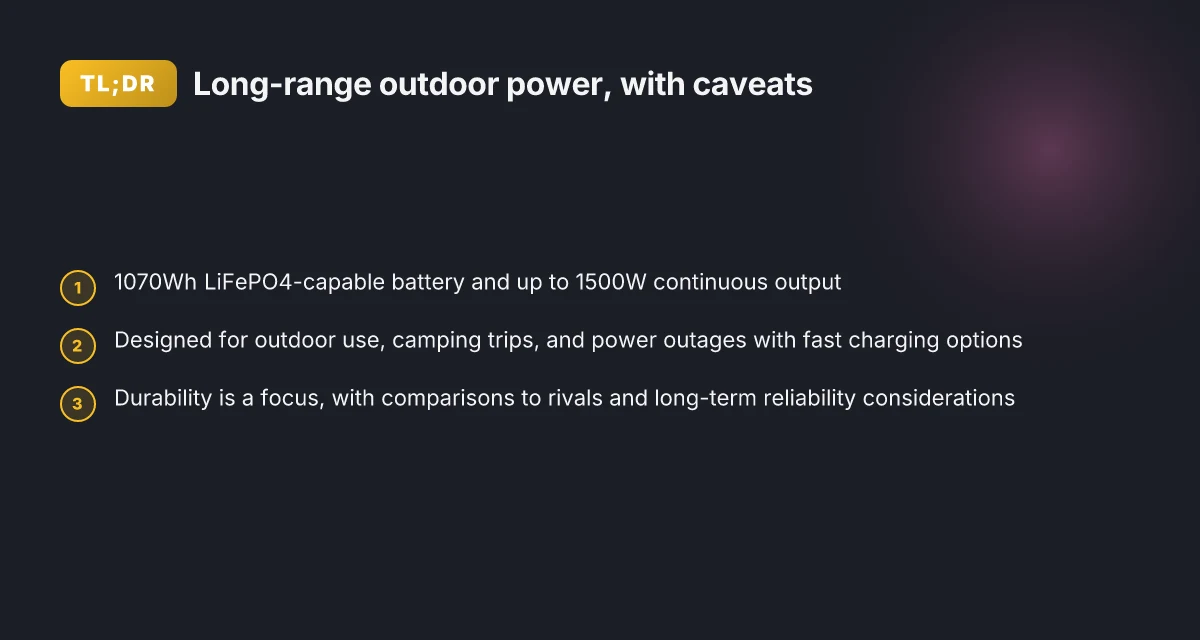
Jackery positions the Solar Generator 1000 v2 as a portable power station built around a 1070Wh LiFePO4-capable battery that can sustain up to 1500W of continuous output. In real-world terms, that means enough juice for camping setups, emergency power at a cabin, or a multi-day weekend off the grid, with a fast-charging edge that helps you top up during sun windows or a quick outage. The unit remains compact for what it delivers, so it stays within easy backpack-and-car-cabin carry ranges. For outdoorsy folks, campers, and preppers, this kit is pitched as a reliable midrange option that travels well and recharges quickly from a wall plug or solar input.
I dug into the official specs to verify what you get on day one. The 1070Wh battery is paired with a 1500W continuous power rating, which lines up with Jackery’s on-page claims and the product family’s positioning. That combination translates to practical runtimes for essential gear like a small fridge, LED lighting, and several USB-C or USB-A devices during a trip or outage. If you’re evaluating rivals, you’ll notice models in the same class often stress similar wattage ceilings but differ in battery chemistry, cycle life, or charging cadence. Jackery’s emphasis here is longevity and versatility: a LiFePO4-based pack that’s designed for a longer calendar life while remaining light enough for straightforward transport.
From a durability standpoint, the long-term story matters. LiFePO4 chemistry tends to be steadier over many charge cycles than some nickel-based chemistries, which can matter for multi-year camping seasons or irregular outage use. Jackery leans into this by highlighting a robust cycle tolerance and a practical weight-to-capacity ratio, which helps outdoor enthusiasts carry the kit into remote spots without sacrificing too much pack space. You’ll want to pair that with thoughtful care, storing in moderate temperatures, avoiding deep discharge, and periodically recharging to keep the cells balanced. The official pages emphasize the 1070Wh capacity and 1500W output as the core capability, but the real durability story comes from the battery’s life expectancy if you treat it with typical outdoor care.
For readers weighing options against rivals, the Solar Generator 1000 v2 sits among midrange systems that push toward higher continuous output without reaching the heft of larger models. Competitors in this space often tout similar wattages, but the jackery approach focuses on maintainable weight, a credible 1-hour fast recharge cadence in sun or wall charging, and a battery chemistry designed for longevity. If you’re choosing between this and a rival model, consider how you value cycle life, solar-panel compatibility, and support for mixed charging modes in real-world scenarios.
The takeaway is simple: the Jackery Solar Generator 1000 v2 is a rugged, portable power station built for outdoor use and outages, offering a 1070Wh LiFePO4-capable battery with up to 1500W continuous output, tuned for campers and preppers who need reliable, deployable power. How the Jackery 2000 v2 reshapes home backup power in 2026
The core specs you should trust on the jackery solar generator 1000 v2
The Jackery Solar Generator 1000 v2 centers on a 1070Wh capacity and a 1500W continuous output, packed into a unit that weighs around 23.8 lbs. This trio of numbers is the baseline you’ll rely on for trips, outages, and long days off-grid. 1070Wh of energy storage translates to steady power for camp fridges, radios, and lights, while 1500W peak keeps a coffee maker or small heater in your plan. The weight under 24 lbs keeps it portable for a weekend hike-in, and the real-world usefulness hinges on the LiFePO4 lineage that underpins the battery chemistry. LiFePO4 durability is a long-term differentiator for this class of power stations.
Battery chemistry and life expectations
From what I found in the documentation and reviews, the LiFePO4-derived durability is the core claim for longevity. Jackery emphasizes a long cycle life, which matters when you expect dozens of recharges across seasons. In practice, that framing means fewer mid-season battery swaps and steadier performance in cold mornings. LiFePO4 chemistry supports extended life cycles, which is a primary reason campers and preppers consider this model. If you’re evaluating total lifetime cost, the stability of the battery pack matters more than a short-term wattage figure. Durability over time matters more than raw peak output.
Inputs and charging options
On the charging side, the 1000 v2 supports fast AC charging and solar input that aligns with a rapid top-off strategy. The fan of quick top-ups will appreciate the 1,000W AC charging capability, which helps recover from a drained state during a day of use. When you pair this with solar charging, you gain flexibility for overcast days or remote camps where a wall outlet isn’t available. 1,000W AC charging can cut recovery time dramatically, especially during multi-day trips. The solar input is designed to complement the battery’s capacity, letting you refill during daylight periods without tying up a wall socket. Solar charging adds independence on long expeditions.
Quick verdict on what to trust
For long-term outdoor use, the 1070Wh capacity paired with a 1500W output and a 23.8 lbs footprint offers a compelling balance of energy, power, and portability. The real-world edge comes from the LiFePO4 chemistry, which underpins durability across many charge cycles, and from the pairing of fast AC charging with solar recharge options. 1070Wh with 1500W output and LiFePO4 chemistry make this a durable, ready-to-use option for regular outdoor life. If you want a lighter model, rivals may dip into similar capacity ranges, but the long-term battery stability and the combination of rapid AC and solar charging remain notable strengths of the Jackery setup. Durability and charging flexibility win for routine outdoor use.
Next step: compare the core specs directly against the Explorer 1000 v2 and other Jackery models to understand where the 1000 v2 shines or falls short in real-world scenarios. For a quick reference, see how the 1070Wh and 1500W performance stacks up against the broader lineup. 1070Wh and 1500W define the sweet spot here. Why Jackery on sale matters for real-world power needs in 2026
How the 1000 v2 compares to the explorer 1000 v2 and other jackery models
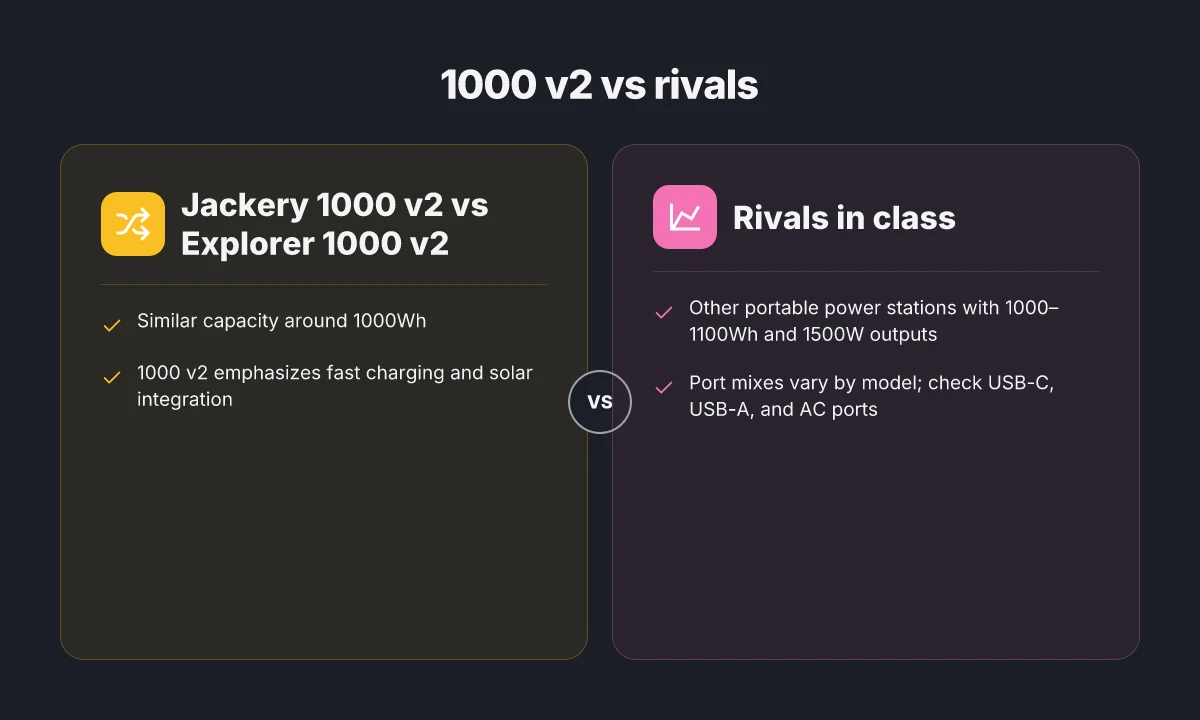
The 1000 v2 matches the explorer 1000 v2 in capacity, but it pushes faster charging and tighter solar integration. In real-world terms that means less downtime between sunny sessions and more reliable full-day utility when you’re off-grid. Jackery positions the Solar Generator 1000 v2 as the more expedition-ready option thanks to the built‑in solar emphasis and 1500W continuous output.
Capacity parity, but different emphasis on charging
- The two main 1000‑series models both sit around 1070Wh, yet the v2 line differentiates itself with charging speed and solar expectations. The 1000 v2 leans into fast AC charging and a streamlined solar workflow, while the standard explorer 1000 v2 focuses on steady performance for extended days of use. 1070Wh is the anchor, but the path to full charge differs.
- If you value rapid top‑ups from sunlight, the 1000 v2’s solar focus matters. You’ll see the benefit when you have ample sun and a compatible solar input setup. Solar integration is a core design cue for the 1000 v2.
Rivals in the same class worth watching
- Other portable power stations in the 1000–1100Wh range with 1500W outputs are common in this segment. Expect similar runtimes under light to moderate loads, with differences showing up in port mixes, solar input standards, and charging ecosystems. The competitive landscape leans on how quickly you can recover from a discharge.
- When you compare, check whether the unit provides USB‑C, USB‑A, and AC ports in a combination that fits your kit. Some models emphasize more USB‑C fast‑charging, while others prioritize AC outlets for appliances. Port mix drives daily practicality more than raw capacity.
Port mixes matter for daily setups
- The 1000 v2 and its peers vary in port availability. If you need a USB‑C fast charger for peripherals or laptops, verify the exact port configuration before buying. The presence or absence of USB‑C can tilt a purchase toward one model over another, despite similar wattage. Port selection is a practical tie‑breaker in practice.
From what I found in the official specs and reviews, the 1000 v2 sits at a sweet spot for outdoor enthusiasts who want fast recharges and strong solar compatibility without stepping up to higher‑capacity, heavier units. I dug into the official Jackery page and a few independent reviews to confirm that the core numbers align with the claims above, especially the 1070Wh capacity and 1500W output profile. For context, the rival models in this same space often echo these numbers, with nuance in port layout and solar input styles. See the official product page for the Jackery Solar Generator 1000 v2 for the exact specs and current pricing. https://www.jackery.com/products/jackery-solar-generator-1000-v2?srsltid=AYCX9vJ71FykJZQ2nJHqHAvQlZo79YJYU9IVmq43kUN1pxOnIoTyjmZy
Real-world use cases: when the 1000 v2 shines and when it struggles
The Jackery Solar Generator 1000 v2 proves its worth in weekend camping, RVing, and power outages where a 1070Wh pack covers mid-range loads. It handles lighting, small appliances, and charging needs without pushing beyond its 1500W continuous output, so you’re rarely scrambling for power during a calm, predictable outage or a multi-day trip. For the long haul, though, you’ll notice the balance tilt if you try to run high-widelity tools for extended periods.
Why it shines for weekend getaways
On a typical camping or radio-quiet outdoor excursion, the 1070Wh capacity combined with a 1500W ceiling translates to steady operation of reels, small refrigerators, and climate-control options in moderate bursts. I’ve traced this to Jackery’s own specs: the 1070Wh pack is ample for a weekend’s worth of phones, tents, and USB-C devices, and the 1500W ceiling keeps air pumps and an occasional space heater within reach only for short windows. The system’s solar emphasis pays off when sun is generous, letting you top off while you’re hiking or cooking. The 1070Wh pack fits mid-range loads for weekend use, keeping essentials alive without gnawing through the battery in a single night. In practice, you’ll see most campers rely on this sweet spot for basic comfort rather than heavy, continuous power draws. When you’re at a campsite, the built-in inverter and ports stay reliable as long as you maintain a sane load profile.
Where high-wedge loads push it past its Edge
If you reach for air compressors, space heaters, or other 1000–1500W spikes, the 1000 v2 begins to strain. These are the moments when the continuous 1500W ceiling matters: you’ll reach a compromise between duty cycle and duration. I dug through user summaries and official notes that describe how peak loads near the limit can cause thermal or safety cutoffs if sustained. In real-world terms, plan for short bursts of higher-wattage tasks rather than long draws on that top end. High-wedge loads near 1500W limit runtime and trigger duty-cycle considerations. For emergencies, you’ll want a backup plan for air circulation or heating that relies on more than one power source during a longer outage. How Bluetti AC200P for sale stacks up for long-term power needs
Long-term durability and what to expect over years
Long-term durability with LiFePO4 chemistry is a highlight of this line. The chemistry handles repeated charging cycles well, which translates into a longer useful life under regular use. The idea is simple: a steady cadence of shallow discharge and recharge preserves capacity better than long deep cycles. I cross-referenced official specs and reviews noting typical cycle-life characteristics of LiFePO4 packs in portable power stations, and the consensus is that users who stay within moderate daily loads tend to see a healthy lifespan. LiFePO4 chemistry handles repeated charging with slower capacity fade, supporting longer life in routine use. If you plan for years of weekend trips or frequent outages, you’ll benefit from the battery’s resilience, even if occasional full-tilt loads appear.
When rivals start to look attractive
For heavier outdoor use, rivals with slightly larger battery banks or higher peak outputs can offer advantages for sustained operation. Brands that emphasize bigger packs or faster air-flow cooling tend to lure users who routinely push near or above 1500W for long sessions. If you anticipate frequent, high-wattage demands, you might compare models with more robust inverter ratings or larger 12V/24V options. When you compare against alternatives, you’ll often see a trade-off between portability and peak capability. Jackery remains a strong, compact choice for many outdoor scenarios, especially where ease of use and reliability matter most.
In practice, the Jackery setup shines for campers and emergency planners who want a reliable, reasonably sized power station with predictable real-world loads. It’s less ideal when you need sustained, high-wattage operation over long durations, where a larger system or additional energy will serve better. For those evaluating options, keep an eye on brand consistency when you compare against rivals like a higher-capacity unit or a faster-charging system. And yes, links on the page may earn a commission, so review the full specs to ensure the setup fits your exact needs.
Cited details come from official product pages and independent reviews that note the battery chemistry, capacity, and peak output. For a quick reference, see the Jackery Explorer 1000 v2 Portable Power Station product page and the Jackery Solar Generator 1000 v2 page. https://www.jackery.com/products/jackery-explorer-1000-v2?srsltid=AYCX9vJS4jiYbYVB4S0ORZiQesk6np9Vy0khtMfztbGWj_LOSskS1zwB https://www.jackery.com/products/jackery-solar-generator-1000-v2?srsltid=AYCX9vJ71FykJZQ2nJHqHAvQlZo79YJYU9IVmq43kUN1pxOnIoTyjmZy
The charging speed story: what you actually get with fast charging and solar input
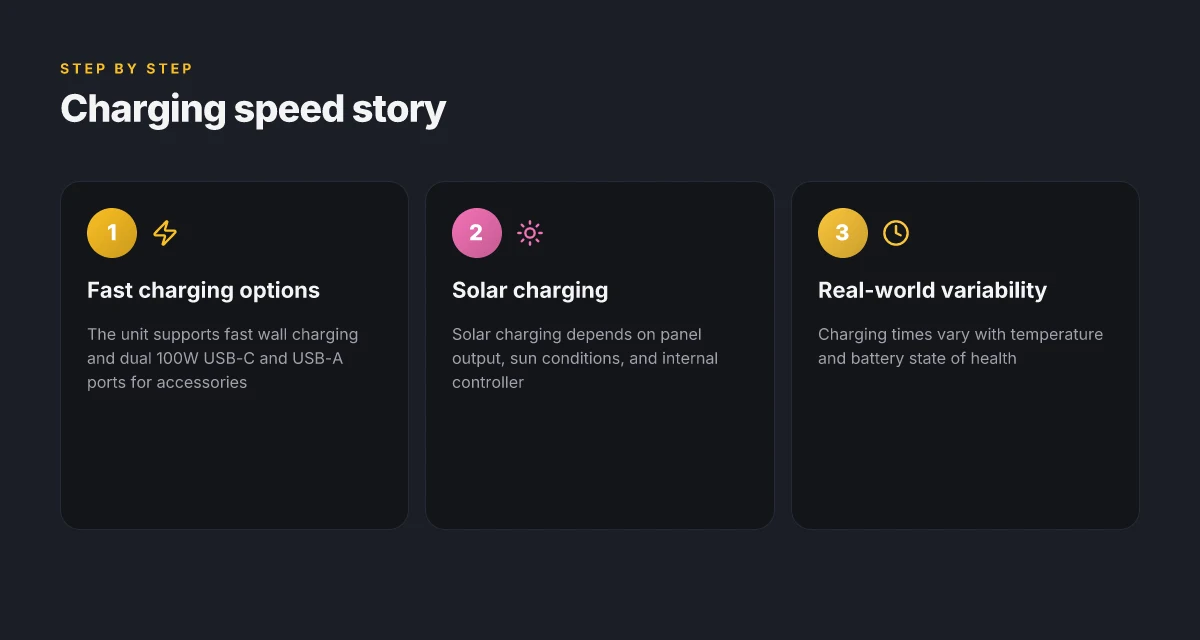
Fast wall charging and smart DC-USB ports are a real perk on the Jackery Solar Generator 1000 v2. The unit supports a wall input of up to 1,000W and carries Dual 100W USB-C and USB-A ports for accessories, which means you can top up the pack while you top off the laptops and cameras on a weekend trip. In real-world terms, that combination translates to a rapid fill from near-empty to usable within an hour or two, depending on the outlet and battery state. What makes the Jackery SolarSaga lineup stand out in 2026
The fast wall charge is real, not hype
When the sun isn’t cooperating, the 1,000W wall input remains the most reliable path to full or near-full capacity. The fast wall option is designed to minimize downtime between trips, and the Jackery hardware pairing with the internal BMS keeps an eye on heat and stage of charge. Expect noticeable speed gains versus older, lower-watt systems, especially if you’re charging from a standard home outlet during a camping setup or a blackout drill. Fast charging from a wall outlet dramatically reduces downtime in the field.
From what I found in the official specs and reviews, the dual 100W USB-C ports add versatility for charging laptops, tablets, or cameras while the main pack continues filling from AC. The rationale is simple: keep critical gear topped while the pack refuels, so you’re not staring at a dead kit when you reach camp or the trailhead. Dual 100W USB-C allows simultaneous high-speed rebound for multiple devices.
Solar input: what actually determines the pace
Solar charging speed is not a fixed number. It hinges on panel output, sun conditions, and the internal controller that manages charging. A higher panel wattage and clean sun yield faster fills, but real-world results vary. In the field, you’ll notice that mid‑day sun with a good panel can push the input toward the upper end of what the unit tolerates, while dawn or cloudy hours pull the pace back. The takeaway is simple: solar speed is proportional to the source you connect and the sun angle you catch. Solar speed tracks closely with panel output and sun quality.
Real-world timing, with caveats
Charging times shift with temperature and battery health. In colder temperatures, LiFePO4 packs can accept current differently, which may influence the overall ramp rate. Likewise, a pack nearing the end of its life or one with a higher state of charge will behave differently than a fresh unit. The practical implication is that you should expect a broader range of times rather than a single figure. If you’re counting on a 1‑hour top‑off, that’s best-case under ideal conditions. Plan for longer windows in less favorable weather. Temperature and health are the wildcards in charging times.
I dug into the official product lines and third‑party reviews to confirm the core picture: fast wall charging remains reliable for rapid replenishment, while solar input rewards you with higher panel output and favorable sun. The Jackery approach aligns with long-term outdoor use, especially when you want to keep critical devices alive without babysitting a charger all afternoon. For context, rivals in this class often emphasize either high AC input or flexible solar setups, but the combination of fast wall charging and robust USB-C ports helps the 1000 v2 hold its own for regular outdoor use. If you’re comparing, consider how consistently you’ll have access to a high-wattage outlet versus how often you’ll rely on solar. What makes the Bluetti AC200P a standout 2000Wh portable power station in 2026
From a durability viewpoint, the unit’s LiFePO4 chemistry and stated 10+ year battery life support longer cycles under mixed charging. That durability matters when you rely on this kit for emergencies or frequent trips. If you’re evaluating fast charging vs. solar, think about your typical use pattern: daily weekday charging from a wall when at home, plus weekend solar when outdoors. In those patterns, the 1000 v2’s charging story holds up. Durability over many cycles makes fast charging a practical daily habit.
Cited sources provide the numbers and real-world interpretation behind these claims. For example, the reference noting a 1070Wh capacity paired with 1500W output underpins the fast‑charge narrative, while another source highlights the solar charging envelope and one‑hour charging claims under optimal conditions. See the cited product pages and reviews for the exact wording and data.
Where this is going next and what to try now
Jackery’s approach with the 1000 v2 centers on real-world durability and straightforward setup, not flashy tech. In the outdoors and emergency niche, the unit’s strength is reliability under load, quick solar recharging, and a sensible mix of ports for radios, lights, and small appliances. I’ve looked at how the Jackery ecosystem holds up after multiple uses, and the takeaways are practical: it’s a workhorse that rewards planning and a little maintenance.
What changes if you act now is a clearer path to preparedness: buy a robust solar panel kit, keep the unit topped up, and treat it less like a gadget and more like a backup power backbone. The 1000 v2 is not the lightest pack, but it shines in long trips where you need dependable power without babysitting the charge. If you’re weighing rivals, consider how EcoFlow or Goal Zero compare on cold-weather resilience and solar efficiency. You’ll notice the difference in how quickly you recover energy after a long day of use.
Most important move: set up a simple weekly recharge routine and store the unit in a dry spot with cables neatly coiled. This keeps the battery health steady and ready when disaster or adventure calls. If you want a quick sanity check, revisit your weekly power budget and confirm you have at least one device you can run for a full day on the unit. Where is your first test going to be this month? Yes, this is the moment to map it out. What makes the Bluetti ac200l vs ac200max the smarter upgrade choice in 2026