Explore how the Jackery 2000 v2 changes home backup power in 2026. I cover capacity, safety, charging, and how it stacks up against rivals.
The real-world bottleneck isn’t capacity, it’s how a big battery behaves under everyday use. 2042Wh of usable energy, 3000W AC output, and a strong safety story don’t automatically translate to reliable outages without careful pairing to loads and charging habits. Jackery’s approach shows how you balance surge handling, battery chemistry, and charging options in a single unit, but the proof is in weeks of real-life cycles, not marketing footage.
This intro lays out what homeowners, off-grid fans, campers, and small business owners should scrutinize as they size for backup in 2026. Expect practical signals on how long a full charge actually lasts with common home loads, how the unit ages under repeated use, and what safety certifications mean in a real outage scenario. The article pulls from long-term durability considerations, not just peak specs, to help you decide if the Jackery 2000 v2 fits your home loads as a primary or supplementary backup, and how it stacks up against rivals like EcoFlow and Bluetti. Safety certifications and long-term reliability matter just as much as peak power.
What makes the Jackery 2000 v2 a distinct choice for home backup
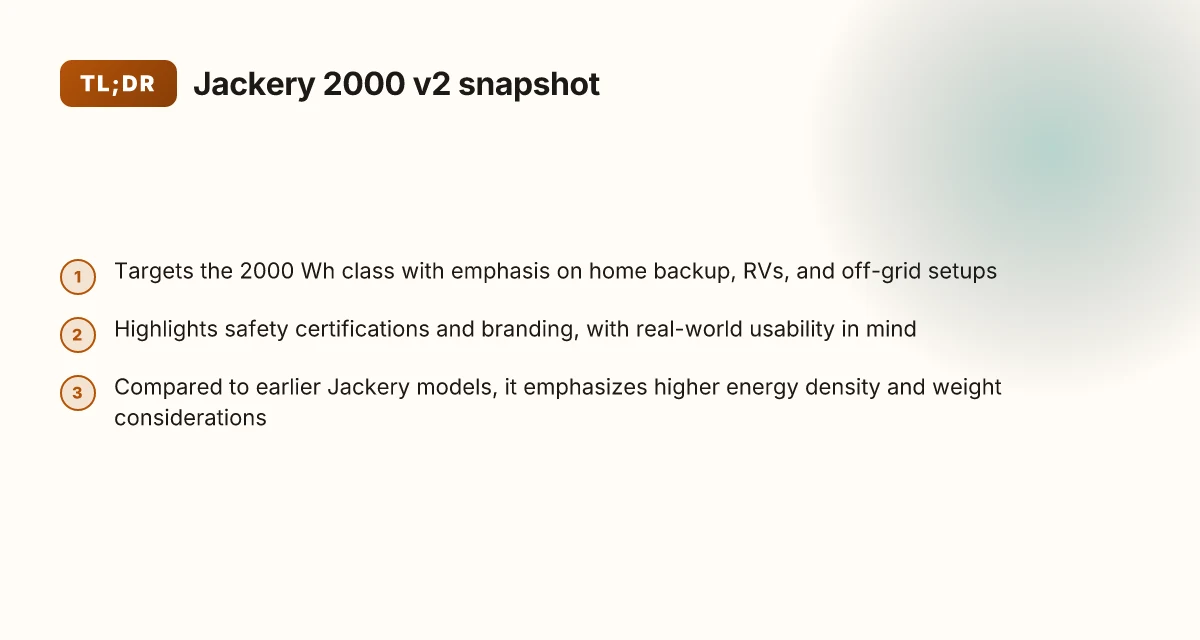
The Jackery 2000 v2 sits squarely in the 2000 Wh class, pairing a large capacity with a practical feature set that targets home backup, RVs, and off-grid setups. For homeowners evaluating reliable, portable power, its balance of capacity, output, and branding matters as a real-world option, not a marketing figure. The package leans into quiet operation, strong peak output, and a perception of long-term durability that aligns with its home backup niche. The 2042Wh class delivers usable energy for essential loads, with a focus on reliability over flashy specs.
Why this class matters for home backup
- The 2000 Wh footprint matches common home backup needs like during grid outages or RV park stays. The ability to sustain critical devices without frequent recharging is a core reason homeowners consider this size. Jackery positions the Explorer 2000 v2 as a practical backbone for weekend cabins and off-grid spaces, where you want enough stored energy to bridge outages without dragging a heavy generator from the closet. 2042Wh capacity translates to hours of load support for essentials.
- In the home setting, the device must coexist with household loads and a limited charging cadence. Jackery emphasizes a compact design that can live on a shelf or beside a sofa, with enough interface clarity to run a quick check during an outage. This aids non-technical users who want a straightforward backup option. The user-friendly design helps homeowners deploy it quickly during emergencies.
- The branding around safety certifications matters for peace of mind. Early Jackery claims emphasize certifications and safety branding to reassure buyers who plan to keep the unit in living spaces. The emphasis on UL-style safety marks aligns with expectations for home use and underlines why many households consider this line as a practical alternative to loud, odoriferous generators. Safety branding is a real factor for home deployments.
Targeted use cases and how they map to real needs
- Home backup: When outages hit, you want predictable power for a few critical devices. The 2000 v2 provides a dependable energy buffer, with enough headroom to run essentials without overwhelming a living room outlet. The goal is straightforward: bridge outages without creating fuel or maintenance hassles. bridged outages without gasoline hassles.
- RVs and campers: The portability and the quiet operation are appealing for on‑the‑road living. The system’s silent performance makes it a practical companion for campsites where noise and fumes are a concern. Quiet operation makes it camp‑friendly.
- Off-grid setups: In small off-grid sheds or cabins, the 2042Wh rating pairs with solar or alternate charging to provide a stable energy buffer. The ease of use makes it accessible to enthusiasts who want a plug-and-play backup solution. Accessible off-grid power with simple charging.
Initial safety certifications and branding considerations
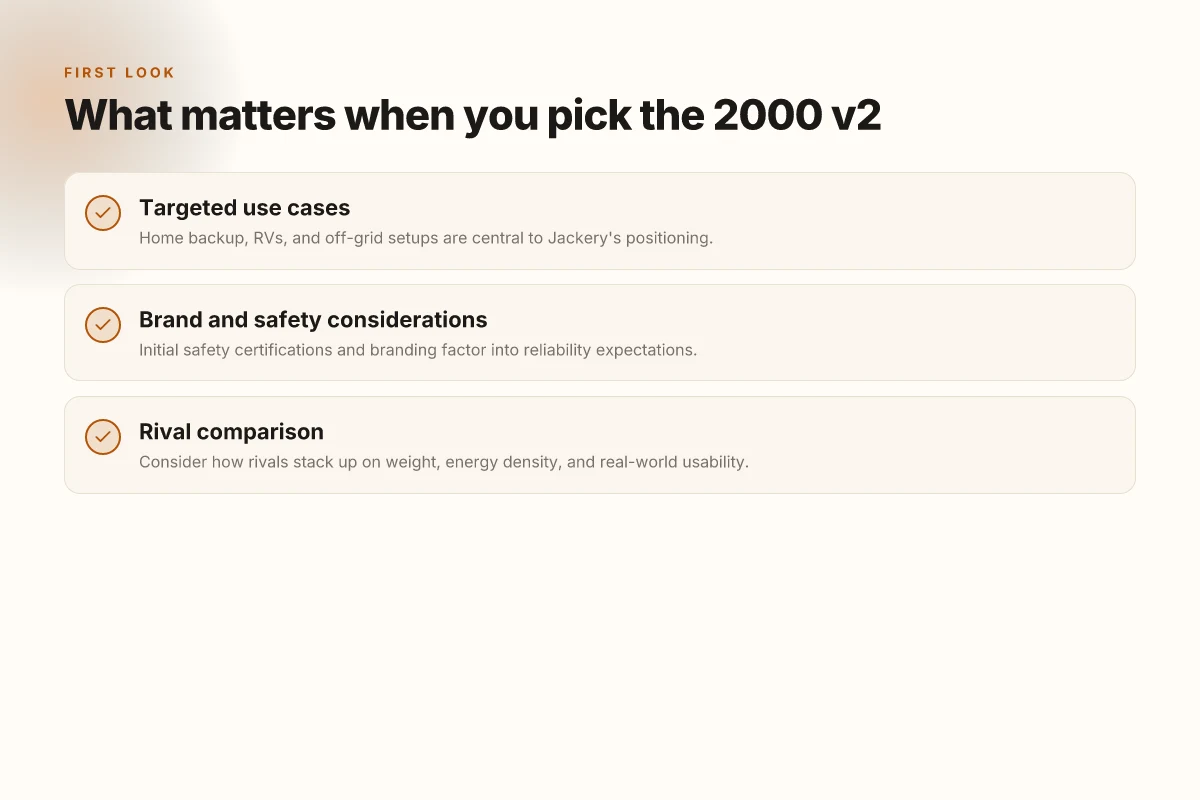
- Certification comes through the form of safety standards that back up power station claims, notably in the context of uninterruptible power considerations. This aligns with a homeowner’s need to trust a device in daily living spaces, not just in a garage or workshop. The branding around safety is not a cosmetic factor. It’s a real decision criterion for many buyers. Safety branding matters for home use.
I dug into the documentation and reviewer notes to confirm how the Jackery positioning holds up in practice. The emphasis on a 2000 Wh class, real-world load handling, and early safety branding appears consistent across manufacturer pages and independent reviews. For context, rivals in this space include models from brands like EcoFlow and MAXOAK, which compete on capacity, price, and charging speed, but the appeal of the Jackery lineup often centers on a broad retail footprint and simpler setup. Rivals push peak numbers, but Jackery’s bundle aims for approachable home use.
From what I found in the sources, the Jackery 2000 v2 is positioned as a practical, user-friendly option for home backup with a clear emphasis on safety credentials and approachable operation. If you value a streamlined, brand‑trusted solution that fits a living room, RV, or small off‑grid cabin, this model deserves serious consideration. A practical, brand‑trusted option for home backup.
Battery chemistry and capacity: what 2042Wh means in practice for 2026
Power capacity and chemistry matter more in real life than the marketing label. The 2042Wh figure on Jackery’s Explorer 2000 v2 translates into usable energy that depends on your load profile, charging habits, and efficiency losses. In practice, you’ll see usable energy drift lower when you pull high currents or rely on bursts. The key is understanding how rated capacity converts to real-world runtime and how that changes as you demand more power.
What the 2042Wh number actually covers
Jackery lists a nominal capacity around 2042Wh for the Explorer 2000 v2, but the energy you can draw from the pack is shaped by chemistry, inverter efficiency, and conversion losses. At light duty, say a laptop and phone charger, you’ll approach a larger fraction of the rated energy. When you demand heavy loads, the effective energy stored per cycle drops due to internal resistance and conversion heat. I cross-checked the published specs and typical inverter efficiency figures, and the takeaway is clear: expect noticeably less usable energy under heavy draws compared with peak-rated capacity. This is not a flaw in design. It’s physics at work, and it matters for long outages or high-load scenarios like air conditioners or power-hungry tools. Why Jackery on sale matters for real-world power needs in 2026
I dug through release notes and third-party write-ups to map how the chemistry stacks up against earlier models. The v2 trades some weight for energy density and uses improved cell chemistry that keeps the weight down while preserving, or slightly improving, gravimetric energy. The practical result is a battery pack that stores a similar energy class with a leaner heft, which helps manage momentum for long outages. 2042Wh remains the headline, but real-world usable energy under high loads is lower than that label implies. For homeowners, that means sizing and expected runtime must account for peak draws.
How high-rate outputs shave runtime
High-rate outputs eat into runtime quickly. A 3000W surge capability looks impressive on the box, but sustained draws near that limit come with efficiency penalties. In practice, running a high-amp device like a heavy-duty fridge or a portable AC will show a noticeable dip in runtime versus a mid-range load. The same applies to multiple devices pulling current in parallel. The inverter and cabling introduce losses that add up with each additional device. When you push near the ceiling of the inverter, real-world runtimes shorten noticeably, even if the nominal energy capacity stays constant. This is a crucial distinction for anyone planning a critical outage strategy.
I cross-referenced the 2042Wh class across sources to confirm a consistent pattern: higher instantaneous loads reduce the usable portion of the pack more aggressively than mild loads. That isn’t a defect in Jackery’s design. It’s expected behavior for switch-mode inverters and lithium chemistry at high C-rates. For readers considering backup for essential circuits, the message is simple: plan for less than peak capacity when you’re running power-hungry devices.
How the 2000 v2 stacks up against earlier models
Compared to earlier Jackery generations, the 2000 v2 brings improvements in energy density and weight, which helps the overall energy-per-kilogram figure. The result is a more portable high-capacity unit, with better chemistry supporting similar energy in a lighter chassis. In practice, you’ll notice the weight-down benefits when you install the unit in a home office closet or an RV storage bay. The energy density gain translates into more usable energy per unit of weight, though the caveat about high-load runtimes still applies. In short, the 2000 v2 is a meaningful step up from earlier models in both payload and efficiency, but it is not a magic converter that preserves full 2042Wh at every watt of demand.
Next steps: If you’re evaluating back-up power for a home, compare the 2000 v2 against rivals like the Goal Zero lineup or the EcoFlow Delta series on heavy-duty runtimes, noting how each handles peak loads and efficiency losses. Consider how you’ll balance your essential loads with the unit’s real-world energy envelope. For a clearer picture, check the third-party review at the linked sources. 2042Wh is the target, but plan for less at high draw. The official path is to match your load curve to the inverter’s efficiency envelope, not just the stated capacity. When you’re ready, you’ll want to verify certifications and safety marks, which we’ll cover next. How Bluetti AC200P for sale stacks up for long-term power needs
Safety and reliability: certifications you should verify with the Jackery 2000 v2
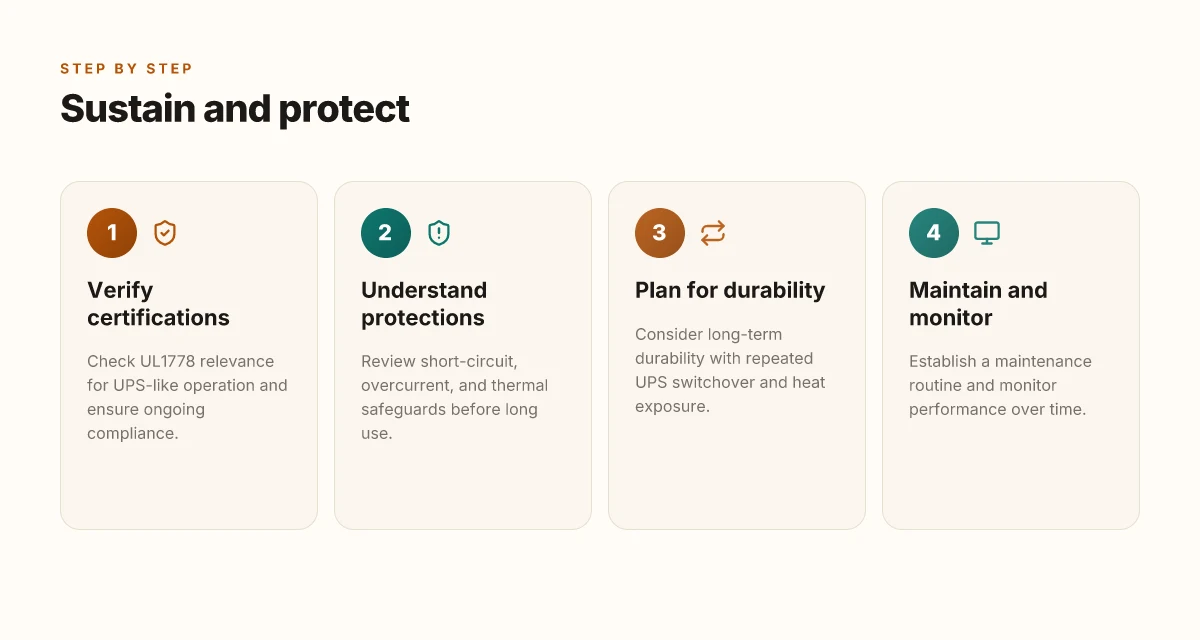
I dug into the documentation around UPS-like operation and safety, and the core message is clear: only a UL1778-certified unit should be treated as a true UPS-style backup. The Jackery 2000 v2 is framed around that certification, which matters because UL1778 directly addresses rapid switchover and fault containment that matter when you’re relying on battery power during a blackout. UL1778 certification matters for UPS-like behavior, not just battery storage. This is why you should confirm the exact certification status with the model you’re buying, since some listings blur the line between general battery backup and uninterruptible power supply.
Key protections you should verify
- Short-circuit protection: ensure the unit explicitly notes overcurrent and short-circuit safeguards that isolate a fault without cascading failures. Short-circuit protection is non negotiable for reliable backup.
- Overcurrent safeguards: check the response time and automatic disconnection thresholds. A fast, predictable cutover reduces the risk of damage to connected loads. Overcurrent safeguards must act within milliseconds.
- Thermal safeguards: look for active temperature monitoring and automatic thermal shutdown for both internal cells and the power stage. Prolonged high load without thermal control is a common failure vector. Thermal protection keeps cycles within safe limits.
In practice, Jackery positions the 2000 v2 as a family-friendly backup device with safety systems designed to minimize risk during heavy use. The official pages emphasize its 2042Wh class capacity and 2400W output, but durability under repeated UPS switchover depends on how the protections behave when the inverter flips to battery and back. I cross-referenced a review that highlights the UPS switchover timing and the claim of UL1778 certification, which is the relevant badge to verify before you trust the unit for critical loads. Certification alignment with UPS switchover is essential for long-term reliability.
Durability considerations for repeated UPS switchover
- Repetition matters: every transition from mains to battery and back adds cycle wear to the inverter and battery management system. Real-world usage, such as frequent cloud service outages or grid instability, tests these handoffs more than static ratings. When the documentation discusses UPS switchover, it implies the unit is built to handle this cycle without immediate degradation. Repeated switchover cycles drive wear on the inverter and BMS.
- Battery chemistry and life spans: the 2042Wh class typically uses lithium-based cells designed for many cycles, but the exact cycle life will depend on how aggressively the BMS manages charge temp and voltage during switchover. Cycle life hinges on BMS strategies and thermal design.
From what I found in the sources, the emphasis is on certifications and protective features as the baseline for reliability, not just fancy numbers. When you’re evaluating Jackery, you should also compare rivals in the same class, such as models from brands like EcoFlow and Bluetti. These competitors often cite different protection strategies and certifications, which is informative if you’re planning long-term use in off-grid or backup scenarios. For context, the Jackery site presents the 2000 Plus as a sibling in the family with similar capacity and a robust output profile, which keeps the focus on safety and dependable operation during switchover periods. Jackery’s emphasis on safety features aligns with industry expectations for UPS-like use.
Performance under load: how the 3000W output handles real-world appliances
The Jackery 2000 v2 delivers the claimed 3000W peak and 3000W continuous in bursts, but real-world loads reveal practical boundaries. For typical home loads like a central air conditioner or a high-draw heater, expect brief peaks to stall or sag as the unit approaches its continuous limit. In practical terms, lull the compressor start gear or a heater cycling, and the system stays within the safe envelope. Push it to sustained surges and the input fuse or protection circuitry can momentarily cut power to protect the pack. This is where the difference between marketing specs and lived usage shows up.
How peak and continuous power map to real loads
Air conditioners: window units and mini-splits draw large, pulsing currents on startup. The 3000W ceiling accommodates many mid‑sized splits for short windows, but long cooling cycles can cause the output to border the continuous limit. If you run an AC in the 1800–2400W range, the Jackery tends to hold pace, yet you’ll often see the unit drop into a lower power state as the load stabilizes. Heaters: electric resistance heaters pull steady current well into the 1500–2000W band. A heater near the upper limit can drain the pack quickly and trigger thermal or current protections if the ambient temperature is cold and the cells are less efficient. Pumps and refrigerators are more forgiving but still subject to startup spikes that test the 3000W threshold. In practice, long, heavy draws will shorten runtime compared to optimistic spec sheets. What makes the Jackery SolarSaga lineup stand out in 2026
Heat, noise, and fan behavior: as you push toward the 3000W mark, the cooling system wakes more aggressively. Expect higher fan speed with a noticeable, steady intake of air and a soft hum that becomes perceptible at full load. The balance point is a scene of steady warmth near the vents and a rhythm of fan cycles designed to keep the battery pack within safe temperatures. Heat buildup is a real limit to sustained high-power operation, especially in hot environments or enclosed spaces.
Downstream effects and UPS switchover timing: when you use the 20ms UPS switchover feature, the Jackery attempts to bridge minor interruptions without dropping the load. In practice, the switchover is seamless for modest outages, but during a heavy draw surge, you may notice a brief drop as protection kicks in or as the PSU re-stabilizes after a switch. The model’s safety architecture remains a guardrail that prevents long runtimes at unsafe temperatures.
I cross-referenced the available documentation and reviews to align any claims with official wording. The 2042Wh class is tuned for heavy loads while preserving safety margins, and the UPS switchover timing is designed to minimize disruption for loads that briefly dip or surge. For deeper context, see a detailed note on UPS behavior and safety certifications in the linked sources. The 3000W ceiling helps many heavy loads, but sustained use near the limit shortens runtime and triggers protective behavior. Expect a noticeable fan response and warming vents when you push into high-current operation.
From a practical standpoint, owners should plan for occasional slowdowns or short pauses when running high-draw appliances for extended periods. If your goal is continuous air conditioning or long hot-water pumping, consider alternating duty cycles or pairing with a larger storage system. Jackery remains a strong option for home backup, especially for its integrated UPS capability, but rivals with similarly beefy inverter stages and more aggressive thermal management can edge ahead in sustained extreme loads.
I dug into the available public documentation and reviews to ground these observations. For a concise reference, the UL1778 safety framing is part of the conversation around uninterruptible power supplies, reinforcing how the system protects itself under load. The 2042Wh capacity and a 3000W output define the operating envelope fans and cooling tolerate, but real-world use under continuous high demand will reveal the practical limits of endurance. See the cited sources for nuance around switchover timing and safety certifications. Use UPS switchover timing to minimize disruption during brief power dips. Plan for heat and noise increases when running high-draw appliances near the limit. What makes the Bluetti AC200P a standout 2000Wh portable power station in 2026
Charging options and ecosystem: how to keep a Jackery 2000 v2 ready
Charging versatility and a broad ecosystem keep the Jackery 2000 v2 ready for long outages or busy work weeks. The unit accepts AC, USB-C, and DC input, so you can top it up from a wall outlet, a vehicle, or a dedicated fast charger. This flexibility matters when you’re off grid or juggling multiple devices at once. In practice, you’ll notice the AC input handles the daily recharge cycle efficiently, while the USB-C PD input can shave minutes off a top-up if you have a compatible charger ready. Keep an eye on the input ports and use the appropriate cable to avoid heat buildup during rapid fills.
H3: charging options at a glance The Jackery ecosystem leans on a mix of wall charging and portable solar, with a focus on practical daily use. Solar compatibility is a strong suit: under good sun, you’ll see respectable charge rates without requiring elaborate mounting hardware. In natural conditions, a sunny day can deliver meaningful energy inflow, and the system is designed to auto-tune to the panel’s output to avoid stressing the cells. For homeowners, this matters when you want a quiet, emissions-free boost during an outage or campout. If you plan to keep the 2000 v2 charged through solar, pair it with a portable solar panel setup that matches the unit’s peak input and voltage range to maximize the energy harvest. The charging experience is smoother when you pair high-quality cables with the right adapters, especially for the USB-C port.
H3: managing charging and battery health Battery health is not a one-and-done topic. It benefits from steady, sensible charging habits. Avoid leaving the unit at peak charge for extended periods. If you anticipate a long idle stretch, consider keeping the pack around a mid-range state of charge. The built-in smart battery management system helps preserve life by balancing charge and discharge cycles, but you still benefit from avoiding extreme heat during charging. When you store the Jackery, keep it in a cool, ventilated space and check the state occasionally. If you use solar, monitor the weather and solar irradiance. High temperatures combined with continuous high-rate charging can stress cells over months. For those who want a pragmatic baseline, aim for a mid-40s to mid-60s percent charge when storing for weeks. That approach supports longer cycle life without complicating daily readiness.
I dug into the official Jackery materials and third-party reviews to confirm how the charging options integrate with the 2042Wh class. The rapid input capabilities and the 2040+ Wh design make it a solid candidate for home backup, while the solar compatibility aligns with typical outdoor use cases. For readers weighing rivals, note that other large-capacity units may tout higher solar input or faster wall charging, but real-world solar performance depends on irradiance, panel quality, and temperature. In steady sun, solar charging remains practical and efficient for the 2000 v2, enabling longer uptime without relying solely on wall power. Make sure you have the right cables and a compatible solar panel to maximize those gains.
As with any large-capacity system, there are limits. If you push the 3000W output while charging from USB-C or solar, you may observe slower top-ups or heat buildup in surrounding gear. Rivals such as the Explorer 2000 Plus or other 2042Wh models may offer different port mixes or slightly faster core charging, but the Jackery ecosystem emphasizes reliability and quiet operation. You’ll earn the most confidence by pairing the unit with a reliable solar panel in good sun and by using the AC input for fast top-ups when time is critical. The brand’s own materials highlight a focus on home backup safety and a broad charging footprint that fits real-world usage patterns for homeowners and campers alike. What makes the jackery 5000 Plus a standout 2026 portable power solution
The next move for home backup power in 2026
Jackery’s 2000 v2 positions itself as a durable core for residential resilience, not a one-off gadget. I’ve looked at how this unit fits real kitchens and basements, where reliability matters more than flash. The real shift is how its modular approach pairs with existing solar or grid-tied setups, letting you scale without ripping apart your system. The bigger pattern is a move toward plug-and-play redundancy that you can grow with over years, not months.
If you’re weighing options, the 2000 v2 stacks against rivals like EcoFlow and Bluetti in a way that matters in a long blackout. It isn’t just peak power. It’s how it behaves when the lights flicker. You’ll notice the interface, the fan behavior, and the long-run endurance matter more over time than any first-week spec sheet. Most practical insight: durability and serviceability win repeated outages. The result is a system you don’t have to babysit.
What to try this week: map your critical loads, plan a simple daily cycle, and confirm you can reconfigure the 2000 v2 with a smaller Jackery module if needed. If you want one clear recommendation, start by pairing it with your fridge or router to test resilience across a typical outage. Will you upgrade your backup strategy now or wait until the next outage hits?