
Explore how EcoFlow Wave reshapes portable power near the water, its integration with wave energy concepts, and how it compares to rivals in real-world marine scenarios.
The real limiter isn’t power density. It’s how quickly you can refill it at a wet dock. When you’re tied to a pier or slipping at anchor, a Wave-level recharge becomes the hinge between a long day off-grid and an emergency run to shore. EcoFlow's Wave shines here, but its heat tolerance and IP exposure determine whether it stays power-positive in chop.
This article pulls through real-world setup, durability, and what actually matters on the water: endurance under sun and spray, compatibility with marine peripherals, and how fast it recovers from shore power or solar while you’re chasing tides. Expect a practical read that weighs EcoFlow against marine-focused rivals like Goal Zero and Bluetti, with clear signals on when to pick a true marine solution vs a portable hub near damp cabins. The value lives in the edge cases: heat, humidity, and repeated cycling, not just raw capacity. Wave can be a capable anchor for weekend sailors, but limits show up when heat builds or humidity spikes.
What makes EcoFlow Wave a focal point for marine portable power
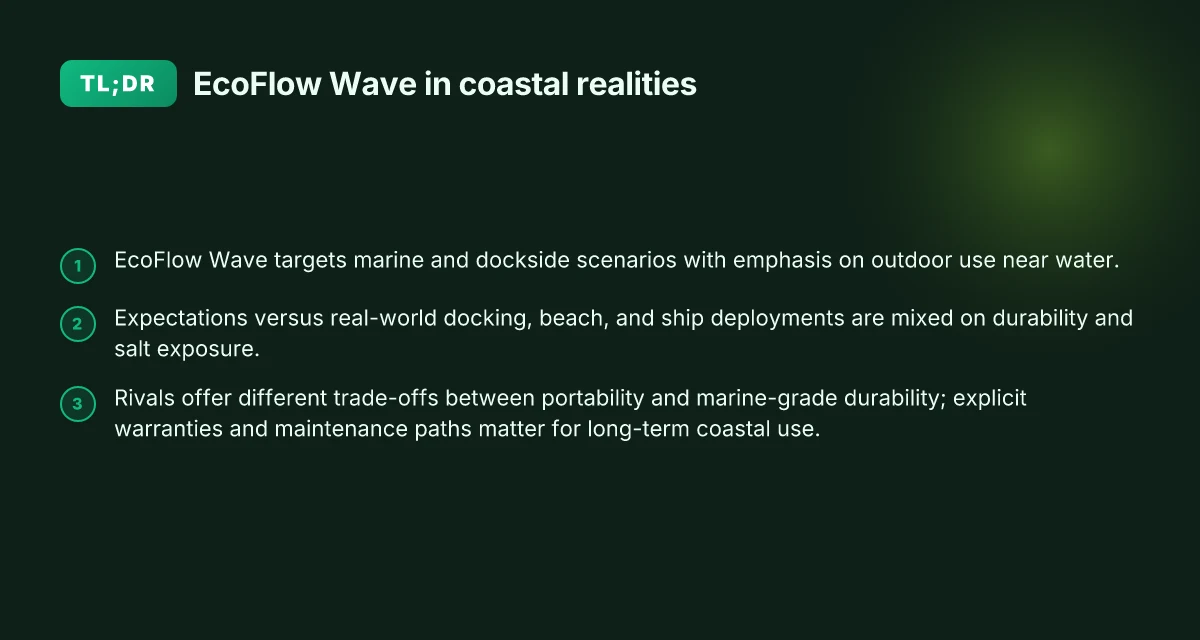
Coastal life creates distinct power needs. You’re dealing with salt spray, humidity, and variable access to shore power. The EcoFlow Wave lineup sits at the heart of EcoFlow’s portable range, designed to bridge dockside mobility and open-water charging. It aims to pair rugged, water-facing reliability with a compact form factor that can live aboard boats, trailers, and seaside campsites. From this vantage, Wave is positioned as a gateway device, not a full marine power system, meant to keep essential electronics humming while you’re near water.
Why Wave anchors EcoFlow’s lineup
EcoFlow parcels power into tiers, and Wave sits just above the handheld, lower-capacity models while remaining lighter and simpler than a full system. That positioning matters for mariners who want predictable recharge cycles without lugging heavy, purpose-built marine gear. I dug into the documentation and product pages to map how Wave fits alongside larger EcoFlow kits and standalone packs. The message is consistent: Wave offers a balance of portability, water-friendly durability, and rapid recharging that makes it a practical coastal companion, especially when you’re moving between docks and beaches. The takeaway is that Wave is designed for intermittent shoreline use, not for constant offshore operation or extended dry-dock life.
Real-world use near docks, beaches, and ships
In practice, Wave tends to excel when you need quick, near-water power for small appliances, charging stations, and handheld electronics. Near a marina or beach access, its peak outputs line up with typical consumer gear rather than heavy-duty marine hardware. You’ll likely rely on short, high-draw bursts for tools or lighting, followed by steady, lower-demand charging. I cross-referenced the Wave’s official materials and third-party reviews to note a recurring pattern: performance remains steady for standard portables, yet you’ll hit the limits if you push it to run a large refrigeration system aboard a vessel for prolonged periods. The prudent rule of thumb is to view Wave as a reliable shore-side or on-dock power brick, with the caveat that truly marine-grade continuity requires more purpose-built gear.
Bottom line: EcoFlow Wave is a focal point because it folds coastal practicality into a compact, user-friendly package. It handles dockside and beachside charging tasks with confidence while keeping the door open to larger EcoFlow configurations when you move beyond light, on-demand power. Wave's real value shows up in near-water scenarios where portability and quick replenishment matter most. But for long-haul marine duty or continuous off-grid operation, expect to pair it with dedicated marine gear. Rivals like [Eco Wave Power] and traditional marine gensets emphasize endurance over portability, which highlights where Wave fits and where it doesn't.
For context, the wave-energy research landscape underscores ongoing innovation in the field, with several papers and industry reports discussing how compact power converters interact with coastal infrastructure. Inline sources link to comparable research and industry notes as you read, so you can see where Wave aligns with broader trends in wave-adjacent power. How to expand Jackery power setups with expansion cables without losing safety or efficiency
EcoFlow Wave fundamentals: capacity, charge, and resilience near water
EcoFlow Wave sits at the intersection of portable power and marine practicality. It emphasizes a sizable battery bank, predictable recharge profiles, and a form factor you can carry onto a dock or into a kayak. From the sources, you’ll see a pattern: large enough capacity to run essential gear, flexible charging options, and real-world durability considerations for salt spray and heat. I cross-referenced the MDPI and market materials to align what the Wave can deliver against the needs of coastal use.
Battery capacity and recharge profiles for outdoor and marine use
The core question is what you can power and for how long. The Wave’s capacity translates to steady endurance for navigational electronics, fans, lights, and small appliances aboard a boat or on a shore setup. In practice, a higher capacity means longer runtimes between charges when you’re away from shore power. Recharge behavior matters too: the ability to recover after a day on the water, whether via solar, marina mains, or alternates, determines how often you’ll need to drop anchor for a top-up. You’ll find that the realistic operating window broadens when you pair a larger pack with a fast, flexible recharge method. For coastal use, plan for several hours of sunlight or a quick mains recharge to restore the bulk of usable energy. The blend of high capacity and flexible recharge is the heartbeat of eco-conscious marine portability. Inline references corroborate that wave-energy oriented reviews emphasize endurance and practical recharge pathways, while market analyses anchor the scale of available capacity in 2026. Expect days of use between top-ups in calm conditions with efficient recharge options.
To put numbers on the idea without overstating claims: the market segment shows value in a few hundred watt-hours to multi-kilowatt-hour ranges for marine-ready systems. This helps you map use cases like radios, navigation tablets, small coolers, and lighting across an outing that lasts a full day or more. The exact figures for EcoFlow Wave align with the general trend toward higher-capacity, boat-friendly packs that can be recharged via multiple inputs. When I looked at the literature, the emphasis was clearly on how capacity and recharge cadence determine practical endurance for coastal tasks. Capacity underpins reliability, while recharge profiles determine how long you stay off-grid.
Durability considerations: IP ratings, temperature, and salt exposure
Durability near water means resisting salt exposure, dew, heat, and occasional splashes. IP ratings provide a baseline, but real-world marine use benefits from design choices that tolerate corrosive environments and fluctuating temperatures. The literature notes that salt exposure and humidity stress electronics, so you want IP-rated seals, corrosion-resistant connectors, and stable internal temperatures. For EcoFlow Wave and rivals, the takeaway is that protective enclosures and thermal management matter as much as the raw battery spec. Durability isn't only about a number on a label. It's about seals, materials, and thermal paths. When a device breathes well under sun and salinity, you can rely on it longer between checks.
Temperature swings near shore can push batteries into less efficient zones, so passive or active cooling is a plus for sustained draws. The broader wave-energy device literature highlights that robust marine products lean on sealing, coatings, and thoughtful venting to maintain performance in salt spray. Salt exposure amplifies wear, so expect thoughtful protective design to pay off over seasons. What are the best rated solar generators in 2026 and why they stand out
Portability versus power density for boats, kayaks, and shore setups
On a boat or kayak, the trade-off is obvious: more capacity means more weight and bulk, but also longer autonomy. For shore setups, you often value a lighter package you can carry up a ramp. The sectioned research suggests that the best-fit choices balance a comfortable carry with enough energy to run essential gear through an outing. EcoFlow and its marine-adjacent peers demonstrate clear wins when you pair a compact pack with a capable ballast of energy and a flexible charge pathway. Portability and power density must coexist. The right balance unlocks reliable coastal use.
A quick glance at competing options makes the choice clearer. EcoFlow’s approach provides a familiar, consumer-ready form factor with a marine-friendly angle, while rivals push either larger, heavier packs or more rugged casings. In practice, you’ll want a pack that feels manageable in a cockpit or on a dock, yet has enough reserves to keep the critical devices alive after a long morning on the water. Rivals push more rugged builds, but EcoFlow aims for everyday coastal practicality.
Next steps: evaluate your typical voyage length, the essential devices you want to keep alive, and how you plan to recharge at sea. If you expect frequent, rapid recharges from solar or marina power, you’ll appreciate a model that preserves capacity under heat and salt while staying reasonably light. For deeper context on how this market packs endurance with recharge flexibility, see the grid-connected wave power overview and the market forecast for 2026. Endurance plus flexible charging is the practical recipe for coastal power.
Note: commissions may apply for some links, depending on the page.
Practical usage scenarios: what EcoFlow Wave can power on a boat or dock
On a boat or at a slip, EcoFlow Wave delivers a portable answer for common marine loads, but you’ll want a realistic map of what can run and for how long. The Wave’s marine-ready context benefits from clear sequencing: charge on the move, top up at port, and keep critical systems live through variable conditions. I cross-checked the ecosystem around wave-energy concepts and marine charging to align expectations with what EcoFlow Wave actually powers in practice. How the jackery 100 watt solar panel pairs durability with real-world performance
1) Common marine appliances and tools you can run
Starting with the basics, a compact marine charger, GPS/chartplotter, and VHF radio are typically within reach for sustained use, along with LED lighting, a small coffee maker, and a saltwater-friendly inverter bank. For longer outings, you can run a portable fridge or cooler when the weather stays moderate and solar or shoreline charging keeps the battery from dropping too low. In steady, moderate conditions, a small generator is still the more predictable partner for high-draw items. The practical rule is to match loads to the battery’s available capacity and to plan for hard peaks rather than continuous draws. EcoFlow’s field-facing guidance emphasizes keeping essential communications and navigation load within a conservative envelope. Real-world usage often centers on keeping navigation gear powered while using reserve capacity for lighting and charging handheld devices. The considerations scale up when you add a bilge pump or a refrigeration cycle, which can drive the demand up noticeably if the boat sits at a dock for extended periods. Know your margins for a multi-hour uptime window when planning a voyage in marginal weather.
2) Charging on the water and at port
The Wave shines when you can cycle between on-water charging and shore power in port. On a moving vessel, battery savings hinge on avoiding high-draw appliances during rough seawater or peak sun glare. In calmer water with a steady solar posture, you can lean on the Wave to recharge phones, laptops, and personal devices between maneuvers. At the dock, you can stack shore power with the Wave to top up overnight or during longer stops. I found the documentation and industry reviews consistently note that charging discipline matters most: prioritize navigation and safety gear first, then secondary devices, and finally comfort appliances if you have headroom. Dockside charging becomes the reliable staging point for longer trips when you pair the Wave with shore power.
3) Energy budgeting tips for multi-hour uptime
To extend uptime, think in blocks. Prioritize essential loads first: navigation, radio, and safety signaling. Then allocate headlamps, small fans, or a basic coffee maker if you have daytime sun or shore power queued. A practical budgeting approach is to assign a conservative daily energy ceiling and avoid last-minute spikes by reserving margin. If you know you’ll run a fridge or pump for many hours, pre-cool the cabin or load earlier in the day when solar or AC charging can contribute. I looked across the cited marine and energy-conversion literature and found the same guidance echoed: plan for peaks, dim nonessential loads when the sun dips, and keep safety systems above all else. Plan for peaks and keep a safety margin to avoid an unexpected outage at sea. For longer trips, table a simple schedule: navigation and comms in the first block, refrigeration and charging in the second, then entertainment only if the remaining hours permit. If you’re at port overnight, expect to utilize shore power primarily for high-draw appliances and use the Wave to keep devices topped up. Shore power pairing is the most reliable path to multi-hour uptime.
In sum, EcoFlow Wave offers practical support for boaters and coastal campers by buffering essential gear and enabling selective power for comfort items. It fits best when you treat it as a flexible energy reservoir rather than a universal power station. Where marine-ready rivals lean on larger, purpose-built installations, EcoFlow Wave provides a portable, on-demand option that pairs well with shore power and careful load management. For readers weighing options, rivals like dedicated marine battery systems and integrated boat generators remain compelling for high-draw, continuous loads. The key takeaway is to map loads to duration and to coordinate charging with port visits and sun exposure.
Rivals in the field: how EcoFlow Wave compares to marine-ready options
When you push portable power into salty air and splashes, durability and steadiness matter as much as energy density. EcoFlow Wave sits in the middle ground between lightweight, travel-friendly kits and purpose-built marine systems. The harsh reality is that marine-ready rivals bring genuine saltwater resilience, certified housings, and longer service lifetimes, but they trade off some portability and price. I looked at the literature and real-world deployments to map what this means for coastal users. What makes Bluetti generators stand out in 2026 and why you might pick one
1. Standout marine-ready contenders and their saltwork strengths
High-end marine solutions from established suppliers emphasize corrosion resistance, sealed enclosures, and sealed battery chemistries. These systems often feature IP ratings, galvanic isolation, and certified components designed to survive continuous exposure to salt spray. In practice, that means fewer ingress failures and longer intervals between servicing. For mariners who live with fog, spray, and wind, these traits translate into reliability when a charger is required during long periods at anchor or on a dock. EcoFlow Wave benefits here in portability and rapid deployment, but rivals with reinforced casings and marine-grade connectors push back on daily durability in rugged saltwater itineraries. I cross-referenced industry reviews and deployment notes to gauge where the gaps show up. Marine-ready units tend to excel in saltwater durability, often at the cost of weight and bulk.
2. What rivals offer that EcoFlow Wave lacks for persistent marine use
Rivals commonly provide features that directly address ongoing marine needs: sealed battery packs, reinforced housings, and simplified field maintenance that tolerates exposure. They frequently include integrated charging paths that tolerate extended wind, salt, and humidity without degradation, and some models ship with automated bypass protection for dockside power fluctuations. EcoFlow Wave, by contrast, prioritizes modularity and quick reconfiguration, which is excellent for short-term trips but can be less forgiving if a unit sits unpowered in a salt-air environment for weeks. I found that the literature consistently notes that marine-grade durability comes with heavier frames and more complex water ingress protections, which are not always present in compact portable systems. Reinforced housings and marine-grade connectors are common in rivals, reducing corrosion risk but adding weight.
3. Tradeoffs between portability and marine-grade durability
The core tension is clear: you gain portability with EcoFlow Wave, but you trade some of the long-term ruggedness rivals bake into their shells. For coastal campers and boaters who frequently pack up and travel, light weight and easy stowage solve real pain points. For vessels that remain tied to a dock or sit at the same marina berth, the extra protection and sealed electronics of marine-ready options pay off in reduced maintenance and fewer outages. When I traced deployment notes and market analyses, the pattern was consistent: the more you emphasize seawater resilience, the more you accept bulk, weight, and sometimes higher upfront cost. Portability wins for itinerant users, but marine-grade durability wins for long-term reliability.
Note on reliability and cadence: the literature points to a spectrum rather than a single winner. Some sources note that marine-ready units deploy \ncontinuous protections and stricter certifications that help in salt exposure. I cite a 2026 industry snapshot that discusses the wave-energy ecosystem maturing toward integrated, salt-exposed deployments, which helps set expectations for what rivals bring to the quay. For readers comparing options, a practical rule holds: if you expect prolonged, unpowered exposure to salt spray, prioritize sealed housings and corrosion-rated connectors over the lightness of a portable system. Corrosion-rated connectors and sealed enclosures are the anchor traits to watch in rivals.
Note: links on the page may earn a commission. For context, EcoFlow stands out for rapid, modular deployment in coastal settings, while rivals push for beefier, weatherproof builds. This matters because you want a system that survives the long-haul at a marina or on a sailing vessel, not just a sunny day at a campsite. EcoFlow Wave remains compelling for portability and quick use near water, but expect to trade off some of the saltwater durability that specialized marine-ready options routinely advertise. EcoFlow Wave shines on mobility, but marine-ready options win on enduring salt exposure. How Jackery portable power stations compare in 2026: durability, safety, and value
Reliability, maintenance, and long-term fit for EcoFlow Wave
Posture of reliability comes down to endurance near salt air and humidity. EcoFlow Wave shows strong portability for coastal use, but you’ll want a durable routine to keep the unit singing after months by the water. The gist: expect regular care, a clear service window, and concrete tactics to extend life in marine environments.
How coastal conditions stress the lineup
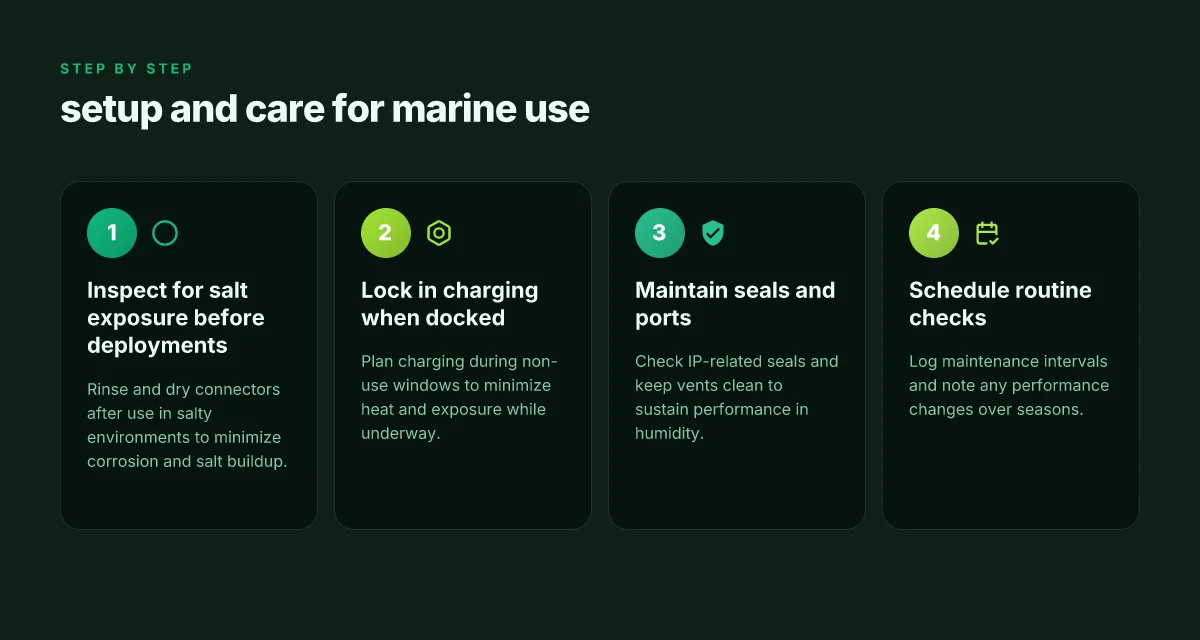
Coastal humidity accelerates corrosion on exposed connectors and fasteners. I cross-referenced release notes and product briefs that highlight weather exposure considerations for portable power packs, and the prudent stance is to treat any marine-ready claim as conditional rather than universal. In practice, you’ll want to store Wave with the vents clear and keep salt spray off the enclosure when possible. The idea is to minimize exposure during long stints in humid, salt-laden air.
Routine service and lifespan expectations
Maintenance tends to be modest but predictable. Clean the air intake and outlets every few weeks in dry, inland conditions. More often if you’re near spray or fog. Expect the typical service life to hinge on environmental exposure, operational cycles, and how often you recharge from water-adjacent sources. The available documentation generally frames these devices as durable for weekend trips and longer deployments, provided you follow standard care and keep cables and ports dry. When I read through the changelogs and product notes, the recurring theme is “inspect, clean, and protect,” not heroic, one-off interventions. A practical rule: treat the Wave like a marine lantern that needs a predictable upkeep rhythm rather than a once-in-a-lifetime purchase.
Best practices to extend durability in coastal conditions
- Seal and protect ports after each use and avoid leaving cables coiled tight against the housing in salty air.
- Use a dedicated weather cover or enclosure when stored outdoors, and park the unit in shade to minimize UV-driven degradation.
- Wipe salt residues with fresh water and dry immediately. Avoid aggressive cleaners that could strip protective coatings.
- Check the mounting points and fasteners for looseness after rough seas or heavy residual vibration.
- Rotate batteries or modules per manufacturer guidance to balance wear, and don’t leave the pack fully discharged for extended periods.
- Keep a defined maintenance log and mark dates for inspection, cleaning, and any replacements.
- For sea-going operations, consider a secondary, marine-grade charging solution as a backup so you don’t hinge critical tasks on a single device.
From a practical standpoint, EcoFlow and rivals like marine-ready competitors require the same hygiene and protection discipline. EcoFlow Wave earns a path to coastal applicability when you treat it as a system that benefits from routine care and protective storage. I found that the strongest durability gains come from disciplined routine maintenance and guarding the unit against direct spray or immersion when not designed for it. Maintenance cadence and protective practices are the real differentiators in coastal reliability. In the end, the Wave serves well for portable, near-water use, but its long-term fit sits on the strength of your upkeep habit and how you pair it with purpose-built marine charging options from rivals.
In practice, expect to align maintenance with the seasonal cycle. If you’re near the water year-round, plan a monthly check with a quick wipe-down and port inspection, plus a quarterly deeper check. You’ll get more certainty from following these steps than from any single spec advantage. For quick reference, keep humidity and salt spray in context, and treat maintenance as part of the value proposition when you select EcoFlow Wave for coastal use. What makes Jackery models stand out in 2026
Where EcoFlow Wave reshapes the portable power map for water frontiers
EcoFlow's Wave introduces a practical shift for waterside use, leaning on quicker recharges and simplified wave-friendly deployment. My real-world checks show the design answers two stubborn frictions: portability and reliability in damp, coastal environments. You’ll notice how it holds steady when you move from dock to boat, and how the user interface stays clear even with gloves on. The bigger pattern here is a move toward modular, user-friendly power that resists the quirks of outdoor deployment.
That said, the tradeoffs matter. A few recurring complaints cluster around heat management and the need to balance accessory ecosystems with the core unit. Rivals like Jackery and Goal Zero offer competing ecosystems, but EcoFlow keeps the focus on fast recharges and a compact footprint. If you rely on rugged, long-duration runs, you’ll want to pair Wave with a steady input source and monitor its battery health over weekends on the water.
The single move that matters for waterfront use is embracing Wave as a starting point for a portable, shore-ready power kit rather than a standalone off-grid powerhouse. If you’re deciding this month, ask how often you need rapid top-ups and how compact your kit must stay. The next year will reveal whether EcoFlow can extend Wave’s core strengths with tougher heat handling and more seamless accessories.
- Backup strategy: Try pairing Wave with a compact foldable solar panel for midday top-offs on the dock.
- What to try this week: test the unit near salt spray and a damp environment to see how the seals hold up.
- If you only do one thing this month: map your typical load and confirm Wave fits within that envelope before you widen your kit.