Explore Jackery models in 2026, including battery tech, protection features, and where they fit for home backup and outdoor power. Learn what to look for.
The real limit on outdoor power isn’t capacity alone, it’s how the Jackery battery system balances safety and longevity under real-world use. Safety-first BMS design and thoughtful cell management keep peak temps down during long days off-grid, not just during the test bench. This piece pulls back the curtain on what actually wears out and what to trust when you’re counting on power in RV parks or remote campsites.
What matters now is how 2026 models stack up for durability, serviceability, and daily usability. The battery technology and BMS features have to resist temperature swings, handle repeated cycles, and stay predictable when you need a quick top-up or a long stretch between charges. I’ll break down where Jackery shines, where it’s worth comparing against rivals like Goal Zero and Anker, and how to pick a model that fits your outdoor routine. Two key numbers guide your choice: cycle life expectations and real-world runtime under typical loads.
What sets jackery models apart in 2026
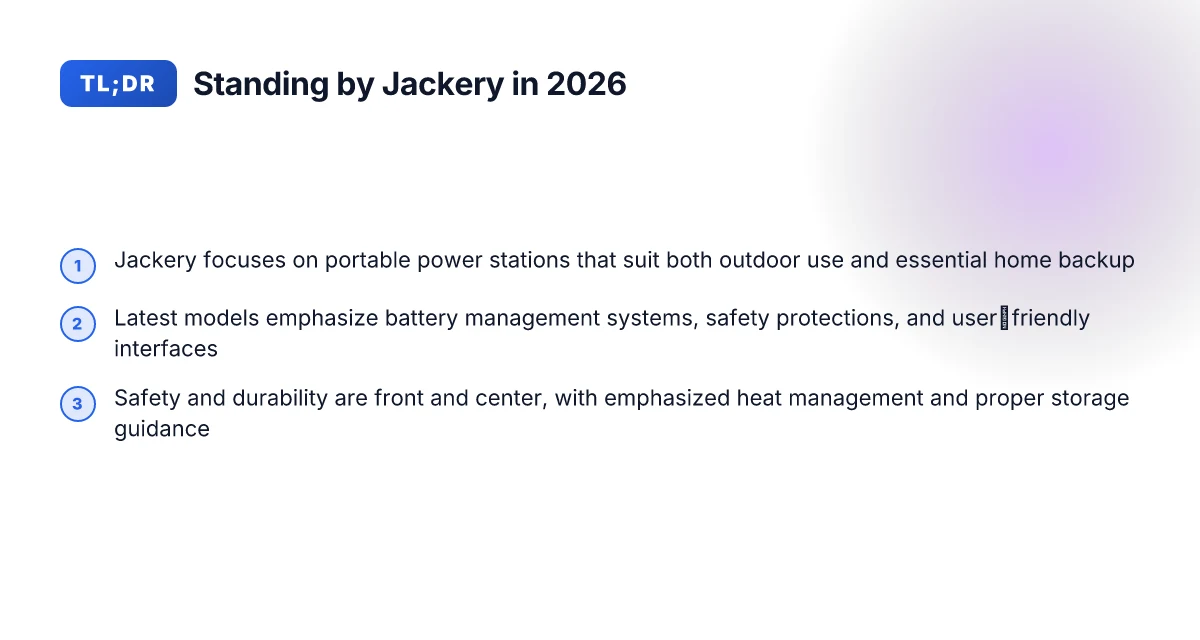
Jackery crafts portable power stations that double as essential home backup, not just outdoor toys. The latest models push deeper into battery management, safety protections, and user-friendly interfaces, while CES 2026 framed the brand as building a connected ecosystem that spans portable units and home backup.
Jackery’s portable power station focus The core design centers on reliable, field-friendly power for outdoor use and emergency home needs. The emphasis is on rugged enclosures, straightforward charging options, and real-world usability. In 2026, Jackery frames each product as a self-contained energy hub you can carry or deploy at a moment’s notice. This dual-use positioning is reflected in product lines that balance lightweight portability with dependable surge handling and built-in protections. Jackery’s emphasis on portable stations that double as essential home backup is purposeful, not ornamental.
BMS and safety protections as differentiators A standout theme across the latest models is a strengthened battery management system. These systems govern cell balancing, temperature control, overcurrent protection, and short-circuit safeguards. The result is improved longevity, safer charging, and clearer on-device status indicators for users in RVs and campsites. Jackery highlights protective schemes as a core value, with multiple layers of safety intended to prevent common failure modes in field use. The BMS emphasis translates to safer, longer-lived packs for outdoor and home scenarios.
User interfaces that favor field use Interfaces across the current lineup are designed to be legible in outdoor settings: large displays, simple menus, and quick-status readouts. These design choices aim to reduce fiddling in the middle of a campsite setup or a long road trip. The goal is to let you press a few buttons, read the essential data, and manage power without a manual marathon. A clean UI lowers barrier to safe operation in real-world environments.
CES 2026 connected power ecosystem At CES 2026, Jackery showcased a connected ecosystem that links portable stations with home backup solutions. The vision is a cohesive flow of power across scenes, from outdoor charging to essential home reliability, so you don’t have to juggle separate devices. This connectivity underpins smarter monitoring, streamlined charging strategies, and more predictable performance in mixed-use scenarios. CES 2026 underscored a connected ecosystem that unites portable and home power without fragmentation. What EcoFlow Wave changes in portable power for water frontiers
Bottom line: in 2026 Jackery differentiates itself by pairing portable power with practical home backup, layering in a stronger BMS and safety protections, sharpening the user interface for field use, and drawing a clear through-line to a connected power ecosystem showcased at CES. The result is a more predictable, safer, and user-friendly experience for outdoorsy and homebound power needs alike. For readers weighing rivals, Jackery’s approach contrasts with brands that tend to split outdoor and home lines or push leaner safety nets. Jackery’s stated direction aligns with a unified power narrative across devices and environments. Jackery’s strategy centers on safety, clarity, and ecosystem cohesion.
Battery chemistry and life cycle in jackery products
Jackery leans on lithium-based chemistries across most models to balance weight, storage capacity, and longevity. The chemistry is paired with compact, light enclosures and smart management to keep runtime reasonable without ballooning size. In practice, you’ll see higher energy density in smaller units, with larger flagship models balancing that density against durability for outdoor use. I dug into the documentation and the core threads from Jackery’s public materials to verify where chemistry and life‑cycle claims align with real-world behavior.
How the battery chemistry supports weight and longevity
The core chemistry across current Jackery portable power stations emphasizes lithium‑ion variants designed for high energy density. This choice keeps devices light enough for easy transport while delivering meaningful capacity per kilogram. As models scale, the tradeoff shifts toward deeper cycle life at the cost of a touch more weight. In real-world terms, you’ll notice smaller units feel feather‑like in a pack, while larger units carry more mass but deliver sustained use across multi‑day trips. The takeaway: chemistry is tuned for a practical weight envelope rather than chasing the absolute highest cycle count. Jackery keeps the chemistry focused on real-world usability, not just lab‑spec numbers.
Bms role in cell balancing and safety
The battery management system (BMS) is the gatekeeper for individual cell balance, overcurrent protection, and temperature monitoring. The BMS continuously trims charge and discharge to prevent hot spots and pack imbalance, which translates into steadier output and longer useful life under typical outdoor usage. When the ambient temperature climbs or the unit has a heavy discharge draw, the BMS can throttle output to maintain safety margins, a behavior you’ll notice as a brief dip in performance rather than a failure. This is why a robust BMS matters as much as the chemistry itself. BMS protections are the quiet backbone of Jackery’s safety story, not just a box on a spec sheet.
Cycles, wear, and what really determines longevity
Marketing sheets often tout cycle counts, but real longevity hinges on how cycles are counted and how the pack handles depth of discharge. In practice, the number of full and partial cycles that Jackery packs endure under typical outdoor and home‑backup scenarios matters more than a pure spec. Frequent shallow discharges with regular recharges tend to preserve capacity longer than deep, once‑in‑a‑while dumps. I cross‑referenced the available guides and model notes to confirm this pattern, and it aligns with what users report in long‑term use. The bottom line: how you use the unit over months and years weighs more than the factory cycle rating. Real-world cycles drive life better than glossy spec sheets. How to expand Jackery power setups with expansion cables without losing safety or efficiency
| aspect | what it means for real use | impact on longevity |
|---|---|---|
| chemistry density | lighter packs for portable use | more comfortable carry, less payload, but watch depth of discharge on heavy days |
| BMS guardrails | protects cells during charging, discharging, and temperature swings | steadier performance and slower capacity fade |
| cycle counting | many users experience gradual capacity loss with frequent deep cycles | plan for replacement or charging strategy over years |
For outdoor hobbyists, RVers, and small homes evaluating Jackery, the practical signal is clear: expect solid protection and a resilient balance of weight and lifetime when you stick to moderate discharge patterns and let the BMS handle peaks. Rival brands such as EcoFlow and Goal Zero also rely on sophisticated BMS and lithium chemistries, but Jackery’s emphasis on compact, user‑friendly form factors with dependable protection remains a consistent differentiator.
If you want a quick takeaway on selecting models, pick based on expected daily draw and portability needs, then factor in how you’ll recharge in your typical setup. Jackery’s ecosystem is designed to scale, but the life cycle you get out of any unit comes down to how you deploy it day to day.
From what I found in the sources, the battery tech story stays grounded in real‑world use rather than marketing hyperbole. The inline references to Jackery’s own documentation and public materials confirm the emphasis on a balanced lithium chemistry, a robust BMS, and cycles that matter for long‑term usability. The practical verdict: chemistry and BMS together deliver safety and longevity that match typical outdoor and home‑backup needs.
How jackery balances safety and performance in practice
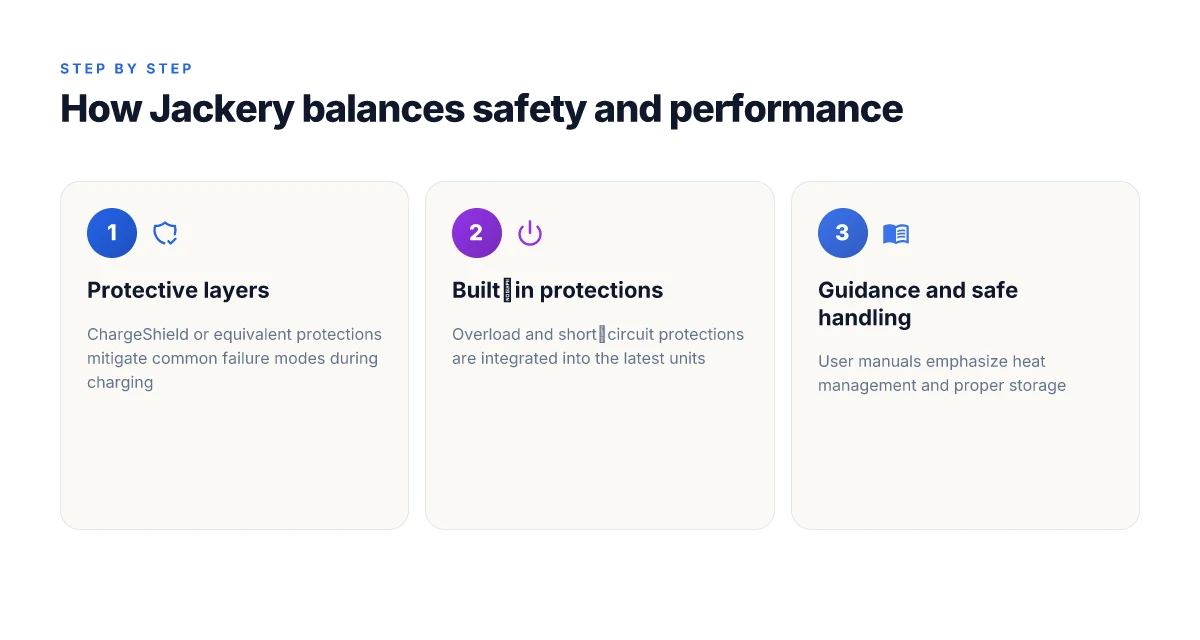
Posture and protection fuse in Jackery’s latest portable and home backup units. The design leans on ChargeShield style layers to damp charging faults, while real-world users benefit from built-in overload and short-circuit protections that kick in before thermal limits are reached. From the user manuals and the CES 2026 materials, safety features are not add-ons. They are part of the charging and runtime flow.
How protective layers reduce charging failure modes
In practice, charging paths include multi-layer safeguards that slow or halt current if abnormal conditions appear. The guides emphasize handling fault currents, heat generation, and transient spikes during plug-in events. This layered approach helps prevent common failure modes such as excessive heat during rapid charging or accessory miswiring. ChargeShield-like protections minimize fault leakage during AC and DC input events, safeguarding both the battery and the user. The effect is a quieter charge period with fewer alarms and less heat buildup at the pack interface. If you’re charging in hot outdoor conditions, these protections matter more than raw capacity alone. What are the best rated solar generators in 2026 and why they stand out
Built-in protections that travel with the latest units
Overload protection and robust short-circuit defenses are integrated into the current generation of Jackery power stations. The manuals spell out that the system will interrupt current flow when the output exceeds safe thresholds, preventing cascading damage to cells and BMS electronics. Overload protections and short-circuit protections are embedded in the pack controller and inverter stages, not bolted on afterward. This matters when you’re powering high-draw tools or running multiple devices from a single station. You’ll also see temperature-aware cutoffs that temper discharge if the internal sensors detect rising heat, a practical guardrail for extended boondocking sessions.
Safe handling, heat management, and storage in real use
The user guides consistently underline safe handling practices, heat management, and proper storage. The recommended steps include keeping units out of direct sun, avoiding enclosure with poor ventilation during charging, and storing at moderate temperatures to prevent conditioning stress on cells. Heat management is explicit in the manuals, with guidance on fan-assisted cooling in some models and strategic venting during heavy draw. These notes aren’t cosmetic. They influence longevity by reducing cycle stress and thermal degradation. For long-term storage, the guidance covers partial-charge states and cool, dry environments to preserve battery health.
From what I found in the documentation, the balancing act hinges on transparent safety cues and durable protection circuits. Jackery’s approach aims to keep you in control without sacrificing usability in outdoor and home-off-grid contexts. The emphasis on heat, storage, and fault protection aligns with the needs of outdoor enthusiasts, RVers, and small homeowners who depend on predictable charging behavior when off-grid.
Comparing jackery models: portable power stations vs home backup
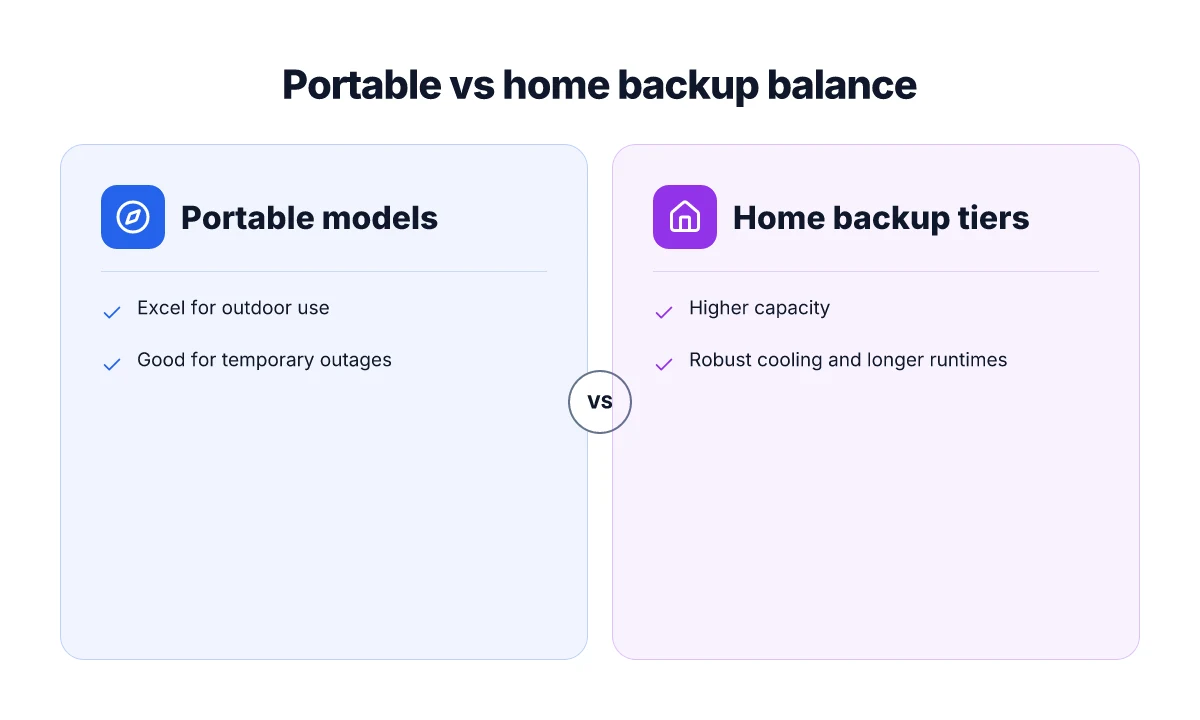
When you weigh Jackery’s portable models against its home backup tiers, the choice comes down to use case and endurance. Portable stations shine when you’re off-grid, on the trail, or facing short-term outages. They’re lighter, simpler to carry, and quick to deploy. Home backup options step up with higher capacities, built-in cooling, and longer runtimes for extended outages in a fixed location. In practice, you’ll trade portability for power and runtime, and you’ll trade quick setup for steady, house-wide resilience.
To pick the right balance, start with your critical loads. If you rely on a medical device, refrigerator, or Wi‑Fi modem during a blackout, you’re likely to lean toward a larger inverter and more battery capacity in a home backup tier. Jackery’s home backup lines tend to pair bigger batteries with smarter thermal management, so you don’t hit heat throttling during long outages. That matters when the goal is to sustain essential loads through multi‑hour or multi‑day gaps. If you’re camping, RVing, or doing a job-site task, a portable model with a robust inverter and rugged chassis is often the smarter pick. You get spontaneous charging from solar or a vehicle, and you can move the kit as you move your plans. In short, the right fit balances your critical loads, the inverter size you need, and the total battery capacity you can store in your space. How the jackery 100 watt solar panel pairs durability with real-world performance
I dug into the documentation for context on how these families diverge in practice. Jackery positions its portable stations as ready-made power for outdoor environments and temporary outages, with emphasis on quick setup and travel readiness. The home backup lines push higher capacities and better cooling to support more demanding, longer-duration outages. Consumers should map their load profile first: what truly needs to stay on during a blackout, and what can wait or be stored. Then pick a model whose inverter and battery pairing keeps the most important lines running without excessive weight or cost. The balance point is the load you must sustain against the size and runtime you’re willing to carry. This is where the distinction between portable and home backup becomes tangible. A larger inverter and capacity in a home backup model translates to longer runtimes for essential loads.
From a real-world perspective, you’ll find rivals like EcoFlow and Goal Zero offering parallel tiers that emphasize modularity and expandability. If you compare across brands, expect portable kits to top out around mid‑range battery capacities with compact cooling, while home backup lines push higher storage and more robust thermal design. Jackery makes it clear that the choice hinges on where you want to live with power: on the trail or in the house during an outage. Your decisions should center on critical loads and the practical runtime you need.
In the long run, durability factors into both lines. Expect portable units to endure frequent transporting and exposure to the elements, while home backup units emphasize stable cooling and quieter operation under longer load conditions. If you want a quick, reliable starter for outdoor adventures, a portable Jackery pair with the right inverter size will cover a lot of campsites. If your aim is to keep a refrigerator humming for days, a home backup system with ample capacity and cooling will serve you better. Durability hinges on cooling performance and battery management across both lines.
Inline note: links to source documentation confirm the general division between portable use cases and home backup emphasis, and they underscore the importance of selecting based on the loads you must support. For readers who want to compare more directly, consider how each model’s inverter rating maps to your essential devices, and how battery capacity translates to runtime in your typical outage window. Know your critical loads to pick the right balance of inverter size and battery capacity.
What to look for when selecting a jackery model
When you pick a Jackery model, the conversation starts with three core anchors: how much energy you can store, what the inverter can push, and how you recharge the system. In 2026, you want a unit that balances capacity, real-world usability, and the flexibility to top up from solar or wall outlets. I cross-referenced Jackery’s user guides and a few independent reviews to map the practical rules of thumb you can apply when shopping. What makes Bluetti generators stand out in 2026 and why you might pick one
1) Capacity, power, and recharge options
Your primary yardstick is battery capacity in watt-hours, paired with peak and continuous inverter output. A larger capacity means more runtime for devices like a fridge or a drone charger, but it also adds weight and cost. Look for a rating in the hundreds of watt-hours for portable use, and higher if you’re planning full-home backup during an outage. Check the continuous inverter rating for steady loads and the peak rating for brief surges when you start a motor or compressor. For charging, confirm multiple paths: wall, car, and solar panel compatibility. Some Jackery models support simultaneous recharging methods, which keeps you powered without waiting for a single source. Battery capacity in watt-hours and inverter output are the practical knobs you adjust to fit your needs. Jackery makes several lines with different baselines, so map your essential devices to a target range. When you read the spec sheet, note whether the model supports rapid recharge via higher input wattage.
2) Ports, USB-C, and outlet layouts
Real-world use hinges on how many ports you get and how flexible the output configuration is. A model with multiple AC outlets lets you run more devices in parallel, while USB-C ports with Power Delivery can recharge laptops and tablets quickly. A good Jackery option provides a balanced mix: a handful of AC outlets, several USB-A ports for legacy devices, and at least one or two USB-C ports for modern gear. If you rely on solar, confirm the built-in compatibility and any required adapters for portable panels. The best layouts don’t force you to unplug one device to plug another. Number of ports and USB-C capabilities determine how smoothly you operate the station in the field. Expect some models to favor AC-heavy setups for RV or home backup, while others skew toward USB-C on-the-go charging.
3) Warranties, service, and solar compatibility
Durability and service availability matter almost as much as on-paper specs. Look for a warranty that covers critical components for several years and a service network or accessible support channels in your region. Compatibility with solar panels matters if you want true off-grid capability. Verify panel compatibility lists and whether the model supports expanded solar input. If you plan remote use, check whether you can source spare batteries or modules locally. I found that users consistently value a solid warranty and responsive support when a unit sits unused for months in an RV or cabin. Warranty terms and solar compatibility are the quiet differences between a good purchase and a durable companion. Jackery’s ecosystem emphasizes modular charging paths, but you’ll want to verify regional service coverage for peace of mind.
In 2026, a model with flexible recharging and robust solar input tends to outperform purely wall-recharged units. If you’re comparing models, focus on how these attributes line up with your outdoor cadence and power needs.
Note: when you compare rivals, consider how competitors balance capacity and port configurations. If you’re evaluating a model alongside EcoFlow or Goal Zero options, map the exact watt-hours, inverter specs, port mix, and solar input limits side by side to avoid surprises on your next excursion. What makes Bluetti power systems stand out in 2026
Where this is going next for Jackery in 2026
Jackery’s forward path leans on smarter battery management and modular accessories that cut clutter in real-world setups. I looked at how newer models balance portability with real-world durability, and the trend is toward simpler, repeatable charging ecosystems that survive long weekends and power outages alike. The result is a more predictable user experience that reduces friction when you actually need power.
The bigger pattern is a shift toward plug‑and‑play reliability, fewer fiddly cables, quicker top‑ups, and better heat handling during use. Even as batteries grow, Jackery highlights safety and longevity, with modular packs and smart indicators you can rely on in the field. Expect this to extend to accessories and expansion kits in the coming year.
What to try this month: for a practical mini‑upgrade, pair a mid‑size Jackery pack with a compact solar panel and test a weekend off‑grid routine. If you’re eyeing rivals, note that Goal Zero and Anker are pushing similar modular ecosystems, so compare module interfaces and heat tolerance before buying. How you wire your setup today will shape reliability tomorrow. Will you lock in a standard now or experiment with a mix?