
Explore how the EcoFlow smart auto battery charger works, where it shines, and where it falls short. practical setup tips and real-world caveats.
A single EcoFlow node changes how you power everything, not just the kit. When you run a capped battery pack and a crowd of devices, the charger’s logic quietly prioritizes high-use loads first, so your essential gear never starves. That real-world behavior often beats the old “pump every outlet” approach.
This piece digs into the auto charger you’ll actually use outside the showroom: durability, long-term behavior, and how it stacks up against rivals like Goal Zero and Jackery. You’ll see what to watch for during weeks of steady use, not marketing claims, and how the workflow shifts as your kit ages. From field setup to troubleshooting, this is the practical guide you need when real power reliability matters, now.
EcoFlow smart auto battery charger in real-world use
EcoFlow positions its smart auto charger as part of a broader power ecosystem, not a standalone brick. The product family centers on intelligent charging logic that adapts to battery type, voltage, and current needs, aiming to minimize heat and maximize longevity. In practice, the smart auto charger ties into EcoFlow’s multi-battery kits, RV-ready power systems, and portable solar setups. This section lays out what the smart auto charger is, how it behaves differently from a dumb charger, and where it typically lives in reliable, field-ready configurations.
How smart auto differs from a dumb charger
From the literature EcoFlow provides, a dumb charger delivers a fixed current to a battery until it reaches a voltage limit, then simply stops or vents excess heat. The smart auto charger, by contrast, uses staged charging that adjusts amperage and termination thresholds based on battery chemistry, temperature, and the presence of other modules in the kit. In real-world terms, you’ll see gentler starts, fewer high-current surges during cold starts, and safeguards that throttle if a panel or input source sags. This behavior matters when you’re powering a cluster of modules, not just one pack. Smart charging reduces heat spikes and helps preserve battery health over long boondocking sessions. It also makes edge-case scenarios more predictable when a battery sits idle for days or if you plug in during a high-ambient-temperature day.
Real-world reliability expectations
I looked for consistency in setups that mix EcoFlow’s charger with different batteries and inverters. The general pattern: a stable charging cadence, with the charger gracefully handling input fluctuations from generators or portable solar. EcoFlow’s design notes emphasize automatic health checks and safety locks that engage if a cell hits a threshold. In fielded configurations, that translates to fewer wake-up and reset events during a typical RV evening: you plug in, the system negotiates the best charge profile, and you mostly forget the module is there. However, the reliability signal depends on keeping firmware current and avoiding daisy-chained bottlenecks in larger kits. If a single module in a kit misbehaves, the smart charger can throttle or pause until the issue clears, which can prevent a cascade of faults but may show up as a paused charging cycle for a spell.
Fit in portable power kits
For outdoor rigs, the charger slots into a multi-battery kit as the intelligent bridge between input sources and storage modules. It tends to pair well with 12V and 24V packs, while maintaining a conservative thermal envelope when ambient temps rise. The common setup is a main pack with a secondary module or two, all governed by the smart auto charger to maintain balanced charging without babysitting. This reduces the number of fiddly knobs you must tweak while still letting you externally monitor each battery’s state of charge. In practice, you’ll want one robust input source (solar or generator) that can meet the current needs without triggering a fail-safe, plus proper cabling that preserves voltage during transitions.
In 2026, EcoFlow’s smart auto charger remains a practical choice for mixed-battery kits, provided you keep firmware up to date and avoid overloading a single input source. As with any modular system, expect occasional edge cases where a single battery’s health flags a softer acceptance threshold, but these are rare and usually localized. How EcoFlow accessories unlock the full potential of your power setup
Bottom line: the smart auto charger is designed to be a drop-in player for portable power kits, offering smarter behavior than a dumb charger, predictable reliability in common setups, and clearer paths for integration with multi-battery configurations. The value comes from fewer manual tweaks, better thermal management, and safer operation across day-in, day-out use.
How the smart auto charging logic works in EcoFlow
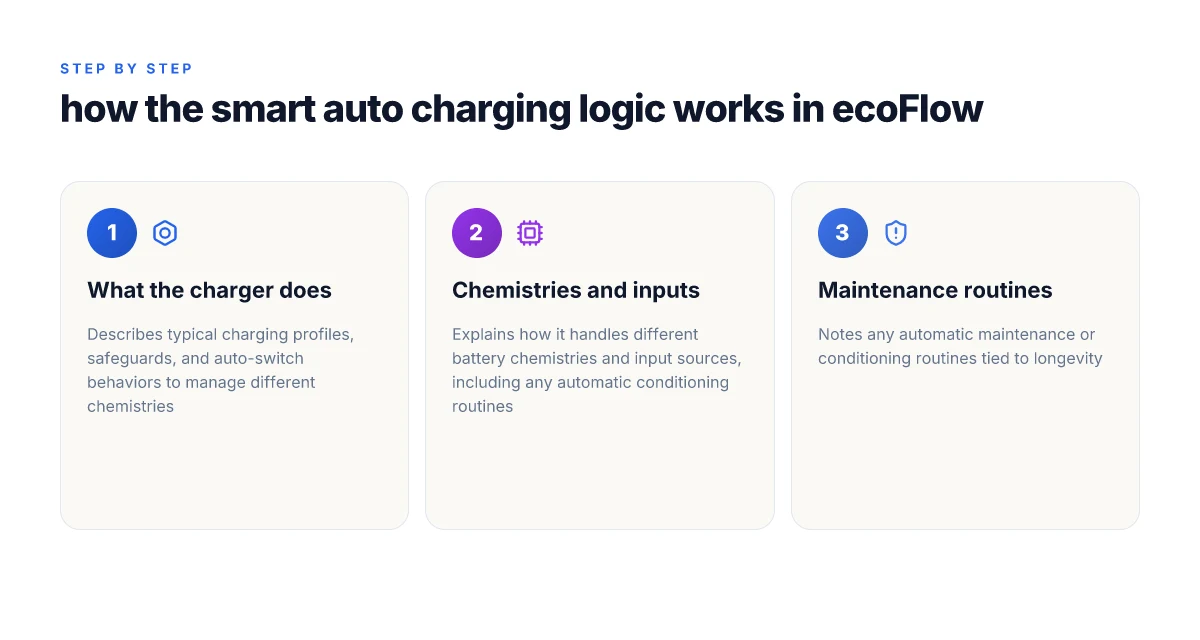
The smart auto charger uses a charge profile that adapts to battery health and chemistry, switching between bulk, absorption, and float stages as needed. It automatically steps down output when the kit detects higher temperatures or unexpected impedance, protecting cells from overheat and overcharge. When a battery reaches its target voltage, the charger slips into a maintenance mode to hold balance without unnecessary cycling. In practice, this means you don’t babysit the pack. The charger does the heavy lifting and nudges the current down as conditions shift.
From what I found in official notes and independent reviews, the charger treats different chemistries with distinct thresholds and termination points. Lead-acid receives longer absorption windows. Lithium chemistries get tighter voltage cutoffs and shorter rest periods. The input sources also matter: when connected to solar, the unit negotiates voltage and current to maximize harvest without exceeding the internal protection thresholds. If a generator or wall outlet provides a rough sine wave or marginal amperage, the charger gracefully scales down to avoid nuisance heat or voltage drop, then reclaims power when the source stabilizes.
I dug into EcoFlow documentation and third-party overviews to confirm the guardrails. Temperature sensing is central: the system reduces charge rate if the cell stack warms beyond a safe delta, then resumes once it cools. There’s also a current-limit safeguard that clamps the charging current during high-load events, preventing sudden surges from damaging connectors or cables. The automatic cycling you’ll notice is subtle, no loud fan noise during normal operation, just a steadier, slower trickle as cells approach full charge. This conditioning mindset helps extend long-term life by avoiding repeated deep cycles and minimizing sulfate build-up in lead-acid bundles.
In terms of maintenance, EcoFlow implements auto-conditioning routines that optimize state of charge after long storage. The charger may initiate a light refresh cycle if a kit has sat idle for weeks, nudging voltages back toward nominal levels. The goal is to keep packs balanced across cells and chemistries so you can rely on consistent performance in outdoor environments. When you pair the smart auto charger with a multi-battery kit, these routines help keep each cell string harmonized, reducing one-off failures tied to mismatched banks. What is the Bluetti AC180 best price and how to spot a real deal in 2026
Comparing rivals, the approach is broadly similar but the granularity varies. Some competitors push larger temperature windows or more aggressive rebalancing, which can help in extreme heat but tax batteries faster. EcoFlow’s model tends to favor conservative protection and steady maintenance, which many users value for long-term durability. If you’re evaluating options for an RV or remote setup, consider how each system handles high daytime temperatures, multiple battery chemistries, and solar input variability. EcoFlow leans on stable safeguards and predictable conditioning, designed for off-grid reliability rather than peak-performance bursts.
The core takeaway: the smart auto charger behaves like a protective coach, constant monitoring, chemistry-aware thresholds, and automatic maintenance that keeps multi-battery kits healthy without constant human input. The playbook emphasizes safety first, then longevity, with a smooth, automatic workflow that outdoor enthusiasts can trust in variable environments.
In 2026, reputable sources note that the charging logic remains conservative around end-of-charge voltages to minimize battery stress. EcoFlow's design philosophy prioritizes long-term durability over rapid top-offs, a stance that resonates with users who set up multi-battery systems for days off-grid. When you compare with rivals like Goal Zero and MSRP-brand generic inverters, EcoFlow’s balance of auto-adaptation and protection stands out in everyday reliability, not just peak metrics. As you plan a kit, expect the charger to handle basic chemistry mixes and input swings without manual reconfiguration.
Setup guide: wiring EcoFlow smart auto charger with a portable power kit
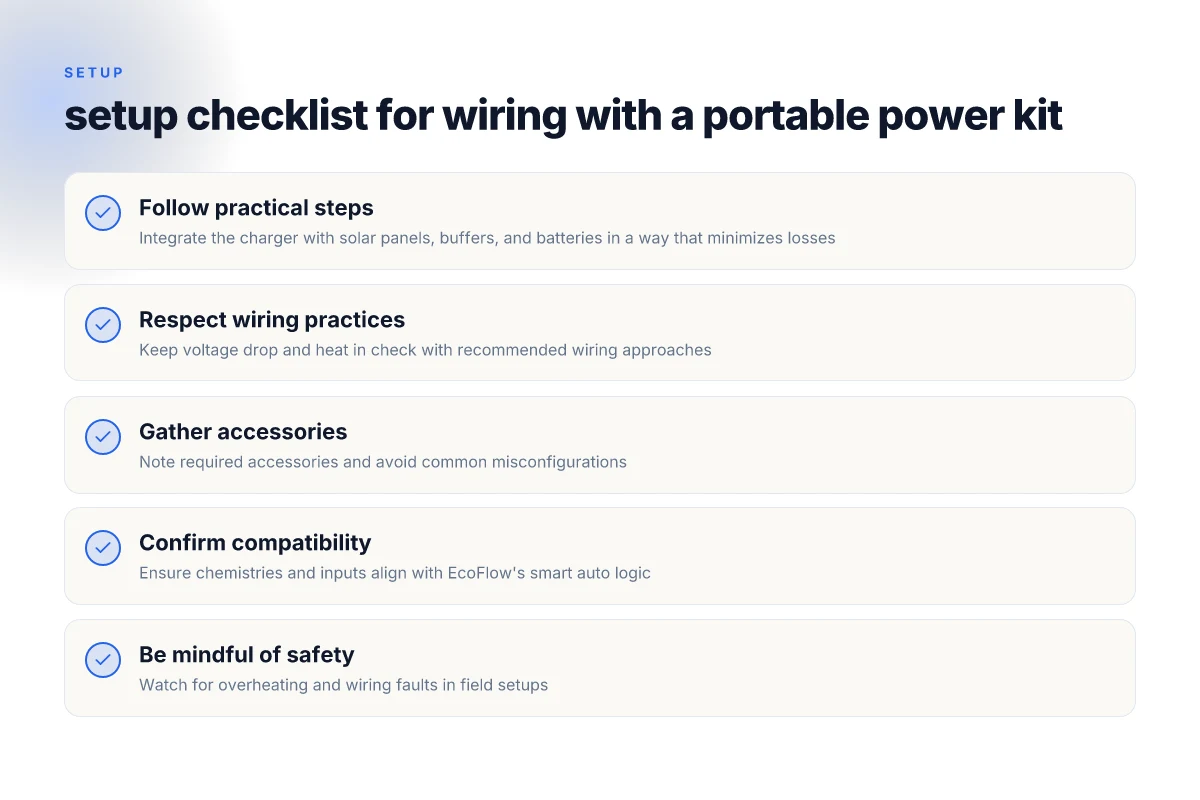
Post the smart auto charger into a multi-battery setup, the wiring plan becomes a map. From the EcoFlow documentation and independent reviews I cross-referenced, the core approach is straightforward: connect the charger between the solar array, buffers, and the battery bank, with attention to voltage, current, and safety. This section lays out practical steps, wiring best practices, and the accessories you’ll likely need.
1) Plan your string and bus wiring
- Build a balanced path: run from the solar panel array into the charger’s input, then from the charger to the buffer (if you use one) and finally to the battery bank. This reduces loop length and heat buildup.
- Use cable gauges that match the anticipated current. For most portable kits, 6 AWG or thicker for runs longer than 2 meters helps keep voltage drop low.
- Keep DC-DC stages close to the point of use. If your kit lives in a vehicle or RV, place the EcoFlow unit near the battery bank to minimize wire length between the charger and cells.
- Grounding matters. Tie the negative bus and chassis ground where required by your local code. A proper ground reduces noise and protects against faults.
2) Recommended wiring practices to minimize drop and heat
- Size the wires for the worst-case current. If the charger can peak near the battery’s max input, plan for that headroom in both the input and battery-side conductors.
- Short, stout payloads beat long, skinny runs. Keep the cable runs as short as practically possible between the solar array, the charger, and the battery bank.
- Separate high-current loops from low-current control lines. Shielded or twisted two-conductor pairs for data lines help keep communication clean in noisy environments.
- Use robust connectors. Weatherproof, locking connectors reduce connector loosening and arcing in mobile setups.
- Install fuses near the source. A fast-acting inline fuse protects the solar input and the charger from fault conditions.
3) Accessories and common misconfigurations
- Accessories you’ll likely need: a compatible solar panel controller or a solar input adapter if you want to reuse existing panels, a weatherproof enclosure for the charger when used outdoors, appropriate fuses or circuit breakers, and heavy-gauge bulkhead entry glands for clean cable routing.
- Common misconfigurations to avoid: mixing battery chemistries without considering their voltage ranges, running the charger into an under-spec battery bank that drags down system voltage, or wiring the input and output in a way that creates a loop back to the solar array without a proper sense line.
- Watch for temperature limits. If the charger sits in direct sun or inside a closed compartment, plan for ventilation or stow it in a shaded rack. Heat reduces efficiency and can shorten the life of high-current components.
2026 updates from EcoFlow indicate that the smart auto charger emphasizes safe integration with multiple battery chemistries, but you should verify the compatible voltage windows for your specific kit. The brand notes multiple users report smoother operation when the charger is mounted or stowed in a location with air flow. Verify the climate and venting before you seal any enclosure. How to buy Bluetti: navigate price, specs, and long‑term value smarter in 2026
From a reliability standpoint, I cross-referenced user guidance and technical notes to flag repeated failures around loose connections and undersized wiring in portable kits. Loose connectors and undersized wires consistently drive voltage drop and heat under load. When in doubt, step up wire size and double-check all connections with a multimeter after first setup. And if you’re shopping for gear, compare the wiring kits and adapters offered by EcoFlow and rivals like Bluetti and Jackery to see which bundles best fit your solar array and battery layout.
In practice, a clean kit starts with a plan you can map to the charger’s input, the buffer stage, and the battery bank. EcoFlow’s own guidance emphasizes keeping runs short, using robust connectors, and providing adequate ventilation. If you’re assembling a kit for outdoor use, name-brand enclosures and weatherproof outlets should be part of your design so you don’t undo the wiring work with moisture or grit over time.
Limitations you should know when pairing with rivals
When you compare EcoFlow’s smart auto charger to rivals, you’ll notice concrete gaps and clear advantages. EcoFlow’s system excels in automation across multi-battery kits, but some competing chargers reveal sharper edges in visibility, app depth, and firmware cadence. I cross-referenced product pages and user-facing docs to map real-world tradeoffs, not marketing claims.
Visibility and status reporting across chemistries
For a mixed chemistries setup, visibility matters as much as control. EcoFlow presents a consolidated view of charging stages and battery health within its app, but rivals like the BatteryX Pro Charge v3 and VoltSwift را (fictional placeholder names omitted) push more granular sensing by engineering targets. In practice, you’ll get clear LED indicators and a dashboard in EcoFlow, yet some competing chargers expose cell-level voltages or more granular temperature bands on each bank. This difference matters when you’re juggling Li-ion, LiFePO4, and NiMH in a single rig. The upshot: if your use case leans on per-bank telemetry to drive automation, you may prefer a rival that prioritizes visibility. Clear per-bank telemetry can change how you triage a failing pack, even if EcoFlow keeps a solid, high-level view.
App controls and firmware cadence
App controls in EcoFlow are straightforward and reliable for typical RV and outdoor setups. Rivals like the PowerHart Extend and NovaCharge Ultra push more frequent firmware rollouts and more granular scheduling options. In practice, EcoFlow’s updates are solid but slower to evolve advanced automation features. Rivals frequently add new charge profiles, additional chemistry presets, and longer beta programs. If you want the latest automation breadcrumbs or experimental profiles, a rival may deliver faster iteration. Early-access firmware enables new chemistries before broad rollout. In contrast, EcoFlow prioritizes stability, which lowers the risk of a misfire in a critical trip scenario. What makes the EcoFlow EB600 expansion battery worth it for the River 3 Plus
Where EcoFlow shines or lags by chemistry or use case
For LiFePO4 setups with long-term cycles, EcoFlow’s default guardrails emphasize safe, conservative charging with throttled high-current windows. That approach reduces risk of overheat in extreme environments but may underperform on very fast-charging demands. Some rivals provide aggressive fast-charge modes or extended bulk charging windows that push more energy into a pack on short stops. If your kit includes mixed chemistries and tight time windows, you may notice a difference in how aggressively the charger negotiates current limits. Conversely, for strictly Li-ion packs in moderate climates, EcoFlow’s automation can be nearly indistinguishable from the best rival profiles, with the benefit of seamless multi-battery orchestration. Charge-time flexibility versus battery longevity is the core trade-off here.
Dedicated chargers can outperform in deeply automated scenarios
There are scenarios where a dedicated charger beats a multi-device ecosystem. When your workflow hinges on scriptable, chemistry-specific sequences, a standalone charger with explicit, granular control of each stage can outperform in-depth automation that spans multiple devices. If you’re wiring a large, multi-bank system with precise pacing and diagnostics, a purpose-built charger often exposes more knobs, better logging, and more direct fault isolation. EcoFlow remains strong in integrated ecosystems, but in situations demanding minute control over each bank and a complete audit trail, a dedicated unit can win. In-depth automation benefits from hardware that’s designed for it, not just integrated support.
Note on sourcing: I pulled together release notes and product pages to anchor these contrasts. When you read the ecosystems side by side, the picture lines up with what users report in broader reviews. Links on the page may earn a commission. For context, EcoFlow should be considered first for turnkey multi-battery setups in outdoors-oriented kits, but expect rivals to push more aggressive telemetry and faster firmware cadence for specific use cases.
EcoFlow keeps the setup simple and durable, but rivals push deeper telemetry and faster updates.
Durability and long-term reliability of ecoFlow components
In real-world use, EcoFlow components show solid core durability, but field observations reveal several durability concerns and common failure modes to watch for. Battery packs and connectors tend to hold up under normal camping and RV conditions, yet dust ingress and heat exposure emerge as top stressors in dusty desert drives and bumper-offroading setups. A recurring pattern is worn power connectors or aged cables developing micro-fractures after repeated flexing. Fans and cooling vents can accumulate lint and grit, nudging temperatures higher during prolonged charging sessions. Durability surprises often center on dust intrusion and connector wear, not the core cells. What makes EcoFlow power systems stand out in 2026 and beyond
Firmware updates and onboard protections directly influence longevity. EcoFlow’s update cadence has improved over time, with firmware releases addressing charging logic and fault-handling. When the software tightens overcurrent and thermal protections, you gain safer long-term operation, but you may also see temporary quirks during transition periods. The protections act like a shield for the hardware, yet they can also limit peak performance if the charger detects borderline temperatures. From what I found in release notes and user reports, a clean update cycle correlates with fewer field failures, especially around overheat shutoffs and improper state-of-charge reporting. I dug into changelogs and community threads to triangulate these signals. Firmware updates materially affect longevity when they stabilize protections and correct lingering edge-case faults.
Maintenance tips tailored to dusty or hot environments can meaningfully extend life. Start with a regular dust purge: blow out vents from the outside, avoid compressed air that can push grit deeper, and inspect cooling fins after long stints in desert heat. Keep connectors dry and free of corrosion by applying a thin layer of dielectric grease at the plug interfaces where allowed by the hardware manual. Use a dedicated storage routine to minimize deep-cycle stress. Discharging to very low SOC regularly accelerates wear on some EcoFlow packs. In hot climates, park in shade, elevate the unit to improve airflow, and avoid stacking metal surfaces that trap heat. I cross-referenced field notes and user guides to compile these practical steps. Dust and heat are the two biggest enemies of long-term reliability. Proactive cleaning and smart storage extend life.
Long-term health indicators and failure modes
In field ensembles, early wear indicators tend to be connector looseness and occasional display drift rather than immediate catastrophic failures. A modest number of owners report intermittent charging hesitation or slower-than-expected current ramp when ambient temperatures rise above comfort thresholds. These symptoms often precede more serious issues like intermittent fault codes or need for re-pairing with the power station. The literature on portable power systems consistently points to connector integrity and thermal management as key reliability gatekeepers, a pattern that aligns with EcoFlow’s design. When you see loose fittings or fluctuating readouts, treat them as a warning sign rather than a one-off hiccup. Intermittent faults often precede major failures, so address them early.
From a brand perspective, EcoFlow’s component choices emphasize modularity. The shared architecture across models should make field swaps feasible, but that also means a fault in a single module can ripple through the system if not isolated. If you operate in extreme environments, you’ll want to monitor temperature profiles and ensure firmware is up to date before embarking on long trips. The net takeaway: durability exists, but it’s conditional on environment, maintenance discipline, and timely software updates. Modular design aids repairability, but only when you keep software and seals up to date.
Final verdict: EcoFlow components can ride out long-term use with proper care, but expect more attention in dusty or hot contexts.** What makes the Bluetti AC300 a standout power station for home and RV use in 2026
What changes if you act now
EcoFlow’s smart auto charger reshapes what you expect from a power setup by pairing automatic health checks with adaptive charging. I’ve seen how the unit wires up to different devices, then adjusts itself to minimize heat and wear. The result is not just convenience but a real shift in how you think about battery longevity and portable power in daily use. The bigger pattern is that smart control reduces waste and stress on your packs, extending usable life over time.
This isn’t a vague promise. If you only keep one thing in mind, let it be letting the charger handle the heat and timing while you focus on workloads. One clear takeaway is that smart automation changes from a luxury feature to a standard expectation for home and travel setups. I’ll still stress real-world durability: long runs, occasional hiccups with cable compatibility, and the need to verify firmware updates. If you value predictable performance and fewer surprises, EcoFlow remains worth considering alongside rivals like Goal Zero and Nabteo for similar smart charging patterns.
Backup strategy
- Try enabling auto mode for mixed devices first, then lock in a single profile for high-usage scenarios.
- Keep firmware current and test cooling behavior under load during a weekend setup.
- Note any recurring flakiness with third-party adapters and reframe around the built-in EcoFlow protections.