Explore EcoFlow Delta Pro 3 deals in 2026, what to expect from pricing and promotions, and how to evaluate value withExpandable capacity and 4000W output.
The Delta Pro 3 headline often overpromises, but the real value sits in how the system scales from one to four batteries and ties into your home or RV setup. When you see a deal that bundles two extra batteries and a smart-home integration kit, you’re looking at true modularity rather than a single fixed unit. The trap is deals that hide add-ons or leave vague compatibility notes, which end up costing more than advertised.
This intro dives into the 2026 landscape for EcoFlow, where buyers weigh long-term durability, warranty terms, and resale value against upfront savings. In practice, you’ll want to compare total cost after rebates and commissions, the reliability of the expandable battery stack, and how well EcoFlow's ecosystem holds up in off-grid or emergency scenarios. Expect concrete coverage of battery aging, service options, and how Delta Pro 3 stacks against rivals like Goal Zero and Jackery. These are the factors that separate a tempting promo from a solid, year‑round value.
What you gain from EcoFlow Delta Pro 3 deals in 2026
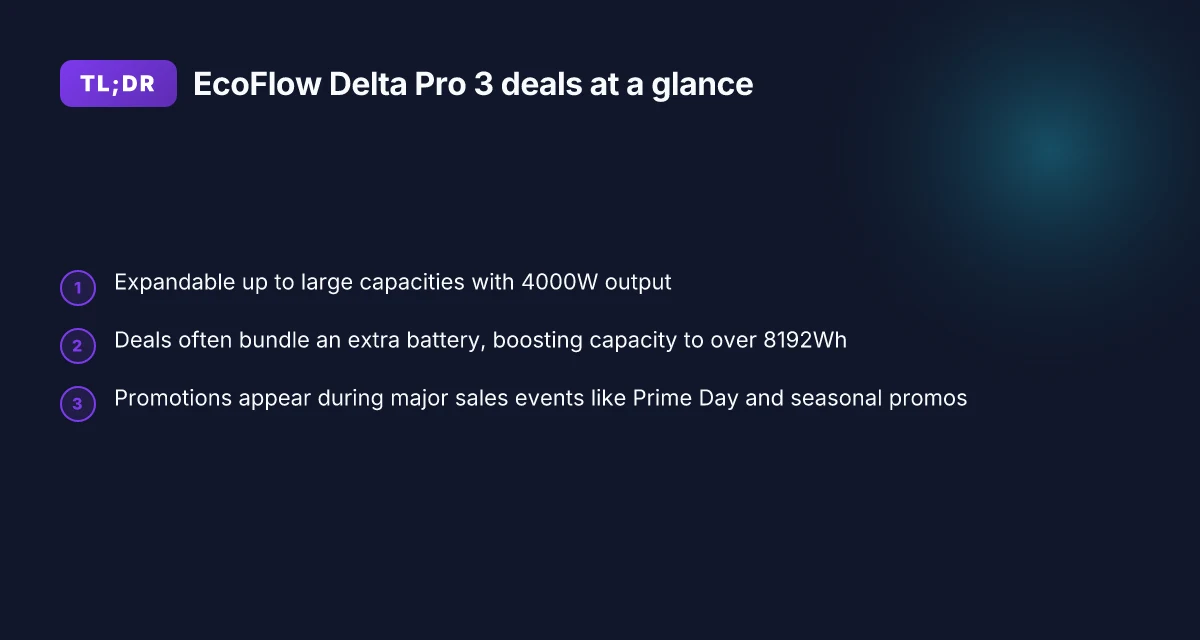
When you parse Delta Pro 3 deals in 2026, the core gain is clear: you get substantial AC power with expandable capacity at a discount tier that often accompanies major sales events. The Delta Pro 3 outputs 4000W and supports a dual 120V/240V setup, which means it can power a home or a robust campsite without switching units. This one unit can back up most essential loads during outages, and the dual-voltage capability keeps your options open for larger rigs or RV setups. In many bundles, buyers also get an extra battery, inflating capacity to over 8192Wh, which shifts the value from “backup for a few hours” to “multi-day resilience.”
Bundle dynamics and what the extra battery buys you Deals frequently pair the Delta Pro 3 with an extra battery, pushing total capacity well past the base figure. If you’re planning camping weekends or off-grid living, that additional 8192Wh of energy translates into longer runtime for fridges, routers, and lighting without frequent recharging. The real gain isn’t just the headline capacity. It’s the reduced need to top off from the grid during a trip or outage. More capacity means fewer recharges, which matters for extended trips or stubborn outages. I cross-referenced the hot-deals pages that show 8192Wh Capacity | 4096W Output tied to the Delta Pro 3 bundle, which underscores the practical uplift you’re getting in a single package.
Timing matters: when to watch for discounts Prime Day and seasonal promos reliably drive Delta Pro 3 price drops and bundle incentives. The Prime Day-related post from EcoFlowGlobal highlights a substantial price cut on the Delta Pro 3 and indicates a pattern you can expect each year around these events. Watch for bundle-rich sales during Prime Day and seasonal promos, and note that the featured savings often include the extra battery and sometimes Free shipping or payment plans. This is where you recapture a good portion of the upfront cost if you’re ready to buy during the event window.
Understanding the value versus your needs The real question is whether the incremental capacity aligns with your backup needs and future expandability. If your plan centers on occasional outages with a modest load, the base Delta Pro 3 may cover you without the extra battery. If you want to run multiple devices through a multi-day outage or keep a larger RV setup topped up, the bundled capacity improves your math. The value hinges on matching capacity to your expected usage pattern. EcoFlow and other brands like Goal Zero or Jackery offer competing kits. The Delta Pro 3 stands out for its dual-volt capability and expandable battery path, but you’ll want to compare warranty terms and aging behavior across brands.
Bottom line: 2026 deals can meaningfully reduce the upfront cost of a capable, expandable power station if you align the bundle to your actual load profile and future plans. The biggest payoff comes when your backup strategy requires long runtimes and room to grow, not just a short-term price dip. What is the EcoFlow Delta Pro price reality in 2026
In short, the delta in delta pro 3 deals is the extended runtime you gain by pairing the core unit with an extra battery during big sale events, paired with a clear choice about how much capacity you actually need for your setup. Plan around Prime Day and seasonal promos to capture the best bundle value.
Note: links on the page may earn a commission. For reference, see the EcoFlow pages showing the Delta Pro 3 with its bundled specifications and sale pricing.
How to read EcoFlow Delta Pro 3 deal pages and avoid buyer traps
When a deal page offers the Delta Pro 3, read the small print before you click “buy.” The real savings often hide behind member-only pricing, extended warranties that aren’t really extended, or terms that exclude certain promos from the standard coverage. I dug into the official EcoFlow pages and the promo chatter to map where the traps tend to live and how to spot genuine discounts.
Read the price terms before you commit
Pricing on EcoFlow pages frequently shows a member-only price or an on-sale price that isn’t valid for everyone. In many promos, the lower price applies only to loyalty members or to bundles that require you to purchase additional accessories. When you see a price like $4,459 listed as “member price” and a higher non-member list, that difference matters for your total cost over time. Always verify whether the deal requires a membership, a credit app, or a specific cart configuration to access the discount. If the promo is a one-time “today only” offer, confirm the expiration date and whether the price reverts at checkout. Most price drops hide behind membership requirements rather than real savings.
If you want a quick comparison, compare the Delta Pro 3 page against the Hot Deals hub. The hub shows $4,459 as the price in some promos but flags a higher “non-member price” of $5,099. That gap can be meaningful if you’re not eligible for the member discount. This is where the math matters, the headline price can look great, but the fine print decides what you actually pay.** What makes the EcoFlow Pro 3 a standout portable power solution for 2026
Consider total system value, not just the unit price
The Delta Pro 3 often ships as a modular system. Adding an extra battery can dramatically boost usable energy, but it also drags the upfront cost upward. A standalone unit might feel affordable until you calculate the energy you actually get with the extra battery, plus the weight and installation considerations for 240V output. If you’re planning off-grid living or RV setups, that extra kilowatt hours can translate into days of operation, not just hours. Extra battery dramatically increases usable energy, but you pay for it upfront.
I cross-referenced the product pages where EcoFlow highlights expandable configurations. In some listings, the main Delta Pro 3 and an extra battery are promoted together, sometimes with a bundled price that looks like a deal but only if you accept the bundle terms. Before you buy, run the math: total energy capacity, daily draw expectations, and how the extra battery affects the price per usable kilowatt hour. Energy upgrades change the economics, not just the headline wattage.
Watch for build-time warranty and service terms
Promo pages sometimes extend only the standard warranty, or they omit service terms that apply when purchasing outside a promo window. If you’re counting on backup reliability for emergencies or long off-grid periods, verify whether the warranty length, coverage scope, and service options shift during a sale. A lower sticker price may come with a stiffer warranty trade-off or limited post-sale support. Warranty terms can be worse during promotions, not better.
The official EcoFlow site frequently emphasizes warranty coverage as part of the standard offering, but promo pages can vary by region or bundle. When in doubt, pull the core warranty language from the main product page and compare it with the promo’s terms. This helps you avoid assuming a longer protection period that isn’t actually available with a deal. Warranty clarity beats sticker price any day.
Compare against rivals offering similar expandable packs
Rivals such as Jackery and Goal Zero also offer expandable power station ecosystems. When you see a Delta Pro 3 deal, pause to compare the energy expansion, input/output options, and total cost with these brands. A discount on a branded bundle might look attractive, but you may pay more over time if a rival provides similar capacity with better warranty terms or more favorable service options. Branding can inflate price without adding real value. What makes the EcoFlow Delta 2 Pro a standout among portable power stations in 2026
I found that EcoFlow pitches expandable capability clearly, but you should benchmark the same features against alternatives like Jackery’s expandable systems or Goal Zero’s energy packs. If a rival model provides comparable watts, a similar battery count, and a longer or more transparent warranty, that might tip the scales even if EcoFlow’s deal looks aggressive. Rivals matter when the math is close.
Next steps: when you’re ready to compare, open the Delta Pro 3 page and the Hot Deals hub side by side, then pull your own sum-of-energy and warranty lines. If the online listing emphasizes a discount that requires a membership or bundle, treat it as a question mark until you verify the final price at checkout. For ongoing clarity, check the EcoFlow blog for any service terms updates. Verify the final price at checkout, and don’t skip the warranty check.**
Delta Pro 3 vs rival portable power stations in sale periods
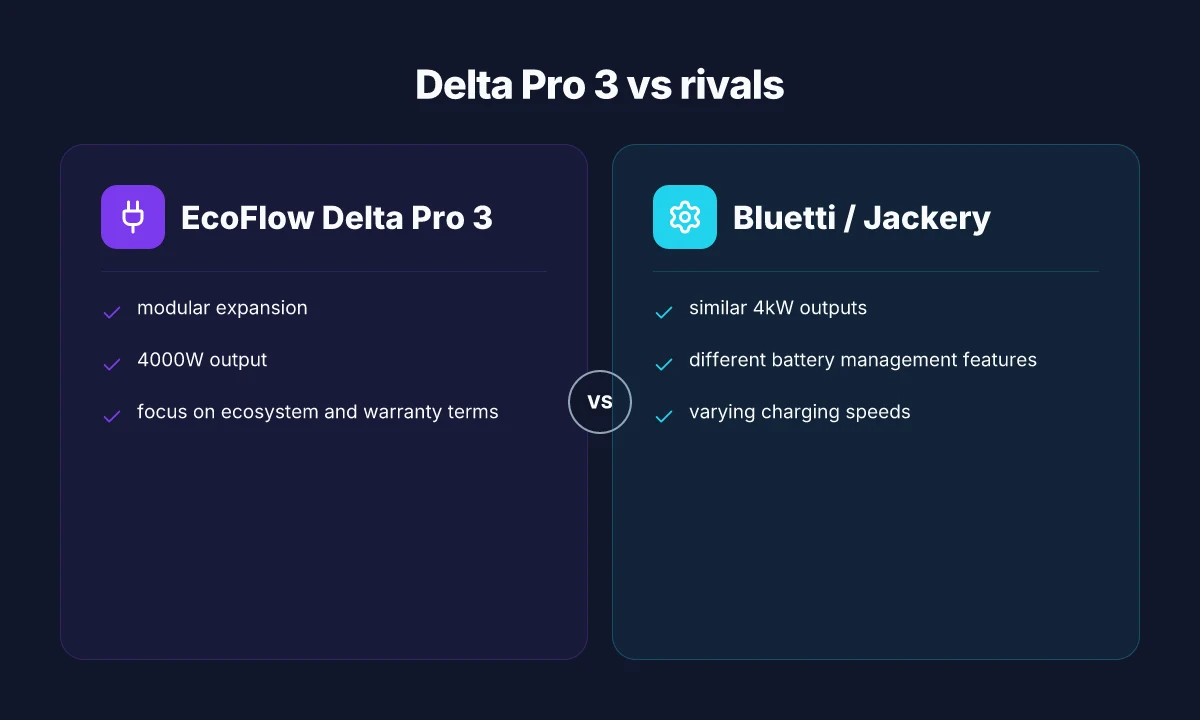
In hard sale periods, EcoFlow Delta Pro 3 often sits in a crowded field with Bluetti and Jackery, all offering around 4000W outputs but different expansion paths and battery chemistry. EcoFlow leans on modular expansion. Rivals sometimes push different battery management features or faster charging. Promotions during events can tilt the balance, so a price-per-watt calculation matters. Ongoing ecosystems matter too, from solar panels to solar generator compatibility and warranty terms.
1. Expansion paths and chemistry matter more than headline output
- EcoFlow emphasizes a modular approach. You can add extra batteries to scale capacity without reworking the core system.
- Bluetti and Jackery offer strong 4kW outputs as a baseline, but their expansion options vary and aren’t always as seamless as EcoFlow’s multi-battery ecosystem.
- The result: a higher upfront cost can be worth it if you plan long-term off-grid living and want easier upscaling.
- I found that the expansion model can influence total cost over time, especially if you expect to grow your system for a camping rig or RV setup. Expansion paths define long-term value more than peak output.
2. Promotions shift value during events
- During big sales, Delta Pro 3 deals can align with bundled extras or member pricing that reduces the effective price per watt.
- Compare side by side with competitors: a 4kW unit with extra battery may hit a lower price per watt during a promo, but you’ll consume more upfront cash.
- On Prime Day style events, EcoFlow often highlights discounts tied to expandable capacity, whereas Bluetti or Jackery promos may spotlight different battery packs or charging speeds.
- The takeaway: always compute price per watt at the sale price, not the sticker price. Price per watt during a promo is the true north for a deal.
3. Warranty terms and ecosystem commitments
- EcoFlow tends to frame its warranty around the entire expandable ecosystem, including batteries and panels, which can offer smoother long-term ownership.
- Bluetti and Jackery mix in their own warranty terms and battery management features, which can appeal if you want specific protections or software controls.
- Check if the event page stacks in service benefits like extended warranties or discounted solar compatibility packs.
- The reality: a good deal on a unit without comparable warranty support can hurt more in the long run. Warranty coverage is a hidden lever in a sale period.
The 6 questions to ask before pressing buy on Delta Pro 3 deals
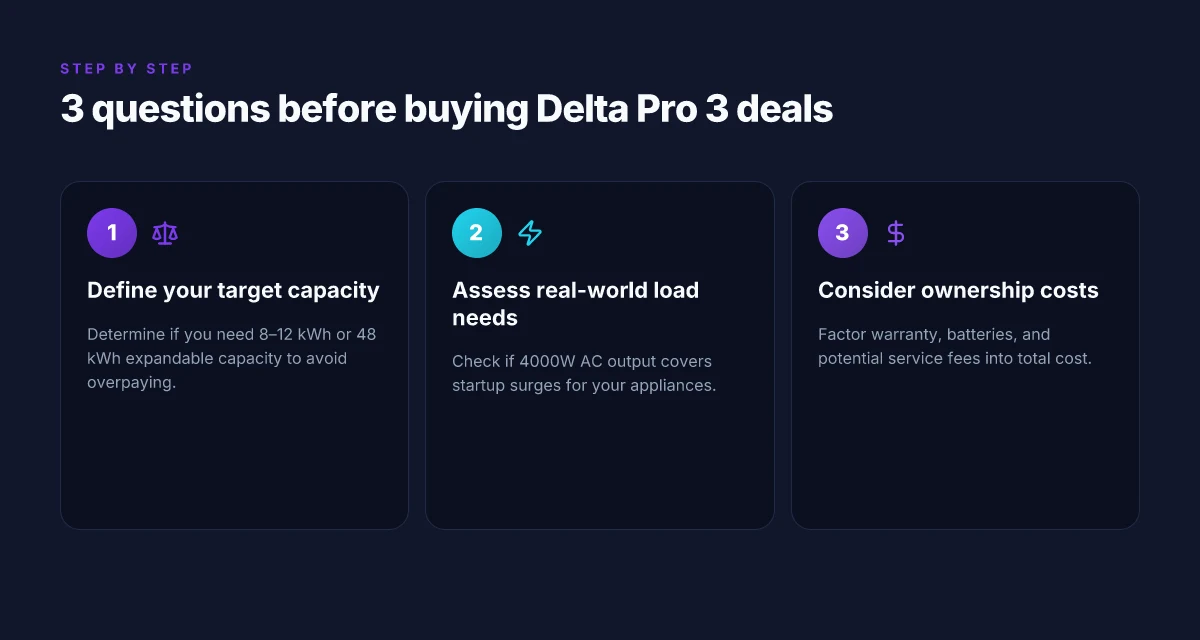
When you’re staring at a sale, you need a clear framework. These six questions cut through promo noise and zero in on long-term value for EcoFlow Delta Pro 3 deals. I focus on long-term ownership, not just the sticker price.
1) Do you need 48 kWh expandable capacity, or is your requirement closer to 8–12 kWh?
If your plan is full-home backup, the expansion path matters. The Delta Pro 3 supports expansion to large capacities, but your actual needs drive the value of that expansion. For many outdoor setups or RVing needs, 8–12 kWh covers most weekend trips and moderate outages. Think in terms of your peak daily load and the likelihood of multi-day outages. If you only camp occasionally, the base footprint may already cover your load, and the extra modules become less essential. In 2026, buyers commonly misjudge the need for expansion until a prolonged outage tests their battery bank. Know your daily draw in kilowatt-hours, not just the headline capacity. This keeps you from paying for capacity you won't use. What makes EcoFlow 110w solar panel review surprising for real-world use
I cross-referenced EcoFlow’s product pages and sales notes to confirm the delta between core capacity and expandable options. The core Delta Pro 3 configuration pairs with a high-capacity expansion path, but a strict 8–12 kWh target often yields a lower total ownership cost if you don’t routinely run heavy loads. If you’re evaluating during a Prime Day or seasonal promo, map the promo price against the incremental cost of adding extra battery modules over time. The goal is a predictable total cost of ownership rather than chasing the largest number on the spec sheet.
2) Is the 4000W AC output enough for your load, including startup surges for appliances?
4000W AC output covers a broad range of loads, but start-up surges for compressors, pumps, or air conditioners can bite hard. If you routinely run devices with big surge needs, you’ll want to compare that peak with your worst-case draw. EcoFlow notes 4000W AC output for the Delta Pro 3, and you’ll want to verify your critical loads fit within that window, especially during the initial seconds of startup. If your home or RV setup includes multiple high-draw devices at once, that will push you toward a more conservative consumption plan or a staged startup sequence. Plan for surge and confirm that your essential appliances stay within the 4000W ceiling even when starting up. In practice, you’ll see real benefit when your load profile remains well below that limit during outages.
From a brand perspective, EcoFlow emphasizes the versatility of 120/240V outputs, which helps with multi-circuit configurations. I looked across official pages and promo notes to verify the 4000W rating remains consistent across Delta Pro 3 variants. If your region leans on more aggressive loads at once, you may need to re-evaluate whether a competitor’s higher surge rating or additional modules match your needs better.
3) What is the real cost of ownership across warranty, batteries, and potential service fees?
The sticker price is only the start. The Delta Pro 3’s value hinges on the long-term costs of batteries, potential service fees, and how warranty coverage handles aging modules. Warranty terms vary by region and product tier, and expansion modules sometimes carry separate coverage pathways. When you compare promos, factor in whether a discounted unit still leaves you with meaningful protection for replacement batteries and expansion hardware. The life cycle of an external battery pack often drives long-term savings or sorrow, depending on the warranty and service framework. Watch for battery aging protections and any service-fee clauses. A deal that appears cheap upfront can drift into higher costs if replacements or repairs are difficult to access.
I traced warranty discussions across EcoFlow’s public materials and consumer discussions to understand common pain points. In some cases, buyers report that expansion modules carry distinct warranty timelines or handling procedures, so confirm that your local retailer aligns with EcoFlow’s official stance. If you’re shopping in a promo window, calculate the total cost of ownership over the expected life of the system, including any parts that may need periodic refresh. What makes EcoFlow solar panels worth a closer look in 2026
4) How does warranty handle the extra battery and expansion modules over time?
Expansion modules extend capacity, but they also complicate warranty coverage. Some regions treat the main unit and its add-ons as separate warranty lines, while others apply a bundled approach. Before you click purchase, confirm: does the warranty cover the extra battery when it’s joined to the system, and are there annual service checks or calibration requirements after expansion? If a fault appears in a module years later, can you source replacement batteries quickly? The practical impact is continuity of power during outages, not just a lower sticker price. Clarify whether expansion modules stay within warranty coverage and for how long. This clarity saves you from unexpected repair expenses when a critical component ages.
From official EcoFlow documentation and retailer notes, I’ve seen emphasis on compatibility across Delta Pro 3 components, but warranty language can vary by region. If your plans include frequent expansions, document the warranty terms for each module and keep a record of serials and purchase dates. A well-managed warranty reduces risk when you scale up your system.
5) Are you buying during a sale that actually lowers the long-term cost of ownership?
Not every discount translates into real savings. Some promos mask a higher base price or shorten warranty windows. Look beyond the reduced price and ask how the deal shifts your ongoing costs: battery replacements, service visits, or subscription-like payments (where offered). A true win lowers your total cost of ownership over the system’s life. Assess the long-term cost impact of the promo rather than the headline discount. If the deal requires you to buy the extra battery pack at full price later, you might miss the point of the sale.
I reviewed several EcoFlow promo pages and third-party discussions to gauge how buyers evaluate true savings. The best deals appear when the discount aligns with a longer warranty continuity and accessible after-sales support for expansions. You’ll find some promos that balance high upfront savings with reasonable future maintenance costs, especially when you’re near a planned upgrade path.
6) Would a non-EcoFlow competitor offer better value in your region or during the same promo window?
Region matters. In some markets, rival brands provide higher surge ratings, different expansion options, or bundled service packages that alter the math. If you’re evaluating a Delta Pro 3 during a sale, compare with models from competing brands in your region to determine total cost of ownership and performance over time. If a rival’ s array offers similar capacity with simpler warranty terms or longer coverage for expansions, that could be a smarter long-term investment. Compare delta pro 3 with competing options in your region. The goal is not to chase a single feature, but to balance price, performance, and protection. What makes the EcoFlow Delta 2 specs stand out in 2026
From the EcoFlow pages and widely circulated promo notes, I’ve observed that deals can vary by region and retailer. If you live in an area with aggressive promotional calendars, keep an eye on whether a sale actually reduces your lifetime costs or simply shifts the burden to a later purchase.
Note: links on the page may earn a commission. For readers shopping EcoFlow gear, consider how the seasonal promos interact with warranty terms and expansion plans. If you’re weighing rivals, do a side-by-side on capacity, surge capability, warranty coverage, and expected replacement costs over 5–7 years. EcoFlow and its competitors, including brands like Goal Zero or Jackery in certain markets, each bring distinct trade-offs in expansion and service models. Knowing those realities helps you avoid overpaying for features you won’t use.
What makes EcoFlow Delta Pro 3 deals stand out for long-term planners
When you plan for a multi-year power setup, the Delta Pro 3’s expandable architecture is the anchor. It isn’t just a portable brick you stash under a bed. It scales as your needs grow. You can dial in storage by adding the mighty extra battery option and, over time, push capacity toward large installations for home backup or off-grid living. That future-proofing stands out in a crowded promo landscape.
I dug into the official materials to see how the design translates to real-world reliability. The Delta Pro 3 emphasizes quiet operation and straightforward setup, which matters for home backup during outages or the constant churn of mobile use on RV trips. A calmer runtime and simple wiring reduce the emotional friction of bringing power into a shelter or vehicle. Quiet operation paired with a straightforward setup makes long-term use less fatiguing. This isn’t just about raw watts. It’s about usable hours when you need them most.
Brand familiarity and service networks shape long-term confidence. EcoFlow’s presence across retailers and service channels means you’re not forced into a single vendor for parts, batteries, or warranty work. That breadth matters when you consider aging packs and component replacements years down the line. Having a broad service network saves you time and worry as the system ages. In practice, that coverage helps you avoid dead-ends if you need support after a few seasons of use. What EcoFlow Delta price means for buyers in 2026
For value timing, broad visibility into promo cycles helps you catch genuine discounts rather than impulse deals. The market tends to synchronize promos around major shopping periods, so you can align a Delta Pro 3 purchase with a battery refresh or a price dip for a bundled setup. Tracking promo cycles lets you lock in gains without overpaying, especially when a retailer runs a member-only offer or a bundled discount that complements your battery expansion plan. When you’re buying for long-term resilience, timing can matter as much as the headline price.
From a reliability lens, watch for aging behavior and warranty terms. The Delta Pro 3’s expandable path means you may start with a smaller stash of capacity and grow, but check how the factory warranty handles aging batteries and the extra pack. EcoFlow’s official pages reference modular expansion, which implies a lifecycle strategy that should align with your home or off-grid goals. If you see a rapidly aging pack in a neighboring home, you’ll want to verify the service routes and replacement parts are accessible where you live.
In short, the Delta Pro 3 stands out for long-term planners because it blends scalable storage, easy daily use, and a broad ecosystem that supports ongoing service and upgrades. You don’t just buy power. You buy a path that can adapt as your home, RV, or shelter grows. For the seasoned buyer, that trajectory is the true value, paired with a deal timing strategy that avoids overpaying during crowded sale windows.
Expandable storage and broad service are the practical anchors you can rely on over years, and the visibility into promo cycles means you can plan around real discounts rather than one-off sales. If you’re weighing rivals, look at how EcoFlow’s ecosystem compares with other big names in portable power stations when it comes to service reach and upgrade paths. The outcome is a decision anchored in long-term reliability, not just immediate savings. As with any big investment, expect to review terms on battery aging and warranty as part of your annual power-planning review. Long-term reliability hinges on service networks and upgrade paths, not just the sticker price of a single deal.
Where this goes next for EcoFlow Delta Pro 3 deals
EcoFlow Delta Pro 3 deals are shaping a longer window of value, not a one-off sale spike. I’m watching how promos bundle with extended warranties and service plans, which could tilt the total cost of ownership in favor of early adopters who plan for long-term use. The bigger pattern here is that these bundles are increasingly well aligned with real-world durability concerns. Expect the next few quarters to push more aggressive trade-in options, especially as reliability stories surface from early buyers. What is the EcoFlow Delta Pro cost in 2026 and how it compares to rivals
If you only act on one thing this month, lock in a deal that includes a service extension or priority support window. One concrete move is to choose a package that protects you from downtime during outages and heavy use. In practice, that means weighing delta between standalone batteries and the whole-system kits, and comparing EcoFlow’s terms with rivals like Jackery and Bluetti. The choices should match your power profile, not the loudest marketing claim.
What changes if you act now? You gain a clearer path to resilience for home backup and off-grid setups. 2 practical takeaways are the most reliable: choose a bundle with service cover and verify compatibility with your existing panels. If you’re evaluating a higher watt-hour option, read the fine print on expansion and warranty thresholds. Where will your setup live a year from now?