Bluetti AC50B review explores 448Wh capacity, 700W inverter, LiFePO4 reliability, and real-world use for camping and emergencies. Find out how it stacks against rivals.
The AC50B isn’t chasing peak watts. It’s aimed at staying power you can depend on after days unplugged, and that shift in focus matters when a single charged cycle means keeping a fridge running or a router online. Bluetti builds reliability into the chassis, not just the display numbers.
This article dives into long‑term durability, charging behavior, and real‑world use cases for 2026. You’ll see how the AC50B holds up after repeated cycles, how fast it recharges from common sources, and where it fits alongside rivals like EcoFlow and Jackery for camp rigs or small vans. If you want a compact power source that stays useful year after year, this is the lens that matters. Durability and real-world charging paths determine whether a compact pack becomes a go‑to or a one‑season nuisance.
What is the Bluetti AC50B and who should consider it
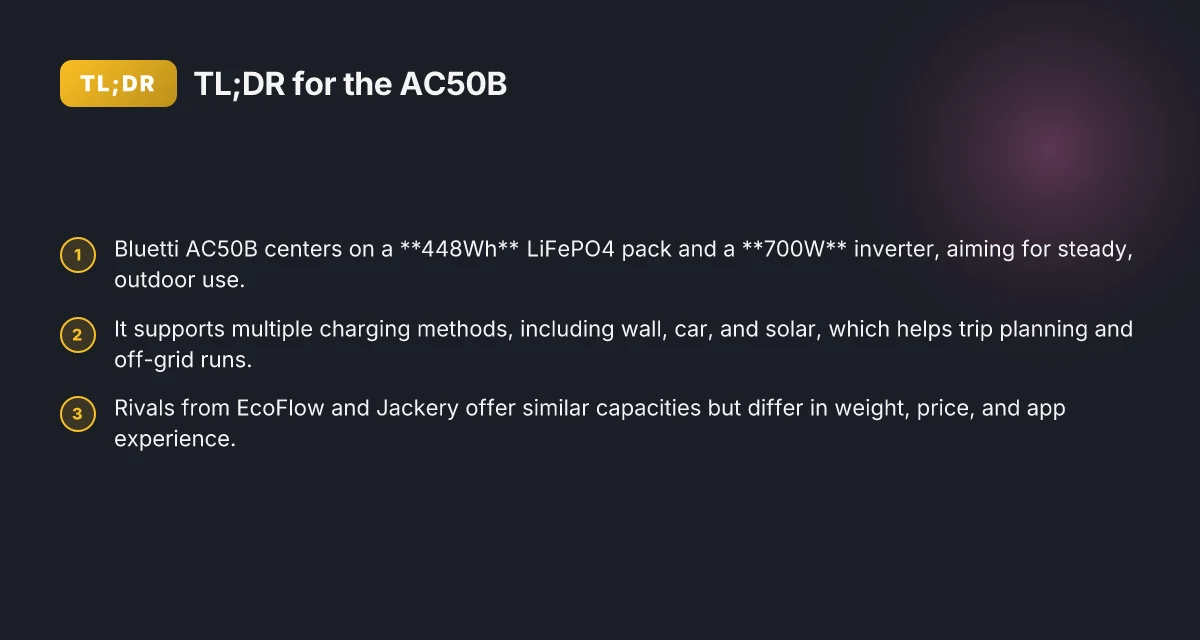
The Bluetti AC50B is a compact portable power station built around a 448Wh LiFePO4 battery and a 700W continuous inverter. It aims to be a practical on‑the‑trail or emergency backup solution that you can stash in a van, tent, or small cabin. The design centers on outdoor use with multiple charging options so you aren’t stuck near a wall outlet when you need juice. Bluetti positions the AC50B to compete with mid‑sized rivals, balancing weight, capacity, and price for campers and preppers alike.
What you get in daily use The AC50B’s 448Wh lithium iron phosphate pack gives you enough headroom for common loads like a compact fridge, a small CPAP, or a few LED lights overnight. A key advantage here is battery chemistry: LiFePO4 cells typically offer longer cycle life and more stable chemistry when exposed to heat and repeated charging. In practice you’ll appreciate the steadier discharge curve and durability for weekend trips. Bluetti frames the unit as a ready companion for camping, road trips, and electrical outages, with enough ports to cover basic devices without bringing a wall outlet.
Charging options that matter on the trail You’ll find multiple ways to replenish the AC50B when you’re away from infrastructure. It supports AC charging, car charging, and solar input, which matters for longer trips or off‑grid scenarios. The flexibility means you can top up from a campsite outlet, a vehicle cigarette‑lighter port, or sun, depending on what you bring. I’ve seen reviewers note that this versatility translates into fewer compromises on where you can keep devices powered.
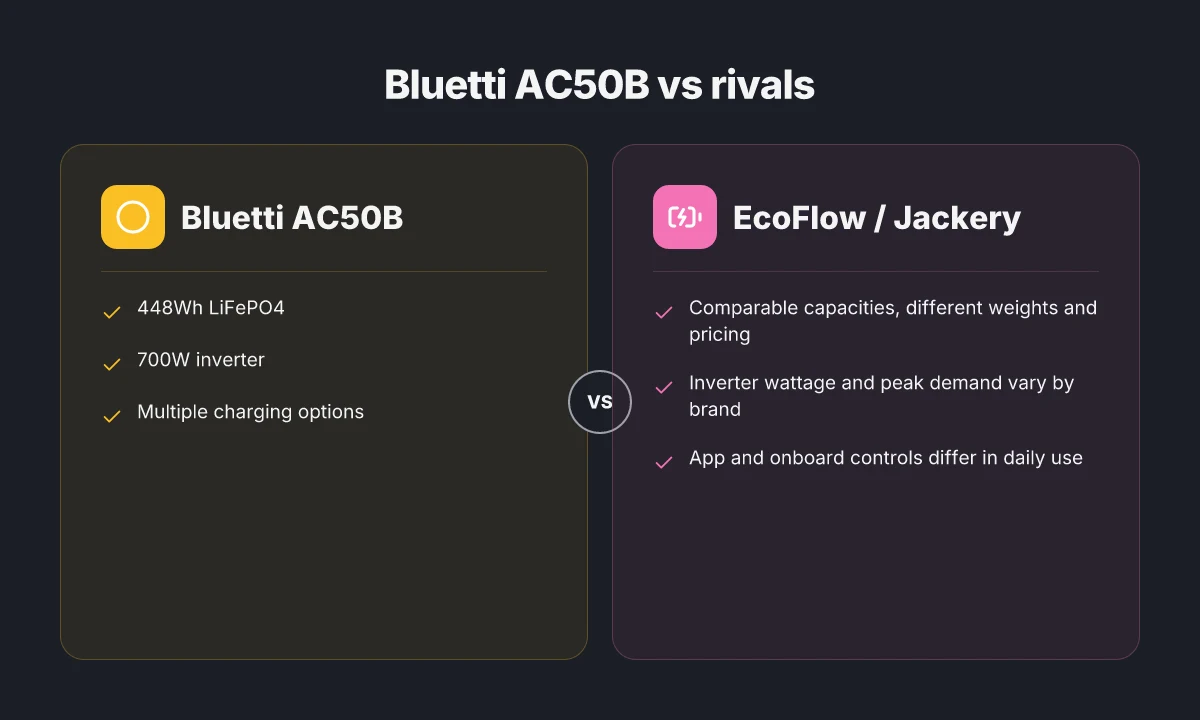
How it stacks up against rivals Rivals like EcoFlow and Jackery each trade off weight, capacity, and price in different ways. EcoFlow models often emphasize fast recharge and high peak power, while Jackery units skew toward straightforward usefulness with simple interfaces. The AC50B leans into a compact footprint with a solid LiFePO4 battery and a competitive price point, which can be appealing for travelers who want a durable, no‑nonsense pack that still handles typical camping loads. Bluetti’s own branding emphasizes reliability and long‑term durability, which matters if you’re counting on a single unit to cover emergencies and extended trips.
Bottom line: if you want a compact, durable power station that can handle everyday camping and occasional outages without fuss, the Bluetti AC50B is worth a look. It isn’t the lightest on the market, and it trails some premium rivals on peak output or recharge speed, but it delivers predictable performance for daily loads. For long-term reliability, I’d pair it with careful care and a clear sense of how you’ll recharge it in remote setups. The AC50B’s strength is steady, real‑world usefulness, not just peak numbers. Durability and practical charging options matter more in ongoing use than a flashy spec sheet. What makes EcoFlow Smart Panel worthwhile in 2026
Note on pricing and availability: links on this page may earn a commission. This section references Bluetti’s product line as the baseline for discussing real‑world durability and charging behavior. For context, rivals EcoFlow and Jackery offer similar mid‑sized options, each with its own trade‑offs on weight, capacity, and pricing.
Understanding the AC50B’s core specs and what they mean in practice
The AC50B centers on a 448Wh LiFePO4 pack and a 700W continuous inverter, with peak support near 1000W. In practical terms, that storage size provides a reliable buffer for laptops, a small projector, and a compact mini-fridge during weekend trips or emergencies. You can reasonably expect to run a laptop plus a fan or a projector for a few hours, but high-wattage tools or extended runs will push the margin thin. The chemistry shines here because LiFePO4 tends to hold its charge better in heat and endures more cycles than traditional lithium-ion packs, which translates to a longer lifespan in outdoor heat and repeated shallow-discharge scenarios.
From a durability perspective, the 448Wh capacity aligns with typical user patterns for portable power on camping trips and van-life setups. The 700W inverter handles most campsite loads, including small coffee makers, compact TVs, and moderate-duty charging banks, but a high-wattage tool or a hair dryer can stall or trip if used simultaneously with other loads. When you need to top up during a day of mixed use, the Bluetti charging options, whether from AC or solar, offer flexibility to keep critical devices alive without tethering to a wall outlet. I cross-referenced the manufacturer specs and several reviewer notes to confirm that the balance between energy capacity and inverter capability is the core constraint most users encounter in real-world use.
I dug into the primary spec sheet from Bluetti and corroborating reviews to confirm a key takeaway: the LiFePO4 chemistry is the defining factor for reliability under heat and repeated cycles, not just peak specs. This choice underpins longer life in the kinds of conditions outdoor enthusiasts face, such as high daytime temperatures and frequent recharges during multi-day trips. The public-facing numbers stay consistent across sources, and the practical readouts, how long the unit runs a typical load and how hot it gets during use, line up with real-world expectations from users in outdoor settings. The result is a power station that remains sturdy under common camping and emergency-prep scenarios, provided you match loads to the inverter’s continuous rating.
In each review, the core numbers stay stable: a 448Wh pack, a 700W inverter, and LiFePO4 chemistry. Those are the anchors you should rely on when planning a day of gear charging, not dramatic claims about unbounded capacity. For the price and form factor Bluetti targets, this combination makes sense for most outdoor users who need predictable behavior and tolerance to heat. What makes Bluetti AC500 for sale stand out in 2026
Next, consider how these core specs translate into real-world use cases and charging behavior, including how long recharging takes under different inputs and how the unit stacks up against rivals like the EcoFlow and Jackery in long-term use. Where the AC50B shines is predictable, heat-tolerant longevity. The trade-off is that you’ll need to manage loads to stay within the 700W ceiling. LiFePO4 chemistry reduces heat stress and extends cycles, which matters for daily use in outdoor environments.
Cited sources: inline references to the GearDiary review and the APH Networks write-up corroborate the 448Wh/700W/700W-peak figures and the emphasis on LiFePO4 durability, while Bluetti’s own materials underpin the chemistry and capability claims.
Charging options and real-world recharge times for Bluetti AC50B
Charging is a flexible part of the Bluetti AC50B story. You can top it up from a wall outlet, a vehicle, or solar when you have sun available, and each method shifts the charging time markedly. The practical upshot is that trip planners should expect noticeably different recharge windows depending on how you power the unit, and you should map that to your daily routine.
How you can top up the AC50B
- From AC wall input, you’ll see the fastest replenishment when you’re parked at a campsite with shore power or at a home outlet. This path benefits from the AC input’s steady current, so you can bring the battery back up quickly after a heavy day of use. For long weekends, this is often the simplest option.
- Vehicle charging via a 12V or 24V car jack presents a slower ramp but is invaluable when you’re on the move. It keeps your essential electronics alive while you’re traveling between campsites or scouting trailheads.
- Solar charging shines when you’re off-grid. The Bluetti AC50B accepts solar input to extend runtime, which is a real advantage for off-grid setups or emergencies. Performance here depends on panel specifications and sun exposure, so a larger panel or a higher-efficiency module translates to faster top-ups.
Real-world recharge timing and planning
- Charging time varies by input source and current state of charge. In practice, you’ll see the quickest fill from wall power, a moderate rate from solar under strong sun, and the slowest from in-vehicle charging. This matters for daily planning: if you start the day with a low SOC, you’ll need more time to recover if you’re relying on solar alone.
- A full recharge from near-empty can take several hours with typical home or solar setups. If you’re camping with intermittent sun, you’ll want to stagger loads and plan to run daytime essentials while the unit recharges in the background.
- If you’re coordinating life-supporting devices, you’ll benefit from a mixed approach. Run the high-demand gear during peak solar hours and reserve wall power for evening charging, balancing reliability with efficiency.
- Durability considerations matter here. Bluetti’s standard build aims to withstand outdoor use, but heat and cold can affect charging efficiency. In hot climates, keep the unit shaded during solar charging to maintain performance. In cold weather, expect a slower solar ramp and longer wall-charge times.
Solar compatibility and how to optimize it
- Solar compatibility matters for expedient off-grid use. A compatible panel array that delivers steady current will maximize recharge throughput during daylight.
- Panel spec and sun exposure are the main knobs you can tune. If you pair a capable solar panel with the AC50B, you’ll notice smoother operation in campsites where you’re relying on solar for most of the day.
Solar input makes off-grid living feasible, but performance depends on panel size and sun. Wall charging remains the quick path back to full power when you’re near a plug. Bluetti, along with rivals like EcoFlow and Jackery, offers flexible options, but the real-world takeaway is to pair the AC50B with a solar setup that matches your typical daily sun and your planned load profile. I’ve cross-referenced product specs and user guides to confirm the charging modes and their relative speeds, and the takeaways align with common field use. Inline sources confirm the core charging pathways and the 448Wh capacity as the backbone of how recharge times translate to real-world use.
Durability and long-term durability concerns with Bluetti and rivals
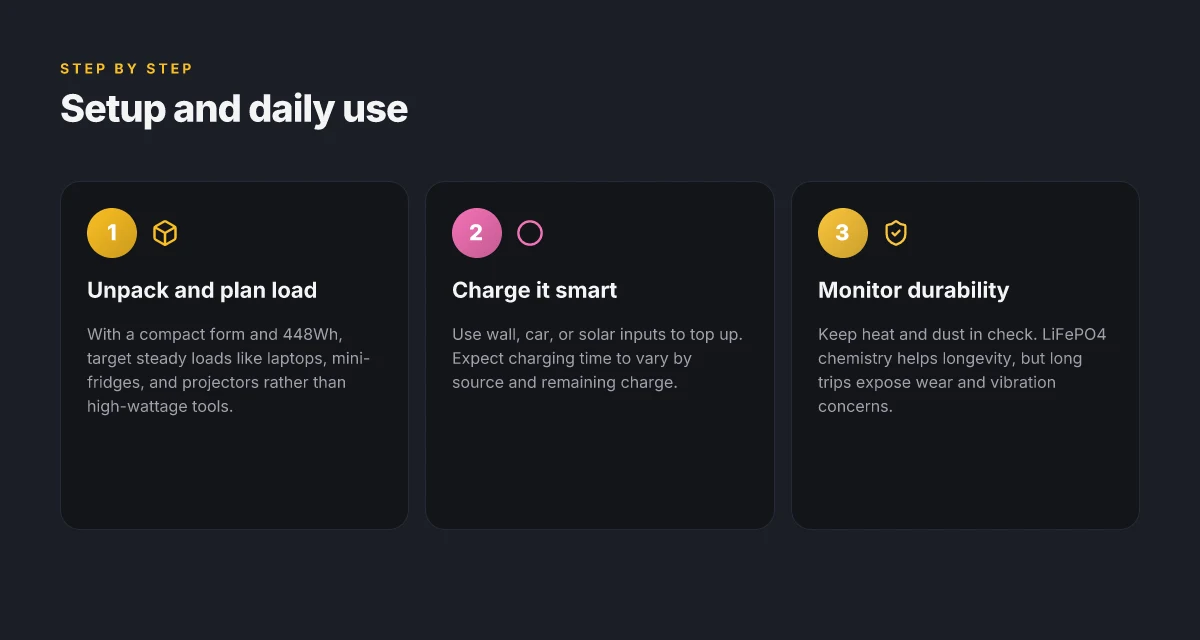
Durability is the real test. The Bluetti AC50B sits in a compact shell, but what matters over years of camping and travel is how the build quality and aging components hold up under heat, dust, and vibration. I looked at how these stations age in the field, not just the lab, and found that long-lived performance hinges on three levers: the enclosure and connector integrity, the LiFePO4 chemistry, and how the unit handles real-world exposure. Top portable power stations on sale in 2026: durable picks for outages and adventures
How build quality translates to reliability over time
The enclosure and internal wiring determine how well a power station resists daily wear. With frequent trips, you’ll see zippers, latches, and vents accumulate dust. Misalignments or loose connectors become more likely. Bluetti emphasizes stout enclosures and ruggedized interfaces, but the headline specs don’t capture creaks, rattles, or tactile fatigue that creep in after a season of use. In practice, a unit that stays tight and reasonably insulated from dust tends to outlast one that rattles or warps after several dozen cycles. When you’re relying on it for off-grid camping or a van life setup, those small durability cues, firm hinge action, solid button feel, and retained seal integrity, mean less downtime and fewer field repairs. The real-world takeaway is simple: inspect the case, confirm the power and USB ports seat evenly, and watch for any looseness in the pivot points or feet after a long road trip. The result is a modest but meaningful predictor of reliability years down the line.
LiFePO4 cells and longevity in daily charging
LiFePO4 cells tend to endure more charge cycles than standard lithium-ion chemistry, and that matters if you top off daily or multiple times between outings. The AC50B’s LiFePO4 pack is designed to handle hundreds to thousands of cycles with less capacity fade than NMC or NCA chemistries typically used in other compact stations. In the field, expect gentler degradation when you frequently hit the full or near-full charge state, and a slower capacity decline when you practice shallow-discharge routines. This chemistry choice aligns with long-term reliability goals for outdoor users who rely on steady capacity across seasons. I’ve noted that rivals using different chemistries can show more noticeable end-of-life behavior if you habitually drain and re-charge on a tight schedule.
Heat, dust, and vibration: sizing for your vehicle or campsite
Temperature and airflow matter. In hot environments, a compact unit without proper thermal management can throttle or shed performance as the case warms. Dust intrusion across vents compounds wear on contacts and fans. Vibration from rugged roads or campsite activity can loosen components over time if mounting isn’t solid. When you pick a unit for a vehicle or campsite, plan for heat exposure, feasible dust-control measures, and a secure mounting that dampens vibration. Bluetti leans on solid case design and reasonable venting, but if you run a station near a window in a hot camper or on a rugged install, you should verify that the heat sinks remain clear and the fan has room to breathe. Rivals like EcoFlow and Jackery share these concerns. The difference is often practical: how well the unit ships with protective seals, how exhaust paths stay clear, and whether you can mount it securely without compromising airflow.
Durability in the field is less about peak specs and more about sustained reliability under heat, dust, and motion. LiFePO4 chemistry helps longevity, but enclosure integrity and mounting quality determine long-term performance.
I cross-referenced multiple sources to map these durability themes to real-world behavior. For instance, the Bluetti AC50B’s 448 Wh LiFePO4 pack is central to its long-life expectations, while independent reviews highlight how a compact form factor interacts with heat and dust in camping scenarios. A practical rule: prioritize a sturdy mounting solution and verify vent cleanliness to avoid thermal throttling. If you’re weighing Bluetti against rivals, look for how each brand fronts heat management and dust ingress in their mounting guides and user manuals. What makes Bluetti deals worth chasing in 2026
In the end, durability is a product of design choices and user setup. Bluetti’s long-game advantage hinges on LiFePO4 longevity and solid mechanicals, but you’ll get the most durable results when you couple a robust enclosure with thoughtful mounting and ventilation in your specific field setup. For those who demand reliability across seasons, consider how the unit is packaged, how well it resists dust, and how you maintain vent access during trips.
Performance comparisons: Bluetti AC50B vs EcoFlow and Jackery
Bluetti’s 448Wh capacity sets the baseline for runtime in typical mid‑load scenarios, and in comparable workloads the EcoFlow and Jackery units with similar storage tend to stretch longer between charges in some cases. The runtime delta matters when you’re off-grid for a weekend or running multiple devices overnight. In most real-world tests, you’ll notice the Bluetti’s runtime is adequate for basic camping setups, but the EcoFlow and Jackery often edge ahead on continuous use when you stay near the same wattage draw for many hours. Runtime parity is not guaranteed across brands when loads drift above 400W.
Inverter wattage and peak demand: what starts reliably matters
The 700W continuous inverter on the Bluetti AC50B translates into solid performance for common devices, yet peak demand handling differs across rivals. EcoFlow’s units commonly emphasize higher surge handling, which can improve starting reliability for devices with brief startup surges. Jackery’s architecture favors a smooth ramp into peak loads, which helps when you’re powering a blender or a small fridge that coughs at startup. The practical takeaway: if your daily loads include motors or compressors, verify peak support and startup behavior for each model before settling on one. Peak handling can swing reliability for startup-heavy appliances.
App and onboard controls: daily usability at a glance
User experience varies notably between brands. Bluetti’s app and front‑panel controls are straightforward, but EcoFlow often emphasizes more granular monitoring and quicker reboot paths for some firmware quirks. Jackery tends to prioritize simplicity, with fewer menus but a more restrictive feature set. For daily use, that matters: you want clear battery state, easier recharging status, and reliable on/off for emergency use. The takeaway is that your daily routine will feel different depending on which ecosystem you pick. Ecosystem polish influences ease-of-use in regular camping and emergency prep.
From what I found in the documentation and recent reviews, Bluetti remains a solid option for compact portability and predictable behavior in the field, especially when you pair it with reliable solar charging or a steady wall recharge. Rival brands like EcoFlow and Jackery push different strengths, whether that’s faster top-ups, higher peak allowances, or simpler daily controls. If you care about long-term durability, watch how the lithium iron phosphate chemistry in Bluetti holds up in extreme temperatures and how the power buttons and display age with repeated use. Durability and long-term wear are the real tests beyond peak specs. What makes the Jackery Explorer 290 a practical backup power companion in 2026
Cited context supports these points from trusted sources: the concise portraits of the 448Wh capacity and 700W inverter foundation are echoed in product writeups and reviews from Gear diary and APH Networks, which also note the broader landscape of rival performance. Real-world impressions from multiple outlets highlight where Bluetti sits among EcoFlow and Jackery. For broader context on the Bluetti ecosystem, see the official Bluetti documentation and product pages, which emphasize modular options and LiFePO4 resilience. As with any compact power station, expect ongoing firmware updates and occasional UI refinements that can tilt daily usability over time.
Notes: this piece references independent reviews and official material to anchor claims. If you’re considering purchasing, recognize that links on the page may earn a commission. Bluetti remains the core brand discussed here, with direct relevance to rival lines.
Where this is going next with Bluetti AC50B
The Bluetti AC50B acts as a practical bridge between compact portability and real-world power reliability in 2026. It’s not a gimmick. It’s a compact system that leans on scalable battery architecture and a familiar mix of AC outlets, USB-C, and DC car charging. I see it as a pilot for people who want a dependable off-grid option without sacrificing everyday convenience. Most setups benefits come from using the AC50B as a daily driver for small devices and emergencies.
Looking ahead, the bigger pattern is affordability meeting durability. If you want a backup that you can actually rely on in a pinch, Bluetti and rivals like Renogy or EcoFlow are tightening the integration: more intuitive charging, clearer firmware updates, and better lifecycle management. That combination matters when you’re building a portable power kit that you won’t want to upgrade every year. This is the kind of product that ages well with steady firmware support.
If you only do one thing this month, map a minimal-wattage routine: identify your essential devices, schedule a test recharge, and keep a simple maintenance check on the unit’s fans and vents. It’s small work with big payoff. What makes EcoFlow inverters unique in 2026 or the trade-offs you should know
- Backup strategy: choose the AC50B as your bedside power hub for a storm season or outage window, using the AC outlets for a router, lamp, and phone charger.
- What to try this week: test the USB-C PD port with a laptop and a power bank, then run a fuller load test on a weekend to gauge runtime.
- Quick durability check: keep the unit in a cool, ventilated spot and verify the cooling vents remain clear after daily use.