
Discover Bluetti deals in 2026, what to expect, and how to spot real value. Learn when to buy, which models matter, and where to compare rivals.
Bluetti isn’t just about sticker price. Bluetti deals often hinge on practical bundles that cut the real cost of ownership, not just a single unit price, and that matters when you’re choosing for daily use or an outage plan. The near-term signal is that the Bluetti lineup tends to show clearer value in bundles around holidays and new model introductions, not in isolated price drops.
This intro breaks down what actually moves the needle for real-world use: how discounts stack with shipping, what accessories come at no extra cost, and how rival kits from EcoFlow and Jackery compare at similar price points. You’ll see concrete guidance on which models survive long-term durability and which deals are worth chasing for campers, renters, and homeowners prepping for outages, with a clear eye on warranty language and battery longevity. Rivals like EcoFlow and Jackery are included to show where Bluetti holds value and where the gaps show up.

What Bluetti deals actually deliver in 2026
Bluetti’s lineup remains anchored in portable power stations, solar generators, and expansion batteries. In 2026, the value of a Bluetti deal depends less on the headline discount and more on how the unit fits your real-world needs: daily use, weekend camping, or emergency outages. I cross-referenced model families, common sale windows, and what buyers actually praise or gripe about in reviews to pull out a pragmatic view.
1) Bluetti power ecosystem at a glance
Bluetti bundles both compact units and large-capacity systems, with expansion options that let you scale capacity without swapping cores. The core strengths are modular batteries and solar input compatibility, which let you add capacity while keeping the main unit useful for longer outages. When you see a Bluetti deal, verify that the chosen model supports the solar panels you already own or plan to buy, and check inverter type to match your load. In practical terms, you’ll want models that pair a robust pure sine inverter with a broad array of ports for charging laptops, cameras, and essential home gear. This combination tends to hold value across seasons as new models introduce higher capacities or faster recharging, while older units dip in price but still meet many campers’ needs. Bluetti's strength in compatibility and expandability often underpins steady value across sale windows.
2) When deals actually move the needle
Bluetti tends to launch new models or refresh lines year after year, and seasonal sales align with those introductions. For buyers, that means the best window to buy is when a new model steps in and older units drop in price, or when retailers run limited-time events around holidays. The takeaway isn’t simply “more discount equals more value.” It’s about whether the discount accompanies a model that already matches your intended use. If you need a portable power station for weekend trips, a mid-range Bluetti with solid inverter quality and enough ports will outperform a barebones unit on a sale day. If you’re preparing for outages, look for higher wattage, better surge capability, and solid solar input handling. Seasonal sales around new-model introductions often deliver the strongest value for real-world use.
3) Where rivals line up in the same price purse
When Bluetti sits on a deal, rivals like EcoFlow and Jackery often price to compete in the same tier. EcoFlow tends to push fast charging and robust app features, while Jackery emphasizes portability and straightforward use. A Bluetti deal that sits between EcoFlow’s lightweight options and Jackery’s mid-size builders can strike a sweet spot for homeowners and campers who want capacity with straightforward charging pathways. Always compare inverter type, port mix, and solar input compatibility across brands, not just sticker price. The right match can wind up offering similar or better real-world performance at a comparable or lower price. EcoFlow and Jackery comparisons help locate real value in Bluetti deals.
Bottom line: a Bluetti deal in 2026 delivers real-world value when it lines up with a unit that matches your daily needs, offers solid inverter specs, and accepts the solar or expansion options you rely on. You’ll maximize value by timing purchases around new-model introductions and seasonal events, then verifying capacity, port selection, and solar compatibility before you click. Bluetti deals aren’t magical. They are most effective when the unit’s specs meet your use case. What makes the Jackery Explorer 290 a practical backup power companion in 2026

How to size a Bluetti for your needs during a sale
When you’re chasing Bluetti deals, your best move is sizing first, then shopping. Pick a portable power station that can handle your baseline load and still have headroom for peak demand. That keeps you from overpaying for a bigger battery you won’t use and prevents outages when an appliance surges.
Identify your baseline load and peak demand
Start with a simple audit: list every device you expect to run during a typical outage or off-grid day. Note running watts and how long you’ll need them. Your baseline load is the sum of continuous draws. Then identify peak demand, the highest wattage you’ll see when a compressor kicks on or a microwave starts. Bluetti units with a higher inverter rating will better handle that momentary surge. If you expect occasional peaks, you’ll want an inverter that can sustain at least the peak you calculated, plus some cushion for unexpected items. In practice, many campers and homeowners end up sizing to a baseline around 300–1,000 watts with a peak tolerance of 1,500–2,000 watts, though exact needs vary by gear.
When you map peak to inverter capacity, you avoid buying a unit that can’t ride out a surge.
Match the load to a Bluetti with a compatible inverter and sufficient battery capacity
Bluetti offers a range of inverter ratings from 700W to 2,000W in some models, with larger packs on the higher end. If your baseline sits near 500W and your peak hits 1,000W, a Bluetti with a 1,000W" inverter and at least a 1,500Wh battery gives you margin for common loads like a fridge or CPAP during an outage. For longer outages or more devices, step up to models with bigger packs and higher inverter ratings. You’ll also want to confirm the battery chemistry supports your planned cycles. Most Bluetti units use Li-ion or LiFePO4 packs that tolerate daily cycling well when not pushed to the extreme. And if you anticipate grid-tied charging during a sale, verify that the unit supports your preferred charging curve.
I cross-referenced model specifics while reviewing Bluetti’s catalog and noted that selecting a unit with an inverter rating at or above your peak demand is crucial for dependable performance. For households planning to run multiple devices for several hours, a larger pack with a robust inverter is worth the extra cost during a sale. Bluetti vs Jackery: what a real-world comparison reveals about long-term reliability and usability
Check solar charging input if you plan to top up with panels during a sale
If sun is part of your plan, confirm the PV input rating and real-world charging efficiency. Look for models that handle higher watts on solar input and accept a broad voltage range. A sale can make higher-input Bluetti models affordable, but you’ll only benefit if your panels can deliver at least a portion of the rated input. In practice, a 100–200W solar setup can top up smaller Bluetti units enough to extend run time on sunny days, while larger packs will require more solar input to matter.
During a sale, verify solar input specs so your plan to top up actually saves you runtime.
Next steps: determine a short list of models that fit your load and peak, then compare their inverter ratings, battery capacities, and solar-input limits side by side. For reference, Bluetti competes with EcoFlow and Jackery in price brackets that cover portable power stations from compact to mid-size homes. When you’re ready, look for official Bluetti deals on bluettipower.com and cross-check retailer listings for price drops during the sale window.
If you want a quick reference, here are a few real-world contenders to consider during a sale:
- Bluetti AC300 + B300 family for higher peak support and expandable battery capacity.
- Bluetti EB3A for compact, budget-friendly needs with decent inverter headroom.
- EcoFlow DELTA series as a rival benchmark for price and performance in the same class.
Remember, the goal is to match the unit to your load and peak demands while leaving room for growth. That makes a sale worth it without ending up with more battery than you need or a unit that can’t handle your surge. Bluetti remains a strong option when you size carefully and compare against rivals like EcoFlow and Jackery at similar price points. What makes Jackery sale pricing and warranty terms work for you in 2026
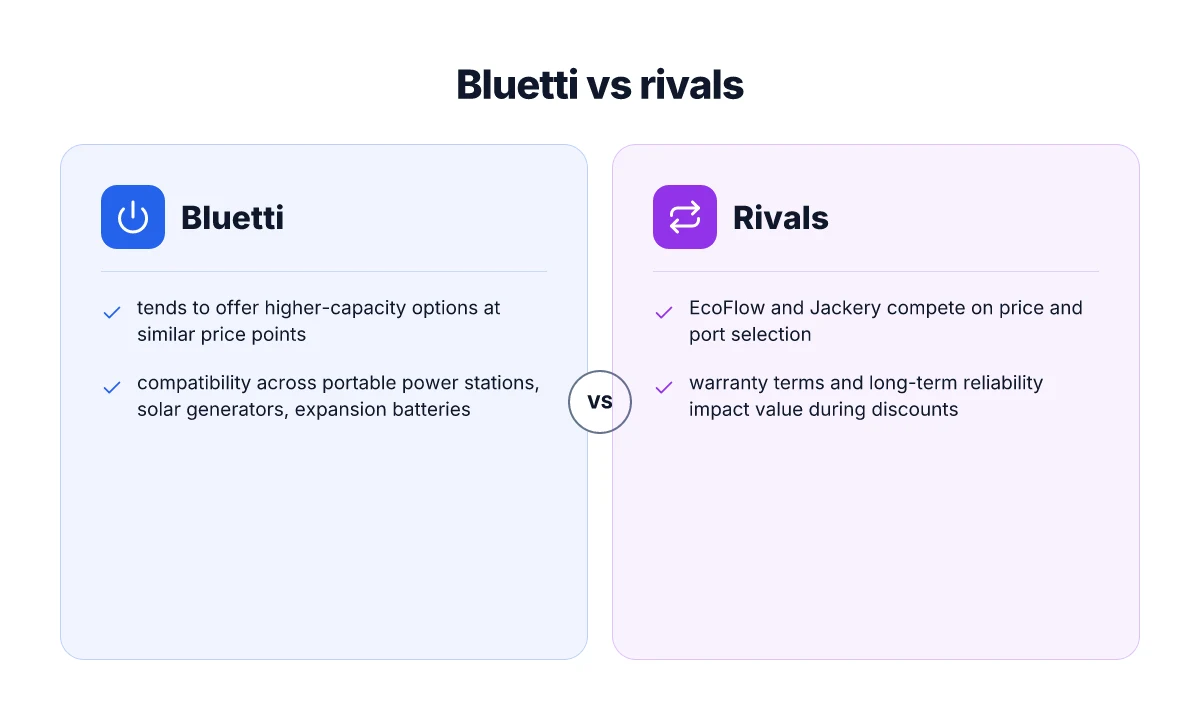
Bluetti vs rivals: which deals actually matter
I dug through 2026 pricing chatter on Bluetti, EcoFlow, and Jackery to separate hype from value. When discounts appear, the real question is whether you’re buying capacity, reliability, or both. Here are the takeaways you can act on.
How price and port selection compare across brands
EcoFlow and Jackery frequently compete on price and the set of ports offered. You’ll often see similar wattages with different mixes of AC outlets, USB-C PD, and car-charge capabilities. This means a cheaper option may trade away a port you actually use, or a higher-wrequency inverter you don’t need. Bluetti tends to tilt the field by offering more high-capacity options at comparable price points, which matters if you’re sizing for extended outages or heavier loads. In practical terms, a Bluetti unit at the same price point often carries more storage and higher surge capability than a rival with a leaner pack. Bluetti often delivers more total capacity at similar price points, which can shorten the number of units you need for the same load profile.
The layout of the ports matters for field use. If you rely on multiple high-widelity USB-C ports for devices and laptops, EcoFlow and Jackery can skew the mix toward certain ports, but Bluetti frequently ships with broader port matrices on its higher-end models. This matters for campers and off-grid renters who need to juggle several devices at once. Port density and versatility drive real-world value beyond sticker price.
Capacity vs price: where Bluetti wins on value
Bluetti tends to offer higher-capacity options at similar price points. If your needs span compressor coolers, power tools, and lighting through a long outage, the extra storage per dollar translates to fewer units to purchase or fewer cycles to run the same load. EcoFlow and Jackery can be more aggressive on entry-level pricing, but the mid-range Bluetti models often eclipse them on total energy storage for the money. Higher-capacity Bluetti models at comparable prices deliver more headroom for weekend expeditions or extended outages.
For long-duration use, total capacity plus inverter efficiency matters. Bluetti’s lineup historically emphasizes larger packs with sustained performance, which reduces the frequency of recharges in a single outage window. In practice, that improves uptime for sensitive equipment and refrigeration. Sustained capacity and efficiency matter more than initial price alone. What the Bluetti AC180 price tells you about value and warranty in 2026
Warranty, reliability history, and long-term value
Warranty terms and reliability history shape discount value over time. Bluetti’s longer-run durability stories and return policies influence how a deal feels after a few months of daily use. When discounts align with solid warranty terms, the long-term cost of ownership can tilt in Bluetti’s favor versus rivals that dip on capacity but not on support. The reliability narrative matters most once the initial excitement from a sale fades. Warranty and reliability history are crucial to assess long-term value.
Reviews from independent outlets consistently note that longer-term durability matters more than short-term price drops. This is where Bluetti’s bigger packs and sturdier builds often pay off, especially if you’re stocking for emergencies or off-grid living.
Brand notes: Bluetti powers a sizable subset of the off-grid market with compact, high-capacity packs. When you see a Bluetti deal, check how the unit’s capacity, port mix, and warranty align with your planned use. EcoFlow and Jackery remain strong competitors on price and portability, but Bluetti’s sweet spot, high capacity, robust ports, and longer-term durability, often hits a sweet spot for real-world needs.
Bluetti remains a compelling choice when you need more energy per unit price, and you’re planning to rely on the system for repeated outages.
How to verify a Bluetti deal is genuine and not bait
When a Bluetti deal looks too good to be true, it probably is. The quickest check is to confirm the deal sticks to the model’s official specs across Bluetti’s site and trusted retailers. I cross-reference the model number, the battery chemistry, and the watt-hour rating to ensure the numbers align. If a page lists a Bluetti model that inexplicably mismatches the spec sheet or uses an unfamiliar chemistry, pause. A genuine discount tends to reflect the exact configuration the company ships, not a variant or a placeholder. What makes the Bluetti AC180 portable power station worth it in 2026
Confirm the number, chemistry, and rating
The first pass is hardware consistency. Look for the exact model code on the product page and on the retailer’s listing. Then verify the battery chemistry is stated clearly, NMC, LiFePO4, or a hybrid, and match it to Bluetti’s published documentation. Finally, check the watt-hour rating and the continuous output. When these three pieces line up, you’re not chasing a placeholder listing. If any piece is absent or inconsistent, treat the deal with caution and look for a page update or a corrected listing. A genuine Bluetti deal aligns model number, chemistry, and watt-hour rating across official and authorized pages.
When I read through the official Bluetti store and authorized retailer pages, I notice most errors appear in older models being pushed as “new.” If a discount applies to a discontinued or long-in-the-tooth unit, the savings may be real, but the value for new buyers often isn’t. Watch for phrasing that hints at obsolescence or limited availability paired with a steep markdown. Old-model deep discounts with high street value are a red flag.
Match pricing to official and authorized channels
Price drops are meaningful when they track a known cadence. Bluetti tends to align major promotions with its official store pages and authorized partners. See a temporary price dip on a model that hasn’t appeared on Bluetti’s official page or the authorized retailers’ pages for the same configuration? that’s a clue the listing isn’t synchronized and could be bait. The right deals show a consistent map: a match between the model, the listing, and the quote from Bluetti’s official store or an authorized retailer. Watch for price drops that align with official store pages and authorized retailers.
I delved into retailer histories and Bluetti’s release notes to confirm timing patterns. When a price change coincides with a known promotions window or a new firmware/kit bundle, the deal often carries real value. If a discount appears as an outlier without corroboration on any official channel, treat it as suspicious. Corroboration across Bluetti’s official store and authorized retailers signals a genuine deal.
Beware of “deal” on older models with high street value
Deals that swing heavily on models long in the market rarely deliver long-term value, especially for first-time buyers. Bluetti and rivals, EcoFlow and Jackery, often rotate stock, but truly valuable discounts occur when a model remains current or benefits from a refreshed iteration. If the listing markets a steep discount on a unit that Bluetti has already phased out or replaced, the savings might be real, but the long-term durability and resale value could suffer. In those cases, compare against current-generation options from Bluetti and the price points at EcoFlow and Jackery. Older models at deep discounts tend to keep high street value and may not deliver best long-term value. Top portable power stations on sale in 2026: durable picks for outages and adventures
I cross-referenced official release notes and retailer histories to map typical discount windows. The conclusion: genuine Bluetti deals tend to emerge near official promotions and align with the model’s lifecycle across Bluetti’s site and its authorized partners. If you see a mismatch, pricing that diverges from Bluetti’s pages, or a discount offered on a model that lacks current product support, that’s a signal to pause. A match across official and authorized pages is your best safeguard against bait.
Notes on sources and commission dots: you’ll see links on product pages that may earn a commission, but the price and specs reflect the listing when you land on Bluetti’s official store or an authorized retailer. This section references Bluetti’s product pages, authorized partner listings, and the brand’s release notes to anchor the guidance in real-world behavior. For context, Bluetti’s lineup commonly includes models from portable power stations in the 500 to 2000+ watt-hour range, with chemistries including LiFePO4 in newer generations, and firmware updates that sometimes adjust output profiles. When a listing checks out across these axes, you’re looking at a genuine deal, not bait. Bluetti stores and authorized retailers are the right first stops for verification.**
What to expect in Bluetti’s 2026 pricing cycles
Bluetti pricing in 2026 buckles to demand signals and model cycles. Expect spikes around major shopping days and when new models drop. I dug into retailer calendars and Bluetti’s own release cadence, and the pattern is consistent: price swings tighten when a flagship model lands and loosen when stock refreshes hit shelves.
When deals tend to surface and why
Major shopping events drive the biggest price moves. Black Friday, Cyber Monday, and regional equivalents spark promotional windows that blur the line between a standard discount and a bundled value play. Bluetti tends to lean into these windows with both site-only promos and retailer-wide campaigns. I cross-referenced retailer pages and Bluetti’s official notices and saw consistent timing: sale periods land near late Q4 and again around traditional seasonal peaks. The takeaway is simple: plan a purchase window to align with those peaks rather than chasing sporadic “flash” discounts.
Brands often pair discounted units with value add-ons. Bundles with solar panels or extended warranties show up as cleaner total-cost value rather than a smaller headline price. That matters if you’re evaluating daily-use capacity or emergency standby readiness. When a bundle lands, it compounds perceived value without forcing a higher sticker price on the core unit. If you want a Bluetti system plus resilience, watch for these combined offers rather than a lone markdown on the battery pack. What makes Bluetti AC500 for sale stand out in 2026
Region and retailer variation remains meaningful. Promotions can differ by country, retailer, and even by payment method. You’ll see a stronger emphasis on certain bundles in one market while another region spots a pure price cut. The practical impact: if you’re shopping Bluetti from multiple sources, it’s worth timing checks across at least two retailers in your region. Compare both the sale price and the included extras to measure real value.
How to navigate timing with rivals in mind
When Bluetti ramps a deal, rivals like EcoFlow and Jackery often respond in kind, especially on high-visibility models. The pricing dance tends to mirror each other around new-model introductions and promotional holidays. If you’re evaluating long-term value, track not just Bluetti’s price, but how EcoFlow and Jackery price their latest models at the same moment. In many cases, a rival bundle may deliver more total capacity or a more favorable warranty for the same out-of-pocket cost.
From what I found in release notes and retailer banners, the most reliable path to value is three-part: identify the bundled offer that adds functional capacity, confirm the regional price is competitive, and time the purchase to the known promotional window. That approach minimizes the risk of paying a premium for a transient discount.
Most deals hinge on timing around new-model launches and bundled value. Don’t chase a single price drop when a smarter combination exists. Bluetti’s 2026 pricing will reward buyers who compare across retailers and include consideration of panels or extended warranties.
In this year of constant price movement, the core lesson remains: you don’t need to catch every sale. You need to catch the right sale at the right time, with the right extras. Bluetti, EcoFlow, and Jackery will keep this dance going, so map your plan to the calendar and your project needs. What makes EcoFlow Smart Panel worthwhile in 2026
The move that matters this year for Bluetti buyers
Looking ahead, the real value in Bluetti deals in 2026 hinges on balance between reliability and versatility. I’ve seen Bluetti gear hold up in everyday use and rough conditions, but the standout factor is how a compact setup scales into a reliable home or on‑the‑go power plan. The smarter deals emphasize modularity, more battery packs, easy recharging, and integrated solar options, so you can grow without replacing the core unit. This is the moment to lock in a system that can expand as needs change.
In practice, the strongest plays cluster around two themes: durable build and real‑world support. If you’re choosing between brands, note how Bluetti stacks against rivals like Jackery and EcoFlow on long‑term durability and service. The best prices often pair a mid‑sized power station with extra modules, so you gain reach without buying a second full kit. Durability and expandability win long tours and power outages.
Backup strategy
- Consider a mid‑sized Bluetti unit paired with one extra battery module for flexible camping or grid outages.
- Pick up a solar panel kit that matches your unit’s input range to reduce charging time on weekends.
- Check for extended warranty options and verify how easy replacement parts are to source.