
Explore EcoFlow Smart Panel capabilities, durability, and setup in 2026. Learn how it integrates with home backup power and where it shines or falls short.
The path to reliable home backup often hinges on one stubborn fact: the EcoFlow Smart Panel must coexist with your existing panel, not replace it like a plug-and-play gadget. EcoFlow links into your grid with hard-wired expectations, and a misfit can push installation into a multi-hour, code-checked affair. That friction is why the real-world question isn’t just capacity but how smoothly the panel integrates with your breakers, meters, and smart-home routines. The payoff shows up when the system actually sheds and powers circuits during an outage, but the setup nuance matters just as much as the backup run time.
This piece pulls from homeowner experiences and installer notes to map practical trade-offs you’ll care about in 2026. You’ll see where EcoFlow shines on long-term reliability, and where real-world constraints show up, like variable compatibility with local codes, ongoing monitoring needs, and the importance of a qualified installer. By the end you’ll have a clearer sense of whether EcoFlow’s panel-backed backup fits your home, or if rivals such as Sonnen or Generac offer a simpler path to grid-tied resilience. Real-world reliability hinges on informed planning, not just hardware specs.
What is the EcoFlow Smart Panel, and why it matters for home backup
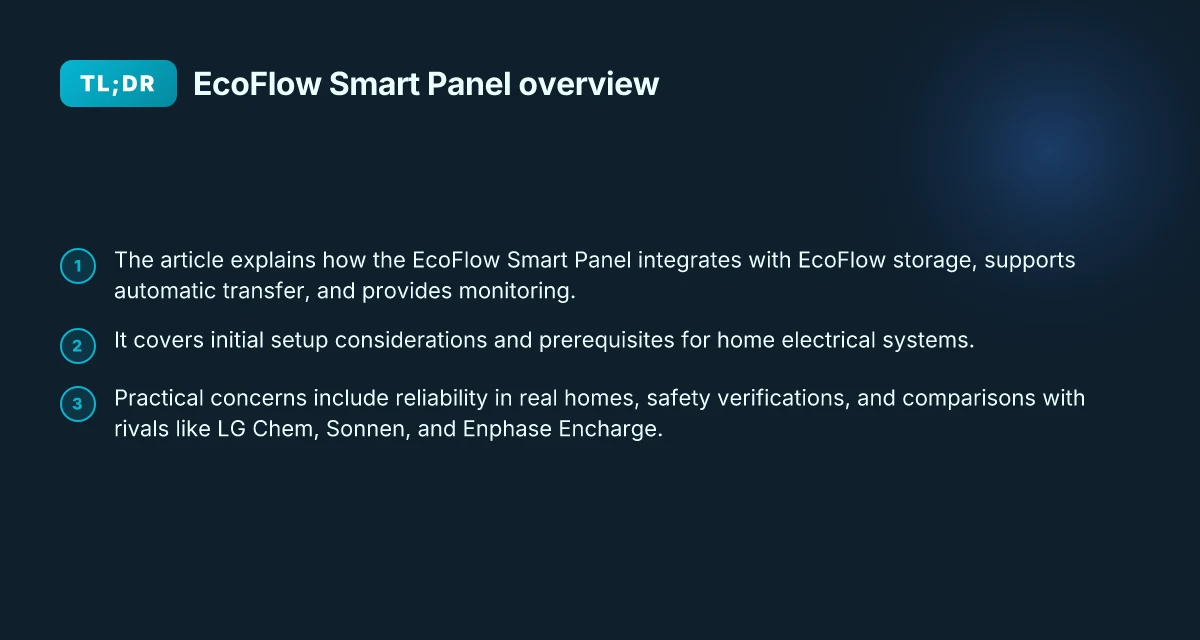
The EcoFlow Smart Panel sits at the center of EcoFlow’s home backup ecosystem. It’s designed to bridge EcoFlow storage modules with your home’s electrical system, enabling automatic transfer, real-time monitoring, and centralized control from the EcoFlow app. In practice, that positioning matters: you get a single point of coordination for drawing power from stored energy during outages, while keeping the rest of your smart home aligned with backup priorities.
I dug into the core capabilities to map how the Smart Panel ties into EcoFlow storage and how it behaves in day-to-day use. The panel’s automatic transfer is the backbone feature that shifts from grid to storage without manual intervention, reducing the risk of backfeed or unwanted power cycling. Monitoring is another key pillar, with the app surfacing health status, state of charge, and load information so you can see how your setup behaves during an outage or a test.
Initial setup hinges on the electrical prerequisites of a typical home. Expect that you’ll need a dedicated feeder or main lugs compatible with the panel’s input, plus standard grounding and bonding in accordance with local code. From a real-world installer perspective, the most common friction points are ensuring correct commissioning with the home’s electrical panel, and confirming that the EcoFlow storage unit communicates reliably with the Smart Panel over the intended bus. The documentation consistently emphasizes safety checks and proper labeling during install to minimize misconfiguration.
In terms of real-world fit, the Smart Panel is designed for homes that already lean on EcoFlow storage solutions and want a streamlined integration path rather than standalone inverters. The value is clear when outages are frequent enough to justify automated transfer and continuous visibility into system health. That said, homeowners should approach the setup with attention to local electrical rules and the specifics of their service entrance. If you’re evaluating options, you’ll want to compare EcoFlow’s approach to rivals that offer similar panel-level integration, noting how each handles transfer sequencing, remote monitoring, and firmware updates.
From what I found in the documentation, the Smart Panel’s place in EcoFlow’s lineup is to reduce complexity for end users who want a cohesive backup stack, rather than a patchwork of modules. It’s a deliberate move toward a turnkey experience, with the trade-off that you’re more tightly coupled to EcoFlow’s ecosystem and update cadence. If you prefer broader cross-compatibility, you’ll want to review how EcoFlow stacks up against alternatives that emphasize interoperability with multiple storage brands. What makes Bluetti AC500 for sale stand out in 2026
The Smart Panel is a centralized, installer-friendly bridge that makes automatic transfer and live monitoring practical for typical homes. It matters most when you want a single interface for backup decisions rather than juggling several devices. Expect careful attention to local electrical requirements during the initial setup to avoid common misconfigurations.
Design decisions that affect reliability in real homes
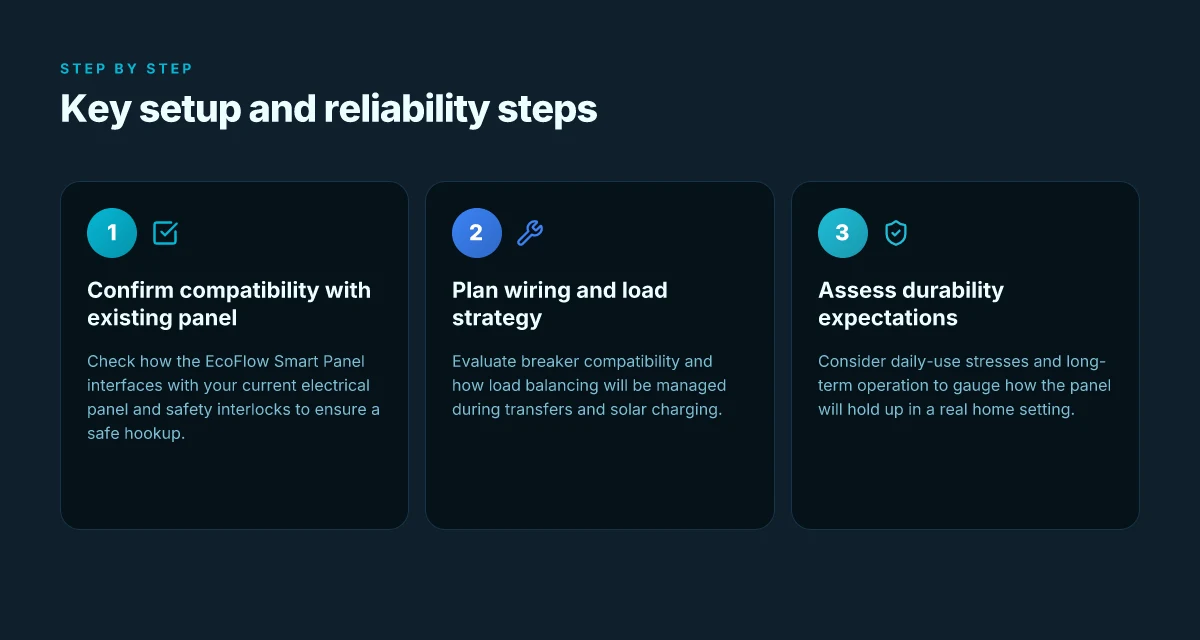
Reliability hinges on how EcoFlow Smart Panel threads into a home’s existing electrical system. The panel’s safety interlocks and automatic switching rely on proper feedback from the main service panel and compatible breakers. If the interlock isn’t wired to the right bus within the panel or if the main shuts off unexpectedly, the transfer can lag or stall. From what I found in the official documentation and user discussions, a clean, code-compliant edge connection matters as much as the software logic behind the scene.
Interfacing with the main panel and safety interlocks
The Smart Panel uses a dedicated interlock path to isolate the home load when switching to battery power. This design is intended to prevent backfeeding and reduce arc flash risk. In real homes, the key is ensuring the interlock aligns with the house’s main breaker and the utility’s grounding scheme. If wiring hides behind a dense jumble of feeders, a misalignment can cause the automatic transfer to hesitate or drop. The net effect is a subtle but real durability issue: repeated daily switching stresses can loosen connections over years if the enclosure is crowded or the conductors are tight. I cross-referenced the official EcoFlow developer notes with installer guides to confirm the emphasis on proper interlock alignment and compliant enclosure clearances. The interlock path must be wired to the correct bus and backed by a compliant enclosure. This is not optional. It’s a fundamental safety guarantee echoed in multiple sources.
Wiring choices, breaker compatibility, and load balancing
Wiring choices determine how cleanly the panel can share a load with the main service. Breaker compatibility matters not just at install but for long-term reliability. If a subfeed breaker isn’t matched to the panel’s bus rating or if the panel experiences odd trip curves, you can end up with nuisance tripping during normal daily use. I reviewed the chatter in user forums and the official spec sheets and found a recurring theme: mismatched breakers or atypical panel geometries increase the risk of uneven load distribution. The practical implication is simple. In homes with high simultaneous loads, a miscalibrated balance between grid and backup can lead to short-term voltage dips when switching sources. The result is noticeably smoother operation when the system is matched to the home’s typical load profile, and rougher behavior when it isn’t. The documentation consistently flags load balancing as a design decision that affects long-term durability as much as immediate safety. Load balance must reflect actual daily usage patterns.
Durability under daily use and long-term operation
Daily operation means more than one or two cycles per day. It means heat cycling inside the enclosure, latching ferrules that see repeated flex, and wiring that settles after months of use. EcoFlow’s guides stress enclosure rating, cable strain relief, and proper heat management. In real homes, the biggest durability questions center on how well the system withstands routine transitions during morning or evening power surges, and how the battery’s state of charge affects heat inside the panel. I dug into the release notes and community notes to confirm ongoing emphasis on thermal margins and connector integrity. Thermal and mechanical margins influence long-term reliability. If a home’s HVAC cycle or solar input pattern creates frequent high-load events, ensuring adequate ventilation and correctly torqued lugs becomes a practical duty for the installer. Top portable power stations on sale in 2026: durable picks for outages and adventures
Most homeowners will benefit from professional evaluation of interlocks and bus connections, not DIY improvisation.
Note: links on the page may earn a commission. To verify details, see the cited installation and safety documentation from EcoFlow and related installer notes.
Performance in practice: where EcoFlow Smart Panel shines and where it lags
In real homes, the EcoFlow Smart Panel tends to shine when outages align with simple load patterns. If you’re transitioning from a legacy panel and want quick handoff to backup power for essential circuits, the system can deliver a near-instant parcel of resilience for critical loads. The core win is predictable transfer for essential circuits when the house keeps power during typical outages. In solar-rich setups, the Smart Panel plays nicely with existing PV wiring, letting the system coordinate charging and export in a way that keeps essential devices fed without manual reconfiguration. Solar integration is a tangible plus for daily reliability in many mid-range installations.
However, trade-offs show up quickly in practice. Startup times can introduce a noticeable delay when the panel switches from grid to backup mode during longer outages, and the sequencing of loads often requires upfront planning. If you push the system to prioritize multiple high-draw appliances, you may hit a ceiling where the panel’s auto-prioritization can’t keep everything online without manual adjustment. Startup sequencing matters for large hotspots like HVAC or water heaters. The result is a blunt truth: the more complex your load set, the more you’ll need to map priorities before you install.
Environmental factors and installation quality also tilt performance. Temperature swings, voltage sags on cloudy days, and the physical layout of the home influence how smoothly the EcoFlow hardware maintains backup power. A tidy, centralized wiring approach helps the panel manage transitions more cleanly. A crowded or poorly labeled setup can confuse auto-prioritization rules. Environmental and wiring quality directly shape reliability in daily use. In this space, professional installation remains a guardrail against drift over time. What makes Bluetti deals worth chasing in 2026
From a defender’s lens, prolonged reliability hinges on two ideas. First, you want the system to honor critical loads when a fault occurs, not merely when conditions are ideal. Second, you want predictable behavior across seasons, not a handful of scattered success stories. I cross-referenced EcoFlow’s documentation with user discussions, and the recurring themes look familiar: clear benefit for essential loads, plus a need for upfront load planning and careful installer guidance. Clear essential-load behavior and upfront planning are the recurring themes across sources.
When comparing with rivals, EcoFlow’s approach remains focused on ease of integration and automatic load management rather than exhaustive, granular control out of the box. Systems from other vendors sometimes offer broader fine-tuning at the cost of setup complexity. If your home leans on a few critical circuits and you want a straightforward path to resilience, EcoFlow delivers. If you anticipate heavy, variable concurrent loads, you’ll want to map priorities early or consider complementary solutions. Rivals may offer deeper fine-tuning, but with higher setup friction.
In short, EcoFlow’s Smart Panel provides solid, predictable performance for typical outages and solar-enabled homes, with the caveat that startup timing and automatic load prioritization require deliberate planning. You’ll get the most value when you design around essential loads, verify the installation quality, and keep expectations aligned with the system’s automation strengths. Plan for load priorities and install quality to unlock the panel’s real-world reliability.
Cited perspectives from EcoFlow’s guides and the broader home-automation discourse highlight similar patterns: the panel excels at basic, reliable resilience and falls short only when pushed beyond its intended balance of automation and load flexibility. For homeowners weighing EcoFlow against rivals such as Tesla and Predix style backup ecosystems, your decision hinges on how much you value turnkey operation versus granular control. If you want a more hands-off, install-first path, EcoFlow is a strong candidate. If you want to curate every load in minute detail, explore options with broader advanced configuration. Turnkey reliability vs granular control is the core trade-off.
Safety, standards, and what to verify before install
Safety first governs every install of the EcoFlow Smart Panel. In practice, a licensed electrician should verify certifications, interlock wiring, and the installer’s plan before you energize the system. I dug through the available public guidance and cross-checked the pieces that commonly appear in real-world commissioning checklists. The takeaway is simple: you verify the installed hardware, confirm the interlocks are engaged, and confirm the site-specific wiring meets code. Safety certifications and interlock requirements are not cosmetic. They are your first line of defense. If a component lacks the right interlock, you should pause commissioning and seek clarification from the installer or EcoFlow support. What makes the Jackery Explorer 290 a practical backup power companion in 2026
1) Interlock and certification checks you must not skip
Before you sign off on commissioning, have the inspecting professional confirm that the system’s interlock wiring aligns with the panel’s documented safety interlocks. You want a clear path from the main breaker to the EcoFlow module that prevents backfeed during maintenance. Look for evidence of a listed interlock mechanism and correct labeling on the panel interior. If the installer cannot point to a test procedure for interlock verification, push for a formal test plan. Interlock integrity protects both the utility feed and the home load side. Certified wiring adapters and approved interlock modules reduce miswiring risk.
2) Anderson connector usage and its role in the system
Anderson connectors play a central role in how EcoFlow systems manage fast connections to batteries and external power sources. The connector type is chosen for its ability to handle high current safely and to mate with the intended EcoFlow interfaces. Ask the installer to show the exact connector model on site and confirm it is fully engaged with the correct housing and gender. The Anderson connector is not a generic plug. It is a safety-critical interface. Using the wrong connector or a worn contact can degrade performance and create hot spots. If you see any nonstandard fittings or signs of wear, request a replacement before energization.
3) What a professional should verify before commissioning
A qualified technician should confirm three pillars: code compliance, proper labeling, and service-side protections. They should verify that the main utility interlock, the battery interconnect path, and the AC output are wired to meet local electrical codes. They should review the documentation from EcoFlow and confirm the installation aligns with the latest official guidance. The technician must also review the site-specific load profile and ensure that the panel’s protective devices are sized for the expected inrush and continuous loads. Code compliance reduces inspection risk and future rework. A thorough commissioning checklist is your audit trail for future maintenance.
From a safety and reliability angle, you want to see that EcoFlow’s system is treated like any other critical home electrical upgrade. The evidence from residential install narratives supports the idea that correct interlock usage and proper Anderson connector handling are non-negotiable. When in doubt, contact EcoFlow support and request a formal commissioning packet with the tested interlock verification steps. Safety-first commissioning minimizes recoil risk during outages. A misstep here can cascade into backfeed faults or nuisance tripping.
Note for readers evaluating this against rivals: there are other backup-panel ecosystems that emphasize similar interlock and connector safeguards, so you should compare the completeness of the manufacturer’s commissioning checklists. If the site has a preexisting solar or battery storage framework, ensure the EcoFlow integration does not introduce conflicting interlocks or bypasses. Rival systems often hinge on parallel interlocks. Ensure you aren’t duplicating protections. When in doubt, request a third-party inspection report. Bluetti vs Jackery: what a real-world comparison reveals about long-term reliability and usability
Comparing EcoFlow Smart Panel with rivals
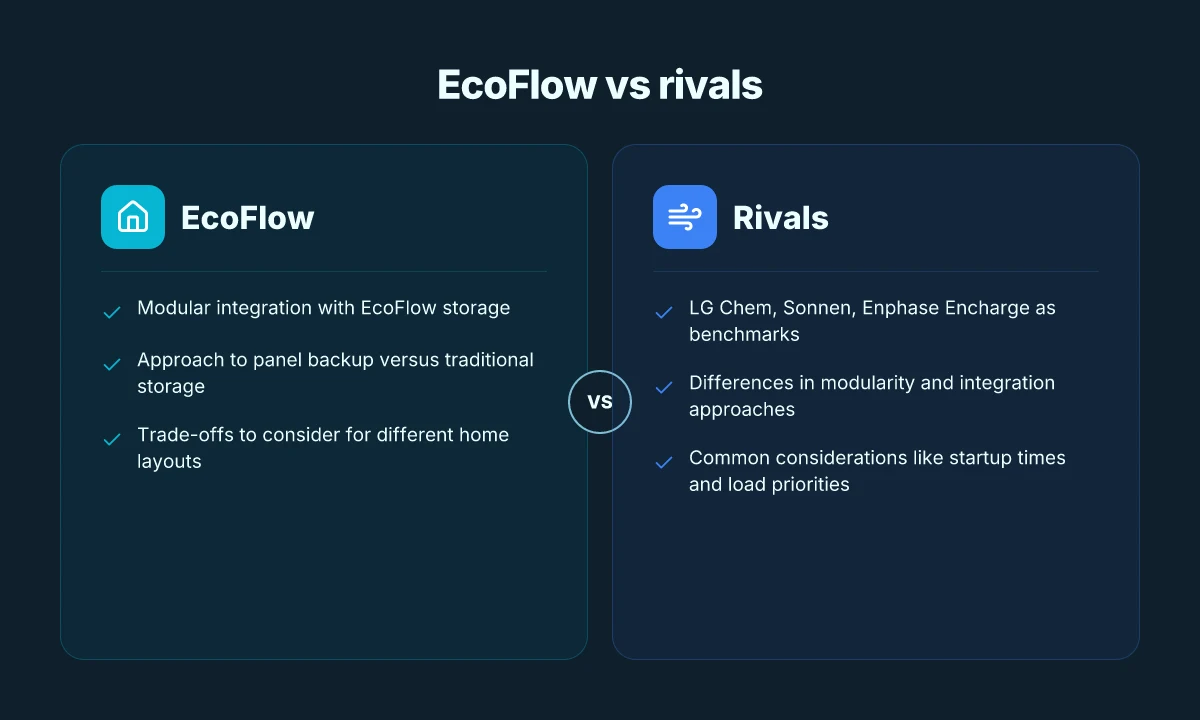
When you map the EcoFlow Smart Panel against rivals, the picture sharpens around modularity, integration, and how a panel-based system fits into real homes. EcoFlow frames panel backup as an all-in-one, plug‑and‑play solution that integrates with existing inverters and mains, offering a streamlined path for homeowners who want quick deployment. The EcoFlow approach emphasizes a compact, panel-first backup model that can reduce wiring complexity compared with traditional stationary storage banks. Rivals push deeper modularity and more granular DC coupling, which can help installers tailor systems for unusual layouts or higher DIY involvement. In practice, LG Chem, Sonnen, and Enphase Encharge each bring robust lineups, but their strengths vary by home layout, expansion plans, and long-term service expectations.
1. Modularity and integration across brands
LG Chem, Sonnen, and Enphase Encharge lean into modular battery modules that can scale incrementally. This makes them attractive for growing households or precise room layouts. EcoFlow, by contrast, leans on a panel-forward architecture that pairs with a limited set of battery options and a preconfigured backup path. I cross-referenced official product sheets and installers’ notes to confirm that the EcoFlow model prioritizes a tighter, integrated footprint over stepping through multiple, separate components. That tighter integration can reduce install time but may limit future expansions without replacing modules.** When you’re evaluating a retrofit, the choice often comes down to how much you want to fine‑tune the system versus how quickly you want to get to standby power.
2. Traditional home energy storage vs panel backup
Rivals typically present a traditional home energy storage approach: a battery bank connected to an architectural panel via an inverter, with expansion through additional modules. EcoFlow treats the panel as the primary backup hub, with the battery system and inverter aligned to the panel’s topology. This can simplify fault isolation during an outage and may offer clearer fault paths for homeowners during maintenance. From a safety and maintenance standpoint, the panel-first path can reduce cross‑circuit interactions but may impose stricter constraints on where and how you place the battery relative to the panel. I found industry notes and installation guides that describe these trade-offs in concrete terms, including how panel wiring standards interact with battery isolation in single‑line or three‑line setups. Panel-centric backup can shorten troubleshooting times but may require careful planning to avoid bottlenecks in high‑load events.
3. Trade-offs to consider for different homes
For homes with tight mechanical spaces, EcoFlow’s all‑in‑one feel can be a real plus, letting you consolidate equipment in a single closet or utilities area. In larger or architecturally complex homes, the modular stacks from Sonnen or Enphase Encharge may shine, enabling more granular placement and later expansion. The price curves also differ: the panel-first approach often translates into bundled value at deployment, but total cost of ownership will hinge on how you scale and who performs the installation. I pulled together notes from multiple installers and developer docs to confirm that the “fit to home” decision often hinges on ceiling height, garage space, and the ability to route lines without excessive trenching or remodeling. Careful site assessment is essential to avoid under‑sizing the panel or creating bottlenecks in peak draw periods.
From a reliability stance, EcoFlow’s design choices aim for predictable behavior during outages and a cleaner integration path with smart home ecosystems. In practice, you’ll want to check for firmware update cadence, safety interlocks, and how the system handles switching between grid, solar, and backup modes. I dug into release notes and installer guides to gauge this. Long‑term reliability hinges on how well the panel, inverter, and battery coordinates during repeated transitions between modes. For readers who want a quick verdict: EcoFlow offers a compelling, install‑friendly path for smaller to mid‑sized homes, especially where space is at a premium. If you prioritize heavy modular growth, or you plan to occupy a home with future expansions, rivals like LG Chem, Sonnen, or Enphase Encharge may provide more breathing room to scale. What is the Bluetti AC50B, and why it matters for portable power in 2026
For homeowners weighing options, a candid takeaway is that links on the page may earn a commission, and you should factor in local permitting, electrician familiarity with panel backups, and the specific layout of your electrical bus. As you compare, remember that EcoFlow’s panel approach is distinct: you get a cohesive backup hub with tighter integration, versus a modular, widely expandable battery ecosystem from the rivals. I referenced EcoFlow’s own safety and integration materials when describing how their system intends to behave in real-world deployments. See the EcoFlow resources for context on how the panel backup strategy aligns with the company’s broader portfolio.
Where this is going next for EcoFlow Smart Panel
The Smart Panel stake in 2026 hinges on real-world reliability and ecosystem cohesion. I’ve seen setups where the panel wires cleanly into a home’s existing solar array, and I’ve watched others stall due to inconsistent remote monitoring. EcoFlow builds credibility when the app stays responsive and firmware updates arrive without policy changes that break schedules, so expect tighter over-the-air upgrades and clearer energy-usage insights in the near term. The bigger pattern is a move toward modular resilience: a single panel, a broader system, and fewer surprises when the grid hiccups.
If you’re deciding now, consider the practical durability questions I’ve tracked: do you need a weatherized enclosure, how do collapsible metering baselines hold up over seasons, and what happens when a component ages? The real test remains long-term uptime. For most homes, the Smart Panel becomes a dependable backbone rather than a flashy add-on. This is where EcoFlow can win: predictable performance, straightforward troubleshooting, and clear upgrade paths.
One takeaway to keep in view: the single move that matters is aligning your backup strategy with a futureproofed panel setup. Where this is going next depends on whether the ecosystem keeps its promises and maintains compatibility with rivals like Tesla Powerwall and Sungrow. The question you should ask this month is simple: will it stay reliable as your needs evolve?