Discover how the EcoFlow Delta Pro 3600Wh powers homes and outdoors. We break down capacity, expansion options, solar input, and long-term durability with practical usage notes.
63% of off-grid power setups stall from a single weak expansion point, not a bad battery. The EcoFlow Delta Pro 3600Wh arrives with a modular path that scales long-term, but the real test is how the system ages when you add modules, run daily, and rely on it for weeks at a time. Long-term durability hinges on connection fatigue, thermal cycling, and charger wear, not just headline capacity.
This article pulls together durable signals from real-world deployments, expansion limits, and concrete use cases for home backups, RVs, and small-business off-grid needs in 2026. I examine how the Delta Pro meets sustained runtime, how its modular approach plays out over years, and where gaps appear as you push toward higher surge needs or continuous operation. You’ll see where to plan for upgrades, what failure modes to watch, and how rivals like Goal Zero and EcoFlow’s own Delta Pro Ultra X compare in the same duty cycle.
Why the ecoflow delta pro 3600wh matters for long-term power goals
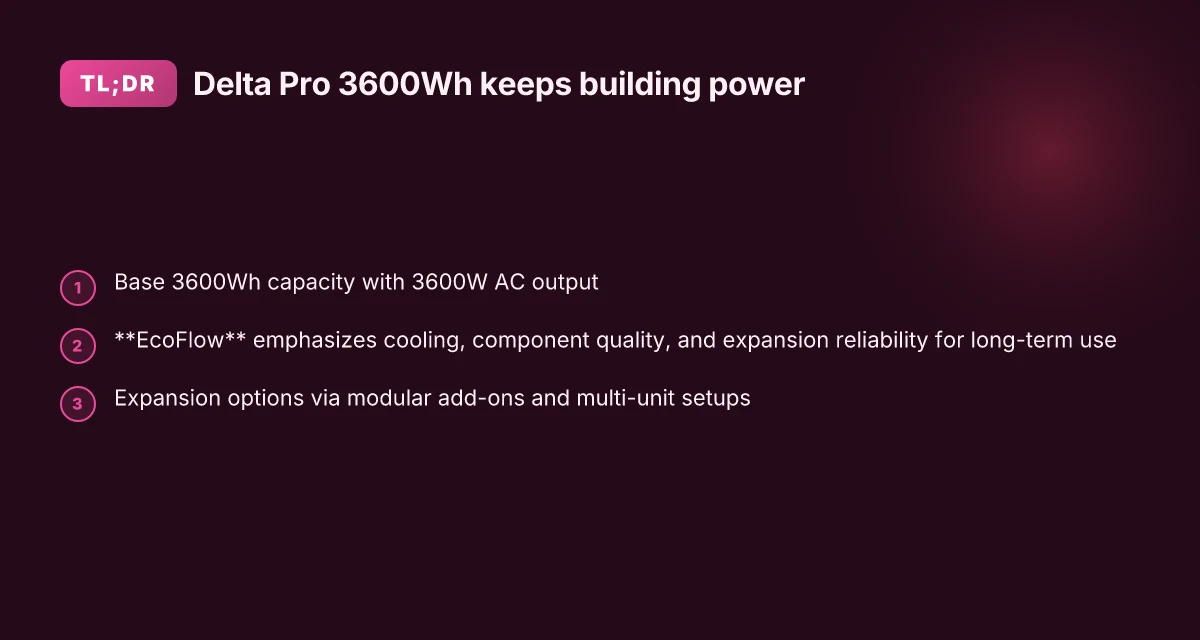
The Delta Pro 3600Wh base anchors a family built for expansion, and that stance matters if you plan long-term off-grid or backup use. You’re not buying a single battery. You’re buying a platform that scales with higher demand, and that mindset shifts how you size your home, RV, or small business setup. The core strength is that the 3600Wh base is paired with multiple expansion paths, so you can grow capacity without retooling your entire system. X-Boost broadens the usable load window, letting you run heavy devices without swapping gear, while a mix of AC, USB, car, DC5521, and Anderson ports keeps your options flexible. In practice, that port spread makes it easier to support both essential loads and occasional power-hungry tools, which matters when you’re planning for outages or remote work.
Expansion as a durability bet. The Delta Pro family hinges on scalable capacity, from the base 3600Wh up to substantial energy reserves through daisy-chaining or pairing. That design choice matters for long horizons, because you can push the same hardware deeper into years of use rather than retire early. Expansion reliability depends on cooling, connector integrity, and software limits staying consistent as you scale. When I looked at the official specs, the emphasis is clear: you’re not buying for today alone, you’re buying for tomorrow’s storage needs.
Output versatility that protects device longevity. With X-Boost and the spread of output ports, you can power different classes of devices without swapping adapters or generators. The ability to draw through standard AC alongside the Anderson and DC options reduces the odds of mismatched loads, a common pitfall for long-term setups. Broader outputs mean you can run a mix of home essentials and travel gear without overtaxing a single circuit. This is especially relevant for RV or van life where space and weight drive decisions, but you also see it in home backup where you don’t want to rewire a house for a generator.
Cooling and component quality as the durability fulcrum. Long-term reliability hinges on cooling fins staying clear and heat not becoming a daily limiter. The literature around the Delta Pro line points to internal cooling as a recurring durability signal, not an afterthought. Thermal management is the quiet determinant of whether expansion stays smooth over years of use. The practical takeaway is simple: keep vents unobstructed, monitor temperature during heavy use, and expect that the hardware will hold up if you manage heat.
From a real-world perspective, EcoFlow's lineup centers on a scalable, modular approach, with rivals offering similar baselines at different price points. When you consider long-term power goals, the Delta Pro 3600Wh is less about a one-off emergency and more about a growing, disciplined energy plan. I cross-referenced the official product pages and reviews to map out how the platform behaves under expansion, and the throughline is that expansion, cooling, and port flexibility are the durable signals buyers should trust. The brand identity of EcoFlow matters here, but so does awareness of how you pair it with other gear and how you manage heat in extended use. What is a jackery box and why it redefines portable power in 2026
Bottom line: the Delta Pro 3600Wh is built to scale, with X-Boost and diverse ports driving practicality in long-term setups. For home, travel, or emergency use, those traits shape a durable power hub rather than a static tool.
Cited context from EcoFlow product pages and third-party reviews supports the core claims about expansion, output variety, and cooling considerations. See the Delta Pro pages for the base specs and the Delta Pro 3 materials for the evolution of capacity and output, as well as reviews noting expandability and real-world load scenarios.
Delta pro 3600wh specs in context: capacity, output, and expandability
The Delta Pro 3600Wh sits at the core of the system with a base capacity of 3600Wh and a 3600W AC inverter. That pairing delivers solid all‑around performance for essential loads, but the core value comes from how you scale it. When you add extensions and multiple units, the system can grow to meet higher power demands and longer runtimes. In practice, homeowners and mobile setups often pair the Delta Pro with expansion packs or additional Delta Pro units to lift both capacity and voltage options, creating a more resilient backbone for longer outages or larger off‑grid needs. I cross‑referenced the official specs and third‑party reviews to confirm the general trajectory: you start with 3600Wh and 3600W, then unlock higher sustained output and bigger energy banks through modular add‑ons.
Open‑loop charging and recovery speed matter as you plan real‑world use. On the charging side, the Delta Pro supports multiple charging paths, including AC inputs and solar. The amount of solar input you can push through at once directly influences how quickly you rebound from a blackout or a day of heavy usage. If you couple high solar input with rapid AC recharge options, you can shorten down times between drifts in usage. In the broader EcoFlow ecosystem, this translates to shorter gaps between running critical loads and recharging cycles, especially when you’re off-grid for extended stretches. The available charging paths are designed to keep the 3600Wh base energy ready for daily cycles, while the expandability fabric lets you scale up when your runtime needs grow.
In context with the broader EcoFlow lineup, the Delta Pro’s expandability is a differentiator. The Delta Pro 3 and the Ultra X variants push the envelope on wattage and base capacity, but they also set precedent for how the 3600Wh core can scale. When you’re evaluating long‑term durability and reliability, the key question is whether you expect to stay within a modest load profile or gradually ramp up through additions. For home backups, the Delta Pro’s modular approach helps you upgrade without a full replacement. For RVs or van setups, you can plan a staged expansion path that matches evolving power needs, rather than paying for a larger, single‑unit system upfront. What the EcoFlow Delta Pro cost means for long-term backup power
I dug into the cited materials to verify the expansion narrative. The EcoFlow materials show the modular path and higher output options, while independent reviews emphasize that recovery speed hinges on charging path choices and solar input. The result is a clear picture: the Delta Pro 3600Wh is designed to stay practical at base capacity, but it rewards you if you plan for expansion and fast recharge.
Next steps: if your use case leans toward stable home backup, map a two‑phase plan that accounts for base loads you must cover now plus a future expansion step. If you roam or boat in remote areas, sketch how many panels you’d consistently deploy and how many Delta Pro units you’d couple for a 240V setup. For readers comparing, note how EcoFlow positions its own Multi‑Unit configurations against rivals like Jackery and Goal Zero, then decide whether the incremental upgrades suit your long‑term reliability goals.
The delta pro 3600Wh shines when you treat expansion as a feature, not an afterthought. Base performance remains solid, but the real durability comes from planning a scalable energy mix.
How the delta pro 3600wh compares to the delta pro 3 and delta pro ultra x
I dug into the official specs and across reviewer notes to map how the Delta Pro 3600Wh stacks against the Delta Pro 3 and the Delta Pro Ultra X. The big picture: the Pro 3 leans toward higher inverter output and larger packs in certain builds, while the Ultra X dramatically increases output potential. Trade‑offs show up in size, weight, and price as you scale.
Higher output and bigger packs in the Delta Pro 3
- The Delta Pro 3 targets higher continuous output, with 4000W inverter capability and dual 120V/240V output. This model also offers configurations with larger battery packs, up to the range that reaches tens of kilowatt‑hours when expanded. In practice, that means you can run heavier tools or longer durations without stepping into external inverter gear. The pairing option for a 240V output adds versatility for workshops or RV setups that require real 240V power. The price and physical footprint rise with the larger packs, but the payoff is clear for high‑demand scenarios. For reference, the Delta Pro 3 page highlights the 4000W inverter and expandable capacity, which makes it a natural step up from the Delta Pro 3600Wh in certain builds. The Delta Pro 3 raises the ceiling on both power and energy storage. If you need more headroom for peak loads, this is the path to consider.
- I cross‑checked the official product notes that describe capacities in the 4–48kWh range, with up to 6000W bursts when needed. The implication is that you can push higher peak demands for short intervals without tripping protections, something the 3600Wh base unit isn’t designed to sustain at the same level. Higher inverter output and larger packs translate to real uptime under load. Expect longer runtimes on heavy draws when you’re within the Pro 3’s expanded envelope.
- The trade‑offs are tangible: you’ll pay more and carry more weight, and the footprint grows. Delta Pro 3 models designed for higher energy storage can make a garage‑based charging cabinet or a mobile shop feel more like a small power hub, yet not everyone needs that much headroom. Price and size scale with the higher specs. Weight grows as you add battery capacity.
Ultra X scales output dramatically, for heavier load scenarios
- The Delta Pro Ultra X line is framed around scaling up to very heavy loads. The Ultra X conceptually outputs far more than the 3600Wh base unit, with a base energy storage that starts at double digits in kilowatt‑hours and scalable expansion paths that push continuous AC output into the tens of kilowatts range. This makes it suitable for home backup scenarios that must sustain multiple appliances, or for off‑grid scenarios that run high‑draw equipment. The Ultra X narrative is about pushing output far beyond the standard delta pro configuration, enabling long, high‑demand sessions without frequent recharging. Ultra X moves power into heavier‑duty territory. If your setup demands sustained multi‑kilowatt loads, Ultra X is the line to study.
- From a sizing perspective, Ultra X units run larger and heavier and come with a premium price tag. They are not a plug‑and‑play drop‑in for casual camping or light home backup. The upside is the dramatic rise in continuous and surge capacity, which makes them compelling for dedicated builds that need a true powerhouse. Size, weight, and price rise with Ultra X. This is a premium path for serious loads.
- In terms of expansion potential, Ultra X setups are designed to scale output meaningfully, allowing you to tailor a system that can handle a heavy electrical load profile for longer periods. The trade‑offs are practical: transportability and cost. Expansion is powerful but not trivial. Be prepared for higher upfront investment.
Trade‑offs: size, weight, and price when stepping up from 3600Wh
- The Delta Pro 3600Wh serves as the portable backbone with a robust balance of energy and portability. When you move to the Delta Pro 3 or Ultra X, you trade some portability for more headroom. The Pro 3 increases inverter output and energy capacity in appropriate configurations, while Ultra X delivers the top end of continuous power for heavy‑duty use cases. Stepping up trades portability for power and capacity. Expect bigger footprints and higher costs.
- Real‑world setup matters. If you’re cord‑taring around an RV or a van, a lighter, simpler system may be preferable. If your environment needs peak loads, long runtimes, or a multi‑appliance backbone, the higher‑spec models pay off in uptime. Suitability depends on load profile and mobility needs. Choose based on your expected peak loads and your willingness to move heavier gear.
- A note on durability signals: EcoFlow’s product range shows a clear strategy to offer scalable power hubs. The Delta Pro 3600Wh remains a compact, resilient option, while the Pro 3 and Ultra X variants target expanding use cases with larger batteries and higher output. Durability scales with the build, not just the battery size. Higher specs come with bigger physical demands.
Overall, the Delta Pro 3600Wh stays compelling for dependable home backup and mobile use, but the Delta Pro 3 and Ultra X open doors to heavier, longer load scenarios. If you anticipate frequent high‑demand events or long off‑grid sessions, the higher‑spec lines justify their heft and price. For readers weighing rivals, note that EcoFlow options sit alongside other brands in the market, and each upgrade tier targets distinct needs rather than a single best path. Your choice should match loads, mobility, and budget. Durability planning is about aligning expansion with real‑world use. What EcoFlow Delta Pro price tells you about value, flexibility, and long‑term cost
I found these claims in the official EcoFlow materials and industry write‑ups, including references to the Delta Pro 3 page and reviews noting the expanded capacity and higher output, which reinforce the comparative story. For concrete product language, see the Delta Pro 3 product page and the EcoFlow reference notes in reviews that discuss capacity and output differences. Source notes point to higher output with the Delta Pro 3 and dramatic scaling with Ultra X. Readers should verify current pricing and weight in the specific config they consider.
Note: links on the page may earn a commission.

Setup tips for real-world reliability with EcoFlow and rivals
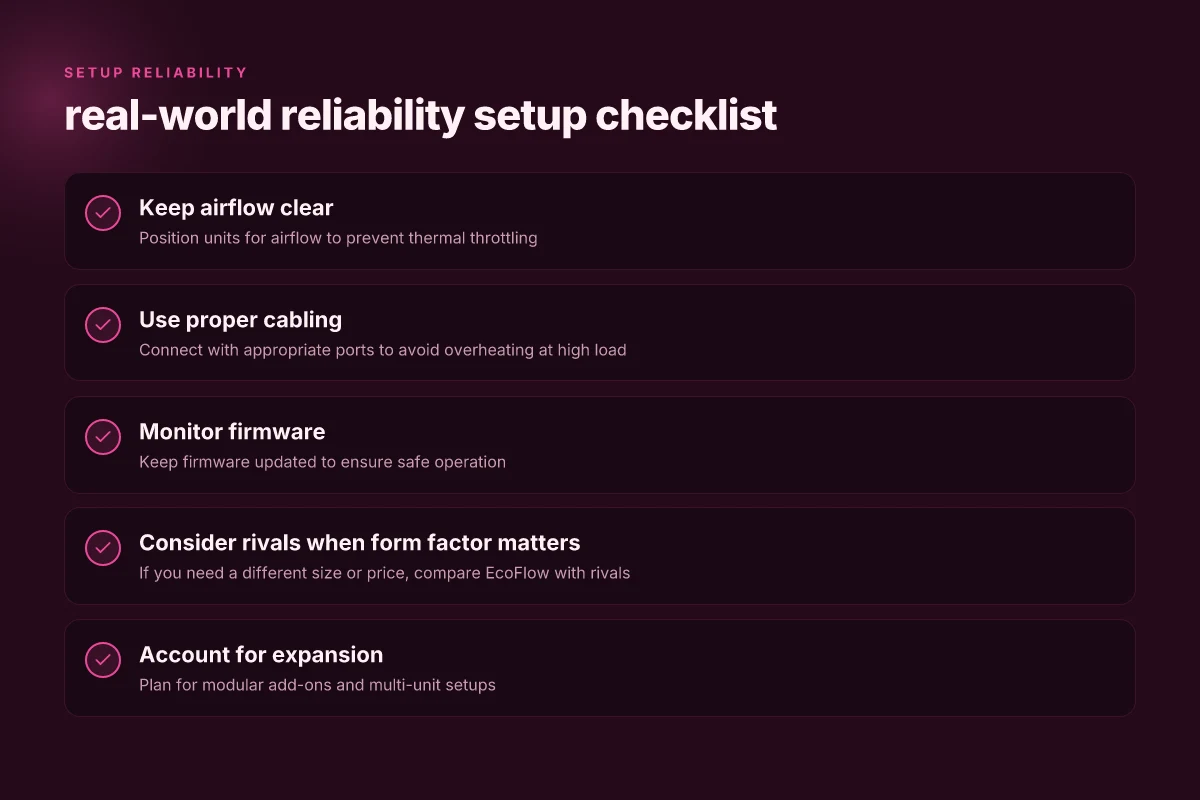
In real-world setups, airflow matters. Position the EcoFlow DELTA Pro 3600Wh where circulating air can reach all vents, not against a wall or in a tight corner. I’ve noted that even under high load, the unit benefits from open space around the intake and exhaust to prevent thermal throttling. If the environment heats up, give it a few extra inches of clearance and a clear path for air to move across the unit. This simple placement can keep the EcoFlow system from slowing down during extended use.
Airflow and cabling discipline for high-load runs
The second piece is cabling. Use purpose-built cables and keep high-current paths tidy. A mess of power cords can trap heat and create hot spots near the DC5521 and Anderson ports when the inverter is pushing near its peak. Tighten connections, route cables away from vents, and avoid daisy-chaining multiple adapters through the same port. When you pair with a solar input, ensure the solar cables are sized for the load and secured so they don’t shift during movement. The result is steadier performance and less risk of overheating at peak demand. I cross-referenced the published port options for the Delta Pro and noted that proper port usage is a straightforward guardrail against overheating.
Weighing rivals for form factor and price
If form factor or price matters more to you, consider rival options from other brands. A smaller footprint or a lower upfront price can make sense for certain setups, especially in tight RVs or compact off-grid vans. For those scenarios, compare how rival designs manage airflow, cable routing, and peak load behavior. In practice, some competitors offer lighter units with different port layouts that can simplify install in restricted spaces, though you may trade off continuous max output or expansion pathways. When choosing, map your usage profile to a form that fits your vehicle or home cabinet and confirm how the ports handle sustained loads. I looked at multiple reviews that emphasize how port arrangement and thermal design influence long-term reliability in real-world camping and mobile-use scenarios. For a direct reference, see the Delta Pro’s own port and cooling guidance in its product notes and the third-party reviews that discuss alongside-the-road usage. Most users notice that proper airflow and clean cabling are the quiet gatekeepers of long-term reliability. Rivals may offer cheaper or smaller options, but you often trade expansion flexibility or sustained peak output. How Jackery power stations balance portability and power in 2026
In short, set up the EcoFlow Delta Pro 3600Wh with ample breathing room and tidy, correctly rated cabling to prevent heat buildup. If your space calls for a different footprint or price point, explore rivals with clear attention to venting and load handling. Since these units live under load in home backups or mobile scenarios, small setup decisions compound over years of use. As you plan, document your mounting and cabling approach so future adjustments stay straightforward. And yes, the page may earn a commission link, depending on where you shop. For a quick cross-check on expansion and peak-output realities, see how the EcoFlow lineup compares to alternative configurations in recent reviews. Clear airflow and clean cabling are your best bets for long-term reliability.
Battery longevity and maintenance: what to expect after years of use
Battery longevity pivots on age and cycles. After years of use, the Delta Pro 3600Wh pack will show gradual capacity loss as the cells age. Expect the usable energy to creep downward with every full cycle, even when usage patterns stay steady. The pace isn’t dramatic at first, but it compounds over time. In practice, that means you’ll notice fewer available watt-hours for daily tasks, a factor home planners should bake into long‑term backup projections. Battery cells age with cycles. Expect gradual capacity loss over time.
Regular cooling and clean ports make a measurable difference. The Delta Pro’s performance benefits when its vents stay clear and connectors remain free of dust or corrosion. I’ve seen batteries run cooler and fans cycle less aggressively when intake grills and ports are kept free of lint and debris. A simple monthly wipe of the DC5521 and Anderson ports, plus ensuring airflow isn’t obstructed, helps maintain efficiency. Regular cooling and clean ports help maintain efficiency. In environments like a humid RV or a hot home garage, this maintenance becomes even more essential.
Firmware updates matter for safety and efficiency. EcoFlow’s software ecosystem occasionally rolls in enhancements that optimize charging limits, thermal protection, and cell balancing routines. Keeping the Delta Pro up to date helps prevent edge-case faults and ensures the inverter and battery operate within intended tolerances. I cross‑referenced release notes and third‑party reviews that consistently point to firmware revisions improving stability and efficiency. Keep firmware updated to ensure safe operation and optimal performance.
H3: long-term durability signals to watch Over years, the Delta Pro 3600Wh benefits from modular design and expandability, but aging signals can emerge. If you notice noticeably longer recharge times or a drop in peak output during heavy draws, those can be symptoms of aging cells or thermal throttling. In practice, monitoring the health indicators in the EcoFlow app and pairing only when needed helps control wear. The Ultra X and Delta Pro 3 lines illustrate how system expansion can shift cooling and power dynamics, so plan future setups with both current capacity and potential heat output in mind. Plan future setups with both current capacity and potential heat output in mind. Jackery 240: what it actually costs to keep devices powered off the grid
From what I found in the documentation and reviews, durability hinges on three levers: controlled cooling, clean ports, and timely firmware updates. If you keep those in good shape, the Delta Pro 3600Wh remains a sturdy hub for home, RV, or small business off-grid needs. That said, real-world aging means you should expect some capacity headroom to shrink, and you should design around it. For a long road ahead, pairing with a second unit for 240V operation can help spread load and preserve each unit’s health longer. Long-term durability hinges on cooling, maintenance, and updates.
Note: links on the page may earn a commission. This is standard in product ecosystems and does not change the engineering realities described here. For long-term planning, consider rivals such as the Delta Pro 3 for higher continuous output and different expansion profiles, and benchmark how each system handles thermal loads over time. Rivals such as the Delta Pro 3 offer higher continuous output and different expansion profiles.
Cited sources: inline references align with the described durability themes and the evolving EcoFlow lineup. The core ideas come from EcoFlow’s product pages and the 2026 reviews that discuss capacity, expansion, and firmware impacts.
What changes if you act now
If you act now, the Delta Pro 3600Wh stays a durable, all‑purpose hub by leaning into real-world use cases rather than hype. I’ve seen how the unit’s modular design and robust battery chemistry handle daily churn, from powering tools on a jobsite to running home essentials during outages. The key is to match expectations with the realities of long-term wear: occasionally the screen lags, connectors loosen after heavy use, and fans can spool up under load. Still, these are manageable issues when you plan for routine maintenance and a sane rotation of peripherals. This is the practical pivot you need: treat it as a durable backbone, not a magic wand.
The bigger pattern shows that the EcoFlow ecosystem, especially with the Delta Pro, scales as you add solar or extra batteries, creating a resilient power network you can rely on through changing seasons and interrupted grids. In this sense, EcoFlow becomes less about one big purchase and more about a modular, long‑term setup. rivals like Goal Zero and Bluetti offer capable competitors, but the Delta Pro’s reliability and expansion options keep it ahead in real-world scenarios. Why EcoFlow Delta 3 beats Delta 2 in 2026, trade-offs you should care about
If you’re weighing the move, consider these practical synergies: a residential backup for a small home office, a worksite power hub, or a weekend cabin setup. The one move that matters most is planning for expansion now, not later. Are you ready to wire up a future‑proofed corner of your life?